Apistogramma Care Guide — Tank Setup, Feeding and Breeding
Introduction
The Cockatoo Dwarf Cichlid, known scientifically as Apistogramma cacatuoides, is one of the most popular and widely kept dwarf cichlids in the freshwater aquarium hobby. Named for the male’s striking dorsal fin spines that recall the crest of a cockatoo, this small but charismatic South American cichlid has earned a devoted following among aquarists of all experience levels. Its manageable size, relatively hardy constitution compared to many of its Apistogramma relatives, and spectacular array of captive-bred colour forms make it an outstanding choice for community tanks, planted aquariums, and species-specific breeding setups alike.
First described by Hoedeman in 1951, Apistogramma cacatuoides hails from the slow-moving tributaries and floodplain habitats of the western Amazon basin. In the wild, these fish inhabit leaf-litter-strewn waters with an abundance of natural caves and hiding spots, a preference that translates directly into how they should be kept in captivity. Unlike some of the more demanding Apistogramma species that require extremely soft and acidic water, A. cacatuoides is notably tolerant of a wider range of water chemistry, which has contributed significantly to its popularity and to the ease with which it can be bred in home aquariums.
Whether you are drawn to this species by its flamboyant finnage, its fascinating breeding behaviour, or simply its personality — Cockatoo Dwarf Cichlids are remarkably engaging fish that quickly learn to recognise their keeper — this guide will provide you with everything you need to keep and breed them successfully.
Quick Stats
| Scientific name | Apistogramma cacatuoides |
| Common names | Cockatoo Dwarf Cichlid, Cockatoo Cichlid, Cockatoo Apisto, Big Mouth Apistogramma |
| Family | Cichlidae |
| Origin | Western Amazon basin — Peru, Colombia, and Brazil |
| Adult size | Males 7–9 cm; Females 5–6 cm |
| Lifespan | 3–5 years |
| Difficulty | Easy |
| Breeding difficulty | Easy |
| Temperature | 24–28 °C |
| pH range | 5.5–7.5 |
| General hardness (GH) | 1–15 dGH |
| Carbonate hardness (KH) | 1–10 dKH |
| Minimum tank size | 75 litres |
| Conservation status | Not Evaluated |
Appearance
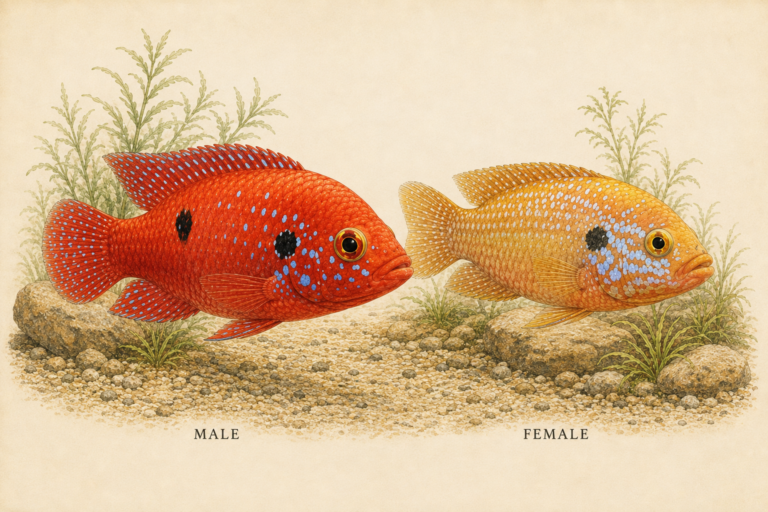
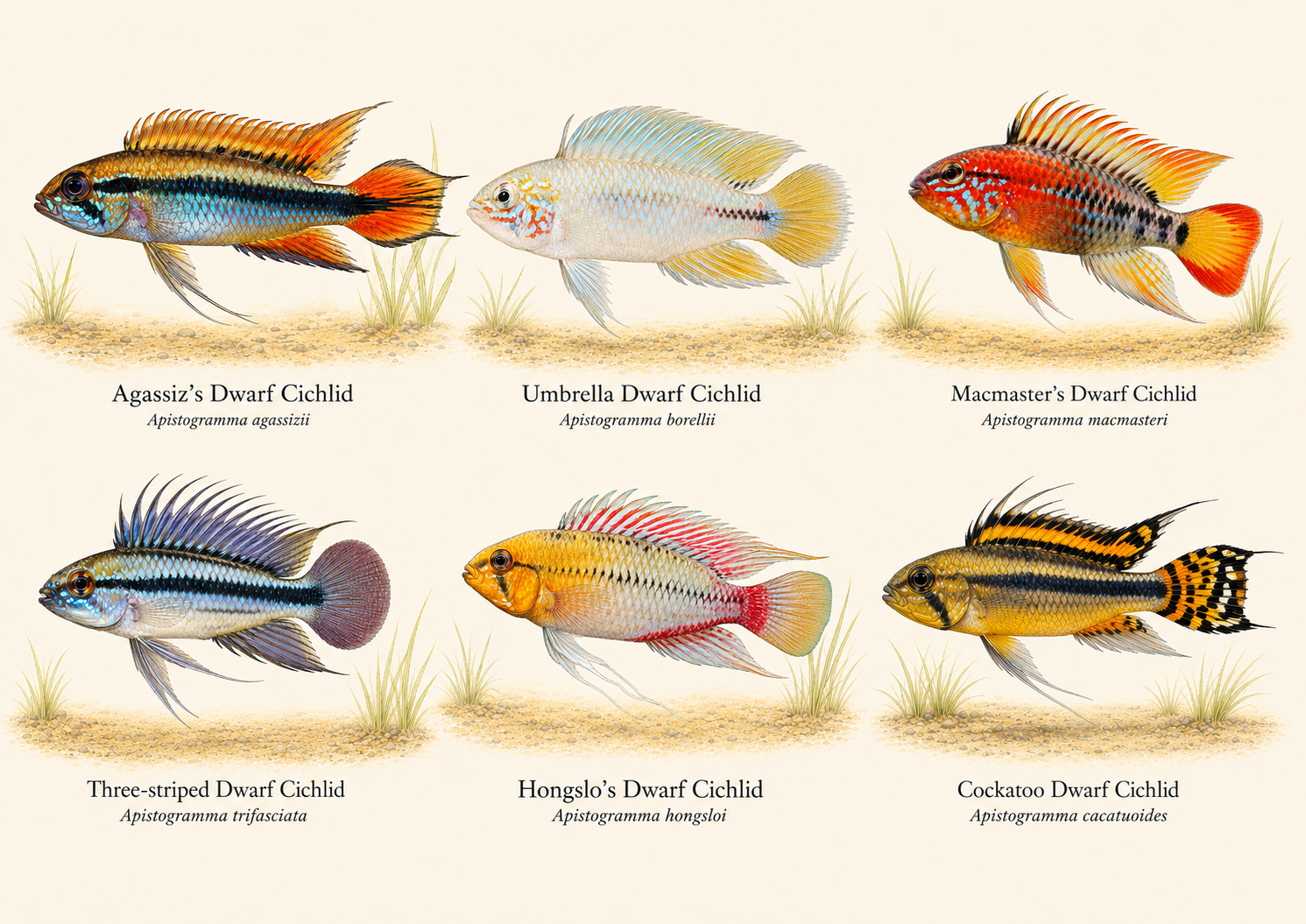
Apistogramma cacatuoides is a sexually dimorphic species, meaning males and females differ considerably in size, colouration, and finnage. Males are the showier sex, reaching up to 9 cm in total length and displaying elongated, spiky anterior dorsal fin rays that extend well above the rest of the dorsal fin, forming the distinctive “cockatoo crest” from which the species takes its common name. The caudal fin is typically lyrate, or lyre-shaped, with extended upper and lower lobes that add further elegance to the fish’s profile.
Wild-type males possess a base colour of greyish-olive to sandy yellow, overlaid with a prominent dark lateral stripe running from the snout through the eye to the base of the tail. A series of less distinct vertical bars may be visible along the flanks depending on the fish’s mood and social context. The dorsal, caudal, and anal fins are often marked with striking red, orange, or yellow spots and streaks, even in wild populations. The mouth is noticeably large for an Apistogramma — hence the occasional trade name “Big Mouth” — giving the fish a somewhat pugnacious expression.
Females are significantly smaller, typically reaching only 5 to 6 cm, and have a more rounded body shape with much shorter finnage. In their neutral colouration, females appear rather plain, with a similar olive-grey tone and lateral stripe. However, when in breeding condition, they undergo a dramatic transformation, turning a vivid buttercup yellow with intensified black markings on the face and ventral region. This yellow breeding dress serves as a visual signal both to males and to potential threats, and it is one of the most recognisable behaviours associated with the species.
Varieties and Morphs
Apistogramma cacatuoides has been selectively bred for decades, resulting in a dazzling range of colour morphs that are widely available in the aquarium trade. These captive-bred varieties retain the same body shape and behavioural traits as their wild counterparts but exhibit dramatically enhanced colouration, particularly in the fins. Below are the most commonly encountered forms.
The Double Red is arguably the most popular and widely available morph. Males display vivid red colouration across both the dorsal and caudal fins, often with intense red edging on the anal fin as well. Females of this line may also show subtle red tints in the caudal fin. The Triple Red takes this further, with red colouration extending more intensely into the dorsal, caudal, and anal fins simultaneously, producing a truly striking display fish.
The Orange Flash features bold orange rather than red in the finnage, giving the fish a warm, fiery appearance. This morph is particularly eye-catching under warm-toned aquarium lighting. The Super Red is an intensified selection of the Double Red and Triple Red lines, where breeders have pushed for the deepest and most saturated red pigmentation possible across all fins and sometimes extending onto the body.
The Full Gold morph exhibits a predominantly golden-yellow body with reduced or absent dark lateral markings, paired with orange to red fins. It has a cleaner, more luminous look than the wild type. The Sunburst variant is closely related to the Full Gold but features more intense orange-gold colouration across the body and fins, creating an almost sunset-like appearance.
The Double Full Red is a line that combines the intense red finnage of the Double Red with a cleaner, less heavily marked body, giving the fins even greater visual prominence. The White Gold or Platinum morph displays a pale, almost silvery-white body with subtle yellow tones and may carry reduced fin colouration, offering an unusual and understated alternative to the more vivid forms.
The Wild Type remains available and is favoured by purists and breeders interested in maintaining the natural genetic diversity of the species. Wild-caught or wild-type bred specimens tend to be hardier and may show more nuanced and context-dependent colouration than their selectively bred cousins. Finally, various regional wild variants exist, sometimes sold under collection locality names, which differ subtly in fin shape, pattern intensity, and base colour, reflecting the natural variation found across the species’ broad geographic range.
Natural Habitat
Apistogramma cacatuoides is found across a broad swathe of the western Amazon basin, with populations documented in Peru, Colombia, and western Brazil. Its range centres on the Ucayali River drainage and extends into numerous tributaries, oxbow lakes, and seasonal floodplain habitats throughout the region. This wide distribution contributes to the natural variation seen among wild populations and has provided the genetic foundation for the many captive-bred morphs available today.
In the wild, these fish inhabit shallow, slow-moving or still waters with abundant leaf litter, fallen branches, and submerged root systems. The substrate is typically sandy or muddy, and the water is often stained a deep amber or tea colour by tannins leaching from decomposing organic matter. These blackwater and clearwater environments tend to be soft and acidic, though A. cacatuoides is found across a surprisingly wide range of water chemistries compared to many congeners, including some whitewater habitats with higher mineral content.
The leaf litter layer is critically important to wild populations. It provides shelter from predators, a rich hunting ground for micro-invertebrates and insect larvae, and — perhaps most importantly — the caves and crevices formed by curled leaves serve as spawning sites. The canopy above typically filters much of the direct sunlight, resulting in a dimly lit environment that the fish clearly prefer. Understanding this natural habitat is key to creating an aquarium environment in which A. cacatuoides will thrive and display its most natural behaviours.
Tank Size and Setup
A single pair of Apistogramma cacatuoides can be comfortably housed in a tank of 75 litres, though a larger aquarium of 100 litres or more is recommended if you wish to keep a male with two or three females, which is the species’ preferred social arrangement. For community setups that include dither fish and other species, 120 litres or above will give everyone adequate space and help reduce territorial aggression, particularly during breeding.
The tank should ideally have a footprint that prioritises length and width over height, as these are bottom-dwelling fish that spend the majority of their time in the lower third of the water column. A standard 80 cm tank provides a much better environment than a tall, narrow design of equivalent volume. The substrate should be fine sand, which allows the fish to engage in their natural sifting behaviour and is gentle on their bodies as they forage.
Décor is of paramount importance for this species. Provide an abundance of caves using coconut shell halves, small ceramic or terracotta flowerpots laid on their sides, purpose-made cichlid caves, or stacked flat stones. Each female in the group will need access to her own cave, and having surplus caves reduces competition and stress. Position caves so that their entrances face away from one another and are partially obscured by plants or hardscape, giving each territory a degree of visual separation.
Driftwood and bogwood pieces add visual interest and release beneficial tannins into the water, mimicking the natural habitat. A generous layer of dried leaf litter — Indian almond leaves, oak leaves, or beech leaves work well — provides additional cover, spawning sites, and promotes the growth of biofilm and microfauna that both adults and fry will feed upon. Live plants are an excellent addition, with species such as Java fern, Anubias, Cryptocoryne, and floating plants like Amazon frogbit all being well suited. Floating plants in particular help diffuse overhead light, creating the subdued conditions these fish prefer.
Lighting should be moderate to dim. If you are growing demanding plant species that require intense light, ensure there are shaded areas created by floating plants or overhanging hardscape where the Apistogramma can retreat. A tightly fitting lid is advisable, as these fish can occasionally jump when startled.
Water Parameters
| Temperature | 24–28 °C |
| pH | 5.5–7.5 |
| General hardness (GH) | 1–15 dGH |
| Carbonate hardness (KH) | 1–10 dKH |
| Ammonia | 0 ppm |
| Nitrite | 0 ppm |
| Nitrate | Below 20 ppm |
One of the key reasons Apistogramma cacatuoides has become such a widely kept species is its tolerance of a broader range of water parameters than many other Apistogramma. While it will certainly appreciate soft, slightly acidic water that replicates its natural environment, captive-bred specimens — which constitute the vast majority of fish available in the trade — will adapt well to moderately hard, neutral water. This makes the species accessible to aquarists who do not have access to very soft tap water or reverse osmosis systems.
That said, if you intend to breed these fish, softer and slightly acidic water in the range of pH 6.0–6.5 and GH 2–8 dGH will typically yield better results, including higher fertilisation rates, improved fry survival, and a more balanced sex ratio in the offspring. Temperature stability is more important than hitting an exact number; avoid sudden fluctuations, which can stress the fish and trigger disease. A consistent 25–26 °C is ideal for general maintenance, while a slight increase to 27–28 °C can help condition fish for breeding.
Pristine water quality is non-negotiable. Ammonia and nitrite must always read zero, and nitrates should be kept as low as practically possible through regular partial water changes of 20–30% weekly. These fish are sensitive to dissolved organic waste even when measurable parameters appear acceptable, so consistent maintenance is essential for long-term health.
Filtration and Equipment
Apistogramma cacatuoides does not require powerful filtration, and indeed excessively strong water flow should be avoided, as these fish naturally inhabit slow-moving or nearly still water. A gentle sponge filter is an excellent choice, particularly in breeding tanks, as it provides effective biological filtration without creating strong currents and poses no risk to fry. In larger community setups, a small hang-on-back filter or canister filter with an adjustable flow rate or a spray bar to diffuse the outflow works well. Position the filter outlet so that the main body of the tank remains calm, even if there is some surface agitation for gas exchange.
A reliable heater with a thermostat is essential, as these tropical fish require stable temperatures within their preferred range. Choose a heater rated appropriately for your tank volume and consider using a heater guard if your fish are particularly active around equipment. An accurate thermometer — ideally a digital one — should be used to monitor temperature independently of the heater’s built-in thermostat.
Adding tannin sources such as Indian almond leaves, alder cones, or driftwood can serve as a form of natural water conditioning, helping to lower pH slightly and providing mild antibacterial and antifungal properties. If you wish to maintain a blackwater-style environment, commercially available blackwater extracts or peat filtration can also be employed. An air pump with an airstone provides additional oxygenation if needed, though this is generally optional if the filter creates adequate surface movement.
Diet and Feeding
In the wild, Apistogramma cacatuoides is a micro-predator, feeding primarily on small invertebrates, insect larvae, crustaceans, and other tiny organisms found within the leaf litter and substrate. In captivity, they are not overly fussy eaters, but a varied diet that includes a strong component of live or frozen foods will bring out the best colouration, condition, and breeding behaviour.
A high-quality micro pellet or small granule designed for dwarf cichlids can form the staple of the diet. Choose a product with a high proportion of animal-derived protein and avoid foods bulked out with cereal fillers. Many keepers find that their Cockatoo Cichlids readily accept these prepared foods after a brief adjustment period. However, prepared food alone will not produce optimal results.
Frozen foods such as bloodworm, brine shrimp, daphnia, cyclops, and mosquito larvae should be offered regularly — ideally several times per week — to provide essential nutrients and encourage natural feeding behaviours. Live foods are even better when available. Newly hatched brine shrimp (Artemia nauplii) are invaluable both as a conditioning food for adults and as a first food for fry. Grindal worms, micro worms, and live daphnia cultures are all excellent supplementary options that dedicated breeders often maintain alongside their fish.
Feed small amounts two to three times daily rather than one large feeding. These fish have small stomachs and benefit from frequent, modest meals. Remove any uneaten food promptly to maintain water quality. During breeding, increase the proportion of live and frozen foods to help condition the adults and support the nutritional demands of egg production and fry rearing.
Behaviour and Temperament
Apistogramma cacatuoides is a fascinating species to observe, displaying a rich repertoire of social behaviours that make it one of the most engaging small fish available to aquarists. Males are territorial but generally not aggressive towards species that do not compete for the same resources or living space. They spend much of their time patrolling their territory, which in a well-set-up aquarium typically encompasses the territories of two or three females. This polygynous social structure — one male with multiple females — is the most natural and successful arrangement in captivity.
Males display to females and rival males using a characteristic lateral display, in which they spread all their fins to maximum extent, intensify their colouration, and present their flank. Confrontations between males are usually resolved through these ritualised displays rather than physical combat, though in confined spaces or inadequately decorated tanks, genuine aggression can occur and may result in injury or death of the subordinate male. For this reason, it is advisable to keep only one male per tank unless the aquarium is large enough — typically 150 litres or more — to support two distinct territories with clear visual barriers between them.
Females are more sedentary and tend to remain close to their chosen cave. When in breeding condition, a female will become highly territorial in defence of her cave and, later, her brood. She may chase away tankmates of all species, including the male, from the immediate vicinity of her spawning site. This maternal aggression is entirely normal and typically does not cause serious harm to tankmates provided there is sufficient space and cover for other fish to retreat.
These fish are intelligent and quickly learn to associate their keeper with food. Many aquarists report that their Cockatoo Cichlids will approach the front glass in anticipation of feeding and will even take food from tweezers or fingers with time. They are generally peaceful towards midwater and upper-water species, reserving their territorial behaviour for other bottom-dwelling fish that encroach on their space.
Tank Mates
Good tank mates
- Cardinal Tetra — These small, peaceful schooling fish inhabit the middle and upper water column and make excellent dither fish that help Apistogramma feel secure.
- Rummy-Nose Tetra — Another ideal dither species that schools tightly, stays in the mid-water zone, and shares similar soft-water preferences.
- Ember Tetra — Their tiny size and calm disposition mean they pose no threat and are small enough to avoid triggering territorial responses.
- Harlequin Rasbora — A hardy, peaceful shoaling fish that occupies the middle of the tank and tolerates a wide range of water parameters.
- Otocinclus — These small, algae-eating catfish are completely non-aggressive and occupy a different ecological niche, making cohabitation trouble-free.
- Pygmy Corydoras — Their diminutive size and tendency to hover in the mid-water column rather than rest on the substrate reduces competition with the Apistogramma.
- Pencilfish — Slender, surface-oriented, and extremely peaceful, pencilfish complement Apistogramma wonderfully in a biotope-style setup.
- Amano Shrimp — Large enough to avoid predation by adult Apistogramma, these shrimp serve as useful algae cleaners without causing conflict.
Fish to avoid
- Oscar — Far too large and predatory; an Oscar would view Apistogramma as food rather than a tank mate.
- Convict Cichlid — Highly territorial and aggressive, Convict Cichlids would easily overpower and stress dwarf cichlids in a shared tank.
- German Blue Ram — Although similar in size, Rams compete for the same bottom-dwelling territory and breeding sites, often leading to persistent conflict.
- Tiger Barb — Notorious fin-nippers that would target the Apistogramma’s elaborate finnage, causing stress and physical damage.
- African Cichlids — Incompatible in terms of water chemistry, temperament, and territorial behaviour; mixing African and South American cichlids is inadvisable.
- Common Pleco — Grows far too large for an Apistogramma tank and may disturb breeding sites, consume eggs, or outcompete the cichlids for cave space.
- Betta — The male Betta’s territorial nature and similar use of lower water levels can create ongoing conflict with a male Apistogramma.
- Chinese Algae Eater — Becomes increasingly aggressive with age and is known to harass and attach to the flanks of slower-moving fish.
Breeding
Apistogramma cacatuoides is one of the easiest Apistogramma species to breed in captivity, making it an ideal introduction to dwarf cichlid breeding for newcomers to the hobby. Breeding typically occurs readily in a well-maintained tank with appropriate décor, good water quality, and a nutritious diet. Many aquarists find that their fish breed without any specific intervention once conditions are to their liking.
The ideal breeding group consists of one male and two to three females. Each female should have access to her own cave, positioned so that entrances face away from one another to create distinct micro-territories. Condition the group with frequent offerings of live and frozen foods for two to three weeks. If breeding has not yet occurred, a partial water change with slightly cooler, softer water can sometimes act as a trigger, simulating the onset of the rainy season.
Spawning takes place inside the female’s chosen cave. She will clean the interior surface — typically the ceiling — and deposit between 40 and 80 adhesive eggs, which the male fertilises by entering the cave briefly. After spawning, the female assumes sole responsibility for egg care, fanning and guarding them while turning a vivid yellow breeding dress that serves as a warning to all other fish to keep their distance. The male continues to patrol the broader territory but is generally kept away from the cave entrance by the female.
Eggs hatch in approximately three to four days at 26 °C, and the larvae remain attached to the cave surface by their yolk sacs for a further four to five days. Once free-swimming, the fry emerge from the cave under the close supervision of the mother, who shepherds them around the territory as they forage for microfauna. This maternal care is remarkable to witness, with the female using body language, fin movements, and colour changes to communicate with her brood.
Free-swimming fry can be fed on infusoria, commercially available liquid fry food, or — ideally — freshly hatched brine shrimp nauplii, which are the gold standard first food. As they grow, microworms and finely crushed flake or pellet food can be introduced. In a community tank, some fry losses to predation are inevitable, but a well-planted tank with plenty of cover can allow a reasonable number to survive. For maximum yield, breeders often remove the female and her clutch to a dedicated rearing tank once the fry are free-swimming, or transfer the entire cave to a separate container.
It is worth noting that water chemistry can influence the sex ratio of the offspring. Warmer, more acidic, and softer water tends to produce a higher proportion of males, while cooler, harder, and more neutral water skews the ratio towards females. Breeders aiming for a balanced sex ratio typically target a pH of around 6.5 and a temperature of 25–26 °C during rearing.
Common Diseases
Apistogramma cacatuoides is generally a robust species, particularly compared to some of the more delicate members of the genus, but it is not immune to disease. The most common health issues encountered are typically related to poor water quality, stress, or inadequate diet rather than inherent susceptibility.
Ich, or white spot disease, is perhaps the most frequently encountered ailment and presents as small white cysts on the fins and body. It is almost always triggered by temperature fluctuations or the introduction of new, unquarantined fish. Treatment involves raising the temperature gradually to 30 °C and, if necessary, administering a proprietary ich medication. Salt-based treatments should be used with caution, as Apistogramma are sensitive to elevated salinity.
Bacterial infections, including fin rot and body ulcers, can occur in tanks with chronically elevated nitrate levels or where organic waste is allowed to accumulate. Maintaining a rigorous water change schedule is the best preventative measure. If bacterial infection is suspected, a broad-spectrum antibacterial treatment should be used promptly, and water quality should be addressed as a priority.
Hole-in-the-head disease, also known as lateral line erosion, occasionally affects cichlids including Apistogramma. It manifests as small pits or erosions on the head and lateral line and is thought to be linked to poor diet, vitamin deficiency (particularly vitamins C and D), and the parasite Hexamita. A varied diet rich in live and frozen foods is the best defence, and affected fish often respond well to improved nutrition combined with targeted antiparasitic treatment.
Internal parasites, including intestinal worms and flagellates, can be introduced with wild-caught specimens or live foods harvested from outdoor sources. Quarantining new arrivals for a minimum of two to four weeks and observing them for signs of weight loss, stringy white faeces, or lethargy will help prevent the introduction of parasites into an established tank. Prophylactic treatment with an appropriate antiparasitic medication during quarantine is a sensible precaution for wild-caught fish.
Fungal infections are most commonly seen on eggs rather than adult fish. Unfertilised eggs in a clutch are particularly susceptible and can spread fungus to viable eggs if the female does not remove them. Indian almond leaves and alder cones in the breeding tank help inhibit fungal growth through their mild antifungal properties.
FAQs
How many Apistogramma cacatuoides should I keep together?
The ideal grouping is one male with two or three females. Keeping multiple males in the same tank typically leads to persistent aggression and stress unless the tank is very large — 150 litres or more — with robust visual barriers dividing the space into distinct territories. A single pair can work, but the female may receive excessive attention from the male without the presence of additional females to distribute his focus.
Can I keep Apistogramma cacatuoides in hard water?
Yes, captive-bred specimens of this species are notably adaptable and can be kept successfully in moderately hard water up to around 15 dGH with a pH of up to 7.5. However, for breeding purposes, softer and slightly acidic water in the range of pH 6.0–6.5 and GH 2–8 dGH will significantly improve fertilisation rates and fry survival. Wild-caught specimens generally require softer water from the outset.
Will Apistogramma cacatuoides eat shrimp?
Adult Cockatoo Cichlids will readily consume small shrimp such as Cherry Shrimp and juvenile shrimp of most species. Larger shrimp like Amano Shrimp are generally safe, as they are too big to be swallowed. If you wish to maintain a breeding colony of small ornamental shrimp alongside these cichlids, heavy planting and abundant moss will provide some refuge, but losses should be expected. Baby shrimp in particular will be treated as a food source.
How can I tell male and female Apistogramma cacatuoides apart?
Males are significantly larger than females, with more elongated and elaborate finnage, particularly the extended dorsal fin spines and lyrate caudal fin. They are also more brightly coloured, especially in captive-bred colour morphs. Females are smaller, more rounded in body shape, with shorter fins and subtler colouration. When in breeding condition, females turn a distinctive bright yellow with bold black markings, making sexing straightforward.
Do Apistogramma cacatuoides need a planted tank?
While plants are not strictly essential, they are highly beneficial. Live plants improve water quality by absorbing nitrates, provide shade and cover that reduce stress, and create visual barriers that help define territories. Floating plants in particular are valuable for diffusing light and making the fish feel more secure. A well-planted tank will bring out more natural behaviours and better colouration compared to a bare setup.
Related Guides
- Apistogramma borellii Care Guide — Another beginner-friendly dwarf cichlid with similar care requirements and a peaceful disposition.
- Apistogramma agassizii Care Guide — A closely related and equally popular Apistogramma species that shares many husbandry needs with A. cacatuoides.
- German Blue Ram Care Guide — A popular alternative dwarf cichlid with more demanding water requirements, useful for comparison.
- Cardinal Tetra Care Guide — One of the best companion species for Apistogramma, sharing overlapping water parameter preferences.
- How to Set Up a Blackwater Aquarium — A comprehensive guide to creating the tannin-rich, soft-water environment that Apistogramma thrive in.