Zebra Danio Care Guide — Tank Setup, Feeding and Breeding
Introduction
The Zebra Danio is one of the most recognisable and enduringly popular freshwater aquarium fish in the hobby. Named for the bold horizontal stripes that run along its slender body, this small cyprinid has been a staple of community tanks for well over a century. Its hardiness, peaceful disposition, and ceaseless activity make it an outstanding choice for beginners, yet it remains a firm favourite among experienced fishkeepers who appreciate a reliable, attractive shoaling species.
Beyond the aquarium hobby, the Zebra Danio holds a remarkable position in science. Under the name zebrafish, Danio rerio has become one of the most important model organisms in genetics, developmental biology, and medical research. Its transparent embryos and rapid reproductive cycle have helped scientists unlock insights into vertebrate development, disease, and drug discovery. This dual identity — beloved aquarium fish and laboratory workhorse — speaks to the extraordinary adaptability and resilience of the species.
In the home aquarium, Zebra Danios are best appreciated in groups. A shoal of six or more will constantly interact, racing back and forth across the tank in tight formation, establishing a subtle but fascinating social hierarchy. They are among the most active freshwater fish available, and their energy brings a dynamic quality to any setup. This guide covers everything you need to know to keep them thriving, from water parameters and tank design to breeding and disease prevention.
Quick Stats
| Scientific name | Danio rerio |
| Common names | Zebra Danio, Zebrafish, Striped Danio |
| Family | Cyprinidae |
| Origin | South Asia — India, Bangladesh, Nepal, Myanmar, Pakistan |
| Adult size | 4–5 cm |
| Lifespan | 3–5 years |
| Difficulty | Easy |
| Breeding difficulty | Easy |
| Temperature | 18–26 °C |
| pH range | 6.0–8.0 |
| General hardness (GH) | 2–20 dGH |
| Carbonate hardness (KH) | 1–15 dKH |
| Minimum tank size | 60 litres |
| Conservation status | Least Concern (IUCN) |
Appearance
The Zebra Danio has a streamlined, fusiform body built for speed. Adults typically reach between four and five centimetres in standard length, though exceptional individuals in spacious, well-maintained tanks may push slightly beyond this. The body is laterally compressed, with a slightly upturned mouth that reflects its surface-feeding tendencies in the wild.
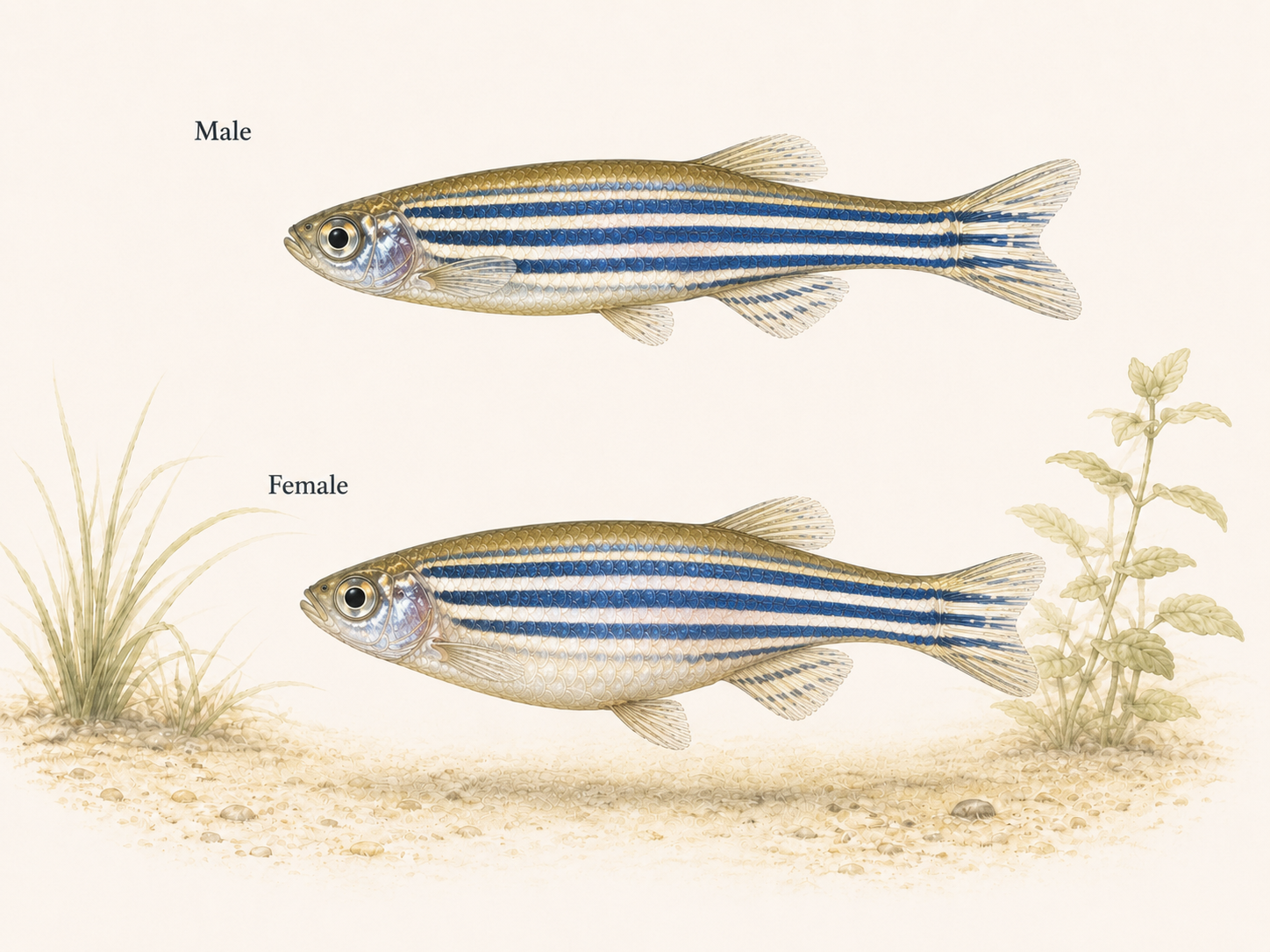
The defining feature is, of course, the striping. Five to seven dark blue to purplish-blue horizontal stripes alternate with silvery-gold bands, running from just behind the gill cover to the end of the caudal fin. The stripes extend into the anal fin and, to a lesser degree, into the caudal fin, giving the fish an elongated visual profile. The dorsal fin is set far back on the body and is relatively small, while the pectoral fins are well-developed and constantly in motion.
Sexual dimorphism is subtle but discernible in mature specimens. Females tend to be slightly larger and more rounded in the belly, especially when carrying eggs. Their stripes may appear slightly more silvery compared with the deeper gold tones seen in males. Males are generally slimmer and may display more intense colouration, particularly during courtship. Both sexes possess a pair of short barbels at the corners of the mouth, though these can be difficult to see without close inspection.
Varieties and Morphs
Decades of captive breeding — both in the aquarium trade and in research laboratories — have produced a number of distinct Zebra Danio variants. Some are well established in the hobby, while others are more niche. Below are the most notable forms you are likely to encounter.
The longfin Zebra Danio is one of the oldest and most widely available morphs. It retains the classic striped pattern but possesses dramatically elongated fins, particularly the caudal, anal, and pectoral fins. The flowing finnage gives the fish a more graceful appearance, though it can slightly reduce swimming speed compared with the wild-type form.
The leopard Danio was once considered a separate species, Danio frankei, but is now recognised as a spotted morph of Danio rerio. Instead of continuous horizontal stripes, it displays a pattern of dark spots and broken dashes against a golden background, reminiscent of a leopard’s coat. A longfin version of the leopard morph is also widely available and combines the spotted pattern with extended finnage.
GloFish Danios are genetically modified Zebra Danios that express fluorescent proteins derived from jellyfish or coral. They are available in a range of vivid colours including Starfire Red, Electric Green, Sunburst Orange, Cosmic Blue, and Galactic Purple. These fish fluoresce under blue or ultraviolet light and pass the trait to their offspring. GloFish are legal to sell in most countries, though they are prohibited in the United Kingdom, the European Union, Australia, and Canada, among other jurisdictions. Where they are available, their care requirements are identical to those of standard Zebra Danios.
The golden Zebra Danio is a leucistic variant with much-reduced melanin pigmentation. It appears pale gold to yellowish with faint, translucent stripes. This morph is attractive in its own right and can make a striking contrast when kept alongside wild-type fish.
The albino Zebra Danio lacks melanin entirely, resulting in a pale pinkish-white body with red eyes. The stripe pattern is faintly visible as a subtle lighter-and-darker alternation. Albino fish may be slightly more sensitive to bright lighting and benefit from some shaded areas in the tank.
Occasionally, sandy or cream-coloured variants appear in the trade, sometimes marketed under informal names. These tend to be variations on the golden or leucistic theme and do not represent genetically distinct lines. Regardless of the morph, all Zebra Danio variants share the same fundamental care requirements and can be housed together without issue.
Natural Habitat
Danio rerio is native to the freshwater systems of South Asia, with a natural range spanning much of the Indian subcontinent and extending into parts of Myanmar. It is found in the Ganges and Brahmaputra river basins, across the floodplains of northern India and Bangladesh, in Nepal’s Terai lowlands, and in scattered populations in Pakistan and Myanmar. The species occupies a remarkably wide range of habitats, which goes a long way towards explaining its legendary adaptability in captivity.
In the wild, Zebra Danios are most commonly found in shallow, slow-moving or standing waters. They inhabit rice paddies, irrigation channels, seasonal pools, streams, and the margins of rivers. During the monsoon season, they colonise flooded areas rapidly, taking advantage of the explosion of food and breeding opportunities that the rains bring. As floodwaters recede, they concentrate in remaining pools and channels. This seasonal cycle means wild Zebra Danios experience significant fluctuations in water temperature, depth, flow, and chemistry throughout the year.
The substrates in their habitats range from silty mud in paddy fields to gravel and sand in streams. Vegetation is often present in the form of marginal grasses, aquatic plants, and algae. Water clarity varies enormously, from the turbid waters of monsoon-fed floodplains to the clear streams of foothill regions. This ecological flexibility is mirrored in the broad range of water parameters the species tolerates in captivity.
Tank Size and Setup
A minimum tank size of 60 litres is recommended for a small group of Zebra Danios. However, given the species’ active swimming behaviour and preference for horizontal movement, a longer tank is always better than a taller one. A standard 80- to 100-litre tank measuring at least 60 cm in length provides a much more satisfying environment and allows the fish to display their natural shoaling behaviour fully. For larger groups or community setups, tanks of 120 litres or more are ideal.
When aquascaping for Zebra Danios, the key principle is to balance open swimming space with areas of cover. These fish spend much of their time in the upper and middle water columns, darting back and forth in the open water. A tank that is too heavily planted or cluttered with hardscape will frustrate this behaviour. Aim to keep the centre and front of the tank relatively open, with denser planting and décor along the back and sides.
Hardy, undemanding plants such as Vallisneria, Java Fern, Anubias, and Cryptocoryne species work well. Floating plants can be a useful addition, as they diffuse lighting and provide a sense of security, particularly for any shyer tank mates. The substrate choice is not critical — fine gravel or sand both work — though a darker substrate can enhance the fish’s colours. Driftwood and smooth stones add visual interest and create useful territorial boundaries for other community species.
A tight-fitting lid or cover slides are strongly recommended. Zebra Danios are accomplished jumpers, particularly when startled, during feeding frenzies, or when chasing one another. An uncovered tank will almost certainly result in losses over time.
Water Parameters
| Temperature | 18–26 °C |
| pH | 6.0–8.0 |
| General hardness (GH) | 2–20 dGH |
| Carbonate hardness (KH) | 1–15 dKH |
| Ammonia | 0 ppm |
| Nitrite | 0 ppm |
| Nitrate | Below 30 ppm |
The Zebra Danio is genuinely one of the most tolerant freshwater fish when it comes to water chemistry. It thrives across a remarkably broad range of temperature, pH, and hardness values. This tolerance is a direct reflection of the variable conditions it experiences in the wild, from cool mountain streams to warm, stagnant paddy fields.
For general community keeping, a temperature in the range of 22–25 °C suits most situations well. It is worth noting, however, that the species can comfortably tolerate temperatures as low as 18 °C, which makes it suitable for unheated tanks in temperate climates during the warmer months. Conversely, sustained temperatures above 28 °C should be avoided, as they can shorten lifespan and increase susceptibility to disease.
Stability is more important than hitting a specific number. Avoid sudden swings in pH or temperature during water changes by matching the replacement water as closely as possible to the tank water. Regular weekly water changes of 20–30% are sufficient to maintain good water quality. As with all fish, ammonia and nitrite must always be at zero, and nitrate levels should be kept comfortably below 30 ppm through a combination of water changes, sensible stocking, and adequate filtration.
Filtration and Equipment
Zebra Danios do not have demanding filtration requirements, but they do appreciate clean, well-oxygenated water with moderate flow. A hang-on-back filter, internal power filter, or small canister filter rated for the tank’s volume will serve admirably. Because the species naturally inhabits flowing water in parts of its range, a gentle to moderate current across the tank is appreciated and encourages natural swimming behaviour. Avoid excessively strong flow, however, as it can exhaust smaller fish and make feeding difficult.
Aeration is beneficial, particularly in warmer conditions when dissolved oxygen levels drop. A simple air stone or the surface agitation provided by the filter outlet is usually sufficient. If running a spray bar, angling it slightly upwards to break the surface will help with gas exchange.
Lighting should be moderate. Standard LED aquarium lights on a timer set for eight to ten hours per day provide a good balance between illuminating the fish’s colours and supporting plant growth without encouraging excessive algae. If keeping albino or golden morphs, some floating plant cover or dimmer lighting zones are appreciated.
A heater may or may not be necessary depending on the ambient room temperature and the requirements of other species in the community. If the room stays reliably above 20 °C, Zebra Danios alone do not require supplemental heating. In a mixed community with tropical species that need warmer conditions, a reliable heater with a thermostat set to the appropriate temperature is essential. Always use a separate thermometer to verify the heater’s accuracy.
Diet and Feeding
Zebra Danios are omnivorous and thoroughly unfussy eaters. In the wild, their diet consists of small insects, insect larvae, crustaceans, worms, algae, and plant matter. In captivity, they readily accept virtually any food offered, from flakes and micro-pellets to live and frozen fare.
A high-quality tropical flake or micro-pellet food should form the staple of their diet. Choose a product with a balanced nutritional profile that includes both animal and plant-based ingredients. Supplement this with regular offerings of frozen or live foods such as daphnia, brine shrimp, bloodworm, and tubifex. These protein-rich treats help maintain vibrant colour, support immune health, and can condition breeding pairs. Freeze-dried foods are an acceptable alternative when live or frozen options are unavailable, though they should be pre-soaked briefly to prevent digestive issues.
Zebra Danios are enthusiastic surface feeders and will often be the first to the food when it hits the water. Feed small amounts two to three times per day rather than one large feeding. Each portion should be consumed within two to three minutes. Overfeeding is a common pitfall with these eager fish — uneaten food quickly degrades water quality, so restraint at feeding time pays dividends in tank health.
Vegetable matter in the form of blanched spinach, spirulina flakes, or algae wafers can be offered occasionally to round out the diet, though it is not strictly necessary if the staple food already contains plant-based ingredients.
Behaviour and Temperament
The Zebra Danio is a peaceful, gregarious species that should always be kept in groups. A minimum of six individuals is recommended, though larger groups of ten or more produce the most impressive and natural-looking shoaling behaviour. In small numbers or when kept singly, Zebra Danios can become stressed, withdrawn, or occasionally nippy towards other species.
Within the group, a loose but visible hierarchy develops. Males in particular engage in frequent chasing and displaying, racing alongside one another and jostling for position. This behaviour is normal and rarely results in any injury. It is most intense during feeding and in the early morning when light levels increase. Females are generally less confrontational but participate in the group dynamic actively.
Their swimming style is characteristically rapid and somewhat erratic. They spend most of their time in the upper third of the water column, though they will range throughout the tank, especially when foraging. Their speed and constant movement can be intimidating for very timid or slow-moving species, which is worth considering when planning a community.
Zebra Danios are not territorial in any meaningful sense. They do not defend fixed areas of the tank and are content to share space with virtually any peaceful fish. However, their high activity levels and tendency to chase one another can occasionally result in incidental fin-nipping, particularly towards long-finned species such as male Bettas or fancy guppies. This is generally opportunistic rather than aggressive and can be minimised by keeping the danios in a sufficiently large group, which focuses their social energy on one another rather than on tank mates.
Tank Mates
Good tank mates
- Cherry Barb — a similarly sized, peaceful cyprinid that occupies the middle water column and complements the danios’ upper-level activity.
- Harlequin Rasbora — a gentle, shoaling species that shares overlapping water parameter requirements and adds warm colour to the mid-level.
- Corydoras Catfish — peaceful bottom-dwellers that occupy a different zone in the tank, creating a well-rounded community without competition.
- Bristlenose Pleco — a hardy, algae-eating catfish that stays near the substrate and is entirely unbothered by the danios’ activity above.
- Kuhli Loach — a reclusive, nocturnal bottom-dweller that coexists peacefully and makes use of the tank during hours when the danios are less active.
- Neon Tetra — a classic community fish that shoals in the mid-water and is peaceful enough to live alongside active danios without conflict.
- Platy — a robust, easy-going livebearer with a calm disposition and compatible water requirements.
- Honey Gourami — a gentle, small gourami species that adds interest to the upper-middle water column without provoking or being harassed by danios.
- Amano Shrimp — large enough to avoid being eaten by adult danios, and an excellent algae-cleaning addition to any community tank.
- White Cloud Mountain Minnow — another hardy, active shoaler that enjoys similar cooler-range temperatures, making it an excellent companion in unheated setups.
Fish to avoid
- Betta (Siamese Fighting Fish) — the danios’ rapid movement and occasional fin-nipping tendency can stress and injure slow-moving, long-finned Bettas.
- Oscar — a large, predatory cichlid that will view Zebra Danios as food once it reaches even moderate size.
- Red-Tail Shark — a territorial and sometimes aggressive species that may chase and harass active upper-dwelling fish.
- Angelfish — adult angels may prey on small danios, and the danios’ boisterous swimming can stress these more sedate cichlids.
- Flowerhorn Cichlid — a large, highly aggressive cichlid entirely unsuitable for housing with any small community fish.
- Green Terror — another large, territorial cichlid that poses a serious predation risk to small danios.
- African Dwarf Frog — these slow, visually impaired amphibians struggle to compete for food with the lightning-fast danios.
- Fancy Guppy — the elaborate finnage of male fancy guppies can attract unwanted attention from nippy danios, leading to torn fins and stress.
Breeding
Zebra Danios are one of the easiest egg-laying freshwater fish to breed in captivity, making them a superb species for hobbyists looking to gain their first experience with spawning egg-scatterers. With a little preparation, spawning can be triggered reliably and consistently.
Begin by conditioning a group of healthy adults with frequent feedings of high-quality live or frozen foods such as brine shrimp and daphnia for one to two weeks. During this period, females will visibly plump up with eggs, and males will display increased chasing behaviour and more intense colouration.
Set up a separate breeding tank of around 20 to 40 litres. The bottom should be covered with marbles, a mesh grid, or a dense layer of Java Moss. This is critical because Zebra Danios are prolific egg eaters, and without a means of separating the eggs from the adults, very few will survive. Fill the breeding tank with water matched to the main tank’s parameters, and use a gentle sponge filter for aeration and filtration. The water level can be kept relatively shallow, around 15 centimetres.
Introduce the conditioned fish to the breeding tank in the evening. A ratio of two males to every female tends to work well. Spawning typically occurs the following morning at first light. The process is vigorous and unmistakable — males chase females at high speed around the tank, and the female scatters hundreds of small, transparent, non-adhesive eggs as she is nudged and jostled by the males. A single female can produce between 100 and 300 eggs in a single spawning event.
Remove the adults immediately after spawning to prevent egg predation. The eggs hatch within approximately 48 to 72 hours at 25 °C. The fry are tiny and initially survive on their yolk sacs. Once free-swimming, usually two to three days after hatching, they can be fed infusoria, liquid fry food, or commercially available powdered fry food. After a week or so, they are large enough to accept freshly hatched brine shrimp nauplii, which accelerates growth considerably. With good feeding and regular small water changes, the fry grow quickly and begin to show their characteristic stripes within a few weeks.
Common Diseases
Zebra Danios are hardy fish with strong immune systems, but they are not invulnerable. The most commonly encountered ailment is white spot disease, also known as ich, caused by the protozoan parasite Ichthyophthirius multifiliis. Infected fish display small white cysts on their bodies and fins and may flash against hard surfaces or become lethargic. Ich is highly treatable if caught early. Raising the temperature gradually to 28–30 °C and treating with a proprietary white spot remedy will resolve most outbreaks within a week to ten days.
Mycobacteriosis, sometimes referred to as fish tuberculosis, is a bacterial infection that Zebra Danios are somewhat more susceptible to than many other species. Symptoms include wasting, spinal deformities, lethargy, loss of colour, and skin ulcers. Unfortunately, mycobacteriosis is difficult to treat and often fatal. Infected fish should be isolated, and the aquarist should practise good hygiene, as the causative bacteria can theoretically infect humans through open wounds, though this is rare.
Fin rot is another common issue, usually linked to poor water quality or physical injury. Affected fins appear ragged, frayed, or discoloured. Improving water quality through increased water changes is the first and most important step. Antibacterial treatments can be used in more severe cases.
Velvet disease, caused by the dinoflagellate parasite Piscinoodinium, can also affect danios. It manifests as a fine, dusty, gold-to-rust-coloured coating on the skin. Treatment involves dimming the lights, raising the temperature slightly, and using a copper-based medication.
Prevention remains the best medicine. Maintaining excellent water quality, avoiding overcrowding, quarantining new arrivals, and providing a balanced diet will keep Zebra Danios in robust health throughout their lives. Regular observation during feeding time is the most practical way to spot early signs of illness, as changes in appetite or behaviour are often the first indicators of a problem.
FAQs
How many Zebra Danios should I keep together?
A minimum of six is recommended, but groups of ten or more are preferable. Zebra Danios are social fish that rely on group dynamics for their wellbeing. In smaller numbers, they can become stressed and may display uncharacteristic behaviours such as hiding or nipping at other species. A larger shoal distributes social interactions more evenly and produces a far more attractive, natural display.
Can Zebra Danios live in an unheated tank?
Yes, provided the room temperature does not drop below approximately 18 °C for extended periods. Zebra Danios are one of the few tropical fish that can tolerate genuinely cool conditions, and they are often kept successfully in unheated indoor aquariums in the UK and similar temperate climates. They make excellent companions for other cool-water species such as White Cloud Mountain Minnows. If you wish to keep them with more strictly tropical species, a heater set to 24–25 °C is advisable.
Are Zebra Danios aggressive?
Zebra Danios are classified as peaceful community fish, and genuine aggression is rare. However, they are very active and engage in frequent intraspecific chasing, which is a normal part of their social behaviour and not a cause for concern. Occasionally, this boisterous energy spills over into minor fin-nipping, particularly towards slow-moving or long-finned tank mates. Keeping them in an adequately large group and choosing compatible companions effectively eliminates this issue.
What do Zebra Danio eggs look like?
Zebra Danio eggs are very small, roughly one millimetre in diameter, and are transparent to slightly yellowish in colour. They are non-adhesive and tend to fall to the bottom of the tank after being scattered. Fertilised eggs remain clear, while unfertilised or fungused eggs turn white and opaque within 24 hours. Removing any white eggs promptly helps prevent fungus from spreading to viable ones.
Why are my Zebra Danios chasing each other?
Chasing is entirely normal behaviour in Zebra Danios and is most commonly observed among males competing for social rank or courting females. It tends to intensify around feeding time and during the morning hours. As long as no fish are being injured, losing weight, or showing signs of stress such as clamped fins or hiding permanently, this behaviour is healthy and nothing to worry about. Ensuring the group is large enough and the tank provides sufficient swimming space will keep chasing at manageable levels.
Related Guides
- Pearl Danio Care Guide — a closely related danio species with a beautiful iridescent sheen, sharing similar care requirements and making an excellent companion or alternative.
- White Cloud Mountain Minnow Care Guide — another hardy, cool-water tolerant shoaling fish that pairs beautifully with Zebra Danios in unheated community tanks.
- Cherry Barb Care Guide — a peaceful, colourful cyprinid that thrives in the same conditions and makes one of the best community partners for danios.
- Harlequin Rasbora Care Guide — a popular shoaling species from the same family, ideal for aquarists who enjoy active, group-living fish in a planted setup.
- Corydoras Catfish Care Guide — the quintessential bottom-dwelling community fish, covering a different niche in the tank and rounding out any Zebra Danio community perfectly.