Bolivian Ram Care Guide — Tank Setup, Feeding and Breeding
Introduction
The Bolivian Ram is one of those fish that quietly wins people over. It doesn’t demand attention with neon colours or dramatic finnage, instead, it earns its place in a community tank through a mix of subtle beauty, genuine personality, and a temperament that plays well with almost everyone. Officially known as Mikrogeophagus altispinosus, this South American dwarf cichlid has been a staple of the freshwater hobby for decades, and for very good reason.
What makes the Bolivian Ram so appealing is the balance it strikes. It has enough cichlid character to be genuinely interesting to watch, territory disputes, pair bonding, substrate sifting, without the aggression or demanding water requirements that put many keepers off other cichlids. Unlike its more famous cousin the German Blue Ram (Mikrogeophagus ramirezi), the Bolivian tolerates a wider range of water conditions and doesn’t collapse at the first sign of a temperature dip. It’s a hardier fish in almost every respect, which makes it far more forgiving for keepers who are still learning the ropes.
Whether you’re a beginner looking for your first cichlid or an experienced aquarist wanting a peaceful centrepiece for a planted community, the Bolivian Ram fits the bill. It’s a fish that rewards observation, pairs beautifully with a wide range of tank mates, and brings a level of intelligence and awareness to your aquarium that schooling fish simply don’t. Once you’ve kept one, you’ll understand why so many fishkeepers consider it the best all-round dwarf cichlid in the hobby.
Quick stats
| Scientific name | Mikrogeophagus altispinosus |
| Family | Cichlidae |
| Origin | Bolivia and Brazil (Amazon River basin) |
| Adult size | 7–8 cm (3 inches) |
| Lifespan | 4–6 years |
| Difficulty | Beginner |
| Breeding difficulty | Moderate |
| Temperature | 23–28 °C |
| pH range | 6.0–7.5 |
| Minimum tank size | 115 litres (30 US gallons) |
Appearance
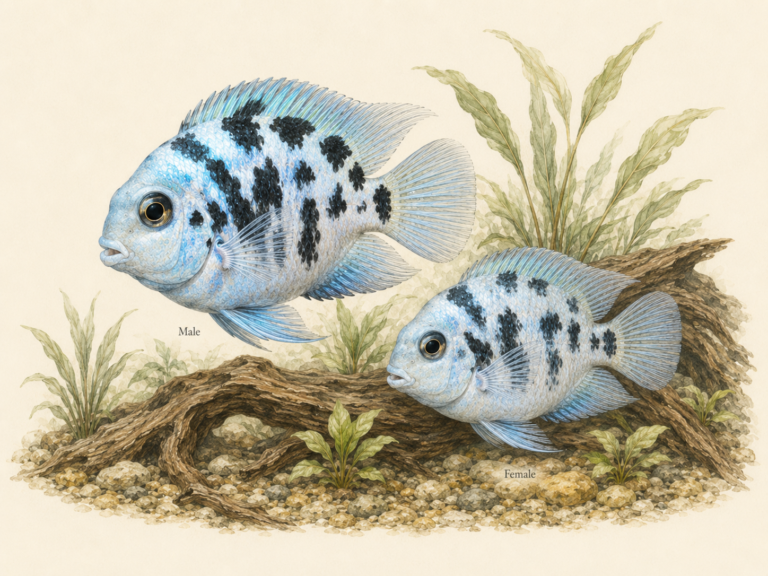
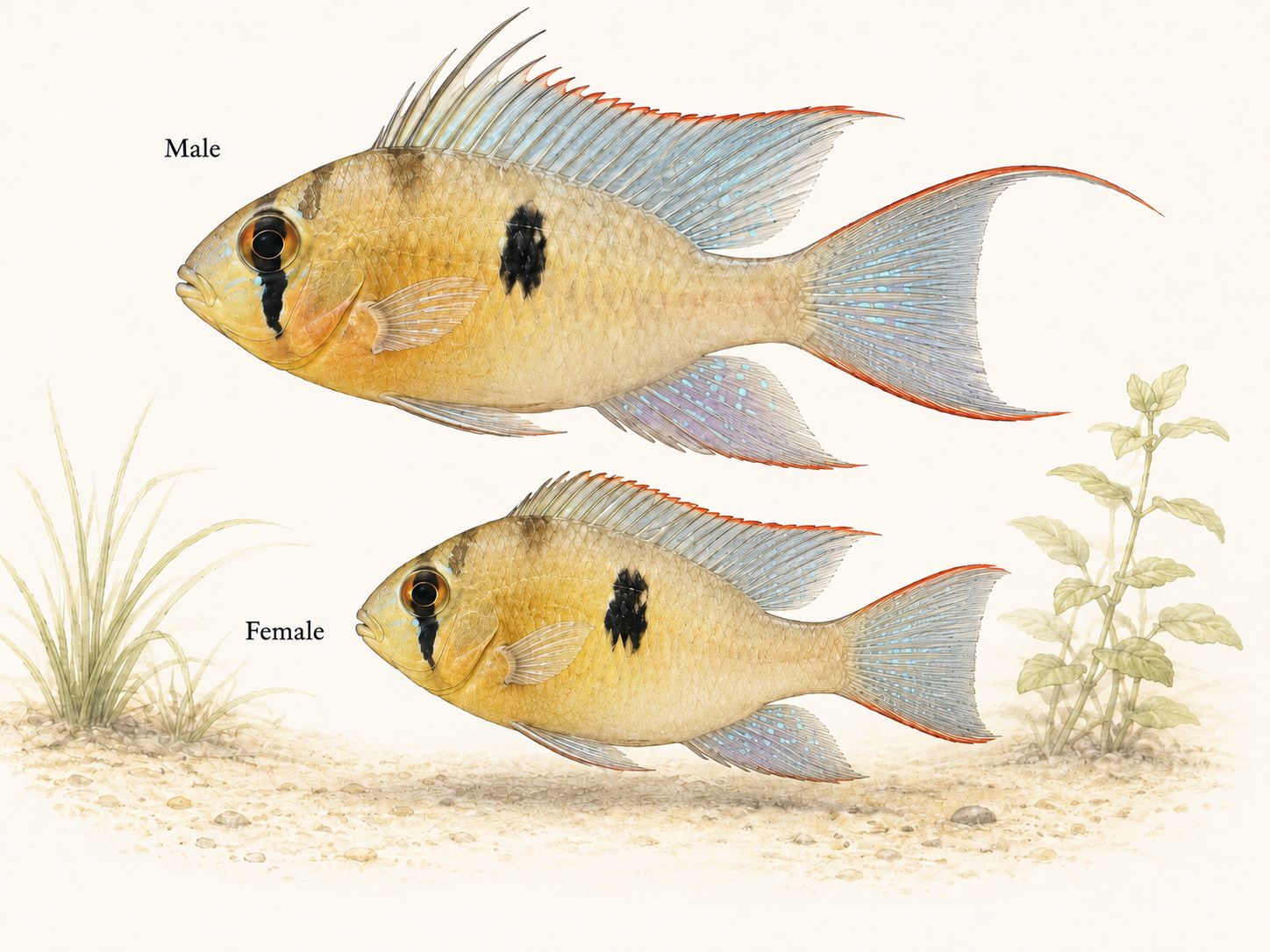
The Bolivian Ram won’t blow you away in a shop display tank, they often look washed out and pale under harsh lighting and stress. But give one a settled home with proper conditions, and the transformation is striking. The base body colour is a warm golden-tan to olive, overlaid with subtle iridescent flecks of blue and orange that catch the light as the fish moves. A prominent dark vertical bar runs through the eye, and a large dark blotch sits mid-body. The dorsal fin features an impressive elongated spine (the “altispinosus” in the name literally means “high spine”), and the edges of the dorsal and caudal fins are often lined with red or orange. The overall effect is understated but genuinely attractive, a fish that looks like it belongs in a natural, well-planted aquarium.
Telling males from females takes a bit of practice, but there are reliable differences once the fish mature. Males tend to be slightly larger, with more elongated dorsal and pelvic fin extensions, and they generally display more intense colouration, particularly during breeding or when asserting territory. Females are a touch smaller and rounder in the belly, with shorter, less pointed fins. In both sexes, colour intensity can shift dramatically with mood, a confident, dominant male in breeding condition can look like an entirely different fish from a stressed individual hiding in a corner. This responsiveness to their environment is part of what makes them so engaging to keep.
Natural habitat
Bolivian Rams are found in the upper Amazon River basin, primarily in Bolivia and western Brazil. They inhabit slow-moving rivers, streams, and tributaries with sandy or muddy substrates, often in areas where leaf litter accumulates and vegetation grows along the margins. The water in these habitats is typically warm, soft to moderately hard, and slightly acidic to neutral. These aren’t blackwater specialists, their natural range includes a variety of water types, which is a big part of why they’re so adaptable in captivity.
Understanding this habitat helps explain what the Bolivian Ram needs in your tank. These fish spend a lot of time near the bottom, sifting through substrate for food, so a soft, sandy bottom is more than a preference, it’s essential for their natural behaviour and for protecting their delicate mouths. Driftwood, leaf litter, and rooted plants mimic the sheltered margins where they feel most secure. The relatively moderate current in their natural waters also means they don’t appreciate being blasted by strong filter outflow. Recreating even a rough approximation of these conditions will bring out their best colours and most natural behaviour.
Tank size and setup
A single Bolivian Ram or a pair can be kept in a tank of at least 115 litres (30 US gallons). If you want to keep a small group or add them to a community with other bottom-dwelling fish, aim for 150 litres or more. While they aren’t large fish, they are territorial during breeding and need enough floor space to establish personal areas without constant conflict. A longer, wider footprint is always better than a tall, narrow tank for this species.
Substrate is perhaps the most important element of a Bolivian Ram setup. Choose a fine, smooth sand, pool filter sand, play sand, or aquarium-specific options like CaribSea Super Naturals or ADA La Plata Sand work well. Avoid sharp-edged gravel or coarse substrates, as these fish constantly pick up mouthfuls of substrate to sift for food, and rough material can damage their gill rakers and mouths. Over the sand, scatter some dried Indian almond leaves or oak leaves for a natural look and to release gentle tannins.
For hardscape, use pieces of driftwood and smooth stones to create caves, overhangs, and line-of-sight breaks. These provide territory markers and spawning sites. Flat stones are particularly useful if you plan to breed them. Planting is encouraged and adds to both aesthetics and the fish’s sense of security. Good choices include Cryptocoryne wendtii, Echinodorus species (Amazon swords), Vallisneria, Java fern (Microsorum pteropus), and Anubias varieties. These are all tolerant of the moderate lighting that suits Bolivian Rams, you don’t need intense light, and in fact subdued to moderate lighting brings out their colours and encourages natural behaviour. Floating plants like Salvinia or Amazon frogbit can help diffuse overhead light. Keep water flow gentle to moderate; a spray bar on your filter outlet or a lily pipe helps distribute flow without creating a strong current.
Water parameters
| Temperature | 23–28 °C (ideally 24–26 °C) |
| pH | 6.0–7.5 |
| General hardness (GH) | 5–15 dGH |
| Carbonate hardness (KH) | 2–10 dKH |
| Ammonia | 0 ppm |
| Nitrite | 0 ppm |
| Nitrate | Below 20 ppm |
One of the Bolivian Ram’s biggest selling points is its flexibility with water chemistry. While they do best in slightly soft, mildly acidic water, they adapt well to moderately hard, neutral tap water that would stress or kill a German Blue Ram. This makes them a realistic option for keepers in areas with harder water, provided you keep things stable. Consistency matters more than hitting a specific number. That said, ammonia and nitrite must always be at zero, these fish are sensitive to poor water quality even if they tolerate a range of pH and hardness. Weekly water changes of 25–30% are a good baseline, and more frequent changes are warranted in smaller or heavily stocked tanks.
Filtration and equipment
A reliable filter that provides gentle to moderate flow is the goal. Hang-on-back filters work well for smaller setups, models like the AquaClear 50 or Fluval C4 offer good biological filtration with adjustable flow. For larger or more heavily stocked tanks, a canister filter such as the Fluval 207 or Eheim Classic 250 is a solid choice, paired with a spray bar to soften the outflow. Sponge filters are also perfectly adequate, especially in breeding tanks, and have the added benefit of being fry-safe.
A heater is essential. Bolivian Rams come from warm waters and need stable temperatures in the 24–26 °C range for day-to-day keeping. An adjustable heater like the Eheim Jäger or Fluval E-series gives you precise control. Always use a separate thermometer to verify your heater’s accuracy, built-in thermostats can drift over time. For water testing, keep an API Freshwater Master Test Kit on hand. It’s the most cost-effective way to monitor ammonia, nitrite, nitrate, and pH, and liquid tests are far more reliable than strips. Test weekly, and always test after any changes to stocking, feeding, or maintenance routine.
Diet and feeding
In the wild, Bolivian Rams are omnivorous bottom feeders. They sift through sand and leaf litter for insect larvae, small crustaceans, worms, and organic detritus. Their diet in captivity should reflect this variety. A high-quality sinking pellet or granule makes a good staple, Hikari Micro Pellets, Northfin Community, or New Life Spectrum Small Fish Formula are all excellent options that are appropriately sized and nutritionally complete.
Supplement the staple diet regularly with frozen or live foods. Bloodworms, brine shrimp, daphnia, and tubifex are all eagerly accepted and help maintain good condition and colour. Live foods are particularly valuable when conditioning a pair for breeding. You can also offer blanched vegetables occasionally, small pieces of zucchini or spinach will sometimes be picked at, though Bolivian Rams are primarily carnivorous in their preferences.
Feed once or twice a day, offering only what the fish can consume in about two minutes. Bolivian Rams are not aggressive feeders and can easily be outcompeted by faster tank mates, so pay attention to whether they’re actually getting their share. Sinking foods help, since these fish naturally feed near the bottom. Overfeeding fouls water quickly and is the single most common mistake new keepers make, err on the side of less.
Behaviour and temperament
Bolivian Rams are among the most peaceful cichlids you can keep. They spend much of their time near the bottom third of the tank, methodically sifting through sand, investigating crevices, and gently patrolling their chosen territory. They’re not shy once settled, and they develop a clear awareness of their keeper, many will come to the front glass at feeding time and watch you with an almost knowing expression. This individual personality is one of their most endearing qualities.
Within their own species, Bolivian Rams form loose hierarchies. A pair will typically claim a territory around a flat stone or piece of driftwood, and they may chase away other Bolivian Rams that get too close, but actual aggression is rare and almost never results in injury. Keeping them as a pair or in a small group of five or more (to spread out any minor squabbles) works best. Trios or groups of two to three can sometimes lead to one fish being persistently bullied. With other species, they’re remarkably tolerant, they may flare briefly at a curious tank mate that ventures too close to their territory, but they don’t pursue or harm other fish. During breeding, territorial behaviour intensifies noticeably, but even then it’s mild compared to most cichlids.
Tank mates
Good tank mates
- Corydoras catfish, Peaceful bottom dwellers that coexist naturally with Bolivian Rams. Choose medium-sized species like C. sterbai or C. aeneus.
- Cardinal tetras, A classic South American pairing. Their mid-water schooling complements the Ram’s bottom-dwelling habits.
- Rummy nose tetras, Tight-schooling and peaceful, they add movement to the middle of the tank without causing conflict.
- Ember tetras, Small, calm, and colourful. They stay out of the Ram’s way and appreciate similar water conditions.
- Cherry barbs, Peaceful and unobtrusive, a good option for adding colour without adding stress.
- Bristlenose plecos, Hardy algae eaters that largely ignore Bolivian Rams and vice versa.
- Harlequin rasboras, Gentle, easy to keep, and they occupy different water levels.
- Kuhli loaches, Nocturnal bottom dwellers that rarely compete with Rams for space during the day.
Fish to avoid
- Oscars, Far too large and predatory. A Bolivian Ram would become food.
- Convict cichlids, Highly aggressive, especially when breeding. They will bully and injure Bolivian Rams.
- Tiger barbs, Notorious fin nippers that will harass the Ram’s long fin extensions.
- Chinese algae eaters, Become territorial and aggressive as they mature, and may latch onto the Ram’s body.
- Jack Dempseys, Aggressive New World cichlids that will dominate and potentially kill a Bolivian Ram.
- Green terrors, Similar story to Jack Dempseys, too large, too aggressive, wrong tank mates entirely.
Breeding
Breeding Bolivian Rams is achievable for most keepers willing to put in a bit of patience. The first step is sexing your fish. As mentioned in the appearance section, males are typically larger with more elongated dorsal and pelvic fins, while females are rounder-bodied and have shorter fins. The most reliable method is to buy a group of six juveniles and let them pair off naturally as they mature, forced pairings don’t always work with cichlids, and Bolivian Rams are no exception.
Condition the pair with frequent feedings of high-quality frozen and live foods, bloodworms, brine shrimp, and daphnia are all excellent. Slightly warmer water around 26–27 °C and soft, slightly acidic conditions (pH 6.5, GH around 6–8) can encourage spawning, though many keepers have had success in neutral, moderately hard water as well. A small water change with slightly cooler water can sometimes trigger spawning behaviour.
When ready, the pair will clean a flat surface, typically a smooth stone, a piece of driftwood, or sometimes even the glass bottom of the tank. The female deposits rows of small, adhesive eggs (usually between 100 and 200), and the male follows behind to fertilise them. Both parents guard the clutch, fanning the eggs and removing any that develop fungus. Eggs hatch in approximately three days at 26 °C, and the wrigglers become free-swimming after another three to four days. During this period, the parents often move the fry to small pits they’ve dug in the sand.
Once free-swimming, the fry are tiny and need appropriately small food. Infusoria or commercially prepared liquid fry food can bridge the first few days, followed by freshly hatched baby brine shrimp (Artemia nauplii) as soon as the fry are large enough to take them. Both parents typically continue guarding the fry for several weeks. First-time parents sometimes eat their eggs or fry, this is normal cichlid behaviour, and they usually improve with subsequent spawns. If you want to maximise survival rates, you can move the fry to a separate rearing tank after they become free-swimming, but watching the parents raise them is one of the most rewarding experiences in fishkeeping.
Common diseases and health
Ich (white spot disease)
Ich is the most common disease you’ll encounter with Bolivian Rams, especially after the stress of transport or introduction to a new tank. It presents as small white spots across the body and fins, and affected fish may flash against objects or become lethargic. Raise the temperature gradually to 30 °C and treat with a copper-based medication or a formalin/malachite green product. Bolivian Rams tolerate heat treatment well, and higher temperatures alone can sometimes resolve mild cases.
Hole-in-the-head disease (HITH)
This condition, also known as lateral line erosion, appears as small pits or lesions on the head and face. It’s most commonly associated with poor water quality, inadequate diet, or the presence of the flagellate Hexamita. Improving water quality through more frequent changes, diversifying the diet, and treating with metronidazole if the condition is advanced are the standard approaches. Prevention is far easier than cure, keep nitrates low and offer a varied diet.
Fungal infections
Fungal infections typically appear as white, cotton-like growths on the body or fins and often occur secondary to an injury or in fish with compromised immune systems from stress or poor conditions. Treat with an antifungal medication such as API Pimafix or a methylene blue bath, and address the underlying cause. Ensure there are no sharp decorations in the tank that could cause wounds.
A note on quarantine: Always quarantine new Bolivian Rams (and any new fish) for at least two to three weeks before adding them to your main tank. A simple quarantine setup, a bare-bottom 40-litre tank with a sponge filter and heater, is inexpensive and can save you from introducing disease to an established community. Observe new arrivals closely for signs of illness, and treat any issues before they have a chance to spread.
Frequently asked questions
Are Bolivian Rams good for beginners?
Yes, Bolivian Rams are one of the best cichlids for beginners. They tolerate a wider range of water conditions than many dwarf cichlids, they’re peaceful enough for community tanks, and they’re hardy enough to forgive minor mistakes. As long as you maintain a cycled tank with clean water and provide a sandy substrate, they’re a very manageable first cichlid.
Can I keep a single Bolivian Ram?
You can, and a single Bolivian Ram will do perfectly well in a community tank. They don’t require a companion of their own species to thrive, though they do seem to show more interesting behaviours when kept as a pair or in a small group. If you’re limited on space, a solo Ram in a well-planted community is a perfectly valid approach.
What is the difference between a Bolivian Ram and a German Blue Ram?
Both belong to the genus Mikrogeophagus, but they are different species with different care requirements. German Blue Rams (M. ramirezi) are more colourful but significantly more delicate, they require warmer water (27–30 °C), softer and more acidic conditions, and are far more susceptible to disease. Bolivian Rams are hardier, tolerate cooler and harder water, and generally live longer in captivity. For most community tanks, the Bolivian Ram is the more practical choice.
Do Bolivian Rams need sand substrate?
Strongly recommended, yes. Bolivian Rams are natural substrate sifters, they pick up mouthfuls of sand, filter it through their gills for food particles, and expel it. This is a core part of their natural behaviour and one of the most enjoyable things to watch. Coarse gravel prevents this behaviour and can injure their mouths. Fine, smooth sand is the right choice for this fish.
Why is my Bolivian Ram hiding and losing colour?
Colour loss and hiding are usually signs of stress. Common causes include poor water quality, aggressive tank mates, a tank that’s too brightly lit with no cover, or the fish simply being new and not yet settled. Test your water parameters, check for bullying, make sure there are plenty of hiding spots and visual barriers, and give the fish time. A settled, healthy Bolivian Ram will be confident and well-coloured. If the behaviour persists alongside other symptoms like clamped fins or loss of appetite, investigate potential illness.