Sparkling Gourami Care Guide — Tank Setup, Feeding and Breeding
Introduction
The Sparkling Gourami is one of those fish that makes you lean in closer to the glass, and then rewards you with something truly unexpected. Tiny, jewel-like, and genuinely vocal, Trichopsis pumila is the smallest member of the gourami family commonly kept in aquariums. It earns its common name from the iridescent scales that catch the light like scattered glitter, but what really sets it apart is its ability to produce an audible croaking sound. Yes, you can actually hear this fish. In a quiet room, the soft clicking and purring sounds of a group of Sparkling Gouramis communicating with each other is one of the more magical experiences in freshwater fishkeeping.
People love this species for a whole stack of reasons. It is peaceful, fascinating to observe, small enough for nano aquariums, and genuinely beautiful under good lighting. Unlike many popular community fish that zip around the tank in constant motion, Sparkling Gouramis are deliberate, curious explorers. They pick their way through plant stems and leaf litter, investigating every nook. They display to each other with flared fins and those trademark croaking sounds, creating a miniature soap opera in your living room. For anyone who has grown tired of the usual neon tetra and guppy recommendations, this fish offers something genuinely different without demanding expert-level care.
Sparkling Gouramis suit a wide range of fishkeepers. A confident beginner with a cycled, planted tank can absolutely keep them well, while experienced aquarists often return to this species after years of keeping larger, flashier fish. They are particularly well suited to anyone interested in nano planted tanks, biotope setups, or breeding projects. If you are the kind of keeper who enjoys sitting quietly and watching behaviour rather than just admiring colour from across the room, the Sparkling Gourami might become your favourite fish in the hobby.
Quick stats
| Scientific name | Trichopsis pumila |
| Family | Osphronemidae |
| Origin | Southeast Asia, Thailand, Vietnam, Cambodia, Laos, Indonesia |
| Adult size | 3–4 cm (1.2–1.6 inches) |
| Lifespan | 4–5 years |
| Difficulty | Beginner |
| Breeding difficulty | Moderate |
| Temperature | 22–28 °C |
| pH range | 5.0–7.5 |
| Minimum tank size | 40 litres (approximately 10 US gallons) |
Appearance
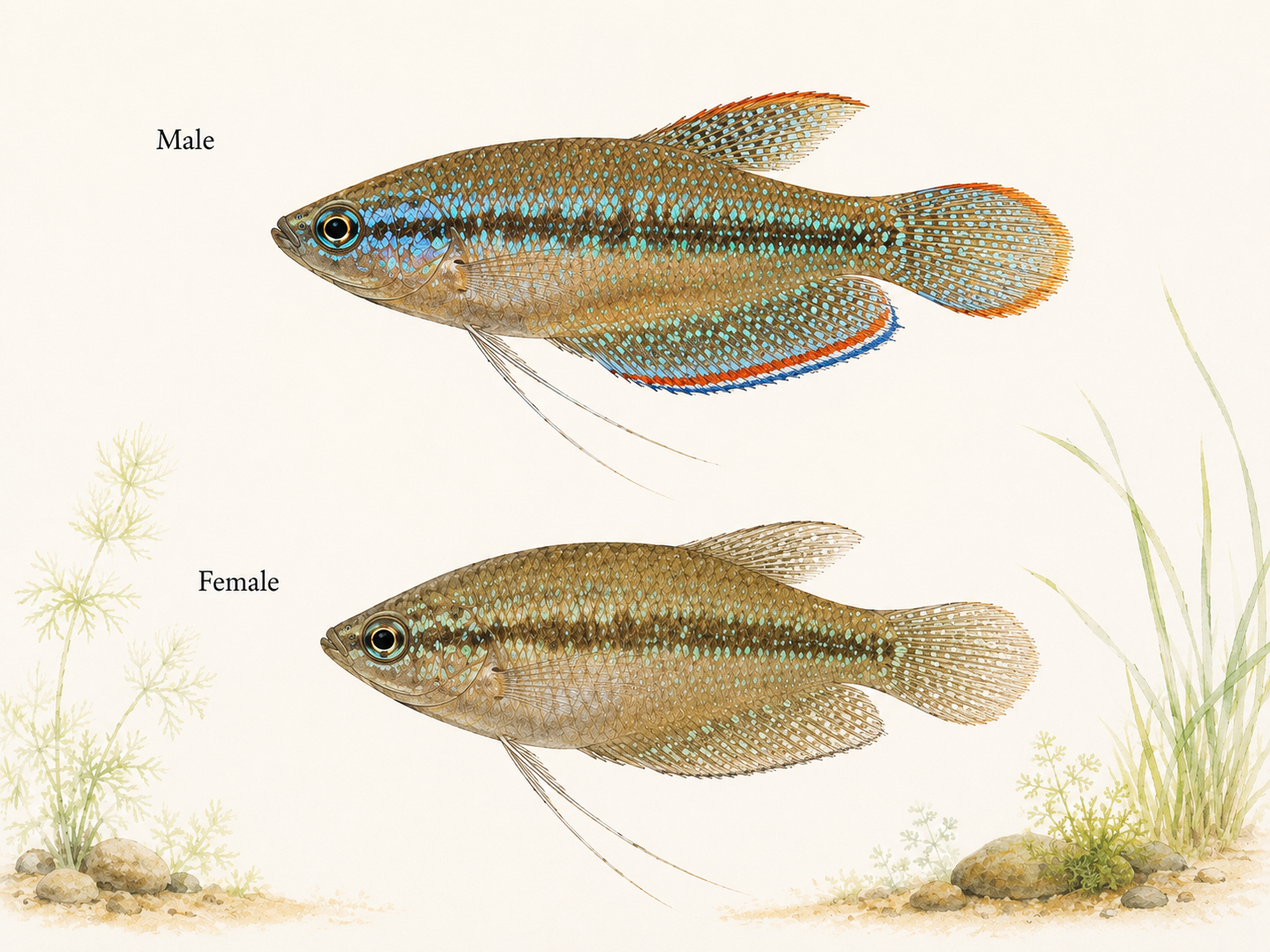
At first glance, the Sparkling Gourami could be mistaken for something plain, a small, brownish fish with a pointed snout. But give it decent lighting and a dark background, and the full picture emerges. The body is covered in rows of iridescent blue-green spots that shimmer as the fish moves, running along the flanks and into the fins. The eye is strikingly large and typically features a bright blue ring, which gives this fish an alert, almost curious expression. The fins are delicate and semi-transparent, edged and spotted with red and blue. Under strong side lighting or in a blackwater setup, these colours intensify considerably, making the fish look almost tropical reef-like in its sparkle.
Males and females look quite similar, which can make sexing a mild challenge outside of breeding condition. Males tend to be slightly more intensely coloured, with longer, more pointed dorsal and anal fins. When displaying to rivals or potential mates, males will flare their fins wide and the blue iridescence becomes especially vivid. Females are generally a touch rounder in the belly, particularly when carrying eggs, and their fins are slightly shorter and more rounded. The size difference between sexes is minimal. There are no widely established colour morphs or selectively bred varieties of this species, what you see in the shop is essentially the wild form, and honestly, it does not need any improvement.
Natural habitat
Sparkling Gouramis are found across a broad swathe of mainland and insular Southeast Asia. They inhabit slow-moving or still waters, rice paddies, shallow ponds, swamps, floodplain pools, and the margins of streams where vegetation grows thick. These are often low-oxygen environments choked with aquatic plants, leaf litter, and overhanging terrestrial vegetation. The water is typically warm, soft, and acidic, sometimes stained dark brown by tannins from decomposing organic matter. The substrate in these habitats tends to be mud or fine silt, with a deep carpet of fallen leaves on the bottom.
Understanding this natural environment is key to keeping Sparkling Gouramis well. Like all gouramis, they possess a labyrinth organ that allows them to breathe atmospheric air directly from the surface. This adaptation evolved precisely because their wild habitats are often oxygen-poor. In the aquarium, this means they need reliable access to the surface and should not be kept in tanks with extremely strong surface agitation that makes it difficult for them to gulp air. Their preference for dense vegetation, subdued lighting, and gentle water flow all trace directly back to these still, plant-filled waters. Replicating even a rough approximation of this habitat will bring out the best colour, behaviour, and overall health in your fish.
Tank size and setup
A group of four to six Sparkling Gouramis can live comfortably in a tank of 40 litres or more. If you plan to keep them with tank mates or want a larger group, aim for 60 to 80 litres. These are not active open-water swimmers, so floor space matters more than height. A standard rectangular tank with a footprint of around 60 × 30 cm works well as a starting point. Tall, narrow tanks are less ideal because Sparkling Gouramis spend much of their time in the mid to lower levels of the water column, weaving through plant stems and exploring near the substrate.
For substrate, a fine-grained option works best. Sand such as JBL Sansibar or ADA La Plata Sand gives a natural look and is gentle on the fish if they forage near the bottom. You can also use a dedicated aquasoil like Tropica Aquarium Soil or ADA Amazonia if you plan a heavily planted setup, as these will buffer the water slightly acidic and support robust plant growth. Adding a layer of dried leaf litter, Indian almond leaves (catappa) or oak leaves, over the substrate is a simple touch that transforms the environment, providing tannins, microfauna for grazing, and a much more natural feel.
Plants are not optional for this species, they are essential. Dense planting provides cover, reduces stress, and encourages natural behaviour. Excellent choices include Cryptocoryne wendtii, Cryptocoryne parva, Java Fern (Microsorum pteropus), Java Moss (Taxiphyllum barbieri), Hygrophila pinnatifida, and floating plants such as Salvinia natans, Amazon Frogbit (Limnobium laevigatum), or Red Root Floaters (Phyllanthus fluitans). Floating plants are particularly valuable because they diffuse overhead light and give the gouramis a sense of security near the surface where they go to breathe. Small pieces of driftwood, coconut shells, or clay caves provide additional hiding spots and visual barriers, which help reduce any territorial tension within a group.
Lighting should be moderate. If you are growing demanding plants, a good LED like the Chihiros C2 or Fluval Plant 3.0 on a dimmed setting works well. The floating plant layer will naturally soften the light below. Water flow should be gentle, Sparkling Gouramis come from still waters and will not appreciate being buffeted around the tank. If your filter creates too much current, baffle the outflow with a sponge, spray bar, or a lily pipe aimed at the glass.
Water parameters
| Temperature | 22–28 °C (ideal range 24–26 °C) |
| pH | 5.0–7.5 (ideal 6.0–7.0) |
| Hardness (GH) | 2–12 dGH |
| Ammonia | 0 ppm |
| Nitrite | 0 ppm |
| Nitrate | Below 20 ppm |
Sparkling Gouramis are reasonably adaptable to a range of water chemistry, but they truly thrive in soft, slightly acidic conditions. If your tap water is moderately hard and neutral, they will still do fine, but you are unlikely to see breeding behaviour or the richest colouration without softer, more acidic water. Using RO water remineralised with a product like Seachem Equilibrium, or simply adding catappa leaves and driftwood to naturally lower pH and soften the water, can make a real difference. Stability matters more than hitting a precise number, avoid sudden swings in pH or temperature, and keep up with regular water changes of around 20 to 25 percent weekly to maintain low nitrate levels.
Filtration and equipment
A sponge filter is the single best filtration option for a Sparkling Gourami tank. It provides gentle biological filtration, produces minimal current, and creates no risk of trapping tiny fish or fry. A basic dual-sponge filter driven by a small air pump is inexpensive, reliable, and practically silent. If you prefer something more polished, a small hang-on-back filter like the Aquael Versamax Mini or Fluval C2 will also work, but reduce the flow rate to its lowest setting and consider adding a pre-filter sponge over the intake.
A heater is necessary unless you live somewhere with consistently warm room temperatures year-round. A reliable 25 to 50 watt adjustable heater, such as the Eheim Jäger or Fluval M series, will hold the temperature steady. Place it near the filter outflow so heat distributes evenly. For water testing, an API Freshwater Master Test Kit covers all the essentials, ammonia, nitrite, nitrate, and pH, and is far more reliable than test strips. Test weekly during the first few months and whenever you notice changes in fish behaviour.
Diet and feeding
In the wild, Sparkling Gouramis are micro-predators. They feed primarily on tiny invertebrates, insect larvae, zooplankton, worms, and other small organisms found among vegetation and leaf litter. They have small mouths and are somewhat deliberate feeders, so food size and delivery matter.
In captivity, they readily accept high-quality micro pellets and crushed flakes, but the foundation of their diet should include live or frozen foods. Daphnia, baby brine shrimp, cyclops, micro worms, grindal worms, and frozen bloodworm (chopped small) are all excellent. Brands like Hikari Bio-Pure frozen foods and Fluval Bug Bites (small granule formula) are widely available and well received. For a dry staple, Northfin Veggie or Community formula in the 0.5 mm pellet size, or Sera Vipan Micro, work well for their small mouths.
Feed small amounts once or twice a day, only what the fish can consume in about two minutes. Overfeeding is easy with fish this small and leads to water quality problems fast. Varying the diet between live, frozen, and dry foods keeps them in the best colour and condition, and if you are hoping to breed them, increasing the proportion of live foods is one of the most effective conditioning methods.
Behaviour and temperament
Sparkling Gouramis are peaceful, inquisitive fish with a surprising amount of personality for their size. They spend their days moving methodically through the plant canopy, inspecting leaves, picking at surfaces for tiny food items, and occasionally hovering in mid-water to observe their surroundings. They are not schooling fish in the way that tetras are, they do not move in coordinated groups. Instead, they form loose social groups with a clear sense of individual space. Each fish tends to establish a small territory around a favourite hiding spot, particularly males.
The croaking is, of course, the standout behaviour. Males croak during territorial displays, courtship, and sometimes seemingly just because they feel like it. Two males facing off will flare their fins, align themselves parallel, and produce a rapid series of clicks and purrs that you can hear from several feet away. These encounters are almost always resolved without any real harm. Females also croak on occasion, though less frequently. Keeping a group of at least four fish brings out the full range of social behaviours and keeps any one individual from being singled out. They are at their most confident in a densely planted, dimly lit tank with plenty of cover, in a bare, brightly lit setup, they tend to hide and fade in colour.
Tank mates
Good tank mates
- Ember Tetra, tiny, peaceful, occupies similar soft-water conditions and stays out of the gourami’s way
- Chili Rasbora (Boraras brigittae), another nano species that thrives in soft, acidic water and gentle flow
- Pygmy Corydoras (Corydoras pygmaeus), a peaceful bottom dweller that adds activity to the lower level without causing stress
- Otocinclus, gentle algae grazers that completely ignore gouramis
- Kuhli Loach, a shy, bottom-dwelling species that overlaps very little with Sparkling Gouramis in terms of territory
- Celestial Pearl Danio, similar size, similar water preferences, and generally peaceful
- Amano Shrimp and Nerite Snails, excellent clean-up crew members that are too large to be bothered by the gouramis
Fish to avoid
- Betta splendens, another labyrinth fish that may see the gourami as a rival, leading to aggression from one or both species
- Tiger Barbs, too boisterous, too nippy, and will easily intimidate a small gourami
- Angelfish, large enough to eat Sparkling Gouramis or at least stress them considerably
- Dwarf Gourami (Trichogaster lalius), much larger and potentially aggressive, especially males defending territory
- Chinese Algae Eater, becomes territorial and aggressive as it matures, a poor fit for any small peaceful fish
- Most cichlids, even smaller species like Rams can be too assertive or territorial for Sparkling Gouramis to coexist comfortably
- Large, fast-moving fish in general, anything that dominates feeding time or creates constant commotion will stress Sparkling Gouramis into hiding
Breeding
Breeding Sparkling Gouramis is achievable for hobbyists with a bit of patience and a well-maintained tank. Males are the bubble nest builders, and spawning typically occurs under a broad leaf, inside a floating plant canopy, or even beneath a small surface structure like a film canister or overturned plastic lid. To sex your fish, look for the slightly longer, more pointed dorsal and anal fins on males, along with more intense colouration when in breeding condition. Females in breeding condition will appear noticeably rounder in the belly.
Condition your pair or group with frequent feedings of live and frozen foods, daphnia, baby brine shrimp, and grindal worms are all effective. Warmer water, around 26 to 28 °C, and soft acidic conditions with a pH of 6.0 to 6.5 seem to encourage spawning. The male will build a small, often inconspicuous bubble nest, usually tucked under a leaf or floating plant rather than out in the open like a Betta nest. He will then court the female with fin displays and croaking sounds, eventually wrapping around her in the classic gourami embrace beneath the nest. Eggs are released a few at a time and float up into the bubbles.
After spawning, the male takes over parental duties. He guards the nest, retrieves any fallen eggs, and keeps the bubbles intact. The female should generally be left in the tank if there is enough space and cover, though in very small setups she may be chased away. Eggs hatch in roughly 24 to 48 hours, and the fry become free-swimming about two to three days after that. At this stage, the fry are extremely small and need infusoria, paramecium, or commercial liquid fry food such as Hikari First Bites for the first week or so. After that, they can graduate to freshly hatched baby brine shrimp and vinegar eels. Growth is slow but steady. Keep the tank well covered during the fry stage, as developing labyrinth organs are sensitive to cold drafts of air above the water surface.
Common diseases and health
Ich (White Spot Disease)
Ich is one of the most common ailments across all freshwater fish and Sparkling Gouramis are no exception. Symptoms include small white spots on the body and fins, flashing against surfaces, and clamped fins. Treatment involves raising the temperature gradually to 28–30 °C and using a half-dose of a malachite green or formalin-based medication, as gouramis can be sensitive to full-strength treatments. Esha Exit and Seachem ParaGuard are both well-regarded options. Always remove activated carbon from the filter during treatment.
Velvet (Oodinium)
Velvet is caused by the parasite Piscinoodinium and can spread quickly in warm, still water, exactly the conditions Sparkling Gouramis prefer. Infected fish may appear to have a fine gold or rust-coloured dust on their skin, and they often become lethargic, breathe rapidly, and clamp their fins. Velvet is more dangerous than ich because it can progress before you notice it. Dim the lights, raise the temperature slightly, and treat with a copper-based medication. Seachem Cupramine is a reliable choice, but follow dosing instructions carefully as copper can harm invertebrates and plants at higher concentrations.
Fin rot
Fin rot usually appears as fraying, whitish edges on the fins and is almost always a sign of underlying water quality problems. In Sparkling Gouramis, whose fins are already delicate, it can progress quickly if not addressed. The first step is always improving water quality, perform a large water change, test your parameters, and address any ammonia or nitrite spikes. Mild cases often resolve with clean water alone. For more advanced infections, an antibacterial treatment like Esha 2000 or API Melafix can help, though prevention through consistent tank maintenance is always preferable to treatment.
A note on quarantine
Quarantining new fish before adding them to your main tank is one of the simplest and most effective things you can do to prevent disease. A small 20 to 30 litre tank with a sponge filter, a heater, and a few hiding spots is all you need. Keep new arrivals in quarantine for two to three weeks and observe them closely for any signs of illness. This one habit will save you a great deal of heartache and protect the fish already in your care.
Frequently asked questions
Can Sparkling Gouramis live in a 20-litre nano tank?
A single Sparkling Gourami could survive in a 20-litre tank, but it would not thrive. These fish do best in groups of at least four, and the social dynamics and croaking behaviour that make them so interesting only emerge in a group setting. A 40-litre tank is the practical minimum for a small group, and 60 litres gives them much more room to establish territories and behave naturally.
Do Sparkling Gouramis really make noise?
They really do. The croaking sound is produced by a specialised pectoral fin mechanism and is clearly audible to the human ear in a quiet room. Males croak most often during territorial displays and courtship, but females can also produce the sound. It is a soft, rapid clicking or purring, and once you hear it for the first time, you will understand why so many fishkeepers find this species irresistible.
Can I keep Sparkling Gouramis with shrimp?
Adult Amano Shrimp and larger Neocaridina are generally safe with Sparkling Gouramis. However, very small shrimp, particularly baby cherry shrimp, may be picked off occasionally. If you are running a breeding colony of dwarf shrimp, dense plant cover and moss will give the shrimplets plenty of hiding places and improve survival rates significantly. It is a workable combination, but not completely risk-free for the smallest shrimp.
How many Sparkling Gouramis should I keep together?
A group of four to six is a good number for most setups. This allows natural social behaviour to develop without overcrowding. In larger tanks of 80 litres or more, groups of eight to ten can work beautifully, especially with plenty of plant cover and visual barriers. Keeping a single Sparkling Gourami is not recommended, they are noticeably more confident and active in a group.
Why is my Sparkling Gourami hiding all the time?
Persistent hiding usually points to one of a few issues: the tank is too brightly lit, there is not enough plant cover, the fish is being intimidated by tank mates, or water quality is poor. Adding floating plants, reducing lighting intensity, and ensuring there are plenty of hiding spots will often bring a shy fish out over time. Check your water parameters as well, since stressed fish often retreat when ammonia or nitrite levels creep up.
Related guides
- Sparkling Gourami breeding guide
- Sparkling Gourami tank setup and equipment guide
- Sparkling Gourami diet and feeding guide
- Best tank mates for Sparkling Gourami
- Sparkling Gourami diseases and health guide
- Why is my Sparkling Gourami losing colour?
- Back to the fish species directory
- Beginner’s guide to cycling your tank