Quick summary
The Adolfoi Corydoras is a peaceful, beautiful shoaling catfish suited to aquarists who can maintain warm, soft, acidic blackwater conditions and a fine sand substrate, making it a moderate difficulty rather than beginner fish. It’s best kept in groups of six or more, is straightforward to feed, but is difficult to breed and commands a higher price than most corydoras species.
🐠 Build a tank around this species
In this guide:
- Introduction
- Quick Stats
- Appearance
- Natural Habitat
- Tank Size and Setup
- Water Parameters
- Filtration and Equipment
- Diet and Feeding
- Behaviour and Temperament
- Tank Mates
- Breeding
- Common Diseases
- FAQs
Introduction
The Adolfoi Corydoras (Corydoras adolfoi) is one of the most visually striking members of the Corydoras genus, prized by aquarists for its elegant markings and endearing social behaviour. First described by Burgess in 1982, this small armoured catfish hails from the upper Rio Negro basin in Brazil, where it inhabits warm, acidic blackwater tributaries shaded by dense tropical canopy. Its combination of a bright orange patch behind the head, a bold black eye band, and a creamy white body has made it a perennial favourite in the hobby, though it commands a higher price than many of its relatives due to the challenges associated with wild collection and relatively limited captive breeding.
Despite its somewhat premium status, the Adolfoi Corydoras is not an especially difficult fish to keep, provided the aquarist pays attention to water quality and temperature. It shares the peaceful, gregarious temperament common to all corydoras catfish and thrives when kept in groups of six or more. This care guide covers everything you need to know to maintain a healthy, thriving shoal of these beautiful catfish, from tank setup and water chemistry to diet, breeding, and disease prevention.
Quick Stats
| Scientific name | Corydoras adolfoi |
|---|---|
| Common names | Adolfo's Cory, Adolfo's Catfish |
| Family | Callichthyidae |
| Origin | Upper Rio Negro basin, Amazonas, Brazil |
| Adult size | 5.25 cm |
| Lifespan | 5–8 years |
| Difficulty | Intermediate |
| Breeding difficulty | Advanced |
| Temperature | 24–28 °C |
| pH | 5–7 |
| GH | 1–8 dGH |
| KH | 0–4 dKH |
| Minimum tank size | 40 L |
| Conservation status | Least Concern (IUCN, assessed 2020) |
Appearance
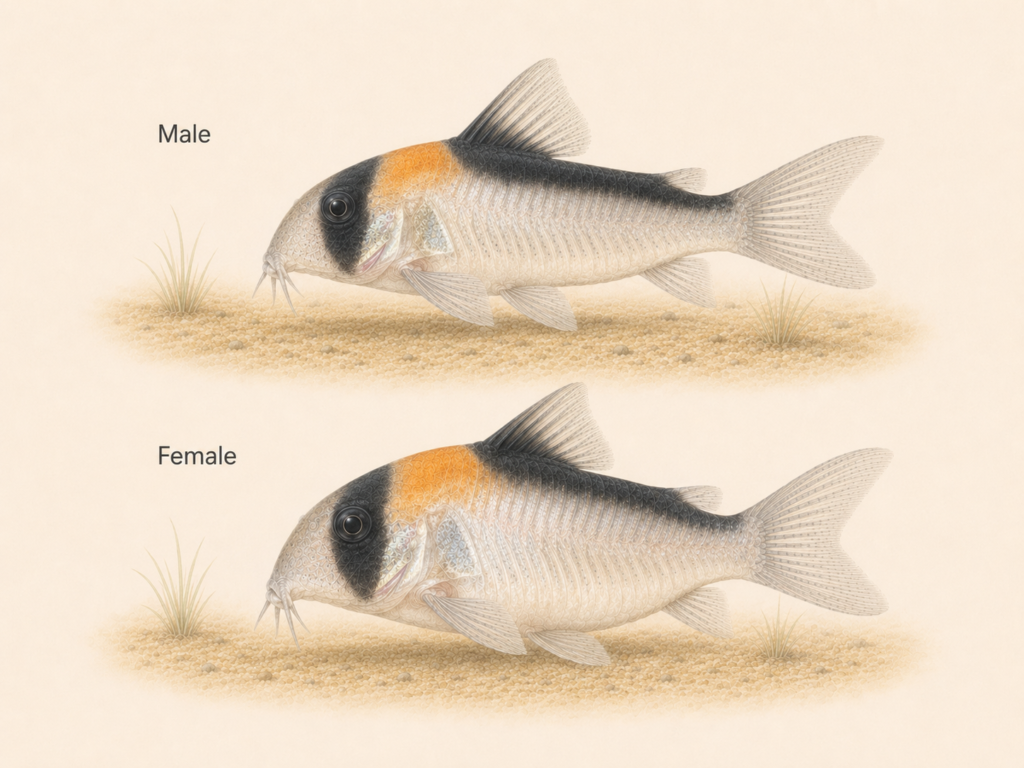
Corydoras adolfoi is a compact, somewhat dorsally flattened catfish that reaches an adult length of around five to five and a half centimetres. Its base colouration is a pale, creamy white to light grey, which provides a clean canvas for its defining markings. The most immediately recognisable feature is a vivid orange or deep amber patch that sits on the nape, directly behind the head and in front of the dorsal fin. This orange blaze varies in intensity between individuals and can appear more or less saturated depending on the fish’s condition, diet, and mood.
A thick, jet-black band runs horizontally across the head, passing through both eyes and curving slightly upward at each end. This mask-like marking gives the fish a distinctive, almost raccoon-like appearance. A second prominent black marking occupies the dorsal region, typically forming a broad saddle or blotch at the base of the dorsal fin that extends partway along the back. The remaining fins are largely transparent to very pale yellow, with the caudal fin sometimes showing faint patterning.
Like all corydoras, C. adolfoi possesses two rows of overlapping bony scutes along each flank rather than traditional scales, giving it the characteristic armoured look of the family. It has a pair of short barbels on the upper jaw, which it uses constantly to probe the substrate for food. The pectoral and dorsal fins each bear a stiffened leading spine, which the fish can lock into position as a defence mechanism. Care should be taken when netting these fish, as these spines can become entangled in fine mesh.
It is worth noting that Corydoras adolfoi is frequently confused with its close relative Corydoras duplicareus, which shares an almost identical colour pattern but typically displays a more intensely orange nape patch that extends further along the body. The two species originate from different tributaries within the broader Rio Negro system, and genetic analysis confirms they are distinct species, though telling them apart in the trade can be challenging.
Natural Habitat
Corydoras adolfoi is endemic to the upper Rio Negro drainage in Amazonas state, Brazil, specifically in tributaries such as the Rio Uaupés and surrounding small streams. The Rio Negro is one of the world’s great blackwater river systems, characterised by deeply tannin-stained waters that appear the colour of strong tea. These tannins leach from decomposing leaf litter and woody debris on the forest floor, creating water that is extremely soft, highly acidic, and low in dissolved minerals.
In its natural environment, C. adolfoi inhabits the shallow, slow-moving margins of these tributaries, where the substrate consists of fine sand overlaid with a deep carpet of fallen leaves, twigs, and seed pods. The dense overhead canopy of the tropical rainforest filters much of the sunlight, resulting in relatively dim conditions at the water’s surface. Water temperatures in these habitats tend to be warm, typically ranging from 24 to 28 degrees Celsius, with pH values often falling between 4.5 and 6.5 and general hardness close to zero.
These fish are found in loose groups foraging across sandy patches and amongst submerged leaf litter, where they sift through the organic detritus in search of small invertebrates, insect larvae, and biofilm. The soft, sandy substrate is crucial to their natural behaviour, as they spend the majority of their active time with their barbels buried in the sediment. Understanding this natural habitat is key to replicating suitable conditions in the aquarium and ensuring the long-term health and well-being of captive specimens.
Tank Size and Setup
A group of six Adolfoi Corydoras requires a minimum tank volume of 75 litres, though a larger aquarium of 100 litres or more is preferable, particularly if you intend to keep them alongside other species in a community setting. As with all corydoras, the footprint of the tank matters more than its height. These fish spend almost all of their time on or near the bottom, so a longer, wider tank with ample floor space is far more beneficial than a tall, narrow one.
The single most important element of the setup is the substrate. Corydoras adolfoi must be kept on fine, smooth sand, ideally a pale or natural-coloured variety that mimics the sandy streambeds of the Rio Negro. Coarse gravel, sharp-edged substrates, or rough materials can abrade and damage the delicate barbels, leading to infections and significantly reducing the fish’s ability to feed naturally. If you observe shortened or eroded barbels on your corydoras, the substrate or water quality is almost certainly the cause.
To replicate the natural blackwater environment, incorporate generous quantities of leaf litter such as Indian almond leaves, oak leaves, or similar botanicals. These not only release beneficial tannins that soften the water and lower the pH, but they also encourage the growth of biofilm and microfauna that supplement the fish’s diet. Driftwood and bogwood pieces are excellent additions, providing both tannin release and visual structure. Arrange these to create shaded resting spots and areas of cover where the fish can retreat when they feel the need.
Live plants are not strictly necessary, as the natural habitat of C. adolfoi is relatively sparse in terms of aquatic vegetation, but low-light species such as Java fern, Anubias, and various mosses can be attached to hardscape pieces to good effect. Floating plants are particularly useful for diffusing light and creating the dim conditions these fish prefer. Avoid overly bright lighting unless it is well-filtered by surface vegetation, as intense illumination can stress blackwater species and cause them to become withdrawn.
Ensure that the tank includes open areas of sand where the shoal can forage freely. Corydoras are most entertaining and display their best behaviour when given unobstructed patches of substrate to root through together. A well-designed tank for C. adolfoi might feature driftwood and leaf litter around the perimeter with a central sandy clearing, mimicking the natural forest stream environment.
Water Parameters
Maintaining appropriate water chemistry is essential for the health and longevity of Corydoras adolfoi. As a blackwater species, it is adapted to conditions that are warmer, softer, and more acidic than those preferred by many commonly kept tropical fish. While captive-bred specimens, where available, may tolerate a slightly broader range of parameters, wild-caught fish, which still make up the majority of those sold in the trade, are best kept in conditions that closely mirror their natural habitat.
| Temperature | 24–28 °C |
| pH | 5.0–7.0 |
| General hardness (GH) | 1–8 dGH |
| Carbonate hardness (KH) | 0–4 dKH |
| Ammonia | 0 ppm |
| Nitrite | 0 ppm |
| Nitrate | Below 20 ppm |
Temperature stability is particularly important. Corydoras adolfoi comes from a warmer part of the corydoras range and does not appreciate the cooler temperatures that some other species, such as Corydoras paleatus, can tolerate. Keeping the water consistently between 25 and 27 degrees Celsius is ideal for day-to-day maintenance. Sudden fluctuations in temperature or chemistry can provoke stress and increase susceptibility to disease.
Soft, acidic water is strongly recommended. If your tap water is hard and alkaline, you may need to use reverse osmosis (RO) water remineralised to the appropriate level, or blend tap water with RO water to achieve the desired parameters. The use of botanical additions such as leaf litter, alder cones, and driftwood will naturally contribute to maintaining a lower pH and softer conditions, though these alone may not be sufficient if your source water is particularly hard.
As with all corydoras, pristine water quality with zero ammonia and nitrite is non-negotiable. These catfish are sensitive to elevated nitrogenous waste, and poor water quality is the single greatest contributor to health problems in the genus. Regular partial water changes of 20 to 30 per cent weekly, using temperature-matched and appropriately treated water, are essential for keeping nitrate levels low and maintaining overall stability.
Filtration and Equipment
Corydoras adolfoi does best with gentle to moderate water flow, reflecting the calm tributaries it inhabits in the wild. A sponge filter is an excellent choice for a dedicated species tank, providing both mechanical and biological filtration without creating excessive current. Sponge filters also have the advantage of being safe for fry should breeding occur, and they support the growth of biofilm that the fish will graze upon.
In a larger community aquarium, a hang-on-back filter or a small canister filter may be more appropriate to handle the increased bioload. If using a canister or power filter, consider adding a spray bar or lily pipe to diffuse the outflow and reduce the strength of the current at substrate level. Corydoras are not strong swimmers and will become stressed if forced to contend with powerful water movement across the tank floor.
A reliable heater is essential, given the species’ preference for consistently warm water. Choose a heater rated appropriately for your tank volume and position it near the filter outflow to ensure even heat distribution. An accurate digital thermometer placed at the opposite end of the tank from the heater will help you monitor for any temperature gradients.
Lighting should be subdued. If you are growing live plants, select a light that provides sufficient intensity for low-light species but avoid anything excessively bright. A timer set to provide eight to ten hours of light per day, supplemented by floating plants to create dappled shade, will produce conditions that closely approximate the natural environment. Corydoras are most active and display their most engaging behaviours under dim lighting, and you will notice them becoming bolder and spending more time in the open when the tank is not harshly illuminated.
Diet and Feeding
In the wild, Corydoras adolfoi is an omnivorous bottom-feeder that sifts through sandy substrates and leaf litter in search of small invertebrates, insect larvae, worms, and organic detritus. In the aquarium, this diet should be replicated as closely as possible with a varied combination of high-quality prepared and live or frozen foods.
A good-quality sinking pellet or wafer designed for bottom-dwelling catfish should form the staple of the diet. Look for products with whole fish, shrimp, or insect meal listed as primary ingredients rather than those padded with excessive grain fillers. Sinking tablets and wafers should be offered in quantities that the group can consume within a few hours, as overfeeding can foul the substrate and compromise water quality.
Frozen and live foods are highly valued by C. adolfoi and should be offered regularly, ideally several times per week. Bloodworm, daphnia, brine shrimp, tubifex, and grindal worms are all eagerly accepted. Live foods in particular stimulate natural foraging behaviour and can help condition fish for breeding. Frozen foods should be thoroughly thawed and rinsed before being added to the tank to avoid introducing excess liquid or preservatives into the water.
Corydoras are often perceived as scavengers that will clean up leftover food from other fish, but this is a dangerous misconception. They require their own dedicated feeding and should not be expected to subsist on scraps. Feed them at a time when other tank inhabitants are less active, just after lights-out is often ideal, as corydoras tend to be most active during the twilight and nighttime hours. Placing food directly onto the sand in a consistent location will train the group to congregate at feeding time, which is a delightful behaviour to observe.
Behaviour and Temperament
Corydoras adolfoi is a peaceful, sociable species that is entirely non-aggressive towards both conspecifics and other tank inhabitants. Like all members of the genus, it is a shoaling fish that derives significant comfort and confidence from the presence of others of its kind. A group of six is the commonly cited minimum, but keeping eight, ten, or more will result in a far more natural display of behaviour, with the fish forming a tight, active foraging group that moves across the substrate in unison.
When kept in insufficient numbers or in stressful conditions, C. adolfoi tends to become reclusive, spending long periods hidden amongst décor and only emerging briefly to feed. In a well-maintained tank with an appropriate group size, however, these fish are surprisingly active and entertaining. They engage in characteristic corydoras behaviours such as rapidly darting to the surface to gulp air, a perfectly normal action related to their ability to absorb atmospheric oxygen through the intestine, and methodically working their barbels through the sand in search of food.
The species is most active during dawn, dusk, and the hours of darkness, though a well-settled group in a dimly lit tank will often be visible throughout the day. They are not territorial and do not establish a pecking order in the manner of cichlids or many other fish families. Aggression within the group is essentially non-existent. Social interactions are limited to gentle nudging, following behaviour during foraging, and the characteristic “T-position” adopted during courtship.
One notable aspect of corydoras behaviour is their sensitivity to changes in barometric pressure and water chemistry. A large water change, particularly one that introduces slightly cooler water, can trigger a flurry of activity and sometimes spawning behaviour. This responsiveness makes them fascinating fish to observe and interact with, as they seem acutely attuned to their environment in ways that many other aquarium species are not.
Tank Mates
Corydoras adolfoi is an ideal community fish, provided its tank mates share its preference for warm, soft, acidic water and are similarly peaceful in temperament. The best companions are small to medium-sized species from the same geographic region or from habitats with comparable water chemistry. Avoid any fish large enough to view the corydoras as prey, any species that is aggressive or territorial at the substrate level, and any fish that requires significantly different water parameters.
Good tank mates
- Cardinal Tetra, a classic Rio Negro companion that thrives in identical warm, soft, acidic water conditions.
- Rummy-Nose Tetra, a peaceful, shoaling species that shares the preference for warm blackwater parameters and occupies the mid-water column.
- Ember Tetra, a tiny, docile tetra that poses no threat and adds warm colour to the upper levels of the tank.
- Harlequin Rasbora, a gentle, adaptable rasbora that coexists peacefully and tolerates soft, acidic conditions well.
- Otocinclus Catfish, a small, herbivorous catfish that occupies different feeding niches and shares the need for pristine water quality.
- Beckford’s Pencilfish, a calm, slender characin that stays in the upper water column and does well in blackwater setups.
- Chocolate Gourami, a quiet, slow-moving species that appreciates the same warm, soft, tannin-rich conditions.
- Apistogramma agassizii, a small dwarf cichlid that is generally peaceful towards bottom-dwelling catfish, provided the tank is spacious enough to allow territories.
- Green Neon Tetra, a diminutive, soft-water tetra from the Rio Negro system that is a natural sympatric companion.
- Pygmy Corydoras, a smaller relative that can coexist harmoniously, adding variety to the corydoras contingent without competition.
Fish to avoid
- Oscar, a large, predatory cichlid that will readily consume small corydoras and requires vastly different tank conditions.
- Common Pleco, grows far too large for most community tanks and can be territorial over bottom space, potentially stressing corydoras.
- Tiger Barb, a boisterous, nippy species that can harass slow-moving bottom dwellers and prefers harder, more alkaline water.
- Convict Cichlid, an aggressive, territorial cichlid, especially when breeding, that will bully and injure small catfish.
- African Rift Lake Cichlids, require hard, alkaline water that is wholly incompatible with the soft, acidic conditions needed by C. adolfoi.
- Red-Tail Catfish, an enormous predatory catfish that is entirely unsuitable as a companion for any small species.
- Chinese Algae Eater, becomes increasingly aggressive and territorial with age and has been known to attach to the flanks of slow-moving fish.
- Jack Dempsey, a large, aggressive New World cichlid that poses a serious predation risk to small corydoras.
Breeding
Breeding Corydoras adolfoi in captivity is achievable but considered more challenging than breeding many of the commoner corydoras species. The difficulty lies primarily in the exacting water parameter requirements and the relatively small clutch sizes typical of this species. However, with patience and careful preparation, successful spawning and rearing of fry is well within the reach of a dedicated hobbyist.
To condition a breeding group, begin by feeding heavily with high-protein live and frozen foods such as bloodworm, white worm, and brine shrimp for several weeks. Maintain impeccable water quality throughout this period. A breeding group should consist of at least two males for every female, as the presence of multiple males seems to encourage spawning activity. Females can be distinguished from males by their broader, rounder body shape when viewed from above, particularly when gravid with eggs.
Spawning is typically triggered by simulating the onset of the rainy season. Perform a large water change of 50 per cent or more using water that is slightly cooler (by two to three degrees Celsius), softer, and more acidic than the tank water. This drop in temperature, combined with the change in water chemistry, often provokes spawning within 24 to 48 hours. Increasing aeration and reducing the photoperiod slightly can also help set the mood.
The spawning ritual follows the classic corydoras pattern. Males pursue the female actively, vibrating alongside her body. When the female is receptive, she will adopt the “T-position,” pressing her mouth against the male’s genital area to receive sperm. She then cups a small number of eggs, typically two to four, between her ventral fins, fertilises them, and deposits them on a chosen surface. Favoured spawning sites include the glass walls of the aquarium, broad plant leaves, and smooth surfaces on driftwood or décor. The process is repeated many times over the course of several hours, with the female depositing a total clutch of between 20 and 60 eggs, though numbers vary.
The eggs are adhesive and relatively large for a corydoras species, appearing pale white to slightly yellowish. Neither parent provides any care after spawning, and there is a risk of the adults consuming the eggs if left in the same tank. For the best hatch rates, carefully remove the eggs using a finger or a razor blade and transfer them to a separate rearing container with water taken from the breeding tank. Adding a few drops of methylene blue or a small piece of Indian almond leaf to the rearing container can help prevent fungal infection of the eggs.
At temperatures around 25 to 26 degrees Celsius, the eggs typically hatch in three to five days. The newly hatched fry are tiny and will absorb their yolk sacs over the following two to three days before becoming free-swimming. Initial foods should be infusoria, commercially available liquid fry food, or very finely powdered dry food. As the fry grow, they can be transitioned to freshly hatched baby brine shrimp and then microworms. Growth is relatively slow compared to more prolific species, and the fry will take several months to develop their adult colouration fully.
Common Diseases
Corydoras adolfoi is generally a hardy fish when kept in appropriate conditions, but like all corydoras, it is susceptible to certain health issues, particularly when water quality deteriorates or when the fish is subjected to stress from improper tank mates, inadequate group sizes, or unsuitable substrates.
Barbel erosion is one of the most frequently encountered problems and is almost always attributable to poor substrate choice or chronically elevated nitrate levels. When kept on sharp gravel or in tanks with degraded water quality, the barbels become shortened, reddened, and eventually eroded to stumps. This condition is entirely preventable by using fine, smooth sand and maintaining rigorous water change schedules. In early stages, barbel damage can partially regenerate once the underlying cause is corrected.
White spot disease (ichthyophthirius), commonly known as ich, can affect C. adolfoi, particularly newly imported wild-caught specimens that have been subjected to the stresses of capture and transport. Corydoras are sensitive to many common ich medications, especially those containing copper or malachite green at full concentration. If treatment is necessary, use a half dose of the medication or, preferably, raise the temperature gradually to 30 degrees Celsius for a period of ten to fourteen days while maintaining excellent aeration, as the elevated temperature accelerates the parasite’s lifecycle.
Bacterial infections, including fin rot and body sores, can develop in fish that are stressed or injured. These are best prevented through stable, clean water conditions and avoided by ensuring the tank is free of sharp décor that could cause physical injury. Should a bacterial infection arise, broad-spectrum antibacterial treatments designed for tropical fish can be used, though again, dosing should be approached cautiously with corydoras.
Internal parasites may be present in wild-caught specimens. Symptoms can include weight loss despite feeding, white or stringy faeces, and a generally hollow-bellied appearance. A course of treatment with an anti-parasitic medication containing praziquantel or levamisole is usually effective. Quarantining all new arrivals for a minimum of two to four weeks before introducing them to an established tank is the best way to intercept such issues before they spread to other fish.
FAQs
How many Adolfoi Corydoras should I keep together?
A minimum group of six is recommended, but these fish are noticeably happier and more active in larger shoals of eight to twelve or more. Corydoras are highly social animals, and keeping them in insufficient numbers leads to stress, shyness, and reduced longevity. If your tank allows it, always err on the side of a larger group.
What is the difference between Corydoras adolfoi and Corydoras duplicareus?
The two species are very closely related and share an almost identical colour pattern, making them easy to confuse. The most reliable visual distinction is the orange nape patch: in C. duplicareus, it tends to be more intensely coloured and extends further along the back, whereas in C. adolfoi, the patch is typically smaller and more restrained. The two species also originate from different tributary systems within the Rio Negro basin. In practice, misidentification is common in the aquarium trade, and some fish sold as one species may actually be the other.
Can Adolfoi Corydoras be kept with shrimp?
Adult Corydoras adolfoi are generally safe to keep with larger ornamental shrimp species such as Amano shrimp and adult cherry shrimp. However, very small shrimp and shrimplets may occasionally be consumed, particularly if they are encountered during the fish’s substrate foraging. If you are breeding shrimp in the same tank, providing dense moss and plenty of hiding spots will improve shrimplet survival rates significantly.
Why do my Adolfoi Corydoras keep darting to the surface?
This behaviour is entirely normal and is not a cause for concern in most cases. All corydoras possess the ability to supplement their oxygen intake by gulping air at the surface and absorbing it through the intestinal lining. Occasional trips to the surface are a routine part of their behaviour. However, if the fish are doing this very frequently or appear to be gasping, it may indicate low dissolved oxygen levels in the tank, and you should check your aeration and water quality immediately.
Do Adolfoi Corydoras need a heated tank?
Yes. Corydoras adolfoi is a tropical species from one of the warmer parts of the corydoras range and requires a consistently heated aquarium maintained between 24 and 28 degrees Celsius. Unlike some temperate corydoras species that can tolerate cooler conditions, C. adolfoi will become stressed and vulnerable to disease if kept at temperatures below 23 degrees Celsius. A reliable, thermostatically controlled heater is essential equipment for this species.
Related Guides
- Corydoras duplicareus Care Guide, the most closely related species, often confused with C. adolfoi, with very similar care requirements.
- Bronze Corydoras Care Guide, one of the most widely kept corydoras species, offering a useful comparison for those new to the genus.
- Pygmy Corydoras Care Guide, a miniature corydoras species that makes an excellent companion in a blackwater community tank.
- Cardinal Tetra Care Guide, the quintessential Rio Negro tetra and one of the best tank mates for C. adolfoi.
- Blackwater Aquarium Setup Guide, a comprehensive guide to creating the tannin-rich, soft-water environment that C. adolfoi thrives in.
- Corydoras Breeding Guide, detailed advice on breeding corydoras catfish, including tips applicable to the more challenging species like C. adolfoi.