Quick summary
The Electric Blue Ram is a beautiful but delicate colour variant of the German Blue Ram, best suited to experienced keepers who can maintain warm, soft, acidic water with stable, pristine parameters. It is not a good choice for beginners, as it is more prone to disease, water fluctuations, and breeding failures than the standard German Blue Ram.
🐠 Build a tank around this species
In this guide:
- Introduction
- Quick Stats
- Appearance
- Varieties and Morphs
- Natural Habitat
- Tank Size and Setup
- Water Parameters
- Filtration and Equipment
- Diet and Feeding
- Behaviour and Temperament
- Tank Mates
- Breeding
- Common Diseases
Introduction
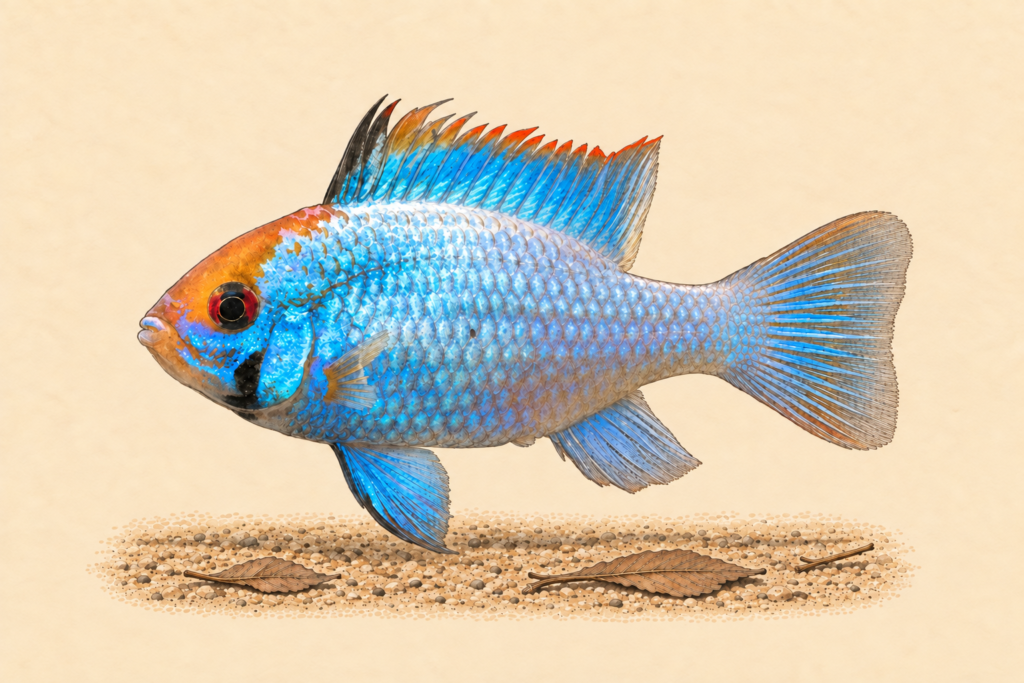
The Electric Blue Ram is a selectively bred colour variant of Mikrogeophagus ramirezi, commonly known as the German Blue Ram. It is not a separate species. Through intensive line-breeding – primarily carried out in Southeast Asian aquaculture facilities in countries such as Thailand, Singapore, and Indonesia – breeders have progressively eliminated the yellow, orange, and red pigmentation found in wild-type and standard German Blue Rams. The result is a striking fish that displays an all-over metallic sky-blue body colouration, often with an iridescent, almost electric sheen that gives the variant its popular trade name.
While the Electric Blue Ram shares the same fundamental care requirements as the standard German Blue Ram, it is widely regarded as a more delicate fish. The intensity of the selective breeding programme that produced its uniform blue pigmentation has, in many cases, narrowed the genetic pool and reduced the overall hardiness of commercially available stock. Some overseas farms also use hormones to intensify colour and boost egg production before export, which can leave affected fish short-lived and often infertile. Electric Blue Rams tend to be less tolerant of water parameter fluctuations, more susceptible to bacterial and parasitic infections, and noticeably more challenging to breed successfully than their standard-form counterparts. These are not trivial differences, and prospective keepers should be fully prepared for the additional demands this variant places on aquarium management.
For readers wanting a comprehensive overview of the species as a whole – including its natural history, baseline care fundamentals, and the full range of colour variants available – please refer to our main German Blue Ram care guide. This guide focuses specifically on the unique characteristics, sourcing considerations, and husbandry challenges associated with the Electric Blue morph.
Quick Stats
| Scientific name | Mikrogeophagus ramirezi (Electric Blue morph) |
|---|---|
| Common names | Electric Blue Balloon Ram, Blue Ram, Neon Blue Ram, Electric Blue Ramirezi |
| Family | Cichlidae |
| Origin | Selectively bred variant; wild-type species native to the Orinoco River basin in Venezuela and Colombia. Commercially bred primarily in Southeast Asia. |
| Adult size | 4 cm |
| Difficulty | Advanced |
| Breeding difficulty | Advanced |
| Temperature | 26–30 °C |
| pH | 4–7 |
| GH | 1–8 dGH |
| Minimum tank size | 75 L |
| Conservation status | Not separately assessed (the wild-type parent species, M. ramirezi, is Least Concern per IUCN) |
Appearance
The defining visual trait of the Electric Blue Ram is the near-total replacement of the warm yellow, orange, and red tones found in wild-type German Blue Rams with a uniform, intensely metallic blue that covers the head, body, and fins. In well-bred, healthy specimens, this blue has a luminous, almost neon quality that shifts between sky blue and deeper cobalt depending on the viewing angle and lighting conditions. The iridescence is produced by iridophores – specialised pigment cells that reflect light – which have been selectively amplified while xanthophores (yellow pigment cells) and erythrophores (red pigment cells) have been suppressed through generations of targeted breeding.
The body shape is identical to the standard German Blue Ram: laterally compressed, oval, and somewhat deep-bodied with a slightly rounded belly. The dorsal fin features the characteristic elongated first few spiny rays that create a small crest or spike, though this can be less pronounced in some commercially bred lines. The caudal fin is rounded, and the ventral fins are elongated and somewhat trailing in mature males.
A key feature to look for when selecting healthy Electric Blue Rams is the intensity and evenness of the blue colouration. A high-quality specimen will display rich, saturated blue across the entire body without significant pale patches, grey areas, or muddy brown undertones. The iconic dark vertical bar through the eye, present in all M. ramirezi variants, should still be visible in Electric Blues, though it can sometimes appear muted against the blue background. Some specimens retain a faint dark spot on the flank, reminiscent of the ocellus seen in standard Rams, but in many Electric Blue lines this has been largely bred out or is only visible under certain lighting.
Signs of poor-quality or stressed stock include washed-out or greyish body colour, clamped fins, visible fin erosion, sunken bellies, and laboured or rapid breathing. Unfortunately, due to the high-volume, cost-driven nature of much Southeast Asian aquaculture, a significant proportion of Electric Blue Rams arriving in shops are in suboptimal health. Taking the time to observe fish before purchase – watching for active swimming, an alert demeanour, and willingness to feed – is essential with this variant more than most.
Sexing Electric Blue Rams can be slightly more challenging than sexing standard Rams because the loss of warm pigmentation removes one traditional visual cue: in wild-type females, the belly flushes a vivid pink or red, especially when in breeding condition. In Electric Blue females, this area may appear a slightly paler or pinkish-tinged blue, but the difference is subtler. Males tend to be marginally larger, have more elongated dorsal fin rays, and display a more angular head profile. Females are generally smaller, rounder-bodied, and may show a slightly pinker ventral region when mature and well-conditioned.
Varieties and Morphs
The Electric Blue Ram itself is a colour morph of the German Blue Ram (Mikrogeophagus ramirezi), and within the Electric Blue line, further sub-variants have been developed by breeders in Southeast Asia and, to a lesser extent, in European breeding facilities.
The most commonly encountered sub-variant is the Electric Blue Balloon Ram, which combines the Electric Blue colouration with a selectively bred shortened, rounded body shape. Balloon Rams of any colour form are controversial among aquarists because the compressed spine and altered body proportions can lead to reduced swimming ability, buoyancy issues, and a shorter lifespan. The combination of balloon body genetics and the already fragile constitution of Electric Blue stock means that Electric Blue Balloon Rams are among the most delicate commercially available freshwater fish and are generally not recommended for inexperienced keepers.
A Gold Electric Blue Ram has also appeared in the trade, displaying a paler, more pastel blue-gold wash rather than the intense metallic blue of the standard Electric Blue. Long-finned variants of the Electric Blue, featuring exaggerated finnage particularly in the dorsal and caudal fins, have been produced as well, though these remain less common.
For a comprehensive overview of all available M. ramirezi variants – including the standard German Blue Ram, Gold Ram, Black Ram, and others – please refer to the Varieties and Morphs section of our main German Blue Ram care guide.
Natural Habitat
The Electric Blue Ram does not occur in the wild. It is entirely a product of selective breeding in captivity. However, understanding the natural habitat of the parent species, Mikrogeophagus ramirezi, is crucial for providing appropriate aquarium conditions, because the genetic blueprint of the fish – its physiological tolerances, behavioural drives, and environmental preferences – remains that of its wild ancestors regardless of its altered pigmentation.
Wild German Blue Rams are native to the llanos (tropical savannahs) of the Orinoco River basin, found in both Venezuela and Colombia. They inhabit slow-moving streams, pools, and tributaries where water is characteristically warm, soft, and acidic. Typical habitats feature sandy or muddy substrates, abundant leaf litter, submerged vegetation, and overhanging riparian plants that provide dappled shade. Water temperatures in these habitats typically range from 27 to 30 degrees Celsius, the pH is typically between 5.0 and 6.0, and hardness ranges from 5 to 12 dH, per FishBase, since Seriously Fish gives no figures for this species’ wild habitat.
These conditions are important context for Electric Blue Ram husbandry. The species’ evolutionary adaptation to warm, soft, acidic water is not a preference that can be trained out of it through captive breeding. While commercially bred Electric Blue Rams may tolerate a slightly broader parameter range than wild-caught standard Rams, pushing them into harder, more alkaline, or cooler water significantly increases stress and disease susceptibility. Given the already reduced hardiness of intensively line-bred Electric Blue stock, replicating the warm, soft, acidic conditions of the Orinoco basin as closely as is practical within the home aquarium is not merely ideal – it is essential for keeping these fish alive and healthy long-term.
The natural habitat also informs tank setup decisions. Wild Rams are benthic feeders that sift through sandy substrates for small invertebrates and organic particles. They use plant cover, driftwood, and leaf litter for shelter, territory establishment, and spawning sites. Recreating these environmental features in the aquarium provides both physical comfort and psychological security for Electric Blue Rams.
Tank Size and Setup
A minimum tank size of 75 litres is recommended for a single Electric Blue Ram or a pair. This is consistent with guidance for the standard German Blue Ram, as the fish’s body size and territorial behaviour are identical across colour variants. However, because Electric Blue Rams are more sensitive to water quality deterioration, there is a stronger argument for erring on the generous side with tank volume. A larger body of water dilutes waste more effectively and buffers against rapid parameter shifts, both of which benefit this delicate variant. For a pair of Electric Blue Rams housed with a small community of compatible species, 100 to 120 litres or more is preferable.
Substrate choice should prioritise fine sand, ideally in a natural pale or medium-toned colour. Sand allows the Rams to express their natural sifting behaviour, where they take mouthfuls of substrate and filter it through their gills to extract tiny food particles. Coarse gravel can damage the delicate gill tissues and impede this behaviour. A pale sand substrate also has the added benefit of showcasing the Electric Blue colouration beautifully under aquarium lighting.
The tank layout should include ample hiding spots and visual barriers. Driftwood, smooth rocks, and dense plantings of hardy species such as Cryptocoryne, Anubias, Echinodorus, and Java Fern create a sense of security and allow the Rams to establish territories without constant visual confrontation with tank mates. Indian almond leaves or other dried botanical leaves scattered on the substrate serve a dual purpose: they provide additional cover and, as they decompose, release tannins that gently acidify the water and have mild antibacterial properties. Both effects are beneficial for Electric Blue Rams.
Lighting should be moderate rather than intense. Very bright, unshaded lighting can cause Electric Blue Rams to become stressed and pale in colour, and it does not reflect the dappled, shaded conditions of their ancestral habitat. If strong lighting is needed for plant growth, provide shade through floating plants such as Salvinia, Limnobium, or Red Root Floaters, which will soften the light reaching the lower levels of the tank where the Rams spend most of their time.
Ensure the tank is fully cycled and biologically mature before introducing Electric Blue Rams. These fish should never be added to a newly set-up aquarium. A tank that has been running and cycled for at least six to eight weeks is a minimum; a well-established tank with stable biological filtration and a mature substrate biofilm is far more likely to support the long-term health of this variant.
Water Parameters
| Temperature | 26-30 °C |
| pH | 4.0-7.0 |
| General hardness (GH) | 1-8 dGH |
| Ammonia | 0 ppm |
| Nitrite | 0 ppm |
| Nitrate | Below 20 ppm |
The water parameters listed above apply to all Mikrogeophagus ramirezi, but the margin for error with Electric Blue Rams is notably thinner than with standard-form German Blue Rams. Where a well-sourced, genetically robust standard Ram might tolerate brief parameter deviations – a temporary nitrate spike, a small pH fluctuation during a water change – an Electric Blue Ram from a heavily line-bred commercial source is considerably more likely to develop health problems under the same conditions.
Temperature stability is arguably the single most critical parameter for Electric Blue Rams. They require consistently warm water, ideally maintained at 27-29 degrees Celsius. Drops below 25 degrees Celsius, even briefly, can trigger immune suppression and lead to outbreaks of diseases such as ich or bacterial infections within days. A reliable, high-quality heater with an accurate thermostat is non-negotiable. In cooler climates or rooms with significant temperature variation between day and night, a secondary backup heater is a worthwhile investment.
Soft, acidic water is strongly preferred. While commercially bred Electric Blue Rams may survive in neutral to slightly alkaline water (pH up to 7.0), they thrive and display their best colouration in water with a pH of 5.5 to 6.5 and general hardness below 6 dGH. If your tap water is hard and alkaline, consider using reverse osmosis (RO) water remineralised with an appropriate product to achieve the desired parameters. Attempting to chemically alter hard tap water with pH-lowering additives without addressing hardness is generally ineffective and can lead to dangerous parameter instability.
Ammonia and nitrite must be maintained at zero at all times. Electric Blue Rams are acutely sensitive to nitrogenous waste, and even trace levels that a hardier species might tolerate can cause gill damage, lethargy, and rapid decline. Nitrate should be kept below 20 ppm, with lower being better. Very large water changes are best avoided with this species. Regular changes of 10 to 15 per cent weekly are recommended, and the replacement water must be temperature-matched and parameter-matched to avoid shocking the fish. Drastic water changes with parameter-mismatched water are a common cause of sudden Electric Blue Ram deaths.
Filtration and Equipment
Filtration for an Electric Blue Ram tank needs to be efficient but gentle. These are not strong swimmers, and they naturally inhabit slow-moving or near-still waters. An overpowered filter creating strong currents will stress them, cause them to hide constantly, and waste energy fighting the flow. A sponge filter, a small internal filter with an adjustable flow rate, or a hang-on-back filter with a baffled outflow are all suitable choices. Canister filters are excellent for their superior biological filtration capacity, but the return flow should be diffused with a spray bar or lily pipe to reduce current strength at the bottom of the tank where the Rams reside.
Biological filtration capacity is the priority. The filter should house ample biological media – ceramic rings, sintered glass, or bio-balls – to support a robust colony of nitrifying bacteria. Given the Electric Blue Ram’s acute sensitivity to ammonia and nitrite, an undersized or poorly maintained biological filter is a recipe for disaster. Avoid over-cleaning filter media; when maintenance is needed, rinse media gently in a bucket of old tank water rather than under the tap, which would destroy the beneficial bacterial colony.
A high-quality, adjustable heater is essential. As discussed in the Water Parameters section, temperature consistency is critical for this variant. Choose a heater rated appropriately for your tank volume and set it to maintain 27-29 degrees Celsius. Verify its accuracy with a separate, reliable thermometer – cheap heaters are notorious for being several degrees off their dial setting. For tanks housing valuable or delicate fish like Electric Blue Rams, a dual-heater setup (two heaters, each rated at half the required wattage) provides redundancy: if one fails, the other prevents a catastrophic temperature drop.
An air pump is not strictly necessary if filtration provides adequate surface agitation for gas exchange, but gentle aeration can be beneficial, particularly in warmer tanks where dissolved oxygen levels are naturally lower. If using an air pump, keep the airflow gentle to avoid excessive surface disruption and current.
Lighting should be provided on a consistent photoperiod of 8 to 10 hours daily. A timer ensures regularity. As noted in the Tank Size and Setup section, moderate lighting with areas of shade is preferred. LED fixtures with adjustable brightness and colour temperature allow you to fine-tune the light to levels that keep plants healthy without overwhelming the fish.
Consider incorporating Indian almond leaves, alder cones, or other botanical tannin sources into the setup. While not strictly equipment, these natural additions serve a functional role by releasing humic acids and tannins that lower pH, tint the water a light amber, and provide mild antimicrobial benefits. Many experienced Electric Blue Ram keepers consider botanicals an integral part of their maintenance regime rather than a mere aesthetic choice.
Diet and Feeding
The dietary requirements of the Electric Blue Ram are identical to those of the standard German Blue Ram. They are omnivorous with a strong preference for small, protein-rich live and frozen foods. In the wild, M. ramirezi feeds on small invertebrates, insect larvae, and organic detritus sifted from the substrate. In captivity, a varied diet that mimics this natural intake produces the best health, colouration, and breeding condition.
A high-quality, small-pellet cichlid food can serve as a staple, but it should not be the sole diet. Many commercially bred Electric Blue Rams arrive in shops having been raised almost exclusively on commercial pellets or flakes, and transitioning them onto a more varied diet can take patience. Offer food in small quantities and observe whether the fish are eating actively. Newly acquired Electric Blue Rams may refuse food for the first day or two as they acclimatise to their new environment; this is normal, but prolonged appetite loss beyond three to four days warrants investigation into water quality or health issues.
Frozen foods should form a regular part of the diet. Bloodworm, daphnia, brine shrimp, cyclops, and mosquito larvae are all excellent choices and are readily accepted. Live foods, when available, are even more nutritious and stimulating. Live baby brine shrimp are particularly valuable for conditioning breeding pairs and for feeding fry. Freeze-dried foods are an acceptable occasional supplement but should not replace frozen or live options, as they can cause digestive issues if fed in excess and are less nutritionally complete.
Feed small amounts two to three times daily rather than one large feeding. Electric Blue Rams have small stomachs and benefit from frequent, modest meals. Remove any uneaten food after a few minutes to prevent it decomposing and degrading water quality. Given the species’ sensitivity to nitrogenous waste, overfeeding is a particularly dangerous habit with this variant.
A varied, protein-rich diet also plays a direct role in maintaining the intensity of the Electric Blue colouration. Fish fed a monotonous diet of low-quality flakes often display dull, washed-out colour compared to those receiving a diverse menu of frozen and live foods. Colour-enhancing foods containing astaxanthin or spirulina can help, though their effect on the blue iridescence is less dramatic than on red or orange pigments found in other species.
Behaviour and Temperament
The behaviour and temperament of the Electric Blue Ram is fundamentally the same as the standard German Blue Ram, which is not recommended for the general community aquarium since it requires pristine water quality and is a poor competitor for food. In a carefully chosen, calm setup they can coexist with a range of similarly sized, non-aggressive species, provided tank mates are chosen thoughtfully. They are territorial, particularly during breeding, but their territories are small and their aggression is mild compared to most other cichlid species.
Electric Blue Rams typically occupy the lower third of the water column, spending much of their time near the substrate, investigating the sand surface for food, and hovering near favoured hiding spots. They are inquisitive and, once settled, will often approach the front glass when their keeper is nearby, particularly if they associate human presence with feeding.
One behavioural note specific to commercially bred Electric Blue Rams is that newly acquired specimens can be markedly more timid and stress-prone than standard Rams. This is likely a consequence of both their line-bred genetics and the stress of commercial farming and shipping conditions. It is common for newly introduced Electric Blue Rams to hide extensively for the first several days, lose colour temporarily, and refuse food. Providing ample hiding places, keeping the tank in a low-traffic area during the acclimation period, and dimming lights can all help ease this transition. Resist the urge to constantly check on a hiding fish, as this tends to prolong the stress response.
Male Electric Blue Rams can display territoriality towards one another, particularly in smaller tanks. Keeping two males in a 75-litre aquarium is likely to result in persistent chasing and stress for the subordinate fish. If you wish to keep multiple Rams, either maintain a single male-female pair or provide a significantly larger tank (150 litres or more) with ample visual barriers to allow each fish to establish its own territory.
Pair bonding in Electric Blue Rams follows the same pattern as standard Rams. They are generally monogamous within a breeding cycle, and a bonded pair will select and defend a spawning site together. However, pair bonds can be less stable in commercially bred stock, and failed spawning attempts (which are common with this variant) can lead to aggression between the pair. Monitoring a breeding pair closely and being prepared to separate them if aggression becomes severe is advisable.
Tank Mates
Choosing tank mates for Electric Blue Rams requires the same considerations as for standard German Blue Rams – peaceful temperament, similar water parameter preferences, and an absence of fin-nipping or overly boisterous behaviour – but with an additional layer of caution. Because Electric Blue Rams are more stress-prone and less assertive than many standard-form Rams, it is particularly important to avoid tank mates that are hyperactive, much larger, or even mildly aggressive. The ideal companions are calm, small to medium-sized species that thrive in the same warm, soft, acidic water conditions.
Good tank mates
- Green Neon Tetra – A small, peaceful shoaling tetra that shares the Electric Blue Ram’s preference for warm, soft, acidic water and occupies the mid-water column without competing for territory.
- Chili Rasbora – A tiny, non-threatening nano fish that thrives in the same warm, low-pH conditions and adds a beautiful contrasting red accent to the tank.
- Celestial Pearl Danio – A peaceful, visually stunning micro fish that coexists well with dwarf cichlids in well-planted tanks, though it prefers slightly cooler water so aim for the overlap zone around 26-27 degrees Celsius.
- Sparkling Gourami – A diminutive, calm labyrinth fish that occupies the upper-to-middle water column and will not bother bottom-dwelling Rams.
- Panda Corydoras – A gentle bottom-dwelling catfish that shares the sandy substrate habitat; keep in groups of six or more for best behaviour and minimal competition with the Rams.
- Pygmy Corydoras – One of the smallest Corydoras species, peaceful and unobtrusive, posing no territorial threat and thriving in the same soft water conditions.
- Glowlight Rasbora – A small, peaceful shoaling fish with a warm orange-red lateral stripe that contrasts attractively with the blue of the Rams while requiring similar water chemistry.
- Chocolate Gourami – A soft-water specialist that matches the Electric Blue Ram’s water parameter requirements closely; both species are calm and unlikely to come into conflict.
Fish to avoid
- Jack Dempsey – A large, territorial cichlid that would easily bully or kill an Electric Blue Ram and requires a fundamentally different tank setup.
- Tiger Barb – A notorious fin-nipper whose boisterous shoaling behaviour would stress the delicate Electric Blue Ram relentlessly.
- Jewel Cichlid – A highly aggressive African cichlid that is wholly incompatible in temperament and preferred water chemistry.
- Pictus Catfish – An active, predatory catfish that grows large enough to harass or consume small Rams and requires more current than Rams prefer.
- Serpae Tetra – A persistent fin-nipper, especially in smaller groups, that would target the Electric Blue Ram’s trailing fins and cause chronic stress.
- Rainbow Shark – A territorial bottom-dweller that aggressively defends its space, creating constant conflict with substrate-dwelling Rams.
- Flowerhorn – An extremely large, aggressive hybrid cichlid that is entirely incompatible with any small, peaceful species.
- African Rift Lake Cichlids – Require hard, alkaline water and display levels of aggression that are dangerous for Electric Blue Rams on every front.
Breeding
Breeding Electric Blue Rams is significantly more challenging than breeding standard German Blue Rams, and this is arguably the area where the differences between the two are most starkly apparent. While the fundamental reproductive biology is identical – they are biparental substrate spawners that lay eggs on flat surfaces and guard their brood – the practical success rate with Electric Blue stock is noticeably and consistently lower. Reduced breeding success is a commonly reported issue in commercially produced Rams generally, and Electric Blue Rams, as an intensively line-bred variant, may be more prone to it, though it isn’t guaranteed for every individual.
The primary issues are threefold. First, clutch viability is often reduced. Electric Blue Ram pairs frequently produce batches of eggs with a higher-than-average proportion of infertile eggs (appearing white and opaque within 24 hours of laying), and some pairs consistently produce largely infertile clutches. Precise fertilisation rates have not been formally studied and vary considerably between individual pairs and breeding lines, but this pattern is widely reported by experienced keepers and breeders, and is commonly attributed to reduced sperm or egg viability linked to intensive commercial line-breeding, though the exact genetic mechanism has not been documented in the scientific literature.
Second, even when eggs are fertilised successfully, parental behaviour is often poor. Standard German Blue Rams are generally attentive parents that fan eggs, remove fungused individuals, and guard free-swimming fry. Electric Blue Rams, particularly those from mass-produced commercial stock, frequently eat their own eggs within hours of spawning, abandon the clutch, or fail to perform adequate egg-fanning, leading to fungal overgrowth. This poor parental instinct is likely another casualty of the breeding-for-colour-over-behaviour selection process. It can improve with successive spawning attempts – first-time pairs of any Ram variant are prone to eating eggs – but many Electric Blue pairs never develop reliable parental behaviour.
Third, fry survival rates are lower. Electric Blue Ram fry tend to be smaller and less robust than standard Ram fry, with higher mortality during the critical first two weeks of free-swimming life. Feeding them requires meticulous attention: infusoria or commercially available liquid fry food for the first few days, transitioning to freshly hatched baby brine shrimp (Artemia nauplii) as soon as the fry are large enough to consume them.
To maximise breeding success, condition the pair for two to three weeks with frequent feedings of high-quality frozen and live foods. Provide a dedicated breeding tank of at least 40 litres with immaculate water quality, a temperature of 28-29 degrees Celsius, a pH of 5.5-6.0, and very soft water (below 3 dGH). Include flat stones, broad plant leaves, or small terracotta pots as potential spawning surfaces. Dim lighting and minimal disturbance encourage spawning behaviour.
When spawning occurs, the female will lay 100 to 200 small, adhesive eggs on the chosen surface, and the male will fertilise them in passes. Both parents typically guard the site, with the female performing most of the egg-fanning. If the parents eat the eggs (a common occurrence), some breeders resort to artificial incubation: carefully removing the egg-laden surface to a separate, gently aerated container with matching water parameters and a few drops of methylene blue to inhibit fungal growth. This method removes the benefit of parental care but can salvage clutches that would otherwise be consumed.
An important consideration for breeders: crossing an Electric Blue Ram with a standard German Blue Ram typically produces offspring that do not display the full Electric Blue colouration, often showing an intermediate, blue-tinged version of the standard pattern instead. The precise inheritance genetics behind the Electric Blue phenotype have not been published in the scientific or aquarium literature, and specific claims about dominance, recessiveness, or expected offspring ratios circulating in the hobby should be treated as breeder anecdote rather than established fact. Breeders wishing to reintroduce genetic diversity into an Electric Blue line without losing the phenotype entirely should expect variable, line-dependent outcomes rather than a predictable one.
Common Diseases
Electric Blue Rams are susceptible to all the same diseases as standard German Blue Rams, but their reduced genetic vigour means they are more likely to succumb to illness and less resilient during treatment. Prevention through excellent husbandry is far more effective than cure with this variant.
Ich (white spot disease) is one of the most common ailments, frequently triggered by temperature drops or transport stress. The parasite Ichthyophthirius multifiliis presents as small white spots on the body and fins. Raising the temperature to around 30 degrees Celsius, near the top of the Electric Blue Ram’s 26-30°C range, accelerates the parasite’s life cycle. Treatment should follow the specific product’s dosing instructions rather than a generic half dose, since this varies by medication and by how sensitive the fish are. Electric Blue Rams can react more sensitively to medications than hardier fish, so monitor closely for adverse reactions during treatment.
Bacterial infections, including fin rot, columnaris, and internal infections, are common in stressed or immunocompromised Electric Blue Rams. Symptoms include frayed or eroding fins, white or grey patches on the body, lethargy, loss of appetite, and rapid breathing. Maintaining pristine water quality is the first line of defence. Mild cases may resolve with improved conditions alone; more severe infections may require treatment with antibacterial medications, though these should be used judiciously as Electric Blue Rams can react poorly to harsh chemical treatments.
Hole-in-the-head disease causes pitting and erosion around the head and lateral line. The exact cause isn’t conclusively established: it’s often linked to poor diet, vitamin deficiency (particularly vitamin C and B-complex deficiencies), and general stress, and can be exacerbated by the reduced overall hardiness often seen in intensively line-bred stock. The protozoan Hexamita has been proposed as a contributing factor in some cases but shouldn’t be assumed as the sole cause without a proper diagnosis. Symptoms include white, stringy faeces and a loss of appetite alongside the visible head pitting. Treatment typically involves improving water quality and diet in the first instance, alongside metronidazole administered in food or as a bath in more advanced cases, following the product’s label instructions and monitoring closely for adverse reactions.
FAQs
Is the Electric Blue Ram a separate species from the German Blue Ram?
No, the Electric Blue Ram is not a separate species. It is a selectively bred colour variant of Mikrogeophagus ramirezi, the German Blue Ram. Through intensive line-breeding, primarily in Southeast Asian aquaculture facilities, breeders have suppressed the yellow, orange, and red pigmentation to produce its distinctive all-over metallic blue colouration.
Is the Electric Blue Ram suitable for beginners?
No, the Electric Blue Ram is not a good choice for beginners. It is widely regarded as more delicate than the standard German Blue Ram due to the narrowed genetic pool resulting from intensive selective breeding. It is less tolerant of water parameter fluctuations, more susceptible to bacterial and parasitic infections, and requires warm, soft, acidic water with stable, pristine parameters throughout its life.
What water parameters do Electric Blue Rams need?
Electric Blue Rams require a temperature of 26-30 °C, a pH range of 4.0-7.0, general hardness of 1-8 dGH, and carbonate hardness of 0-4 dKH. Stability is critical with this variant, as they are notably less tolerant of fluctuations than standard German Blue Rams.
How can you tell the difference between male and female Electric Blue Rams?
Sexing Electric Blue Rams is slightly more challenging than sexing standard Rams because one traditional visual cue is largely absent. In wild-type females, the belly flushes a vivid pink or red when in breeding condition, but in Electric Blue females this area may only appear a slightly paler or pinkish-tinged blue, making the distinction less obvious.
What should I look for when buying Electric Blue Rams?
Look for specimens with rich, saturated blue colouration across the entire body without pale patches, grey areas, or muddy brown undertones. Watch for active swimming, an alert demeanour, and willingness to feed. Avoid fish showing washed-out or greyish colour, clamped fins, visible fin erosion, sunken bellies, or laboured breathing, as a significant proportion of commercially available stock arrives in suboptimal health.
Related Guides
- Checkerboard Dwarf Cichlid – Another small South American dwarf cichlid that thrives in similar warm, soft, acidic water conditions.
- Demon Eartheater – A fellow South American cichlid from the same general region, useful for understanding eartheater and cichlid husbandry in soft water setups.
- Elegant Corydoras – A peaceful bottom-dwelling species well suited to the warm, soft water conditions required by Electric Blue Rams.
- Altifron Eartheater – Another South American cichlid that appreciates soft, acidic water, offering insight into related cichlid care practices.
- Exclamation Mark Tetra – A small, peaceful tetra that favours soft, acidic water, making it a potentially compatible tank mate for Electric Blue Rams.