Lemon Cichlid Care Guide — Tank Setup, Feeding and Breeding
Quick summary
The Lemon Cichlid suits aquarists with some prior African cichlid experience who can provide a 115-litre-plus tank with stable, hard alkaline water and plenty of rocky caves, as it is territorial and sensitive to fluctuating conditions. It’s a good fit if you want a bold, colourful centrepiece for a Tanganyikan setup, but not ideal for total beginners or soft-water community tanks with small, delicate fish.
🐠 Build a tank around this fish
In this guide:
- Introduction
- Quick Stats
- Appearance
- Varieties and Morphs
- Natural Habitat
- Tank Size and Setup
- Water Parameters
- Filtration and Equipment
- Diet and Feeding
- Behaviour and Temperament
- Tank Mates
- Breeding
- Common Diseases
- FAQs
Introduction
The Lemon Cichlid, known scientifically as Neolamprologus leleupi, is one of the most visually striking and popular cichlids to emerge from the depths of Lake Tanganyika. Its vibrant, uniform golden-yellow to deep orange colouration has made it a firm favourite among Rift Lake cichlid enthusiasts and aquarists seeking a smaller, characterful species for their Tanganyikan community. First described by Poll in 1956 and named after the Belgian collector Leloup, this species has been a staple of the aquarium hobby for decades, and its enduring popularity is well deserved.
Despite its modest size, the Lemon Cichlid possesses a bold personality that belies its slender frame. It is a cave-dwelling species in the wild, occupying rocky crevices and rubble zones along the shoreline of Lake Tanganyika. In the aquarium, it retains this preference for rocky retreats and will quickly establish a territory that it defends with surprising vigour. This territorial nature, combined with its relatively straightforward care requirements, places it squarely in the moderate difficulty bracket, accessible to aquarists with some experience of African cichlids but not so demanding as to deter those looking to expand into Tanganyikan species for the first time.
This comprehensive care guide covers everything you need to know to keep Neolamprologus leleupi thriving in captivity, from tank setup and water chemistry to diet, breeding, and compatible tank mates. Whether you are planning a dedicated Tanganyikan biotope or a mixed Rift Lake community, the Lemon Cichlid can be a wonderful centrepiece species when its needs are properly met.
Quick Stats
| Scientific name | Neolamprologus leleupi |
| Common names | Lemon Cichlid, Leleupi Cichlid, Orange Leleupi, Gold Leleupi |
| Family | Cichlidae |
| Origin | Lake Tanganyika, East Africa (Democratic Republic of the Congo, Burundi, Tanzania, Zambia) |
| Adult size | 8–10 cm |
| Lifespan | 8–10 years |
| Difficulty | Moderate |
| Breeding difficulty | Moderate |
| Temperature | 24–27 °C |
| pH range | 7.8–9.0 |
| General hardness (GH) | 8–25 dGH |
| Carbonate hardness (KH) | 10–20 dKH |
| Minimum tank size | 115 litres |
| Conservation status | Least Concern (IUCN) |
Appearance
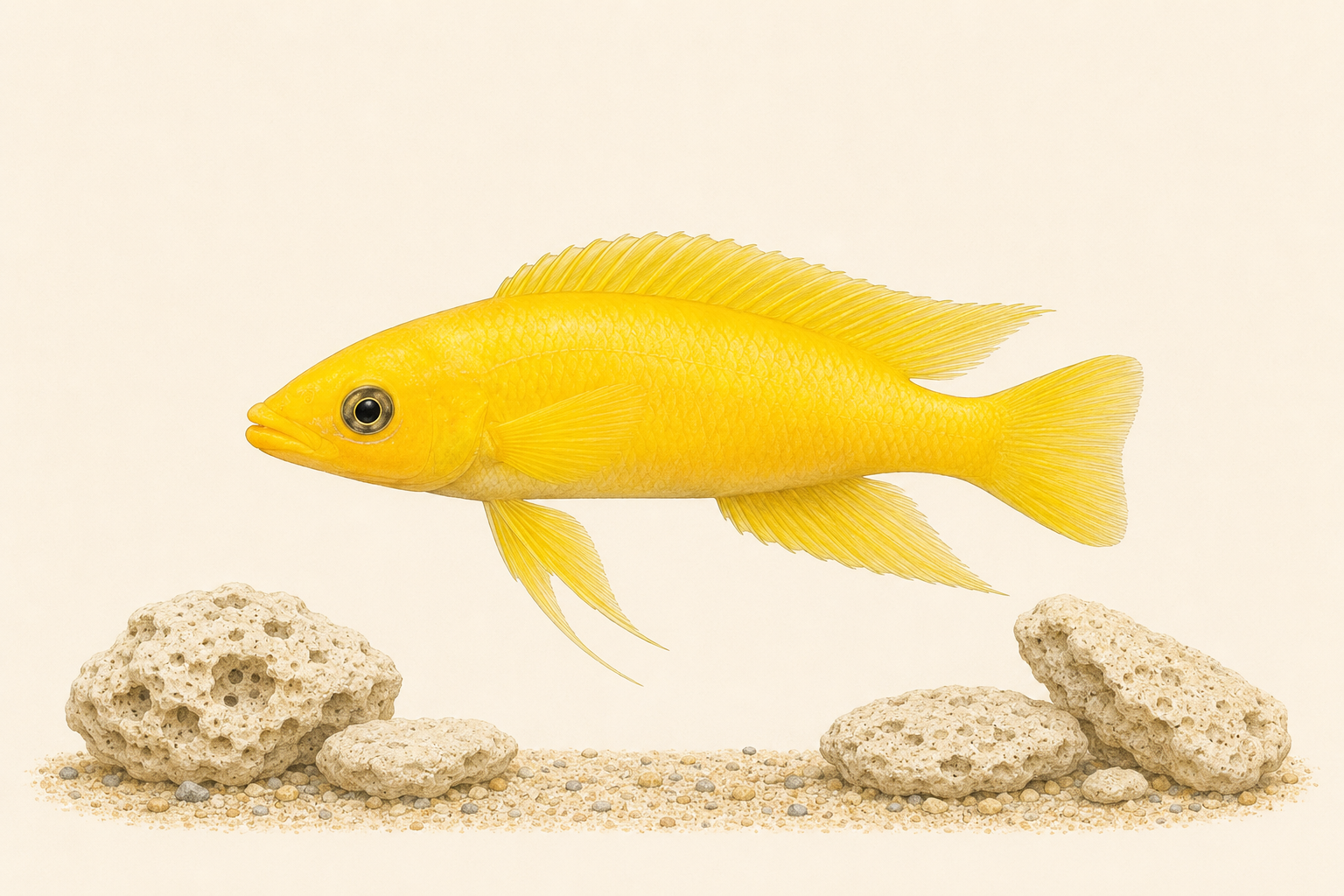
The Lemon Cichlid is an elegantly proportioned fish with a slender, elongated body and a gently curved dorsal profile. Its most immediately arresting feature is its colouration, which ranges from a pale, luminous lemon-yellow through to a rich, deep tangerine-orange depending on the locality of the wild population and the conditions under which it is kept. The colour is remarkably uniform across the entire body, fins included, giving the fish a clean, almost glowing appearance that stands out beautifully against dark rockwork.
The fins are well developed, with the dorsal fin running the length of the back and tapering to a soft, slightly pointed extension at the rear. The caudal fin is rounded to slightly truncate, and the pectoral fins are translucent with the same warm hue as the body. The eyes are relatively large and dark, providing an attractive contrast against the bright body colour. Mature specimens often develop a subtle iridescent sheen along the flanks, particularly when in good health and under appropriate lighting.
Sexual dimorphism in Neolamprologus leleupi is minimal and notoriously difficult to detect. Males tend to grow marginally larger than females and may develop a slightly more robust head profile with age, but these differences are subtle at best. The most reliable method of sexing adults is by examining the genital papillae, which are broader and more rounded in females and more pointed in males. For this reason, many breeders recommend purchasing a small group of juveniles and allowing pairs to form naturally rather than attempting to select a specific pair.
Varieties and Morphs
While Neolamprologus leleupi does not have a wide range of captive-bred designer morphs in the way that some Malawi cichlids do, several distinct geographical colour variants are recognised in the hobby. These locale variants can differ quite markedly in their base colour intensity and are often sold under specific trade names.
The most commonly encountered form is the standard Orange Leleupi, which displays the classic deep orange-gold colouration and is the variant most widely bred in captivity. The Lemon Yellow Leleupi is a paler, more citrus-toned form that some aquarists prefer for its lighter, more delicate appearance. This form was historically described as a separate subspecies, Neolamprologus leleupi leleupi, though the taxonomic distinction is not universally upheld.
A darker variant sometimes referred to as the Super Orange Leleupi is selectively bred for its particularly intense, saturated orange hue. Wild-caught specimens from certain southern localities, particularly around the Zambian coastline, tend to be deeper in colour than those from the northern parts of the lake. Occasionally, specimens with a slightly brownish or dusky undertone appear in imports; these are sometimes sold as the Dark Leleupi and may represent fish from less commonly collected populations or individuals that have not yet achieved their full colour potential under optimal conditions.
Natural Habitat
Neolamprologus leleupi is endemic to Lake Tanganyika, the second oldest, second largest, and second deepest lake in the world. This ancient body of water, estimated to be between nine and twelve million years old, has given rise to an extraordinary adaptive radiation of cichlid species, and Neolamprologus leleupi is one of the many jewels of this evolutionary treasure trove. The lake sits in the western arm of the East African Rift Valley and spans the borders of four nations: the Democratic Republic of the Congo, Burundi, Tanzania, and Zambia.
In the lake, Lemon Cichlids inhabit the rocky littoral zone, typically at depths ranging from around five to forty metres. They are strongly associated with rocky substrates where tumbled boulders, crevices, and rubble fields provide an abundance of small caves and hiding places. These fish are not open-water swimmers; instead, they spend their lives weaving between rocks, foraging in crevices, and defending their chosen shelter from rivals. The rocky habitat also supports the biofilm, small invertebrates, and crustaceans upon which they feed.
Lake Tanganyika’s water is famously alkaline and hard, with a stable pH typically between 8.6 and 9.0 and very high mineral content. Water temperatures are remarkably consistent, hovering around 25 to 27 °C year-round at the depths where Lemon Cichlids are found. The lake water is also exceptionally clear and well oxygenated near the surface and rocky zones, although the deeper waters are anoxic. Understanding this natural environment is key to replicating suitable conditions in the aquarium.
Tank Size and Setup
A single pair of Neolamprologus leleupi can be maintained in a tank of at least 115 litres, though a larger aquarium of 150 litres or more is strongly recommended, particularly if you intend to keep them as part of a community or wish to house a small group. For a Tanganyikan community setup incorporating multiple species, a tank of 200 litres or larger will provide the space needed to establish distinct territories and reduce aggression.
The aquascape should be designed with the species’ natural habitat firmly in mind. A substrate of fine sand or coral sand is ideal, as it buffers pH upward and mimics the lake floor. The most important element of the setup is rockwork. Use a generous quantity of rocks, stones, and rubble to create a complex structure with numerous caves, crevices, overhangs, and tunnels. Each fish will select its own shelter, and providing more hiding spots than there are fish is the single most effective way to manage territorial disputes. Ensure that all rock structures are stable and cannot topple, consider placing the lowest rocks directly on the base glass before adding substrate to prevent undermining.
Live plants are not a significant feature of the Lemon Cichlid’s natural habitat, and the alkaline, hard water of a Tanganyikan setup limits the range of plants that will thrive. However, hardy species such as Anubias, Java Fern, and Vallisneria can be incorporated if desired, either attached to rocks or planted in the substrate. These are not essential but can add visual interest and provide additional cover.
Lighting should be moderate. Lemon Cichlids are not shy fish, but they do appreciate the option of retreating into shaded areas. A standard LED aquarium light on a timer providing eight to ten hours of illumination per day is perfectly adequate. A dark or neutral-coloured background will help the fish’s vivid colouration stand out to best effect.
Water Parameters
Maintaining stable water chemistry is arguably the most critical aspect of keeping any Tanganyikan cichlid, and the Lemon Cichlid is no exception. Lake Tanganyika is renowned for its remarkable chemical stability, and fish from this lake are notably less tolerant of fluctuating conditions than many other freshwater species. Consistency is more important than hitting an exact number, though you should aim to keep all parameters within the ranges outlined below.
| Temperature | 24–27 °C |
| pH | 7.8–9.0 |
| General hardness (GH) | 8–25 dGH |
| Carbonate hardness (KH) | 10–20 dKH |
| Ammonia | 0 ppm |
| Nitrite | 0 ppm |
| Nitrate | Below 20 ppm |
The high KH of Tanganyikan water provides excellent pH buffering, which helps prevent dangerous crashes. If your tap water is naturally soft and acidic, you will need to use a Tanganyikan salt mix or mineral supplement to raise hardness and pH to appropriate levels. Coral sand or crushed coral in the substrate or filter media can also assist with buffering but may not be sufficient on its own in very soft water areas. Regular testing with a reliable liquid test kit is essential, especially during the first few months of a new setup.
Weekly water changes of 20 to 30 per cent are recommended to keep nitrate levels low and maintain water quality. Always ensure that replacement water is temperature-matched and treated to match the tank’s chemistry before adding it. Sudden shifts in pH or temperature, even within the acceptable range, can stress Tanganyikan cichlids and leave them vulnerable to illness.
Filtration and Equipment
Good filtration is essential for any cichlid aquarium, and Neolamprologus leleupi benefits from clean, well-oxygenated water with minimal dissolved waste. An external canister filter rated for the tank’s volume, or slightly above, is the best choice for most Tanganyikan setups. These filters provide excellent mechanical, biological, and chemical filtration whilst allowing flexible media configuration. An internal filter can work for smaller tanks, but a canister is preferable for tanks of 150 litres and above.
Aim for a turnover rate of approximately six to eight times the tank volume per hour. This ensures adequate water movement and oxygenation without creating excessively strong currents. Lemon Cichlids are not adapted to fast-flowing water, so position filter outlets to create gentle circulation rather than a powerful directional flow. An additional powerhead or air stone can help maintain oxygen levels, particularly in warmer weather or densely stocked tanks.
A reliable heater with an accurate thermostat is important, as temperature stability is a priority. Choose a heater appropriate for your tank volume and consider using two smaller heaters rather than one large unit, as this provides a safety net in case one fails. A thermometer, ideally a digital model, should be placed where it can be easily read to allow daily monitoring.
Tanganyikan cichlids are sensitive to dissolved organic waste, so include biological media such as ceramic rings or sintered glass in your filter alongside mechanical sponges. Chemical media such as activated carbon can be used periodically to polish the water, though it is not strictly necessary in a well-maintained tank. Clean or replace mechanical media regularly, but avoid washing biological media in anything other than old tank water to preserve the beneficial bacterial colonies.
Diet and Feeding
In the wild, Neolamprologus leleupi is primarily a micropredator, feeding on tiny invertebrates, insect larvae, small crustaceans, and other organisms found among the rocks and within crevices. It is not a herbivore, and its digestive system is adapted for a protein-rich diet. In captivity, this translates to a relatively straightforward feeding regime, though some care should be taken to provide variety and appropriate nutrition.
A high-quality cichlid pellet or flake formulated for carnivorous or omnivorous cichlids should form the staple of the diet. Look for products with a protein content of around 40 to 50 per cent and minimal filler ingredients. Supplement this with regular offerings of frozen or live foods such as brine shrimp, daphnia, cyclops, mysis shrimp, and bloodworm. These foods not only provide excellent nutrition but also stimulate natural foraging behaviour and help enhance the fish’s vivid colouration.
Feed small amounts two to three times per day rather than a single large meal. Lemon Cichlids have relatively small stomachs, and overfeeding can lead to digestive issues and water quality problems. Each feeding should provide only what the fish can consume within two to three minutes. Remove any uneaten food promptly to prevent it from fouling the water.
Avoid feeding mammalian proteins such as beefheart, as these are difficult for cichlids to digest and can cause intestinal problems over time. Similarly, while spirulina-based foods are not harmful, they should not form the bulk of the diet, as this species is not adapted to a primarily vegetable-based regimen. A varied diet rich in aquatic invertebrate proteins is the key to long-term health, strong colouration, and breeding condition.
Behaviour and Temperament
The Lemon Cichlid has a well-earned reputation for being feisty, territorial, and surprisingly aggressive for its size. While it is not among the most belligerent Tanganyikan species, it will vigorously defend its chosen cave or crevice against intruders, including fish considerably larger than itself. This territorial behaviour is most pronounced during breeding but is present to some degree at all times. Conspecific aggression, aggression towards members of the same species, can be intense, and keeping multiple Neolamprologus leleupi together requires careful management of space and line of sight.
In a well-designed tank with ample rockwork and multiple territories, a pair or small group of Lemon Cichlids can coexist, though skirmishes are to be expected. The fish are generally more tolerant of heterospecific tank mates, that is, fish of other species, provided those tank mates do not encroach upon their territory or compete for the same cave spaces. Lemon Cichlids are inquisitive and active, spending much of their time patrolling the rock structures, investigating crevices, and displaying to one another.
It is worth noting that established pairs can become extremely aggressive when guarding eggs or fry, and they may temporarily expand their defended territory during these periods. If you plan to breed this species in a community tank, be prepared for some disruption and ensure that other inhabitants have sufficient space to retreat. In a species-only tank, a bonded pair can be a joy to observe, as they develop a clear social dynamic and engage in fascinating courtship and parental behaviours.
Despite their territorial nature, Lemon Cichlids are not particularly skittish. They tend to become confident and interactive once settled into a mature aquarium, often approaching the glass when their keeper is nearby, especially around feeding time. This combination of boldness, beauty, and behavioural complexity is a large part of what makes them so rewarding to keep.
Tank Mates
Selecting appropriate tank mates for Neolamprologus leleupi requires a thoughtful approach. The ideal community is composed of other Tanganyikan species that occupy different niches within the tank, thereby minimising direct competition for territory and food. Avoid housing Lemon Cichlids with species that are too similar in size, shape, or ecological niche, as this will escalate aggression. Also avoid very small or docile species that may be bullied or outcompeted.
Good tank mates
- Golden Ornate Julie, another rock-dwelling Tanganyikan cichlid, but one that tends to occupy slightly different zones within the rockwork, reducing territorial overlap.
- Altolamprologus calvus, a slow-moving, laterally compressed species that inhabits narrow crevices and generally avoids direct competition with Neolamprologus leleupi.
- Cyprichromis leptosoma, a peaceful, open-water schooling cichlid that stays well away from the rock-dwelling territories of Lemon Cichlids.
- Neolamprologus brichardi, the Fairy Cichlid occupies a similar rocky habitat but is generally robust enough to hold its own, provided the tank is sufficiently large.
- Synodontis petricola, a small, Tanganyikan-endemic catfish that is peaceful, stays near the substrate, and tolerates the same water chemistry perfectly.
- Lamprologus ocellatus, a shell-dwelling cichlid that occupies a completely different microhabitat, making territorial conflicts rare in a well-designed tank.
- Multifasciatus Shell Dweller, the smallest known cichlid in the world, these shell dwellers stick to their shell beds and rarely provoke aggression from rock-dwelling species.
- Altolamprologus compressiceps, similar in niche to Altolamprologus calvus, this species coexists well due to its non-confrontational nature and preference for tight spaces.
Fish to avoid
- White Spotted Cichlid, a highly territorial and aggressive herbivore that requires a very different diet and social structure, making it a poor match in most community setups.
- Five Barred Cichlid, a large, aggressive cave-dwelling species that will dominate and potentially kill smaller Neolamprologus species in competition for shelter.
- Cyphotilapia frontosa, while not overtly aggressive, this large predator can easily swallow adult Lemon Cichlids and requires a very different tank setup.
- Mbuna cichlids, Lake Malawi mbuna have different water chemistry preferences and their highly aggressive, herbivorous nature makes them incompatible with Tanganyikan communities.
- Neon Tetra, far too small, too soft-water dependent, and too fragile to survive in a Tanganyikan setup; they would be stressed and likely predated upon.
- Oscar, a massive New World cichlid with completely different environmental requirements that would quickly devour a Lemon Cichlid.
- Convict Cichlid, a highly aggressive Central American species with incompatible water parameter requirements and a temperament that would overwhelm Neolamprologus leleupi.
- Common Plecostomus, grows far too large for most Tanganyikan setups, produces excessive waste, and may disturb cave territories occupied by Lemon Cichlids.
Breeding
Breeding Neolamprologus leleupi in captivity is an achievable and highly rewarding endeavour for aquarists willing to meet the species’ requirements. These fish are secretive cave spawners, and the entire breeding process, from courtship to fry rearing, takes place within or very close to the pair’s chosen shelter. Successful breeding begins with obtaining a compatible pair, which is best achieved by raising a group of six or more juveniles together and allowing natural pair formation to occur.
Once a pair has bonded, they will typically select a cave or crevice and begin to prepare it for spawning. The female will clean the interior surfaces of the chosen site, and the pair will become noticeably more territorial, chasing away any fish that venture too close. Courtship involves the male displaying near the cave entrance with flared fins and intensified colouration, while the female may respond with submissive posturing before retreating into the cave to deposit her eggs.
The female lays a relatively small clutch, typically between 50 and 150 eggs, attaching them to the ceiling or walls of the cave. The eggs are small, adhesive, and usually pale in colour. After spawning, the female assumes primary responsibility for guarding and tending the eggs, fanning them with her fins to ensure water circulation and removing any that become fungused. The male patrols the outer perimeter of the territory, driving away potential threats. Incubation takes approximately three to four days at typical Tanganyikan temperatures, after which the fry become free-swimming within a further five to seven days.
The newly hatched fry are tiny but immediately capable of feeding on microscopic organisms. In the aquarium, they should be offered freshly hatched brine shrimp nauplii or a high-quality powdered fry food as a first food. The parents will continue to guard the fry for several weeks, and in a species-only tank or a dedicated breeding setup, survival rates can be quite good. In a busy community tank, however, fry predation by tank mates is almost inevitable unless the parents are particularly vigilant or the fry are removed to a separate rearing tank.
To encourage breeding, ensure that water quality is pristine, the diet is varied and protein-rich, and the pair has access to suitable cave sites. Slightly increasing the temperature to the upper end of the acceptable range and performing a slightly larger-than-usual water change can sometimes trigger spawning behaviour. Once a pair begins breeding successfully, they may produce clutches every four to six weeks under good conditions.
Common Diseases
Neolamprologus leleupi is a generally hardy species when kept in appropriate water conditions, but like all aquarium fish, it is susceptible to certain diseases, particularly when water quality deteriorates or the fish is subjected to stress. Prevention through excellent husbandry is always preferable to treatment, and maintaining stable, clean water is the single most effective measure against disease.
Ich, or white spot disease, caused by the protozoan parasite Ichthyophthirius multifiliis, is one of the most common ailments encountered in aquarium fish. It presents as small white spots scattered across the body and fins, accompanied by flashing, rubbing against objects, and lethargy. Treatment involves raising the temperature gradually to around 30 °C over two to three days and, if necessary, using a proprietary ich medication. Tanganyikan cichlids can be sensitive to certain medications, particularly those containing copper, so always check compatibility before dosing.
Bloat, sometimes referred to as Malawi bloat despite affecting Tanganyikan species as well, is a serious condition characterised by abdominal swelling, loss of appetite, and laboured breathing. It is often associated with poor diet, overfeeding, or bacterial infection of the digestive tract. Treatment typically involves the use of metronidazole-based medications and a thorough review of the feeding regime. Ensuring a varied, appropriate diet and avoiding overfeeding are the best preventive measures.
Fungal infections can occasionally affect Lemon Cichlids, particularly on wounds or abrasions caused by territorial disputes. These appear as cotton-like white growths on the skin or fins. Antifungal treatments are usually effective, but addressing the underlying cause, whether it be aggression, poor water quality, or physical injury from sharp décor, is essential to prevent recurrence. Bacterial fin rot, evidenced by ragged or eroding fin edges, is another condition that responds well to improved water quality and, in persistent cases, antibacterial medication.
Regular observation of your fish is invaluable. Lemon Cichlids that are hiding excessively, refusing food, displaying faded colour, or showing any visible abnormalities should be monitored closely and, if symptoms persist, isolated for treatment in a hospital tank. Quarantining all new fish for a minimum of two to four weeks before introducing them to an established tank is a simple but effective practice that can prevent the introduction of disease to your community.
FAQs
How can I tell the difference between male and female Lemon Cichlids?
Sexing Neolamprologus leleupi is notoriously difficult, as there is very little visible sexual dimorphism. Males tend to be slightly larger and may develop a marginally fuller head profile with age, but these differences are subtle and unreliable in younger fish. The most accurate method is to examine the genital papillae of mature specimens: the female’s papilla is broader and more rounded, while the male’s is narrower and more pointed. For most hobbyists, the simplest approach is to purchase a group of juveniles and allow pairs to form on their own.
Can I keep Lemon Cichlids in a Malawi cichlid tank?
This is generally not recommended. While the water chemistry of Lakes Tanganyika and Malawi shares some similarities, both are alkaline and hard, the specific parameters differ, and more importantly, the behavioural dynamics are poorly matched. Malawi mbuna in particular are highly aggressive, fast-moving, and tend to overwhelm the more measured territorial style of Tanganyikan species. Additionally, mixing species from different Rift Lakes increases the risk of hybridisation in some genera and makes it harder to optimise conditions for all inhabitants. A dedicated Tanganyikan community is always the better choice.
Why has my Lemon Cichlid lost its colour?
Colour fading in Neolamprologus leleupi can be caused by several factors. Stress from aggression, poor water quality, or inadequate hiding places is the most common cause. A diet lacking in carotenoid-rich foods can also result in paler colouration over time. Check your water parameters, ensure that the fish has access to suitable shelter, and review the diet to include foods that support pigmentation, such as brine shrimp and high-quality colour-enhancing pellets. Colour should improve once the underlying issue is resolved.
How many Lemon Cichlids can I keep together?
In a tank of around 115 to 150 litres, a single pair is the safest option. In larger tanks of 200 litres or more with abundant rockwork and multiple cave systems, a small group of four to six can work, but you should be prepared for the inevitable territorial disputes that arise, particularly as pairs form and begin breeding. Providing more caves than fish and breaking sight lines with rock structures are essential strategies for managing aggression in groups.
Do Lemon Cichlids eat snails or shrimp?
Yes, Neolamprologus leleupi is a micropredator by nature and will readily consume small invertebrates, including snails and shrimp. Dwarf shrimp species such as Cherry Shrimp or Amano Shrimp are unlikely to survive in a tank with Lemon Cichlids, as they will be hunted and eaten. Larger snails such as Nerite Snails may fare better, as their hard shells provide some protection, but smaller snails will almost certainly be taken as food. If you wish to maintain a shrimp colony, it is best housed in a separate aquarium.
Related Guides
- Golden Ornate Julie, a complementary rock-dwelling Tanganyikan cichlid that makes an excellent tank mate for Neolamprologus leleupi.
- Neolamprologus brichardi Care Guide, another popular Neolamprologus species with fascinating social behaviour and similar care requirements.
- Cyprichromis leptosoma Care Guide, an open-water Tanganyikan schooling cichlid that occupies a completely different niche in a community tank.
- Lake Tanganyika Tank Setup Guide, a detailed guide to creating an authentic Tanganyikan biotope aquarium, covering water chemistry, aquascaping, and stocking strategies.
- Synodontis petricola Care Guide, care information for this charming Tanganyikan catfish, one of the best bottom-dwelling companions for Lemon Cichlids.