Acei Cichlid Care Guide — Tank Setup, Feeding and Breeding
Quick summary
The Acei Cichlid is a hardy, relatively peaceful Mbuna that’s great for beginners entering the African cichlid hobby, as long as you can provide hard, alkaline water and at least a 250 litre tank for a group of six or more. Just be sure to feed a mostly plant-based diet, since high-protein foods can lead to Malawi bloat, a common and potentially fatal issue in this species.
🐠 Build a tank around this fish
In this guide:
- Introduction
- Quick Stats
- Appearance
- Varieties and Morphs
- Natural Habitat
- Tank Size and Setup
- Water Parameters
- Filtration and Equipment
- Diet and Feeding
- Behaviour and Temperament
- Tank Mates
- Breeding
- Common Diseases
- FAQs
Introduction
The Acei Cichlid, scientifically known as Pseudotropheus acei, is one of the most beginner-friendly and visually striking members of the Mbuna group from Lake Malawi. Unlike many of its more aggressive Mbuna relatives, the Acei is celebrated for its comparatively peaceful disposition, making it an excellent gateway species for aquarists venturing into the world of African cichlids. Its vivid blue-purple body contrasted against bright yellow or white fins gives it an undeniable presence in any aquarium.
First described from the northwestern shores of Lake Malawi, this species occupies a somewhat unusual ecological niche among Mbuna. While most Mbuna are tightly associated with rocky habitats, the Acei is commonly found grazing on algae growing on submerged logs and tree roots near sandy shorelines. This makes it behaviourally distinct and, in many respects, more adaptable in captivity than many of its rock-dwelling cousins. Its willingness to occupy open water and mid-level swimming zones, rather than obsessively defending a single rock crevice, contributes significantly to its more relaxed temperament.
For hobbyists seeking a colourful, hardy, and relatively manageable cichlid that thrives in hard, alkaline water, the Acei Cichlid is a superb choice. This guide covers everything you need to know to keep this species healthy and thriving, from tank setup and water chemistry through to breeding and disease prevention.
Quick Stats
| Scientific name | Pseudotropheus acei |
| Common names | Acei Cichlid, Yellow-tail Acei, White-tail Acei, Msuli Point Acei |
| Family | Cichlidae |
| Origin | Lake Malawi, East Africa (Malawi, Mozambique, Tanzania) |
| Adult size | 12–15 cm (5–6 inches) |
| Lifespan | 8–10 years |
| Difficulty | Easy |
| Breeding difficulty | Easy |
| Temperature | 24–28 °C |
| pH range | 7.5–8.6 |
| General hardness (GH) | 10–20 dGH |
| Carbonate hardness (KH) | 6–12 dKH |
| Minimum tank size | 250 litres |
| Conservation status | Least Concern (IUCN) |
Appearance
The Acei Cichlid possesses an elongated yet robust body shape typical of the Mbuna group, though it is slightly less stocky than many of its relatives. The body is laterally compressed and streamlined, reflecting a lifestyle that involves more open-water swimming than the typical rock-hugging Mbuna. Adults generally reach between 12 and 15 centimetres in total length, with males occasionally pushing towards the upper end of that range in well-maintained aquaria.
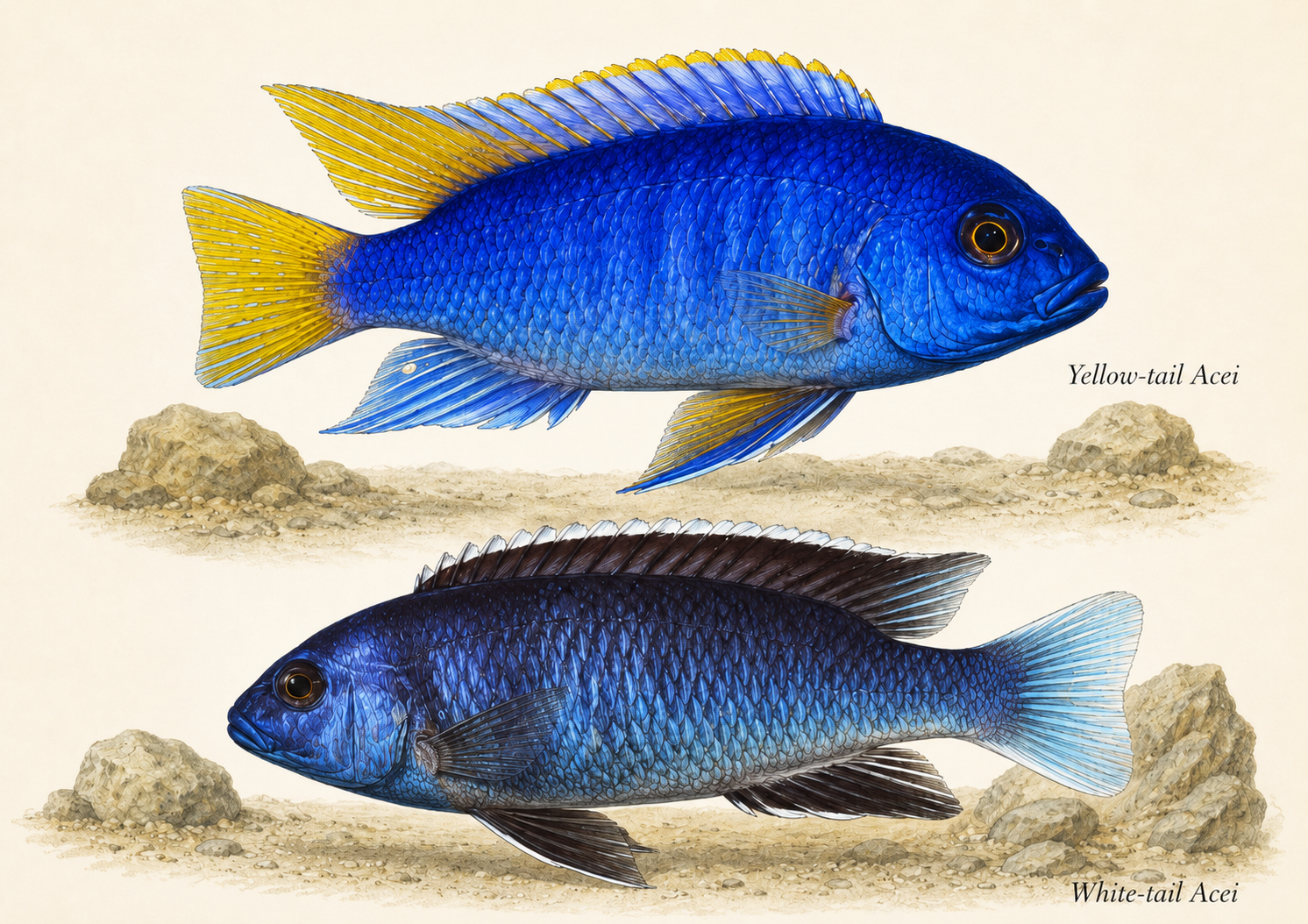
The most commonly encountered form displays a deep blue to violet-blue body colouration that intensifies with age and good health. This striking base colour extends across the flanks, head, and dorsal region. The defining feature that gives rise to one of its common names is the bright yellow colouration of the caudal fin (tail fin) and dorsal fin. In healthy, well-conditioned specimens, this yellow can be remarkably vibrant and creates a stunning contrast against the blue body. The pectoral and anal fins may also show yellow tinting, though this is typically less pronounced.
Sexual dimorphism in the Acei is subtle compared to many other Mbuna species. Males tend to be marginally larger and may display slightly more intense colouration, but both sexes are similarly coloured, which is somewhat unusual in the Mbuna world. Males may develop faint egg spots on the anal fin, though these are not always reliable indicators. The most consistent way to sex adults is by venting, where the genital papilla of the female is broader and more rounded compared to the pointed papilla of the male.
Juveniles are somewhat drab by comparison, displaying a washed-out greyish-blue with hints of the adult colouration. The yellow in the fins typically begins to develop as the fish approaches 4 to 5 centimetres in length, becoming progressively more vivid as the fish matures.
Varieties and Morphs
The Acei Cichlid is collected from several different locations around Lake Malawi, and these geographical variants have established themselves as distinct morphs in the aquarium trade. While they are all the same species, the differences in fin colouration and body tone are noticeable and have led to separate trade names.
The Yellow-tail Acei, sometimes sold as the Msuli Point Acei or Ngara Acei, is by far the most common variant in the hobby. It features the classic deep blue-purple body with bright yellow dorsal and caudal fins. This is the form most aquarists picture when they think of the Acei Cichlid, and it is widely bred in captivity.
The White-tail Acei, also known as the Luwala Reef Acei or Itungi Acei, is a less common but equally attractive variant. As its name suggests, the yellow fin colouration is replaced by white or off-white. The body colour tends to be a slightly lighter or more steel-blue shade compared to the yellow-tail form. This variant commands a higher price due to its relative scarcity in the trade.
Occasionally, hobbyists may encounter locality variants from specific collection points such as Eccles Reef or Chilucha. These may show subtle differences in the depth of blue on the body or the intensity and extent of fin colouration. However, these are generally only distinguished by specialist breeders and collectors rather than the average hobbyist. Crossbreeding between different locality variants should be avoided to preserve the genetic integrity of these populations.
Natural Habitat
The Acei Cichlid is endemic to Lake Malawi, the ninth-largest lake in the world and one of the African Great Rift Lakes. Lake Malawi is renowned for its extraordinary cichlid diversity, harbouring an estimated 800 to 1,000 species, many of which are found nowhere else on Earth. The lake’s water is characteristically hard and alkaline, with a remarkably stable chemistry that has remained largely unchanged for millennia.
What sets the Acei apart from most other Mbuna is its habitat preference. While the vast majority of Mbuna species are tightly associated with the rocky littoral zone, where they graze on aufwuchs (the biofilm of algae, microorganisms, and invertebrates that grows on rock surfaces), the Acei occupies a rather different niche. This species is most commonly found around submerged logs, fallen trees, and woody debris near the shoreline. It grazes on the algae that colonises these wooden structures, often at depths of 3 to 15 metres.
The areas where Acei are found typically feature a transition zone between rocky substrates and sandy or muddy bottoms. Overhanging trees and submerged branches provide both food and shelter. The fish are frequently observed swimming in loose shoals above and around these wooden structures, moving into open water far more readily than most Mbuna. This open-water confidence is one reason why the Acei tends to be less territorial and aggressive in captivity.
The lake’s water temperature in the zones inhabited by Acei typically ranges from 24 to 28 °C, with a pH between 7.7 and 8.6. The water is remarkably clear in most locations, with visibility often exceeding 15 metres, and dissolved mineral content is high, contributing to the hard, alkaline conditions these fish require.
Tank Size and Setup
A minimum tank volume of 250 litres is recommended for a group of Acei Cichlids. While individual specimens could technically survive in smaller quarters, the Acei is an active swimmer that benefits from ample horizontal space. A tank measuring at least 120 centimetres in length provides adequate room for a group of six to eight individuals to swim, establish a loose hierarchy, and display natural behaviours. For a mixed Mbuna community, a tank of 350 litres or more is strongly advisable to allow sufficient territory for all inhabitants.
The aquascape should reflect the species’ natural habitat as closely as practical. A sandy substrate is ideal, as Acei will occasionally sift through sand in search of food particles. Fine-grain pool filter sand or aragonite sand are both excellent choices, with the latter having the added benefit of helping to buffer water hardness and pH. Avoid sharp gravel substrates that could irritate the fish’s mouth and gills during feeding.
Rockwork remains an important element of the setup, providing visual barriers and shelter, but it need not dominate the aquascape as it might for other Mbuna species. Create several rock piles with caves and crevices, ideally placed towards the back and sides of the tank, leaving open swimming space in the centre and foreground. Smooth river rocks, ocean rock, and lace rock are all suitable choices. Ensure all rock structures are stable and cannot collapse, as cichlids are notorious for rearranging their environment.
Given the Acei’s natural affinity for wood, incorporating pieces of driftwood or bogwood can be highly beneficial and will encourage more natural behaviour. Be aware, however, that some types of driftwood can leach tannins and lower pH, which is undesirable in a Malawi setup. Using well-cured or pre-soaked wood, or opting for inert artificial wood decorations, can mitigate this issue. If tannins do become a problem, activated carbon in the filter will help remove them.
Live plants are generally not recommended in Mbuna tanks, as most species will uproot or consume them. The Acei is no exception and will happily graze on soft-leaved plants. Hardy species such as Anubias and Java Fern, which can be attached to rocks and wood rather than planted in the substrate, may survive if the fish are well-fed, though there are no guarantees. Many keepers opt for artificial plants or simply rely on rockwork and wood for decoration.
Lighting should be moderate. While strong lighting can encourage algae growth that the fish will enjoy grazing on, excessively bright conditions can stress some individuals. A standard LED light suitable for freshwater aquaria, running for 8 to 10 hours per day, is generally appropriate.
Water Parameters
Maintaining stable, appropriate water chemistry is fundamental to the long-term health of Acei Cichlids. Like all Lake Malawi species, they require hard, alkaline water and do not adapt well to soft, acidic conditions. Fortunately, many areas of the United Kingdom have naturally hard tap water that is already well-suited to keeping these fish, though minor adjustments may still be necessary.
| Temperature | 24–28 °C |
| pH | 7.5–8.6 |
| General hardness (GH) | 10–20 dGH |
| Carbonate hardness (KH) | 6–12 dKH |
| Ammonia | 0 ppm |
| Nitrite | 0 ppm |
| Nitrate | Below 20 ppm |
Consistency is arguably more important than hitting a precise number within these ranges. Sudden fluctuations in temperature or pH can stress cichlids and make them vulnerable to disease. A reliable heater with a thermostat and regular water testing will help you maintain stable conditions. If your tap water is soft, you can use cichlid buffer salts or mineral additives specifically designed for Malawi setups. Aragonite sand or crushed coral in the substrate or filter can also help maintain elevated pH and hardness naturally.
Weekly water changes of 25 to 30 per cent are recommended to keep nitrate levels low and replenish trace minerals. In heavily stocked tanks, more frequent or larger changes may be necessary. Always match the temperature and chemistry of new water as closely as possible to the tank water to avoid shocking the fish.
Filtration and Equipment
Robust filtration is non-negotiable for any cichlid aquarium. Acei Cichlids produce a moderate bioload, and when kept in groups alongside other Mbuna, the cumulative waste output can be substantial. A filter rated for at least 8 to 10 times the tank volume per hour in turnover is a sound baseline. For a 250-litre tank, this translates to a filter or combination of filters delivering approximately 2,000 to 2,500 litres per hour.
External canister filters are the most popular choice for Malawi cichlid setups and offer excellent biological, mechanical, and chemical filtration capacity. Models from reputable manufacturers such as Fluval, Eheim, and Oase are widely used in the hobby. A canister filter also keeps bulky equipment out of the tank, maximising swimming space. For larger tanks, running two canister filters provides redundancy and ensures that if one unit fails or requires maintenance, biological filtration is not entirely disrupted.
Supplemental filtration in the form of a sponge filter or internal powerhead with a sponge attachment can provide additional biological filtration and water movement. Acei appreciate moderate to strong water flow, which mimics the wave action found along the shoreline of Lake Malawi. Positioning filter outlets or powerheads to create gentle currents across the length of the tank will encourage natural swimming behaviour.
A reliable heater is essential. Submersible heaters with adjustable thermostats are the standard choice. In larger tanks, using two smaller heaters rather than one large unit provides a safety margin: if one heater fails, the other will prevent catastrophic temperature drops, and if one malfunctions in the “on” position, it is less likely to overheat the entire tank. An external or internal thermometer should be checked regularly to verify accuracy.
An air pump with an airstone is not strictly necessary if your filtration provides adequate surface agitation, but it can be a useful addition for oxygenation, particularly in warmer months when dissolved oxygen levels naturally decrease. Good aeration also supports the beneficial bacteria in your biological filter media.
Diet and Feeding
In the wild, Pseudotropheus acei is primarily herbivorous, feeding on the algal biofilm that grows on submerged wood, rocks, and other hard surfaces. Its diet also includes small invertebrates, insect larvae, and organic detritus that it encounters while grazing. This natural diet is high in fibre and relatively low in protein, and replicating this balance in captivity is important for maintaining digestive health.
A high-quality spirulina-based flake or pellet food should form the staple of the Acei’s diet. Products specifically formulated for herbivorous African cichlids are widely available and provide the appropriate balance of vegetable matter, vitamins, and minerals. Pellets are generally preferable to flakes for adult fish, as they produce less waste and can be more easily portion-controlled. Choose a pellet size appropriate for the fish’s mouth; small to medium pellets work well for most adult Acei.
Supplementary foods add variety and ensure a complete nutritional profile. Blanched vegetables such as courgette (zucchini), spinach, peas (shelled and lightly crushed), and cucumber are readily accepted and provide additional fibre. Nori seaweed sheets, the same type used for sushi, can be clipped to the inside of the tank glass and make an excellent grazing food. Occasional treats of frozen foods such as brine shrimp, mysis shrimp, or cyclops are fine in moderation but should not form a significant portion of the diet.
It is vital to avoid feeding high-protein or fatty foods in excess. Bloodworm and tubifex, while often eagerly consumed, can cause a condition known as Malawi bloat if fed regularly. This potentially fatal condition is associated with the disruption of gut flora in herbivorous Mbuna and is one of the most common causes of death in captive Malawi cichlids. If you choose to offer these foods at all, do so very sparingly, no more than once a fortnight at most, and many experienced keepers avoid them entirely.
Feed two to three small meals per day rather than one large feeding. Offer only as much food as the fish can consume within two to three minutes to prevent uneaten food from decomposing and degrading water quality. Observing your fish during feeding is also an excellent opportunity to check for signs of illness, injury, or bullying.
Behaviour and Temperament
The Acei Cichlid is widely regarded as one of the most peaceful Mbuna species, though it is important to put this reputation in context. “Peaceful for a Mbuna” still means the Acei is more assertive and territorial than the average tropical community fish. However, compared to notoriously aggressive species such as Melanochromis auratus or Metriaclima lombardoi, the Acei is remarkably tolerant and is far less likely to inflict serious harm on tankmates.
In the wild, Acei form loose shoals and are not strongly territorial. This social structure carries over into captivity, where groups of Acei will swim together in the mid-water column and generally coexist without the intense intra-species aggression seen in many other Mbuna. Keeping them in groups of at least six individuals is recommended to spread any minor aggression and allow natural social dynamics to develop. A single dominant male may occasionally chase subordinates, but serious injury is uncommon provided the tank is of adequate size and offers sufficient visual barriers.
Their tendency to swim in open water, rather than obsessively guarding a specific rock or cave, makes the Acei an excellent addition to community Mbuna setups. They occupy a slightly different niche within the tank, reducing direct competition with more rock-bound species. This spatial separation is one of the key reasons why mixed Mbuna communities work best when species with different habitat preferences are combined.
Males may display heightened colour intensity and engage in lateral displays to assert dominance or court females. These displays are generally ritualised rather than violent and are fascinating to observe. During breeding periods, males may become slightly more assertive, but this rarely escalates to the level of aggression seen in other Mbuna species.
One behaviour worth noting is their propensity for rearranging substrate and occasionally digging shallow pits. This is normal and should not be cause for concern, though it does mean that decorations and equipment near the substrate should be securely positioned.
Tank Mates
Selecting appropriate tank mates for the Acei Cichlid requires careful consideration of temperament, size, and dietary compatibility. The Acei’s relatively peaceful nature makes it compatible with a wide range of other Mbuna and some non-Mbuna Malawi species, but pairing it with overly aggressive species can result in stress, injury, or death.
Good tank mates
- Yellow Lab Cichlid (Labidochromis caeruleus), another mild-mannered Mbuna with a contrasting yellow colour, making an ideal and visually complementary companion.
- Rusty Cichlid (Iodotropheus sprengerae), a small, peaceful Mbuna that occupies rocky areas without competing directly with the Acei for territory.
- Red Zebra Cichlid (Metriaclima estherae), a moderately tempered Mbuna whose orange-red colouration provides excellent contrast in a mixed community.
- Bristlenose Pleco (Ancistrus sp.), a hardy algae-eating catfish that generally avoids conflict with cichlids and thrives in similar water conditions.
- Synodontis multipunctatus, a Lake Tanganyika catfish that adapts well to Malawi conditions and provides bottom-dwelling activity without provoking cichlids.
- Cobalt Blue Zebra Cichlid, a similarly sized and moderately aggressive Mbuna that coexists well in spacious tanks with ample rockwork.
- Peacock Cichlid (Aulonocara sp.), while mixing Mbuna and peacocks requires caution, the Acei’s mild temperament makes this combination more feasible than with most other Mbuna.
- Afra Cichlid (Cynotilapia afra), a smaller, colourful Mbuna that generally coexists well with the Acei due to differing microhabitat preferences.
Fish to avoid
- Auratus Cichlid (Melanochromis auratus), an extremely aggressive Mbuna that will relentlessly bully the more peaceful Acei, particularly dominant males.
- Kenyi Cichlid (Metriaclima lombardoi), Males become exceptionally aggressive and territorial, posing a significant threat to milder species.
- Neon Tetra (Paracheirodon inneon), far too small and requires soft, acidic water that is fundamentally incompatible with the Acei’s needs.
- Oscar Cichlid (Astronotus ocellatus), a large South American cichlid with completely different water requirements and the potential to eat smaller tank mates.
- Betta Fish (Betta splendens), Requires warm, soft, acidic water and would be severely stressed and likely killed by Mbuna aggression.
- Chipokae Cichlid (Melanochromis chipokae), one of the most aggressive Mbuna species, notorious for killing tank mates in confined spaces.
- Discus (Symphysodon sp.), Requires soft, acidic water and a calm environment, making them entirely unsuitable companions for Mbuna.
- Guppy (Poecilia reticulata), too small and delicate to survive in a Mbuna tank, and their water parameter requirements differ significantly.
Breeding
The Acei Cichlid is one of the easier Mbuna species to breed in captivity, and many aquarists find that breeding occurs naturally without any special intervention once a healthy group is established in appropriate conditions. Like all Mbuna, the Acei is a maternal mouthbrooder, meaning the female incubates the fertilised eggs in her buccal cavity (mouth) until the fry are fully developed and ready to be released.
To encourage breeding, maintain a group with a ratio of one male to two or three females. This reduces the pressure on any individual female from the male’s courtship attentions. Ensure water conditions are optimal and stable, and feed a varied, high-quality diet. Males in breeding condition will intensify their colouration and begin performing courtship displays, typically involving lateral flaring, quivering, and leading the female towards a chosen spawning site, which is often a flat rock or cleared area of substrate.
During spawning, the female deposits a small number of eggs on the chosen surface. The male fertilises them, and the female quickly scoops the eggs into her mouth. This process is repeated in cycles until all eggs are laid and collected. A typical brood ranges from 15 to 40 eggs, depending on the size and maturity of the female. The egg spots on the male’s anal fin play a role in this process, as the female may attempt to pick at them, positioning herself to receive sperm for fertilisation.
The incubation period lasts approximately 21 to 28 days, during which the female will not eat. Her throat will appear visibly distended, and she may become reclusive, retreating to sheltered areas of the tank. It is crucial not to disturb brooding females unnecessarily, as excessive stress can cause them to spit out or swallow the eggs prematurely.
Some breeders choose to strip the eggs or fry from the female’s mouth at around day 18 to 21, raising them artificially in a separate tumbler or grow-out tank. This can improve survival rates and reduces the physical toll on the female. However, allowing the female to carry to full term and release the fry naturally is perfectly viable, especially if the tank has ample hiding spots among rocks and wood where the tiny fry can shelter from larger fish.
Newly released fry are approximately 8 to 10 millimetres in length and are immediately free-swimming. They can be fed crushed spirulina flake, powdered fry food, or newly hatched baby brine shrimp. Growth is steady, and with proper nutrition and clean water, juveniles can reach 3 to 4 centimetres within three to four months. If raising fry in the main tank, expect some predation from adult fish; this is natural and unavoidable without separating the fry.
Common Diseases
Acei Cichlids are generally robust and disease-resistant when kept in appropriate conditions, but they are susceptible to the same ailments that affect other Malawi cichlids. Prevention through good husbandry, stable water parameters, proper diet, and regular maintenance, is always the best approach.
Malawi bloat is arguably the most significant health concern for herbivorous Mbuna, including the Acei. This condition, which is characterised by abdominal swelling, loss of appetite, lethargy, and stringy white faeces, is thought to be caused by a combination of improper diet and a protozoan infection, potentially exacerbated by stress. Feeding a predominantly plant-based diet and avoiding high-protein foods such as bloodworm are the primary preventive measures. If caught early, treatment with metronidazole can be effective, but advanced cases are often fatal. Affected fish should be isolated in a hospital tank for treatment.
Ich (white spot disease), caused by the protozoan Ichthyophthirius multifiliis, is a common affliction across all freshwater fish. It presents as small white spots on the fins, body, and gills, accompanied by flashing (rubbing against surfaces) and increased gill rate. Raising the temperature to 28 to 30 °C and treating with a proprietary white spot remedy typically resolves the infection within a week to ten days. Remove any activated carbon from the filter during treatment, as it will adsorb the medication.
Swim bladder disorders occasionally occur and may be linked to dietary issues, bacterial infections, or physical trauma. Affected fish may swim erratically, float at the surface, or struggle to maintain an upright position. Fasting the fish for 24 to 48 hours followed by a diet of blanched peas can sometimes resolve dietary-related swim bladder problems. Persistent issues may require antibiotic treatment under the guidance of a veterinary professional.
Bacterial and fungal infections can affect cichlids stressed by poor water quality, aggression, or overcrowding. Symptoms include frayed fins, ulcers, cotton-like growths, and cloudy eyes. Maintaining excellent water quality and promptly treating any injuries are the best defences. Broad-spectrum anti-bacterial and anti-fungal treatments are available from aquatic retailers and should be administered in a quarantine tank when possible.
Hole-in-the-head disease (HITH), also known as head and lateral line erosion (HLLE), occasionally affects cichlids and may be linked to poor nutrition, activated carbon use, or Hexamita infections. It manifests as small pits or erosions on the head and along the lateral line. Improving diet, increasing water change frequency, and treating with metronidazole are the standard corrective measures.
FAQs
How many Acei Cichlids should I keep together?
A group of six to eight individuals is ideal, with a ratio of one male to every two or three females. This group size allows natural social dynamics to develop and disperses any minor aggression across multiple fish rather than concentrating it on a single target. Keeping a lone Acei or a pair is not recommended, as isolated individuals may become stressed or overly aggressive without the moderating influence of a group hierarchy.
Can Acei Cichlids be kept with Peacock Cichlids?
Yes, the Acei is one of the few Mbuna species that can coexist reasonably well with Peacock Cichlids (Aulonocara species) in sufficiently large tanks. The Acei’s relatively peaceful temperament and preference for mid-water swimming means it is less likely to harass the typically more docile Peacocks. However, the tank should be at least 350 litres and well-structured with both open areas and rocky retreats. Monitor the fish closely during the initial introduction period for signs of excessive aggression.
Do Acei Cichlids eat plants?
As herbivores, Acei Cichlids will graze on most aquarium plants, particularly soft-leaved species. Very hardy plants such as Anubias and Java Fern may survive if attached to rocks or wood, but even these are not guaranteed to remain untouched. If a planted tank is a priority for you, the Acei is likely not the best choice. Most keepers of Mbuna opt for artificial plants or rely entirely on rock and wood for aquascaping.
Why has my female Acei stopped eating?
If a female Acei has stopped eating and you notice her jaw or throat area appears swollen or distended, she is very likely holding eggs or fry in her mouth. This is entirely normal maternal mouthbrooding behaviour. She will not eat for the duration of the incubation period, which lasts approximately three to four weeks. Avoid disturbing her during this time, and ensure she has access to quiet, sheltered areas of the tank. She will resume eating once the fry are released.
Is the Acei Cichlid suitable for beginners?
The Acei Cichlid is one of the most suitable Mbuna species for beginners, provided the aquarist can meet its basic requirements for hard, alkaline water, a sufficiently large tank, and appropriate diet. Its comparatively mild temperament, hardiness, and willingness to breed in captivity make it an excellent introduction to African cichlid keeping. New keepers should ensure they understand the importance of maintaining stable water parameters and avoiding overfeeding with high-protein foods to prevent Malawi bloat.
Related Guides
- Yellow Lab Cichlid (Labidochromis caeruleus) Care Guide, another beginner-friendly Mbuna that pairs exceptionally well with the Acei in community setups.
- Peacock Cichlid (Aulonocara) Care Guide, a popular Malawi cichlid group that can be kept alongside mild-tempered Mbuna like the Acei.
- Rusty Cichlid (Iodotropheus sprengerae) Care Guide, a peaceful, small Mbuna