Featherfin Squeaker Catfish Care Guide — Tank Setup, Feeding and Breeding
Quick summary
The Featherfin Squeaker is a hardy, easy-to-keep catfish that suits beginners who can provide a 200+ litre tank, plenty of hiding spots, and peaceful, appropriately sized tank mates. It’s a great choice if you want a striking, long-lived bottom-dweller, but not ideal if you keep small fish or shrimp, since it will eat anything small enough to swallow.
🐠 Build a tank around this fish
In this guide:
- Introduction
- Quick Stats
- Appearance
- Natural Habitat
- Tank Size and Setup
- Water Parameters
- Filtration and Equipment
- Diet and Feeding
- Behaviour and Temperament
- Tank Mates
- Breeding
- Common Diseases
- FAQs
Introduction
The Featherfin Squeaker Catfish, known scientifically as Synodontis eupterus, is one of the most visually striking and endearing catfish available in the freshwater aquarium hobby. Named for its magnificent, sail-like dorsal fin and its ability to produce audible squeaking sounds by locking its pectoral fin spines, this species has been a firm favourite among aquarists for decades. Originating from the river systems of West and Central Africa, it brings a combination of hardiness, personality, and striking aesthetics that few other catfish can match.
Often recommended as an excellent introductory Synodontis species, the Featherfin Squeaker is relatively undemanding once established in a well-maintained aquarium. It is a peaceful, predominantly nocturnal fish that becomes increasingly bold over time, often emerging during daylight hours once it feels secure in its surroundings. Its manageable adult size, tolerance of a broad range of water conditions, and omnivorous appetite make it a practical and rewarding addition to medium and large community aquariums. This guide covers everything you need to know to provide exceptional care for this remarkable catfish.
Quick Stats
| Scientific name | Synodontis eupterus |
| Common names | Featherfin Squeaker, Featherfin Synodontis, Featherfin Catfish, Synodontis Eupterus Catfish |
| Family | Mochokidae |
| Origin | West and Central Africa, Niger River basin, White Nile, Chad basin, and associated tributaries |
| Adult size | 15–20 cm (6–8 inches), occasionally up to 22 cm |
| Lifespan | 15–25 years |
| Difficulty | Easy |
| Breeding difficulty | Difficult |
| Temperature | 22–28 °C |
| pH range | 6.0–7.5 |
| General hardness (GH) | 4–15 dGH |
| Carbonate hardness (KH) | 4–12 dKH |
| Minimum tank size | 200 litres |
| Conservation status | Least Concern (IUCN) |
Appearance
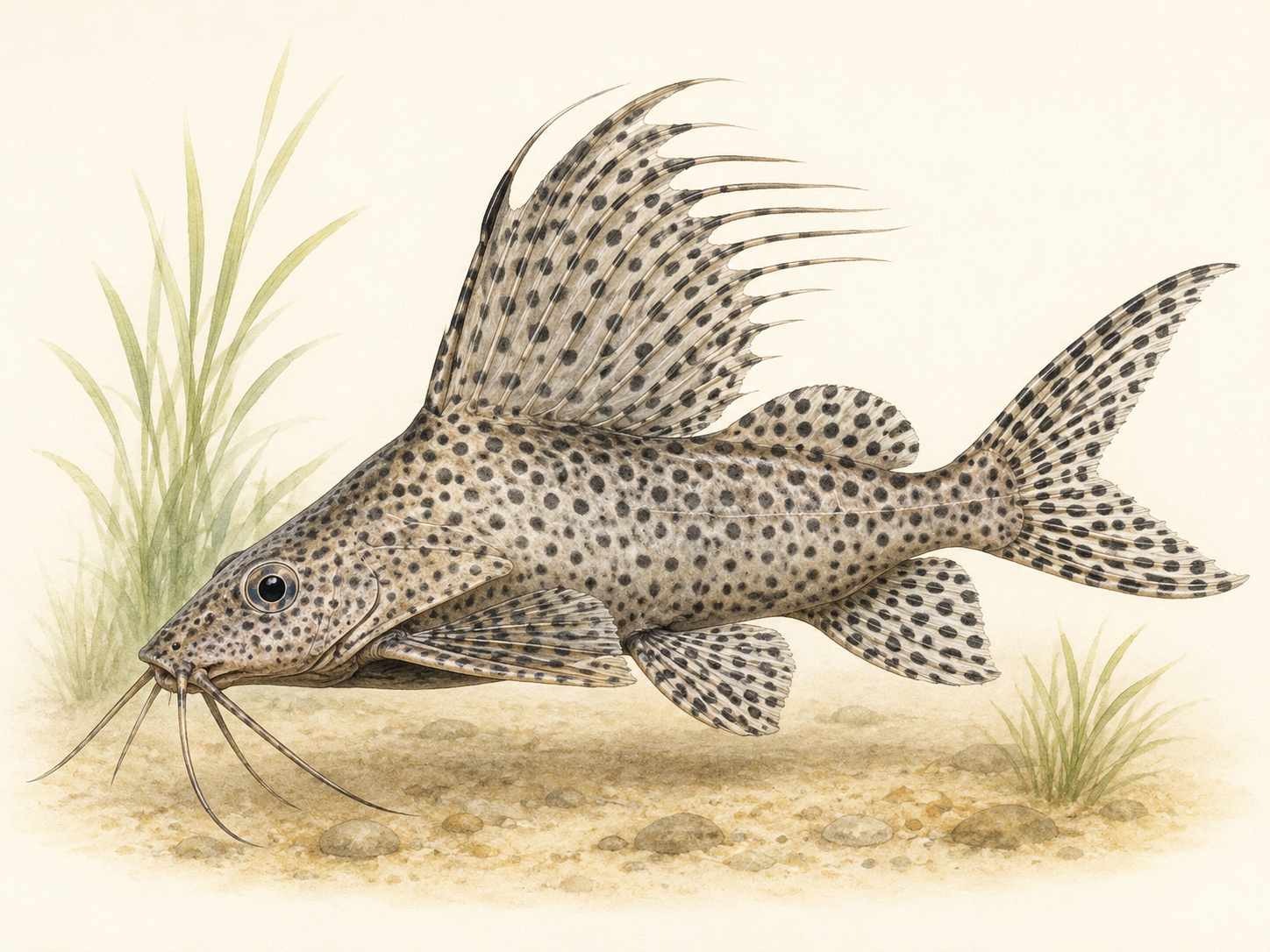
The Featherfin Squeaker is an undeniably handsome catfish. Its body is robust and laterally compressed, tapering towards a deeply forked caudal fin. The base colouration is typically a warm grey-brown to dark chocolate, overlaid with an intricate pattern of dark spots that varies considerably between individuals. In younger specimens, these spots tend to be more pronounced and clearly defined, sometimes merging into irregular blotches or even a subtle banding pattern. As the fish matures, the pattern can become somewhat muted, though it never entirely fades.
The defining feature, and the source of the common name, is the spectacular dorsal fin. In healthy, well-kept specimens, the dorsal fin rays extend into long, feathery filaments that trail elegantly behind the fish as it moves through the water. This effect is most dramatic in juveniles and sub-adults, though adults retain an impressively tall and ornate dorsal fin throughout their lives. The pectoral and pelvic fins are also well-developed, and the pectoral fin spines are notably stout. It is these spines, when locked and rubbed against the pectoral girdle, that produce the characteristic squeaking or grunting sounds the fish is known for, a defence mechanism typically heard when the fish is netted or handled.
The head is broad and somewhat flattened, equipped with three pairs of branched barbels around the mouth that the fish uses to forage along the substrate. The eyes are relatively large for a catfish, giving the Featherfin Squeaker an alert, expressive appearance. Sexing is difficult outside of the breeding season, though mature females tend to be slightly fuller-bodied when viewed from above compared to the more streamlined males.
Natural Habitat
Synodontis eupterus is found across a broad range in West and Central Africa, with its distribution encompassing the Niger River basin, the White Nile system, the Chad basin, and various associated tributaries and floodplain lakes. This wide distribution speaks to the species’ adaptability, as it inhabits a variety of freshwater environments across this vast geographic range.
In the wild, the Featherfin Squeaker tends to favour areas with moderate to strong current, often found in the main channels of rivers and larger streams where the substrate comprises sand, gravel, and scattered rocks. It also inhabits calmer backwaters and seasonal floodplain pools, particularly during the wet season when rivers overflow their banks. The water in these habitats is typically warm, slightly acidic to neutral, and often turbid with suspended sediments. Submerged wood, rocky overhangs, and tangles of roots provide essential daytime shelter, as the species is primarily nocturnal in its native environment, emerging under cover of darkness to forage across the riverbed.
Understanding these natural conditions is key to replicating a comfortable captive environment. The fish’s preference for cover, its tolerance of variable water conditions, and its nocturnal foraging habits should all inform how you set up and manage your aquarium.
Tank Size and Setup
A single Featherfin Squeaker requires an aquarium of at least 200 litres, and larger is always preferable. While juveniles can be temporarily housed in smaller setups, they grow steadily and will need adequate space within the first year or two of ownership. If you plan to keep more than one Synodontis eupterus, or if you intend to house the fish in a community setting with other medium to large species, an aquarium of 300 litres or more is strongly recommended. The tank should prioritise floor space over height, as this is a bottom-dwelling species that spends the majority of its time on or near the substrate.
The substrate should ideally be fine sand or smooth, rounded gravel. Synodontis eupterus actively forages by sifting through substrate with its barbels, and sharp or coarse materials can cause damage to these sensitive organs over time. A sand substrate also allows the fish to exhibit its natural feeding behaviour more fully, which is enriching and enjoyable to observe.
Providing ample hiding places is absolutely essential. In the wild, this species retreats to cover during the day, and it will become stressed and reclusive if adequate shelter is not available. Use a combination of driftwood, bogwood, rock caves, PVC pipes, or purpose-made ceramic caves to create multiple retreats throughout the aquarium. It is wise to provide more hiding spots than you have catfish, as this reduces competition and territorial tension. Arranging decor to create shaded areas will encourage the fish to venture out during the daytime, as they feel more secure when partial cover is nearby.
Live plants can be included, though robust species are advisable. While the Featherfin Squeaker is not a dedicated plant-eater, its enthusiastic foraging can uproot delicate or poorly anchored plants. Hardy species such as Anubias, Java Fern, and Bolbitis are good choices, particularly when attached to wood or rock rather than planted directly in the substrate. Floating plants can also be beneficial, as they dim the lighting and help create the subdued conditions this crepuscular species prefers.
Moderate to good water movement is appreciated, reflecting the riverine habitats the species occupies in the wild. A well-positioned filter outlet or a supplementary powerhead can provide the gentle current that encourages natural behaviour without creating excessively turbulent conditions.
Water Parameters
The Featherfin Squeaker is a tolerant species when it comes to water chemistry, which is one of the reasons it is so well-suited to captive life. Nevertheless, maintaining stable, clean conditions within the recommended ranges is important for long-term health and longevity. Sudden fluctuations in temperature or pH are far more harmful than water that sits slightly outside the ideal range but remains consistent.
| Temperature | 22–28 °C |
| pH | 6.0–7.5 |
| General hardness (GH) | 4–15 dGH |
| Carbonate hardness (KH) | 4–12 dKH |
| Ammonia | 0 ppm |
| Nitrite | 0 ppm |
| Nitrate | Below 30 ppm |
Regular water changes of 25–30% weekly are recommended to keep nitrate levels in check and maintain overall water quality. The Featherfin Squeaker is a relatively messy feeder, and in an aquarium with other medium to large fish, organic waste can accumulate quickly. Consistent maintenance is the single most important factor in keeping this species healthy over its potentially very long lifespan. Always treat replacement water with a suitable dechlorinator and match the temperature closely before adding it to the tank.
Filtration and Equipment
Given the size and feeding habits of the Featherfin Squeaker, robust filtration is a non-negotiable requirement. A canister filter rated for the full volume of the aquarium, or ideally slightly above, is the best choice for most setups. These filters provide excellent mechanical, biological, and chemical filtration, and their adjustable flow rates allow you to create the moderate current this species enjoys. If you are keeping a larger community tank, consider running two filters or supplementing a canister with an internal filter or sponge filter for additional biological capacity.
Mechanical filtration is particularly important, as the Featherfin Squeaker’s vigorous substrate-sifting behaviour can stir up fine particles and cloud the water. A filter with a good pre-filter sponge will capture this debris efficiently. Clean filter media regularly according to the manufacturer’s recommendations, but always rinse biological media in old tank water rather than tap water to preserve the beneficial bacteria colonies.
A reliable aquarium heater is essential to maintain a stable temperature within the recommended range. Submersible heaters with built-in thermostats are the most practical option. In larger tanks, using two smaller heaters rather than one large unit provides a safety net, if one fails, the other prevents a catastrophic temperature drop. An accurate digital thermometer placed at the opposite end of the tank from the heater helps you monitor conditions effectively.
Lighting should be moderate to subdued. As a crepuscular and nocturnal species, the Featherfin Squeaker is most active in low light conditions. Overly bright lighting will cause the fish to hide persistently and may contribute to chronic stress. If you are growing live plants that require stronger light, use floating plants or tall background species to create shaded zones where the catfish can rest comfortably. A timer set to provide a consistent photoperiod of around 8–10 hours per day is helpful for establishing a routine that benefits all inhabitants.
Diet and Feeding
Synodontis eupterus is a true omnivore with an enthusiastic and indiscriminate appetite, which makes feeding straightforward. In the wild, it feeds on a diverse diet of insect larvae, algae, plant matter, detritus, small crustaceans, and whatever else it encounters during its nocturnal foraging. In captivity, this broad palate should be catered to with a varied diet that includes both protein-rich and plant-based foods.
A high-quality sinking pellet or wafer should form the staple of the diet. Look for products specifically formulated for catfish or bottom-dwelling omnivores, as these tend to sink quickly and hold together well in water without fouling the tank. Supplement the staple diet with frozen or live foods such as bloodworm, brine shrimp, daphnia, and tubifex worms to provide essential proteins and encourage natural foraging behaviour. Blanched vegetables, courgette, cucumber, spinach, shelled peas, and sweet potato, are readily accepted and provide important plant fibre and micronutrients.
Algae wafers are another excellent supplementary food, particularly for younger fish that may graze on biofilm and algae growth within the tank. While the Featherfin Squeaker will consume some algae naturally, it should not be relied upon as an algae-control species, as its appetite for algae diminishes as it grows and it will always prefer meatier fare.
Feed once daily, ideally in the evening shortly before or after the aquarium lights are switched off. This timing aligns with the fish’s natural activity cycle and ensures it gets its fair share of food before more assertive daytime-feeding tank mates consume everything. If you notice your Featherfin Squeaker appears thin or is being outcompeted, target feeding using a feeding dish or placing food directly near its preferred hiding spot can be very effective. Avoid overfeeding, as uneaten food will decompose and compromise water quality. Remove any uneaten fresh vegetables after 12–24 hours.
Behaviour and Temperament
The Featherfin Squeaker is a peaceful and generally unproblematic catfish, well-suited to community aquariums with appropriately sized tank mates. It is primarily nocturnal, spending much of the daylight hours resting in caves, under driftwood, or wedged into crevices. As it becomes accustomed to the aquarium and its keeper, it often becomes increasingly bold, emerging during the day to investigate the tank and even approaching the front glass at feeding time. This transition from shy newcomer to confident resident is one of the great pleasures of keeping this species.
Towards other fish, Synodontis eupterus is remarkably tolerant. It rarely shows aggression towards species that do not intrude on its chosen hiding spots, and it coexists peacefully with a wide range of community fish. However, it can be somewhat territorial towards conspecifics and other Synodontis species, particularly in smaller tanks where hiding places are limited. This territoriality is typically expressed through chasing and occasional fin-flaring rather than serious physical harm, but providing multiple shelters and adequate space will minimise any friction. Keeping a single specimen is perfectly acceptable and arguably the simplest approach for most community setups, though small groups can work well in sufficiently large aquariums with abundant cover.
The squeaking behaviour that gives this fish its common name is most commonly heard when the fish is startled or netted. The sound is produced by the locking mechanism of the pectoral fin spines, a stridulation process that creates audible clicks and squeaks. Exercise caution when netting this species, as the locked pectoral spines can become entangled in fine mesh nets. Using a solid container or a coarse-meshed net is strongly recommended to avoid injuring the fish or tearing the net.
One behaviour worth noting is the Featherfin Squeaker’s occasional habit of swimming upside down, particularly when feeding on the underside of driftwood or rock overhangs. While not as dedicated to inverted swimming as its close relative Synodontis nigriventris, this behaviour is perfectly normal and nothing to be concerned about.
Tank Mates
The Featherfin Squeaker’s peaceful disposition and manageable size make it compatible with a broad range of freshwater community fish. The key considerations are ensuring that tank mates are too large to be swallowed, are not excessively aggressive or territorial, and share broadly similar water parameter requirements. Very small fish, particularly slender-bodied species, may be at risk as the catfish grows, since Synodontis eupterus is an opportunistic feeder that will consume anything it can fit into its mouth under cover of darkness.
Good tank mates
- Congo Tetra, a peaceful, mid-water schooling fish from the same geographic region that thrives in similar water conditions and is too large to be predated upon.
- Boesemani Rainbowfish, an active, colourful mid-water species that occupies a different zone of the aquarium and poses no threat to a bottom-dwelling catfish.
- Angelfish, a classic community centrepiece fish that coexists well with Synodontis, provided the tank is spacious enough for both species to establish their own territories.
- Bristlenose Pleco, another peaceful bottom-dweller that rarely competes directly with Synodontis for hiding spots and shares similar dietary requirements.
- Keyhole Cichlid, one of the most docile cichlids available, making it an ideal companion that will not harass or intimidate the catfish.
- Clown Loach, a sociable bottom-dweller that is large enough to avoid predation and peaceful enough to coexist without conflict.
- Pearl Gourami, a calm, elegant surface-to-mid-water fish that shares a preference for well-planted tanks with subdued lighting.
- Silver Dollar, a robust, peaceful schooling fish that occupies the middle to upper water column and is far too large to be bothered by the catfish.
- Kribensis, a small, generally peaceful West African cichlid that can coexist with Synodontis in a well-decorated tank, though breeding pairs may become temporarily territorial.
- Denison Barb, a fast-swimming, active schooling fish that appreciates similar water flow and is too large and quick to be at risk.
Fish to avoid
- Neon Tetra, far too small and slender-bodied; likely to be consumed by an adult Featherfin Squeaker during nocturnal feeding.
- Oscar, a large, aggressive predatory cichlid that may attack or consume a Synodontis, and whose messy feeding habits would strain filtration in a shared tank.
- Red-Tail Catfish, Grows to an enormous size and will readily eat any tank mate it can swallow, including a Featherfin Squeaker.
- Tiger Barb, a notorious fin-nipper that may harass the catfish and damage its delicate dorsal fin filaments, especially if kept in insufficient numbers.
- Jack Dempsey Cichlid, an aggressive, territorial cichlid that is likely to bully or injure a peaceful bottom-dwelling catfish.
- Cherry Shrimp, Will almost certainly be eaten by the catfish, which is a natural predator of small invertebrates.
- Flowerhorn Cichlid, Extremely aggressive and territorial, posing a serious threat to virtually any tank mate.
- Endler’s Livebearer, far too small to be safely housed with a growing Synodontis; adults and especially fry would be consumed.
Breeding
Breeding Synodontis eupterus in captivity is a challenging undertaking that has been achieved only rarely under home aquarium conditions. The species does not readily spawn in standard community setups, and most successful breedings have been accomplished using hormone injections in commercial breeding facilities. This places deliberate breeding beyond the reach of most hobbyists, though understanding the process remains worthwhile for those who wish to attempt it or simply to appreciate the species’ reproductive biology.
In the wild, spawning is believed to be triggered by seasonal changes, specifically the onset of the rainy season, which brings cooler, softer water, increased flow, and a surge in food availability. To simulate these conditions in captivity, some breeders have had limited success by performing large, cool water changes with softer water, increasing flow rates, and conditioning the fish with a rich, varied diet for several weeks beforehand. The aquarium should contain flat rocks or smooth surfaces that may serve as spawning sites.
The species is an egg scatterer. During spawning, the female releases adhesive eggs that are fertilised by the male and settle onto the substrate or decor. The parents show no parental care and will readily consume their own eggs if given the opportunity, so separating the adults after spawning is essential. Eggs typically hatch within 48–72 hours at temperatures around 26–28 °C, and the fry become free-swimming a few days later. Initial foods for fry include infusoria, liquid fry food, and newly hatched brine shrimp nauplii. Growth is slow in the early stages.
Given the difficulty of natural spawning in captivity, most Featherfin Squeaker Catfish available in the aquarium trade are either wild-caught or produced in commercial hatcheries using hormonal induction. Hobbyists should not be discouraged if breeding attempts are unsuccessful, even experienced breeders consider this a challenging species to reproduce.
Common Diseases
The Featherfin Squeaker is a robust and hardy species that is not particularly susceptible to disease when maintained in clean, stable conditions. However, like all aquarium fish, it can fall victim to a number of common ailments if water quality deteriorates, the fish is stressed, or new additions introduce pathogens to the tank.
White spot disease, also known as Ich (caused by the protozoan Ichthyophthirius multifiliis), is perhaps the most frequently encountered illness. It presents as small white spots resembling grains of salt on the body and fins. Treatment involves raising the water temperature gradually to around 28–30 °C and administering a proprietary white spot remedy. It is essential to note that Synodontis species, like many scaleless or reduced-scale catfish, can be sensitive to certain medications, particularly those containing copper or malachite green. Always use medications at half the recommended dose initially when treating catfish, and monitor the fish closely for signs of distress. Consult the product label carefully for any warnings regarding scaleless fish.
Bacterial infections can occur, often secondary to physical injuries or poor water quality. Symptoms may include reddened patches on the skin, frayed fins, lethargy, and loss of appetite. Improving water quality through increased water changes is the first and most important step, and broad-spectrum antibacterial treatments can be used if the condition does not resolve.
Fungal infections, recognisable by cotton-wool-like growths on the body or fins, can develop on damaged tissue. These are usually treated effectively with antifungal medications, again at reduced dosages for catfish. Maintaining pristine water quality is the best preventative measure against fungal issues.
Barbel erosion is a condition that particularly affects bottom-dwelling catfish kept on rough or sharp substrates, or in tanks with chronically poor water quality. The sensitive barbels become shortened, inflamed, or eroded, which impairs the fish’s ability to forage. Prevention is straightforward, use fine, smooth substrate and maintain excellent water quality through regular water changes and effective filtration.
Quarantining all new fish for a minimum of two to four weeks before introducing them to an established aquarium is strongly recommended to prevent the introduction of disease. A simple quarantine setup with a sponge filter, heater, and a hide is sufficient.
FAQs
How big does a Featherfin Squeaker Catfish get?
In captivity, most Featherfin Squeaker Catfish reach an adult size of 15–20 cm (6–8 inches), with occasional specimens growing slightly larger under ideal conditions. Growth is relatively steady during the first two to three years and then slows considerably. Their ultimate size makes a minimum tank of 200 litres necessary, with larger tanks preferred for community setups.
Is the Featherfin Squeaker Catfish nocturnal?
Yes, this species is primarily nocturnal and crepuscular, meaning it is most active during the twilight hours and at night. However, well-established individuals in a secure aquarium environment often become bolder over time and will emerge during the day, especially around feeding time. Providing plenty of hiding places and subdued lighting encourages this transition to more visible daytime activity.
Can I keep more than one Featherfin Squeaker in the same tank?
You can keep multiple individuals together provided the aquarium is large enough and there are more hiding places than catfish. In smaller tanks, conspecific aggression can occur, with dominant individuals chasing subordinates away from preferred shelters. A tank of 350 litres or more with abundant rockwork and driftwood can comfortably house a small group of three to four specimens. Alternatively, keeping a single individual works perfectly well, as this species does not require the company of its own kind to thrive.
Why does my Featherfin Squeaker make squeaking noises?
The squeaking sound is produced by the fish’s pectoral fin spine locking mechanism. When the spine is locked and then moved, it rubs against the pectoral girdle in a process called stridulation, creating an audible click or squeak. This is a defensive behaviour, most commonly triggered when the fish is stressed, startled, or handled. It is perfectly normal and not a sign of illness, though hearing it frequently may suggest the fish is being disturbed too often or is uncomfortable in its environment.
Will a Featherfin Squeaker eat my smaller fish?
While the Featherfin Squeaker is not an active predator, it is an opportunistic omnivore and will consume any fish small enough to fit in its mouth, particularly during its nocturnal foraging. Very small species such as Neon Tetras, Endler’s Livebearers, and small shrimp are at risk once the catfish reaches adult size. Choose tank mates that are at least 4–5 cm in length as adults to avoid any predation issues.
Related Guides
- Upside-Down Catfish, a closely related and popular Synodontis species known for its distinctive inverted swimming behaviour, offering an interesting comparison in care requirements.
- Bristlenose Pleco Care Guide, another excellent bottom-dwelling catfish for community tanks, often kept alongside Synodontis species in larger setups.
- African Cichlid Tank Setup Guide, Useful guidance for keepers interested in creating a biotope-inspired African community aquarium featuring Synodontis catfish.
- Clown Loach Care Guide, a popular bottom-dwelling community fish with similar care requirements and a comparable lifespan, making it a frequent companion species.
- Aquarium Filtration Guide, Comprehensive advice on selecting and maintaining filtration systems suitable for medium to large community tanks housing messy feeders like Synodontis catfish.