Buffalo Head Cichlid Care Guide — Tank Setup, Feeding and Breeding
Introduction
The Buffalo Head Cichlid, known scientifically as Steatocranus casuarius, is one of the most characterful and unusual cichlids available to freshwater aquarists. Hailing from the turbulent rapids of the lower Congo River in Central Africa, this species has evolved a suite of fascinating adaptations that set it apart from the vast majority of cichlids kept in home aquaria. Its reduced swim bladder, bottom-dwelling habits, and the prominent cranial hump that gives it its common name all speak to a life spent navigating some of the most powerful freshwater currents on Earth.
Despite its somewhat intimidating appearance, the Buffalo Head Cichlid is a surprisingly manageable species that rewards attentive keepers with engaging behaviour and a genuine personality. Pairs form strong monogamous bonds that can last for years, and their breeding behaviour is endlessly fascinating to observe. They are not demanding in terms of water chemistry, tolerating a reasonably broad range of parameters, and they adapt well to captive diets. For aquarists who want something a little different from the typical Malawi or Tanganyikan cichlid setup, Steatocranus casuarius offers an authentic slice of one of Africa’s most extraordinary aquatic ecosystems.
This guide covers everything you need to know to keep Buffalo Head Cichlids successfully, from tank setup and water parameters through to breeding, disease prevention, and choosing appropriate tank mates.
Quick Stats
| Scientific name | Steatocranus casuarius |
| Common names | Buffalo Head Cichlid, Blockhead Cichlid, Lionhead Cichlid, Humphead Cichlid, African Blockhead |
| Family | Cichlidae |
| Origin | Lower Congo River basin, Democratic Republic of the Congo and Republic of the Congo |
| Adult size | Males up to 11 cm; females up to 8 cm |
| Lifespan | 8–10 years |
| Difficulty | Moderate |
| Breeding difficulty | Easy |
| Temperature | 24–28 °C |
| pH range | 6.0–8.0 |
| General hardness (GH) | 5–15 dGH |
| Carbonate hardness (KH) | 3–10 dKH |
| Minimum tank size | 120 litres |
| Conservation status | Least Concern (IUCN) |
Appearance
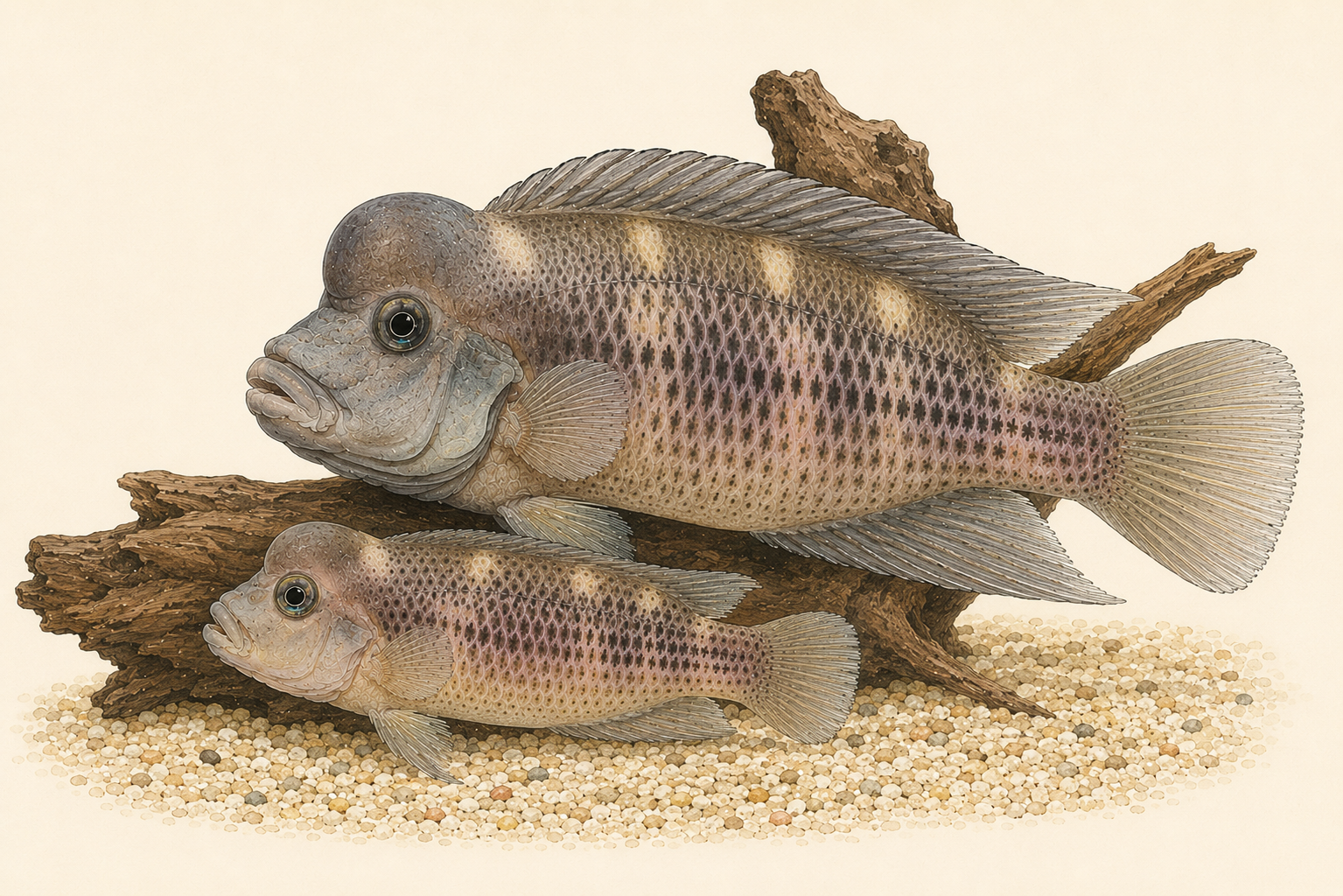
The Buffalo Head Cichlid is a stocky, somewhat elongated cichlid with a large head and a body that tapers noticeably towards the caudal peduncle. The most striking feature is the nuchal hump — a fatty, bulbous growth on the forehead that develops most prominently in mature males, giving the fish its various common names. This hump can become truly impressive in dominant males, sometimes extending forward to overhang the upper lip. Females do develop a modest hump, but it remains far smaller and less conspicuous than that of males.
The base colouration is a muted grey-brown to olive, overlaid with faint darker vertical bars that may intensify or fade depending on the fish’s mood, social status, and surroundings. The scales have a slightly rough or granular texture to the eye, and the fins are generally dark with subtle edging. The pectoral fins are notably large and muscular, reflecting the species’ adaptation to life in fast-flowing water — these fins are used almost like legs to prop the fish against the substrate and to hop along the bottom rather than swim in the conventional sense. Indeed, watching a Buffalo Head Cichlid move is one of the great pleasures of keeping the species; they scuttle, perch, and hop in a manner more reminiscent of a goby than a cichlid.
The eyes are relatively large and expressive, positioned high on the head, which aids in detecting threats and food in turbulent water. Males are generally larger than females and possess a more robust build in addition to their enlarged cranial hump. Juveniles lack the hump entirely and are slimmer in profile, making sexing young fish challenging until they reach around 4–5 cm in length. At full maturity, a healthy male in good condition is an undeniably impressive fish, with a powerful presence that belies its relatively modest size.
Natural Habitat
Steatocranus casuarius is found in the lower reaches of the Congo River system, particularly in the rapids and fast-flowing stretches between Pool Malebo (formerly Stanley Pool) and the river’s mouth at the Atlantic coast. The Congo River is the world’s second largest river by volume and contains some of the most powerful rapids found in any freshwater system. The stretch inhabited by Buffalo Head Cichlids is characterised by enormous volumes of well-oxygenated water surging over and between large boulders, bedrock outcrops, and rocky rubble.
In these conditions, there is little room for open-water swimming. Fish that inhabit this environment have had to adapt to a life spent sheltering among rocks, wedging themselves into crevices, and feeding on whatever algae, invertebrates, and organic material can be found clinging to stone surfaces. The Buffalo Head Cichlid’s reduced swim bladder is a direct response to this environment — a fully inflated swim bladder would make it difficult to maintain position near the bottom in such powerful currents. Instead, the species relies on its strong pectoral fins to anchor itself and move along the substrate.
The water in these rapids is typically warm, slightly acidic to neutral, and moderately soft, though it can vary depending on the season and specific location. It is always very well oxygenated due to the constant turbulence. The substrate is composed primarily of rock, gravel, and coarse sand, with little in the way of rooted aquatic plants — the current is simply too strong for most plant species to establish themselves. Understanding this habitat is key to providing appropriate conditions in captivity, particularly the importance of strong oxygenation, plenty of rocky cover, and a current-swept environment.
Tank Size and Setup
A single pair of Buffalo Head Cichlids can be housed in a tank of at least 120 litres, though a larger aquarium of 180 litres or more is preferable, especially if you plan to keep them alongside other species. These are territorial fish, particularly during breeding, and providing ample space helps to diffuse aggression and allows each fish to establish its own patch of territory. For a community that includes multiple pairs or additional bottom-dwelling species, a tank of 250 litres or larger is strongly recommended.
The aquascape should reflect the species’ natural habitat as closely as possible. A substrate of fine to medium gravel or coarse sand works well, and the tank should be heavily furnished with rocks, stones, and other hardscape materials arranged to create numerous caves, overhangs, and crevices. Clay pots, coconut shells, and purpose-made cichlid caves are all excellent additions. Each prospective pair will want at least one enclosed cave that they can claim as their own, so providing more caves than pairs is a sound strategy to reduce territorial disputes.
Driftwood can be added for visual interest and to create additional hiding spots, though it is not a primary feature of the species’ natural habitat. Plants are not essential, but hardy species such as Anubias and Java Fern, which can be attached to rocks and wood rather than rooted in the substrate, are a good choice if you want some greenery. These plants also benefit from the strong water flow that Buffalo Head Cichlids appreciate. Avoid delicate stem plants, as the fish may uproot them when rearranging the substrate around their caves.
Lighting can be moderate. The species is not particularly light-sensitive, but subdued lighting combined with plenty of shaded areas created by rockwork will encourage the fish to spend more time in the open and display more natural behaviour. A secure lid is not strictly critical for this species — they are very much bottom-dwellers with little inclination to jump — but it is always good practice to cover a tank to prevent accidents and reduce evaporation.
Water Parameters
Buffalo Head Cichlids are tolerant of a fairly broad range of water parameters, which is one of the reasons they are considered a moderate rather than difficult species to keep. The most important factor is water quality — they come from rapids where the water is constantly refreshed and highly oxygenated, so they are sensitive to the accumulation of waste products. Regular water changes and efficient filtration are non-negotiable aspects of their care.
| Temperature | 24–28 °C |
| pH | 6.0–8.0 |
| General hardness (GH) | 5–15 dGH |
| Carbonate hardness (KH) | 3–10 dKH |
| Ammonia | 0 ppm |
| Nitrite | 0 ppm |
| Nitrate | Below 20 ppm |
Aim for a temperature around 25–26 °C for day-to-day keeping, which sits comfortably in the middle of their preferred range. A neutral to slightly acidic pH of 6.5–7.5 is ideal, though the species is adaptable enough to thrive in mildly alkaline conditions as well. Weekly water changes of 25–30% are recommended to keep nitrate levels low and maintain the pristine water quality that these riverine cichlids require. If you keep them in a densely stocked community, more frequent or larger water changes may be necessary.
Filtration and Equipment
Given the Buffalo Head Cichlid’s origins in fast-flowing rapids, strong filtration and good water movement are essential components of a successful setup. An external canister filter rated for at least 1.5 times the tank volume is the ideal choice, as it provides excellent mechanical and biological filtration while generating meaningful water flow. Many experienced keepers of this species supplement the main filter with an additional powerhead or wavemaker positioned to create a directional current across the tank floor, mimicking the conditions the fish would experience in the wild.
The emphasis on oxygenation cannot be overstated. Surface agitation from the filter outlet, an airstone, or a spray bar will help to maintain high dissolved oxygen levels, which these fish need to thrive. Stagnant, poorly oxygenated water will lead to stress and increased susceptibility to disease. If your filter setup does not create sufficient surface movement, adding a simple air pump with an airstone is an inexpensive and effective solution.
A reliable heater set to maintain a stable temperature of 25–26 °C is essential. Submersible heaters with built-in thermostats are the most practical option, and it is worth investing in a quality unit to avoid dangerous temperature fluctuations. In tanks over 200 litres, using two smaller heaters rather than one large one provides a safety net — if one fails, the other will prevent a catastrophic temperature drop. A separate thermometer should always be used to verify the heater’s accuracy.
Standard aquarium lighting is perfectly adequate for Buffalo Head Cichlids. If you are growing Anubias or Java Fern, moderate lighting on a timer set for 8–10 hours per day will support healthy plant growth without encouraging excessive algae. The fish themselves have no particular lighting requirements beyond a natural day-night cycle.
Diet and Feeding
In the wild, Steatocranus casuarius is an omnivore that feeds primarily on small invertebrates, insect larvae, crustaceans, and algae scraped from rock surfaces. In captivity, they are generally unfussy eaters that will accept a wide range of foods, making feeding one of the more straightforward aspects of their care.
A high-quality cichlid pellet or granule should form the staple of their diet. Choose a sinking pellet, as the species feeds almost exclusively from the substrate and mid-water and will rarely venture to the surface to take floating food. Supplement the staple diet with regular offerings of frozen or live foods such as bloodworm, brine shrimp, daphnia, and mosquito larvae. These protein-rich foods help to maintain condition, encourage natural foraging behaviour, and are particularly valuable when conditioning pairs for breeding.
Vegetable matter should also feature in the diet. Blanched courgette, spinach, or shelled peas can be offered once or twice a week, and spirulina-based flakes or wafers provide a convenient alternative. A varied diet not only ensures nutritional completeness but also keeps the fish engaged and active at feeding time. Feed once or twice daily, offering only as much food as can be consumed within a few minutes to avoid fouling the water.
Avoid feeding large quantities of high-fat foods such as beef heart or excessive amounts of bloodworm, as these can contribute to digestive issues and the accumulation of unhealthy internal fat deposits over time. A balanced, varied diet is the foundation of long-term health for this species.
Behaviour and Temperament
The Buffalo Head Cichlid is a territorial but generally manageable species whose behaviour in the aquarium is endlessly entertaining. Their most immediately noticeable characteristic is their mode of locomotion — rather than swimming freely through the water column, they hop, scuttle, and perch on rocks and the substrate, using their powerful pectoral fins almost like limbs. This bottom-hugging behaviour is a direct consequence of their reduced swim bladder, and it gives them a charming, almost reptilian quality that sets them apart from most other aquarium fish.
Pairs form strong, long-lasting bonds and will typically claim a cave or sheltered area as their territory, defending it vigorously against intruders. Aggression is most pronounced during breeding but can be a factor at other times as well, particularly in smaller tanks where space is limited. Males are the more territorial of the two sexes and will display, flare, and chase rival males that venture too close to their cave. In a well-structured tank with plenty of visual barriers and hiding spots, this aggression is usually manageable and rarely results in serious injury.
Outside of their immediate territory, Buffalo Head Cichlids tend to be relatively peaceful, especially towards fish that occupy different areas of the water column. They are intelligent and quickly learn to recognise their keeper, often approaching the front glass at feeding time. Some individuals will even accept food from their owner’s fingers once a degree of trust has been established. They are not shy fish by nature, provided they have adequate cover to retreat to when they feel the need, and a well-settled pair will spend a great deal of time in the open, perching on favourite rocks and surveying their domain.
It is worth noting that while they can be kept as single specimens, Buffalo Head Cichlids are far more interesting and behaviourally rich when kept as a pair. Solitary fish can become withdrawn and less active, whereas a bonded pair will interact constantly, engage in courtship behaviours, and display a much fuller repertoire of natural behaviour.
Tank Mates
Choosing tank mates for Buffalo Head Cichlids requires some thought, but it is by no means difficult. The key considerations are to avoid fish that are small enough to be eaten, fish that will compete directly for bottom-dwelling territory, and overly aggressive species that might bully or stress the cichlids. Conversely, midwater and upper-water species that are robust enough to hold their own but not aggressive enough to cause problems make excellent companions.
Good tank mates
- Congo Tetra — A fellow Congo River native, this beautiful midwater schooling fish occupies a completely different zone of the tank and thrives in similar water conditions.
- African Butterfly Fish — This surface-dwelling species stays at the top of the water column, well away from the Buffalo Head’s territory, and appreciates the same warm, well-oxygenated water.
- Synodontis petricola — A peaceful, modestly sized catfish that is robust enough to hold its own while not being aggressive enough to cause territorial conflict.
- Bristlenose Pleco — An excellent algae-eating companion that generally avoids conflict and is armoured enough to shrug off minor aggression from territorial cichlids.
- Boesemani Rainbowfish — An active midwater species that adds colour and movement to the upper levels of the tank without interfering with bottom-dwelling territories.
- Cherry Barb — A peaceful, hardy schooling fish that stays out of the cichlid’s way and is large enough to avoid being mistaken for food.
- Kribensis — Another West African cichlid of similar size and temperament that can coexist in a sufficiently spacious and well-structured tank with ample territories.
- Synodontis multipunctatus — A sociable, mid-sized catfish that does well in groups and generally coexists peacefully with moderately territorial cichlids.
Fish to avoid
- Oscar — Far too large and aggressive, an Oscar would dominate the tank and could easily injure or kill a Buffalo Head Cichlid.
- Jack Dempsey — This highly territorial and aggressive Central American cichlid would create constant conflict and stress in a shared tank.
- Neon Tetra — Too small and delicate to be housed with a territorial cichlid; they risk being eaten or constantly harassed.
- Red Devil Cichlid — An extremely aggressive and large cichlid that would terrorise and likely kill a Buffalo Head.
- Guppy — Too small, too slow, and too fragile for a cichlid tank; they would quickly become expensive live food.
- Flowerhorn — A large, highly aggressive hybrid that requires species-only housing and would be wholly incompatible.
- Common Pleco — While not aggressive, this species grows far too large for the tank sizes typically used for Buffalo Heads and produces an enormous bioload.
- Jewel Cichlid — Extremely aggressive when breeding and territorial at all times, Jewel Cichlids would create serious conflict in most community setups.
Breeding
One of the great appeals of the Buffalo Head Cichlid is the relative ease with which it can be bred in captivity. This is a cave-spawning species that forms monogamous pairs, and once a compatible pair has bonded, breeding often occurs with little intervention from the aquarist. Indeed, many keepers find that their fish begin breeding almost as soon as they are provided with a suitable cave and stable conditions.
To encourage breeding, ensure the pair has access to at least one enclosed cave — a clay pot laid on its side, a coconut shell with an entrance hole, or a purpose-made ceramic cichlid cave are all effective options. The cave should be just large enough for both fish to enter, with an opening that is small enough to be easily defended. Slightly raising the temperature by one or two degrees and increasing the frequency of water changes can help to trigger spawning behaviour, though established pairs often spawn regularly without any special conditioning.
Courtship involves the male displaying to the female with exaggerated body movements, flared fins, and colour intensification. He will clean the interior of the chosen cave and attempt to lure the female inside. When the female is ready, she will enter the cave and deposit a clutch of eggs — typically between 30 and 100 — on the ceiling or walls. The male then enters to fertilise them. After spawning, the female takes on primary responsibility for guarding and fanning the eggs, while the male patrols the territory outside the cave entrance, aggressively driving away any perceived threats.
The eggs hatch in approximately three to four days at 26 °C, and the fry become free-swimming after a further four to five days. During this period, both parents are extremely attentive and will aggressively defend the brood. It is normal for aggression towards tank mates to increase significantly during this time, which is another reason why a spacious, well-structured tank is so important. The free-swimming fry can be fed on newly hatched brine shrimp, microworms, or finely crushed high-quality flake food. Growth is steady, and the fry benefit from the parents’ continued protection for several weeks. In many cases, the pair will tolerate older fry in their territory even as they prepare for the next spawning event, leading to the charming sight of multiple generations cohabiting in and around the parental cave.
If you wish to raise the maximum number of fry, they can be removed to a separate grow-out tank once they are free-swimming, though leaving them with the parents provides an unparalleled opportunity to observe natural parental care behaviour in cichlids.
Common Diseases
Buffalo Head Cichlids are generally hardy fish that are not especially prone to disease when kept in appropriate conditions. However, like all aquarium fish, they can be affected by a range of common illnesses, most of which are preventable through good husbandry.
Ich (white spot disease) is perhaps the most frequently encountered ailment and manifests as small white cysts on the fins and body. It is typically triggered by sudden temperature drops or poor water quality and responds well to treatment with raised temperature (to 30 °C for a few days) combined with a proprietary ich medication. Catching it early is important, as heavy infestations can be debilitating.
Bacterial infections, including fin rot and skin ulcers, can occur when water quality deteriorates or when fish sustain injuries from territorial disputes. Maintaining clean water through regular changes and efficient filtration is the best prevention. Should an infection develop, antibacterial treatments are available from aquatic retailers and are generally effective when used promptly.
Hole-in-the-head disease (HITH) is a condition sometimes seen in cichlids, characterised by pitting and erosion of the skin on the head and along the lateral line. While the exact cause is debated, poor water quality, nutritional deficiencies (particularly a lack of vitamins and minerals), and the presence of the flagellate parasite Hexamita are all considered contributing factors. A varied, high-quality diet combined with excellent water conditions is the most effective prevention strategy. Treatment with metronidazole is commonly recommended if the condition does develop.
Internal parasites can occasionally affect wild-caught specimens or fish that have been kept in substandard conditions. Symptoms may include weight loss despite a good appetite, white or stringy faeces, and lethargy. Anti-parasitic foods or medications can be used to treat suspected internal parasite infections, and quarantining new arrivals for two to four weeks before introducing them to an established tank is a wise precaution that helps to prevent the spread of parasites and other diseases.
Stress is an underlying factor in many health issues, and it is best managed by providing a stable environment with appropriate water parameters, adequate cover, compatible tank mates, and a consistent routine. A well-cared-for Buffalo Head Cichlid is a robust and long-lived fish that rarely requires medical intervention.
FAQs
How can I tell the difference between male and female Buffalo Head Cichlids?
Males are generally larger than females, reaching up to 11 cm compared to the female’s typical maximum of around 8 cm. The most reliable distinguishing feature is the nuchal hump — the fleshy growth on the forehead — which is significantly larger and more prominent in mature males. Females do develop a small hump, but it is far less pronounced. Males also tend to have a more robust overall build and may display slightly more intense colouration, particularly during breeding. Sexing juveniles is difficult, and it is often best to purchase a small group of young fish and allow them to pair off naturally.
Can Buffalo Head Cichlids be kept in a planted aquarium?
Yes, though with some caveats. Buffalo Head Cichlids may dig around their cave entrances and rearrange the substrate in their territory, which can dislodge rooted plants. Hardy, rhizome-based species such as Anubias and Java Fern, which can be attached to rocks and driftwood rather than planted in the substrate, are the best choices. These plants are also tolerant of the moderate to strong water flow that the species prefers. Delicate stem plants and floating species with long roots are less suitable and may suffer from the cichlids’ substrate-rearranging tendencies.
Do Buffalo Head Cichlids need to be kept in pairs?
While a single specimen can be kept successfully, Buffalo Head Cichlids are far more interesting and behaviourally active when kept as a bonded pair. Solitary fish often become reclusive and display a limited range of behaviours. If you have the space, keeping a pair allows you to observe courtship, territorial defence, and potentially breeding behaviour, all of which are highlights of keeping this species. Avoid keeping two males together in a small tank, as this is likely to result in persistent aggression and stress.
Are Buffalo Head Cichlids aggressive?
They are territorial rather than broadly aggressive. A pair will defend their cave and the immediate surrounding area, particularly during breeding, but they rarely pursue other fish across the entire tank. In a well-structured aquarium with plenty of visual barriers and hiding spots, their territorial behaviour is easily managed. Aggression is most likely to become problematic in small, sparsely decorated tanks where there are insufficient territories for all inhabitants. Choosing tank mates that occupy different zones of the water column also helps to minimise conflict.
How long does it take for the cranial hump to develop?
The nuchal hump begins to appear in males at around 4–5 cm in length, typically when the fish is between six and twelve months old. It continues to grow throughout the fish’s life, becoming most impressive in mature, dominant males that are well fed and kept in good conditions. Diet plays a role in hump development — fish that receive a varied, high-quality diet tend to develop larger humps than those on a monotonous or nutrient-poor diet. Females develop a much smaller hump that may not become noticeable until they are fully mature.
Related Guides
- Congo Tetra Care Guide — A natural companion species from the same river system that makes an ideal tank mate for Buffalo Head Cichlids.
- Kribensis Care Guide — Another popular West African cave-spawning cichlid with similar care requirements and temperament.
- Bristlenose Pleco Care Guide — A compatible bottom-dwelling species that works well alongside Buffalo Head Cichlids in a community setup.
- African Butterfly Fish Care Guide — A surface-dwelling African species that complements the Buffalo Head’s bottom-dwelling habits perfectly.
- Cichlid Tank Setup Guide — A broader guide to creating optimal environments for cichlid species, including rockwork arrangement and territory management.