Honduran Red Point Cichlid Care Guide — Tank Setup, Feeding and Breeding
Introduction
The Honduran Red Point Cichlid is one of the most visually striking small Central American cichlids available in the freshwater aquarium hobby. Often abbreviated to HRP among enthusiasts, this fish has earned a devoted following thanks to its brilliant blue body colouration contrasted with vivid red or orange fin markings. Despite its relatively recent emergence in the aquarium trade, it has quickly become a favourite for keepers seeking a compact cichlid with personality, manageable aggression, and fascinating breeding behaviour.
Taxonomically, the Honduran Red Point has had a somewhat turbulent journey. It is closely related to the well-known Convict Cichlid and was historically grouped under the genus Cryptoheros or Archocentrus before being tentatively placed within Amatitlania. Its precise species designation remains a matter of some debate, and it is frequently listed in the trade as Amatitlania sp. “Honduran Red Point” rather than being assigned a formal species epithet. This taxonomic ambiguity has done nothing to diminish its popularity, however, and hobbyists across the globe now breed and keep this fish with great success.
What makes the Honduran Red Point particularly appealing is its combination of hardiness and beauty. It is forgiving of minor fluctuations in water chemistry, breeds readily in captivity, and displays complex parental care that is endlessly rewarding to observe. At the same time, it remains small enough to be housed in modestly sized aquaria, making it accessible to a broad range of fishkeepers. This guide covers everything you need to know to keep and breed this remarkable cichlid successfully.
Quick Stats
| Scientific name | Amatitlania sp. “Honduran Red Point” |
| Common names | Honduran Red Point Cichlid, HRP Cichlid, Blue Convict Cichlid |
| Family | Cichlidae |
| Origin | Honduras, Central America |
| Adult size | 10–13 cm (4–5 inches) |
| Lifespan | 8–10 years |
| Difficulty | Easy |
| Breeding difficulty | Easy |
| Temperature | 24–28 °C |
| pH range | 6.5–8.0 |
| General hardness (GH) | 8–20 dGH |
| Carbonate hardness (KH) | 4–15 dKH |
| Minimum tank size | 150 litres |
| Conservation status | Not Evaluated |
Appearance
The Honduran Red Point is a compact, laterally compressed cichlid with a robust build typical of its close relatives within the Amatitlania complex. Males generally reach around 12–13 cm in total length, while females tend to remain slightly smaller at 8–10 cm. The body shape is broadly oval, with a gently sloping forehead that becomes more pronounced in mature males, which may develop a slight nuchal hump with age.
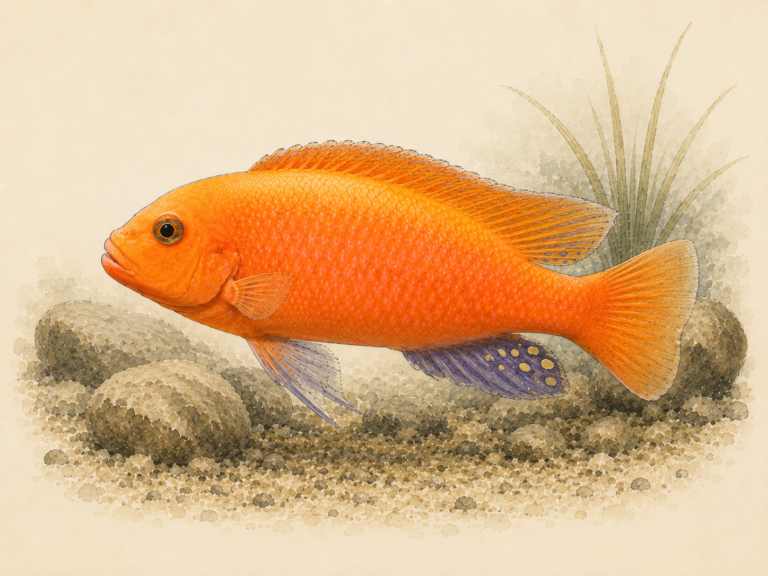
The base body colour is a stunning powder blue to steel blue, overlaid with faint dark vertical barring reminiscent of the Convict Cichlid. These bars are typically less bold and numerous than those seen on a standard Convict, and in many specimens they appear muted or broken, becoming more or less prominent depending on the fish’s mood and social context. The iridescent blue scales shimmer under aquarium lighting, giving the fish a jewel-like quality that photographs rarely do full justice.
The feature that gives this fish its common name is the vibrant red or orange colouration found on the fins and, in many specimens, extending onto the lower portion of the body. The dorsal, caudal, and anal fins are often edged or suffused with red to orange pigment, with the intensity of this colouration varying between individuals and intensifying considerably during breeding. Females in breeding condition frequently develop a rich orange-red flush across their ventral region and may show more vivid fin colouration than males, which is somewhat unusual among Central American cichlids.
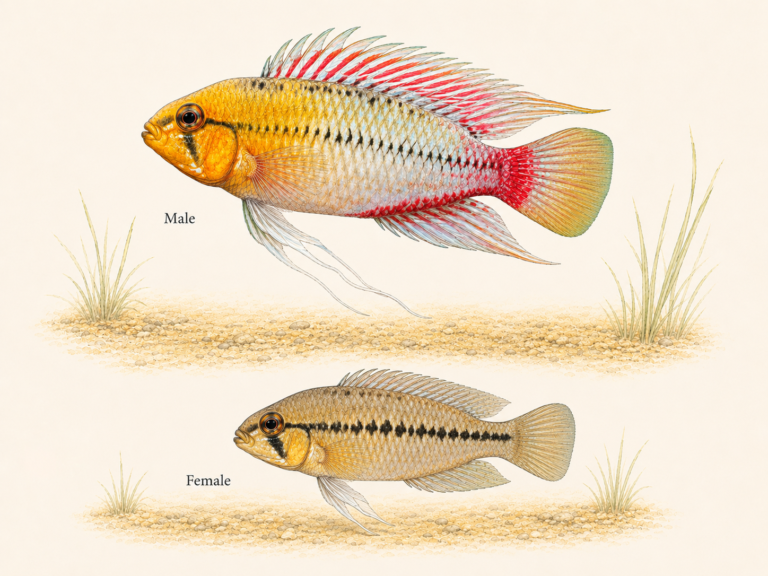
Sexual dimorphism is reasonably straightforward to identify in mature specimens. Males are larger, tend to develop more elongated dorsal and anal fin extensions, and may show a slightly more robust head profile. Females are smaller, often more intensely coloured on the belly and lower fins, and display a rounder body profile, particularly when gravid. Juvenile fish can be more difficult to sex reliably until they reach around 4–5 cm in length.
Natural Habitat
The Honduran Red Point Cichlid originates from the freshwater river systems of Honduras in Central America. It is found in relatively shallow, slow-to-moderately flowing rivers and streams, typically in areas where the substrate is composed of sand, gravel, and scattered rocks. These waterways are often bordered by tropical vegetation, and the fish tends to inhabit zones where rocks, submerged wood, and leaf litter provide ample cover and territorial boundaries.
In its native range, the water tends to be moderately hard and slightly alkaline, though conditions can vary seasonally with rainfall patterns. The streams and rivers where the species is found are generally clear, with good oxygenation provided by moderate flow. Water temperatures in these tropical lowland habitats remain warm and relatively stable throughout the year, typically hovering between 24 and 28 °C.
The natural diet of the Honduran Red Point in the wild consists of a broad range of food items, including small invertebrates, insect larvae, algae, detritus, and plant matter. This omnivorous feeding strategy reflects the opportunistic nature of the species and contributes to its adaptability in captive conditions. In the wild, the fish is a substrate-brooding cichlid that selects cave-like crevices among rocks for spawning, with both parents actively defending the nest site and free-swimming fry.
Although the species has not been formally evaluated by the IUCN, habitat degradation, agricultural run-off, and deforestation in parts of Honduras pose potential threats to wild populations. The vast majority of specimens available in the aquarium trade are captive-bred, which reduces collection pressure on wild stocks.
Tank Size and Setup
A single pair of Honduran Red Point Cichlids can be comfortably housed in an aquarium of at least 150 litres. If you intend to keep them in a community setting with other similarly sized cichlids or robust species, a tank of 250 litres or more is strongly recommended to allow adequate territory for each fish and to diffuse aggression. Larger tanks also provide more stable water parameters, which is always beneficial.
The aquascape should replicate the rocky, structured environment the species inhabits in the wild. Use a substrate of fine sand or smooth gravel, as this allows the fish to engage in natural digging behaviour without injuring themselves. Rounded river stones, stacked slate, and pieces of driftwood should be arranged to create multiple caves, overhangs, and line-of-sight breaks throughout the tank. Providing at least two or three potential cave sites is essential, particularly if you hope to encourage breeding, as the fish will select a preferred spawning cave and defend it vigorously.
Live plants can be included, though it is worth noting that Honduran Red Points, like many Central American cichlids, may uproot or damage delicate plantings, especially during breeding. Hardy species such as Anubias, Java Fern, and Vallisneria tend to fare better, particularly when attached to rocks or wood rather than planted directly into the substrate. Floating plants can also be useful for dimming light and providing a sense of security.
Ensure that the tank has a secure, well-fitting lid, as cichlids can occasionally jump when startled or during intense territorial disputes. Lighting should be moderate; excessively bright illumination can cause stress and wash out the fish’s colours. A natural day-night cycle of around 8–10 hours of light per day is ideal.
Water Parameters
The Honduran Red Point is a hardy species that tolerates a fairly broad range of water conditions, which is one of the reasons it is so well suited to both beginner and experienced keepers. That said, maintaining stable parameters within the optimal range will promote the best health, colouration, and breeding success.
| Temperature | 24–28 °C |
| pH | 6.5–8.0 |
| General hardness (GH) | 8–20 dGH |
| Carbonate hardness (KH) | 4–15 dKH |
| Ammonia | 0 ppm |
| Nitrite | 0 ppm |
| Nitrate | Below 20 ppm |
Consistency is more important than hitting a precise number. Sudden swings in pH or temperature are far more harmful than keeping the fish at a steady value that falls within the acceptable range. Regular water changes of 25–30% per week are the cornerstone of good water quality management and will help keep nitrate levels comfortably low. When performing water changes, ensure that the replacement water is temperature-matched and dechlorinated before being added to the tank.
If your tap water is particularly soft, you may wish to add a mineral buffer or use calcareous décor such as limestone or coral sand to gently raise hardness and maintain a stable pH. Conversely, if your water is extremely hard, the species will generally adapt without issue, as it naturally occurs in moderately hard conditions.
Filtration and Equipment
Effective filtration is essential for maintaining the water quality these cichlids require. An external canister filter rated for the tank volume, or slightly above, is the preferred choice for most setups. Canister filters offer excellent mechanical, biological, and chemical filtration capacity while keeping the tank interior uncluttered. For smaller setups, a high-quality hang-on-back filter can also perform well, though it may require more frequent media maintenance.
Flow rate should be moderate. The Honduran Red Point naturally inhabits gently flowing water and does not appreciate excessively strong currents. If your filter output is too powerful, use a spray bar or lily pipe to diffuse the flow across the tank surface. This also aids gas exchange, ensuring good oxygenation without creating uncomfortable turbulence for the fish.
A reliable heater with a built-in thermostat is necessary to maintain the tropical temperatures this species requires. Choose a heater rated appropriately for your tank volume and consider using a heater guard to prevent the fish from burning itself, as cichlids can be territorial around equipment. A separate thermometer, either digital or glass, is recommended to verify that the heater is functioning accurately.
An air pump is not strictly necessary if your filter provides adequate surface agitation, but it can be a useful backup for oxygenation, particularly in warmer months when dissolved oxygen levels naturally decrease. Standard aquarium lighting is perfectly adequate; LED units that offer adjustable brightness and colour temperature allow you to showcase the fish’s blue and red tones effectively.
Diet and Feeding
The Honduran Red Point is an unfussy omnivore that accepts a wide variety of foods in captivity. A high-quality cichlid pellet or flake should form the staple of its diet, providing a balanced nutritional profile that supports growth, colour, and overall vitality. Look for foods that list whole fish meal or insect meal as a primary ingredient and avoid those heavily padded with fillers such as wheat flour.
To supplement the staple diet and promote the best possible colour and condition, offer regular portions of frozen or live foods. Bloodworm, brine shrimp, daphnia, and mosquito larvae are all eagerly accepted and provide valuable protein and fat. Vegetable matter is also important for this omnivorous species; blanched spinach, courgette medallions, shelled peas, and spirulina-based foods help to round out the diet and support digestive health.
Feed adult fish once or twice daily, offering only as much food as they can consume within two to three minutes. Overfeeding is a common cause of poor water quality and digestive issues in cichlids, so restraint is key. Juvenile and growing fish benefit from two to three smaller feeds per day to support their rapid growth rate. Fasting one day per week is a practice some experienced keepers adopt to allow the digestive system a rest period, though this is optional.
During breeding, both the male and female may reduce their food intake as they focus on guarding eggs and fry. This is entirely normal behaviour and appetite will return to normal once the fry become more independent. Newly free-swimming fry can be fed freshly hatched brine shrimp, microworms, or finely crushed flake food.
Behaviour and Temperament
The Honduran Red Point Cichlid is a territorial species with a personality that far exceeds its modest size. It is intelligent, curious, and often develops a recognisable relationship with its keeper, approaching the front glass at feeding time and responding to movement outside the tank. This responsiveness is one of the most endearing qualities of the species and a significant part of its appeal.
In terms of aggression, the HRP sits in a moderate position among Central American cichlids. It is considerably less aggressive than larger species such as the Jack Dempsey or Red Devil, but it is by no means a passive community fish. Territorial aggression is most pronounced during breeding, when a bonded pair will vigorously defend their chosen spawning site and the surrounding area against all comers. Outside of breeding, the species is generally manageable, particularly in a well-structured tank with adequate space and visual barriers.
Conspecific aggression can be an issue if multiple pairs are housed in an insufficiently large aquarium. In smaller tanks, a dominant pair will typically harass or even kill subordinate fish. If you wish to keep more than one pair, a tank of 400 litres or more with abundant rockwork and territory divisions is advisable. Single specimens can also be kept, though they tend to display more natural behaviour and colouration when housed as a pair.
The species is a dedicated substrate spawner and biparental carer, meaning both male and female participate in defending the brood. This cooperative parental behaviour is one of the most captivating aspects of keeping HRPs. The pair will work together to excavate pits in the substrate, move fry between locations, and aggressively chase away any fish that ventures too close to their young. This behaviour is fascinating to observe but does require careful planning in a community setting to ensure that tank mates have adequate refuge.
Tank Mates
Selecting appropriate tank mates for the Honduran Red Point requires a balance between choosing species robust enough to withstand occasional territorial displays and avoiding fish so large or aggressive that they would bully the HRP. The ideal community consists of similarly sized, moderately tempered fish that occupy different areas of the water column or have non-overlapping territorial needs. Always ensure the tank is large enough to provide adequate space for all inhabitants, and be prepared to separate fish if aggression becomes excessive during breeding periods.
Good tank mates
- Firemouth Cichlid (Thorichthys meeki) — A similarly sized Central American cichlid that relies on threat displays rather than outright violence, making it a well-matched companion in spacious tanks.
- Rainbow Cichlid (Herotilapia multispinosa) — A peaceful, smaller Central American species that typically avoids direct confrontation and occupies slightly different microhabitats.
- Bristlenose Pleco (Ancistrus sp.) — A hardy bottom-dwelling catfish that stays out of the cichlid’s territorial zone and provides useful algae control.
- Giant Danio (Devario aequipinnatus) — A fast-swimming, active dither fish that occupies the upper water column and is too quick to be caught by territorial cichlids.
- Swordtail (Xiphophorus hellerii) — A robust livebearer that tolerates moderately hard water and is generally quick enough to evade aggression.
- Blue Acara (Andinoacara pulcher) — A moderately tempered South American cichlid of comparable size that coexists well in larger community setups.
- Platy (Xiphophorus maculatus) — A peaceful, adaptable livebearer that thrives in the same water parameters and adds colour to the upper regions of the tank.
- Synodontis Petricola — A peaceful, cave-dwelling catfish that is robust enough to coexist with territorial cichlids, though extra caves should be provided.
Fish to avoid
- Oscar (Astronotus ocellatus) — Far too large and predatory; an Oscar will quickly outgrow and potentially consume a Honduran Red Point.
- Red Devil Cichlid (Amphilophus labiatus) — Extremely aggressive and much larger, this species would dominate and injure the smaller HRP.
- Neon Tetra (Paracheirodon innesi) — Too small and delicate to house with a territorial cichlid; likely to be stressed, chased, or eaten.
- Convict Cichlid (Amatitlania nigrofasciata) — Closely related and highly aggressive when breeding; the two species may hybridise, which is strongly discouraged.
- Jaguar Cichlid (Parachromis managuensis) — A large, highly predatory cichlid that would pose a serious danger to the much smaller HRP.
- Cardinal Tetra (Paracheirodon axelrodi) — Much too small and fragile to withstand cichlid aggression, particularly during breeding periods.
- Flowerhorn Cichlid — An extremely aggressive hybrid cichlid that requires solitary housing and would severely injure or kill a Honduran Red Point.
- Dwarf Gourami (Trichogaster lalius) — A slow-moving, timid species that would be relentlessly harassed and outcompeted for food and territory.
Breeding
Breeding the Honduran Red Point Cichlid is one of the most rewarding aspects of keeping this species, and it is among the easiest Central American cichlids to breed in captivity. A healthy, well-conditioned pair will often spawn spontaneously without any special intervention from the keeper, provided their basic needs for territory, water quality, and diet are met.
Pair formation can occur naturally within a group of juveniles raised together. Purchasing six to eight young fish and allowing them to pair off as they mature is the most reliable method of obtaining a compatible breeding pair. Once a pair has formed, the bond is typically strong and long-lasting, though it is wise to observe newly paired fish carefully for signs of incompatibility, which can manifest as persistent aggression between the male and female.
The pair will select a cave, overhanging rock, or sheltered flat surface as their spawning site. In the days leading up to spawning, both fish will meticulously clean the chosen surface, and the female’s colouration will intensify noticeably, often displaying a vivid orange or red flush across her belly. The female deposits rows of adhesive eggs on the prepared surface, which the male then fertilises. A typical clutch ranges from 100 to 300 eggs, depending on the size and maturity of the female.
The eggs are guarded constantly by the female, who fans them with her pectoral fins to ensure adequate water flow and removes any unfertilised or fungused eggs. The male patrols the wider territory, driving away any fish that approaches the nest. At typical breeding temperatures of around 26–27 °C, the eggs hatch in approximately two to three days. The wriggling fry remain attached to the substrate by their yolk sacs for a further four to five days before becoming free-swimming.
Once free-swimming, the fry are shepherded around the tank by both parents, who guide them to food sources and defend them aggressively against perceived threats. This is the period of peak parental aggression, and tank mates may be confined to corners or the opposite end of the aquarium. If the aggression becomes unmanageable in a community setting, it may be necessary to separate the breeding pair and their fry into a dedicated rearing tank.
Free-swimming fry should be fed freshly hatched brine shrimp, microworms, or commercially available fry foods several times per day. Growth is relatively rapid with good nutrition and clean water, and the young fish will begin to show colour within a few weeks. The parents may continue to guard the fry for several weeks before the brood disperses or the pair prepares to spawn again.
Common Diseases
The Honduran Red Point is a robust and hardy cichlid that is not particularly prone to disease when maintained in clean, well-filtered water with appropriate parameters. However, like all freshwater fish, it can be susceptible to a range of common ailments if conditions deteriorate or if new fish are introduced without proper quarantine.
Ich, or white spot disease, caused by the protozoan parasite Ichthyophthirius multifiliis, is perhaps the most frequently encountered illness in freshwater aquaria. It presents as small white spots across the body and fins, often accompanied by flashing (rubbing against surfaces) and lethargy. Treatment involves gradually raising the water temperature to 30 °C over 24–48 hours and administering a proprietary ich medication. Early intervention is key, as the disease can spread rapidly through a tank.
Hole-in-the-head disease, also known as head and lateral line erosion (HLLE), is another condition that can affect Central American cichlids. It manifests as pitted lesions on the head and along the lateral line and is commonly associated with poor water quality, vitamin deficiencies (particularly vitamins A and C), and the overuse of activated carbon in filtration. Improving water quality through more frequent water changes, enriching the diet with varied and vitamin-rich foods, and removing activated carbon typically leads to recovery.
Bacterial infections, including fin rot and body ulcers, can occur in fish that are stressed, injured, or housed in suboptimal water conditions. Maintaining ammonia and nitrite at zero and keeping nitrate below 20 ppm is the best preventive measure. Affected fish can be treated with broad-spectrum antibacterial medications, and isolating them in a hospital tank during treatment is advisable to avoid medicating the entire display aquarium unnecessarily.
Internal parasites may occasionally affect cichlids, particularly wild-caught specimens or fish sourced from poorly maintained breeding facilities. Symptoms can include weight loss despite a healthy appetite, white stringy faeces, and lethargy. Anti-parasitic foods or dedicated internal parasite treatments are effective when administered promptly. Quarantining all new fish for a minimum of two to four weeks before introducing them to an established tank is the single most effective way to prevent the introduction of disease.
FAQs
Can Honduran Red Point Cichlids be kept in a planted tank?
Yes, though with some caveats. HRPs are diggers by nature and will rearrange substrate, particularly during breeding. Delicate, rooted plants are likely to be uprooted. Hardy species such as Anubias and Java Fern, attached to rocks or driftwood rather than planted in the substrate, tend to survive well. Floating plants like Amazon Frogbit or Water Lettuce are also good choices, as they are beyond the fish’s reach and help to soften lighting.
How can I tell the difference between a male and female Honduran Red Point?
Mature males are typically larger, reaching up to 13 cm, and tend to have more elongated dorsal and anal fin extensions. They may also develop a subtle nuchal hump with age. Females are smaller and often display more vivid orange or red colouration on their ventral area and fins, particularly when in breeding condition. In juveniles below about 4–5 cm, sexing can be unreliable without venting, which involves examining the genital papillae under magnification.
Will Honduran Red Points hybridise with Convict Cichlids?
Yes, this is a genuine concern. The Honduran Red Point and the standard Convict Cichlid are closely related within the Amatitlania complex and will readily hybridise if housed together. The resulting offspring are fertile hybrids that dilute the genetic integrity of both parent species. Responsible keepers should avoid housing these two species in the same aquarium, and hybrid fry should never be distributed or sold.
How aggressive are Honduran Red Points compared to standard Convict Cichlids?
Honduran Red Points are generally considered to be slightly less aggressive than standard Convicts, though individual temperament can vary. Their aggression peaks during breeding, when they will fiercely defend their territory and fry against all tank mates. Outside of breeding, they are typically manageable in a well-structured community tank with appropriate species. Providing ample rockwork and line-of-sight breaks significantly helps to mitigate aggression.
Can I keep a single Honduran Red Point Cichlid on its own?
A single HRP can be kept alone and will generally do well, often becoming highly interactive with its owner. However, the species truly shines when kept as a pair, as the social interactions and cooperative breeding behaviour are among its most captivating qualities. If you do keep a single specimen, ensure it has plenty of environmental enrichment in the form of caves, driftwood, and rearrangeable décor to explore.
Related Guides
- Convict Cichlid Care Guide — A comprehensive guide to the closely related and widely kept Convict Cichlid, useful for understanding the broader Amatitlania group.
- Firemouth Cichlid Care Guide — Another popular Central American cichlid of similar size and temperament that makes an excellent companion species in larger setups.
- Blue Acara Care Guide — A moderately tempered cichlid with comparable care requirements, often kept alongside HRPs in community cichlid tanks.
- Bristlenose Pleco Care Guide — Detailed care information for one of the best bottom-dwelling tank mates for Central American cichlids.
- Rainbow Cichlid Care Guide — A peaceful Central American species that shares similar water parameter preferences and is a suitable community companion.