Midas Cichlid Care Guide — Tank Setup, Feeding and Breeding
Introduction
The Midas Cichlid (Amphilophus citrinellus) is one of Central America’s most iconic and commanding freshwater fish. Named after the mythical King Midas for its ability to develop stunning golden colouration, this large, robust cichlid has been a mainstay in the hobby for decades. It is a fish that demands respect — both for its impressive size and for its formidable personality. Midas Cichlids are intelligent, interactive creatures that often develop strong bonds with their keepers, readily recognising the person who feeds them and frequently begging for attention at the front glass.
Despite their undeniable charm, Midas Cichlids are not a species to be taken on lightly. They require spacious aquaria, powerful filtration, and an owner who understands how to manage a large, territorial cichlid. They are prolific diggers, enthusiastic redecorators, and can be intensely aggressive, particularly during breeding. For the aquarist who can meet their considerable needs, however, they are enormously rewarding pets that can live for well over a decade. This guide covers everything you need to know to keep Amphilophus citrinellus successfully in the home aquarium.
Quick Stats
| Scientific name | Amphilophus citrinellus |
| Common names | Midas Cichlid, Lemon Cichlid, Gold Cichlid, Red Devil (often confused with A. labiatus) |
| Family | Cichlidae |
| Origin | Central America — Nicaragua and Costa Rica (Lakes Nicaragua, Managua, and associated drainages) |
| Adult size | 25–35 cm (10–14 inches) |
| Lifespan | 10–15 years, occasionally longer |
| Difficulty | Moderate |
| Breeding difficulty | Easy |
| Temperature | 24–28 °C |
| pH range | 6.5–8.0 |
| General hardness (GH) | 10–20 dGH |
| Carbonate hardness (KH) | 4–15 dKH |
| Minimum tank size | 450 litres |
| Conservation status | Least Concern (IUCN) |
Appearance
The Midas Cichlid is a thick-bodied, powerful fish with a deep, laterally compressed profile and a large head. Wild specimens are typically dark grey to olive-brown with a series of darker vertical bars running along the flanks, often accompanied by a prominent black lateral blotch roughly midway along the body. This barred, cryptic colouration is the norm in natural populations, where it provides camouflage among rocky substrates and submerged timber.
What makes this species truly famous, however, is the phenomenon of colour transformation. A minority of individuals — estimated at roughly 10 per cent of wild populations — undergo a dramatic metamorphosis in which they shed their dark pigmentation and develop bright gold, orange, or reddish-orange colouration. This process, driven by the breakdown of melanophores and the expression of underlying xanthophores and erythrophores, can occur gradually over several months and may begin at any point from juvenile to early adult life. In captivity, selective breeding over many generations has made the golden and orange colour forms far more prevalent than they are in the wild.
Mature males are typically larger and more robust than females, and they frequently develop a pronounced nuchal hump — a fleshy, rounded protuberance on the forehead that can become quite substantial with age. Females may also develop a modest hump, but it is rarely as pronounced. Both sexes possess strong, thick lips and powerful pharyngeal jaws equipped with sturdy teeth, reflecting their omnivorous diet and their habit of crushing hard-shelled invertebrates. The fins are well developed, with the dorsal and anal fins tapering to elongated trailing points in mature specimens, particularly in males.
Varieties and Morphs
The Midas Cichlid has been bred in captivity for many years, and while it does not have as many formalised trade names as some other popular cichlids, several colour morphs and variants are commonly encountered in the hobby.
The wild-type morph retains the natural dark grey to olive-brown barred colouration seen in the majority of wild fish. These specimens are less commonly sought after in the trade but are valued by purists and breeders interested in maintaining the natural phenotype. They are sometimes sold simply as “barred Midas” or “normal Midas.”
The gold or lemon morph is perhaps the most iconic form. These fish display a rich, uniform golden-yellow body colouration with little to no dark pigmentation. They are the form most people picture when they think of a Midas Cichlid and are widely available in the trade.
The orange or red morph is closely related to the gold form but displays a deeper, more saturated orange to reddish-orange hue. The intensity of the red can vary significantly between individuals and tends to deepen with age and high-quality nutrition.
The white or leucistic morph is a paler variant that lacks much of the yellow and orange pigmentation, resulting in a creamy white to pinkish body. These fish are less common but are occasionally produced in breeding programmes.
There are also piebald or patterned individuals that display an incomplete colour transformation, resulting in a striking combination of dark blotches or patches on a gold, orange, or white background. These are sometimes called “calico Midas” in the trade and can be quite attractive.
It is worth noting that the Midas Cichlid is frequently confused with and mislabelled as the Red Devil Cichlid (Amphilophus labiatus), a closely related species from the same lakes. The two species can hybridise freely, and much of the stock available in the hobby is likely of mixed heritage. True A. labiatus tends to have more pronounced, thicker lips and a slightly more elongated body, but distinguishing the two in pet shops can be extremely difficult.
Natural Habitat
Amphilophus citrinellus is native to the great lakes and associated river systems of Nicaragua and Costa Rica in Central America. Its primary range encompasses Lake Nicaragua (also known as Cocibolca), Lake Managua (Xolotlán), and several smaller crater lakes and rivers connected to these major water bodies. These are large, warm, often turbid lakes with volcanic origins, characterised by rocky shorelines, sandy substrates, and areas of submerged wood and vegetation.
In the wild, Midas Cichlids are typically found in shallow to moderately deep water along rocky shores and around submerged boulders, where they establish territories and forage. The water in their native lakes tends to be moderately hard and slightly alkaline, with temperatures that remain warm and relatively stable throughout the year owing to the tropical latitude. Visibility can vary from reasonably clear to quite murky depending on the specific location and season, and the substrates range from volcanic rock and gravel to fine sand and silt.
These fish occupy a mid-level position in the food web, feeding on a diverse diet that includes algae, plant matter, aquatic invertebrates such as snails and insect larvae, small fish, and organic detritus. Their robust pharyngeal jaws allow them to crush the shells of molluscs and crustaceans with ease. In the wild, they are both territorial and somewhat gregarious, forming loose aggregations outside of the breeding season but becoming fiercely territorial when spawning.
The Midas Cichlid has also been introduced to several regions outside its native range, including parts of Florida in the United States, where feral populations have become established in warm-water canals and lakes. These invasive populations can have significant impacts on native ecosystems, which underscores the importance of responsible fishkeeping and never releasing aquarium fish into the wild.
Tank Size and Setup
Given that Midas Cichlids routinely reach 30 cm or more in length and are both highly active and intensely territorial, spacious housing is an absolute necessity. A single adult requires a tank of at least 450 litres, and a breeding pair should ideally be kept in 550 litres or more. If you intend to house multiple large cichlids together, you should be thinking in terms of 750 litres and upwards. Length and footprint are more important than height — aim for a tank that is at least 180 cm long and 60 cm wide for a pair.
The aquascape for a Midas Cichlid tank should prioritise durability and practicality over aesthetics. These fish are enthusiastic and relentless diggers that will excavate pits in the substrate, uproot plants, and rearrange décor to suit their preferences. A sand substrate is the best choice, as it allows the fish to express their natural digging behaviour without injuring themselves. Gravel can be used but should be smooth and of a moderate grain size to avoid damage to the gills during substrate sifting.
Large rocks and boulders can be used to create territories and visual barriers, but they must be placed directly on the tank base or secured in such a way that the fish cannot undermine and topple them. Unstable rockwork in a Midas Cichlid tank is a genuine hazard — these are powerful fish that can shift surprisingly heavy objects. Silicone-sealed rock structures or purpose-built ceramic caves are safer alternatives. Driftwood can be included but is likely to be pushed around. Live plants are generally not practical in a Midas Cichlid setup, as they will be uprooted and destroyed. Tough species such as Anubias or Java Fern attached to heavy rocks or wood may survive, but success is by no means guaranteed.
A secure, well-fitting lid is essential. Although Midas Cichlids are not habitual jumpers, they can leap when startled or during aggressive encounters, and a large, heavy fish launching itself out of the tank can result in injury or death. A sturdy canopy also helps to reduce evaporation and maintain stable water conditions.
Water Parameters
Midas Cichlids are reasonably adaptable when it comes to water chemistry, which is one of the reasons they have been so successful in the hobby and as an invasive species. They do best in moderately hard, slightly alkaline water that mimics the conditions found in their native Nicaraguan lakes, but they will tolerate a fairly broad range provided conditions are kept stable. Consistency matters more than hitting an exact number — sudden swings in pH, temperature, or hardness are far more dangerous than slightly suboptimal but stable values.
| Temperature | 24–28 °C |
| pH | 6.5–8.0 |
| General hardness (GH) | 10–20 dGH |
| Carbonate hardness (KH) | 4–15 dKH |
| Ammonia | 0 ppm |
| Nitrite | 0 ppm |
| Nitrate | Below 30 ppm |
Regular water changes are crucial for maintaining good water quality with a fish of this size and appetite. Aim for weekly water changes of 30 to 50 per cent, adjusting the volume and frequency based on your stocking density and filtration capacity. Large cichlids produce substantial amounts of waste, and nitrate levels can climb rapidly in an underfiltered or overstocked system. Investing in a reliable liquid test kit and monitoring your parameters on a weekly basis is strongly recommended, particularly in the first few months after setting up the tank.
Filtration and Equipment
Filtration is arguably the single most important piece of equipment in a Midas Cichlid setup. These are large, messy fish that produce a significant bioload, and inadequate filtration will quickly lead to deteriorating water quality, elevated nitrate levels, and increased susceptibility to disease. A high-capacity external canister filter is the preferred choice, and many experienced keepers run two large canister filters simultaneously to provide redundancy and ensure adequate turnover. Aim for a combined turnover rate of at least eight to ten times the tank volume per hour.
Biological filtration capacity should be a priority when choosing filter media. Sintered glass, ceramic rings, and other high-surface-area biological media will support the large bacterial colonies needed to process the ammonia and nitrite produced by these fish. Mechanical filtration in the form of coarse and fine sponges will help to keep the water clear, as Midas Cichlids stir up considerable amounts of debris through their digging activities. Chemical filtration with activated carbon can be useful for maintaining water clarity and removing dissolved organics, but it is not strictly essential if water changes are performed regularly.
A reliable aquarium heater rated for the tank volume is necessary to maintain stable tropical temperatures. In larger tanks, using two heaters — one at each end — provides more even heat distribution and offers a safety net in case one unit fails. Choose heaters with built-in thermostats and consider using an external temperature controller for added precision and protection against malfunction. A separate thermometer should be used to verify the heater’s accuracy.
An air pump or supplementary powerhead can be beneficial for improving oxygenation, particularly in warmer water where dissolved oxygen levels are naturally lower. Good surface agitation from the filter outflow is usually sufficient, but additional aeration is a sensible precaution in heavily stocked systems. Lighting is largely a matter of personal preference, as Midas Cichlids are not particularly light-sensitive. A moderate LED light on a timer providing eight to ten hours of illumination per day works well.
Diet and Feeding
Midas Cichlids are true omnivores with hearty appetites, and providing a varied, nutritionally balanced diet is key to maintaining their health, colour, and vitality. In the wild, their diet encompasses algae, plant matter, invertebrates, small fish, and organic detritus, so captive diets should aim to replicate this diversity as closely as possible.
A high-quality cichlid pellet should form the staple of the diet. Choose a pellet designed for large Central and South American cichlids, with a moderate to high protein content and a good balance of vitamins and minerals. Pellets are preferable to flakes for a fish of this size, as they are more nutritionally dense and produce less waste. Sinking pellets are generally better received than floating ones, though many Midas Cichlids will happily feed at the surface.
Supplement the staple pellet with a range of fresh, frozen, and occasionally live foods. Prawns, mussels, cockles, earthworms, and blanched vegetables such as peas, courgette, and spinach are all excellent choices. Frozen foods like bloodworm, krill, and brine shrimp can be offered as treats but should not make up the bulk of the diet due to their relatively low nutritional value for a fish of this size. Occasional offerings of spirulina-based foods or algae wafers help to address the vegetable component of their natural diet.
Avoid feeding mammalian meat, poultry, or foods high in saturated fats, as these are difficult for fish to digest and can contribute to fatty liver disease and other health problems over time. The once-common practice of feeding beef heart to large cichlids is now generally discouraged for this reason. Feeder fish should also be avoided — they carry a high risk of introducing parasites and diseases and are nutritionally poor compared to purpose-made fish foods.
Feed adult Midas Cichlids once or twice daily, offering only as much food as they can consume within a few minutes. Overfeeding is a common mistake that leads to poor water quality and obesity. One fasting day per week can be beneficial for digestive health, particularly in mature adults. Juveniles should be fed two to three times per day in smaller portions to support their rapid growth.
Behaviour and Temperament
The Midas Cichlid is a fish with a big personality in every sense. It is intelligent, curious, and highly interactive — qualities that endear it to many keepers but that can also make it a challenging fish to manage. Midas Cichlids quickly learn to recognise their owners and will often follow your movements around the room, come to the front of the tank when you approach, and even allow gentle hand-feeding once trust has been established. This level of engagement is one of the most appealing aspects of keeping large cichlids.
However, there is another side to this coin. Midas Cichlids are among the most aggressive cichlids commonly kept in the hobby. They are highly territorial and can be dangerously hostile towards tank mates, particularly in cramped or poorly structured environments. Aggression typically intensifies as the fish matures and reaches a peak during breeding, when a pair will defend their spawning site and offspring with extraordinary ferocity. It is not uncommon for a breeding pair of Midas Cichlids to kill or severely injure every other fish in the tank if escape routes and visual barriers are insufficient.
Their digging behaviour is instinctive and constant. They will excavate large pits in the substrate, often down to the tank base, and will move astonishing quantities of sand or gravel in the process. This behaviour should be accommodated rather than discouraged — attempting to prevent a Midas Cichlid from digging is an exercise in futility and will only frustrate the fish. Their habit of rearranging décor and dismantling aquascapes is simply part of life with this species, and keepers need to embrace it.
Midas Cichlids can be kept singly, in mated pairs, or in large community setups with other robust cichlids, depending on the tank size and the temperament of the individual fish. Solitary specimens often become extremely bonded to their owner and can make fascinating, almost pet-like companions. Pairs can be wonderful to observe, especially during breeding, but require careful management and a contingency plan in case the pair bond breaks down, which can happen suddenly and violently.
Tank Mates
Choosing tank mates for a Midas Cichlid requires careful consideration of size, temperament, and available space. Only large, robust fish capable of holding their own against significant aggression should be considered, and the tank must be large enough to allow each fish to establish and defend a territory without constant conflict. Even with ideal conditions, there is always a risk that a particularly aggressive Midas Cichlid will prove intolerant of any companions.
Good tank mates
- Jaguar Cichlid (Parachromis managuensis) — A similarly sized and robust Central American cichlid that can hold its own in a large tank with appropriate territory divisions.
- Oscar (Astronotus ocellatus) — A large, tough South American cichlid whose size and resilience make it a viable companion in very spacious setups.
- Jack Dempsey (Rocio octofasciata) — A sturdy Central American cichlid that is large and assertive enough to coexist with a Midas in a sufficiently large aquarium.
- Green Terror (Andinoacara rivulatus) — A robust and moderately aggressive cichlid that can match a Midas in temperament when given adequate space.
- Convict Cichlid (Amatitlania nigrofasciata) — Though much smaller, their hardiness and tenacious attitude can help them survive alongside larger cichlids in spacious, well-structured tanks.
- Sailfin Pleco (Pterygoplichthys gibbiceps) — A large, heavily armoured catfish that is generally ignored by aggressive cichlids and helps with algae and debris management.
- Common Pleco (Hypostomus plecostomus) — Another large, armoured catfish that tends to avoid conflict and occupies different areas of the tank.
- Firemouth Cichlid (Thorichthys meeki) — Can coexist in very large tanks where visual barriers and territory options are plentiful, though careful monitoring is needed.
- Red Devil Cichlid (Amphilophus labiatus) — A close relative of similar size and temperament that can coexist in very large setups, though aggression must be carefully managed.
Fish to avoid
- Neon Tetra (Paracheirodon innesi) — Far too small and will be eaten or killed almost immediately by a Midas Cichlid.
- Guppy (Poecilia reticulata) — Tiny, slow, and defenceless — they would serve only as live food for a large cichlid.
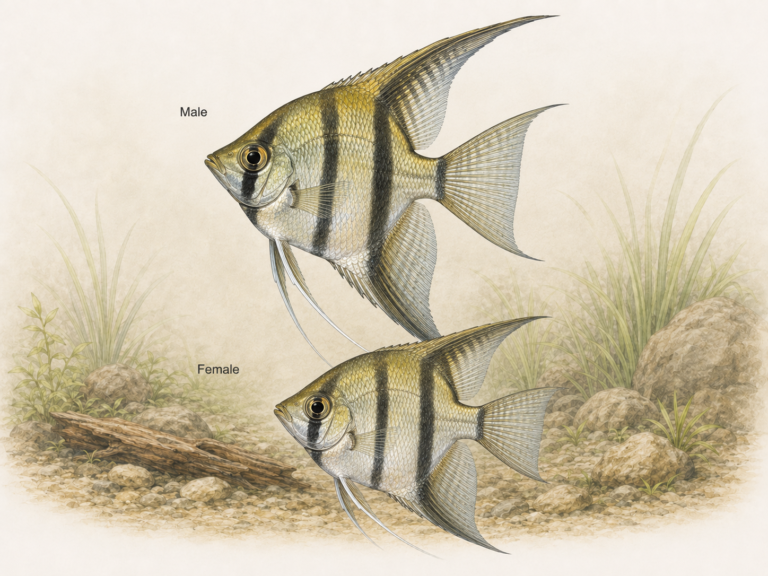
- Angelfish (Pterophyllum scalare) — Their tall, laterally compressed body and peaceful temperament make them extremely vulnerable to Midas aggression.
- Discus (Symphysodon spp.) — Sensitive, peaceful, and slow-moving, Discus would be relentlessly harassed and quickly stressed to death.
- Dwarf Gourami (Trichogaster lalius) — Much too small and timid to survive in a tank with a large, aggressive cichlid.
- Corydoras Catfish (Corydoras spp.) — These small, peaceful bottom-dwellers would be at constant risk of predation and injury.
- Betta (Betta splendens) — Completely incompatible in terms of size, temperament, and water flow requirements.
- Cherry Shrimp (Neocaridina davidi) — Would be consumed within minutes of introduction as a snack rather than a tank mate.
Breeding
Midas Cichlids are among the easier large cichlids to breed in captivity, and successful spawns are a common occurrence even without deliberate effort on the keeper’s part. They are substrate spawners that form monogamous pairs, and their parental care is exemplary — both parents actively guard and tend their eggs, larvae, and free-swimming fry for weeks after hatching.
Obtaining a compatible pair is the first step, and this can be achieved either by purchasing an established pair or by raising a group of six to eight juveniles together and allowing them to pair off naturally as they mature. The latter approach is generally more reliable, though it requires a very large tank and a willingness to rehome the unpaired individuals once a dominant pair has formed, as the pair will relentlessly attack any remaining fish.
Breeding pairs typically select a flat, hard surface on which to spawn — a large flat rock, a clay pot, or even the bare glass of the tank base. Both fish will meticulously clean the chosen site for several days before spawning. The female deposits rows of adhesive eggs on the prepared surface while the male follows closely behind to fertilise them. A single clutch can contain anywhere from 500 to over 3,000 eggs, depending on the size and condition of the female.
Both parents guard the eggs vigilantly, fanning them to ensure adequate water circulation and removing any unfertilised or fungused eggs. At typical aquarium temperatures of around 26–28 °C, the eggs hatch within approximately 48 to 72 hours. The parents then move the wriggling larvae to pre-dug pits in the substrate, where they continue to be guarded and tended. The fry become free-swimming approximately five to seven days after hatching and will begin to feed on newly hatched brine shrimp (Artemia nauplii), microworms, and finely crushed flake or pellet food.
Parental aggression reaches its peak during the fry-guarding stage, and it is important to ensure that any tank mates have adequate space and hiding places to escape the parents’ wrath. In many cases, breeding Midas Cichlids are best kept as a solitary pair to avoid casualties. The pair bond can occasionally break down, particularly after a failed spawn, and if the male turns on the female (or vice versa), they must be separated immediately, as injuries can be severe and swift.
Rearing the fry is straightforward provided they are offered appropriately sized foods and frequent small water changes to maintain excellent water quality. Growth is rapid with good nutrition, and juveniles can reach 5 cm within a few months. Be prepared for the challenge of rehoming potentially hundreds of young fish — Midas Cichlid fry grow quickly and will need to be thinned out or moved to grow-out tanks as they develop.
Common Diseases
Midas Cichlids are generally hardy fish with strong immune systems, but like all aquarium species they are susceptible to certain diseases, particularly when water quality is poor, the diet is inadequate, or stress levels are elevated due to aggression or overcrowding.
Hole-in-the-head disease (HITH), also known as head and lateral line erosion (HLLE), is one of the most common ailments seen in large cichlids. It manifests as small pits or lesions on the head and along the lateral line, which can enlarge and deepen if left untreated. The exact cause is debated, but it is strongly associated with poor water quality, high nitrate levels, a lack of dietary variety, and deficiencies in vitamins and minerals. Treatment involves improving water quality through more frequent water changes, diversifying the diet with vitamin-rich foods, and in some cases treating with metronidazole under veterinary guidance.
Ichthyophthirius multifiliis, commonly known as white spot or ich, is a parasitic infection that presents as small white cysts on the body and fins. It is typically triggered by temperature fluctuations, stress, or the introduction of infected fish. Treatment involves gradually raising the water temperature to 30 °C and adding aquarium salt or a proprietary white spot medication according to the manufacturer’s instructions.
Bacterial infections can affect Midas Cichlids, particularly following injuries sustained during aggressive encounters. Fin rot, ulcers, and septicaemia can develop if wounds become infected. Maintaining pristine water quality is the best preventive measure, and mild cases often resolve with water changes alone. More serious infections may require treatment with a broad-spectrum antibacterial medication.
Internal parasites, including intestinal worms and flagellate protozoans such as Hexamita, can occur, especially in wild-caught specimens or fish that have been fed live feeder fish. Symptoms include weight loss despite a good appetite, white or stringy faeces, and lethargy. Treatment typically involves anti-parasitic medications such as praziquantel or metronidazole, depending on the type of parasite involved.
Prevention is always preferable to treatment. Maintaining excellent water quality through regular water changes and adequate filtration, providing a varied and nutritious diet, quarantining all new fish before introducing them to the main tank, and minimising stress through appropriate tank size and setup are the best defences against disease.
FAQs
What is the difference between a Midas Cichlid and a Red Devil Cichlid?
The Midas Cichlid (Amphilophus citrinellus) and the Red Devil Cichlid (Amphilophus labiatus) are closely related species that originate from the same Nicaraguan lakes and are frequently confused in the hobby. The most reliable distinguishing feature is the lip structure — A. labiatus typically has noticeably thicker, more rubbery, and often more pendulous lips compared to the Midas Cichlid. A. labiatus also tends to have a slightly more elongated body shape. However, extensive hybridisation in captivity means that many fish sold under either name are of mixed ancestry, making definitive identification challenging without genetic analysis.
Can I keep a Midas Cichlid in a 200-litre tank?
No. A 200-litre tank is far too small for an adult Midas Cichlid, which can easily exceed 30 cm in length and is an active, powerful swimmer. Keeping one in such a confined space would result in stunted growth, chronic stress, poor water quality, and a shortened lifespan. The absolute minimum for a single adult is 450 litres, with larger tanks strongly recommended, particularly if you intend to keep a pair or a community.
Why has my Midas Cichlid changed colour?
Colour change is a natural and well-documented phenomenon in Midas Cichlids. Some individuals undergo a transformation from their juvenile dark barred colouration to gold, orange, or reddish hues as they mature. This process is genetically determined and cannot be induced through diet or water conditions alone, though good nutrition and low stress may support brighter pigmentation in fish that are predisposed to change. Not all individuals will undergo this transformation — many retain their wild-type dark colouration throughout their lives.
Are Midas Cichlids suitable for beginners?
Midas Cichlids are not generally recommended as a first cichlid for beginners due to their large adult size, significant space requirements, and high levels of aggression. However, a dedicated beginner who thoroughly researches the species beforehand, invests in an appropriately sized tank and filtration system, and is prepared for the demands of keeping a large, territorial cichlid can certainly succeed with this species. Prior experience with smaller, less aggressive cichlids is beneficial but not strictly essential.
How can I tell if my Midas Cichlid is male or female?
Sexing Midas Cichlids with certainty can be difficult, particularly in young fish. Males tend to grow larger overall, develop a more prominent nuchal hump, and often display more elongated dorsal and anal fin trailing points. Females are typically smaller and rounder in the belly when gravid. The most reliable external method is to examine the genital papilla near the vent — in females, this is broader and more blunt, while in males it is narrower and more pointed. Observing the fish during spawning behaviour provides the most definitive confirmation.
Related Guides
- Red Devil Cichlid (Amphilophus labiatus) Care Guide — A closely related species frequently confused with the Midas Cichlid, with similar care requirements and temperament.
- Jaguar Cichlid (Parachromis managuensis) Care Guide — Another large, aggressive Central American cichlid that shares many husbandry requirements with the Midas Cichlid.
- Oscar (Astronotus ocellatus) Care Guide — A popular large cichlid with comparable intelligence and personality, offering useful comparisons in care and setup.
- Convict Cichlid (Amatitlania nigrofasciata) Care Guide — A smaller, more manageable Central American cichlid that provides a useful introduction to the family before advancing to larger species.
- Jack Dempsey (Rocio octofasciata) Care Guide — A robust Central American cichl