Congo Synodontis Care Guide – Tank Setup, Feeding and Breeding
Quick summary
The Congo Synodontis is a large, hardy nocturnal catfish that needs at least a 300 litre tank with plenty of caves and hiding spots, making it best suited to experienced keepers with spacious setups rather than small community tanks. It’s a peaceful but rewarding fish for those who can meet its size and shelter needs, though breeding it at home is very difficult.
🐠 Build a tank around this fish
In this guide:
- Introduction
- Quick Stats
- Appearance
- Natural Habitat
- Tank Size and Setup
- Water Parameters
- Filtration and Equipment
- Diet and Feeding
- Behaviour and Temperament
- Tank Mates
- Breeding
- Common Diseases
- FAQs
Introduction
The Congo Synodontis (Synodontis congicus) is a robust and fascinating catfish native to the vast Congo River basin in Central Africa. As a member of the family Mochokidae, it shares many of the endearing characteristics that have made Synodontis catfish popular among aquarists worldwide – a whiskered face, an armoured body, and a largely nocturnal lifestyle that rewards patient observation. While not as commonly seen in the hobby as some of its relatives such as the Featherfin Synodontis or the Upside-Down Catfish, the Congo Synodontis has a dedicated following among keepers who appreciate its understated beauty, impressive adult size, and engaging personality.
This species can grow to a substantial size in captivity, making it better suited to medium-to-large aquaria rather than the modest community tanks in which some smaller Synodontis species thrive. It is a rewarding fish to keep, provided the aquarist understands its spatial requirements, dietary preferences, and need for suitable shelter. With proper care, the Congo Synodontis can live for well over a decade, becoming a true centrepiece of an African biotope or large community setup.
In this comprehensive care guide, we cover everything you need to know about keeping Synodontis congicus successfully in the home aquarium, from tank size and water parameters through to diet, breeding, and compatible tank mates. Whether you are an experienced catfish enthusiast or encountering this species for the first time, this guide will help you provide the best possible environment for your Congo Synodontis.
Quick Stats
| Scientific name | Synodontis congicus |
| Common names | Congo Synodontis, Congo Squeaker Catfish |
| Family | Mochokidae |
| Origin | Congo River basin, Central Africa (Democratic Republic of the Congo, Republic of the Congo) |
| Adult size | 25-30 cm (10-12 inches) |
| Lifespan | 12-18 years |
| Difficulty | Moderate |
| Breeding difficulty | Difficult |
| Temperature | 23-27 °C |
| pH range | 6.0-7.5 |
| General hardness (GH) | 4-15 dGH |
| Carbonate hardness (KH) | 3-10 dKH |
| Minimum tank size | 300 litres |
| Conservation status | Least Concern |
Appearance
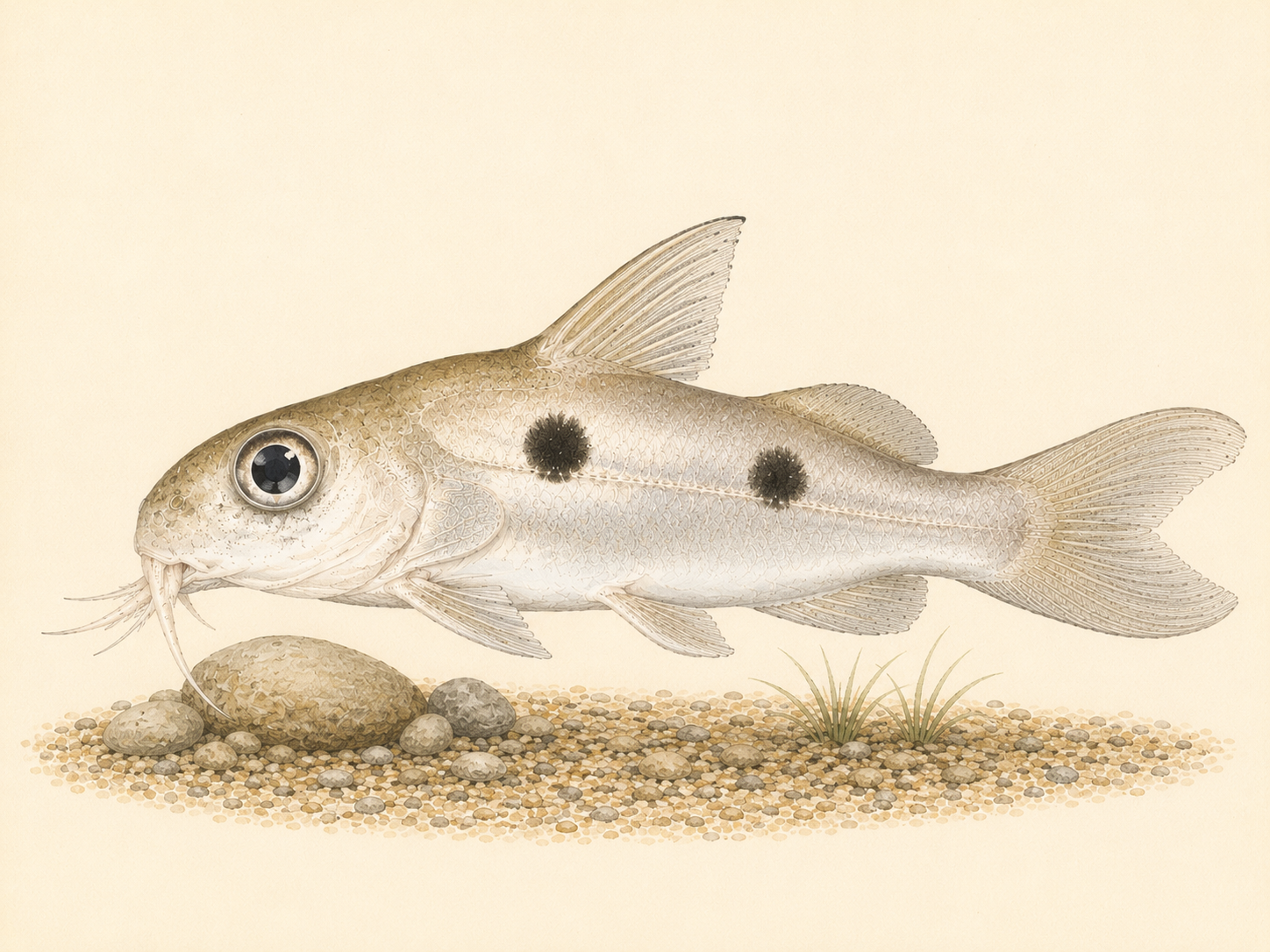
Synodontis congicus is a solidly built catfish with the characteristic broad, flattened head and downward-facing mouth typical of the Synodontis genus. The body is elongated and laterally compressed toward the caudal peduncle, giving the fish a muscular, torpedo-like profile. A prominent adipose fin sits between the dorsal and caudal fins, a hallmark of the Mochokidae family. The dorsal fin features a strong, serrated leading spine that can lock into an erect position – a defensive mechanism that also makes netting this species a task requiring care, as the spine can easily become entangled in fine mesh.
The base body colour typically ranges from greyish-brown to olive-brown, overlaid with a pattern of darker spots or blotches that can vary considerably between individuals. In younger specimens, these markings tend to be more clearly defined and numerous, sometimes forming an attractive leopard-like pattern. As the fish matures, the spots may become less distinct, and the overall colouration can darken, though this is variable. The ventral surface is generally paler, ranging from creamy white to light grey.
Three pairs of barbels adorn the mouth area: one pair of maxillary barbels, which are the longest and most prominent, and two pairs of mandibular barbels. These sensory organs are essential for the fish’s nocturnal foraging behaviour, allowing it to detect food items in low-light conditions and navigate its environment by touch. The maxillary barbels may have branching or feathery extensions, a feature that helps distinguish this species from some of its congeners.
The eyes are relatively large for a catfish, positioned laterally on the head, and reflect light with a distinctive sheen in dim conditions. The pectoral fins also bear a stout, serrated spine on each side. When alarmed or handled, the fish may lock these spines outward and produce an audible squeaking or grunting sound by rubbing the spines against their sockets – hence the common name “squeaker catfish” applied to many members of this genus.
Sexual dimorphism in Synodontis congicus is subtle. Mature females tend to be slightly fuller-bodied than males, particularly when viewed from above, and may reach a marginally larger overall size. Males may have a slightly more elongated genital papilla, but reliably sexing this species outside of breeding condition is challenging even for experienced keepers.
Natural Habitat
Synodontis congicus inhabits the Congo River basin, one of the most biodiverse freshwater ecosystems on the planet. The Congo River system stretches across a vast area of Central Africa, primarily within the Democratic Republic of the Congo, and encompasses a remarkable range of aquatic environments – from powerful main-channel rapids to slow-moving tributaries, flooded forests, and marshy backwaters.
This species is typically found in areas with moderate to strong current, often associated with rocky substrates where boulders, crevices, and submerged wood provide ample hiding spots. The riverbed in these zones tends to be composed of sand, gravel, and rocks, with accumulations of leaf litter and fallen branches creating a complex structural habitat. These sheltered microhabitats are critical for the fish during daylight hours, when it retreats to dark, enclosed spaces to rest.
The water in the Congo basin varies considerably depending on the specific location and season. In general, the water ranges from slightly acidic to neutral, with moderate hardness. Seasonal flooding events can dramatically alter water conditions, bringing influxes of tannin-rich water from flooded forest floors, which temporarily reduces pH and stains the water a tea-like brown. The temperature in the Congo River system remains relatively stable year-round owing to its equatorial location, typically hovering between 23 and 27 degrees Celsius.
The Congo Synodontis shares its habitat with a remarkably diverse array of fish species, including numerous other Synodontis species, various cichlids, characins, and other catfish families. Understanding this natural environment is invaluable for the aquarist, as replicating key elements – such as rocky hiding places, moderate current, and subdued lighting – will help the fish feel secure and display natural behaviours in captivity.
Tank Size and Setup
Given its potential adult size of 25 to 30 cm, the Congo Synodontis requires a generously proportioned aquarium. A minimum tank size of 300 litres is recommended for a single adult specimen, and larger tanks of 400 litres or more are preferable if you intend to keep a small group or house the fish alongside other large species. A tank with a footprint of at least 120 cm in length and 45 cm in width will provide adequate swimming space and territory for this active nocturnal catfish.
The substrate should ideally be composed of fine to medium-grain sand or smooth, rounded gravel. Avoid sharp or jagged substrates, as the fish’s barbels are sensitive and can be damaged by abrasive materials, potentially leading to infection. A sand substrate also allows the fish to engage in natural foraging behaviour, sifting through the substrate in search of food particles.
Rockwork is an essential component of the aquarium setup for this species. Arrange large, stable rocks and stones to create caves, overhangs, and crevices that the fish can use as daytime retreats. Ensure that all rock structures are securely positioned – either resting directly on the tank base glass before the substrate is added, or carefully stacked and wedged so that there is no risk of collapse. A large, powerful catfish moving through its territory can easily dislodge poorly placed rocks, with potentially disastrous consequences.
Driftwood and bogwood are also excellent additions to the aquarium. These provide additional shelter, contribute to a more natural-looking environment, and release beneficial tannins into the water that can help maintain a slightly acidic pH. Large pieces of branching wood are particularly effective, as they create a network of hiding spots and visual barriers.
Live plants are not strictly necessary for this species, and the Congo Synodontis may uproot delicate or poorly established plants during its nocturnal forays. If you wish to include vegetation, choose robust, hardy species such as Anubias, Java Fern, or Bolbitis, which can be attached to rocks or wood rather than rooted in the substrate. These plants also tolerate the subdued lighting that Synodontis catfish prefer.
Lighting should be moderate to dim. The Congo Synodontis is primarily nocturnal and will be most active during twilight and nighttime hours. Bright lighting can cause the fish to remain hidden for extended periods. If you wish to observe the fish during evening hours, consider using a low-intensity blue or red LED moonlight, which will illuminate the tank without disturbing the catfish’s natural activity cycle.
A secure, well-fitting lid or cover glass is essential. While the Congo Synodontis is not typically regarded as a prolific jumper, powerful catfish can occasionally launch themselves out of open-topped tanks, especially when startled. A tight-fitting lid also helps maintain stable water temperature and reduces evaporation.
Water Parameters
Maintaining stable, clean water conditions is fundamental to the health of Synodontis congicus. While this species is reasonably adaptable and can tolerate a range of water chemistry values, consistency is far more important than hitting an exact number. Sudden fluctuations in temperature, pH, or hardness can stress the fish and compromise its immune system.
| Temperature | 23-27 °C |
| pH | 6.0-7.5 |
| General hardness (GH) | 4-15 dGH |
| Carbonate hardness (KH) | 3-10 dKH |
| Ammonia | 0 ppm |
| Nitrite | 0 ppm |
| Nitrate | Below 30 ppm |
Ammonia and nitrite must always read zero in a properly cycled aquarium. The Congo Synodontis, like most catfish, is sensitive to elevated levels of dissolved nitrogenous waste. Regular water testing, particularly during the first few months after introducing new fish, is strongly advised. Aim to keep nitrate levels below 30 ppm through regular partial water changes – a weekly water change of 25 to 30 per cent is a good baseline for most setups, though heavily stocked tanks may require more frequent changes.
The ideal temperature range of 23 to 27 degrees Celsius mirrors the conditions found in the equatorial Congo River basin. A reliable aquarium heater with an accurate thermostat is essential to maintain stable temperatures, particularly in cooler climates or during winter months. Position the heater near a point of good water flow to ensure even heat distribution throughout the tank, and consider using a heater guard to prevent the catfish from resting against or damaging the unit.
A slightly acidic to neutral pH of 6.0 to 7.5 is suitable. The addition of driftwood and dried leaf litter can help maintain a naturally soft, slightly acidic environment that closely replicates the fish’s wild habitat. If your tap water is particularly hard or alkaline, you may wish to use a reverse osmosis (RO) unit or peat filtration to soften and acidify the water, though this is not always necessary if the fish has been captive-bred and accustomed to local water conditions.
Filtration and Equipment
Robust, efficient filtration is non-negotiable for a tank housing a large catfish species like Synodontis congicus. As a sizeable, omnivorous fish, the Congo Synodontis produces a significant biological load, and the filtration system must be capable of handling this comfortably. An external canister filter rated for at least 1.5 to 2 times the tank volume per hour is recommended. For a 300-litre tank, this means selecting a filter with a flow rate of approximately 450 to 600 litres per hour.
Canister filters are ideal for this type of setup because they offer substantial media capacity, allowing for a combination of mechanical, biological, and chemical filtration. A typical media arrangement might include coarse foam or filter floss for mechanical filtration, ceramic bio-media or sintered glass for biological filtration, and activated carbon or filter pads for chemical polishing. Ensure that the biological filtration component is generous, as this is the primary defence against ammonia and nitrite accumulation.
Supplemental filtration can be provided by a powerhead or wavemaker to create additional water movement. The Congo Synodontis appreciates moderate current, which mimics the flowing river habitats it occupies in the wild. Positioning the filter outlet or a separate powerhead to create a directional flow across the tank will encourage natural behaviour and improve oxygenation. However, ensure there are also calmer zones where the fish can rest without fighting against strong current.
An air pump and airstone can provide additional oxygenation, particularly in warmer weather when dissolved oxygen levels naturally decline. This is a worthwhile precaution in larger tanks with substantial bioloads.
As previously mentioned, a reliable heater with an accurate thermostat is essential. For tanks of 300 litres or more, consider using two smaller heaters rather than one large unit. This provides redundancy in case of heater failure and also helps distribute heat more evenly throughout the tank. Heater guards are highly recommended to prevent the catfish from burning itself on exposed heating elements.
Lighting should be chosen with the fish’s nocturnal habits in mind. Standard aquarium LED units with adjustable intensity are ideal, as they can be dimmed during evening hours to encourage the fish to emerge from hiding. A timer is useful for maintaining a consistent photoperiod of approximately 8 to 10 hours of moderate light per day, with a gradual transition to darkness that mimics a natural dusk.
Diet and Feeding
Synodontis congicus is an omnivore with a hearty appetite and a willingness to accept a wide variety of foods. In the wild, it feeds on a diverse diet that includes insect larvae, small crustaceans, algae, plant matter, detritus, and any other organic material it encounters during its nocturnal foraging. This flexible feeding strategy makes the species relatively easy to cater for in captivity.
A high-quality sinking pellet or wafer should form the staple diet. Look for products specifically formulated for catfish or bottom-dwelling omnivores, as these tend to have an appropriate balance of protein, fat, and vegetable matter. Sinking pellets are preferable to floating foods, as the Congo Synodontis feeds almost exclusively at the substrate level and is unlikely to rise to the surface to take food.
Supplement the staple diet with a variety of frozen and live foods to provide nutritional diversity and enrichment. Bloodworms, brine shrimp, daphnia, and chopped earthworms are all readily accepted and provide valuable protein. Occasional offerings of blanched vegetables – such as courgette (zucchini), cucumber, shelled peas, or spinach – help ensure the fish receives adequate plant-based nutrition and fibre.
The Congo Synodontis is primarily a crepuscular and nocturnal feeder, so offering food shortly after lights-out or during the dimming period will encourage the fish to emerge and feed actively. If you notice that tankmates are consuming all the food before the Synodontis has a chance to eat, try target-feeding by placing sinking pellets directly near the fish’s preferred hiding spot using feeding tongs or a turkey baster.
Avoid overfeeding, as this species will eat readily and can become obese if given unlimited access to food. Feed once daily, offering only as much as the fish can consume within a few minutes. One or two fast days per week can be beneficial for the fish’s digestive health and helps prevent excess waste accumulation in the tank.
Behaviour and Temperament
The Congo Synodontis is a generally peaceful species, though it possesses the confident, somewhat territorial personality that characterises many larger Synodontis catfish. During daylight hours, it will typically retreat to its chosen cave, crevice, or piece of driftwood, remaining largely motionless until the lights dim. As darkness falls, the fish becomes increasingly active, emerging to patrol the tank, forage along the substrate, and explore its territory.
While not overtly aggressive, the Congo Synodontis can be territorial toward other bottom-dwelling species, particularly conspecifics or similarly shaped catfish that attempt to share its preferred hiding spots. Providing multiple caves and shelters that are generously distributed throughout the tank will help mitigate territorial disputes. If keeping more than one Congo Synodontis, ensure the tank is large enough to accommodate separate territories for each individual – a tank of 500 litres or more is advisable for a pair or small group.
This species is capable of producing audible sounds by rubbing its pectoral fin spines against their sockets, a behaviour known as stridulation. These squeaking or grunting sounds are most commonly heard when the fish is stressed, being handled, or during aggressive encounters with tankmates. While the sounds can be alarming to new keepers, they are a normal part of the fish’s behavioural repertoire and usually indicate that the fish feels threatened rather than being in any genuine danger.
The Congo Synodontis is not known for displaying the inverted swimming behaviour that makes the Upside-Down Catfish (Synodontis nigriventris) famous, though it may occasionally be observed resting in an inverted position under overhangs or cave roofs. This is perfectly normal and not a cause for concern.
One behaviour to be aware of is the fish’s tendency to rearrange its environment. Large Synodontis catfish are quite capable of moving lightweight decorations, uprooting plants, and shifting substrate to create preferred resting spots. This is a natural behaviour and should be accommodated rather than discouraged – simply ensure that all heavy structures are stable and secure.
Tank Mates
Selecting appropriate tank mates for the Congo Synodontis requires consideration of the fish’s size, nocturnal habits, and mildly territorial nature. Ideal companions are species that are too large to be considered prey (the Congo Synodontis will readily consume very small fish), occupy different zones of the water column, and are not so aggressive as to bully or stress the catfish. African species that share similar water parameter requirements make particularly natural choices, but the Congo Synodontis is adaptable enough to coexist with a range of tropical species from other regions provided basic environmental needs overlap.
Good tank mates
- Congo Tetra – A classic Congo basin companion that occupies the mid-water column and is too swift and large enough to avoid predation.
- African Butterfly Cichlid – A peaceful, moderately sized cichlid from West Africa that shares similar water requirements and temperament.
- Leopard Bushfish – Another African species that appreciates similar water conditions and is large enough to coexist peacefully.
- African Red-Eye Tetra – A hardy, active schooling fish from the Congo basin that adds movement to the upper water column.
- Featherfin Synodontis – A related species that can coexist in sufficiently large tanks with adequate hiding spots for both.
- Rainbow Cichlid – A relatively peaceful cichlid that is robust enough to share space with a larger catfish.
- Bristlenose Pleco – A hardy algae eater that generally ignores other bottom dwellers and occupies different microhabitats.
- Ropefish – A peaceful, elongated African species that makes an unusual and compatible companion in large tanks.
Fish to avoid
- Neon Tetra – Far too small and will almost certainly be eaten by a large Congo Synodontis during nocturnal foraging.
- Guppy – Small, slow-moving fish that would be easy prey for this catfish, especially at night.
- Jaguar Cichlid – An extremely aggressive, predatory cichlid that would harass and potentially injure the Synodontis.
- Red Devil Cichlid – Highly aggressive and territorial, likely to attack and stress any catfish sharing its space.
- Cherry Shrimp – Small invertebrates that would be consumed immediately by a foraging Synodontis.
- Celestial Pearl Danio – A tiny species that would be at serious risk of predation from a catfish of this size.
- Flowerhorn Cichlid – An aggressive hybrid cichlid that is wholly incompatible with peaceful community fish.
- Oscar – While large enough to avoid predation, Oscars are messy, boisterous fish that may bully the catfish and dramatically increase the bioload.
Breeding
Breeding Synodontis congicus in the home aquarium is a challenging endeavour that has been achieved only rarely. Like many larger Synodontis species, the Congo Synodontis does not breed readily in captivity, and most specimens available in the trade are wild-caught or produced through hormonal induction in commercial breeding facilities. Nevertheless, understanding the species’ reproductive biology is valuable for the dedicated aquarist who may wish to attempt breeding.
In the wild, Synodontis congicus is believed to be an egg scatterer. Spawning is likely triggered by the onset of the rainy season, which brings changes in water chemistry – notably a drop in hardness, a slight decrease in temperature, and an increase in water flow and volume. These environmental cues stimulate hormonal changes that lead to spawning behaviour.
To attempt breeding in captivity, start with a well-conditioned group of adults in a spacious tank (500 litres or more). Condition the fish with a rich and varied diet heavy in live and frozen foods for several weeks. Gradually lower the water temperature by 2 to 3 degrees Celsius over a period of days, simultaneously performing larger-than-usual water changes with slightly softer, cooler water to simulate rainy season conditions. Increasing the flow rate from the filter or adding a powerhead can further mimic the onset of seasonal flooding.
If spawning does occur, the female will scatter adhesive eggs among rocks, wood, and other structures. The parents offer no parental care and may consume the eggs if given the opportunity, so it is advisable to remove the adults or the eggs as soon as spawning is observed. The eggs typically hatch within 48 to 72 hours at tropical temperatures, and the fry become free-swimming a few days later.
Rearing the fry requires small, frequent feedings of infusoria, newly hatched brine shrimp (Artemia nauplii), and microworms. Water quality must be maintained meticulously, with gentle filtration that does not create currents strong enough to sweep the tiny fry about. Growth is relatively slow, and the fry can take several months to reach a size at which they can be safely housed with larger fish.
It is worth noting that some Synodontis species, most famously Synodontis multipunctatus, are brood parasites that deposit their eggs among the eggs of mouthbrooding cichlids. There is no strong evidence that Synodontis congicus employs this reproductive strategy, but the possibility has not been entirely ruled out. Hobbyists who keep this species alongside mouthbrooding cichlids may wish to observe spawning interactions carefully.
Common Diseases
The Congo Synodontis is a hardy species that is not particularly prone to disease when maintained in clean, stable water conditions. However, like all aquarium fish, it can succumb to a range of common ailments if water quality deteriorates, the fish is stressed, or new arrivals introduce pathogens to the tank.
White spot disease (Ichthyophthirius multifiliis), commonly known as ich, is one of the most frequently encountered diseases in freshwater aquaria. It presents as small white cysts on the skin, fins, and gills of the fish. The Congo Synodontis, like many scaleless and armoured catfish, can be sensitive to certain ich medications, particularly those containing copper or malachite green. If treatment is necessary, use a formulation specifically labelled as safe for scaleless fish, and consider raising the water temperature to 28-30 degrees Celsius to accelerate the parasite’s life cycle, in combination with increased aeration.
Bacterial infections can manifest as fin rot, skin ulcers, or cloudy eyes, and are typically secondary to poor water quality or physical injury. Maintaining pristine water conditions through regular water changes and efficient filtration is the best prevention. If bacterial infection is suspected, a broad-spectrum antibiotic or antibacterial treatment suitable for catfish should be used, ideally in a hospital tank to avoid disrupting the biological filtration in the main aquarium.
Fungal infections, appearing as white, cotton-like growths on the skin or fins, can occur following physical damage or in immunocompromised fish. Treatment with an antifungal medication is usually effective, but as with all treatments, care should be taken to select products that are safe for use with catfish.
Internal parasites may be a concern, particularly with wild-caught specimens. Signs of internal parasitic infection include weight loss despite a healthy appetite, bloating, and abnormal faeces. A course of anti-parasitic medication, administered via medicated food or direct treatment of the water, may be required. Quarantining all new arrivals for a minimum of two to four weeks before introducing them to the main tank is an excellent preventative measure.
Barbel erosion is a condition that affects many catfish species and is typically caused by poor substrate quality or chronically high nitrate levels. If the barbels appear shortened, reddened, or frayed, review the substrate choice and water quality immediately. Switching to a fine, smooth sand substrate and improving water change routines will usually allow the barbels to regenerate over time.
FAQs
How big does a Congo Synodontis get?
In captivity, Synodontis congicus typically reaches an adult size of 25 to 30 cm (10 to 12 inches), though some individuals may grow slightly larger in very spacious aquaria with optimal conditions. Growth rate is moderate, and the fish may take several years to reach full size. Planning for the adult dimensions of this species from the outset will help avoid the need for tank upgrades later on.
Is the Congo Synodontis aggressive?
The Congo Synodontis is generally a peaceful species, though it can be mildly territorial toward other bottom-dwelling fish, particularly those that attempt to occupy the same hiding spots. Aggression is rarely severe and typically amounts to chasing or brief displays of dominance rather than actual physical harm. Providing ample hiding spaces and maintaining a sufficiently large tank will minimise territorial behaviour.
Can I keep more than one Congo Synodontis together?
Yes, it is possible to keep a small group of Congo Synodontis together, provided the tank is large enough to accommodate separate territories for each individual. A tank of 500 litres or more is recommended for a group of two to three specimens. Each fish should have access to its own cave or hiding spot. In groups, they may display interesting social dynamics, including hierarchical behaviour and occasional sparring.
Will a Congo Synodontis eat my smaller fish?
The Congo Synodontis is an opportunistic omnivore and will consume any fish small enough to fit in its mouth. This means that very small species such as neon tetras, guppies, and small rasboras are at risk, particularly during the catfish’s active nocturnal period. Choose tank mates that are too large to be considered prey – generally fish of at least 5 to 6 cm in body depth are safe.
Why does my Congo Synodontis hide all day?
This is perfectly normal behaviour for a nocturnal catfish species. Synodontis congicus is most active during twilight and nighttime hours and will spend the majority of the daytime resting in caves, under driftwood, or in other sheltered spots. To observe the fish more regularly, try reducing the tank lighting intensity during evening hours, or install a low-level moonlight LED. Over time, well-established specimens may become bolder and emerge during feeding times even when the main lights are on.
Related Guides
- Featherfin Synodontis – A closely related Synodontis species with an iconic elongated dorsal fin, sharing many care requirements.
- Upside-Down Catfish – A smaller, more commonly available Synodontis species famous for its inverted swimming habit, ideal for those interested in the genus.
- Congo Tetra – A natural companion species from the same geographic region, perfect for an authentic Congo River biotope.
- Synodontis multipunctatus – The well-known cuckoo catfish from Lake Tanganyika, notable for its unique brood-parasitic breeding strategy.
- Bristlenose Pleco – A popular bottom-dwelling catfish that makes a compatible tank mate and shares some care considerations.