Quick summary
The Electric Blue Maingano suits intermediate keepers who can provide a 200+ litre tank with hard, alkaline water and heavy rockwork, plus a group with multiple females per male to spread its territorial aggression. It’s not ideal for beginners with small tanks or anyone wanting a peaceful community, since it’s feisty, needs a strictly herbivore-leaning diet to avoid Malawi bloat, and shouldn’t be mixed with similar-looking species like the Electric Blue Johanni.
🐠 Build a tank around this species
In this guide:
- Introduction
- Quick Stats
- Appearance
- Natural Habitat
- Tank Size and Setup
- Water Parameters
- Filtration and Equipment
- Diet and Feeding
- Behaviour and Temperament
- Tank Mates
- Breeding
- Common Diseases
- FAQs
Introduction
The Electric Blue Maingano Cichlid (Melanochromis cyaneorhabdos) is one of the most visually striking members of the Mbuna group of cichlids endemic to Lake Malawi in East Africa. With its vivid electric blue colouration contrasted against bold dark horizontal stripes, this relatively small but highly spirited cichlid has earned a devoted following among African cichlid enthusiasts. First formally described by Bowers and Stauffer in 1997, the species was originally collected from the rocky shoreline near Likoma Island, and its dazzling appearance quickly made it a staple in the aquarium trade.
Despite its beauty, the Electric Blue Maingano is not a fish for the faint-hearted. Like many Mbuna, it possesses a feisty, territorial temperament that demands careful planning when it comes to tank setup and community selection. It is often confused with the closely related Melanochromis johannii (the Electric Blue Johanni), but the Maingano is generally considered to be somewhat less aggressive and maintains its vivid blue colouration in both sexes, unlike the Johanni where males and females display markedly different colours. This distinction is important for aquarists looking to maintain a visually uniform group.
The Electric Blue Maingano is a hardy species that adapts well to aquarium life, provided the keeper meets its requirements for hard, alkaline water, a rock-heavy environment, and appropriate stocking strategies to diffuse aggression. It is a maternal mouthbrooder, which adds an extra layer of fascination for those interested in observing natural breeding behaviour in a home aquarium. This guide covers everything you need to know to keep, feed, breed, and enjoy this remarkable cichlid.
Quick Stats
| Scientific name | Melanochromis cyaneorhabdos |
|---|---|
| Common names | Maingano, Blue Maingano, Electric Blue Maingano Cichlid |
| Family | Cichlidae |
| Origin | Lake Malawi, East Africa (Likoma Island) |
| Adult size | 10 cm |
| Difficulty | Intermediate |
| Breeding difficulty | Moderate |
| Temperature | 24–28 °C |
| pH | 7.6–8.8 |
| GH | 10–25 dGH |
| Minimum tank size | 154 L |
| Conservation status | Critically Endangered (IUCN, assessed 2018) |
Appearance
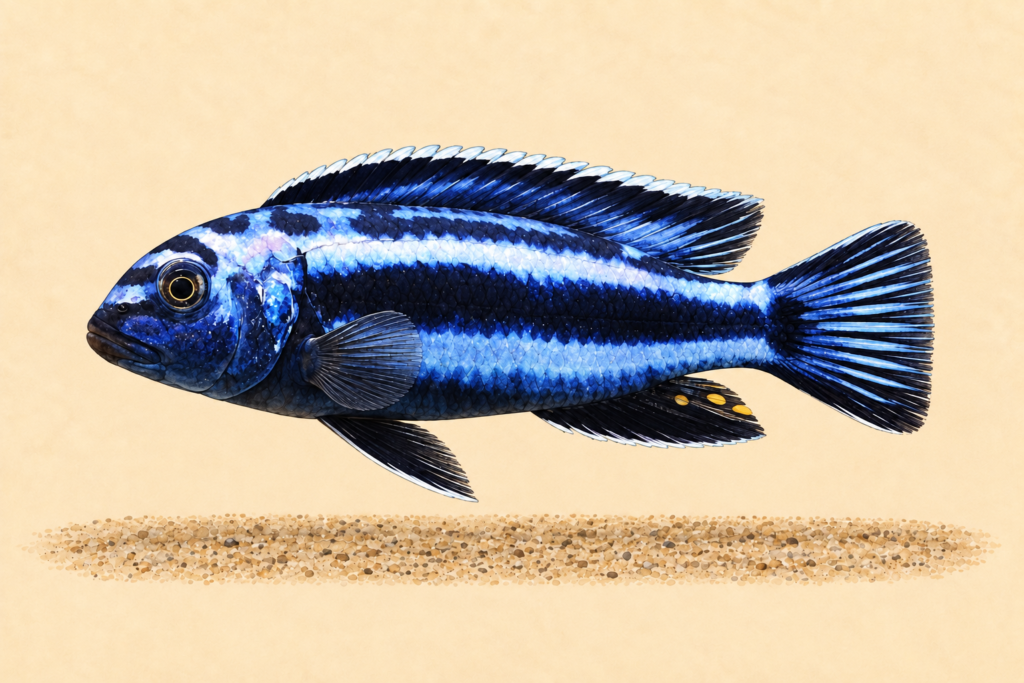
The Electric Blue Maingano Cichlid is immediately recognisable by its intense, luminous blue body colour, which ranges from a deep cobalt to a bright electric blue depending on the individual, lighting conditions, and mood. Running horizontally along the flanks are two or three prominent dark blue to near-black stripes, which create a striking contrast against the lighter blue base colour. This pattern extends from the snout through to the caudal peduncle, giving the fish a sleek, streamlined appearance.
One of the most appealing aspects of this species is that both males and females display the same vivid blue colouration, unlike many other Melanochromis species where sexual dimorphism in colour is pronounced. This makes the Maingano an excellent choice for aquarists who want a uniformly colourful display. Males do tend to be slightly more intense in colouration and may develop a marginally deeper shade of blue, but the difference is subtle and can be difficult to detect without direct comparison.
The dorsal fin is elongated and edged with a narrow band of lighter blue or white, adding further visual interest. The anal fin in males typically features one or more egg spots (ocelli), which play a role in breeding behaviour. The pelvic and pectoral fins are generally translucent to light blue. The body shape is typical of the Mbuna group – somewhat elongated and laterally compressed, with a moderately sized head, thick lips adapted for scraping algae from rocks, and a slightly undershot mouth.
Juveniles display the same basic colour pattern as adults, though the blue is often paler and the stripes may appear less defined. As they mature, the intensity of the blue deepens considerably, reaching its peak at around 12-18 months of age. Adults typically reach 8-10 cm in standard aquarium conditions, with males occasionally growing slightly larger than females.
Natural Habitat
Melanochromis cyaneorhabdos is endemic to Lake Malawi, the third-largest lake in Africa and one of the most biodiverse freshwater bodies on Earth. Specifically, this species is found around Likoma Island, a small island situated in the Mozambican waters of the lake but politically part of Malawi. The waters surrounding Likoma Island are characterised by extensive rocky shorelines, which provide the complex habitat that Mbuna cichlids depend upon.
In the wild, the Electric Blue Maingano inhabits the shallow to intermediate rocky zones, typically at depths of 5-10 metres. The substrate in these areas consists of large boulders and rocky outcrops interspersed with patches of sandy sediment. The rocks are covered in a thin biofilm of aufwuchs – a complex mixture of algae, micro-organisms, invertebrate larvae, and organic detritus – which forms the primary food source for this species and most other Mbuna.
Lake Malawi’s waters are famously hard and alkaline, with a pH that typically ranges from 7.7 to 8.6 and a general hardness that can exceed 15 dGH. The water is exceptionally clear, with visibility often exceeding 20 metres in undisturbed areas. Water temperatures remain relatively stable throughout the year, generally between 24 and 28 degrees Celsius, owing to the lake’s tropical location and immense thermal mass.
The rocky habitat is critically important for the Maingano’s natural behaviour. Individual males establish and defend small territories among the rocks, using crevices and caves as the focal points of their domain. Females and subordinate males tend to move in loose groups around and between these territories. The complex three-dimensional structure of the rock formations allows subordinate individuals to break line of sight with dominant fish, reducing the intensity and frequency of aggressive encounters. This natural dynamic is essential to replicate in the aquarium.
Tank Size and Setup
A minimum tank size of 200 litres is recommended for a small group of Electric Blue Maingano Cichlids. However, a larger aquarium of 300-400 litres is strongly preferred, particularly if you plan to keep them alongside other Mbuna species in a community arrangement. The additional volume provides more territory for individuals to claim and more space for subordinate fish to retreat, both of which are critical for managing aggression.
The aquascape should be dominated by rockwork. Use a combination of large, stable rocks to create an intricate network of caves, overhangs, crevices, and passages. Ocean rock, lava rock, Texas holey rock, and limestone are all popular choices, as they not only provide the structural complexity required but can also help buffer the water towards the alkaline pH that Lake Malawi cichlids demand. Ensure all rockwork is securely placed to prevent collapse, ideally resting directly on the base glass rather than on the substrate, as Mbuna are persistent diggers and can undermine stacks of rock.
Sand is the preferred substrate for Mbuna tanks. A fine to medium-grade sand in a natural colour, such as aragonite sand or pool filter sand, works well and allows the fish to exhibit their natural digging behaviour without risk of injury. Avoid sharp gravel, which can damage the mouths and gills of fish that routinely sift through the substrate.
Live plants are generally not recommended in a Maingano tank. Mbuna are voracious algae eaters and will readily consume soft-leaved plants. Tougher species such as Anubias and Java Fern may survive if attached to rocks or driftwood, but even these can be uprooted or damaged by the fish’s constant excavation. Many keepers opt for a purely rock-and-sand aquascape, which also mirrors the species’ natural habitat more closely.
Lighting should be moderate to strong. Bright lighting encourages the growth of algae on rockwork, which the Maingano will graze upon, supplementing its diet. It also brings out the best of the fish’s electric blue colouration. A light cycle of 8-10 hours per day is sufficient.
Provide a tight-fitting lid or cover slides, as Mbuna can and do jump, especially when startled or during aggressive chases. Adequate cover also reduces evaporation, which is an important consideration for maintaining stable water parameters in hard, alkaline setups.
Water Parameters
The Electric Blue Maingano Cichlid requires the hard, alkaline water conditions characteristic of Lake Malawi. Maintaining stable parameters is just as important as hitting the correct ranges. Sudden fluctuations in pH, hardness, or temperature can stress these fish and leave them vulnerable to disease.
| Temperature | 24-28 °C |
| pH | 7.6-8.8 |
| General hardness (GH) | 10-25 dGH |
| Ammonia | 0 ppm |
| Nitrite | 0 ppm |
| Nitrate | Below 20 ppm |
If your tap water is naturally soft or acidic, you will need to use a Malawi buffer or mineral supplement to raise the pH and hardness to appropriate levels. Crusite substrates such as aragonite sand and the inclusion of limestone or ocean rock in the aquascape can also provide passive buffering. Test your water regularly, particularly in the first few months of a new setup, to ensure that buffering capacity is adequate and consistent.
Weekly water changes of 25-30% are recommended to keep nitrate levels low and replenish trace minerals. When performing water changes, ensure the replacement water is temperature-matched and treated to the same hardness and pH as the tank water. Using a dechlorinator or water conditioner is essential if you are working with treated mains water.
Filtration and Equipment
Mbuna tanks demand robust filtration. The Electric Blue Maingano is typically kept in a well-stocked community of similarly sized cichlids, and the cumulative bioload of such a setup can be substantial. A canister filter rated for at least 1.5 to 2 times the tank volume per hour is the standard recommendation. For a 200-litre tank, aim for a filter with a flow rate of 300-400 litres per hour at minimum. Many experienced Mbuna keepers run two filters simultaneously for redundancy and additional biological capacity.
Biological filtration is the most critical component. Ensure your filter contains ample high-surface-area media such as ceramic rings, sintered glass, or bio-balls. Mechanical filtration, including coarse and fine sponge layers, helps to trap particulate waste and prevents the water from appearing cloudy. Chemical filtration with activated carbon can be used optionally but is not strictly necessary if water changes are maintained consistently.
An appropriately rated heater is essential to maintain the tropical temperatures this species requires. A heater rated at approximately 1 watt per litre is a useful rule of thumb. In larger tanks, using two heaters placed at opposite ends of the aquarium helps to distribute heat evenly and provides a backup in case one fails. Always use a heater guard to prevent the fish from burning themselves, as Mbuna can be quite physical during territorial disputes and may be thrown against equipment.
An air pump and airstone are beneficial additions, as they increase surface agitation and improve oxygen exchange. While not strictly necessary if your filter provides adequate surface movement, supplementary aeration is valuable in heavily stocked Mbuna communities where oxygen demand is high, particularly during warmer months.
A reliable aquarium thermometer, whether digital or glass, should be positioned in a clearly visible location so you can monitor temperature at a glance. A timer for your lighting system ensures a consistent photoperiod, which helps regulate the fish’s natural rhythms and reduces stress.
Diet and Feeding
In the wild, the Electric Blue Maingano is primarily herbivorous, feeding on the aufwuchs – the algal biofilm and associated micro-organisms – that coat the rocky surfaces of its habitat. In the aquarium, this dietary preference must be respected. A diet too high in animal protein can cause a condition known as Malawi bloat, which can be fatal.
The staple diet should consist of a high-quality spirulina-based flake or pellet food formulated specifically for herbivorous African cichlids. Several reputable brands produce Mbuna-specific foods that contain the appropriate balance of plant matter, vitamins, and minerals. Pellets or flakes should be offered once or twice daily in amounts that the fish can consume within two to three minutes. Overfeeding should be strictly avoided, as uneaten food contributes to poor water quality and increases the risk of bloat.
Supplement the staple diet with blanched vegetables such as courgette (zucchini), cucumber, spinach, or shelled peas. These can be offered two to three times per week and provide additional fibre, which aids digestion. Attach vegetables to a clip or weight them down so they sink to the bottom where the fish can graze on them naturally.
Occasional treats of frozen or live foods such as brine shrimp, daphnia, or cyclops can be offered sparingly – no more than once or twice per week. These provide variety and can help condition breeding fish. Avoid feeding bloodworms, tubifex worms, or other high-fat, high-protein foods, as these are strongly associated with digestive problems and Malawi bloat in Mbuna species.
Allowing algae to grow on the rockwork in the aquarium provides a valuable natural food source that the fish will graze on throughout the day. This mimics their wild feeding behaviour and contributes to their overall wellbeing.
Behaviour and Temperament
The Electric Blue Maingano is an active, bold, and territorial cichlid. Like all Mbuna, it is a rock-dwelling species with a strong instinct to claim and defend a specific area of the aquarium. Males are the primary aggressors, establishing territories centred around favoured caves or rock formations and vigorously chasing away any fish that encroaches.
Aggression in this species is moderate by Mbuna standards but should not be underestimated. Intraspecific aggression – aggression directed at members of the same species – tends to be more intense than interspecific aggression. A dominant male will relentlessly pursue subordinate males if they cannot escape his line of sight. For this reason, it is advisable to keep the Maingano in a ratio of one male to at least three or four females. This spreads the dominant male’s attention across multiple targets and reduces the risk of any single female being harassed to the point of exhaustion or injury.
The Maingano is a poor candidate for lightly stocked tanks. In a sparsely populated aquarium, a dominant individual can terrorise the remaining fish with devastating effectiveness. The well-known Mbuna strategy of deliberate overstocking applies here: by maintaining a higher density of fish, aggression is diffused across the group and no single individual bears the brunt of it. This strategy must, of course, be supported by appropriately powerful filtration and diligent water maintenance.
Despite their combative nature, Electric Blue Maingano Cichlids are endlessly entertaining to watch. They are constantly in motion, patrolling their territory, sparring with neighbours through displays of flared fins and lateral posturing, and industriously rearranging the substrate to suit their preferences. They are also quite intelligent and will quickly learn to recognise their keeper, often approaching the front glass in anticipation of feeding.
It is worth noting that the Maingano can be somewhat shy when first introduced to a new aquarium. Providing ample hiding spots from the outset helps new arrivals settle in more quickly. Once established, they become confident and conspicuous inhabitants of the tank.
Tank Mates
Selecting appropriate tank mates for the Electric Blue Maingano requires careful consideration of temperament, size, and dietary requirements. The best companions are other Mbuna species of similar size and disposition. Avoid pairing the Maingano with species that are too passive, as they will be bullied, or species that look too similar in colour and pattern, as this can trigger heightened aggression due to mistaken identity. It is particularly important to avoid keeping the Maingano with Melanochromis johannii, as the two species can and will hybridise, producing undesirable crossbreeds.
Good tank mates
- Yellow Lab Cichlid (Labidochromis caeruleus) – A relatively peaceful Mbuna with contrasting yellow colouration that reduces conspecific aggression triggers.
- Red Zebra Cichlid (Maylandia estherae) – A similarly sized and moderately aggressive Mbuna whose orange-red colour provides excellent visual contrast.
- Acei Cichlid (Pseudotropheus acei) – A peaceful, open-water Mbuna that occupies a different ecological niche, reducing territorial conflict.
- Rusty Cichlid (Iodotropheus sprengerae) – A mild-mannered Mbuna with a distinct brownish-lavender colour that avoids visual competition.
- Demasoni Cichlid (Pseudotropheus demasoni) – A small, active Mbuna that does well in large groups and can hold its own in a mixed community.
- Cobalt Blue Zebra Cichlid (Maylandia callainos) – A robust species of comparable size and temperament, though care must be taken to avoid hybridisation concerns.
- Bristlenose Pleco (Ancistrus sp.) – A hardy algae-eating catfish that generally coexists peacefully with Mbuna and appreciates similar water parameters.
- Synodontis multipunctatus – A Lake Tanganyika catfish that tolerates hard, alkaline water and is robust enough to withstand Mbuna aggression.
Fish to avoid
- Electric Blue Johanni Cichlid (Melanochromis johannii) – Too closely related and similar in appearance, leading to hybridisation and extreme aggression.
- Auratus Cichlid (Melanochromis auratus) – An exceptionally aggressive Melanochromis species that will dominate and potentially injure the Maingano.
- Neon Tetra (Paracheirodon innesi) – Far too small, too peaceful, and requires soft, acidic water that is incompatible with Mbuna requirements.
- Angelfish (Pterophyllum scalare) – A slow-moving, laterally compressed fish that will be harassed and outcompeted by aggressive Mbuna.
- Discus (Symphysodon spp.) – Requires soft, acidic, warm water and a calm environment, making it wholly incompatible with Mbuna.
- Guppy (Poecilia reticulata) – Much too small and docile to survive in a Mbuna tank and will be quickly eaten or killed.
- Oscar Cichlid (Astronotus ocellatus) – A large, predatory New World cichlid with completely different water requirements and temperament.
- Frontosa Cichlid (Cyphotilapia frontosa) – A slow-growing, peaceful Tanganyikan cichlid that is too docile and too large for a Mbuna community.
Breeding
The Electric Blue Maingano is a maternal mouthbrooder, meaning the female incubates the fertilised eggs in her mouth until the fry are free-swimming. Breeding in the aquarium is relatively straightforward provided the fish are healthy, well-fed, and housed in appropriate conditions. This species breeds readily in captivity, and many hobbyists find that spawning occurs without any special intervention.
To encourage breeding, maintain a group with a ratio of one male to three or four females. The dominant male will establish a territory around a flat rock surface or within a cave, which he will clean meticulously in preparation for spawning. When a receptive female approaches, the male performs an elaborate courtship display, shimmying and flaring his fins to attract her attention. The pair then engages in a circular spawning dance, during which the female deposits a small number of eggs on the substrate and immediately picks them up in her mouth.
The male’s anal fin, adorned with egg spots, plays a crucial role at this point. The female, instinctively attempting to collect what she perceives as additional eggs, mouths at the egg spots on the male’s anal fin. During this action, the male releases sperm, which the female inadvertently takes into her mouth, fertilising the eggs. This process is repeated multiple times until the female has collected and fertilised all of her eggs, typically numbering between 10 and 30 depending on her size and maturity.
The female will carry the eggs in her buccal cavity for approximately 21-28 days. During this period, she will not eat, and her throat will appear visibly distended. It is important not to disturb a holding female, as stress can cause her to spit out or swallow the eggs prematurely. Some breeders choose to strip the eggs from the female’s mouth after 14-18 days and raise the fry artificially in a separate tumbler, though this is not strictly necessary for hobbyist-level breeding.
Once released, the fry are surprisingly large and fully formed, capable of accepting crushed flake food, baby brine shrimp, or finely ground spirulina powder from day one. They should be raised in a separate grow-out tank if possible, as adult Mbuna, including their own parents, will readily consume small fry. A 50-80 litre tank with a sponge filter, gentle aeration, and regular water changes provides an ideal nursery environment.
It is essential to avoid keeping the Maingano with other Melanochromis species during breeding to prevent hybridisation. Hybrids are not only genetically undesirable but can be difficult to identify and may inadvertently enter the trade, diluting the purity of captive populations.
Common Diseases
Malawi bloat is the most significant health concern for the Electric Blue Maingano and all Mbuna species. This condition, which shares some similarities with dropsy, is characterised by abdominal swelling, loss of appetite, lethargy, white or stringy faeces, and laboured breathing. It is strongly associated with a diet too high in animal protein, poor water quality, and stress. Prevention is far more effective than treatment: feed a primarily herbivorous diet, maintain excellent water quality, and minimise stress through appropriate stocking and aquascape design. If caught early, Malawi bloat can sometimes be treated with metronidazole-based medications, but advanced cases are frequently fatal.
Ich (white spot disease), caused by the protozoan Ichthyophthirius multifiliis, can affect Maingano cichlids, particularly when they are stressed by poor water quality, temperature fluctuations, or aggressive tank mates. It presents as small white spots on the body and fins, accompanied by flashing (rubbing against objects) and clamped fins. Raising the temperature gradually to 28-30 degrees Celsius and treating with a copper-based or formalin-based ich medication is the standard approach. Many Mbuna keepers add aquarium salt at a rate of 1-2 teaspoons per 20 litres as an additional measure, though this should be done cautiously and is not a substitute for proper medication.
Swim bladder disorder can occasionally affect this species, manifesting as difficulty maintaining balance or buoyancy. This is often linked to overfeeding, constipation, or internal bacterial infections. Fasting the affected fish for 24-48 hours and offering a blanched, shelled pea can help resolve mild cases related to digestive issues. Persistent or severe cases may require antibiotic treatment.
Aggression-related injuries are common in Mbuna communities. Torn fins, split lips, and superficial wounds from territorial disputes usually heal quickly in clean water with stable parameters. However, open wounds can become infected if water quality deteriorates. Maintaining pristine conditions is the best preventive measure. For more serious injuries, isolating the affected fish in a hospital tank with mild antibacterial treatment may be necessary.
Lateral line erosion, sometimes called hole-in-the-head disease, can occur in Mbuna kept in suboptimal conditions. It is associated with poor nutrition, particularly vitamin and mineral deficiencies, and consistently high nitrate levels. Improving diet quality, performing more frequent water changes, and supplementing with vitamins typically resolves early-stage cases.
FAQs
How can I tell the difference between male and female Electric Blue Maingano Cichlids?
Sexing the Electric Blue Maingano is notoriously difficult because both males and females display the same vivid blue colouration. Males tend to be slightly larger, may exhibit marginally more intense colour, and typically have more prominent egg spots on their anal fin. Behavioural observation is often the most reliable method: males are more territorial and will defend specific areas of the tank, while females tend to be less confrontational and may be seen holding eggs in their mouth during breeding periods. Venting – examining the genital papillae – is the most accurate method but requires experience and careful handling of the fish.
Can I keep Electric Blue Maingano Cichlids in a 100-litre tank?
A 100-litre tank is too small for a group of Electric Blue Maingano Cichlids. This species requires a minimum of 200 litres, and larger tanks of 300 litres or more are strongly recommended. In a tank that is too small, territorial aggression escalates dramatically because subordinate fish have nowhere to retreat. This leads to chronic stress, injuries, and potentially death. If you are limited to a smaller tank, consider other, more peaceful Mbuna species such as the Yellow Lab, or explore non-Mbuna options altogether.
Why is my Maingano not eating and has a swollen mouth?
If your Maingano has stopped eating and appears to have a swollen or distended mouth and throat, it is very likely a female holding fertilised eggs. Maternal mouthbrooders carry their eggs and developing fry in their buccal cavity for approximately three to four weeks, during which time they do not eat. This is perfectly normal behaviour. Avoid disturbing the holding female, as stress can cause her to spit out or swallow the eggs. Once she releases the fully formed fry, she will resume eating, though she may appear noticeably thinner and will need time to regain condition.
Can I keep Electric Blue Maingano Cichlids with Electric Blue Johanni Cichlids?
No, it is strongly advised not to keep these two species together. Melanochromis cyaneorhabdos and Melanochromis johannii are closely related and will readily hybridise, producing crossbred offspring that lack the genetic purity of either parent species. Additionally, the visual similarity between the two species can trigger intense aggression, as dominant males may perceive the other species as conspecific rivals. To maintain the integrity of both species and reduce aggression, keep them in separate tanks.
How many Electric Blue Maingano Cichlids should I keep together?
A minimum group of five to six individuals is recommended, ideally with one male and four to five females. Keeping a single male with multiple females ensures that the male’s attention is spread across several targets, reducing the risk of any one female being excessively harassed. If you have a larger tank of 300 litres or more, you may be able to keep two males with a proportionally larger group of females, provided the aquascape offers enough visual barriers and territories to separate them. Avoid keeping two males in a small tank, as the dominant male will almost certainly persecute the subordinate relentlessly.
Related Guides
- Yellow Lab Cichlid Care Guide – One of the most popular and peaceful Mbuna species, making it an ideal tank mate for the Maingano.
- Demasoni Cichlid Care Guide – Another striking small Mbuna from Lake Malawi that shares similar care requirements and can coexist with the Maingano in well-planned communities.
- Red Zebra Cichlid Care Guide – A colourful and moderately aggressive Mbuna that complements the Maingano’s blue colouration beautifully in a mixed tank.
- Acei Cichlid Care Guide – A peaceful, open-water Mbuna with a unique temperament that adds variety to a Lake Malawi biotope aquarium.
- Bristlenose Pleco Care Guide – A versatile algae-eating catfish that thrives in the hard, alkaline water conditions of a Mbuna tank.