Quick Summary
The Golden Dwarf Barb is a tiny, peaceful shoaling fish ideally suited to planted nano tanks – if you can provide soft, slightly acidic water, a well-planted aquarium, and a group of at least eight, this charming little barb is an excellent choice for fishkeepers of any experience level.
🐠 Build a tank around this species
In this guide:
- Introduction
- Quick Stats
- Appearance
- Natural Habitat
- Tank Size and Setup
- Water Parameters
- Diet and Feeding
- Behaviour and Temperament
- Tank Mates
- Breeding
Introduction
The Golden Dwarf Barb (Pethia gelius) is one of the smallest barbs available in the freshwater aquarium hobby, reaching a maximum adult size of around 4 cm. Native to slow-moving streams, ponds, and wetlands across parts of India, Bangladesh, and Nepal, this diminutive cyprinid has earned a loyal following among nano-tank enthusiasts and planted-aquarium hobbyists. Its golden-yellow body, marked with dark blotches, brings a subtle yet attractive flash of colour to densely planted setups without the boisterous behaviour associated with many of its larger barb relatives.
Despite its small size, the Golden Dwarf Barb is a robust and adaptable fish when its core requirements are met. It thrives in soft, slightly acidic to neutral water and benefits greatly from the company of its own kind. A shoal of eight or more individuals will display far more natural behaviour – darting confidently among plant stems rather than hiding nervously in corners. For aquarists looking for a genuinely nano-tank-suitable species that is peaceful, visually appealing, and relatively straightforward to keep, Pethia gelius deserves serious consideration.
This guide covers everything you need to know to keep Golden Dwarf Barbs successfully, from tank setup and water chemistry to diet, breeding, and compatible tank mates.
Quick Stats
| Scientific name | Pethia gelius |
|---|---|
| Common names | Golden Dwarf Barb, Golden Barb (dwarf), Gelius Barb |
| Family | Cyprinidae |
| Origin | South Asia - India, Bangladesh, Nepal |
| Adult size | 4 cm |
| Lifespan | 3–5 years |
| Difficulty | Easy |
| Breeding difficulty | Moderate |
| Temperature | 18–26 °C |
| pH | 6–7.5 |
| GH | 2–10 dGH |
| KH | 1–6 dKH |
| Minimum tank size | 40 L |
| Conservation status | Least Concern (IUCN) |
Appearance
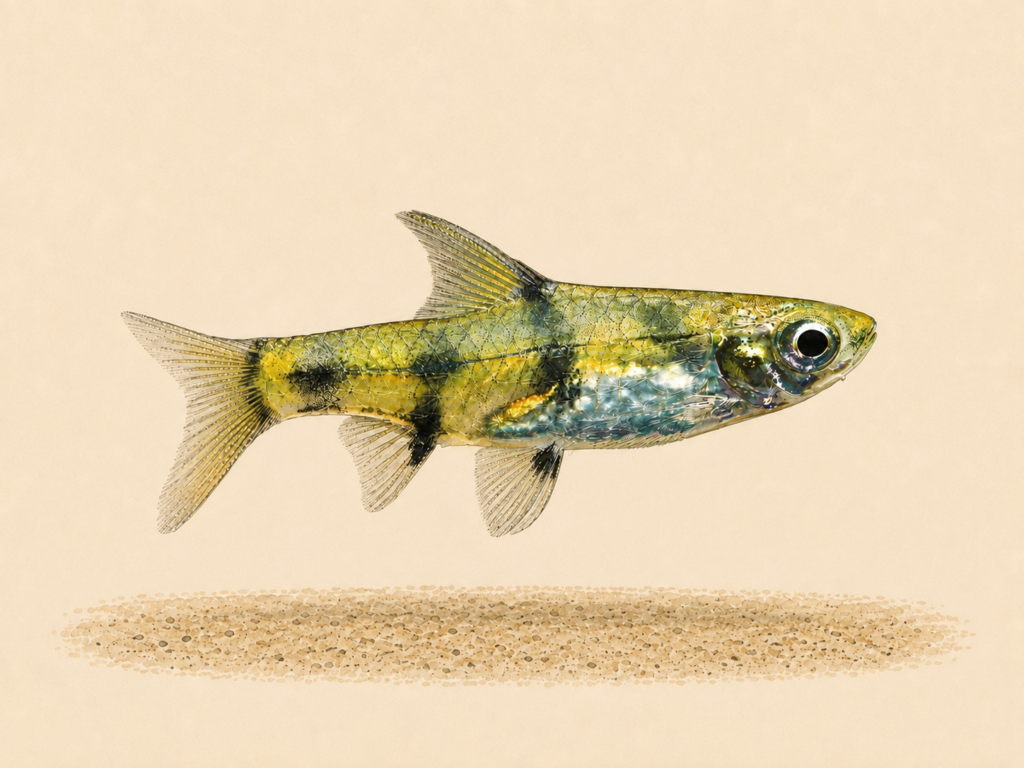
The Golden Dwarf Barb is a petite, laterally compressed fish with a body shape typical of the smaller Pethia species. Its base colour ranges from translucent pale gold to a warm, honeyed yellow, with the intensity of colouration varying between individuals and influenced by diet, mood, and water quality. When in peak condition and settled into a well-planted tank with dark substrate, the golden hue becomes noticeably richer and more vivid.
The most distinctive feature is the pattern of dark markings on the flanks. Most specimens display two to three irregularly shaped dark blotches – one near the gill cover, one roughly at the midpoint of the body, and a third near the base of the caudal peduncle. These blotches can vary considerably in size and definition; in some individuals they appear as bold, well-defined spots, while in others they are more diffuse or partially merged. The fins are generally transparent to lightly tinted yellow, and in breeding males the dorsal and anal fins may show faint dark edging.
Males tend to be slightly slimmer than females and often develop more intense golden colouration, particularly during courtship. Females are typically a touch larger, with a rounder belly profile – especially when carrying eggs. The difference can be subtle outside of breeding condition, but in a well-maintained shoal the sex ratio usually becomes apparent over time.
At just 2 to 2.5 cm in total length, this is genuinely one of the smallest barb species kept in aquaria. Its diminutive size makes it an ideal candidate for nano aquascapes, but it also means that the fish can be easily overlooked in very large or sparsely decorated tanks. A dark substrate and plenty of green plant growth provide the best backdrop for appreciating the Golden Dwarf Barb’s understated beauty.
Natural Habitat
Pethia gelius is found across a wide swathe of the northern Indian subcontinent, with populations recorded in the Ganges and Brahmaputra river basins in India, lowland regions of Bangladesh, and the Terai wetlands of Nepal. Within this broad range, the species tends to occupy slow-moving or still-water habitats rather than fast-flowing rivers. Typical collection sites include small streams, irrigation ditches, floodplain pools, rice paddies, and the vegetated margins of ponds and lakes.
These habitats share several common characteristics. The water is generally soft and slightly acidic to neutral, often tea-stained with tannins from decomposing leaf litter and organic matter. Substrates tend to be muddy or silty, and aquatic vegetation is abundant – both submerged plants and emergent marginal growth. Light levels beneath the canopy of floating and overhanging vegetation are often relatively low, and the fish spend much of their time in and around dense plant cover.
Water temperatures in these habitats fluctuate seasonally. During the cooler months, temperatures may drop to 18 C or even slightly below, while the pre-monsoon summer heat can push water temperatures above 26 C. This seasonal variation means that the Golden Dwarf Barb is more tolerant of temperature fluctuations than many tropical aquarium species, and it does not necessarily require a heater in a room that stays reliably above 18 C. However, stable temperatures within the 20 – 24 C range are ideal for long-term aquarium care.
The species’ IUCN conservation status is Least Concern, reflecting its wide natural distribution and general adaptability. Nevertheless, localised populations face pressures from habitat degradation, agricultural runoff, and wetland drainage. Most specimens available in the aquarium trade are wild-caught, though captive breeding is entirely feasible and increasingly common among dedicated hobbyists.
Tank Size and Setup
The Golden Dwarf Barb is one of the few barb species that can genuinely thrive in a nano aquarium. A minimum tank size of 40 litres is recommended for a group of eight to ten individuals. Larger groups or the addition of other small species will require proportionally more space – a 60 to 80 litre tank is a comfortable choice for a mixed nano community centred around this species. While the fish are small enough to survive in even smaller volumes, a 40 litre minimum provides adequate swimming space and a more stable environment in terms of water chemistry and temperature.
The aquascape should prioritise dense planting. In the wild, Pethia gelius is rarely found far from vegetation, and in the aquarium, plant cover is essential for the fish to feel secure. Fine-leaved plants such as Cabomba, Myriophyllum, Java Moss, Rotala, and Pogostemon are excellent choices. Floating plants like Salvinia, Amazon Frogbit, or Red Root Floaters help diffuse overhead light and provide additional cover, which encourages bolder behaviour. Leave an open swimming area in the front or centre of the tank so the shoal can move freely, but ensure that the sides and back are well planted.
Substrate choice is largely a matter of preference, but a dark, fine-grained substrate – such as aquasoil, fine gravel, or sand – will show off the fish’s golden colouration to best effect and more closely replicate its natural habitat. Adding dried leaf litter (Indian almond leaves, oak leaves, or beech leaves) is an excellent way to condition the water naturally, release beneficial tannins, and provide an additional food source in the form of the microfauna that colonises decomposing leaves.
Small pieces of driftwood or bogwood complement the planted look and further soften the water through tannin release. Avoid sharp or rough decorations that could damage the fish’s delicate fins and scales. Hiding spots provided by wood, dense plant thickets, or small ceramic caves are appreciated, particularly by subordinate individuals or females resting between spawning bouts.
Lighting should be moderate. While bright lighting is fine if the plants require it, ensure there are shaded areas beneath floating plants or overhanging growth. Excessively bright, unshaded tanks can make these small fish feel exposed and stressed, leading to washed-out colours and nervous behaviour.
Water Parameters
Replicating the soft, slightly acidic conditions of its natural habitat is key to keeping Golden Dwarf Barbs in peak health and colour. While the species is reasonably adaptable and can tolerate a range of conditions, consistently hard or alkaline water is not ideal and may shorten lifespan or inhibit breeding.
| Temperature | 18 – 26 C |
| pH | 6.0 – 7.5 |
| General hardness (GH) | 2 – 10 dGH |
| Carbonate hardness (KH) | 1 – 6 dKH |
| Ammonia | 0 ppm |
| Nitrite | 0 ppm |
| Nitrate | Below 20 ppm |
Ammonia and nitrite must always read zero in a properly cycled tank. Golden Dwarf Barbs are small-bodied and consequently more vulnerable to spikes in nitrogenous waste than larger, hardier species. Regular partial water changes of 20 to 30 per cent weekly will help keep nitrate levels comfortably below 20 ppm and maintain overall water quality.
The optimal temperature range for everyday keeping is 20 to 24 C. The species can tolerate the lower end of its range (around 18 C) during cooler months and does not necessarily need a heater if room temperature is stable, but prolonged exposure to temperatures below 18 C or above 28 C should be avoided. If your home experiences significant temperature swings, a small adjustable heater set to 22 C provides a useful safety net.
If your tap water is moderately hard or alkaline, consider using a blend of reverse osmosis (RO) water and tap water to bring hardness and pH into the preferred range. Alternatively, filtering through peat or adding Indian almond leaves and driftwood will naturally lower pH and soften the water over time. Always make water chemistry changes gradually – sudden shifts in pH or hardness are more harmful than slightly suboptimal but stable values.
Filtration and Equipment
Given their small size and preference for gentle water flow, Golden Dwarf Barbs are best served by a filter that provides reliable biological and mechanical filtration without creating a strong current. Sponge filters are an excellent choice for nano tanks housing this species. They are gentle, affordable, easy to maintain, and provide additional surface area for beneficial bacteria. Air-driven sponge filters also create minimal surface agitation, which is appreciated in a tank with floating plants.
Small hang-on-back (HOB) filters or internal filters can also work well, provided the flow rate is adjustable or can be baffled. If using a power filter, consider directing the outflow against the glass or through a spray bar to diffuse the current. These tiny fish can struggle in strong flow, and excessive current will cause them to use energy fighting the water rather than feeding and socialising.
A heater is optional if your room temperature remains stable within the 20 to 24 C range but is recommended as a precaution in cooler climates or draughty rooms. A small, adjustable heater rated for the tank volume is sufficient – avoid oversized heaters that could cause rapid temperature swings in a small body of water.
Lighting requirements are driven primarily by plant choice rather than the fish themselves. A standard LED light suitable for low to moderate plant growth is ideal. A timer set to provide 8 to 10 hours of light per day helps maintain a consistent photoperiod and supports healthy plant growth without encouraging excessive algae. If using high-intensity lighting for demanding plants, ensure floating plants or tall stem plants create shaded refuges.
A tight-fitting lid or cover glass is advisable. While Golden Dwarf Barbs are not habitual jumpers, small fish can occasionally leap – especially when startled – and a covered tank also reduces evaporation and heat loss in smaller setups.
Diet and Feeding
Golden Dwarf Barbs are micropredators and omnivores in the wild, feeding on tiny invertebrates, insect larvae, algae, and organic detritus found among vegetation and leaf litter. In the aquarium, they accept a wide range of foods, but their small mouth size means that food items must be appropriately tiny.
A high-quality micro-pellet or crushed flake food should form the staple diet. Choose products designed for small tropical fish, with a balanced blend of protein and plant-based ingredients. Crushing standard flakes between your fingers ensures the pieces are small enough for these diminutive fish to eat comfortably.
Supplement the staple diet regularly with live or frozen foods. Baby brine shrimp (Artemia nauplii), micro worms, grindal worms, daphnia, and cyclops are all excellent choices and will significantly enhance colouration, vitality, and breeding readiness. Live foods are particularly valuable for conditioning pairs before spawning attempts. Frozen versions of these foods are a convenient alternative and are readily accepted.
Feed small amounts two to three times per day rather than one large feeding. Golden Dwarf Barbs have tiny stomachs and benefit from frequent, small meals. Each feeding session should offer only as much food as the fish can consume within two to three minutes – uneaten food will decay and compromise water quality, which is especially critical in smaller tanks.
A varied diet is the single most important factor in maintaining vibrant colour and robust health. Fish fed exclusively on dry foods often look pale and may be more susceptible to disease. Even occasional offerings of live or frozen food make a noticeable difference to the overall condition of the shoal.
Behaviour and Temperament
The Golden Dwarf Barb is a genuinely peaceful species with no fin-nipping tendencies, making it an excellent community fish for nano and small planted aquaria. It is a shoaling species that benefits enormously from being kept in groups. A minimum group of eight is recommended, with ten or more being preferable. In smaller groups, individuals tend to be shy, spending most of their time hidden among plants and displaying pale, washed-out colours. In a larger shoal, the fish gain confidence, swim openly, and display much more vibrant golden hues.
Within the group, males engage in gentle sparring and display behaviour, flaring their fins and intensifying their colour to impress females and establish a loose hierarchy. This behaviour is entirely harmless and entertaining to watch. There is no significant aggression – no torn fins, no persistent chasing, and no bullying of subordinate individuals. The social dynamic is subtle and relaxed compared to many other barb species.
Golden Dwarf Barbs occupy primarily the mid-water and lower regions of the tank, weaving through plant stems and occasionally picking at surfaces for microorganisms. They are not particularly fast swimmers and tend to hover and drift rather than dart around the tank. This calm demeanour makes them compatible with other shy, slow-moving species, but it also means they can be easily outcompeted for food by more assertive tank mates.
The species is diurnal and most active during daylight hours. During the evening and at night, the fish typically settle among dense vegetation to rest. They are not overly skittish once settled, but sudden loud noises, vibrations, or rapid movements near the tank can startle them. A calm location away from heavy foot traffic or slamming doors is ideal.
Tank Mates
Choosing tank mates for Golden Dwarf Barbs requires careful consideration of their tiny size and gentle temperament. Any tank mate must be peaceful, similarly sized or at least non-predatory, and should not be so active or boisterous that it outcompetes the barbs for food or causes them stress. The best companions are other small, calm species that share similar water parameter preferences.
Good tank mates
- Chili Rasbora – A similarly tiny, peaceful nano species that thrives in the same soft, slightly acidic conditions.
- Ember Tetra – A small, calm tetra whose warm orange colour complements the golden barbs beautifully in a planted nano tank.
- Celestial Pearl Danio – Another peaceful micro fish that does well in planted setups with soft water and gentle flow.
- Pygmy Corydoras – A tiny bottom-dwelling catfish that occupies a different zone and shares similar water preferences.
- Otocinclus – A small, peaceful algae-eating catfish that stays out of the barbs’ way and helps with biofilm control.
- Sparkling Gourami – A diminutive, quiet labyrinth fish that coexists well in a densely planted nano community.
- Amano Shrimp – Excellent algae cleaners that are too large for Golden Dwarf Barbs to bother and share the same water conditions.
- Cherry Shrimp – Generally compatible, though the barbs may eat very small shrimplets in a sparsely planted tank; dense moss helps protect young shrimp.
Fish to avoid
- Tiger Barb – Far too large and boisterous; will outcompete and likely harass the much smaller Golden Dwarf Barbs.
- Angelfish – Large enough to eat Golden Dwarf Barbs and prefers different water conditions in most setups.
- Betta – While temperaments vary, many male bettas may harass or prey upon fish this small, and the barbs’ activity can stress a betta.
- Convict Cichlid – An aggressive, territorial cichlid that would view Golden Dwarf Barbs as food rather than tank mates.
- Chinese Algae Eater – Grows large, becomes aggressive with age, and may latch onto or harass small fish.
- Paradise Fish – Too large and territorial; likely to bully or eat Golden Dwarf Barbs despite sharing some water parameter overlap.
Breeding
Breeding Golden Dwarf Barbs in captivity is achievable and represents a rewarding project for hobbyists with some experience. The species is an egg scatterer with no parental care, meaning that adults will readily eat their own eggs and fry if given the opportunity. Successful breeding therefore requires some planning to protect the eggs after spawning.
To condition a breeding group, increase the proportion of live and frozen foods in the diet for two to three weeks before attempting to spawn them. Baby brine shrimp, daphnia, and micro worms are particularly effective conditioning foods. Well-conditioned females will appear noticeably rounder as they fill with eggs, and males will display intensified golden colouration and increased sparring behaviour.
A separate breeding tank of 10 to 20 litres is ideal. Set it up with soft, slightly acidic water (pH 6.0 to 6.5, GH 2 to 4 dGH) at a temperature of 24 to 26 C. The bottom should be covered with a layer of Java Moss, spawning mops, or a mesh grid that allows eggs to fall through but prevents the adults from reaching them. Gentle filtration from a small air-driven sponge filter is sufficient; avoid strong currents.
Introduce a well-conditioned pair or a small group (two males and three females works well) to the breeding tank in the evening. Spawning typically occurs the following morning, often triggered by the first light of day. The males will pursue females through the vegetation, and eggs are scattered among the plants or moss in small batches. A single spawning event may produce 50 to 100 eggs, though numbers vary.
Remove the adults immediately after spawning to prevent egg predation. The eggs are small, transparent, and slightly adhesive. They hatch in approximately 24 to 48 hours at 24 to 26 C, and the tiny fry become free-swimming after a further two to three days once the yolk sac has been absorbed.
Free-swimming fry are extremely small and require infusoria, paramecium cultures, or liquid fry food for the first week to ten days. Once they have grown sufficiently, they can be transitioned to freshly hatched baby brine shrimp and then gradually weaned onto micro-pellets and crushed flake. Growth is relatively slow, and the fry may take three to four months to reach a size where they can safely be introduced to a community tank. Maintain excellent water quality in the rearing tank with frequent small water changes, being careful to match temperature and chemistry precisely.
Common Diseases
Golden Dwarf Barbs are generally hardy fish when kept in appropriate conditions, but their small size makes them vulnerable to rapid deterioration if problems arise. Prevention through good husbandry – stable water parameters, a varied diet, and low stress levels – is always preferable to treatment.
Ich (white spot disease) is perhaps the most commonly encountered ailment in freshwater aquaria and can affect Golden Dwarf Barbs, particularly after introduction to a new tank or following a temperature drop. Symptoms include small white cysts on the body and fins, flashing (rubbing against surfaces), and clamped fins. Gradually raising the temperature to 28 C and treating with a proprietary ich medication at the recommended dose usually resolves the issue, but dose carefully – small fish in small tanks are more susceptible to medication overdose.
Fin rot, caused by bacterial infection, may occur in tanks with poor water quality or following physical damage. It presents as fraying, discolouration, or erosion of the fin edges. Improving water quality through water changes is often sufficient to halt mild cases; more advanced infections may require antibacterial treatment.
Columnaris is a bacterial infection that can affect stressed or immunocompromised fish, presenting as white or greyish patches on the body, mouth, or fins. It can progress rapidly and requires prompt treatment with appropriate antibacterial medication. Maintaining stable, clean conditions significantly reduces the risk.
Internal parasites can occasionally be an issue, particularly in wild-caught specimens. Signs include weight loss despite normal feeding, white or stringy faeces, and a generally emaciated appearance. Anti-parasitic foods or treatments may be necessary if internal parasites are suspected.
Stress is the underlying factor in many disease outbreaks. Keeping Golden Dwarf Barbs in appropriate group sizes, with suitable water conditions, adequate plant cover, and compatible tank mates, goes a long way towards preventing illness. Quarantine all new fish for at least two weeks before adding them to an established community to minimise the risk of introducing pathogens.
FAQs
How many Golden Dwarf Barbs should I keep together?
A minimum of eight is recommended, with ten or more being ideal. In smaller groups, the fish tend to be shy, hide frequently, and display pale colouration. A larger shoal brings out confident, natural behaviour and much more vivid colour. Their tiny adult size means that even a 40 litre tank can comfortably house a group of eight to ten.
Can Golden Dwarf Barbs live in an unheated tank?
Yes, provided the room temperature remains stable within the range of 18 to 26 C. The species tolerates cooler temperatures better than many tropical fish, making it suitable for temperate indoor environments without a heater. However, if your room temperature drops below 18 C or fluctuates significantly, a small adjustable heater set to around 22 C is a worthwhile safeguard.
Are Golden Dwarf Barbs safe with shrimp?
Adult shrimp such as Amano Shrimp and adult Cherry Shrimp are generally safe with Golden Dwarf Barbs. However, very small shrimplets may be eaten, particularly in tanks with sparse plant cover. If you are breeding shrimp alongside these barbs, provide dense moss and plenty of hiding spots to give shrimplets a chance to survive. In a well-planted tank, a viable shrimp population can usually sustain itself despite some predation on the smallest juveniles.
Do Golden Dwarf Barbs nip fins?
No. Unlike some of their larger relatives, Golden Dwarf Barbs are not fin nippers. They are peaceful, mild-mannered fish that pose no threat to the fins of other species. They are safe to keep with long-finned tank mates, though the primary concern should be ensuring those tank mates are not large or aggressive enough to threaten the barbs themselves.
Why are my Golden Dwarf Barbs pale and hiding?
Pale colouration and excessive hiding are almost always signs of stress. The most common causes are insufficient group size (keep at least eight), lack of plant cover, overly bright lighting without shaded areas, aggressive or boisterous tank mates, or poor water quality. Address these factors and the fish should regain their colour and confidence within a week or two. A dark substrate also helps bring out their natural golden tones.
Related Guides
- Cherry Barb – A slightly larger but equally peaceful barb species that thrives in similar planted setups.
- Chili Rasbora – Another excellent micro fish for nano planted tanks, sharing many of the same care requirements.
- Celestial Pearl Danio – A popular nano community fish with compatible water parameter needs and peaceful temperament.
- Pygmy Corydoras – A tiny catfish ideal for the bottom layer of a nano community alongside Golden Dwarf Barbs.
- Ember Tetra – A warm-toned nano tetra that pairs beautifully with Golden Dwarf Barbs in planted aquaria.