Quick summary
The Reed Fish is a hardy, nocturnal, carnivorous species suited to aquarists who can provide a spacious, securely lidded tank of at least 250 litres, since it is a notorious escape artist and does best kept in groups with peaceful, appropriately sized tank mates. It’s a good long-term commitment for moderately experienced keepers, but breeding it is considered expert-level and rarely achieved in the home aquarium.
🐠 Build a tank around this species
In this guide:
- Introduction
- Quick Stats
- Appearance
- Natural Habitat
- Tank Size and Setup
- Water Parameters
- Filtration and Equipment
- Diet and Feeding
- Behaviour and Temperament
- Tank Mates
- Breeding
- Common Diseases
- FAQs
Introduction
The Reed Fish (Erpetoichthys calabaricus) is one of the most unusual and captivating freshwater species available in the aquarium hobby. Often sold under the name Ropefish, this elongated, eel-like creature belongs to the ancient family Polypteridae, making it a close relative of the bichirs. Unlike most bichirs, however, the Reed Fish possesses an extraordinarily slender, serpentine body that can reach impressive lengths, giving it a truly distinctive appearance in any aquarium. Its primitive anatomy includes functional lungs alongside its gills, a feature that allows it to gulp atmospheric air at the water’s surface – a behaviour that fascinates hobbyists and underscores its evolutionary heritage.
Native to the slow-moving rivers, lagoons, and swamps of West Africa, the Reed Fish has adapted to oxygen-poor environments where its ability to breathe air provides a significant survival advantage. In captivity, it is generally considered a hardy and relatively peaceful species, though its care requirements differ markedly from those of typical tropical fish. Its nocturnal habits, escape-artist tendencies, and carnivorous diet mean that keepers must invest thought into tank design and husbandry. Despite these considerations, the Reed Fish rewards dedicated aquarists with years of engaging behaviour and a genuinely prehistoric aesthetic that few other freshwater species can match.
This guide provides a comprehensive overview of Reed Fish care, covering everything from tank setup and water parameters to diet, breeding, and compatible tank mates. Whether you are considering your first Reed Fish or looking to refine the care of a specimen you already keep, the information below will help you provide the best possible environment for this remarkable animal.
Quick Stats
| Scientific name | Erpetoichthys calabaricus |
|---|---|
| Common names | Ropefish, Snakefish, African Rope Fish |
| Family | Polypteridae |
| Origin | West Africa (Nigeria, Cameroon, Benin, Republic of the Congo) |
| Adult size | 40 cm |
| Lifespan | 15–20 years |
| Difficulty | Intermediate |
| Breeding difficulty | Advanced |
| Temperature | 22–28 °C |
| pH | 6–7.5 |
| GH | 5–15 dGH |
| KH | 3–10 dKH |
| Minimum tank size | 550 L |
| Conservation status | Near Threatened (IUCN) |
Appearance
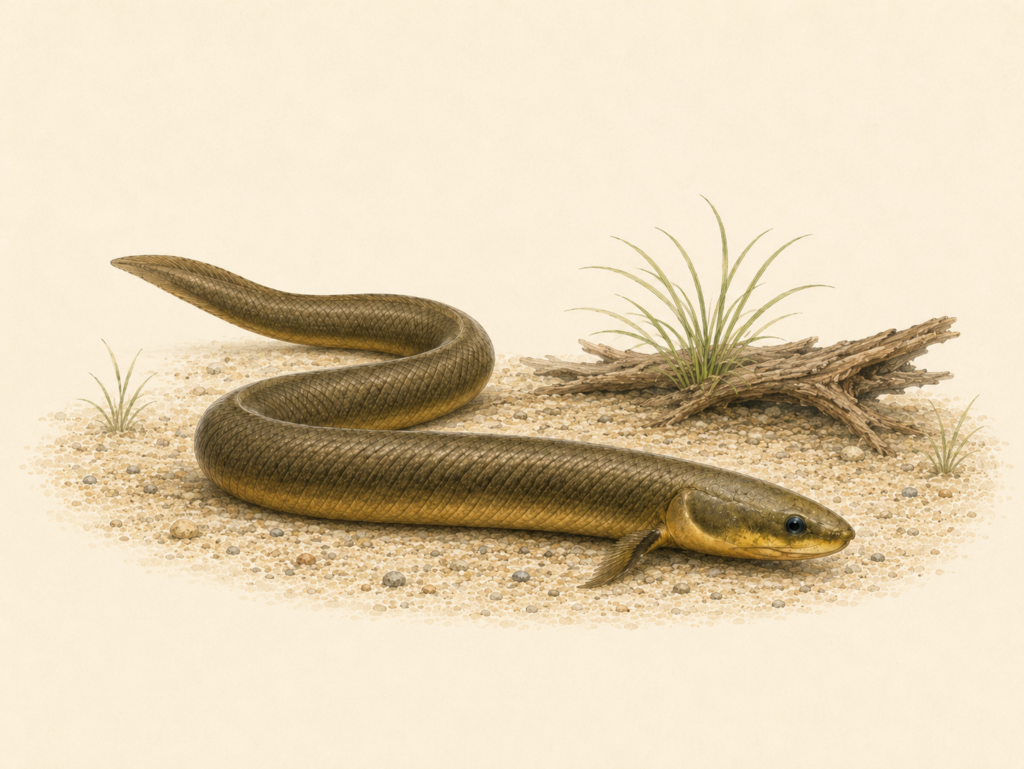
The Reed Fish is immediately recognisable thanks to its long, slender, almost snake-like body. Adults typically reach between 30 and 40 cm in the aquarium, though wild specimens and particularly well-kept captive individuals may approach 50 cm. The body is cylindrical in cross-section, tapering to a narrow caudal region, and is covered in tough, diamond-shaped ganoid scales that are characteristic of the Polypteridae family. These scales have a slightly bony, armoured texture and lend the fish a segmented, almost mechanical appearance when it moves.
The base colouration is a warm olive-green to yellow-brown, with the ventral surface being noticeably paler – often a creamy yellow or off-white. The dorsal surface tends to be darker, and in good lighting conditions, individual scales may show subtle iridescent highlights. There is generally no patterning or barring on the body, giving the Reed Fish a clean, uniform look. The pectoral fins are small, rounded, and paddle-like, set on fleshy lobes that resemble miniature limbs – another nod to the species’ ancient lineage. These pectoral fins are used in a rowing motion that, combined with undulations of the body, gives the Reed Fish its characteristic sinuous locomotion.
One of the most distinctive anatomical features is the dorsal fin arrangement. Rather than possessing a single continuous dorsal fin, the Reed Fish has a series of small, flag-like dorsal finlets running along its back. These finlets can be raised and lowered independently and are tipped with short spines. The head is relatively small, slightly flattened, and bears a pair of prominent tubular nostrils that the fish uses to locate food by scent – a testament to its poor eyesight. The eyes themselves are small and somewhat bead-like, positioned high on the head. The mouth is moderately sized and subterminal, well-suited to foraging along the substrate and amongst dense vegetation.
Sexual dimorphism is minimal and difficult to discern in juveniles. In mature specimens, males may exhibit a slightly broader and more heavily lobed anal fin compared to females, and gravid females may appear marginally thicker through the midsection. However, reliable sexing often remains challenging even for experienced keepers.
Natural Habitat
The Reed Fish is found throughout the coastal river systems, lagoons, floodplains, and swampy lowlands of West Africa, with its range extending across Nigeria, Cameroon, Benin, and parts of the Republic of the Congo. It inhabits slow-moving or still waters with dense marginal vegetation, submerged roots, and abundant organic debris. These environments are typically characterised by warm water temperatures, soft to moderately hard water, and a slightly acidic to neutral pH. The substrate in these habitats is usually composed of mud, leaf litter, and decomposing plant matter.
In the wild, Reed Fish are closely associated with reed beds, floating vegetation mats, and tangled root systems, which provide both cover and a rich hunting ground for small invertebrates. They are primarily nocturnal, emerging at dusk to forage amongst the vegetation and returning to sheltered hiding spots during daylight hours. The waters they inhabit are frequently low in dissolved oxygen, and it is in these conditions that their ability to breathe atmospheric air via a modified swim bladder becomes essential. They will regularly rise to the surface to gulp air, supplementing their gill respiration.
The seasonal flooding patterns of West African river systems also play a role in their ecology. During the wet season, Reed Fish may move into newly inundated areas where food is plentiful and cover is abundant. During drier periods, they retreat to deeper permanent water bodies. This adaptability to changing conditions is one reason they tend to be relatively hardy in captivity, provided their basic environmental needs are met.
Tank Size and Setup
A minimum tank size of 250 litres is recommended for a single Reed Fish or a small group of two to three individuals. Given that these fish can reach 40 cm or more in length and are active swimmers during the evening and night, a tank with a generous footprint is more important than height. A tank measuring at least 120 cm in length and 45 cm in width provides adequate swimming space. If you plan to keep a larger group – which is advisable, as Reed Fish are gregarious and benefit from the company of their own kind – a tank of 400 litres or more is preferable.
A tightly fitting lid is absolutely essential. Reed Fish are notorious escape artists. Their slender, flexible bodies can squeeze through remarkably small gaps, and their ability to breathe air means they can survive for some time outside water. Every opening in the hood or lid must be sealed, including filter intake holes, cable entry points, and gaps around equipment. Many keepers use weighted lids or secure mesh coverings to prevent escapes. Failing to address this is one of the most common causes of Reed Fish mortality in home aquaria.
The aquascape should provide ample hiding places. Driftwood, smooth rocks, PVC pipe sections, and dense plantings all serve this purpose well. Hardy plants such as Anubias, Java Fern, and Vallisneria are good choices, as they tolerate the lower light levels that suit the Reed Fish’s nocturnal lifestyle and are robust enough to withstand contact with the fish’s body. Floating plants are also beneficial, as they dim the light and provide a sense of security. A soft substrate such as fine sand or smooth gravel is recommended, as the Reed Fish frequently rests on and moves across the bottom, and rough substrates can abrade its ventral surface.
Lighting should be subdued. The Reed Fish is most active in low light or darkness, and bright illumination tends to make it reclusive and stressed. If the tank houses live plants that require moderate lighting, floating plants or shaded areas created by decor will help the fish feel comfortable. Many keepers observe that their Reed Fish become significantly more active and visible once lighting intensity is reduced or a proper day-night cycle with dim evening periods is established.
Water Parameters
| Temperature | 22 – 28 °C |
| pH | 6.0 – 7.5 |
| General hardness (GH) | 5 – 15 dGH |
| Carbonate hardness (KH) | 3 – 10 dKH |
| Ammonia | 0 ppm |
| Nitrite | 0 ppm |
| Nitrate | Below 30 ppm |
The Reed Fish is reasonably tolerant of a range of water conditions, which is one of the factors that makes it suitable for aquarists with some experience. However, it does best in warm, slightly acidic to neutral water that is well-maintained. Stability is more important than hitting a precise number; sudden swings in temperature or pH are far more damaging than parameters that sit slightly outside the ideal range but remain consistent.
Regular water changes of 20 to 25 percent per week are recommended to keep nitrate levels in check and maintain overall water quality. As a carnivorous species that produces a moderate bioload, the Reed Fish benefits from diligent maintenance. Ammonia and nitrite must always read zero in a properly cycled aquarium. While the species’ air-breathing ability offers some resilience in low-oxygen conditions, this should never be used as a justification for poor water quality. Clean, well-oxygenated water with gentle surface agitation promotes the best health and activity levels.
It is worth noting that the Reed Fish requires access to the water surface to breathe atmospheric air. The gap between the water surface and the lid should be a few centimetres at minimum, and this airspace should be humid rather than cold and dry. A tight-fitting lid naturally traps warm, humid air above the water, which is ideal. If the air above the water is significantly colder than the water itself, the fish may be prone to respiratory issues when it surfaces to gulp air.
Filtration and Equipment
A good quality canister filter or large internal power filter is recommended for a Reed Fish aquarium. The filter should provide adequate biological and mechanical filtration to handle the bioload of a carnivorous species, but flow rates should be moderate rather than strong. Reed Fish naturally inhabit slow-moving or still waters and may become stressed in tanks with powerful currents. If your filter produces a strong outflow, use a spray bar, lily pipe, or baffle to diffuse the flow.
A reliable heater appropriate for the tank volume is essential, as the Reed Fish requires consistently warm water. In larger tanks, two heaters positioned at opposite ends help ensure even heat distribution. A heater guard is advisable, as the Reed Fish may rest against equipment and could be burned by an unprotected heater element.
An air pump is not strictly necessary given the species’ air-breathing capability, but gentle aeration can benefit overall water quality and the health of tank mates. Avoid airstones or powerheads that create excessive surface turbulence, as this can make it more difficult for the Reed Fish to comfortably access the surface for air gulps.
As previously emphasised, all equipment entry points in the lid must be sealed. This includes filter intake and outflow pipe openings, heater cable slots, and airline tubing holes. Foam or mesh cut to fit around these entry points is a simple and effective solution. Some keepers also cover the filter intake with a sponge pre-filter to prevent the Reed Fish’s slender tail from being drawn into the intake, particularly in the case of juvenile specimens.
Diet and Feeding
The Reed Fish is a dedicated carnivore and must be offered a protein-rich diet. In the wild, it feeds on small invertebrates, insect larvae, worms, and crustaceans, locating prey primarily through its excellent sense of smell. In captivity, the diet should reflect this natural preference as closely as possible.
Excellent staple foods include frozen bloodworms, frozen brine shrimp, frozen Mysis shrimp, and chopped earthworms or nightcrawlers. Live foods such as blackworms, tubifex worms, and small earthworms are eagerly accepted and can be used to encourage feeding in newly imported or shy specimens. Prawns and mussel meat, finely chopped, are also readily taken. Some keepers successfully wean their Reed Fish onto sinking carnivore pellets or wafers, which can serve as a convenient dietary component alongside fresh and frozen offerings. However, not all individuals accept prepared foods, and patience is required during the weaning process.
Reed Fish are slow, deliberate feeders and can easily be outcompeted by faster tank mates at feeding time. This is a critical consideration when planning the community. Target feeding with tweezers or a feeding pipette, particularly after lights-out when the fish is most active, is often the most reliable way to ensure the Reed Fish eats well. Placing food directly in front of the fish or near its favoured hiding spot helps it locate the meal without competition.
Feed adult Reed Fish once daily or every other day. Juveniles benefit from daily feeding to support growth. Avoid overfeeding, as uneaten food will quickly foul the water. It is good practice to observe the fish during feeding to confirm it is eating, especially in a community tank where food theft by faster species is a genuine risk.
Behaviour and Temperament
The Reed Fish is a peaceful, predominantly nocturnal species. During the day, it typically remains hidden amongst decor, plants, or in purpose-built caves and tubes. As dusk falls, it emerges to explore the tank, weaving through vegetation and along the substrate in its characteristic serpentine fashion. This crepuscular and nocturnal activity pattern is entirely normal and should not be mistaken for lethargy or ill health.
Reed Fish are social and do best when kept in groups of three or more. Solitary individuals tend to be more reclusive and may show signs of stress, such as persistent hiding and reluctance to feed. In a group, they frequently interact, often resting in close proximity or even piling on top of one another in favoured hiding spots. This gregarious nature is one of the species’ most endearing qualities and is a strong argument for keeping multiple specimens.
Toward other species, the Reed Fish is generally non-aggressive. It will not bother fish that are too large to swallow. However, it is an opportunistic predator and will eat any fish or invertebrate small enough to fit in its mouth. This includes small tetras, young livebearers, dwarf shrimp, and small catfish. It does not chase or attack larger fish, and aggressive fin-nipping species are more of a threat to it than it is to them.
The air-breathing behaviour is a notable aspect of the Reed Fish’s daily routine. Multiple times per hour, particularly in warm or still water, the fish will rise to the surface, take a gulp of air, and return to the bottom. This is completely normal and should not cause alarm. However, if the fish is gasping at the surface continuously or appears unable to submerge comfortably, this may indicate a water quality issue that requires immediate attention.
Reed Fish can become surprisingly tame over time, learning to associate their keeper’s presence with feeding. Some individuals will take food directly from the hand or from tweezers, displaying a level of interactivity that is unusual for fish. Their inquisitive nature and willingness to explore make them genuinely engaging pets for those who appreciate their unique behaviour.
Tank Mates
Choosing appropriate tank mates for the Reed Fish requires balancing several factors. The ideal companions are peaceful to moderately active species that are too large to be eaten, not aggressive enough to bully or harass the Reed Fish, and not so fast at feeding that they monopolise all the food before the Reed Fish can eat. Slow-moving or bottom-dwelling species that share similar water parameter requirements tend to work best. Avoid very small fish, territorial cichlids, and any species known for fin-nipping, as the Reed Fish’s elongated body makes it a tempting target for such behaviour.
Good tank mates
- Congo Tetra – A peaceful, appropriately sized West African tetra that occupies the mid-water column and shares similar water parameter preferences.
- African Butterfly Fish – A calm surface-dweller from the same geographic region that coexists well without competing for space or food.
- Synodontis eupterus – A robust, peaceful catfish that is too large to be eaten and shares the Reed Fish’s preference for dim lighting and hiding spots.
- Angelfish – Tall-bodied and generally peaceful enough to coexist with Reed Fish, provided the tank is spacious and well-structured.
- Kribensis – A small but assertive cichlid that is generally too large to be eaten by an adult Reed Fish and occupies a different niche in the tank.
- Bristlenose Pleco – A hardy, algae-eating catfish that stays out of the Reed Fish’s way and is not competitive at feeding time.
- Senegal Bichir – A close relative that shares similar care requirements and coexists peacefully, creating an engaging polypterid community.
- Pearl Gourami – A peaceful, medium-sized gourami that is too large to be consumed and does not exhibit aggressive tendencies.
- Leopard Bush Fish – Another West African species with compatible temperament and water requirements, adding variety to a biotope-style setup.
Fish to avoid
- Tiger Barb – A persistent fin-nipper that will harass the Reed Fish’s elongated body and finnage relentlessly.
- Neon Tetra – Far too small and will almost certainly be consumed by an adult Reed Fish during nocturnal foraging.
- Oscar – A large, aggressive cichlid that may bully or even injure the Reed Fish, especially during territorial disputes.
- Red-Tail Catfish – Grows far too large and will eventually view the Reed Fish as prey.
- Jaguar Cichlid – Highly aggressive and territorial, posing a serious threat to the peaceful Reed Fish.
- Cherry Shrimp – Tiny invertebrates that will be quickly devoured by the Reed Fish.
- Serpae Tetra – Known for nipping at long-bodied or slow-moving species, making it a poor companion.
- Flowerhorn – An aggressive, territorial hybrid cichlid that is entirely incompatible with the peaceful Reed Fish.
Breeding
Breeding the Reed Fish in captivity is extremely rare and has only been achieved on a handful of documented occasions. The species is not commercially bred in any significant numbers, and virtually all specimens available in the hobby are wild-caught. For this reason, breeding is rated at the expert level, and most keepers should not expect to reproduce this species in a home aquarium.
In the wild, breeding is thought to be associated with seasonal flooding and the onset of the rainy season, which brings changes in water chemistry, temperature, and food availability. Males court females using their enlarged anal fin, which is thought to function as a clasping or guiding organ during mating. The female deposits adhesive eggs amongst dense vegetation, and the male fertilises them externally. Beyond this, detailed information about wild spawning behaviour remains limited.
Aquarists who have attempted to breed Reed Fish in captivity report that a large, densely planted tank with soft, slightly acidic water and a seasonal simulation involving a gradual temperature drop followed by a slow increase may encourage spawning behaviour. A varied diet rich in live foods is also considered important for conditioning breeding adults. However, success remains exceptionally uncommon, and rearing fry – which are tiny and fragile at hatching – presents additional challenges.
Sexing adult Reed Fish is difficult but not impossible. Males typically have a thicker, more muscular anal fin with more prominent fin rays, while females may appear slightly heavier-bodied when in breeding condition. Keeping a group of six or more individuals increases the likelihood of having both sexes represented, which is a necessary starting point for any breeding attempt.
Common Diseases
The Reed Fish is generally a hardy species that, when kept in appropriate conditions, is not especially prone to disease. However, it is susceptible to the same range of freshwater ailments that affect other tropical fish, and its scaleless or semi-scaleless nature means that certain treatments must be used with caution.
Ich (white spot disease) can affect Reed Fish, particularly after the stress of transport or introduction to a new tank. The characteristic white cysts are visible on the body and fins. Reed Fish are sensitive to many conventional ich medications, particularly those containing copper or malachite green, and dosing must be reduced – typically to half the standard dose – or alternative heat-based treatments used. Raising the tank temperature gradually to 30 °C over 48 hours, combined with increased aeration, is often the safest approach for treating ich in a tank containing Reed Fish.
Bacterial infections, including fin rot and skin ulcers, can occur if water quality deteriorates or the fish sustains an injury, for example from a rough substrate or a failed escape attempt. Maintaining pristine water conditions and addressing any physical damage promptly with aquarium salt baths or a mild antibacterial treatment can prevent minor issues from becoming serious.
Internal parasites are a concern with wild-caught specimens. Newly acquired Reed Fish should be quarantined for a minimum of two to four weeks before being introduced to an established community tank. During quarantine, observation for signs of parasitism – such as weight loss despite feeding, white or stringy faeces, or bloating – allows for early treatment with appropriate anti-parasitic medications.
Stress-related issues, including appetite loss and lethargy, are common when the Reed Fish is kept alone, in a brightly lit tank, or without adequate hiding places. These problems are environmental rather than pathological and are resolved by addressing the underlying husbandry issue. Ensuring the tank is escape-proof also prevents injuries sustained during out-of-water episodes, which can lead to secondary infections and desiccation damage.
FAQs
Can Reed Fish live with shrimp?
No. Reed Fish are carnivorous and will readily consume any shrimp small enough to fit in their mouths. This includes popular aquarium species such as Cherry Shrimp, Amano Shrimp, and Ghost Shrimp. Even larger shrimp species may be harassed or gradually picked off during nocturnal foraging sessions. If you wish to keep ornamental shrimp, they should be housed in a separate tank.
Why does my Reed Fish keep going to the surface?
Reed Fish are obligate air-breathers and must periodically rise to the surface to gulp atmospheric air. This is entirely normal behaviour and not a sign of distress. They possess a modified swim bladder that functions as a primitive lung, supplementing their gill respiration. However, if the fish is constantly at the surface, gasping rapidly, or appears unable to settle at the bottom, this may indicate poor water quality or inadequate dissolved oxygen levels, and you should test your water parameters immediately.
How many Reed Fish should I keep together?
Reed Fish are social animals and are best kept in groups of three or more. Solitary specimens tend to be shy, reclusive, and may refuse food more readily. In a group, they display more natural behaviour, are more confident, and often become visible earlier in the evening. A tank of 250 litres is suitable for a small group of two to three, while larger groups require proportionally more space – aim for 400 litres or more for a group of five or six.
Will my Reed Fish escape from the tank?
Yes, almost certainly, if given the opportunity. Reed Fish are among the most determined escape artists in the freshwater hobby. Their slender, flexible bodies can squeeze through gaps that appear far too small. Every opening in the tank lid must be sealed, including filter and heater cable slots, feeding hatches, and any structural gaps. Use aquarium-safe mesh, foam, or custom-cut acrylic panels to block potential escape routes. A secure lid is not optional with this species – it is a fundamental requirement.
Can Reed Fish be kept with bichirs?
Yes, Reed Fish generally coexist well with bichirs, as they are closely related and share similar care requirements, temperaments, and activity patterns. Species such as the Senegal Bichir and Delhezi Bichir make particularly good companions. However, ensure that the bichirs are not significantly larger than the Reed Fish, as very large bichir species may become territorial or view smaller tank mates as food. Provide ample hiding places so that each fish can establish its own retreat.
Related Guides
- Senegal Bichir – A closely related polypterid species with overlapping care requirements, ideal for a West African biotope community.
- Congo Tetra – A colourful, peaceful schooling fish from the same geographic region that makes an excellent mid-water companion for the Reed Fish.
- Leopard Bush Fish – Another West African predatory species with compatible temperament, useful for building an authentic biotope aquarium.
- African Butterfly Fish – A surface-dwelling oddball from West Africa that pairs well with the Reed Fish in a themed setup.
- Delhezi Bichir – A moderately sized bichir species frequently kept alongside Reed Fish in polypterid-themed aquaria.