Quick Summary
The Spottedsail Dwarf Barb is a tiny, peaceful shoaling fish ideally suited to well-planted nano tanks and community setups with other small, gentle species. If you can maintain stable water quality in a modestly sized aquarium and keep them in groups of eight or more, they are a rewarding and undemanding species for aquarists of all experience levels.
🐠 Build a tank around this species
In this guide:
- Introduction
- Quick Stats
- Appearance
- Natural Habitat
- Tank Size and Setup
- Water Parameters
- Diet and Feeding
- Behaviour and Temperament
- Tank Mates
- Breeding
Introduction
The Spottedsail Dwarf Barb (Pethia phutunio) is one of the smallest barb species available in the freshwater aquarium hobby, yet what it lacks in size it more than makes up for in character. Native to shallow, vegetated waters of northeastern India and Bangladesh (lower Ganges-Brahmaputra basin), this diminutive cyprinid has been quietly winning over nano-tank enthusiasts and planted-aquarium keepers for years. Its understated elegance – a translucent body punctuated by bold dark markings – makes it a compelling alternative to the more commonly seen rasboras and tetras that dominate the small-fish market.
Despite its modest profile in the mainstream hobby, Pethia phutunio is an excellent species for beginners and experienced aquarists alike. It is hardy within its preferred parameter range, tolerant of a reasonable variety of water conditions, and breeds readily in captivity when given appropriate conditions. Its peaceful disposition means it can be housed with virtually any similarly sized, non-aggressive tank mate, making it a versatile choice for community nano tanks.
Often confused with or sold alongside the Golden Dwarf Barb (Pethia gelius), the Spottedsail Dwarf Barb is a distinct species with its own particular charm. The two share similar care requirements and can even be kept together, but the Spottedsail Dwarf Barb tends to display slightly bolder patterning and a subtly different body shape. Understanding the differences is worthwhile for hobbyists who appreciate the diversity within this genus.
This guide covers everything you need to know to keep Spottedsail Dwarf Barbs healthy and thriving, from tank setup and water parameters through to breeding and disease prevention.
Quick Stats
| Scientific name | Pethia phutunio |
|---|---|
| Common names | Pygmy Barb, Dwarf Barb, Phutunio Barb |
| Family | Cyprinidae |
| Origin | Northeastern India and Bangladesh (lower Ganges-Brahmaputra basin) |
| Adult size | 2.5 cm |
| Lifespan | 3–5 years |
| Difficulty | Easy |
| Breeding difficulty | Moderate |
| Temperature | 18–26 °C |
| pH | 6–7.5 |
| GH | 2–12 dGH |
| KH | 1–8 dKH |
| Minimum tank size | 40 L |
| Conservation status | Least Concern (IUCN) |
Appearance
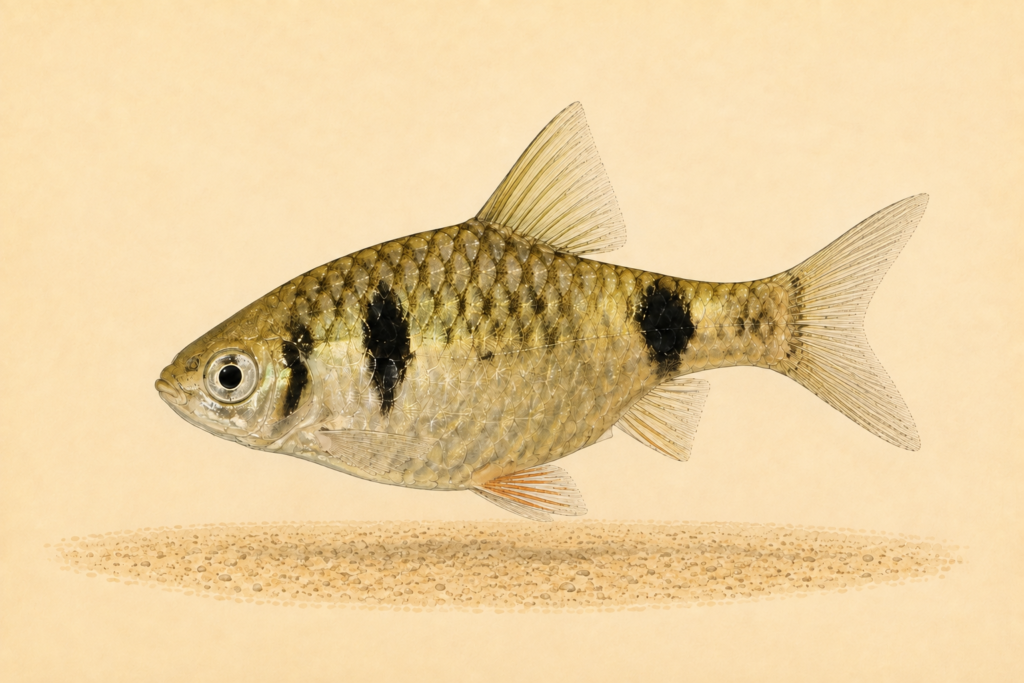
The Spottedsail Dwarf Barb is a petite, laterally compressed fish that typically reaches only 2 to 3 centimetres in total length at maturity. Its body is somewhat deeper in proportion to its length than many other micro-barbs, giving it a rounded, stocky silhouette despite its tiny size. The base body colour ranges from a pale silvery-gold to a warm yellowish hue, often with a subtle translucency that allows internal structures to be faintly visible, particularly in younger or less well-conditioned specimens.
The most distinctive feature of this species – and the one that gives it its common name – is a prominent dark blotch located at the base of the dorsal fin. This spot is typically deep black and sharply defined, creating a striking contrast against the lighter body. A second, often slightly less bold, dark spot is usually present on the caudal peduncle (the narrow region just before the tail fin). In well-conditioned individuals, a faint third spot may sometimes be discernible on the flank, though this varies between individuals and populations.
The fins are generally transparent to very lightly tinted, sometimes showing a faint yellowish or orange wash, particularly in males during breeding condition. Males tend to be slightly slimmer and may develop more vivid colouration, with a subtle reddish or orange flush appearing along the flanks and the base of the fins when in peak condition. Females are typically a little deeper-bodied, especially when gravid, and tend to display less intense colouration.
Juveniles are paler overall and may not display the full extent of their dark spotting until they reach a few months of age. As the fish matures and settles into a well-maintained aquarium with good nutrition, its colours intensify noticeably. A dark substrate and dense planting tend to bring out the best colouration in this species, as the fish feels more secure and its pigmentation deepens in response.
Natural Habitat
In the wild, Pethia phutunio inhabits slow-moving or still freshwater bodies across a wide swathe of the Indian subcontinent. Its range spans parts of India (particularly the Ganges and Brahmaputra river basins, as well as drainages along the eastern coast), Bangladesh, Sri Lanka, Nepal, and possibly parts of Pakistan. Within these regions, it is typically found in shallow marginal habitats – the edges of ponds, ditches, rice paddies, floodplain pools, and sluggish streams.
These habitats share several common characteristics. The water is generally soft to moderately hard, slightly acidic to neutral, and often stained with tannins from decomposing leaf litter and organic matter. The substrate tends to be muddy or silty, with an abundance of submerged and emergent vegetation providing cover and foraging opportunities. Water depth is frequently very shallow, sometimes just a few centimetres during the dry season, though populations may move into deeper, more permanent water bodies when seasonal conditions change.
The presence of dense aquatic vegetation is a key feature of the Spottedsail Dwarf Barb’s natural environment. Floating plants, submerged grasses, and marginal vegetation provide shelter from predators, spawning sites, and a rich supply of microorganisms and tiny invertebrates on which the fish feeds. The water movement in these habitats is minimal, and the lighting is often subdued by overhanging terrestrial vegetation and floating plant cover.
Understanding these natural conditions is invaluable when designing an aquarium for this species. The emphasis should be on gentle or negligible water flow, abundant planting, a soft or fine-grained substrate, and moderate to subdued lighting. Replicating even some of these elements will help the fish feel secure and display its natural behaviours.
Tank Size and Setup
A minimum tank volume of 40 litres is recommended for a group of Spottedsail Dwarf Barbs. Given their tiny adult size and relatively modest swimming requirements, they do not need large aquaria, but sufficient volume is important for maintaining stable water parameters – something that becomes increasingly challenging as tank size decreases. A 40 to 60 litre tank comfortably houses a group of eight to twelve individuals with room for plants and decor.
The tank should be set up with dense planting as a priority. Live plants serve multiple purposes for this species: they provide cover and security, reduce stress, create visual barriers that help diffuse any minor social squabbles within the shoal, and offer surfaces on which biofilm and microorganisms can grow as supplementary food sources. Excellent plant choices include fine-leaved species such as Cabomba, Myriophyllum, Ceratopteris thalictroides (Indian Fern), Hygrophila polysperma, and various mosses like Java Moss (Taxiphyllum barbieri). Floating plants such as Salvinia, Pistia, or Amazon Frogbit (Limnobium laevigatum) are highly beneficial, as they diffuse light and mimic the shaded conditions of the fish’s natural habitat.
The substrate can be fine sand, aquasoil, or a fine-grained gravel. Dark substrates tend to show off the fish’s colours better and are more representative of the silty bottoms found in their wild habitats. Avoid large, coarse gravels that might trap food and detritus in hard-to-clean gaps.
Driftwood, leaf litter (such as Indian Almond leaves or dried oak leaves), and smooth stones can be used to create additional cover and to release beneficial tannins into the water. A modest layer of leaf litter on the substrate provides a naturalistic look and supports populations of infusoria and other microorganisms that the fish will graze on.
Lighting should be moderate. While the plants will need adequate light to grow, the fish prefers somewhat subdued conditions. Floating plants are the simplest way to achieve a balance, providing shade beneath while allowing rooted plants to receive enough light from areas not covered by floaters.
Ensure the tank has a secure lid or cover. Although Spottedsail Dwarf Barbs are not prolific jumpers, small fish can occasionally leap when startled, and a lid also reduces evaporation and helps maintain stable temperatures.
Water Parameters
The Spottedsail Dwarf Barb is reasonably adaptable when it comes to water chemistry, but it does best in soft to moderately hard, slightly acidic to neutral water. Stability is more important than hitting an exact number, so focus on maintaining consistent conditions rather than chasing a perfect reading.
| Temperature | 18 – 26 C |
| pH | 6.0 – 7.5 |
| General hardness (GH) | 2 – 12 dGH |
| Carbonate hardness (KH) | 1 – 8 dKH |
| Ammonia | 0 ppm |
| Nitrite | 0 ppm |
| Nitrate | Below 20 ppm |
One notable aspect of this species’ care is its tolerance of relatively cool water. Unlike many tropical fish that require consistently warm temperatures above 24 C, the Spottedsail Dwarf Barb can thrive at room temperature in many climates, making a heater optional in homes that maintain indoor temperatures of around 20 C or above. This makes it an excellent candidate for unheated nano tanks. However, if the room temperature fluctuates significantly between day and night or across seasons, a small heater set to around 22 C provides useful stability.
Ammonia and nitrite must always be at zero. Like all fish, Pethia phutunio is sensitive to these compounds, and their tiny body mass means even small spikes can be lethal. Regular water changes of 20 to 30 per cent weekly, combined with appropriate filtration, will help keep nitrate levels comfortably below 20 ppm.
If your tap water is very hard or alkaline, consider using a blend of reverse osmosis (RO) water and tap water to achieve softer, slightly acidic conditions. Adding Indian Almond leaves, alder cones, or driftwood can gently lower pH and release beneficial humic substances.
Filtration and Equipment
Filtration for a Spottedsail Dwarf Barb tank should be gentle and reliable. These are small fish from still or very slow-moving waters, and they do not appreciate strong currents. A sponge filter is arguably the ideal choice for a nano tank housing this species. Sponge filters provide excellent biological filtration, produce minimal water movement, and pose no risk of trapping tiny fish or fry. They are also inexpensive and extremely easy to maintain.
If you prefer a hang-on-back (HOB) filter or a small internal canister, choose a model with an adjustable flow rate and turn it down to the lowest effective setting. You can further baffle the outflow using a sponge pre-filter cover, a spray bar, or by directing the output against the glass to dissipate the current. The goal is to maintain biological filtration capacity without creating a strong flow that exhausts these small fish.
A heater may or may not be necessary depending on your ambient room temperature. If you choose to use one, a small, thermostatically controlled heater rated for your tank size is sufficient. Place it near the filter outflow to help distribute heat evenly.
Lighting should be chosen primarily to support plant growth, as the fish itself has no special lighting requirements. A basic LED fixture on a timer set for 8 to 10 hours per day works well. If the fish seem skittish or washed-out under bright lighting, increasing the floating plant cover is the simplest remedy.
A thermometer (either a simple stick-on or a digital probe) is essential for monitoring temperature, especially in unheated setups where seasonal fluctuations might catch you off guard. A reliable liquid-based water test kit for ammonia, nitrite, nitrate, and pH is also indispensable for ongoing maintenance.
Diet and Feeding
In the wild, Spottedsail Dwarf Barbs are omnivorous micro-predators and opportunistic grazers. They feed primarily on tiny invertebrates, insect larvae, zooplankton, algae, and detritus. Their small mouths limit them to correspondingly small food items, so in captivity, all foods should be appropriately sized.
A high-quality micro-pellet or finely crushed flake food should form the staple of their diet. Look for products designed for small or nano fish, as these are formulated in a size that Spottedsail Dwarf Barbs can easily consume. Feed only what the group can finish within two to three minutes, once or twice daily. Overfeeding is a common pitfall in nano tanks, where uneaten food can quickly foul the water.
Supplement the staple diet regularly with small live or frozen foods. Excellent choices include baby brine shrimp (Artemia nauplii), micro worms, grindal worms, daphnia, and cyclops. These foods are nutritionally rich and encourage natural foraging behaviour. Live foods are particularly valuable for conditioning breeding adults and for feeding newly free-swimming fry.
Blanched vegetable matter, such as tiny pieces of courgette or spinach, can be offered occasionally but is not a dietary priority for this species. They will also graze on biofilm and algae that develop on plant leaves, driftwood, and other surfaces, which is another reason why a well-established, densely planted tank is beneficial.
Variety is important. Rotating between two or three different dry foods and supplementing with live or frozen options two to three times per week will help ensure the fish receive a complete nutritional profile and remain in vibrant health.
Behaviour and Temperament
The Spottedsail Dwarf Barb is a peaceful, shoaling species that is most comfortable and confident when kept in groups. A minimum group size of eight is strongly recommended, with ten to twelve or more being ideal. In smaller numbers, individuals tend to be timid, spending much of their time hiding amongst plants and displaying pale, stressed colouration. In a suitably sized group, however, they become noticeably bolder, spending more time in open water and displaying their colours to best effect.
Within the shoal, there is a gentle social dynamic. Males may occasionally display to one another, flaring their fins and intensifying their colours in low-key sparring bouts, but these interactions are entirely harmless and do not escalate to fin-nipping or injury. This mild competitive behaviour is, in fact, one of the more engaging aspects of keeping a group, as it encourages the males to show their best colouration.
The species occupies primarily the mid-water and lower portions of the water column, though they will venture to all levels when feeding or exploring. They tend to move through the tank as a loose, somewhat dispersed shoal rather than in the tight, coordinated formations seen in some tetra species. Their swimming style is active but unhurried, with frequent pauses to investigate plant surfaces and decor for tiny food items.
They are not aggressive towards other species and will not nip fins or harass tank mates. Their small size and gentle temperament make them vulnerable to bullying from larger or more boisterous fish, so tank mate selection should prioritise similarly sized, peaceful species.
Spottedsail Dwarf Barbs may initially be shy when first introduced to a new tank, but given a few days to settle in – especially with adequate plant cover and dim lighting – they typically become confident and visible. Sudden loud noises, vibrations, or rapid changes in lighting can startle them, so placing the tank in a relatively calm area of the home is advisable.
Tank Mates
The Spottedsail Dwarf Barb’s small size and gentle nature make it an ideal community fish for nano setups, provided all tank mates share a similar disposition. The key considerations are size compatibility (avoiding anything large enough to view the barbs as food), temperament (avoiding aggressive or highly active species that would outcompete or stress them), and water parameter overlap. The best companions are other small, peaceful species from similar soft-water, planted-tank environments.
Good tank mates
- Golden Dwarf Barb – A close relative with virtually identical care requirements and a similarly peaceful temperament, making them an excellent companion species.
- Ember Tetra – A tiny, peaceful tetra that thrives in the same warm, soft-water conditions and adds a lovely contrast of colour.
- Chili Rasbora – Another nano-sized shoaling fish with a gentle nature, well suited to the same densely planted setups.
- Celestial Pearl Danio – A small, peaceful danio that appreciates planted tanks and overlapping water parameters.
- Pygmy Corydoras – A diminutive bottom-dwelling catfish that peacefully occupies different tank levels and helps clean up fallen food.
- Asian Stone Catfish – A tiny, docile catfish that stays near the substrate and poses no threat to small barbs.
- Amano Shrimp – Excellent algae-eating invertebrates that coexist peacefully with small barbs and contribute to tank cleanliness.
- Cherry Shrimp – Hardy dwarf shrimp that do well alongside small, non-predatory fish, though some adult shrimp predation of very young shrimplets is possible.
- Nerite Snail – Peaceful algae-grazing snails that are entirely compatible and help maintain clean surfaces in the tank.
Fish to avoid
- Angelfish – Far too large and predatory; would readily consume Spottedsail Dwarf Barbs.
- Tiger Barb – Much larger and considerably more boisterous; known fin-nippers that would bully and stress these tiny barbs.
- Betta – Although sometimes kept in nano tanks, bettas can be territorial and aggressive, posing a risk to small, defenceless shoaling fish.
- Convict Cichlid – An aggressive, territorial cichlid that would harass and likely kill small barbs.
- Chinese Algae Eater – Grows large and becomes increasingly aggressive and territorial with age, posing a serious threat to small tank mates.
- Paradise Fish – A robust and sometimes aggressive species that would easily dominate and stress tiny barbs in a shared tank.
Breeding
Breeding Spottedsail Dwarf Barbs in captivity is achievable and can be a rewarding project for hobbyists willing to set up a dedicated breeding arrangement. Like most small cyprinids, they are egg-scattering spawners that provide no parental care, and the adults will readily eat their own eggs and fry if given the opportunity.
To condition a breeding group, separate the sexes if possible and feed generously with high-quality live or frozen foods such as baby brine shrimp, daphnia, and micro worms for one to two weeks. Females will become noticeably plumper as they fill with eggs, and males will display more vivid colouration.
Prepare a small breeding tank of around 10 to 20 litres. Fill it with water matching the parameters of the main tank but aim for the softer, slightly acidic end of the range (pH 6.0 to 6.5, GH 2 to 6 dGH). The temperature can be raised slightly to around 24 to 26 C to encourage spawning. Place a layer of fine-leaved plants or spawning mops on the bottom to catch the eggs, or use a mesh grid that allows eggs to fall through but prevents the adults from reaching them.
Introduce a well-conditioned pair or a small group (two males to one female, or a similar ratio) into the breeding tank in the evening. Spawning typically occurs in the early morning hours. The female scatters small, adhesive eggs amongst the plants or substrate, and the male fertilises them. A single spawning event may produce anywhere from 50 to over 100 eggs, though the number varies considerably.
Remove the adults immediately after spawning to prevent egg predation. The eggs are tiny, clear to slightly amber, and will hatch in approximately 24 to 48 hours at 24 to 26 C. The fry are extremely small and will initially absorb their yolk sacs before becoming free-swimming after a further two to three days.
First foods for the fry should be infusoria, commercially available liquid fry food, or very finely powdered dry food. After a week or so, they can usually accept freshly hatched baby brine shrimp. Growth is slow but steady, and the fry will begin to show their characteristic dark spots after several weeks. Maintain impeccable water quality in the fry tank with gentle sponge filtration and very frequent, small water changes.
Common Diseases
The Spottedsail Dwarf Barb is a generally hardy species and is not predisposed to any species-specific diseases. However, like all freshwater fish, it is susceptible to common aquarium ailments, particularly when water quality is poor, the fish is stressed, or new additions introduce pathogens.
Ich (White Spot Disease) is perhaps the most frequently encountered illness. It presents as small, white, grain-of-salt-like cysts on the body and fins. It is almost always triggered by stress, temperature fluctuations, or the introduction of infected fish. Treatment involves gradually raising the water temperature to around 28 to 30 C (if the fish can tolerate it) and/or using a proprietary ich treatment at a dose appropriate for small, sensitive fish. Half-doses are sometimes recommended for very small species.
Fin rot is another common condition, typically resulting from poor water quality or physical damage. It manifests as fraying, discolouration, or erosion of the fin edges. Improving water quality through increased water changes is often sufficient to resolve mild cases, with antibacterial treatments reserved for more advanced infections.
Fungal infections can occur on damaged skin or gills and appear as white, cotton-like growths. They are usually secondary to an existing injury or bacterial infection. Antifungal treatments are effective, but addressing the underlying cause is essential for long-term resolution.
Internal parasites may occasionally be present, particularly in wild-caught specimens. Signs include weight loss, lethargy, and stringy, white faeces despite normal feeding. Antiparasitic medications designed for internal worms and flagellates can be used if an infestation is suspected.
Prevention is always preferable to treatment. Quarantine all new fish for a minimum of two weeks before adding them to an established tank. Maintain excellent water quality through regular testing and water changes. Feed a varied, nutritious diet. Avoid sudden changes in temperature, pH, or other parameters. These simple measures will go a long way towards keeping your Spottedsail Dwarf Barbs healthy throughout their lives.
FAQs
How many Spottedsail Dwarf Barbs should I keep together?
A minimum of eight is recommended, with ten to twelve or more being preferable. This species is a social shoaling fish that becomes stressed, timid, and dull-coloured when kept in insufficient numbers. In a larger group, the fish are more confident, more active, and display much better colouration, as the security of the shoal encourages natural behaviour and mild social interactions between males.
Can Spottedsail Dwarf Barbs live in an unheated tank?
Yes, in many cases they can. This species tolerates temperatures as low as 18 C and does well at typical room temperatures of 20 to 24 C. If your home stays within this range consistently, a heater is not strictly necessary. However, if indoor temperatures drop significantly at night or during colder months, a small heater set to around 20 to 22 C provides a useful safety net against harmful fluctuations.
What is the difference between the Spottedsail Dwarf Barb and the Golden Dwarf Barb?
The Spottedsail Dwarf Barb (Pethia phutunio) and the Golden Dwarf Barb (Pethia gelius) are closely related species within the same genus, and they are sometimes confused in the trade. Both are tiny, peaceful barbs suited to nano tanks. The Spottedsail Dwarf Barb generally has a more prominent dark spot at the dorsal fin base and tends to display slightly different proportions and marking patterns compared to the Golden Dwarf Barb, which often shows a more golden-yellow body hue. Their care requirements are virtually identical, and they can be kept together without issue.
Will Spottedsail Dwarf Barbs eat cherry shrimp?
Adult Spottedsail Dwarf Barbs are generally safe with adult cherry shrimp. However, very small shrimplets may occasionally be picked off, as they fall within the size range of the tiny invertebrates that constitute part of this fish’s natural diet. If maintaining a breeding colony of shrimp is a priority, providing very dense plant cover, including mosses and floating plants, will give shrimplets places to hide and significantly improve their survival rate.
Are Spottedsail Dwarf Barbs suitable for a planted tank?
Absolutely. They are one of the best fish for planted nano tanks. They do not uproot or damage plants, they benefit enormously from the cover and microhabitats that dense planting provides, and their small bioload is easily managed by a healthy plant mass. A well-planted tank with floating cover closely mimics their natural habitat and brings out the best in their behaviour and colouration.
Related Guides
- Golden Dwarf Barb Care Guide – A close relative with almost identical care needs, often kept alongside the Spottedsail Dwarf Barb in nano community setups.
- Ember Tetra Care Guide – Another excellent nano-tank species that pairs beautifully with small barbs in planted aquaria.
- Chili Rasbora Care Guide – A tiny rasbora with overlapping care requirements, ideal for hobbyists exploring the world of nano fish.
- Pygmy Corydoras Care Guide – A diminutive bottom-dwelling companion species that complements small barbs in community nano tanks.
- Cherry Shrimp Care Guide – Hardy dwarf shrimp that are among the most popular invertebrate tank mates for small, peaceful fish like the Spottedsail Dwarf Barb.