Quick summary
The Combtail Betta is an easy-to-keep, hardy variant with fin rays that extend slightly beyond the webbing, making it a good choice for beginners who like the textured look of a Crowntail but want sturdier, less fragile finnage. It needs at least a 20 litre tank with stable, clean water, gentle filtration, and smooth decor to protect its delicate ray tips, and breeding is rated moderate difficulty due to the space and effort required to raise fry.
🐠 Build a tank around this fish
In this guide:
- Introduction
- Quick Stats
- Appearance
- Varieties and Morphs
- Natural Habitat
- Tank Size and Setup
- Water Parameters
- Filtration and Equipment
- Diet and Feeding
- Behaviour and Temperament
- Tank Mates
- Breeding
- Common Diseases
- FAQs
Introduction
The Combtail Betta is a distinctive tail-type variant of the domestic Betta splendens, sitting neatly between the elegant sweep of a Veiltail and the dramatic spikes of a Crowntail. Created by crossing Veiltail and Crowntail genetics, the Combtail displays fin rays that extend slightly beyond the webbing of the tail and other finnage, producing a subtle serrated or “comb-like” edge. The effect is less extreme than a true Crowntail – where rays can extend well beyond half the tail’s web – but more textured and intricate than a standard Veiltail or Halfmoon.
Because the Combtail is genetically a midpoint between two established tail types, it often appears in spawns where breeders are working with Crowntail lines, sometimes intentionally and sometimes as a natural result of outcrossing. Fish labelled as Combtails in the trade may vary considerably in how pronounced their ray extensions are, and some hobbyists use the term interchangeably with “half-sun” when the base spread is wider. Understanding where the Combtail sits on this spectrum is key to appreciating – and properly caring for – its unique finnage.
As a variant of Betta splendens, the Combtail shares the same fundamental care requirements as any domestic betta. For readers wanting a comprehensive overview of baseline betta husbandry – including the nitrogen cycle, general health, and day-to-day maintenance – our full Betta Fish Care Guide covers everything you need to know. This guide focuses specifically on what makes the Combtail different: its finnage characteristics, the genetic relationship to Crowntail and Veiltail lines, and the particular considerations that its unique fin structure demands in terms of tank setup, water quality, and long-term care.
Quick Stats
| Scientific name | Betta splendens var. Combtail |
|---|---|
| Common names | Comb Tail Betta, Half Crowntail Betta |
| Family | Osphronemidae |
| Origin | Southeast Asia (Thailand, Cambodia, Laos, Vietnam) |
| Adult size | 7 cm |
| Lifespan | 3–5 years |
| Difficulty | Easy |
| Breeding difficulty | Moderate |
| Temperature | 24–28 °C |
| pH | 6–7.5 |
| GH | 3–12 dGH |
| KH | 2–8 dKH |
| Minimum tank size | 20 L |
| Conservation status | Not evaluated (captive-bred variant); wild Betta splendens is Vulnerable (IUCN) |
Appearance
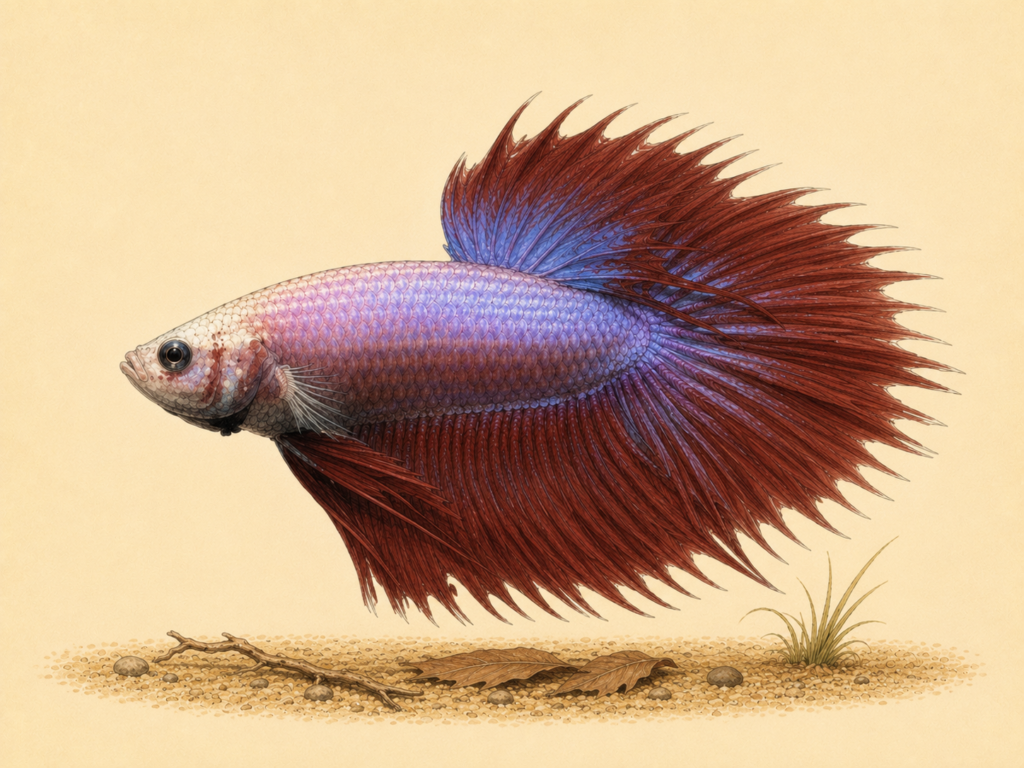
The defining feature of the Combtail Betta is the subtle extension of fin rays beyond the webbing of the caudal (tail), anal, and sometimes dorsal fins. Unlike a Crowntail, where the rays can extend dramatically – often protruding more than one-third beyond the web – the Combtail’s ray extensions are shorter and more uniform, typically extending only a small fraction beyond the membrane. This produces a gently serrated or scalloped edge that resembles the teeth of a comb, hence the name.
The overall tail spread of a Combtail varies depending on the specific genetic background. Fish derived from crosses involving wider-spread parents (such as Halfmoon Crowntails or Plakat Crowntails) may show a broader tail base with the comb effect distributed across a larger area. Those with Veiltail heritage tend to have a more tapered, downward-sweeping caudal fin with the ray extensions visible along the trailing edge. In well-bred specimens, the comb effect is even and symmetrical, with each ray extending to a roughly equal length.
Body shape is typical of domestic Betta splendens: a streamlined, laterally compressed form with an upturned mouth and prominent opercular (gill) covers. Males are generally larger-finned and more intensely coloured than females, though female Combtails also display the characteristic ray extensions to a lesser degree. The ventral (pelvic) fins are long and slender, and in males these too may show slight ray separation at the tips.
Combtails are available in the full spectrum of betta colours, including solid reds, blues, blacks, whites, and multicolour patterns such as marble, butterfly, koi, and galaxy. Iridescent scaling is common, particularly in blue and green variants, and the extended rays can catch light beautifully when the fish flares. Because the Combtail is essentially a fin-type variant rather than a colour morph, it can be combined with virtually any colour or pattern gene.
One practical consideration regarding appearance is fin condition. The partially extended rays of a Combtail are more delicate than fully webbed fins but less fragile than the long, unsupported rays of a true Crowntail. This makes the Combtail a somewhat hardier choice for keepers who like the aesthetic of ray extensions but want to reduce the risk of fin damage. That said, the ray tips are still susceptible to curling, splitting, or erosion if water quality is poor or the environment contains rough surfaces.
Varieties and Morphs
Because the Combtail is itself a variant rather than a base species, the concept of “varieties” relates primarily to the degree of ray extension and the underlying tail spread, as well as the wide range of colour genetics that can be layered onto the Combtail fin type.
In terms of fin genetics, the Combtail occupies a spectrum. At one end are fish with very mild ray extensions that are barely distinguishable from a standard Veiltail or Halfmoon – these are sometimes sold without the Combtail label at all. At the other end are fish approaching true Crowntail expression, where the rays extend further and the webbing between them recedes more noticeably. Breeders sometimes use the term “half-sun” for Combtails with a wide Halfmoon-like spread of 180 degrees or more, combined with the comb-edged finnage.
The Combtail trait can appear on several base tail shapes. The most common are:
- Veiltail Combtail – the classic pairing, with a sweeping asymmetrical tail showing gentle ray extensions along the trailing edge.
- Delta Combtail – a triangular tail with moderate spread and even comb edges on all sides.
- Halfmoon Combtail (Half-Sun) – a full 180-degree spread with ray extensions, highly prized when symmetrical.
- Plakat Combtail – short-finned fish showing the comb trait on compact finnage, producing a robust and active variant.
Colour varieties are independent of the Combtail fin type and encompass the full range seen in domestic bettas. Particularly striking combinations include metallic or copper Combtails, where the iridescent scales complement the textured fin edges, and bicolour or butterfly patterns, where the colour break occurs partway along the fin and the ray extensions display a different hue from the webbing.
Female Combtails are less commonly sold under the Combtail label because their shorter finnage makes the ray extensions less visually obvious. However, genetically they carry the same traits and will pass them on to offspring. Experienced breeders examine female fins closely under strong light to identify the subtle comb effect when selecting breeding stock.
Natural Habitat
As a captive-bred variant, the Combtail Betta does not exist in the wild. However, its ancestor, Betta splendens, is native to the shallow, slow-moving freshwater habitats of Southeast Asia, particularly Thailand (formerly Siam), Cambodia, Laos, and Vietnam. Understanding these natural conditions provides useful context for replicating an appropriate captive environment.
Wild Betta splendens inhabit rice paddies, shallow ponds, marshes, flood plains, and the margins of slow streams. These habitats are characterised by warm temperatures, soft to moderately hard water, slightly acidic to neutral pH, and abundant vegetation. The water is often stained with tannins from decaying plant matter, giving it a brownish tint. Depth is frequently very shallow – sometimes just a few centimetres during the dry season – but the total surface area is large enough for the fish to establish territories.
Dense aquatic and emergent vegetation provides cover, foraging grounds, and anchor points for bubble nests. The substrate is typically mud or fine sediment, and water flow is minimal or absent. This still-water preference is important for all domestic betta variants, but especially so for the Combtail, whose partially extended rays create slightly more drag than fully webbed fins. While the Combtail handles current better than a Crowntail (whose extremely long, unsupported rays can struggle in even moderate flow), it still benefits from a calm environment.
The labyrinth organ – a specialised respiratory structure found in all Osphronemidae – allows Betta splendens to breathe atmospheric air, an adaptation to the low-oxygen conditions common in their native habitat. This is true of all domestic variants, including the Combtail, and means they must always have access to the water surface.
Tank Size and Setup
The minimum recommended tank size for a single Combtail Betta is 20 litres, though 30 litres or more is preferable and provides a more stable environment. While bettas can survive in smaller volumes, the Combtail’s finnage benefits from the improved water quality that a larger volume maintains more easily. Extended fin rays are among the first structures to show damage when water conditions deteriorate, so extra volume acts as a buffer.
When setting up a tank specifically for a Combtail, the primary consideration is avoiding anything that could snag, tear, or erode the delicate ray extensions. This means choosing decor with smooth edges and no sharp points. Driftwood should be sanded if necessary, and any artificial decorations should pass the “tights test” – if a pair of tights dragged across the surface snags, the item is too rough for a betta’s fins. The Combtail’s rays are sturdier than a Crowntail’s, but they are still more vulnerable than the fully webbed fins of a Veiltail or Halfmoon.
Live plants are the ideal choice for a Combtail tank. They provide cover without the risk of sharp edges, help maintain water quality by absorbing nitrates, and create a naturalistic environment that reduces stress. Excellent plant choices include Anubias species (which thrive attached to hardscape rather than planted in substrate), Java Fern, Java Moss, Cryptocoryne species, and floating plants such as Salvinia or Amazon Frogbit. Floating plants are particularly beneficial as they diffuse overhead light and give the betta a sense of security near the surface, where it naturally spends much of its time.
Substrate choice is largely a matter of preference, but fine gravel or sand is gentle on the fish if it ventures near the bottom. Avoid substrates with rough or jagged particles. A dark substrate tends to bring out the best colouration in bettas, as they often appear washed out over pale or reflective surfaces.
Lighting should be moderate. Bettas do not require intense light, and overly bright conditions can cause stress and encourage algae growth. If growing live plants, a standard LED aquarium light on a timer providing 8 to 10 hours of light per day is sufficient. A gentle photoperiod helps regulate the fish’s circadian rhythm.
A tight-fitting lid or cover is essential. All Betta splendens are capable jumpers, and the Combtail is no exception. Additionally, a lid helps maintain the warm, humid air layer above the water surface that bettas need for comfortable use of their labyrinth organ. Breathing cold, dry air can cause respiratory issues over time.
Water Parameters
Maintaining stable, clean water is arguably the single most important factor in keeping a Combtail Betta in good health – and this is even more true for the Combtail than for fully webbed varieties. The partially extended fin rays are exposed tissue with limited webbing support, making them highly sensitive to dissolved waste products, particularly ammonia and nitrite. Even low-level chronic exposure to these toxins can cause ray erosion, curling, and increased susceptibility to bacterial and fungal infections.
| Temperature | 24 – 28 °C |
| pH | 6.0 – 7.5 |
| General hardness (GH) | 3 – 12 dGH |
| Carbonate hardness (KH) | 2 – 8 dKH |
| Ammonia | 0 ppm |
| Nitrite | 0 ppm |
| Nitrate | Below 20 ppm |
Temperature stability is crucial. Bettas are tropical fish and do not tolerate temperature swings well. A reliable, adjustable heater is a necessity in most climates, and the heater should be appropriately sized for the tank volume. For tanks of 20 to 40 litres, a 25-watt to 50-watt heater is usually adequate. Use a separate thermometer to verify the heater’s accuracy, as built-in thermostats can drift over time.
Soft to moderately hard water is preferred. Extremely hard water (above 15 dGH) can be tolerated but is not ideal for long-term health or breeding. If your tap water is very hard, consider blending with RO (reverse osmosis) water and remineralising to achieve the target range. Indian almond leaves (Terminalia catappa) or alder cones can be added to the tank to release beneficial tannins that slightly soften the water and provide mild antibacterial properties – many betta keepers find these particularly helpful for maintaining fin condition.
Weekly water changes of 20 to 30 per cent are recommended for most Combtail setups. In smaller tanks or those without live plants, more frequent changes may be necessary to keep nitrate levels below 20 ppm. Always treat replacement water with a quality dechlorinator and match the temperature to the tank before adding it.
Filtration and Equipment
Filtration for a Combtail Betta tank must balance effective biological and mechanical filtration with minimal water flow. The Combtail’s partially extended rays create more drag than a short-finned fish’s tail, and strong current forces the fish to work harder to maintain position, leading to stress and potential fin damage over time.
Sponge filters are widely regarded as the best option for betta tanks of all types, and the Combtail is no exception. They provide excellent biological filtration, generate only gentle water movement, and pose zero risk of fin entrapment. An air-driven sponge filter rated for the tank’s volume, paired with an adjustable air pump, allows you to fine-tune the flow rate easily. If you prefer a hang-on-back (HOB) filter, choose a model with an adjustable flow control and baffle the output if necessary using a piece of filter sponge or a pre-filter attachment.
Internal power filters can work if their output is reduced and redirected, but canister filters are generally overkill for the small tanks typically used for bettas. Whatever filter type you choose, ensure there are no intake slots or grilles that could trap fin rays. Cover intakes with a fine sponge pre-filter.
A heater is essential equipment, as discussed in the water parameters section. Choose a fully submersible, adjustable heater with a reliable thermostat. In very small tanks (under 20 litres), a preset mini heater can be used, but adjustable models offer better control.
Additional useful equipment includes a digital thermometer (stick-on LCD strips are less accurate), a gravel vacuum for substrate cleaning during water changes, and a basic liquid test kit for monitoring ammonia, nitrite, nitrate, and pH. Test strips are convenient but less precise than liquid reagent kits for ongoing monitoring.
Lighting, as mentioned in the tank setup section, should be moderate and controlled by a timer. Avoid leaving lights on for more than 10 hours per day. If the tank receives direct sunlight, position it to minimise this exposure, as sunlight promotes algae growth and can cause temperature fluctuations.
Diet and Feeding
The Combtail Betta’s dietary requirements are the same as those of any domestic Betta splendens – it is a carnivore that thrives on a protein-rich diet. However, there is an aspect of feeding that is particularly relevant to the Combtail: nutrition has a direct and visible impact on fin condition. A well-fed Combtail with a varied, high-quality diet will maintain strong, well-defined ray extensions with vibrant colour, while a poorly nourished fish may develop brittle, curling, or fading fins.
A high-quality betta-specific pellet should form the staple diet. Look for products where whole fish or insect meal is the first ingredient, with a protein content of at least 40 per cent. Feed two to three small meals per day, offering only as much as the fish can consume in about two minutes per feeding. Bettas have small stomachs – roughly the size of their eye – and overfeeding is a common mistake that leads to bloating, constipation, and water quality issues.
Supplement the staple pellet with a rotating variety of frozen and live foods. Excellent options include bloodworms, daphnia, brine shrimp, mosquito larvae, and tubifex worms. Daphnia is particularly valuable as an occasional food because its high fibre content acts as a mild digestive aid, helping to prevent the constipation and bloating that bettas are prone to. Live foods stimulate natural hunting behaviour and are eagerly accepted.
Freeze-dried foods are a convenient alternative to frozen options but should be pre-soaked in tank water for a few minutes before feeding. Dry freeze-dried foods can expand in the fish’s stomach and cause discomfort. They are also lower in nutritional value than their frozen or live equivalents, so they should not replace fresh options entirely.
One day of fasting per week is a common and beneficial practice. It allows the digestive system to clear fully and reduces the risk of bloating. This is standard advice for all bettas, and the Combtail is no different in this regard.
Behaviour and Temperament
The Combtail Betta shares the characteristic temperament of all domestic Betta splendens: males are territorial and aggressive towards other males of their species, while generally being curious, interactive, and even personable with their keepers. Females tend to be less aggressive but can still be feisty, particularly in confined spaces.
One behavioural note specific to the Combtail relates to its finnage and activity level. Because the Combtail’s fins are lighter and less cumbersome than those of heavily finned varieties like Halfmoons or Rosetails, Combtails tend to be more agile and active swimmers. They navigate their environment with greater ease and are less prone to the lethargy and resting behaviour that can be seen in bettas carrying extremely heavy finnage. This makes the Combtail an excellent choice for keepers who want a visually interesting betta that is also lively and engaging to watch.
Flaring – the display behaviour where a male spreads his gill covers and extends all fins to appear larger – is particularly striking in Combtails. The extended rays fan out and create a jagged, dramatic silhouette that is more complex than a smooth-edged tail type. Brief flaring sessions (a minute or two) stimulated by a mirror or the sight of another betta can be beneficial exercise, but prolonged or chronic flaring is stressful and should be avoided. If your Combtail is flaring constantly, check for reflections on the glass, nearby tanks with visible bettas, or other environmental stressors.
Combtails are intelligent fish that can learn to recognise their keeper and may come to the front of the tank at feeding time. They can be trained to follow a finger, swim through hoops, and perform other simple tricks using food rewards. Environmental enrichment – rearranging decor occasionally, providing floating objects to investigate, or adding leaf litter – helps keep them mentally stimulated.
Like all bettas, Combtails are labyrinth breathers and will regularly visit the surface to gulp air. This is normal behaviour and not a sign of oxygen deprivation. Ensure the surface is not completely covered by floating plants, leaving gaps for easy access.
Tank Mates
Choosing tank mates for a Combtail Betta requires the same careful consideration as for any betta, with one additional factor: the Combtail’s extended fin rays, while sturdier than a Crowntail’s, are still more vulnerable to nipping than the solid fins of a Plakat. Potential tank mates should be peaceful species that are not known fin nippers, and they should not be brightly coloured or long-finned enough to trigger the betta’s territorial aggression. A tank of at least 40 litres is recommended when keeping a Combtail with other species, as the extra space reduces territorial stress significantly. Always have a backup plan to separate fish if aggression occurs, as individual bettas vary widely in their tolerance of companions.
Good tank mates
- Ember Tetra – Tiny, peaceful, and subtly coloured, these tetras occupy the mid-water column and are too small and quick to interest most bettas.
- Pygmy Corydoras – Bottom-dwelling and extremely peaceful, these miniature catfish stay out of the betta’s preferred zones and add activity to the lower tank.
- Amano Shrimp – Large enough to avoid being eaten by most bettas, these industrious shrimp are excellent algae cleaners and generally ignored by Combtails.
- Harlequin Rasbora – A classic peaceful shoaling fish with muted colouration that rarely provokes betta aggression when kept in groups of six or more.
- Ramshorn Snail – Hardy and unobtrusive, these snails help clean up uneaten food and algae without bothering the betta in any way.
- Kuhli Loach – Nocturnal and bottom-dwelling, these eel-like loaches are shy and occupy a completely different niche in the tank to the betta.
- Celestial Pearl Danio – Small, peaceful, and beautifully patterned, these micro fish do well in planted tanks that suit Combtails perfectly.
- Mystery Snail – Peaceful, large enough to be left alone, and entertaining to watch; they also help control algae and detritus.
Fish to avoid
- Tiger Barb – Notorious fin nippers that will relentlessly target the Combtail’s extended rays, causing severe damage and stress.
- Serpae Tetra – Known for nippy behaviour within groups and towards other species, making them a poor choice with any long-finned betta.
- Chinese Algae Eater – Becomes increasingly aggressive and territorial with age, and may latch onto the betta’s body or fins.
- Paradise Fish – Another labyrinth fish with territorial tendencies; housing two territorial labyrinth species together usually ends badly.
- Dwarf Gourami – Closely related and similar in body shape, which often triggers mutual aggression; also competes for the same surface territory.
- Convict Cichlid – Far too aggressive and territorial for a community with any betta, and will quickly dominate and injure the Combtail.
- Red Tail Shark – Highly territorial bottom-dwellers that become aggressive in small tanks and may chase and stress the betta.
- Angelfish – Can be aggressive, grow much larger than bettas, and their flowing fins may trigger the betta’s territorial instinct, causing conflict from both sides.
Breeding
Breeding Combtail Bettas is a rewarding endeavour that offers fascinating insights into betta fin genetics, but it requires planning, space, and a commitment to raising potentially hundreds of fry. The genetics of the Combtail are central to understanding what offspring to expect: because the Combtail sits between Veiltail and Crowntail on the fin-type spectrum, the outcomes of breeding depend heavily on the genetic background of both parents.
The Crowntail trait is generally considered to be recessive or at least partially recessive in its full expression. When a Crowntail is crossed with a Veiltail, the first generation (F1) offspring typically display the intermediate Combtail phenotype – rays extending only partially beyond the webbing. This is, in fact, the original way most Combtails arise. If two Combtails are bred together, the F2 generation will typically show a range of fin types: some approaching full Crowntail, some closer to Veiltail, and many falling in the Combtail range. Breeders aiming to produce consistent Combtails should select parents that both display the desired degree of ray extension.
To breed Combtails, begin by conditioning a healthy male and female separately with high-quality live and frozen foods for one to two weeks. The female should be plump with eggs, visible as a pale or yellowish patch near her vent (the ovipositor). Select a breeding tank of at least 20 litres, filled to a depth of 10 to 15 centimetres, with a gentle sponge filter or no filter, a heater set to 27 to 28 degrees Celsius, and several hiding spots for the female, such as dense plants or a section of PVC pipe.
Introduce the male first and allow him to explore the breeding tank. Then place the female in a clear container (a hurricane glass or similar) within the tank so the pair can see each other without physical contact. The male should begin building a bubble nest at the surface within a day or two – often anchored to a floating plant leaf or piece of Indian almond leaf. When the female displays vertical barring (pale vertical stripes on her body) and appears receptive, release her into the tank.
Courtship can be rough. The male will chase and display, and some fin nipping and body contact is normal. Monitor closely, and separate the pair if aggression becomes excessive or if either fish is being injured. When spawning occurs, the pair will engage in a nuptial embrace beneath the bubble nest, with the male wrapping his body around the female. Eggs are released and fertilised, and the male collects them in his mouth and places them into the bubble nest.
After spawning, remove the female immediately, as the male will become aggressive in defending the nest. The male tends the eggs and fry for the first two to three days, retrieving any that fall from the nest. Once the fry are free-swimming (typically 48 to 72 hours after hatching), remove the male as well.
Free-swimming fry are tiny and require infusoria or commercially available liquid fry food for the first few days, graduating to freshly hatched brine shrimp (Artemia nauplii) after about a week. Maintain pristine water quality with gentle daily water changes of 10 to 15 per cent using aged, temperature-matched water. As the fry grow, they can be transitioned to micro worms, crushed pellets, and eventually standard betta foods.
Be prepared for the reality of betta breeding: a single spawn can produce 50 to 300 or more fry. As males mature, they will need to be separated into individual containers to prevent fighting. This requires significant space and resources, so plan accordingly before undertaking a breeding project.
Common Diseases
Combtail Bettas are susceptible to the same diseases as all domestic Betta splendens, but their particular fin structure means that certain conditions present differently or require slightly adjusted observation. The extended fin rays of a Combtail can be early indicators of water quality problems or the onset of disease, making them a useful barometer of overall health.
Fin rot is the most common ailment and the one most directly relevant to the Combtail. Caused by bacterial (and sometimes fungal) infection, fin rot typically begins at the edges of the fins and progresses inward. In a Combtail, the first sign is often the tips of the extended rays becoming ragged, discoloured (blackened or reddened), or receding. Because the ray extensions are already somewhat irregular in appearance, early fin rot can be easy to miss – familiarise yourself with your fish’s normal fin edge so you can spot changes quickly. Mild cases respond to improved water quality alone; more advanced infections may require treatment with antibacterial medications such as those containing methylene blue, kanamycin, or furan-based compounds.
Ich (white spot disease), caused by the protozoan Ichthyophthirius multifiliis, presents as small white spots resembling grains of salt on the body and fins. Treatment involves raising the temperature gradually to 30 degrees Celsius (if the fish tolerates it) and using a proprietary ich medication. Remove any activated carbon from the filter during treatment, as it will absorb the medication.
Velvet disease (Oodinium) is another parasitic condition that produces a fine, gold or rust-coloured dusting on the body and fins, best seen under a torch beam. It is highly contagious and can be fatal if untreated. Darken the tank (the parasite is photosynthetic) and treat with a copper-based medication.
Swim bladder disorder is common in bettas and often linked to overfeeding, constipation, or gulping air while eating floating pellets. Affected fish may float at odd angles, sink to the bottom, or struggle to maintain buoyancy. Fasting for two to three days and then offering daphnia as a high-fibre food often resolves mild cases.
Columnaris is a bacterial infection that can cause white or greyish patches on the body, frayed fins, and mouth fungus. It progresses quickly and requires prompt treatment with antibacterial medications. Good water quality and reduced stress are the best preventive measures.
Preventive care is always preferable to treatment. Maintain stable water parameters, perform regular water changes, avoid overfeeding, quarantine new tank mates or plants before introduction, and observe your Combtail daily for any changes in behaviour, appetite, or appearance. The ray extensions of the Combtail are among the most sensitive structures on the fish – if they begin to look ragged, curled, or discoloured, investigate water quality as a first step before assuming disease.