Quick summary
The Tiger Silver Dollar is a peaceful, plant-eating shoaling fish best suited to aquarists who can provide a large tank (450+ litres) and keep a group of at least five, making it a moderate difficulty choice rather than one for complete beginners. Expect it to eat most live plants, so plan your aquascape accordingly.
🐠 Build a tank around this species
In this guide:
- Introduction
- Quick Stats
- Appearance
- Natural Habitat
- Tank Size and Setup
- Water Parameters
- Filtration and Equipment
- Diet and Feeding
- Behaviour and Temperament
- Tank Mates
- Breeding
- Common Diseases
- FAQs
Introduction
The Tiger Silver Dollar, known scientifically as Metynnis fasciatus, is one of the most visually striking members of the silver dollar family. Named for the bold, dark vertical bars that adorn its gleaming silver flanks, this South American characin has been a favourite among keepers of large community aquariums for decades. It combines the classic disc-shaped profile of the silver dollar group with a pattern that immediately sets it apart from its plainer relatives.
Despite its somewhat imposing appearance and adult size, the Tiger Silver Dollar is a peaceful, shoaling herbivore that rarely troubles its tank mates. It does, however, demand generous swimming space and the company of its own kind to thrive. For aquarists willing to provide a suitably large aquarium, this species rewards with years of active, engaging behaviour and a distinctive presence that few other freshwater fish can match. This guide covers everything you need to know to keep Metynnis fasciatus healthy and content in the home aquarium, from water chemistry and diet through to breeding and disease prevention.
Quick Stats
| Scientific name | Metynnis fasciatus |
|---|---|
| Common names | Striped Silver Dollar, Banded Silver Dollar, Striped Metynnis |
| Family | Serrasalmidae |
| Origin | South America, Amazon and Orinoco basins (Brazil, Venezuela, Guyana) |
| Adult size | 15 cm |
| Lifespan | 10–15 years |
| Difficulty | Intermediate |
| Breeding difficulty | Advanced |
| Temperature | 24–28 °C |
| pH | 5.5–7.5 |
| GH | 4–18 dGH |
| KH | 2–12 dKH |
| Minimum tank size | 300 L |
| Conservation status | Least Concern (IUCN, assessed 2018) |
Appearance
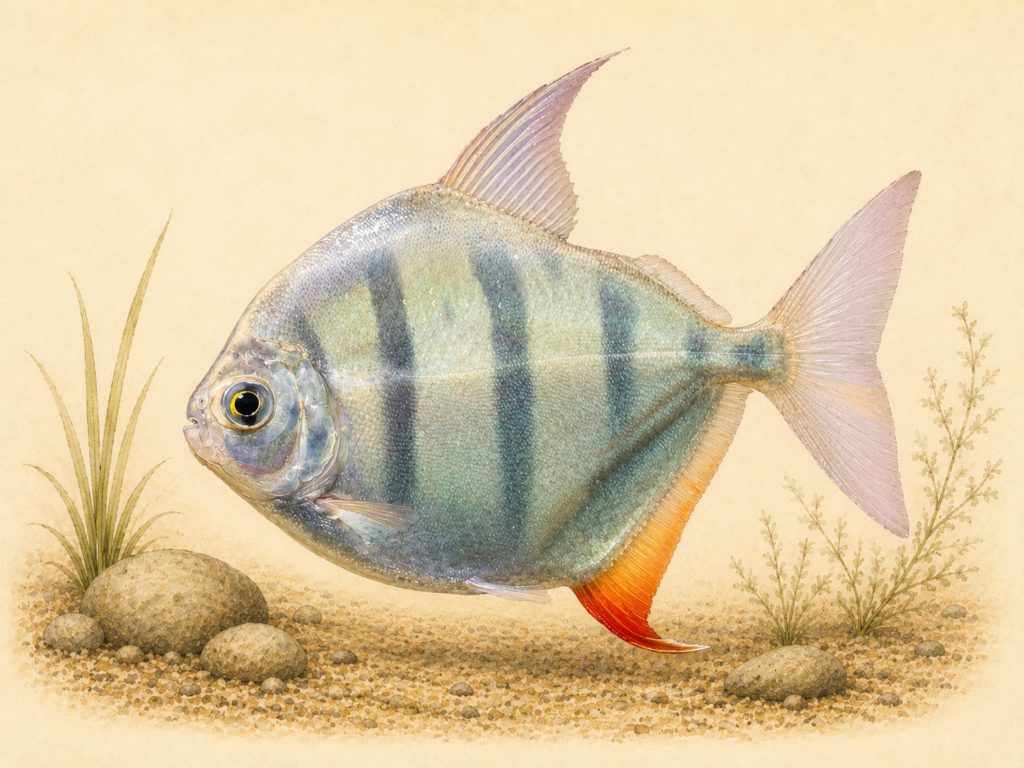
Metynnis fasciatus shares the laterally compressed, roughly circular body shape that gives all silver dollars their common name. The overall body colour is a bright, metallic silver with a slight greenish or yellowish cast depending on the lighting and the individual’s mood. The defining feature of this species is its series of dark vertical bars or bands running from the dorsal region down towards the belly, giving rise to the “tiger” moniker. The number, width, and intensity of these bars can vary between individuals and populations, and they may become more or less prominent depending on the fish’s stress level, social standing, and environmental conditions.
The dorsal fin is relatively tall and slightly pointed, while the anal fin is long-based and runs along much of the ventral profile, a characteristic shared with other serrasalmids. Both the dorsal and anal fins may show subtle hints of red or orange, particularly in mature males. The caudal fin is forked and powerful, well suited to the steady swimming this species prefers. The eye is large and silvery with a dark pupil, giving the fish an alert, watchful expression.
Juveniles tend to display their banding less distinctly, and the bars may appear faded or incomplete. As the fish matures, the contrast between the dark bars and the silver base colour intensifies considerably. In prime condition, a well-fed adult Tiger Silver Dollar is a genuinely handsome fish, its barred flanks flashing as it turns in the current. Sexual dimorphism is subtle: males are often slightly smaller and slimmer than females and may develop a more intensely coloured anal fin, sometimes with a reddish or orange edge, especially during the breeding season. Females tend to be deeper-bodied when viewed from the side, particularly when carrying eggs.
Natural Habitat
The Tiger Silver Dollar inhabits the slow-moving rivers, tributaries, flooded forests, and vegetated lakes of the Amazon and Orinoco basins. These environments are characterised by warm, soft to moderately hard water, often stained dark with tannins from decomposing leaf litter and submerged wood. During the wet season, vast areas of forest become inundated, and silver dollars move into these flooded zones to feed on the abundant vegetation, fruits, and seeds that fall from overhanging trees.
In these habitats, Metynnis fasciatus is typically found in loose shoals among submerged vegetation and marginal plant growth, where the dark vertical bars on its flanks may serve as disruptive camouflage against the dappled light filtering through aquatic plants and floating debris. The substrate in these environments ranges from soft mud and sand to tangled root systems and decaying plant matter. Water flow is generally gentle to moderate, and the fish prefer areas with some cover but also open stretches for swimming.
Understanding this natural environment is key to creating a successful aquarium setup. The warm temperatures, slightly acidic to neutral pH, and soft to moderate hardness found in their native waters should be replicated as closely as possible in captivity. The presence of vegetation, driftwood, and subdued lighting will also help these fish feel secure and display their best colours.
Tank Size and Setup
Given its adult size of up to 15 cm and its strong preference for shoaling, the Tiger Silver Dollar requires a spacious aquarium. A minimum of 450 litres is recommended for a group of five to six individuals, and larger is always better. These are active, mid-water swimmers that appreciate a tank with a significant horizontal footprint rather than one that is merely tall. An aquarium measuring at least 150 cm in length will allow the shoal to swim freely and exhibit natural behaviours.
When planning the interior layout, keep in mind that this species will consume most live plants with enthusiasm. Soft-leaved species will be devoured almost immediately, while tougher plants such as Anubias and Java Fern may last somewhat longer but are not immune to determined nibbling. Many experienced keepers opt for artificial plants, or they use robust species attached to driftwood where they are less accessible. Alternatively, fast-growing floating plants such as water lettuce or Amazon frogbit can be used as a sacrificial crop, providing cover while accepting that they will be regularly cropped by the fish.
Driftwood and smooth rocks make excellent hardscape choices, providing visual barriers and a sense of security without risking damage to the fish. Tiger Silver Dollars can be somewhat skittish, particularly when newly introduced, and will occasionally dash against the glass or decor if startled. Ensure that all hardscape elements are securely placed and that there are no sharp edges that could injure a panicking fish. A dark substrate, such as fine sand or rounded gravel in black or brown tones, will help the fish feel at ease and will enhance the contrast of their silver and black colouration.
A secure, tight-fitting lid is essential. Like many characins, Tiger Silver Dollars are capable jumpers, especially when startled or during acclimatisation. Gaps around filter inlets, heater cables, and airline tubing should all be covered or blocked. Lighting should be moderate; overly bright illumination can make these fish nervous and cause them to lose colour. Dimmed lighting, or light diffused by floating plants, is ideal.
Water Parameters
Metynnis fasciatus is reasonably adaptable when it comes to water chemistry, but it does best in conditions that approximate its natural habitat. Soft to moderately hard, slightly acidic to neutral water is ideal. Consistency is more important than hitting exact numbers, so once you have established a stable set of parameters within the recommended ranges, focus on maintaining them through regular water changes and diligent filter maintenance.
| Temperature | 24–28 °C |
| pH | 5.5–7.5 |
| General hardness (GH) | 4–18 dGH |
| Carbonate hardness (KH) | 2–12 dKH |
| Ammonia | 0 ppm |
| Nitrite | 0 ppm |
| Nitrate | Below 30 ppm |
Weekly water changes of 25–30% are strongly recommended to keep nitrate levels low and maintain overall water quality. Tiger Silver Dollars are somewhat sensitive to deteriorating conditions, and elevated nitrate can contribute to stress, loss of colour, and increased susceptibility to disease. If you are using driftwood and leaf litter to recreate a blackwater-style environment, be aware that these will gradually lower pH and soften the water over time, which is generally beneficial for this species but should be monitored to prevent sudden swings.
Filtration and Equipment
A robust filtration system is essential for a tank housing a group of Tiger Silver Dollars. These are relatively large, active fish that produce a moderate bioload, particularly given their primarily herbivorous diet, which generates a fair amount of plant waste. A high-quality external canister filter rated for at least 1.5 times the tank volume is a sensible starting point. Many keepers choose to run two filters for redundancy and to ensure thorough mechanical and biological filtration across the full length of the aquarium.
Water flow should be moderate. While Tiger Silver Dollars do not require the strong currents favoured by some riverine species, a gentle to moderate flow helps with oxygenation and waste distribution. Position the filter outlet to create a broad, even current across the middle of the tank where the fish swim, rather than a single powerful jet. Spray bars or lily pipes work well for this purpose.
A reliable heater, appropriately sized for the tank volume, is necessary to maintain stable tropical temperatures. In larger tanks, consider using two heaters placed at opposite ends to ensure even heat distribution. A thermometer placed away from the heater will help you verify that the entire tank is within the target range. An air stone or additional powerhead can provide supplementary oxygenation, which is particularly beneficial in warmer water where dissolved oxygen levels are naturally lower.
Lighting, as mentioned, should be moderate to subdued. LED fixtures with adjustable intensity or a dimming function are ideal, as they allow you to find a level that keeps both the fish and any remaining plants comfortable. A timer-controlled photoperiod of eight to ten hours per day will help establish a natural day-night rhythm and reduce algae growth.
Diet and Feeding
In the wild, Metynnis fasciatus is primarily herbivorous, feeding on aquatic plants, algae, fallen fruits, seeds, and occasionally small invertebrates. In the aquarium, this diet should be reflected by offering a varied selection of plant-based foods supplemented with occasional protein-rich treats.
The foundation of the diet should be high-quality spirulina-based flakes or pellets designed for herbivorous fish. These can be supplemented daily with blanched vegetables such as courgette (zucchini) slices, spinach, lettuce, shelled peas, and cucumber. Fresh vegetables should be blanched briefly in boiling water to soften them and then cooled before being placed in the tank. Remove any uneaten portions within a few hours to prevent them from fouling the water.
Algae wafers make a useful supplementary food, particularly for ensuring that all members of the shoal get a share, as they sink to the bottom where less dominant individuals can access them. Occasional treats of frozen or freeze-dried bloodworms, daphnia, or brine shrimp can be offered once or twice a week to add variety and provide additional protein, but these should not form a significant proportion of the diet. Overfeeding protein-rich foods can lead to digestive issues and excessive waste production in predominantly herbivorous species.
Feed two to three times daily in amounts that the fish can consume within a few minutes. Tiger Silver Dollars are enthusiastic eaters and will quickly learn to associate their keeper with food, often coming to the front of the tank at feeding time. This eagerness can make it tempting to overfeed, so discipline is important to maintain good water quality and prevent obesity.
Behaviour and Temperament
The Tiger Silver Dollar is a peaceful, shoaling species that spends the majority of its time swimming in the mid-water column. It is a gregarious fish that should always be kept in groups of at least five, though larger groups of eight or more will result in more natural behaviour, reduced stress, and a more impressive visual display. Solitary individuals or those kept in very small groups often become withdrawn, skittish, and prone to stress-related health problems.
Within the shoal, there is typically a loose hierarchy, but aggression is rare and generally limited to brief chases or displays during feeding. Tiger Silver Dollars are not territorial and do not establish or defend specific areas of the tank. They tend to move as a cohesive group, particularly when startled, and this coordinated shoaling behaviour is one of the most appealing aspects of keeping them.
One trait that keepers should be prepared for is their tendency to be easily spooked. Sudden movements near the tank, loud noises, or abrupt changes in lighting can cause the entire shoal to panic and dash erratically around the aquarium. This can occasionally result in injuries if the fish collide with the glass or hard decor. Placing the tank in a relatively calm area of the home, avoiding sudden changes in room lighting, and providing adequate cover within the aquarium will all help to minimise this behaviour. Over time, well-kept Tiger Silver Dollars do become bolder and more accustomed to their surroundings, particularly if they are fed consistently and not subjected to frequent disturbances.
Their plant-eating habits are worth reiterating in a behavioural context. This is not a species for a meticulously planted aquascape. They will methodically strip soft-leaved plants, and the resulting mess of floating plant fragments can be frustrating for keepers who were not expecting it. Understanding and accepting this behaviour from the outset is essential to a harmonious fishkeeping experience.
Tank Mates
The Tiger Silver Dollar’s peaceful nature and mid-water swimming habit make it compatible with a wide range of similarly sized, non-aggressive species. The key considerations when selecting tank mates are size, temperament, and activity level. Very small fish may be accidentally consumed or at least stressed by the presence of a shoal of large, active silver dollars, while overly aggressive or territorial species may bully or harass them. Ideal companions are medium to large, robust, and peaceful community fish that occupy different areas of the water column or share a similarly calm disposition.
Good tank mates
- Common Pleco (Hypostomus plecostomus), a hardy bottom-dweller that occupies different territory and is far too well-armoured to be troubled by silver dollars.
- Bristlenose Pleco (Ancistrus spp.), a smaller, algae-eating catfish that stays on the substrate and rarely interacts with mid-water swimmers.
- Clown Loach (Chromobotia macracanthus), another large, peaceful shoaling species that adds activity to the lower levels of the tank.
- Severum (Heros efasciatus), a calm, medium-sized cichlid that coexists well with silver dollars in spacious tanks.
- Geophagus (Geophagus spp.), Peaceful, earth-eating cichlids that complement silver dollars beautifully in a South American biotope.
- Blue Acara (Andinoacara pulcher), a generally peaceful cichlid of appropriate size that rarely shows aggression towards non-competing species.
- Flagtail Prochilodus (Semaprochilodus insignis), a large, active characin that shares similar water requirements and temperament.
- Common Silver Dollar (Metynnis hypsauchen), a closely related species that can be kept alongside Tiger Silver Dollars without issue, often forming mixed shoals.
- Giant Gourami (Osphronemus goramy), Suitable only in very large tanks, this gentle giant coexists peacefully with silver dollars.
- Synodontis Catfish (Synodontis spp.), Robust, nocturnal catfish that stay out of the silver dollars’ way and add interest to the lower tank levels.
Fish to avoid
- Neon Tetra (Paracheirodon innesi), far too small and may be accidentally consumed or perpetually stressed by the presence of much larger fish.
- Oscar (Astronotus ocellatus), a large, aggressive cichlid that may bully and injure the more timid silver dollars.
- Red-bellied Piranha (Pygocentrus nattereri), despite being a relative, piranhas are predatory and will likely attack or kill silver dollars.
- Jack Dempsey (Rocio octofasciata), an aggressive, territorial cichlid that can cause significant stress and physical harm.
- Flowerhorn Cichlid, highly aggressive and territorial, posing a serious threat to peaceful shoaling species.
- Guppy (Poecilia reticulata), far too small and delicate to be housed with large, active characins.
- Betta (Betta splendens), Incompatible in terms of both size and environmental needs, and likely to be stressed or harmed.
- Red Devil Cichlid (Amphilophus labiatus), Extremely aggressive and territorial, posing an unacceptable risk to silver dollars.
Breeding
Breeding the Tiger Silver Dollar in captivity is achievable but challenging, and it is not commonly accomplished by casual hobbyists. Success typically requires a dedicated breeding tank, a well-conditioned pair or small group, and careful manipulation of water conditions to simulate the onset of the rainy season that triggers spawning in the wild.
Sexing Metynnis fasciatus can be difficult outside of breeding condition. As noted earlier, males tend to be slightly slimmer and may develop a more colourful anal fin, while females are generally deeper-bodied. The most reliable method of obtaining a breeding pair is to raise a group of juveniles together and allow natural pair formation to occur as they mature.
The breeding tank should be large, ideally 300 litres or more, with soft, slightly acidic water at a temperature of 26–28 °C. Dim lighting and the presence of fine-leaved plants, whether real or artificial, will provide surfaces for egg deposition. Conditioning the pair with a varied, high-quality diet rich in vegetable matter, supplemented with occasional protein foods such as frozen bloodworm, for several weeks prior to spawning attempts will help bring both fish into peak condition.
Spawning is typically preceded by increased activity and courtship displays from the male, which may include circling, trembling alongside the female, and intensified colouration. The pair will eventually release eggs and milt simultaneously, with the eggs scattering among plants or settling on the substrate. A single spawning event can produce several hundred to over a thousand eggs, which are small, non-adhesive, and translucent.
The adults should be removed after spawning, as they will readily consume their own eggs if given the opportunity. The eggs typically hatch within 60 to 72 hours at 27 °C, and the fry become free-swimming a few days later. Initial foods should be very fine, such as infusoria or liquid fry food, transitioning to newly hatched brine shrimp and crushed spirulina flake as the fry grow. Growth is relatively slow, and it may take several months for the young fish to begin displaying the characteristic banding of the species.
Common Diseases
Tiger Silver Dollars are generally robust fish when kept in appropriate conditions, but they are susceptible to the same range of diseases that affect other tropical freshwater species. Maintaining excellent water quality, providing a balanced diet, and minimising stress are the most effective preventative measures.
White spot disease, also known as ich, caused by the protozoan parasite Ichthyophthirius multifiliis, is perhaps the most commonly encountered ailment. It presents as small white spots on the fins and body, often accompanied by flashing (rubbing against objects) and increased respiration. Treatment with a proprietary ich medication at the manufacturer’s recommended dose, combined with a gradual increase in temperature to 28–30 °C, is usually effective. Tiger Silver Dollars generally tolerate standard ich treatments well, but it is important to note that as members of the Serrasalmidae, they can be somewhat sensitive to certain medications, particularly those containing copper. Always check product labels and consider using half-doses initially if you are uncertain.
Bacterial infections, including fin rot and body ulcers, can occur in fish that are stressed, injured, or kept in poor water quality. These conditions typically present as frayed or eroded fins, reddened patches on the body, or open sores. Treatment involves improving water quality immediately through water changes, followed by the use of an appropriate antibacterial medication. Identifying and addressing the underlying cause of the stress, whether it is overcrowding, aggressive tank mates, or inadequate diet, is essential to prevent recurrence.
Skin and gill flukes, caused by various trematode parasites, can occasionally affect silver dollars, particularly those that have been recently imported or that share a tank with wild-caught fish. Symptoms include excessive mucus production, flashing, rapid gill movement, and lethargy. Treatment with an anti-parasite medication containing praziquantel or formalin is usually effective.
Hole-in-the-head disease, or head and lateral line erosion (HLLE), has been reported in silver dollars kept on poor diets or in suboptimal water conditions. It manifests as small, pitted erosions on the head and along the lateral line. While the exact cause is debated, it is strongly associated with dietary deficiencies, particularly a lack of vitamins and minerals, and elevated nitrate levels. Improving the diet, adding vitamin supplements, and bringing nitrate levels down through more frequent water changes are the primary treatments.
Intestinal parasites can also be a concern, especially in wild-caught specimens. Signs include weight loss despite a good appetite, white or stringy faeces, and a general decline in condition. Treatment with an appropriate internal anti-parasitic medication, administered via medicated food if possible, is the standard approach. Quarantining all new arrivals for a minimum of two to four weeks before introducing them to the main display tank is strongly advised to reduce the risk of introducing diseases or parasites to an established community.
FAQs
How many Tiger Silver Dollars should I keep together?
A minimum of five is recommended, but groups of eight or more are preferable. Tiger Silver Dollars are shoaling fish that rely on the presence of conspecifics for security and normal behaviour. Individuals kept alone or in pairs tend to become stressed, reclusive, and prone to health issues. A larger group also distributes any minor social interactions more evenly, reducing the risk of any single individual being picked on.
Will Tiger Silver Dollars eat all my plants?
Almost certainly, yes. Metynnis fasciatus is a committed herbivore that will make short work of most aquarium plants. Soft-leaved species such as Cabomba, Hygrophila, and Vallisneria will be consumed rapidly. Tougher species like Anubias and Java Fern may survive longer but are not guaranteed safe. If you wish to include live plants, consider fast-growing floating species as a renewable food source, or use artificial plants for decoration.
Can Tiger Silver Dollars be kept with piranhas?
This is strongly discouraged. Although both belong to the family Serrasalmidae, piranhas are predatory fish with powerful jaws and an aggressive nature, particularly when feeding. Tiger Silver Dollars, being peaceful herbivores, would be at significant risk of injury or death in a shared tank. The two groups have fundamentally different temperaments and dietary needs, and mixing them invites disaster.
How fast do Tiger Silver Dollars grow?
Growth rate depends on diet, water quality, and tank size, but under good conditions, juvenile Tiger Silver Dollars typically reach 7–8 cm within their first year. They continue to grow steadily, usually reaching their full adult size of 13–15 cm by around two to three years of age. Providing a spacious tank, a varied diet, and excellent water quality will support healthy, steady growth.
Are Tiger Silver Dollars suitable for beginners?
They are rated as moderate in difficulty rather than beginner-friendly, primarily because of their space requirements, their need to be kept in groups, and their sensitivity to water quality fluctuations. An aquarist who has some experience with tropical freshwater fish and who can commit to a large tank and regular maintenance will find them very manageable. Complete beginners would be better served by starting with smaller, hardier species and working up to silver dollars once they have developed their skills and understanding.
Related Guides
- Silver Dollar (Metynnis hypsauchen) Care Guide, a closely related species with similar care requirements, ideal for keepers who want to compare the two or consider a mixed-species shoal.
- Spotted Silver Dollar (Metynnis lippincottianus) Care Guide, another popular Metynnis species with distinctive spotted markings and comparable husbandry needs.
- Severum Care Guide, a peaceful South American cichlid that pairs beautifully with silver dollars in large community setups.
- Clown Loach Care Guide, an excellent bottom-dwelling companion species for Tiger Silver Dollars, with similarly gregarious habits.
- South American Biotope Tank Guide, a comprehensive overview of designing an authentic Amazonian biotope, which is an ideal setting for Tiger Silver Dollars.