Quick summary
The Bumblebee Cichlid is a striking but strongly territorial Mbuna best suited to aquarists with prior African cichlid experience, requiring a tank of 189 litres or more, a rocky aquascape, and careful tank mate selection to manage its aggression. It is not recommended as a first fish, so beginners may want to start with a calmer Mbuna like the Yellow Lab Cichlid before moving on to this species.
🐠 Build a tank around this species
In this guide:
- Introduction
- Quick Stats
- Appearance
- Natural Habitat
- Tank Size and Setup
- Water Parameters
- Filtration and Equipment
- Diet and Feeding
- Behaviour and Temperament
- Tank Mates
- Breeding
- Common Diseases
- FAQs
Introduction
The Bumblebee Cichlid, scientifically known as Pseudotropheus crabro, is one of the most visually striking members of the Mbuna group from Lake Malawi in East Africa. Named for its bold yellow and dark brown-black barring that recalls the pattern of a bumblebee, this species has been a firm favourite among African cichlid enthusiasts for decades. It is also sometimes referred to as the Hornet Cichlid or Chameleon Cichlid, the latter name referencing its remarkable ability to shift between dramatically different colour patterns depending on mood, dominance status, and social context.
What makes Pseudotropheus crabro particularly fascinating from a biological standpoint is its unusual ecological relationship with the large Bagrid catfish Bagrus meridionalis (locally known as Kampango) in Lake Malawi. In the wild, the Bumblebee Cichlid acts as a cleaner fish for the catfish Bagrus meridionalis, picking fish lice from its skin, while also stealing and eating the catfish’s eggs. This complex mutualistic-parasitic relationship is nearly unique among freshwater fish and gives the species a level of behavioural intrigue that extends well beyond its appearance.
In the aquarium, the Bumblebee Cichlid is a moderately challenging species to keep. It can grow to a respectable size for an Mbuna, it is notably aggressive, even by Mbuna standards, and it requires careful tank mate selection and a well-planned aquascape to thrive. However, for aquarists who are prepared for its temperament and spatial needs, it rewards with vibrant colour, active behaviour, and a genuinely engaging personality. This guide covers everything you need to know to keep Pseudotropheus crabro successfully in the home aquarium.
Quick Stats
| Scientific name | Pseudotropheus crabro |
|---|---|
| Common names | Hornet Cichlid, Chameleon Cichlid, Bumblebee Mouthbrooder |
| Family | Cichlidae |
| Origin | Lake Malawi, East Africa |
| Adult size | 20 cm |
| Difficulty | Intermediate |
| Breeding difficulty | Moderate |
| Temperature | 24–26 °C |
| pH | 7.5–8.5 |
| GH | 10–25 dGH |
| Minimum tank size | 189 L |
| Conservation status | Least Concern (IUCN, assessed 2018) |
Appearance
The Bumblebee Cichlid is a robust, laterally compressed Mbuna with a deep body profile and a relatively large head. Adults can reach up to 20 cm in total length. The mouth is subterminal and equipped with sturdy teeth adapted for scraping and picking at substrates, consistent with its omnivorous feeding strategy in the wild.
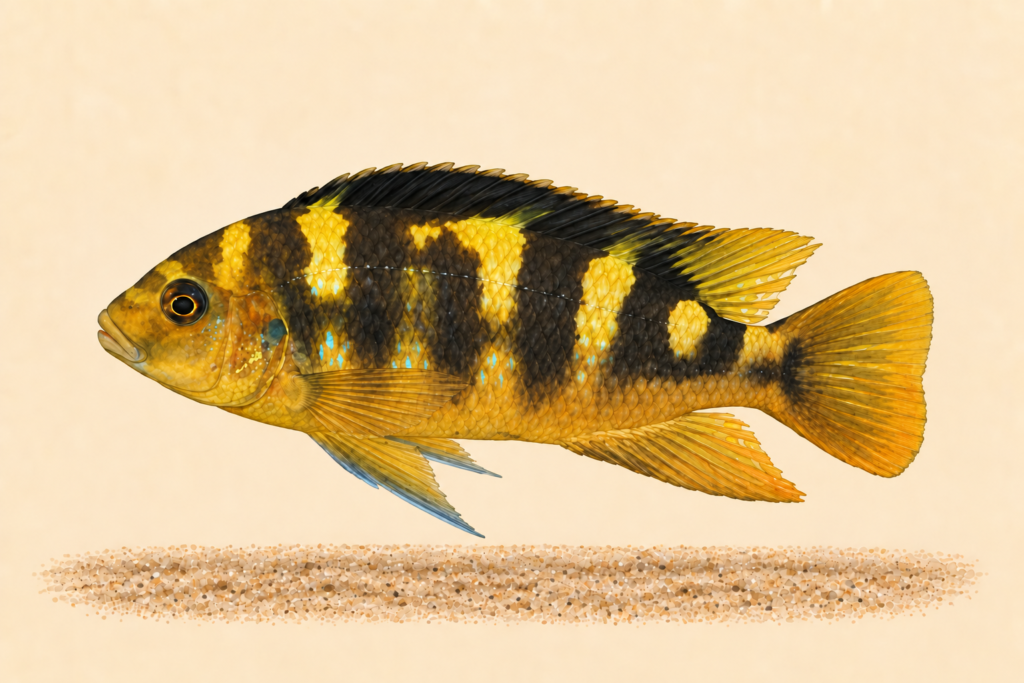
The most immediately recognisable feature of Pseudotropheus crabro is its bold banding pattern. In their standard colouration, these fish display alternating vertical bars of bright golden-yellow and dark brown to black across the body and into the fins. This pattern is strikingly reminiscent of a bumblebee or hornet, lending the species its most common trade names. The bars are typically well-defined in juveniles and subdominant individuals, creating a high-contrast pattern that is very eye-catching in the aquarium.
However, the species’ common name of Chameleon Cichlid is equally well-earned. Dominant males, particularly those in breeding condition, can undergo a dramatic colour transformation, turning almost entirely dark brown or near-black with only faint traces of the yellow banding visible. This dark morph can appear remarkably quickly, sometimes within minutes, and is associated with territorial aggression and courtship displays. In contrast, stressed or submissive individuals may pale significantly, with the yellow brightening and the dark bars fading to a washed-out grey-brown.
Females and juveniles generally maintain the classic bumblebee banding pattern more consistently than dominant males. Females tend to be slightly smaller and less robust in the head and jaw region, though sexing can be challenging outside of breeding condition. Males may develop a slightly more pronounced nuchal hump with maturity, though this is far less dramatic than in some other Mbuna species. Egg spots on the anal fin are present in males and are used during the mouthbrooding courtship ritual typical of Malawi cichlids.
The fins of the Bumblebee Cichlid follow the banding pattern, with the dorsal fin in particular displaying the alternating yellow and dark colouration. The caudal fin is typically rounded to slightly truncate, and the pectoral fins are translucent with a faint yellowish tinge. Overall, this is a visually dynamic species whose appearance can change markedly depending on social context, making observation a genuinely rewarding part of keeping them.
Natural Habitat
Pseudotropheus crabro is endemic to Lake Malawi, the ninth largest lake in the world and the third largest in Africa. Lake Malawi is a rift valley lake renowned for its extraordinary cichlid diversity, with hundreds of species found nowhere else on Earth. The Bumblebee Cichlid is recorded from numerous sites around the lake, including Eccles Reef, West Reef, the Maleri and Mbenji Islands, Likoma and Chisumulu Islands, and Nkata Bay. It is found in a range of habitats but most frequently in large caves or near large boulders.
In its natural environment, this species inhabits the rocky shoreline zones that characterise much of Lake Malawi’s coastline. These areas feature tumbled boulders, rocky outcrops, and sediment-free substrates where algae (aufwuchs) grows on exposed rock surfaces. The water in Lake Malawi is notably alkaline and hard, with a stable pH typically between 7.7 and 8.6 and warm, consistent temperatures. The lake’s waters are famously clear, with high dissolved oxygen levels and minimal organic pollution in undisturbed areas.
What sets the Bumblebee Cichlid apart from many other Mbuna is its ecological niche. While most Mbuna are primarily aufwuchs grazers, Pseudotropheus crabro has evolved a remarkable relationship with the large catfish Bagrus meridionalis (Kampango). The cichlid is specialised in cleaning parasites from Bagrus meridionalis, picking fish lice from the catfish’s skin. During the catfish’s spawning season it also steals and eats the eggs, changing colour to a darker shade as it does so.
While it associates with catfish nesting sites, it is not exclusively dependent on this relationship and can be found in typical Mbuna rocky habitats away from catfish as well. Understanding this natural habitat is essential for replicating appropriate conditions in captivity.
Tank Size and Setup
Given its size, aggression level, and territorial nature, the Bumblebee Cichlid requires a generously sized aquarium. A minimum tank volume of 189 litres, in a tank at least four feet long, is recommended for a single male with a small group of females. Larger tanks provide more territory, more line-of-sight breaks, and more opportunity for subordinate fish to escape the attention of dominant individuals.
The ideal aquascape for Pseudotropheus crabro closely mirrors its natural habitat: a rocky environment with numerous caves, overhangs, crevices, and passageways. Use a combination of large and small rocks to build complex structures that extend from the substrate to near the water surface. Ocean rock, limestone, Texas holey rock, and lava rock are all suitable choices. Ensure that all rockwork is stable and cannot collapse, as Mbuna are active diggers and will rearrange substrate around rock bases. Silicone adhesive or rock supports can be used for added security.
The substrate should be sand or fine gravel. Aragonite sand or coral sand is a popular choice for Malawi setups as it helps buffer the water towards the alkaline pH these fish require. A sand substrate also allows the fish to exhibit natural digging and sifting behaviours without risk of injury.
Live plants are generally not practical in a Bumblebee Cichlid tank. Mbuna will uproot, shred, and consume most aquarium plants. If you wish to include some greenery, hardy species such as Anubias (attached to rocks or wood) or Java Fern may survive, as their tough, bitter leaves are less palatable. Vallisneria is sometimes used in Malawi setups as it can tolerate the hard, alkaline water, though it may still be uprooted by enthusiastic diggers.
Provide strong lighting if you wish to encourage algae growth on rocks, which will serve as a supplementary food source and create a more natural appearance. A tight-fitting lid or cover glasses are essential, as Mbuna can and do jump, particularly when startled or during aggressive chases.
Water Parameters
Maintaining stable, appropriate water chemistry is critical for the long-term health of Pseudotropheus crabro. Lake Malawi is a remarkably stable environment, and its cichlids have evolved with very little tolerance for fluctuating conditions. The key parameters to target are as follows:
| Temperature | 24-26 °C |
| pH | 7.5-8.5 |
| General hardness (GH) | 10-25 dGH |
| Ammonia | 0 ppm |
| Nitrite | 0 ppm |
| Nitrate | Below 20 ppm |
The alkaline, hard water that Malawi cichlids require is naturally provided in many parts of the United Kingdom where tap water is already moderately hard and slightly alkaline. In areas with softer, more acidic water, you may need to use mineral additives, cichlid salts, or buffer compounds to achieve and maintain the correct parameters. Aragonite or crushed coral in the substrate or filter media can also help maintain pH and KH stability.
Consistency is more important than hitting an exact number. Sudden swings in pH or temperature are far more dangerous than being slightly outside the ideal range. When performing water changes, ensure that the replacement water is temperature-matched and treated with a dechlorinator. Weekly water changes of 25-30% are recommended to keep nitrate levels low and maintain water quality in the heavily stocked tanks that Mbuna setups often require.
Invest in a reliable liquid test kit and check your parameters regularly, particularly in the weeks after setting up a new tank or making changes to stocking. Ammonia and nitrite must always read zero in a properly cycled aquarium. Elevated nitrate, while less immediately toxic, can cause chronic stress, suppressed immune function, and increased susceptibility to disease if allowed to accumulate.
Filtration and Equipment
Robust filtration is non-negotiable for a Bumblebee Cichlid aquarium. Mbuna tanks are typically stocked at higher densities than many other freshwater setups, a deliberate strategy to spread aggression, and this creates a correspondingly high bioload. You should aim for a total filtration turnover rate of at least 8-10 times the tank volume per hour. For a 189-litre tank, this means a combined filter output of approximately 1,500 to 1,900 litres per hour.
External canister filters are the preferred choice for most Malawi cichlid setups due to their high capacity, excellent biological filtration, and the fact that they keep equipment out of the tank where it could be damaged by territorial fish. Running two canister filters in parallel is a common and highly recommended approach, as it provides redundancy (if one filter fails, the other continues to support the biological cycle) and makes maintenance easier (you can clean one filter at a time without disrupting the overall bacterial colony).
Filtration media should prioritise biological filtration. Ceramic rings, sintered glass media, and bio-balls all provide excellent surface area for beneficial bacteria. Mechanical filtration through filter floss or sponge pre-filters helps keep the water clear and protects biological media from clogging. Chemical filtration such as activated carbon is optional and generally only needed for specific purposes like removing medications or discolouration.
A reliable aquarium heater rated appropriately for your tank volume is essential. Inline heaters (fitted to the canister filter outlet) or heater guards are advisable, as Mbuna can damage external heaters through collisions or digging. Maintain a stable temperature within the 24-26 degree Celsius range, and consider using a heater controller or thermostat for added precision and safety.
Additional powerheads or wavemakers can be used to create water movement and ensure good oxygenation throughout the tank. Mbuna come from well-oxygenated waters and appreciate moderate to strong flow. Surface agitation from filter returns or powerheads will also help maintain high dissolved oxygen levels. An air pump with an airstone is an optional but useful addition, particularly in warmer weather when dissolved oxygen levels naturally decrease.
Diet and Feeding
In the wild, Pseudotropheus crabro is an omnivore with a varied diet that includes aufwuchs (the algae and associated microorganisms found on rock surfaces), invertebrates, parasites gleaned from catfish, and the eggs of Bagrus meridionalis. This diverse natural diet should inform the feeding strategy in captivity.
A high-quality cichlid pellet or flake food formulated for Mbuna should form the staple of the diet. Look for foods with a significant plant-based component, including spirulina, as Mbuna digestive systems are adapted for processing vegetable matter and can be prone to bloat if fed too much animal protein. Avoid foods with high levels of mammalian fats or excessive protein from land animal sources.
Supplement the staple diet with blanched vegetables such as courgette (zucchini), spinach, peas (shelled), and cucumber. These provide fibre and additional plant nutrition that supports digestive health. Occasional treats of frozen or live foods such as brine shrimp, daphnia, or cyclops can be offered sparingly. Avoid feeding bloodworms and tubifex worms, as these are strongly associated with Malawi bloat in Mbuna species.
Feed two to three small meals per day rather than one large feeding. Mbuna are natural grazers and do best when they can feed little and often. Remove any uneaten food promptly to prevent water quality deterioration. If algae grows on your rockwork, allow it to remain: this provides a natural, continuous food source that the fish will graze on throughout the day, which is excellent for their digestive health and behavioural enrichment.
Vary the diet regularly to ensure complete nutrition. A rotation of two or three different high-quality prepared foods, supplemented with vegetables and occasional frozen foods, will keep your Bumblebee Cichlids in excellent condition and help promote vibrant colouration.
Behaviour and Temperament
The Bumblebee Cichlid is one of the more aggressive Mbuna species, and this is something that must be taken seriously when planning a tank. Dominant males are highly territorial and will vigorously defend their chosen cave or rock formation against all comers. Aggression is directed at conspecifics, fish of similar appearance, and often at any other fish that ventures too close to the dominant male’s territory.
In a properly set up aquarium, this aggression can be managed but never entirely eliminated. The standard approach for keeping Mbuna, including Pseudotropheus crabro, is to overstock the tank slightly. This counterintuitive strategy works by ensuring that no single fish can be singled out for sustained harassment. When there are many potential targets, aggression is distributed more evenly, and no individual bears the brunt of it. This approach absolutely requires robust filtration and diligent maintenance to handle the increased bioload.
It is strongly recommended to keep Bumblebee Cichlids as one male with several females. In smaller setups, a single male with a harem of females is the safest configuration.
The colour-changing behaviour of this species is closely linked to its social dynamics. A dominant, territorial male will frequently display the dark morph, particularly when defending territory or courting females. Subordinate males may retain the banded pattern or display intermediate colouration. Observing these shifts in real time is one of the great pleasures of keeping this species, as it provides a visible window into the social hierarchy of the tank.
Bumblebee Cichlids are active swimmers and spend much of their time patrolling their territory, grazing on surfaces, and interacting with tank mates. They are intelligent fish that quickly learn to recognise their keeper and will often approach the front glass at feeding time. Despite their aggression, they are not typically shy and make for highly engaging aquarium inhabitants.
Tank Mates
Choosing appropriate tank mates for Pseudotropheus crabro requires careful consideration of temperament, size, and appearance. The best companions are other robust Mbuna species of similar size and aggression level that do not closely resemble the Bumblebee Cichlid in colour or pattern. Avoid species that are too docile, too small, or too similar in appearance, as these will either be bullied mercilessly or become targets of misdirected conspecific aggression. Peaceful community fish, slow-moving species, and anything with long, flowing fins should be avoided entirely.
Good tank mates
- Yellow Lab Cichlid (Labidochromis caeruleus) – A relatively peaceful Mbuna with a different colour profile, making it an excellent complement in mixed setups.
- Red Zebra Cichlid (Maylandia estherae) – A hardy, similarly sized Mbuna with contrasting colouration that holds its own in boisterous tanks.
- Kenyi Cichlid (Maylandia lombardoi) – A tough, assertive Mbuna that can match the Bumblebee Cichlid’s temperament without being so similar as to provoke targeted aggression.
- Demasoni Cichlid (Pseudotropheus demasoni) – A smaller but feisty Mbuna that does well in larger groups and adds visual variety to the tank.
- Acei Cichlid (Pseudotropheus acei) – A relatively placid Mbuna that occupies different areas of the tank and has a distinct elongated body shape.
- Auratus Cichlid (Melanochromis auratus) – Another aggressive Mbuna that can coexist in a well-structured, spacious tank with plenty of territories.
- Synodontis multipunctatus – A Lake Tanganyika catfish that is often kept with Malawi cichlids and provides interest at the bottom of the tank.
- Bristlenose Pleco (Ancistrus sp.) – A hardy algae-eating catfish that is generally ignored by Mbuna and helps with tank maintenance.
Fish to avoid
- Neon Tetra (Paracheirodon innesi) – Far too small and peaceful; would be harassed and likely eaten by Bumblebee Cichlids.
- Angelfish (Pterophyllum scalare) – Slow-moving, laterally compressed fish that cannot tolerate the aggression or water parameters required by Mbuna.
- Guppy (Poecilia reticulata) – Tiny, slow, and with trailing fins that make them easy targets for aggressive cichlids.
- Discus (Symphysodon sp.) – Requires soft, acidic water and a calm environment, making them completely incompatible on every level.
- Betta (Betta splendens) – The flowing fins and slow swimming speed of bettas make them entirely unsuitable companions for any Mbuna.
- Peacock Cichlid (Aulonocara sp.) – Though also from Lake Malawi, Peacocks are significantly less aggressive than Mbuna and will be dominated and stressed.
- German Blue Ram (Mikrogeophagus ramirezi) – A delicate dwarf cichlid requiring soft, warm, acidic water; incompatible in every respect.
- Corydoras Catfish (Corydoras sp.) – Peaceful bottom-dwellers that require softer, more acidic water and cannot tolerate Mbuna aggression.
Breeding
Pseudotropheus crabro is a maternal mouthbrooder, following the breeding strategy typical of most Mbuna species. Breeding in captivity is achievable and occurs readily when the fish are well-conditioned and maintained in appropriate conditions. While not the most challenging Mbuna to breed, successful rearing of fry does require some planning and attention.
Courtship is initiated by the dominant male, who will select a flat rock surface or a cleared area of substrate as a spawning site. He displays intensely to passing females, often adopting the dark colour morph and performing a shimmying, lateral display to attract attention. A receptive female will approach the spawning site, and the pair will circle one another in a characteristic T-shaped pattern.
The female deposits a small number of eggs on the substrate, then immediately picks them up in her mouth. She is attracted to the egg spots on the male’s anal fin, and as she mouths at these, the male releases sperm, fertilising the eggs within her buccal cavity. This process is repeated in several bouts until the female has collected a full clutch.
The female incubates the eggs and developing fry in her mouth for about three weeks. During this period, she does not eat, and her throat will appear visibly distended. It is important not to disturb or stress holding females, as they may spit out or swallow the brood prematurely. Some breeders choose to strip the fry from the female’s mouth and raise them artificially in a separate tank, which reduces stress on the female and improves fry survival rates.
Newly released fry are relatively large for cichlid fry and can immediately accept crushed flake food, powdered fry food, or freshly hatched brine shrimp nauplii. They should be raised in a separate grow-out tank to avoid predation by adult fish. Growth is steady with good feeding and water quality, and juvenile colouration, the classic bumblebee banding, develops early. Fry can typically be introduced to the main tank or rehomed once they are large enough not to be eaten, which depends on the size and temperament of the adults in the display tank.
To encourage breeding, maintain excellent water quality, provide a varied and nutritious diet, and ensure a ratio of one male to multiple females.
Common Diseases
Bumblebee Cichlids are generally hardy fish when maintained in appropriate conditions, but they are susceptible to several diseases common to Malawi cichlids. Prevention through good husbandry is always preferable to treatment, and most health issues can be avoided by maintaining stable water parameters, providing a proper diet, and minimising stress.
Malawi bloat is the single most significant health concern for Mbuna species, including Pseudotropheus crabro. This condition presents as abdominal swelling, loss of appetite, lethargy, and often rapid breathing. It can progress quickly and is frequently fatal if not caught early. The exact cause is debated, but it is strongly associated with dietary issues, particularly the feeding of high-protein animal-based foods such as bloodworms, and poor water quality. Prevention involves feeding a predominantly plant-based diet appropriate for Mbuna and maintaining pristine water conditions. Early treatment with metronidazole-based medications may be effective, but the prognosis worsens rapidly once symptoms become severe.
Ich (white spot disease), caused by the protozoan Ichthyophthirius multifiliis, can affect Bumblebee Cichlids, particularly during periods of stress or after the introduction of new, unquarantined fish. It presents as small white spots on the body and fins, accompanied by flashing (rubbing against objects) and lethargy. Treatment with aquarium salt or a proprietary ich medication is effective. Malawi cichlids generally tolerate salt treatment well due to their preference for hard, mineral-rich water.
Bacterial infections can occur secondary to injuries sustained during territorial disputes. Fin rot, ulcers, and cloudy eyes are common presentations. Maintaining excellent water quality is the most effective prevention and treatment for mild cases. More severe infections may require treatment with broad-spectrum antibacterial medications.
Internal parasites can occasionally be an issue, particularly in wild-caught specimens. Symptoms include weight loss despite a good appetite, white or stringy faeces, and general lethargy. Treatment with anti-parasitic medications such as praziquantel or levamisole is typically effective. Quarantining all new arrivals for a minimum of two to four weeks before adding them to an established tank is a sensible precaution that can prevent the introduction of parasites and other pathogens.
Hole-in-the-head disease (HITH or lateral line erosion) occasionally affects cichlids kept in suboptimal conditions. It presents as pitting or erosion around the head and lateral line. Contributing factors are thought to include poor water quality, inadequate diet (particularly vitamin and mineral deficiencies), and the use of activated carbon in filtration. Improving water quality, enriching the diet, and removing carbon from the filter often leads to gradual recovery.
FAQs
How can I tell the difference between male and female Bumblebee Cichlids?
Sexing Pseudotropheus crabro can be challenging, particularly with juveniles. The most reliable method is venting: examining the genital papillae under close inspection, where males have two small openings of similar size and females have one small and one larger, more rounded opening. Behaviourally, dominant males tend to adopt the dark colour morph and display more pronounced territorial aggression. Males are generally larger, may develop a slight nuchal hump, and typically have more prominent egg spots on the anal fin. Females more consistently display the classic yellow and dark banding pattern and tend to be slightly smaller and less robust in build.
Can I keep Bumblebee Cichlids with Peacock Cichlids?
This combination is generally not recommended. While both originate from Lake Malawi and share similar water parameter requirements, Peacock Cichlids (Aulonocara species) are significantly less aggressive than Mbuna. In a mixed tank, Bumblebee Cichlids will typically dominate and bully Peacocks, leading to chronic stress, suppressed colouration, reduced feeding, and potential physical injury. There is also a risk of hybridisation, which is undesirable for maintaining species integrity. It is best to keep Mbuna with other Mbuna of similar temperament and Peacocks with other Peacocks or similarly mild-mannered Malawi species.
Why does my Bumblebee Cichlid keep changing colour?
Colour change is entirely normal and is one of the most fascinating aspects of this species. Pseudotropheus crabro can shift rapidly between its banded “bumblebee” pattern and a much darker, near-black colouration. Dominant males frequently display the dark morph when defending territory or courting females. Submissive or stressed individuals may pale or display washed-out banding. Colour changes can occur in minutes and are driven by mood, social status, and environmental factors. If a fish remains persistently pale or dark with no variation, this may indicate chronic stress or illness and warrants investigation of tank conditions and social dynamics.
How many Bumblebee Cichlids should I keep together?
The ideal group consists of one male with several females, kept in a tank of at least 189 litres. The harem structure allows the male to distribute his attention among several females rather than fixating on a single individual, which significantly reduces stress and injury risk for any one fish.
Is the Bumblebee Cichlid suitable for a beginner?
The Bumblebee Cichlid is best suited to aquarists with some prior experience in fishkeeping, ideally with African cichlids. While not the most demanding species in terms of water chemistry, its high aggression level, specific dietary needs, and requirement for a large, well-structured tank make it a poor choice for a first aquarium. Beginners interested in Mbuna would do well to start with more forgiving species such as Yellow Lab Cichlids (Labidochromis caeruleus) and gain experience with the general principles of Mbuna keeping before progressing to more challenging species like Pseudotropheus crabro.
Related Guides
- Yellow Lab Cichlid (Labidochromis caeruleus) Care Guide – One of the most popular and beginner-friendly Mbuna species, and an excellent tank mate for Bumblebee