Ember Tetra Care Guide — Tank Setup, Feeding and Breeding
Introduction
The ember tetra is one of those fish that quietly wins people over. At barely two centimetres long, it hardly commands attention in a shop tank, but place a shoal of ten or more into a well-planted aquarium and the effect is genuinely stunning. Their warm, amber-orange glow against a backdrop of dark substrate and green plants is the kind of thing that makes visitors stop and stare. First described in 1987 and named after the mother of the ichthyologist who identified it, Hyphessobrycon amandae has become a staple of the planted tank hobby for very good reason.
Part of the ember tetra’s appeal is how easy it is to keep. This is a hardy little fish with a forgiving nature when it comes to water conditions, a peaceful disposition that makes it compatible with a wide range of tank mates, and a modest appetite. It does not need a large aquarium, it does not harass other fish, and it brings a level of colour and movement that species twice its size struggle to match. For nano tank enthusiasts in particular, the ember tetra is something of a gold standard.
Whether you are setting up your first planted tank or looking for a schooling species to complement a mature aquascape, the ember tetra fits the bill. It suits beginners who want a rewarding and low-maintenance fish, and it satisfies experienced keepers who appreciate its subtle beauty and interesting shoaling behaviour. If you can provide a cycled tank, stable water parameters, and a few companions, you are well on your way to keeping these fish successfully for years.
Quick stats
| Scientific name | Hyphessobrycon amandae |
| Family | Characidae |
| Origin | Araguaia River basin, central Brazil |
| Adult size | 1.5–2 cm (0.6–0.8 inches) |
| Lifespan | 2–4 years |
| Difficulty | Beginner |
| Breeding difficulty | Moderate |
| Temperature | 23–29 °C |
| pH range | 5.5–7.0 |
| Minimum tank size | 40 litres |
Appearance
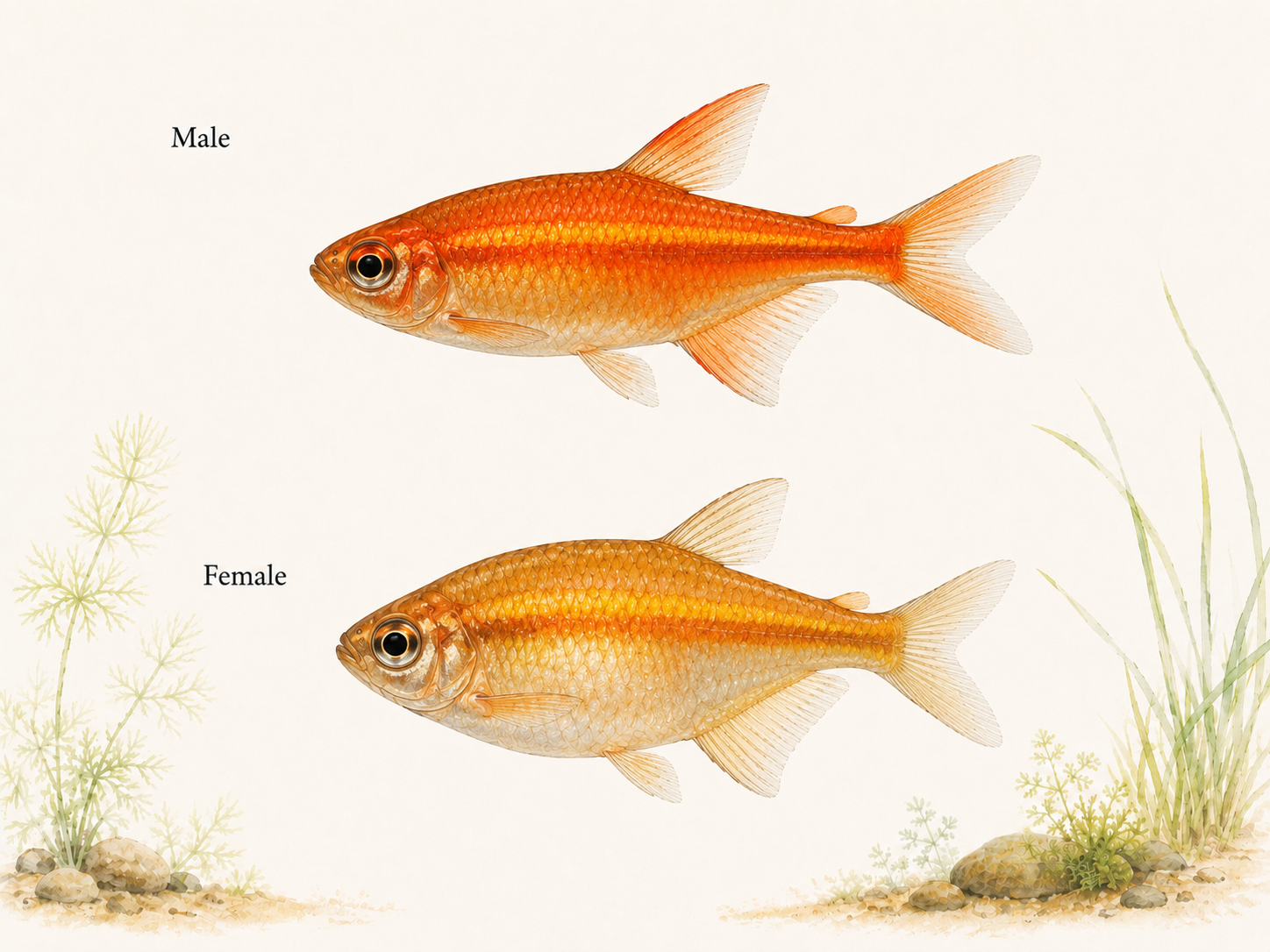
The ember tetra’s entire body is suffused with a warm, translucent orange that ranges from pale amber in stressed or newly acquired specimens to a deep, almost coppery red-orange in well-settled, healthy fish. The colour is remarkably uniform, fins, body, and even the eyes carry that same fiery tone, which is where the common name comes from. The body shape is typical of small characins: slightly compressed laterally with a modest dorsal fin and a forked caudal fin. There are no bold stripes or spots, just that consistent warm glow that intensifies under the right lighting and against a dark background.
Telling males from females takes a little practice but is possible once the fish are mature. Males tend to be slightly slimmer, a touch smaller, and often display more vivid colouration, particularly when they are competing for attention within the shoal. Females are usually a fraction rounder in the belly, especially when carrying eggs, and their colour can appear slightly less saturated by comparison. These differences are subtle, though, and both sexes are equally attractive. You are unlikely to find colour morphs or selectively bred variants on the market, ember tetras are almost always wild-type in appearance, which is part of their charm.
Natural habitat
Ember tetras are found in the Araguaia River basin in the state of Mato Grosso, central Brazil. This region features slow-moving tributaries, backwaters, and floodplain pools that are heavily shaded by overhanging vegetation. The water is typically warm, soft, and slightly acidic, often stained a tea-brown colour by decomposing leaves and organic matter. The substrate in these habitats is usually sand or fine sediment covered in a layer of leaf litter, and dense marginal and aquatic vegetation provides shelter from predators and strong currents.
Understanding this natural environment helps explain what ember tetras need in captivity. They come from warm, gentle waters with subdued lighting and plenty of cover. A tank that replicates even some of these conditions, soft water, a dark substrate, floating plants to diffuse light, and areas of dense planting, will bring out the best in these fish. They will colour up more intensely, school more naturally, and behave more confidently than they would in a bright, sparsely decorated tank with hard, alkaline water.
Tank size and setup
A group of eight to ten ember tetras can live comfortably in a 40-litre aquarium, which makes them a natural choice for nano setups. That said, a tank in the 60 to 80 litre range gives you more flexibility to keep a larger shoal, and ember tetras genuinely look better in bigger groups, ideally twelve or more, while also leaving room for compatible tank mates and a more developed aquascape. Longer tanks are preferable to tall ones, as these fish spend most of their time in the middle and lower-middle water column and benefit from horizontal swimming space.
For substrate, a dark fine-grain option works best. Tropica Aquarium Soil, ADA Amazonia, or even a simple black sand like CaribSea Super Naturals Torpedo Beach will contrast beautifully with the fish’s orange colouration. Ember tetras are not bottom dwellers, so substrate choice is more about aesthetics and plant growth than the fish’s direct needs, but dark tones will make the biggest visual difference.
Plants are essential rather than optional. Java fern, Anubias nana, various Cryptocoryne species, and stems like Rotala rotundifolia or Pogostemon helferi all work well. Floating plants such as Salvinia natans, Amazon frogbit, or red root floaters are particularly useful because they soften the light and give the fish a greater sense of security. Driftwood and botanicals like Indian almond leaves add a natural look and release tannins that mimic the blackwater conditions ember tetras encounter in the wild. Keep the lighting moderate, strong lighting is fine if floating plants or tall stems provide shaded areas, but avoid blasting the tank with intense light and no cover.
Water flow should be gentle. Ember tetras are not strong swimmers, and an overpowered filter output will stress them. If your filter produces too much current, use a spray bar, baffle, or lily pipe to diffuse it across the tank surface.
Water parameters
| Temperature | 23–29 °C (ideal range 24–27 °C) |
| pH | 5.5–7.0 |
| General hardness (GH) | 1–10 dGH |
| Carbonate hardness (KH) | 1–8 dKH |
| Ammonia | 0 ppm |
| Nitrite | 0 ppm |
| Nitrate | Below 20 ppm |
Ember tetras are tolerant of a range within these parameters, but they do best in soft, slightly acidic water. If your tap water is moderately hard and neutral in pH, they will usually adapt without trouble, but you will see the deepest colour and most natural behaviour in softer, more acidic conditions. Stability matters more than hitting a perfect number. Avoid sudden swings in temperature or pH, and always dechlorinate new water before adding it to the tank. Regular partial water changes of around 20 to 25 percent weekly will keep nitrate in check and maintain overall water quality.
Filtration and equipment
A small sponge filter or a gentle hang-on-back filter is ideal for an ember tetra tank. Sponge filters are particularly well suited to nano setups because they provide biological filtration without generating strong currents, and they double as a grazing surface for microorganisms. For slightly larger tanks, a small internal filter or a compact canister filter like the Oase Filtosmart 60 works well, especially if paired with a spray bar to soften the outflow. Whatever filter you choose, make sure the intake is covered with a pre-filter sponge, ember tetras and especially their fry are small enough to be pulled in.
A reliable heater is important since these fish need consistent tropical temperatures. An adjustable heater rated for your tank size will do the job. For a 40 to 60 litre tank, a 25 to 50 watt heater is usually sufficient. Brands like Eheim Jäger and Aquael Ultra Heater are well regarded for accuracy and reliability. Always pair a heater with a separate thermometer so you can verify the actual water temperature independently.
A liquid water testing kit such as the API Freshwater Master Test Kit is a worthwhile investment, especially if you are new to fishkeeping. It allows you to monitor ammonia, nitrite, nitrate, and pH reliably, which is essential during tank cycling and useful for ongoing maintenance. Test strips are convenient but less accurate, so a liquid kit is the better long-term choice.
Diet and feeding
In the wild, ember tetras feed on tiny invertebrates, insect larvae, and microorganisms found in the water column and among leaf litter. They are micro-predators by nature, though in captivity they readily accept a wide range of prepared and frozen foods. The key consideration is size, their mouths are very small, so food needs to be appropriately tiny.
A high-quality micro pellet or crushed flake should form the base of their diet. Hikari Micro Pellets, Fluval Bug Bites (in the small or nano formula), and Sera Vipan Micro Flakes are all excellent options. Supplement this with frozen or live foods a few times a week: baby brine shrimp, micro worms, daphnia, and cyclops are all eagerly accepted and help maintain vibrant colour. Freeze-dried foods are fine as an occasional treat, but frozen and live options provide better nutrition and more natural feeding behaviour.
Feed small amounts once or twice a day, only as much as the fish can consume within about two minutes. Ember tetras are not aggressive feeders, and in community tanks you should make sure food reaches them rather than being intercepted by faster or larger species. Spreading food across the water surface or using a feeding ring can help with this.
Behaviour and temperament
Ember tetras are peaceful, social, and endlessly watchable. They spend much of their time loosely shoaling in the mid-water area of the tank, drifting through plant stems and occasionally darting after a speck of food. The group dynamic is interesting, they are not as tightly schooling as some tetras, but they stay in visual contact with one another and will cluster more closely if they feel exposed or nervous. In a well-planted tank with a large group, they spread out more, each fish moving with quiet confidence.
Males will sometimes display to one another with slightly flared fins and intensified colour, but these interactions are completely harmless and never result in injury. There is no nipping, chasing, or territorial aggression to speak of. They largely ignore other species and focus on their own social group. One behaviour worth noting is that ember tetras can be somewhat shy in the first few days after being introduced to a new tank. They may hide among plants or hover near the bottom. Given time and stable conditions, they almost always come out of their shells and start occupying the full tank with more boldness.
Tank mates
Good tank mates
- Pygmy corydoras (Corydoras pygmaeus), a perfect bottom-dwelling companion that shares the same preference for soft water and gentle flow
- Salt and pepper corydoras (Corydoras habrosus), another tiny cory that occupies the bottom without competing for mid-water space
- Otocinclus, peaceful algae grazers that stay small and will not bother ember tetras
- Celestial pearl danio (Danio margaritatus), similar size and temperament, occupies slightly different areas of the tank
- Chili rasbora (Boraras brigittae), another nano schooling fish with overlapping water parameter needs
- Harlequin rasbora (Trigonostigma heteromorpha), peaceful and a nice size contrast while remaining non-threatening
- Amano shrimp, too large to be eaten, excellent algae crew, completely peaceful
- Cherry shrimp (Neocaridina davidi), generally safe with ember tetras, though very tiny shrimplets may occasionally be picked off
- Nerite snails, helpful algae eaters that pose no compatibility issues whatsoever
Fish to avoid
- Betta splendens, while some bettas are mellow enough, many will harass or stress small tetras, and the risk is not worth taking in a nano tank
- Angelfish (Pterophyllum scalare), adult angelfish can and will eat ember tetras
- Tiger barbs (Puntigrus tetrazona), too boisterous and nippy for a tiny, peaceful species
- Convict cichlids (Amatitlania nigrofasciata), far too aggressive and territorial
- Chinese algae eater (Gyrinocheilus aymonieri), becomes large and increasingly aggressive with age
- Any large or predatory species, as a general rule, if a fish can fit an ember tetra in its mouth, it eventually will
Breeding
Breeding ember tetras is achievable but requires a little deliberate effort because the adults will eat their own eggs and fry if given the chance. The first step is sexing your fish. As mentioned, males are slimmer and slightly more vivid, while females are rounder-bodied, particularly when full of eggs. Having a well-fed group of both sexes in good conditions often leads to natural spawning, but raising the fry to a viable size usually requires a separate breeding setup.
To condition the fish for spawning, feed a varied diet rich in live or frozen foods for a week or two. Baby brine shrimp and daphnia are particularly effective. Set up a small breeding tank of around 10 to 20 litres with very soft, acidic water (pH around 6.0 to 6.5, temperature 26 to 28 °C). Add fine-leaved plants like java moss or spawning mops to give the eggs somewhere to land, and keep the lighting dim. A gentle sponge filter is all you need for filtration.
Introduce a pair or a small group into the breeding tank in the evening. Spawning usually occurs in the early morning, with the female scattering small, slightly adhesive eggs among the plants. Once you observe spawning or see tiny eggs on the plant surfaces, remove the adults immediately. The eggs hatch in roughly 24 to 36 hours, and the fry become free-swimming after another two to three days. Feed the fry infusoria or liquid fry food for the first week, then transition to freshly hatched baby brine shrimp and micro worms as they grow. Growth is slow but steady, and the fry will begin showing colour at around six to eight weeks.
Common diseases and health
Ich (white spot disease)
Ich is one of the most common ailments in freshwater fish and ember tetras are no exception. It presents as tiny white spots on the fins and body, often accompanied by flashing (rubbing against surfaces) and clamped fins. Raising the temperature gradually to 28–30 °C and treating with a half-dose of a copper-free ich medication (ember tetras are sensitive to harsh chemicals) is usually effective. Maintain good oxygenation during treatment, as warmer water holds less dissolved oxygen.
Fin rot
Fin rot typically results from poor water quality or stress. You will notice frayed, discoloured, or receding fin edges. The first and most important step is addressing the water quality, perform water changes, test your parameters, and identify the root cause. In mild cases, clean water alone can resolve the issue. For more advanced cases, a broad-spectrum antibacterial treatment may be needed.
Neon tetra disease and false neon tetra disease
Despite the name, neon tetra disease (caused by the parasite Pleistophora hyphessobryconis) and the bacterial infection commonly called false neon tetra disease can affect many small characins including ember tetras. Symptoms include loss of colour, a faded or whitish patch on the body, erratic swimming, and gradual wasting. Unfortunately, true neon tetra disease has no reliable cure and affected fish should be isolated to prevent spread. The bacterial form can sometimes be treated with antibiotics, but outcomes vary.
A note on quarantining
Always quarantine new ember tetras for at least two weeks before adding them to an established tank. A simple quarantine setup, a small heated, filtered tank with no substrate and a few hiding spots, allows you to observe the fish for signs of illness and treat problems before they reach your main aquarium. This is one of the simplest and most effective things you can do to protect the health of your existing fish.
Frequently asked questions
How many ember tetras should I keep together?
A minimum of six is necessary, but eight to twelve or more is strongly recommended. Ember tetras are shoaling fish that feel safer, behave more naturally, and display better colour in larger groups. In a small nano tank, even going from six to ten makes a noticeable difference in how confidently the fish move around the tank.
Why are my ember tetras pale or losing colour?
Pale colouration in ember tetras is almost always a sign of stress, poor water quality, insufficient group size, or simply that the fish are still settling into a new environment. Check your water parameters, make sure they have plenty of plant cover, and give newly purchased fish a week or two to adjust. A light-coloured substrate and very bright lighting can also wash out their appearance, so a dark substrate and diffused lighting will help enormously.
Can ember tetras live in an unheated tank?
This depends entirely on the temperature of the room. Ember tetras need water between 23 and 29 °C consistently. If your home stays reliably within that range year-round, a heater may not be strictly necessary, but in most climates a heater is the safest option. Temperature drops below 22 °C can stress the fish and leave them vulnerable to illness.
Do ember tetras nip fins?
No, ember tetras are not fin nippers. They are among the most peaceful community fish available and show virtually no aggression toward other species. They may occasionally have brief, harmless displays among themselves, but they leave other tank mates alone entirely.
Can I keep ember tetras with shrimp?
Yes, ember tetras are one of the most shrimp-safe fish you can choose. Adult cherry shrimp, amano shrimp, and other common ornamental shrimp are not at risk. Very newly born shrimplets could potentially be eaten, but a well-planted tank with plenty of moss and hiding spots will give baby shrimp a strong chance of survival even alongside ember tetras.