Quick summary
The Figure 8 Puffer is a charismatic but moderately difficult fish best suited to keepers willing to maintain brackish water conditions and provide a diet of hard-shelled foods like snails to keep its teeth worn down. It’s not a beginner community fish, and with proper care it can live 15-18 years, so it’s a long-term commitment requiring real research before buying.
🐠 Build a tank around this species
In this guide:
- Introduction
- Quick Stats
- Appearance
- Natural Habitat
- Tank Size and Setup
- Water Parameters
- Filtration and Equipment
- Diet and Feeding
- Behaviour and Temperament
- Tank Mates
- Breeding
- Common Diseases
- FAQs
Introduction
The Figure 8 Puffer is one of the most charismatic and engaging fish available in the aquarium hobby. Named for the distinctive figure-of-eight pattern adorning its back, Dichotomyctere ocellatus has earned a devoted following among fishkeepers who appreciate its intelligence, curious personality, and endearing habit of seemingly recognising its owner. Unlike many ornamental fish that exist as background decoration, this puffer actively interacts with its environment and the people around its tank, making it a genuinely rewarding species to keep.
Despite its small size and appealing looks, the Figure 8 Puffer is not a beginner’s fish. It has specific dietary requirements, including the need for hard-shelled foods to wear down its continuously growing beak-like teeth. It also thrives best in brackish water conditions, which places it outside the scope of a standard community aquarium. Misunderstandings about its care needs, particularly regarding salinity, tank mates, and feeding, have unfortunately led to many specimens living shortened, unhealthy lives in unsuitable setups. This guide aims to provide a thorough and accurate overview of everything you need to know to keep this remarkable little puffer in excellent health for the full duration of its surprisingly long lifespan.
Historically, there has been considerable taxonomic confusion surrounding this species. It was long placed in the genus Tetraodon, and many older references and even some current retailers still label it as Tetraodon biocellatus. The currently accepted scientific name is Dichotomyctere ocellatus, following a revision of the freshwater and brackish pufferfish genera. Regardless of the name on the label, the care requirements remain the same, and this guide reflects the most up-to-date husbandry knowledge available.
Quick Stats
| Scientific name | Dichotomyctere ocellatus |
|---|---|
| Common names | Figure Eight Puffer, Eyespot Puffer |
| Family | Tetraodontidae |
| Origin | Southeast Asia (Thailand, Cambodia, Vietnam, Malaysia, Indonesia, Myanmar) |
| Adult size | 7 cm |
| Lifespan | 15–18 years |
| Difficulty | Intermediate |
| Breeding difficulty | Advanced |
| Temperature | 24–28 °C |
| pH | 7–8 |
| GH | 8–20 dGH |
| KH | 6–15 dKH |
| Minimum tank size | 115 L |
| Conservation status | Data Deficient (IUCN, assessed 2019) |
Appearance
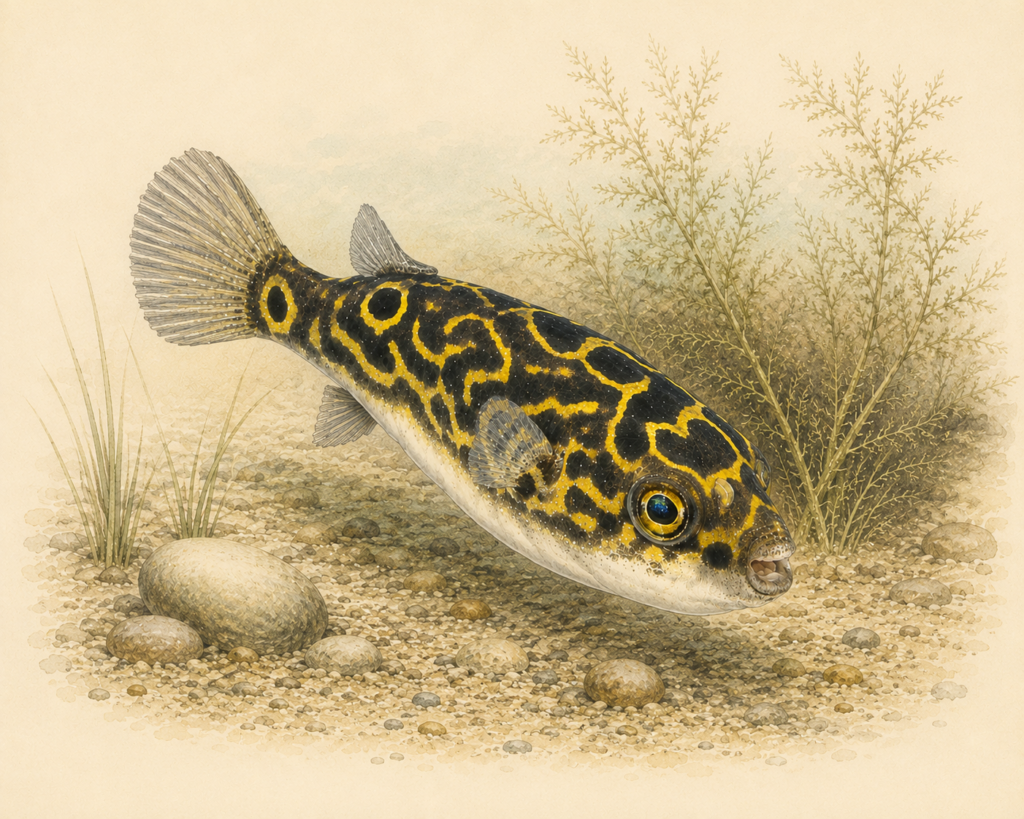
The Figure 8 Puffer is a compact, rounded fish with a body plan typical of the Tetraodontidae family. Its shape is somewhat torpedo-like when relaxed but can inflate dramatically into a near-spherical ball when the fish feels threatened, a defensive mechanism it shares with all true pufferfish. The skin is smooth and scaleless, giving it a somewhat rubbery texture, and the body is propelled primarily by rapid undulations of the dorsal and anal fins rather than by the caudal fin, which serves mainly as a rudder. This unique method of locomotion gives the Figure 8 Puffer a hovering, almost helicopter-like swimming style that many keepers find utterly captivating.
The dorsal surface is a rich greenish-yellow to olive, marked with dark brown or black lines and spots that form the namesake figure-of-eight or infinity-symbol pattern across the back. Two prominent dark spots, or ocelli, sit on either side of the caudal peduncle, which is the origin of its former species name biocellatus, meaning “two-eyed.” The belly is a clean, bright white, and the transition between the dark dorsal colouration and the pale ventral surface is sharply defined. The eyes are large and highly mobile, capable of moving independently of one another, which gives the fish an unusually expressive and intelligent appearance.
Healthy, well-kept specimens display vivid, high-contrast colouration. Stress, poor water quality, or an inadequate diet can cause the colours to fade significantly, with the dark markings becoming dull and the belly sometimes developing a greyish tinge. Observing your puffer’s colouration is therefore a useful daily health check. Males and females are very difficult to distinguish visually; there are no reliable external sexual dimorphisms, though mature females may appear slightly plumper when carrying eggs.
Natural Habitat
In the wild, Dichotomyctere ocellatus inhabits the lower reaches of rivers, estuaries, mangrove swamps, and coastal waterways across a broad range of Southeast Asia. Its distribution spans from Myanmar and Thailand through Cambodia and Vietnam, and extends southward into peninsular Malaysia and parts of Indonesia, including Borneo and Sumatra. These habitats are characterised by fluctuating salinity levels, as tidal movements push seawater upstream and freshwater flows down from the interior. The result is a brackish environment where the specific gravity can vary considerably depending on the season, the tide, and the distance from the coast.
The substrates in these environments are typically composed of fine mud, sand, or silt, often littered with fallen leaves, submerged roots, and decaying organic matter. Mangrove roots provide extensive cover and hunting grounds, and the water tends to be warm, moderately hard, and slightly alkaline. The Figure 8 Puffer is a benthic predator in these habitats, foraging among the substrate and root tangles for small invertebrates, including snails, crustaceans, worms, and insect larvae. Understanding this natural environment is essential for replicating appropriate conditions in captivity, particularly with regard to salinity, hardness, and the provision of ample cover and territory.
It is worth noting that while some populations are found in entirely fresh water at certain times of year, the species consistently shows better long-term health, brighter colouration, and greater longevity when maintained in low-end brackish conditions in aquaria. Keeping them in pure freshwater for their entire lives is a common mistake that can lead to chronic health issues over time.
Tank Size and Setup
A single Figure 8 Puffer requires a minimum tank volume of 115 litres, which equates roughly to a standard 80 cm aquarium. If you wish to keep a small group of two or three individuals, a tank of 200 litres or more is strongly recommended to allow each fish sufficient territory and reduce the risk of aggression. Larger tanks also provide greater water volume, which helps buffer the effects of waste products and makes maintaining stable brackish conditions considerably easier.
The aquascape should prioritise cover, visual barriers, and interesting structures to explore. Use a fine sand substrate, which is gentle on the puffer’s soft belly and allows it to exhibit natural foraging behaviours. Arrange rockwork, bogwood, and driftwood to create distinct territories, caves, and hiding spots. If you are running a low-salinity brackish setup, most standard aquarium plants will not tolerate the salt, but hardy species such as Java Fern, Anubias, and Java Moss can often survive at specific gravities up to around 1.005. Plastic or silk plants can be used as alternatives if live plants prove impractical. The key principle is to break up lines of sight so that if multiple puffers are housed together, subordinate individuals can escape the gaze of dominant ones.
A tight-fitting lid is essential. Although Figure 8 Puffers are not prolific jumpers, they can and do leap when startled, and evaporation in a brackish tank will alter the salinity if left unchecked. The lid also helps maintain stable temperatures and humidity above the water surface, which is important for the overall stability of the system. Ensure the tank is positioned away from direct sunlight and draughts, and allow it to cycle fully before introducing any pufferfish, these are sensitive animals that do not tolerate ammonia or nitrite at any level.
Water Parameters
The Figure 8 Puffer is a brackish water species in the aquarium hobby, and maintaining appropriate salinity is one of the most important aspects of its care. A specific gravity of 1.003 to 1.008 is ideal for long-term health, which corresponds to roughly 5 to 12 grams of marine salt per litre of water. It is essential to use a proper marine salt mix rather than common table salt or aquarium tonic salt, as marine salt contains the full spectrum of trace elements and buffers that replicate natural brackish conditions. Measure specific gravity with a reliable refractometer or hydrometer and check it weekly, topping up evaporated water with dechlorinated freshwater to prevent salinity creep.
| Temperature | 24–28 °C |
| pH | 7.0–8.0 |
| General hardness (GH) | 8–20 dGH |
| Carbonate hardness (KH) | 6–15 dKH |
| Ammonia | 0 ppm |
| Nitrite | 0 ppm |
| Nitrate | Below 20 ppm |
Consistency is more important than hitting exact numbers. Sudden swings in salinity, pH, or temperature are far more harmful than a parameter sitting slightly outside the ideal range. When performing water changes, always pre-mix your replacement water to the correct salinity and temperature before adding it to the tank. Weekly water changes of 25–30% are recommended to keep nitrate levels low and maintain water quality. Pufferfish are messy eaters that produce a significant amount of waste relative to their size, so diligent maintenance is non-negotiable.
Filtration and Equipment
Robust filtration is critical for any pufferfish tank. The Figure 8 Puffer produces a considerable bioload for its size, owing to its protein-rich diet of shellfish and crustaceans. A filter rated for at least 1.5 to 2 times the tank’s volume in turnover per hour is a sensible starting point. External canister filters are an excellent choice, as they offer large media capacity, flexible media configuration, and strong biological filtration. Hang-on-back filters can work for smaller setups but may struggle to cope with the waste output in the long run.
When selecting filter media, prioritise biological filtration capacity. Ceramic rings, sintered glass media, and bio-balls all provide excellent surface area for nitrifying bacteria. Mechanical filtration in the form of filter floss or sponge pads should be rinsed or replaced regularly, as uneaten food fragments and shell debris can clog them quickly. Chemical filtration with activated carbon is optional but can help polish the water and remove dissolved organics. Be aware that some medications are removed by carbon, so it should be taken out during any treatment courses.
A reliable heater with an accurate thermostat is essential to maintain the tropical temperature range. Choose a heater appropriate for the tank volume and consider using a heater guard to prevent the puffer from resting against it and suffering burns, pufferfish are curious creatures and will investigate everything in their environment. An air stone or additional powerhead can help with surface agitation and oxygenation, though excessive current should be avoided as these are not strong swimmers. Standard aquarium lighting on a timer set to a 10–12 hour photoperiod will suffice; no specialist lighting is required unless you are maintaining live plants.
Diet and Feeding
Feeding is arguably the single most important aspect of Figure 8 Puffer husbandry beyond water quality. Like all pufferfish, Dichotomyctere ocellatus possesses a fused beak-like dental plate composed of four continuously growing teeth, two upper and two lower. If these teeth are not regularly worn down through the consumption of hard-shelled foods, they will overgrow and eventually prevent the fish from eating, leading to starvation and death. This is a common and entirely preventable cause of mortality in captive puffers.
The staple diet should consist of small snails, which are the single best food for maintaining dental health. Common pond snails, Malaysian trumpet snails, and ramshorn snails are all suitable and can be cultured easily at home in a separate container. Offer snails daily or every other day, and you will notice the puffer crunching through the shells with evident relish. Supplement this with a variety of other meaty foods, including frozen or live bloodworm, brine shrimp, mysis shrimp, daphnia, krill, chopped cockle, mussel, and small pieces of prawn. Occasional offerings of live or frozen crab legs, crayfish, or clam on the half shell provide additional dental wear and enrichment.
Feed your puffer once or twice daily, offering only as much food as it can consume within a few minutes. Remove any uneaten items promptly to prevent water quality deterioration. Figure 8 Puffers are enthusiastic and sometimes greedy eaters, and it can be tempting to overfeed them. A slightly rounded belly after a meal is normal, but a persistently bloated appearance indicates overfeeding and should be addressed by reducing portion sizes. Fasting one day per week is a practice many experienced puffer keepers follow to allow the digestive system to clear.
Dry foods such as pellets and flakes are generally refused and are nutritionally inadequate for this species even if accepted. Do not rely on them. The effort required to source and prepare appropriate foods is a commitment you must be prepared to make before acquiring a Figure 8 Puffer.
Behaviour and Temperament
The Figure 8 Puffer is widely regarded as one of the more manageable pufferfish in terms of temperament, but it would be a mistake to describe it as peaceful. It is a territorial, predatory fish with a strong personality and a mouth full of shell-crushing teeth. Individual temperaments vary considerably, some specimens are relatively tolerant of tank mates and conspecifics, while others are nippy, aggressive, and best kept alone. There is no reliable way to predict an individual’s personality before purchase, so you should always have a contingency plan if aggression becomes a problem.
In terms of intelligence and interactivity, the Figure 8 Puffer is exceptional among aquarium fish. It will quickly learn to associate your presence with feeding and will often swim to the front of the glass, following your movements with those remarkable independently tracking eyes. Many keepers report that their puffers can distinguish between household members, responding differently to different people. They are highly curious and will investigate any changes to their environment, new objects, or even your hand during maintenance, though you should exercise caution, as a puffer bite can draw blood.
When kept in groups, a clear social hierarchy typically establishes itself. Providing ample space, numerous line-of-sight breaks, and ensuring each fish has access to its own territory are essential for reducing conflict. Even in well-designed setups, fin nipping and chasing can occur, particularly during feeding. If any individual shows persistent signs of stress, faded colouration, clamped fins, hiding constantly, or visible injuries, it should be separated immediately. Solitary keeping is a perfectly valid and often advisable approach, and a single Figure 8 Puffer in a well-furnished tank will display a full range of its fascinating natural behaviours without the added complication of managing social dynamics.
Tank Mates
Selecting tank mates for the Figure 8 Puffer requires careful consideration. The brackish water requirement immediately eliminates the vast majority of common freshwater community fish. Any potential companions must tolerate the same salinity range, be fast enough to avoid nipping, and be robust enough not to become targets. Slow-moving, long-finned, or very small fish are poor choices, as are bottom-dwellers that may encroach on the puffer’s territory. Even with suitable species, success is never guaranteed owing to the individual variation in puffer temperament.
Good tank mates
- Bumblebee Goby, a small brackish-water species that occupies the lower tank regions and is generally fast enough to avoid puffer aggression.
- Knight Goby, a robust brackish-tolerant goby that can hold its own and occupies different territory within the tank.
- Molly, Hardy, fast-moving livebearers that thrive in brackish conditions and are large enough to deter casual nipping.
- Orange Chromide, a brackish-tolerant cichlid that is tough enough to coexist with a puffer in a sufficiently large aquarium.
- Celebes Rainbowfish, an active, mid-water schooling fish that tolerates low-end brackish conditions and stays out of the puffer’s way.
- Indian Glassfish, a peaceful brackish-water species that is quick and nimble enough to avoid conflict with puffers.
- Wrestling Halfbeak, a surface-dwelling brackish species that occupies a completely different zone, reducing territorial overlap.
- Mono Argentus, a robust brackish fish that swims actively in mid-water and is too large and fast to be easily harassed, though it requires a large tank.
Fish to avoid
- Neon Tetra, a tiny freshwater species that cannot tolerate brackish water and would likely be eaten or harassed.
- Betta, Slow-moving with long fins that make them an irresistible target for nipping, and intolerant of brackish conditions.
- Corydoras Catfish, Strictly freshwater bottom-dwellers that would suffer in brackish water and would encroach on the puffer’s territory.
- Guppy, too small and slow with trailing finnage that will attract aggressive attention from the puffer.
- Bristlenose Pleco, a freshwater species that will not thrive in brackish water and whose sedentary habits make it vulnerable to fin nipping.
- Cherry Shrimp, Will be treated as food rather than as a tank mate; shrimp are a natural part of the puffer’s diet.
- Angelfish, a slow-moving, tall-bodied freshwater cichlid with long fins that is entirely unsuitable for a brackish puffer tank.
- Dwarf Gourami, too slow and delicate for cohabitation with a puffer, and unable to tolerate brackish water.
Breeding
Breeding the Figure 8 Puffer in captivity is exceptionally rare and has been documented only a handful of times under controlled conditions. The species is classified as an egg-layer, with spawning typically occurring on a flat surface such as a rock or piece of wood. In the few reported successful spawnings, the male was observed guarding the eggs until they hatched, suggesting a degree of paternal care that is not uncommon among pufferfish.
One of the primary challenges is sexing the fish reliably. There are no consistent external differences between males and females, and behavioural cues are ambiguous at best. Acquiring a group of juveniles and allowing them to grow up together may increase the chances of obtaining a compatible pair, but the aggressive tendencies of the species make group housing in anything but the largest tanks a risky proposition. Conditioning potential breeders with an abundant and varied diet rich in live and frozen foods is essential to bring them into reproductive readiness.
Spawning triggers in the wild are likely related to seasonal changes in salinity, temperature, and water flow associated with monsoon cycles. Replicating these conditions in captivity, for example, by gradually increasing or decreasing salinity, raising temperature slightly, and performing large water changes with slightly cooler water, may help stimulate breeding behaviour. However, even with ideal conditions, success is far from guaranteed. The fry, if hatched, are tiny and require infusoria or similarly minute live foods as a first feed. Raising the fry through their early stages is extremely challenging. For the vast majority of hobbyists, the Figure 8 Puffer is best appreciated as a pet rather than a breeding project.
Common Diseases
The Figure 8 Puffer is a reasonably hardy species when kept in appropriate conditions, but it is susceptible to several health problems, many of which are directly linked to husbandry errors. The most common issue is overgrown teeth, which occurs when the puffer’s diet lacks sufficient hard-shelled foods. The dental plates grow continuously and, without regular wear from crushing snail shells and crustacean exoskeletons, can become so elongated that the fish can no longer open its mouth to eat. In advanced cases, a keeper or veterinarian may need to trim the teeth manually using small clippers, a stressful and delicate procedure that is best avoided entirely by feeding an appropriate diet from the outset.
Like many scaleless or small-scaled fish, the Figure 8 Puffer is highly sensitive to external parasites, particularly Ichthyophthirius multifiliis, commonly known as white spot or ich. The classic presentation is small white cysts scattered across the body and fins, accompanied by flashing, rubbing against objects, and lethargy. Treatment should be approached with caution, as pufferfish are sensitive to many conventional medications, particularly those containing copper and formalin. Half-dose treatments of malachite green-based medications, combined with raising the temperature to 28–30 °C and adding aquarium salt (if the tank is not already brackish), are generally the safest approach. Always research medication compatibility with scaleless fish before dosing.
Internal parasites are another concern, particularly in wild-caught specimens, which make up the majority of Figure 8 Puffers in the trade. Symptoms include weight loss despite a healthy appetite, white or stringy faeces, and a sunken belly. A course of anti-parasitic medication containing praziquantel or levamisole can be effective, though ideally this should be administered under the guidance of a veterinarian experienced with fish. Quarantining new arrivals for a minimum of four weeks in a separate brackish setup before introducing them to the main tank is strongly recommended.
Maintaining pristine water quality, providing the correct salinity, feeding a varied and appropriate diet, and avoiding stressful conditions such as overcrowding or incompatible tank mates are the foundations of disease prevention for this species. A healthy Figure 8 Puffer should display bright, high-contrast colouration, an alert and curious demeanour, a rounded (but not bloated) belly, and clear eyes. Any deviation from this baseline warrants immediate investigation of water parameters and husbandry practices.
FAQs
Can the Figure 8 Puffer live in pure freshwater?
While the Figure 8 Puffer can survive in freshwater for extended periods, it does not thrive in it over the long term. Specimens kept in pure freshwater often develop chronic health problems, display faded colouration, and have significantly shorter lifespans than those maintained in appropriate low-end brackish conditions. A specific gravity of 1.003 to 1.008 using a quality marine salt mix is strongly recommended for the best health outcomes.
How often do I need to feed snails to keep the teeth worn down?
Ideally, snails should form a regular part of the diet, offered every one to two days. Small pond snails and ramshorn snails are easy to culture at home and can be produced in large quantities with minimal effort. If you notice the teeth beginning to look long or the puffer struggling to eat, increase the frequency of hard-shelled food offerings immediately. Prevention is far easier than dealing with overgrown teeth after the fact.
Is the Figure 8 Puffer poisonous?
Like many pufferfish, Dichotomyctere ocellatus is believed to harbour tetrodotoxin in certain tissues, particularly the skin, liver, and gonads. This toxin is produced by symbiotic bacteria and is considerably reduced or absent in captive-bred specimens fed non-toxic diets. Nevertheless, you should always wash your hands after handling the fish or placing them in a bag, and never consume a pufferfish from the aquarium trade. The toxin does not leach into the aquarium water under normal circumstances and poses no risk to other fish in the tank.
Can I keep multiple Figure 8 Puffers together?
It is possible but not without risk. Groups can coexist in sufficiently large aquariums with abundant cover, multiple territories, and careful observation. A tank of at least 200 litres is recommended for two to three individuals. However, aggression between conspecifics is common and unpredictable, and you must be prepared to separate individuals if bullying becomes a problem. Many experienced keepers ultimately find that solitary housing provides the most stress-free experience for both the fish and the keeper.
How long does a Figure 8 Puffer live?
With excellent care, meaning appropriate brackish water conditions, a varied diet rich in hard-shelled foods, good water quality, and a suitable environment, a Figure 8 Puffer can live for 15 to 18 years. This is considerably longer than many people expect from such a small fish and is an important factor to consider before purchase. You are making a long-term commitment comparable to keeping a dog or cat, and you should plan accordingly.
Related Guides
- Green Spotted Puffer Care Guide, a closely related brackish pufferfish species that grows larger and has similar but distinct care requirements.
- Pea Puffer Care Guide, the smallest freshwater pufferfish in the hobby, ideal for those who want a puffer without the brackish water commitment.
- Brackish Water Aquarium Setup Guide, a comprehensive overview of establishing and maintaining a brackish tank, directly applicable to Figure 8 Puffer keeping.
- Bumblebee Goby Care Guide, a popular brackish-water companion species frequently kept alongside Figure 8 Puffers.
- Molly Care Guide, a versatile livebearer that adapts well to brackish conditions and is one of the more reliable tank mate options for puffers.