Quick Summary
The Fire Eel is a stunning but demanding species that grows up to 90 cm in captivity and requires a very large aquarium (minimum 450 litres for juveniles, 700+ litres for adults), soft sand substrate, and a diet of meaty live and frozen foods. This is not a beginner species – it is best suited to experienced fishkeepers who can commit to the long-term space, feeding, and maintenance requirements of a large predatory fish.
🐠 Build a tank around this species
Grows large. Read this before buying. The Fire Eel is usually sold as a small juvenile and is easy to keep at that size, but a healthy adult reaches around 90 cm. A juvenile will be happy in a standard tank for its first year or so. An adult needs a very large tank, six feet long or more, and the water changes to match. Decide now whether you will build for the adult, or have a realistic rehoming plan, because public aquaria and specialist keepers are often full. It is a superb fish for the keeper who plans for it and a sad one for everyone else.
In this guide:
- Introduction
- Quick Stats
- Appearance
- Natural Habitat
- Tank Size and Setup
- Water Parameters
- Diet and Feeding
- Behaviour and Temperament
- Tank Mates
- Breeding
Introduction
The Fire Eel (Mastacembelus erythrotaenia) is the largest and arguably the most visually striking member of the spiny eel family, Mastacembelidae. Native to the river systems of Southeast Asia, it has earned a loyal following among advanced aquarists who appreciate its dramatic appearance, engaging personality, and undeniable presence in a large display tank. With bold red or orange markings set against a dark brown to black body, a fully grown Fire Eel is a genuinely impressive animal that commands attention.
However, potential keepers must be completely honest with themselves about the commitment this species demands. Fire Eels are not small fish. In the wild, they can exceed one metre in length, and captive specimens regularly reach 60 to 90 cm. They are long-lived, often surpassing 15 years in good conditions, and some keepers have reported specimens living well beyond 20 years. This means that acquiring a Fire Eel is a long-term commitment on par with keeping a dog or cat – and the tank requirements are substantial.
Beyond size, Fire Eels have specific husbandry needs that set them apart from most tropical fish. They are obligate burrowers that require a soft sand substrate to avoid damaging their sensitive skin and snout. They are nocturnal predators that will consume any fish small enough to fit in their surprisingly large mouths. They can be shy and secretive, especially when first introduced to a new aquarium, sometimes refusing food for days or even weeks. They are also prone to skin injuries and secondary infections if substrate or decor choices are poor.
None of this is intended to discourage keeping Fire Eels – quite the opposite. In the right hands, with the right setup, they become remarkably personable fish that will learn to take food from their keeper’s hand and emerge from their hiding spots to greet familiar faces. But getting there requires planning, patience, and a willingness to invest in the infrastructure these animals genuinely need.
Quick Stats
| Scientific name | Mastacembelus erythrotaenia |
|---|---|
| Common names | Fire Spiny Eel, True Fire Eel |
| Family | Mastacembelidae |
| Origin | Southeast Asia |
| Adult size | 90 cm |
| Lifespan | 15–20 years |
| Difficulty | Advanced |
| Breeding difficulty | Advanced |
| Temperature | 24–28 °C |
| pH | 6–7.5 |
| GH | 5–15 dGH |
| KH | 3–10 dKH |
| Minimum tank size | 700 L |
| Conservation status | Least Concern (IUCN) |
Appearance
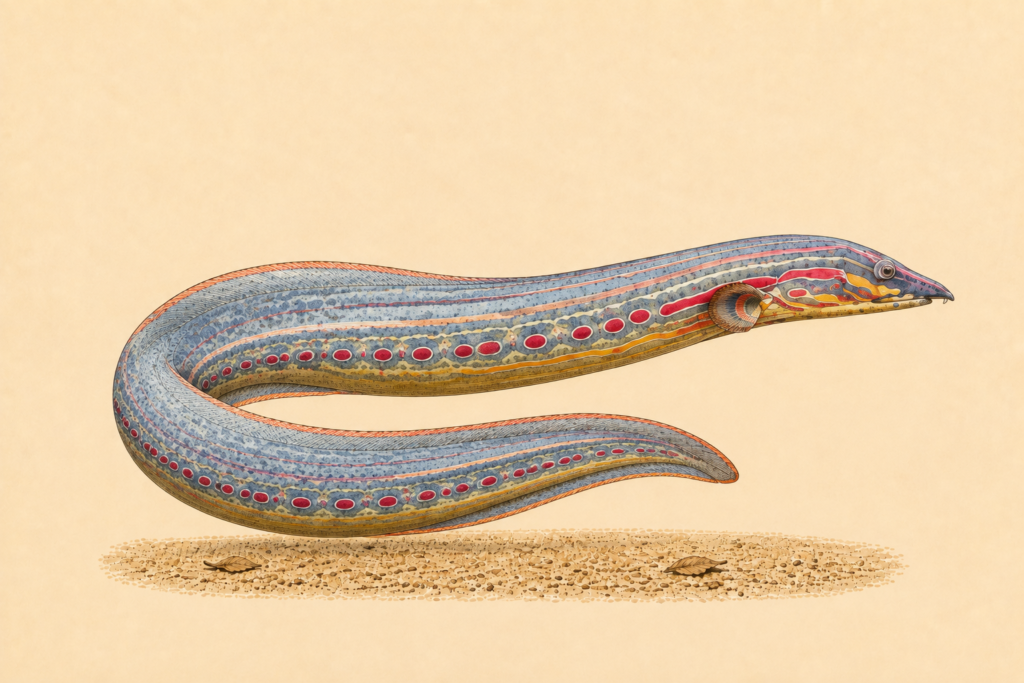
The Fire Eel is an undeniably beautiful fish, and its appearance is the primary reason most keepers are drawn to the species. The body is elongated and eel-like, laterally compressed along the posterior half and more cylindrical towards the head. The base colour is a deep chocolate brown to near-black, overlaid with a pattern of vivid red, orange, or sometimes yellowish markings. These markings typically appear as a series of broken lateral lines and spots running along the flanks from behind the head to the base of the caudal fin. The pattern is highly variable between individuals, and no two Fire Eels look exactly alike.
The dorsal fin is a long, low ridge studded with short spines – the feature that gives the spiny eel family its common name. These spines are not venomous in the traditional sense, but they can deliver a painful prick and are coated in a mildly irritating mucus that can cause localised swelling and discomfort if the handler is careless. The pectoral fins are small, and the pelvic fins are absent entirely, which is characteristic of the Mastacembelidae. The anal and dorsal fins merge with the caudal fin to form a continuous fin fringe around the tail end of the body.
The head is relatively small compared to the body, with a distinctly pointed snout that terminates in a fleshy, trunk-like proboscis. This proboscis is used to probe substrate, crevices, and burrows in search of food. The eyes are small and set high on the head. The mouth is subterminal and surprisingly capacious – a fact that becomes apparent when the eel feeds on larger prey items.
Juveniles tend to display duller colouration, with the red and orange markings often appearing as faint yellowish spots or lines. As the fish matures and grows, the markings intensify dramatically, and the contrast between the dark body and bright patterning becomes increasingly striking. Well-maintained adults in optimal conditions can develop markings that are almost fluorescent in appearance. Colour intensity is influenced by diet, water quality, stress levels, and the overall health of the animal.
It is worth noting that Fire Eels produce copious amounts of mucus as a protective skin coating. This mucus is important for burrowing and for defending against skin parasites, but it can make the fish feel distinctly slimy to the touch. The mucus can also foul nets and transfer bags during transport, which is one reason why careful acclimation and minimal handling are essential.
Natural Habitat
Fire Eels are found across a broad range of freshwater habitats in mainland and insular Southeast Asia. Their range includes the major river basins of Thailand, Myanmar, Cambodia, Laos, and Vietnam, as well as river systems in peninsular Malaysia, Sumatra, and Borneo in Indonesia. Within this extensive range, they occupy a variety of lowland habitats, though they show a strong preference for slow-moving or still waters with soft substrates.
Typical habitats include floodplain lakes, oxbow pools, swampy backwaters, irrigation canals, and the sluggish lower reaches of rivers where fine mud, silt, and sand accumulate on the bottom. Fire Eels are strongly associated with submerged structure – fallen trees, root tangles, dense beds of aquatic vegetation, and undercut banks all provide the cover and burrowing opportunities they require. In many parts of their range, they are found in seasonally inundated forests and rice paddies during the wet season, retreating to deeper permanent water bodies as the floodwaters recede.
The waters they inhabit are typically warm, slightly acidic to neutral, and often stained with tannins from decaying vegetation. Dissolved oxygen levels can be moderate to low in some of the stagnant habitats they frequent, and Fire Eels are somewhat tolerant of sub-optimal oxygen conditions compared to many other tropical fish. However, this tolerance should not be used as an excuse for poor aeration in captivity.
In the wild, Fire Eels are solitary, nocturnal predators that spend the daylight hours buried in soft substrate or hidden amongst dense cover. They emerge at dusk and throughout the night to hunt, using their sensitive proboscis and well-developed sense of smell to locate prey in murky, low-visibility conditions. Their natural diet consists primarily of aquatic insect larvae (especially chironomid midge larvae), small crustaceans, worms, and small fish. Larger individuals will also take frogs and other small vertebrates.
Tank Size and Setup
Do not underestimate the tank size this species requires. Fire Eels are large, active (when they choose to be), and produce a significant bioload. A juvenile of 15-20 cm can be temporarily housed in a 450-litre aquarium, but this is genuinely a temporary arrangement. An adult Fire Eel of 60-90 cm needs a tank of at least 700 litres, and ideally larger. The tank’s footprint – its length and width – matters more than height. A tank measuring at least 180 cm long and 60 cm wide (front to back) should be considered the minimum for a fully grown specimen. Wider tanks of 75 cm or more front to back are even better, as they provide more floor space for burrowing and movement.
The single most important aspect of the Fire Eel’s setup is the substrate. A soft, fine sand substrate is essential. Fire Eels spend a great deal of their time partially or fully buried, and their sensitive snout and scaleless skin are easily damaged by gravel, crusite, or any substrate with sharp or rough particles. Play sand, pool filter sand, or purpose-sold aquarium sand are all suitable. The sand bed should be at least 5-8 cm deep to allow the eel to burrow properly. Some keepers provide even deeper sand beds of 10-15 cm in certain areas of the tank.
Decor should provide ample hiding places. Large pieces of driftwood, lengths of PVC pipe (wide enough for the eel to comfortably enter and turn around in), smooth rocks arranged into caves, and dense plantings of robust aquatic plants all serve this purpose. Fire Eels that do not feel secure will remain stressed, refuse food, and are more prone to disease. It is not unusual for a newly introduced Fire Eel to remain hidden for one to two weeks before it begins to explore the tank regularly. Having multiple hiding spots available from the outset helps the eel settle in more quickly.
A tight-fitting lid with no gaps is absolutely essential. Fire Eels are notorious escape artists. They are powerful, flexible, and can squeeze through remarkably small openings. Any gap around filter inlets, heater cables, airline tubing, or lid hinges must be sealed – foam inserts, cut plastic, or aquarium-safe silicone can be used to block potential escape routes. A Fire Eel that exits the tank will quickly dry out and die, and this is one of the most common causes of loss in captive specimens.
Lighting should be subdued, particularly during the acclimatisation period. Fire Eels are nocturnal by nature and are most active under dim or no lighting. Floating plants such as Amazon frogbit or water lettuce can help diffuse overhead lighting and create shaded areas the eel will appreciate. If you wish to observe your eel’s nocturnal activity, consider installing a low-wattage red or blue LED moonlight, which allows visibility without disturbing the fish.
Live plants can be used, but the eel’s burrowing behaviour will uproot many species. Hardy, well-rooted plants such as Anubias (attached to hardscape), Java fern, and Vallisneria tend to fare best. Delicate carpeting plants are generally a poor choice, as they will be constantly disturbed.
Water Parameters
| Temperature | 24-28 C |
| pH | 6.0-7.5 |
| General hardness (GH) | 5-15 dGH |
| Carbonate hardness (KH) | 3-10 dKH |
| Ammonia | 0 ppm |
| Nitrite | 0 ppm |
| Nitrate | Below 20 ppm |
Fire Eels are reasonably adaptable within the ranges listed above, but they are notably sensitive to poor water quality. As scaleless fish, they lack the physical barrier that scaled species have against dissolved toxins, and they absorb pollutants directly through their skin. Ammonia and nitrite must be maintained at zero at all times – even brief spikes can cause severe skin irritation, secondary bacterial infections, and potentially death.
Nitrate levels should be kept below 20 ppm through regular water changes. Given the substantial bioload a large Fire Eel produces, this typically means performing water changes of 25-30% on a weekly basis, or more frequently in smaller setups. Use a quality liquid test kit rather than strips to monitor parameters reliably.
Temperature stability is important. Rapid fluctuations of more than 2 C in a short period can stress the fish and trigger disease outbreaks. A reliable heater with a guard (to prevent the eel from burning itself by wrapping around it) is essential. In tanks of 700 litres or more, two heaters placed at opposite ends of the tank help ensure even heat distribution.
Fire Eels are also sensitive to many common aquarium medications, particularly those containing copper, malachite green, or potassium permanganate. Always check medication safety for scaleless fish before dosing. Half-doses are often recommended when treatment is unavoidable, and salt-based treatments should be used with caution, as prolonged exposure to elevated salinity can cause osmotic stress.
Filtration and Equipment
Robust filtration is non-negotiable for a species that produces as much waste as a Fire Eel. A large external canister filter, or ideally two, rated for well above the tank’s total volume is the most practical approach. Aim for a total filtration turnover of at least 6-8 times the tank volume per hour. For a 700-litre tank, this means filters providing a combined flow rate of approximately 4,200-5,600 litres per hour. Sump filtration is an excellent alternative for larger setups and offers the added benefit of increasing total water volume.
Filter intakes must be covered or guarded. Fire Eels, particularly juveniles, can become trapped against unprotected intakes. Coarse foam pre-filter covers fitted over intake strainers are an inexpensive and effective safeguard.
Water movement in the tank should be moderate. Fire Eels naturally inhabit slow-moving or still waters and do not appreciate strong currents. Position filter outlets to avoid creating a high-flow zone across the entire tank – spray bars or lily pipes can help diffuse outflow and reduce current strength.
As mentioned in the setup section, heaters should be fitted with guards. Inline heaters installed on the filter return line are another option and eliminate the risk of contact burns entirely. An air pump providing gentle aeration through a fine airstone can supplement oxygenation, particularly in warmer setups where dissolved oxygen levels are naturally lower.
A timer-controlled lighting system that provides a consistent photoperiod of 8-10 hours helps establish a regular day-night cycle, which is important for a nocturnal species. Abrupt changes in lighting should be avoided – a gradual ramp-up and ramp-down using a dimmer or sunrise/sunset function is ideal if your lighting unit supports it.
Diet and Feeding
Fire Eels are carnivorous predators, and their diet in captivity should reflect their natural feeding habits. The staple diet for most captive Fire Eels consists of frozen foods, with frozen bloodworms (chironomid larvae) being the most universally accepted food item. Most Fire Eels will take frozen bloodworms with enthusiasm, even when they refuse all other foods.
Beyond bloodworms, a varied diet should include frozen or live foods such as brine shrimp, mysis shrimp, krill, chopped prawns, earthworms, and small whole fish (such as whitebait or lancefish). Live earthworms are a particular favourite and are excellent for conditioning and for encouraging reluctant feeders. Live river shrimp and small feeder insects (such as crickets and mealworms) can also be offered as occasional treats and enrichment.
Avoid using feeder fish from pet shops as a regular food source. Shop-bought feeder fish are frequently carriers of parasites and diseases, and relying on them introduces unnecessary risk. If you wish to offer live fish as part of the diet, quarantine them thoroughly first, or better yet, breed your own feeder fish in a separate setup.
Some Fire Eels can be trained to accept high-quality sinking carnivore pellets, such as those produced by Hikari, Northfin, or New Life Spectrum. This is a worthwhile goal, as pellet foods are nutritionally balanced and more convenient than frozen foods alone. However, not all individuals will accept pellets, and patience is required – it may take weeks or months of gradual introduction alongside preferred foods before the eel begins to accept them.
Fire Eels are best fed in the evening or after lights-out, in keeping with their nocturnal habits. Juveniles should be fed daily, while adults can be fed every other day or three to four times per week. Overfeeding should be avoided, as it contributes to water quality problems and can lead to obesity. A good rule of thumb is to offer an amount the eel can consume within 10-15 minutes and remove any uneaten food promptly.
One of the great pleasures of keeping a Fire Eel is hand-feeding. Many individuals, once settled and comfortable, will learn to take food directly from their keeper’s fingers or from feeding tongs. This behaviour can take months to develop but is immensely rewarding and allows the keeper to monitor the eel’s food intake closely. Be mindful that Fire Eels have small but functional teeth, and an enthusiastic feeding response can result in a harmless but surprising nip.
Behaviour and Temperament
Fire Eels are primarily nocturnal and spend most of the daylight hours hidden – buried in sand, wedged into caves, or tucked behind driftwood. New keepers are sometimes alarmed by how completely their eel disappears during the day, but this is entirely normal behaviour. As the eel becomes more settled and accustomed to the tank’s routine, it will gradually become bolder and may begin to emerge during the day, particularly around feeding times.
Despite their predatory nature, Fire Eels are not aggressive fish in the conventional sense. They do not chase, harass, or fin-nip tank mates. Their predation is opportunistic rather than aggressive – if a fish is small enough to fit in the eel’s mouth, it will eventually be eaten, often during the night when other fish are resting. This is not malice; it is simply the eel behaving as nature intended. Keepers must select tank mates accordingly.
Fire Eels are generally solitary and do not require the company of conspecifics. In fact, housing multiple Fire Eels together requires a very large tank with abundant hiding spots to prevent territorial disputes. While not overtly aggressive towards each other, they can be intolerant of another large eel occupying the same preferred hiding spot, and low-level stress from proximity can affect feeding and health.
The species is remarkably intelligent for a fish. Long-term keepers consistently report that their Fire Eels recognise them, responding differently to familiar versus unfamiliar people. They learn feeding routines quickly and will often emerge from hiding when they detect their keeper approaching the tank, even outside of normal feeding times. This interactive quality is a significant part of their appeal.
Fire Eels can be skittish, especially when newly introduced or if startled by sudden movements, loud noises, or abrupt changes in lighting. When frightened, they may dash around the tank at speed, potentially injuring themselves against hard decor or the glass. This is another reason why a secure lid, smooth decor, and dim lighting are so important. A panicked Fire Eel can also leap out of the water with considerable force.
Burrowing is a constant and essential behaviour. A Fire Eel denied the ability to burrow – whether due to an inappropriate substrate, insufficient depth, or the absence of suitable burrowing sites – will show signs of chronic stress, including loss of colour, refusal to feed, and increased susceptibility to disease. Burrowing is not optional enrichment; it is a fundamental behavioural need.
Tank Mates
Choosing tank mates for a Fire Eel requires a careful balance. The eel itself is not aggressive, but any fish small enough to be swallowed will eventually be eaten. The rule of thumb is that tank mates should be too large to fit in the eel’s mouth, robust enough to hold their own in a large community, and not so aggressive that they will harass or injure the eel. Slow, shy species that compete poorly for food are also a poor choice, as the eel’s nocturnal feeding habits and large appetite can leave timid tank mates underfed.
Good tank mates
- Oscar – Large enough to avoid predation and hardy enough to share space with a Fire Eel in a suitably sized tank.
- Silver Dollar – A robust, schooling species that is too deep-bodied for the eel to swallow and occupies mid-water, leaving the bottom to the eel.
- Bala Shark – Active, peaceful, and grows large enough to be safe; best kept in a group in a very large tank.
- Common Pleco – A large, armoured catfish that is generally ignored by Fire Eels and occupies a similar nocturnal niche without conflict.
- Clown Loach – When kept in groups and grown to a reasonable size, Clown Loaches are robust enough to coexist; both species appreciate similar water conditions.
- Giant Gourami – A large, generally placid species that does well in similar water parameters and is far too big to be considered prey.
- Tinfoil Barb – A large, active schooling fish that is too fast and too large for the eel to target.
- Severum – A peaceful to moderately territorial cichlid that reaches a good size and generally coexists well with spiny eels.
Fish to avoid
- Neon Tetra – Far too small; these would be treated as live food and consumed rapidly.
- Guppy – Tiny, slow, and defenceless – an easy meal for any Fire Eel.
- Cherry Shrimp – All ornamental shrimp will be consumed; they are natural prey for spiny eels.
- Flowerhorn – Highly aggressive and territorial; a Flowerhorn is likely to injure or kill a Fire Eel, especially if the eel is resting or burrowing.
- Red-Tail Catfish – While not aggressive per se, this catfish grows enormous and can swallow a Fire Eel whole once it reaches sufficient size.
- African Cichlids (Mbuna) – Highly aggressive, territorial, and require hard alkaline water that is unsuitable for Fire Eels.
- Tiger Barb – Nippy and small enough to be eaten; a poor combination on both counts.
- Celestial Pearl Danio – Far too small to coexist safely with a large predator.
Breeding
Breeding Fire Eels in captivity is exceptionally rare and falls firmly into the realm of expert-level fishkeeping. The vast majority of Fire Eels available in the aquarium trade are wild-caught, and only a handful of successful captive breeding events have been documented worldwide, most of them occurring in public aquaria or large-scale breeding facilities in Southeast Asia rather than in home aquaria.
Sexing Fire Eels is difficult. Females are generally reported to be thicker-bodied than males when mature, particularly when gravid, but there are no reliable external sexual dimorphisms visible to the casual observer. Some sources suggest subtle differences in the shape of the genital papilla, but this requires close examination that is rarely practical with a large, mucus-coated, spine-bearing fish.
In the few documented captive spawnings, the breeding pair were housed in very large tanks (well over 1,000 litres) with abundant cover and soft sand. Spawning has been reported to be preceded by an extended courtship period involving the pair swimming together in close contact, often intertwining their bodies. Eggs are reportedly deposited on flat surfaces such as smooth stones or broad leaves, and are small, adhesive, and semi-transparent.
Hormonal induction has been used to trigger spawning in commercial facilities, which further underscores the difficulty of achieving natural breeding in home aquaria. Raising the fry presents additional challenges, as the larvae are tiny and require appropriately small live foods such as infusoria and newly hatched brine shrimp.
For the foreseeable future, breeding Fire Eels remains a project for institutions and specialist breeders with the resources to dedicate enormous tanks, controlled environmental conditions, and potentially hormonal treatments. Home aquarists should not purchase Fire Eels with the expectation of breeding them.
Common Diseases
Fire Eels, like all scaleless fish, are more vulnerable to certain diseases and more sensitive to medications than their scaled counterparts. Prevention through excellent water quality and appropriate husbandry is always preferable to treatment.
White spot disease (Ichthyophthirius multifiliis, commonly known as ich) is one of the most frequently encountered problems. Fire Eels are particularly susceptible to ich, and outbreaks are often triggered by stress from transport, poor water quality, or temperature fluctuations. Standard ich medications containing malachite green or copper should be used at half the recommended dose or avoided entirely for scaleless fish. Heat treatment – gradually raising the temperature to 30 C and maintaining it for 10-14 days alongside increased aeration – is often the safest first-line approach.
Bacterial skin infections are another common issue, often secondary to skin abrasions caused by rough substrate, sharp decor, or physical injury during handling. Symptoms include reddened patches, ulcerations, and frayed fin edges. Maintaining pristine water quality and removing the source of injury are the most important steps. Broad-spectrum antibacterial treatments safe for scaleless fish can be used if the infection does not resolve with improved husbandry alone.
Internal parasites are frequently present in wild-caught Fire Eels. Symptoms can include weight loss despite a good appetite, white stringy faeces, and a generally emaciated appearance. Prophylactic deworming with a praziquantel-based medication upon acquisition is common practice among experienced keepers and is generally well tolerated by spiny eels.
Fungal infections can affect Fire Eels, particularly those with compromised skin integrity. Fluffy white or grey growths on the skin are the primary symptom. Fungal infections often develop as secondary opportunistic infections following bacterial infections or physical injury. Treatment with antifungal medications safe for scaleless fish, combined with addressing the underlying cause, is the standard approach.
Stress-related conditions are perhaps the most significant health concern overall. A Fire Eel that is chronically stressed – due to inadequate hiding places, inappropriate substrate, aggressive tank mates, poor water quality, or excessive light – will have a suppressed immune system and will be far more vulnerable to all of the diseases listed above. The best medicine for a Fire Eel is a well-designed, stable, and peaceful environment.
FAQs
How fast do Fire Eels grow?
Growth rate varies depending on diet, tank size, water quality, and genetics, but Fire Eels are not especially fast growers. A juvenile of 15 cm might reach 30-40 cm within the first two years, with growth slowing considerably after that. It may take five or more years for a Fire Eel to approach its full adult size of 60-90 cm. However, the eventual size is not in doubt – keepers must plan for the full-grown animal from the start, not just the juvenile they bring home.
Can I keep a Fire Eel in a planted tank?
You can include live plants, but you need to choose carefully. The eel’s burrowing will uproot most substrate-rooted plants repeatedly. Species attached to hardscape – such as Anubias tied or glued to driftwood, or Java fern attached to rocks – are your best options. Floating plants work well too, as they provide shade without being disturbed by burrowing. Vallisneria and Cryptocoryne species can sometimes establish themselves in the sand if they develop robust enough root systems, but expect some disruption.
Is the Fire Eel’s sting dangerous?
Fire Eels do not have a true sting. The spines on their dorsal fin can prick the skin if the fish is handled carelessly, and the mucus coating the spines can cause mild irritation, swelling, and localised discomfort similar to a bee sting. The pain is usually short-lived and resolves within a few hours. It is not medically dangerous in the vast majority of cases, but it is unpleasant enough to serve as a strong incentive to avoid handling the fish with bare hands. Use a large container rather than a net when the eel needs to be moved.
Why is my Fire Eel not eating?
Newly introduced Fire Eels frequently refuse food for days or even weeks. This is typically a stress response and resolves once the eel feels secure in its new environment. Ensure there are plenty of hiding spots, the substrate is soft sand, lighting is dim, and water quality is excellent. Offer highly palatable foods such as live earthworms or frozen bloodworms during or after lights-out. If the eel continues to refuse food for more than three to four weeks, consider checking water parameters thoroughly and examining the eel for signs of illness or parasites.
Can I keep more than one Fire Eel together?
It is possible, but it requires a very large tank – well in excess of 1,000 litres for a pair, and larger still for additional individuals. Multiple hiding spots must be provided so each eel can
Related Guides
- False Tiger Knifefish – Tank Setup, Feeding and Breeding – Another large, predatory, nocturnal species with similar tank size requirements and husbandry challenges, making it a natural comparison for advanced keepers.
- Demon Eartheater – Tank Setup, Feeding and Breeding – A sizeable South American cichlid that shares the Fire Eel’s need for a sand substrate and makes a potential large-tank companion.
- Altifron Eartheater – Tank Setup, Feeding and Breeding – Like the Fire Eel, this eartheater sifts through soft sand to feed, so understanding its care helps when planning a shared large-fish community.
- L168 Butterfly Pleco – Tank Setup, Feeding and Breeding – A peaceful, bottom-dwelling pleco that can coexist with Fire Eels in a spacious setup, occupying a different ecological niche.
- Altum Angelfish – Tank Setup, Feeding and Breeding – Another advanced-level species from soft, acidic water that appeals to experienced aquarists looking for visually striking, demanding fish to keep.