Yellow Lab Care Guide — Tank Setup, Feeding and Breeding
Introduction
The Yellow Lab, scientifically known as Labidochromis caeruleus, is one of the most popular and widely recommended African cichlids in the freshwater aquarium hobby. Hailing from the rocky shores of Lake Malawi in East Africa, this vibrant species has earned its place as a staple in Mbuna community tanks thanks to its striking electric yellow colouration, relatively peaceful disposition, and hardy constitution. For aquarists looking to dip their toes into the world of African cichlids without immediately confronting the aggressive temperaments that many Mbuna species are notorious for, the Yellow Lab represents an ideal starting point.
Despite the somewhat confusing scientific name — “caeruleus” translates to “blue” in Latin, referencing the species’ original description from a blue-white colour morph — it is the brilliant yellow variant that has captured the hearts of fishkeepers worldwide. First described by Fryer in 1956, Labidochromis caeruleus was initially overlooked in favour of more flamboyant Malawi cichlids, but by the 1980s and 1990s the electric yellow morph had become one of the most traded freshwater fish on the planet. Today, it remains a cornerstone species for anyone setting up a Lake Malawi biotope or a mixed African cichlid community.
This comprehensive care guide covers everything you need to know to keep Yellow Labs healthy, vibrant, and thriving in your home aquarium, from tank setup and water chemistry to diet, breeding, and compatible tank mates.
Quick Stats
| Scientific name | Labidochromis caeruleus |
| Common names | Yellow Lab, Electric Yellow Lab, Electric Yellow Cichlid, Yellow Labidochromis, Lemon Yellow Lab, Blue Streak Hap |
| Family | Cichlidae |
| Origin | Lake Malawi, East Africa (Malawi, Mozambique, Tanzania) |
| Adult size | 10–13 cm (4–5 inches) |
| Lifespan | 6–10 years |
| Difficulty | Easy |
| Breeding difficulty | Easy |
| Temperature | 24–28 °C |
| pH range | 7.4–8.6 |
| General hardness (GH) | 10–20 dGH |
| Carbonate hardness (KH) | 6–12 dKH |
| Minimum tank size | 200 litres |
| Conservation status | Least Concern (IUCN) |
Appearance
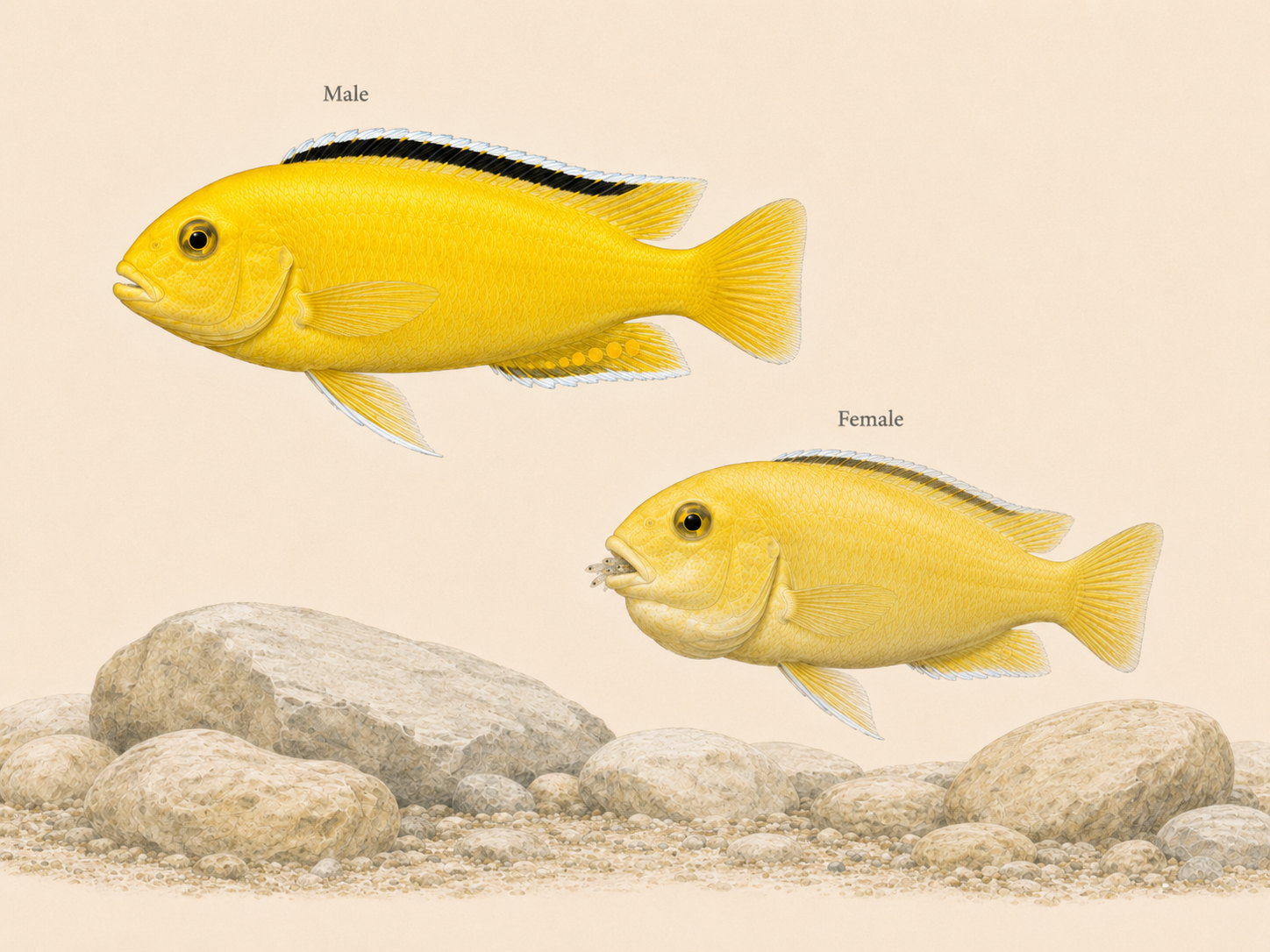
The Yellow Lab is immediately recognisable by its vivid, saturated yellow body that extends from the tip of the snout to the end of the tail. In well-kept specimens, this yellow is intense and uniform, giving the fish an almost luminous quality under aquarium lighting. One of the species’ most distinguishing features is the bold black edging along the dorsal fin, which creates a striking contrast against the yellow body. The anal and pelvic fins may also display subtle black or dark grey margins, though this varies between individuals and populations.
The body shape is typical of Mbuna cichlids — moderately elongated, laterally compressed, and robust, with a slightly rounded head and a small, underslung mouth adapted for picking invertebrates from rock surfaces. The eyes are relatively large and dark, and the lips are noticeably thick, a trait common among Labidochromis species. Adult males tend to be slightly larger and more intensely coloured than females, though sexual dimorphism in this species is notably subtle compared to many other Malawi cichlids. Males often develop more prominent black colouration on the ventral fins and may display faint egg spots on the anal fin, though these are not always reliable indicators of sex.
Juvenile Yellow Labs are paler in colour and may appear washed out or slightly greenish-yellow. As they mature and settle into a well-maintained aquarium with an appropriate diet, their colouration intensifies considerably. Poor water quality, stress, or inadequate nutrition can cause the yellow to fade, making colour vibrancy a useful barometer of overall health. It is worth noting that many commercially bred Yellow Labs have been hybridised or selectively bred to varying degrees, which can affect the purity and intensity of their colouration.
Varieties and Morphs
While the electric yellow morph is by far the most popular and widely available form of Labidochromis caeruleus, the species actually exhibits considerable natural colour variation across different populations in Lake Malawi. Several of these colour forms are occasionally available in the aquarium trade, though they are far less commonly seen than the ubiquitous yellow variant.
The white morph, sometimes sold as the White Lab, displays a clean white to pearl-coloured body with the same black dorsal stripe characteristic of the species. This form originates from certain rocky habitats and is considered attractive in its own right, though it has never achieved the commercial popularity of the yellow form. The blue-white morph, which is actually closest to the type specimen described by Fryer, features a pale blue to white body and is sometimes labelled as the Blue Streak Hap in older aquarium literature.
A pale yellow morph with reduced black edging is occasionally encountered, often the result of selective breeding in commercial facilities rather than a distinct wild population. Some breeders have also produced intensified “super yellow” lines through selective pairing, aiming for deeper, more saturated colouration and heavier black markings on the fins. Conversely, a partially melanistic form with increased dark pigmentation across the body has appeared sporadically in captive-bred populations. Aquarists seeking genetically pure stock are advised to source their fish from reputable breeders or specialist Malawi cichlid importers, as hybridisation with other Labidochromis species and even other Mbuna genera is an ongoing concern in the commercial trade.
Natural Habitat
Labidochromis caeruleus is endemic to Lake Malawi, one of the African Great Rift Lakes and the ninth largest lake in the world. Lake Malawi is renowned for its extraordinary cichlid diversity, with estimates suggesting it hosts over 800 species, many of which are found nowhere else on Earth. The Yellow Lab is classified as a Mbuna, a Tonga word meaning “rockfish,” referring to the group of cichlids that inhabit the rocky littoral zones of the lake.
In the wild, Yellow Labs are found along rocky coastlines at depths ranging from approximately 10 to 40 metres, though they are most commonly encountered between 10 and 20 metres. They occupy the intermediate zone between the open water column and the rock-strewn substrate, often seen darting in and out of crevices and gaps between boulders. The lake bed in these areas typically consists of large rocks and boulders with patches of sandy sediment, and the water is exceptionally clear with visibility often exceeding 20 metres.
The species has been documented at multiple locations around the lake, including the well-known collection points of Lion’s Cove, Nkhata Bay, and Ruarwe along the western shore. Different populations exhibit the colour variation mentioned above, with the famous electric yellow form primarily associated with Lion’s Cove and surrounding areas. The water in Lake Malawi is notably alkaline and hard, with a stable temperature profile that rarely fluctuates more than a few degrees throughout the year. This stability is an important consideration for aquarists, as these fish have evolved in an environment with remarkably consistent water chemistry.
In their natural habitat, Yellow Labs are primarily insectivores, feeding on small invertebrates, larvae, and crustaceans that they pick from rock surfaces and from within biofilm. Unlike many Mbuna that are predominantly herbivorous algae grazers, Labidochromis caeruleus has a more protein-oriented diet in the wild, which influences their dietary requirements in captivity.
Tank Size and Setup
A minimum tank size of 200 litres is recommended for a small group of Yellow Labs, though larger aquariums of 300 litres or more are preferable, particularly if you intend to house them in a mixed Mbuna community. The additional space helps diffuse territorial aggression and provides the multiple line-of-sight breaks that are essential for maintaining harmony among cichlids. A tank measuring at least 120 cm in length is ideal, as horizontal swimming space is more important than height for these rock-dwelling fish.
The aquascape should aim to replicate the rocky shoreline habitat of Lake Malawi. Use a combination of large rocks, cobbles, and boulders to create an intricate network of caves, crevices, overhangs, and passages. Ensure the rockwork is stable and cannot topple — cichlids are enthusiastic diggers, and an unsecured pile of rocks can be dangerous. Many aquarists use aquarium-safe silicone or egg crate light diffuser panels beneath the substrate to prevent rocks from shifting. The goal is to provide numerous hiding spots and territories so that subordinate fish can escape the line of sight of dominant individuals.
For the substrate, fine sand or crushed coral is the best choice. Sand is more natural and allows the fish to exhibit their digging behaviour without risk of injury, while crushed coral or aragonite sand offers the added benefit of slowly buffering the water towards the alkaline pH that these fish require. Avoid sharp-edged gravel, which can damage the mouths of fish that sift through the substrate.
Live plants are not essential and are, in fact, difficult to maintain in a Malawi cichlid setup. The alkaline, hard water and the fish’s tendency to uproot and nibble on vegetation make most aquatic plants impractical. If you wish to include greenery, hardy species such as Anubias and Java Fern attached to rocks or driftwood are your best options, as they are less palatable and do not require planting in the substrate. Vallisneria can also work, as it tolerates hard water reasonably well.
Lighting should be moderate. Bright lighting can encourage algae growth on the rockwork, which the fish will graze on as a supplementary food source — this is actually beneficial. However, excessively bright lighting without sufficient cover can stress the fish, so ensure your rockwork provides shaded areas where they can retreat.
Water Parameters
Maintaining stable, appropriate water chemistry is critical for the long-term health and colouration of Yellow Labs. Lake Malawi is characterised by hard, alkaline water, and replicating these conditions in the aquarium is straightforward, particularly in areas with naturally hard tap water. Consistency is arguably more important than hitting exact numbers — sudden swings in pH or temperature are far more harmful than water that sits slightly outside the ideal range.
| Temperature | 24–28 °C |
| pH | 7.4–8.6 |
| General hardness (GH) | 10–20 dGH |
| Carbonate hardness (KH) | 6–12 dKH |
| Ammonia | 0 ppm |
| Nitrite | 0 ppm |
| Nitrate | Below 20 ppm |
If your tap water is naturally soft and acidic, you will need to use buffering agents to raise the pH and hardness. Crushed coral, aragonite substrate, and limestone rocks all contribute to buffering capacity. Commercial Malawi buffer salts are also available and can be added during water changes to maintain consistent parameters. Regular water changes of 25–30% weekly are strongly recommended to keep nitrate levels low and maintain mineral balance. Yellow Labs are reasonably forgiving of minor parameter fluctuations, but chronically poor water quality will lead to faded colouration, weakened immune systems, and increased susceptibility to disease.
Filtration and Equipment
Robust filtration is non-negotiable for any cichlid aquarium. Yellow Labs, like all Mbuna, produce a significant bioload relative to their size, and overstocking — which is a common and often recommended strategy for managing aggression in Mbuna tanks — places additional demands on the filtration system. A filter rated for at least 1.5 to 2 times the total tank volume per hour is a sensible baseline. External canister filters are the preferred choice for most Malawi setups, as they offer excellent biological, mechanical, and chemical filtration capacity without taking up space inside the tank.
Supplementary filtration in the form of a sponge filter or an internal powerhead with a sponge attachment can provide additional biological filtration and improve water circulation. Good water movement is important, as Lake Malawi has moderate currents along its rocky shores, and Yellow Labs appreciate a gentle to moderate flow. Avoid creating excessively strong currents that would stress the fish or make swimming difficult, but ensure there are no stagnant areas where detritus can accumulate.
A reliable heater with an accurate thermostat is essential for maintaining the stable temperatures these tropical fish require. In larger tanks, using two smaller heaters rather than one large unit provides a safety net — if one fails, the other continues to provide some heat, and if one malfunctions in the on position, it is less likely to overheat the entire tank. An air pump, while not strictly necessary, can provide additional surface agitation to promote gas exchange, which is particularly beneficial in densely stocked tanks.
Invest in a quality aquarium thermometer and a reliable liquid test kit for monitoring ammonia, nitrite, nitrate, pH, GH, and KH. Regular testing, especially during the initial cycling period and after any changes to stocking, is the best way to catch problems before they become crises.
Diet and Feeding
In the wild, Labidochromis caeruleus is primarily an insectivore, feeding on small invertebrates, snails, and crustaceans picked from rock surfaces. This sets it apart from many other Mbuna, which are predominantly herbivorous algae scrapers. In the aquarium, Yellow Labs are omnivorous and unfussy eaters, readily accepting a wide range of prepared and live foods. However, providing a balanced diet that reflects their natural feeding habits is essential for maintaining vibrant colouration and good health.
A high-quality cichlid pellet or flake food should form the staple of their diet. Look for products specifically formulated for Malawi cichlids, as these typically contain an appropriate balance of protein, vegetable matter, and essential vitamins. Spirulina-enriched foods are an excellent choice, as the algae content supports digestive health while the carotenoid pigments help enhance the fish’s yellow colouration. Feed the staple food once or twice daily, offering only as much as the fish can consume within two to three minutes to prevent overfeeding and the associated water quality issues.
Supplement the staple diet with occasional treats of frozen or live foods such as brine shrimp, daphnia, cyclops, and mosquito larvae. These protein-rich foods are relished by Yellow Labs and help condition breeding adults. However, it is crucial to avoid feeding mammalian proteins and fatty foods. Bloodworms, beef heart, and other high-fat foods should be avoided or offered only very sparingly, as they can cause a potentially fatal condition known as Malawi bloat — a digestive disorder particularly prevalent in Mbuna species. Blanched vegetables such as spinach, peas, and courgette can be offered occasionally to provide dietary fibre.
Behaviour and Temperament
The Yellow Lab is widely regarded as one of the most peaceful Mbuna species, which is a significant part of its appeal for aquarists new to African cichlids. However, it is important to understand that “peaceful for a Mbuna” still means the fish exhibits territorial behaviour, occasional chasing, and a hierarchical social structure that would be considered moderately aggressive by community fish standards. Context is everything when discussing cichlid temperament.
In a properly set up aquarium with adequate space and rockwork, Yellow Labs establish small territories around specific caves or crevices, particularly during breeding. Males are more territorial than females and will defend their chosen area from intruders, though disputes rarely escalate to the point of serious injury. The species does not exhibit the relentless, battering-ram aggression seen in more pugnacious Mbuna like Melanochromis auratus or Pseudotropheus demasoni. Confrontations typically involve flared fins, lateral displays, and brief chases rather than sustained attacks.
Keeping Yellow Labs in groups is strongly recommended. A ratio of one male to two or three females works well, as it distributes the male’s attention and reduces stress on any single female. In larger tanks, multiple males can coexist provided there are sufficient territories and visual barriers. Solitary Yellow Labs or pairs kept in isolation may become unusually aggressive or stressed. The Mbuna practice of overstocking — maintaining a higher fish density than would be typical for other freshwater species — can help manage aggression by preventing any single individual from establishing overwhelming dominance. This approach requires correspondingly robust filtration and diligent water change routines.
Yellow Labs are active and curious fish that spend much of their time exploring the rockwork, sifting through substrate, and interacting with tank mates. They are diurnal and most active during daylight hours, retreating to caves and crevices at night. Their inquisitive nature and willingness to approach the front glass make them engaging aquarium inhabitants with genuine personality.
Tank Mates
Selecting appropriate tank mates for Yellow Labs requires an understanding of Mbuna community dynamics. The ideal companions are other moderately tempered Mbuna species that occupy slightly different niches or display different colour patterns. Avoiding species with similar yellow colouration is important, as Yellow Labs may show increased aggression towards fish they perceive as conspecifics. Similarly, avoid extremely aggressive Mbuna that could bully or dominate the comparatively mild-mannered Yellow Labs.
Good tank mates
- Red Zebra Cichlid (Maylandia estherae) — A robust, similarly sized Mbuna with contrasting orange-red colouration that reduces the risk of interspecific aggression.
- Rusty Cichlid (Iodotropheus sprengerae) — One of the most peaceful Mbuna species, its brownish-lavender colouration poses no colour conflict with Yellow Labs.
- Acei Cichlid (Pseudotropheus acei) — A relatively docile, open-water Mbuna that occupies a different ecological niche and complements Yellow Labs well in mixed setups.
- Bristlenose Pleco (Ancistrus sp.) — A hardy, armoured catfish that tolerates the hard, alkaline water of a Malawi tank and helps control algae growth.
- Cobalt Blue Zebra (Maylandia callainos) — Its solid blue colouration contrasts sharply with the Yellow Lab, and the two species share similar care requirements and temperament levels.
- Synodontis multipunctatus — A Lake Tanganyika catfish that adapts well to Malawi water parameters and adds activity to the lower levels of the tank.
- Yellow Tail Acei (Pseudotropheus acei “Ngara”) — A peaceful, shoaling Mbuna with a blue body and yellow tail that provides visual interest without provoking territorial clashes.
- Perlmutt Cichlid (Labidochromis sp. “Perlmutt”) — A closely related Labidochromis species with a subtle pearly colouration and a similarly mild temperament.
Fish to avoid
- Auratus Cichlid (Melanochromis auratus) — One of the most aggressive Mbuna species, mature males will relentlessly harass and potentially kill Yellow Labs.
- Bumblebee Cichlid (Pseudotropheus crabro) — A large, aggressive Mbuna that can grow considerably bigger than Yellow Labs and tends to dominate the tank.
- Neon Tetra (Paracheirodon innesi) — A small, soft-water species entirely unsuited to the hard, alkaline conditions and boisterous environment of a Mbuna tank.
- Oscar (Astronotus ocellatus) — A large South American cichlid with completely different water requirements that would eventually outgrow and consume Yellow Labs.
- Kenyi Cichlid (Maylandia lombardoi) — Males are notoriously aggressive and territorial, and their yellow colouration can provoke intense aggression from and towards Yellow Labs.
- Guppy (Poecilia reticulata) — Far too small and delicate to survive in a Mbuna community, and requires significantly different water conditions.
- Demasoni Cichlid (Pseudotropheus demasoni) — Though small, this species is exceptionally aggressive and can be difficult to manage even with more robust Mbuna, posing a risk to peaceful Yellow Labs.
- Venustus Cichlid (Nimbochromis venustus) — A large predatory Haplochromis that will view smaller Mbuna as potential prey once it reaches its full size of over 25 cm.
Breeding
Yellow Labs are maternal mouthbrooders, and breeding them in captivity is one of the most rewarding aspects of keeping this species. They are among the easiest African cichlids to breed, and spawning will often occur spontaneously in a well-maintained aquarium without any special intervention from the aquarist.
When ready to spawn, the dominant male will intensify his colouration and select a flat rock surface or a cleared patch of substrate as his spawning site. He will display to passing females with vigorous body shaking, fin flaring, and lateral movements designed to entice a receptive female to the site. If a female is interested, she will approach and the pair will begin a circling courtship dance. The female deposits a small number of eggs on the chosen surface, then immediately turns to pick them up in her mouth. As she does so, she nuzzles the male’s anal fin, where egg spots — small, round markings that mimic the appearance of eggs — stimulate her to take the male’s milt into her mouth, fertilising the eggs.
A typical brood consists of 10 to 30 eggs, depending on the size and maturity of the female. The female carries the developing eggs and fry in her buccal cavity for approximately three weeks, during which time she does not eat. Her throat will appear visibly distended, and she will often seek refuge in a secluded area of the tank. It is important not to disturb brooding females, as stress can cause them to swallow or spit out the eggs prematurely.
After roughly 18 to 25 days, the female releases fully formed, free-swimming fry that are large enough to accept crushed flake food and newly hatched brine shrimp. The fry are surprisingly robust for their size but will be eaten by adult fish if left in the main tank. Breeders typically either strip the eggs from the female’s mouth at around 14 days and artificially tumble them, or they move the brooding female to a separate maternity tank where she can release the fry in safety. The fry grow relatively quickly and can reach sellable size within a few months with proper feeding and water quality.
To maximise breeding success, maintain a harem ratio of one male to at least three females, provide ample spawning sites in the form of flat rocks, and ensure water quality is optimal. Slight increases in temperature and generous feedings of protein-rich foods can help condition adults for spawning.
Common Diseases
Yellow Labs are hardy fish that are resistant to many common aquarium ailments when kept in appropriate conditions. However, they are susceptible to several diseases that are particularly prevalent among African cichlids, and awareness of these conditions is essential for any responsible keeper.
Malawi bloat is arguably the most feared disease in Mbuna aquaria. It is characterised by abdominal swelling, loss of appetite, lethargy, white or stringy faeces, and rapid breathing. If left untreated, it is almost invariably fatal. The exact cause is debated, but it is believed to involve a combination of dietary factors, stress, and opportunistic infections by intestinal parasites or bacteria. Feeding a diet low in animal fats, avoiding bloodworms, maintaining excellent water quality, and minimising stress are the best preventative measures. Early-stage treatment with metronidazole has shown some success, but advanced cases are extremely difficult to treat.
Ich, or white spot disease, caused by the protozoan parasite Ichthyophthirius multifiliis, is another common affliction. It presents as small white spots covering the body and fins, accompanied by flashing and rubbing against objects. Treatment involves raising the temperature gradually to around 30 °C and adding aquarium salt or a proprietary ich medication. The alkaline, hard water of a Malawi tank can affect the efficacy of some medications, so always check dosage recommendations for such conditions.
Swim bladder disorders can occasionally affect Yellow Labs, causing difficulties with buoyancy. These are often linked to poor diet, constipation, or bacterial infections. Fasting the fish for a day or two and then offering blanched peas can resolve minor cases related to constipation. Bacterial fin rot, typically triggered by poor water quality or physical injury from aggression, manifests as frayed, discoloured fin edges and responds well to improved water conditions and, in severe cases, antibacterial treatment. Maintaining the stable, clean water parameters outlined in this guide is the single most effective strategy for preventing disease in Yellow Labs.
FAQs
How can I tell the difference between male and female Yellow Labs?
Sexing Yellow Labs is notoriously difficult, especially in juveniles. Adult males tend to be slightly larger, display more intense yellow colouration, and often have more prominent black edging on the dorsal, anal, and pelvic fins. Males may also show faint egg spots on the anal fin. However, these differences are subtle and not always reliable. The most definitive method is venting — examining the genital papillae of the fish — which requires experience and a gentle hand. Observing breeding behaviour is another reliable indicator, as only females carry eggs in their mouths.
Can Yellow Labs be kept with Peacock Cichlids?
Yellow Labs can be kept with certain Peacock Cichlid (Aulonocara) species, though this combination requires careful management. Peacocks are generally less aggressive than Mbuna and may be outcompeted for food or bullied by more assertive tank mates. Because Yellow Labs are among the milder Mbuna, they are better suited to Peacock cohabitation than most, but the tank must be large enough to accommodate the different territorial needs of both groups. Avoid keeping them with very docile or small Peacock species that could be easily overwhelmed.
Why has my Yellow Lab lost its colour?
Colour fading in Yellow Labs is typically a sign of stress, poor water quality, inadequate diet, or illness. Check your water parameters immediately, paying particular attention to ammonia, nitrite, nitrate, and pH levels. Ensure the fish is not being bullied by tank mates and that there are sufficient hiding places. Improving the diet with spirulina-rich and carotenoid-enhanced foods can also help restore vibrant colouration. Newly introduced fish often appear pale due to the stress of transport and acclimatisation, and their colour should return within a few days as they settle in.
How many Yellow Labs should I keep together?
A minimum group of four to six individuals is recommended, ideally with a ratio of one male to every two or three females. Keeping too few fish can result in excessive aggression directed at a single individual, while a larger group distributes social pressure more evenly. In tanks of 300 litres or more, groups of eight to twelve Yellow Labs can create a lively, dynamic display with manageable aggression levels, provided the aquascape offers ample territories and hiding spots.
Do Yellow Labs need a heater?
Yes, a heater is essential unless you live in a climate where room temperature consistently remains within the 24–28 °C range year-round. Yellow Labs are tropical fish that require stable, warm water to thrive. Temperature fluctuations can stress the fish, suppress their immune system, and trigger disease outbreaks. A quality heater with an accurate thermostat is one of the most important pieces of equipment for any Malawi cichlid aquarium.
Related Guides
- Red Zebra Cichlid Care Guide — A popular Mbuna species that pairs well with Yellow Labs in mixed African cichlid communities.
- Acei Cichlid Care Guide — Another peaceful Mbuna that makes an excellent companion species for Yellow Labs.
- Lake Malawi Biotope Setup Guide — A detailed guide to creating an authentic Malawi rocky shore aquascape suitable for Yellow Labs and other Mbuna.
- Mbuna Cichlid Community Guide — Essential reading for anyone planning a mixed Mbuna tank, covering stocking strategies and aggression management.
- African Cichlid Diet and Nutrition Guide — An in-depth look at feeding African cichlids correctly, including how to prevent Malawi bloat.
- Bristlenose Pleco Care Guide — A hardy catfish species commonly kept alongside Malawi cichlids for algae control.