Quick summary
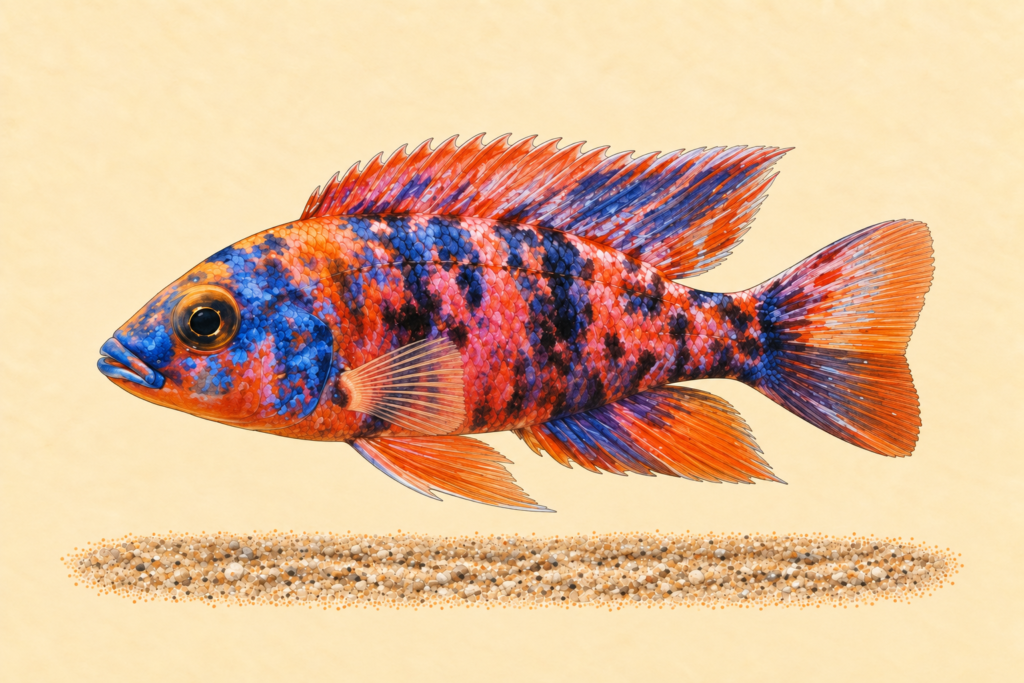
The OB Peacock Cichlid is a colourful, moderately hardy hybrid best suited to intermediate keepers who can provide a 230+ litre tank with hard, alkaline water matching Lake Malawi conditions. It’s a good choice if you want bold, varied colour with less aggression than typical mbuna, but it still needs careful tank mate selection and stable water quality to thrive.
🐠 Build a tank around this species
In this guide:
- Introduction
- Quick Stats
- Appearance
- Varieties and Morphs
- Natural Habitat
- Tank Size and Setup
- Water Parameters
- Filtration and Equipment
- Diet and Feeding
- Behaviour and Temperament
- Tank Mates
- Breeding
- Common Diseases
- FAQs
Introduction
The OB Peacock Cichlid is one of the most visually striking freshwater fish available to aquarists, combining the peaceful temperament of the Aulonocara genus with a dramatic mottled colour pattern not typically found in wild peacock cichlids. The “OB” designation stands for “Orange Blotch,” a term borrowed from the similarly patterned mbuna cichlids of Lake Malawi. This fish is not a naturally occurring species but rather a hybrid, originally created by crossing a male Aulonocara species with a female OB mbuna, most commonly an OB variant of Metriaclima (formerly Pseudotropheus). The result is a fish that carries the distinctive blotched pigmentation of the mbuna mother on the more docile peacock body plan.
Since their initial creation, OB Peacocks have been selectively bred through many generations, and today they are firmly established in the hobby as a line-bred variety in their own right. They are widely available, relatively hardy, and suitable for intermediate fishkeepers who have some experience with African cichlids. Their kaleidoscopic patterning means that no two individuals look exactly alike, which adds a unique appeal to any Malawi-themed aquarium. Despite their hybrid origins, they behave very much like pure Aulonocara and can be housed in similar setups, making them an excellent choice for keepers who want bold colour without the heightened aggression typical of mbuna species.
Quick Stats
| Scientific name | Aulonocara sp. OB (hybrid) |
|---|---|
| Common names | Orange Blotch Peacock, OB Aulonocara, Marmalade Peacock, Calico Peacock |
| Family | Cichlidae |
| Origin | Captive-bred hybrid; parent lineages from Lake Malawi, East Africa |
| Adult size | 14 cm |
| Difficulty | Intermediate |
| Breeding difficulty | Easy |
| Temperature | 24–28 °C |
| pH | 7.5–8.6 |
| GH | 10–25 dGH |
| Minimum tank size | 208 L |
| Conservation status | Not evaluated (captive-bred hybrid, not a wild species) |
Appearance
The defining feature of the OB Peacock Cichlid is its bold, irregular blotched pattern. The base colour can range from pale cream or white to vivid orange, and it is overlaid with patches, spots, and splotches of deep blue, black, red, or brown. This patterning is controlled by the OB gene, which disrupts normal melanin distribution and creates a unique mosaic on every individual fish. Males tend to develop more intense colouration as they mature, often showing electric blue or metallic sheen on the face, gill plates, and fins, combined with the characteristic blotching across the body. Females are generally less vivid, displaying more subdued browns, greys, and muted oranges with dark spots, though they are still far more colourful than the females of most wild-type Aulonocara species.
In terms of body shape, the OB Peacock retains the classic Aulonocara form: a moderately deep, laterally compressed body with a gently sloping forehead and a slightly underslung mouth. The dorsal fin is long and runs almost the full length of the back, often edged in blue or white. The caudal fin is broad and slightly rounded, and the anal fin in males typically features one or more egg spots, which play a role during breeding. Adults usually reach between 12 and 16 centimetres in total length, with males tending towards the larger end of that range. The overall impression is of a robust, well-proportioned cichlid draped in an endlessly variable pattern of colour.
Varieties and Morphs
Because the OB Peacock is itself a line-bred creation, selective breeding has produced a remarkable range of colour forms. Breeders have worked to intensify certain colour traits, and the following varieties are commonly encountered in the trade. It is worth noting that names are not always standardised, and the same fish may be sold under different labels depending on the breeder or retailer.
The Red OB Peacock is one of the most sought-after variants, displaying a rich red or strawberry-red base colour marked with dark blotches. These fish are sometimes produced by crossing OB lines with red-shouldered Aulonocara such as Aulonocara hansbaenschi or the Rubin Red Peacock. The Blue OB Peacock, by contrast, emphasises metallic blue colouration across the body, with the blotched pattern appearing as darker blue or black patches against a lighter blue or lavender base. The Marmalade Peacock is a popular trade name given to OB Peacocks that show a warm orange-and-black pattern reminiscent of marmalade, and this name is sometimes used interchangeably with the general OB Peacock designation.
The Dragon Blood Peacock is a closely related hybrid that is sometimes grouped with OB Peacocks, though it is technically a distinct line. Dragon Bloods typically display a vivid pinkish-red or salmon body with variable blue or dark spotting, and they have become extremely popular in their own right. The Firefish Peacock is another variant with an intensely red or orange body, often with reduced blotching and a more uniform colour, bred for maximum vibrancy. The OB Albino Peacock is a striking morph that combines the blotched pattern with albinism, resulting in a fish with a white or pale pink base, red eyes, and patches of orange or yellow.
The Sunshine OB Peacock leans towards bright yellow and orange tones with contrasting dark spots, while the Calico Peacock is a general trade name applied to fish with a particularly diverse mix of colours, including orange, blue, black, and white, distributed in a calico-like pattern. The German Red OB Peacock is selectively bred for deep, saturated red colouration and is named for the German breeding lines from which many high-quality specimens originate. Finally, the Blue Regal OB Peacock emphasises deep indigo-blue tones, particularly on the face and finnage, blended with the characteristic OB blotching across the flanks.
Natural Habitat
Strictly speaking, the OB Peacock Cichlid does not have a natural habitat because it is a captive-bred hybrid that does not occur in the wild. However, both of its parent lineages originate from Lake Malawi in East Africa, one of the African Great Rift Lakes shared by Malawi, Mozambique, and Tanzania. Understanding the conditions of this lake is essential for replicating appropriate aquarium parameters.
Lake Malawi is a vast, ancient body of water known for its remarkable clarity, alkaline chemistry, and extraordinary cichlid diversity, with over 800 described species. The Aulonocara genus, which forms the paternal side of the OB Peacock’s ancestry, inhabits the transitional zones between sandy substrates and rocky areas. These fish are typically found at moderate depths, often between 5 and 25 metres, where they hunt invertebrates in the sand using specialised sensory pores on their enlarged lower jaw. The mbuna species that contribute the OB gene, on the other hand, are rock-dwelling fish that live among the boulders and rubble of the lake’s shoreline. The OB Peacock, therefore, is a blend of these two ecological niches, and the ideal aquarium setup should reflect elements of both.
Lake Malawi’s water is consistently warm, typically between 24 and 28 °C, and notably hard and alkaline, with a pH generally ranging from 7.7 to 8.6. The mineral content is high, with significant levels of dissolved carbonates that buffer the water and maintain its stability. These conditions are non-negotiable for keeping OB Peacocks successfully, as they have inherited the same physiological requirements as their wild-type ancestors.
Tank Size and Setup
A minimum tank volume of 230 litres is recommended for a small group of OB Peacock Cichlids, though a larger aquarium of 300 litres or more is preferable, particularly if you intend to keep a mixed community of Malawi cichlids. The tank should be at least 120 centimetres in length to provide adequate horizontal swimming space and allow subordinate fish to establish territories away from dominant males. Taller tanks are less important than length and footprint, as these fish spend most of their time in the lower and middle sections of the water column.
The substrate should ideally consist of fine sand, which mimics the sandy zones that Aulonocara species naturally inhabit and allows the fish to engage in their instinctive sifting behaviour. Aragonite sand or coral sand is an excellent choice because it also helps to maintain the alkaline pH and elevated hardness that these fish require. Rockwork is an essential part of the aquascape and should be arranged to create caves, overhangs, and visual barriers. These structures serve as territories for dominant males and refuges for subdominant fish and females. Use inert rocks such as limestone, ocean rock, or lava rock, ensuring that all pieces are stable and securely stacked to prevent collapses.
Live plants are not strictly necessary and can be difficult to maintain in the hard, alkaline water that these cichlids prefer. However, hardy species such as Anubias, Java fern, and Vallisneria can survive in Malawi setups and provide additional cover and visual interest. Attach epiphytic plants to rocks or driftwood rather than planting them in the substrate, as the fish may uproot them. Lighting should be moderate; overly bright illumination can stress the fish, while subdued lighting tends to bring out their best colours.
Water Parameters
Maintaining stable, appropriate water chemistry is one of the most important aspects of keeping OB Peacock Cichlids healthy. These fish are adapted to the hard, alkaline conditions of Lake Malawi, and they do not thrive in soft or acidic water. Consistency is just as important as hitting the correct numbers; sudden fluctuations in pH or hardness can cause significant stress and increase susceptibility to disease.
| Temperature | 24–28 °C |
| pH | 7.5–8.6 |
| General hardness (GH) | 10-25 dGH |
| Ammonia | 0 ppm |
| Nitrite | 0 ppm |
| Nitrate | Below 20 ppm |
If your tap water is naturally soft or acidic, you will need to use a Malawi buffer salt mix or add crusite substrates such as coral sand and limestone to raise and stabilise the pH and hardness. Commercially available Rift Lake salt mixes are convenient and effective. Regular water changes of 20 to 30 per cent weekly are essential to keep nitrate levels low and maintain water quality. OB Peacocks are moderately sensitive to elevated nitrates, and chronic exposure to levels above 40 ppm can lead to lethargy, loss of colour, and increased disease risk.
Filtration and Equipment
Robust filtration is a non-negotiable requirement for any Malawi cichlid aquarium. OB Peacock Cichlids produce a moderate bioload, and when kept in groups or community settings, the cumulative waste output demands a filter capable of turning over the total tank volume at least six to eight times per hour. External canister filters are the preferred choice for most setups, as they offer excellent biological, mechanical, and chemical filtration capacity without occupying space within the tank. For larger aquariums, a sump filtration system provides even greater water volume and filtration flexibility.
Biological filtration media such as ceramic rings, sintered glass, or bio-balls should form the backbone of your filter setup, providing ample surface area for beneficial nitrifying bacteria. Mechanical filtration through foam pads or filter floss removes particulate waste and helps maintain water clarity. Chemical media such as activated carbon can be used periodically to remove dissolved organics and medications, though it is not strictly necessary for day-to-day operation.
A reliable heater is essential to maintain a stable temperature within the recommended range. In larger tanks, two smaller heaters placed at opposite ends of the aquarium provide more even heat distribution and offer a safety margin if one unit fails. An air pump or additional powerhead can be used to increase surface agitation and improve oxygenation, which is beneficial in the warm, heavily stocked conditions typical of Malawi setups. A thermometer, ideally a digital model, should be placed where it can be easily read to allow regular temperature monitoring.
Diet and Feeding
OB Peacock Cichlids are omnivores with a slight carnivorous lean, reflecting the dietary habits of their Aulonocara ancestry. In the wild, peacock cichlids are micro-predators that feed primarily on small invertebrates such as insect larvae, crustaceans, and zooplankton, which they detect using the sensory pores on their lower jaw as they hover over sandy substrates. In the aquarium, a varied diet that mirrors this natural preference will promote optimal health, colour, and vitality.
A high-quality cichlid pellet formulated for Malawi species should form the staple diet. Look for pellets that list whole fish meal, shrimp meal, or spirulina as primary ingredients, and avoid products with excessive fillers such as wheat or soy. Pellets that include natural colour-enhancing ingredients like astaxanthin, spirulina, and krill are particularly beneficial for maintaining the vibrant OB colouration. Feed pellets of an appropriate size for the fish’s mouth, typically 1 to 2 millimetre pellets for juveniles and 2 to 3 millimetre pellets for adults.
Supplement the staple diet with frozen or live foods such as brine shrimp, daphnia, mysis shrimp, and bloodworms. Bloodworms should be offered sparingly, as they are high in fat and can cause digestive issues such as bloat if fed excessively, a particular concern with Malawi cichlids. Blanched vegetables such as spinach, courgette, and shelled peas can be offered occasionally to provide dietary fibre and variety. Feed two to three small meals per day rather than one large feeding, and only offer what the fish can consume within two to three minutes to prevent uneaten food from fouling the water.
Behaviour and Temperament
The OB Peacock Cichlid inherits the relatively mild temperament of the Aulonocara genus, making it one of the more peaceful options among Lake Malawi cichlids. That said, it is still a cichlid, and some degree of territorial behaviour and intra-species aggression is to be expected, particularly among males. Dominant males will establish a territory, usually centred around a cave or rock formation, and will defend it from rivals with displays of flared fins, lateral posturing, and chasing. These confrontations are generally ritualistic rather than violent, but in cramped quarters or poorly designed setups, they can escalate to genuine harm.
The best approach to managing aggression is to keep OB Peacocks in a ratio of one male to three or four females. This distributes the male’s attention across multiple females and prevents any single individual from bearing the brunt of his courtship behaviour. Keeping multiple males together is possible in larger tanks with abundant rockwork and visual barriers, but it increases the risk of conflict and should only be attempted by experienced keepers who can monitor the situation closely and intervene if necessary.
OB Peacocks are active and inquisitive fish that spend much of their time exploring the tank, sifting through the substrate, and patrolling their territories. They are not shy and will readily come to the front of the glass during feeding time, often recognising their keeper. Their activity level and bold nature make them excellent display fish. They generally ignore fish that are neither conspecifics nor similar in appearance, which makes them compatible with a range of other Malawi species, provided the tank mates are chosen carefully.
Tank Mates
Selecting appropriate tank mates for OB Peacock Cichlids requires an understanding of the social dynamics and aggression levels of Lake Malawi species. OB Peacocks do best with other peacock cichlids and with the mild-mannered Haplochromis-type cichlids (commonly called “haps”) that share similar temperaments and water requirements. Avoid housing them with highly aggressive mbuna species, which will bully and stress peacocks, and do not keep them with species so similar in appearance that hybridisation or excessive aggression may result.
Good tank mates
- Yellow Lab Cichlid (Labidochromis caeruleus), one of the least aggressive mbuna species, the Yellow Lab coexists peacefully with peacocks and adds a contrasting solid yellow colour to the tank.
- Electric Blue Ahli (Sciaenochromis fryeri), a moderately sized hap with compatible temperament and stunning metallic blue colouration that complements the OB pattern beautifully.
- Red Empress Cichlid (Protomelas taeniolatus), a peaceful, colourful hap that occupies similar water parameters and rarely conflicts with peacock cichlids.
- Yellow Regal Peacock (Aulonocara baenschi), a fellow Aulonocara species with a distinct yellow colouration, making cross-aggression and hybridisation risk low when proper male-to-female ratios are maintained.
- Bristlenose Pleco (Ancistrus sp.), a hardy algae-eating catfish that tolerates the hard, alkaline water of a Malawi setup and is generally ignored by cichlids.
- Synodontis multipunctatus, a Lake Tanganyika catfish that adapts well to Malawi water parameters and occupies a different ecological niche, reducing competition.
- Red Fin Kadango Cichlid, a peaceful, open-water hap that stays out of the peacock’s territory and adds variety to the upper water column.
- Flavescent Peacock (Aulonocara stuartgranti), another Aulonocara with a different colour profile that cohabitates well when given adequate space and hiding spots.
Fish to avoid
- Red Zebra Cichlid (Maylandia estherae), a highly territorial mbuna that will harass and dominate the more peaceful OB Peacock, especially in smaller tanks.
- Kenyi Cichlid (Metriaclima lombardoi), one of the most aggressive mbuna species, known for relentless bullying that can injure or kill peacock cichlids.
- Bumblebee Cichlid (Pseudotropheus crabro), an aggressive and unpredictable mbuna that grows large and will dominate tank mates of similar or smaller size.
- OB Mbuna (Metriaclima sp. OB), Sharing the OB pattern can trigger heightened aggression due to visual similarity, and hybridisation is a significant risk if breeding occurs.
- Oscar (Astronotus ocellatus), a large South American cichlid with completely incompatible water requirements and the size to consume smaller tank mates.
- Discus (Symphysodon sp.), Requires soft, acidic, warm water that is the polar opposite of Malawi conditions, making cohabitation impossible.
- Neon Tetra (Paracheirodon innesi), far too small and delicate for a Malawi cichlid tank; they would be stressed, outcompeted for food, and likely eaten.
- Jack Dempsey (Rocio octofasciata), a highly aggressive New World cichlid that requires different water chemistry and will engage in damaging territorial disputes.
Breeding
OB Peacock Cichlids are maternal mouthbrooders, following the same reproductive strategy as wild Aulonocara species. Breeding them in captivity is relatively straightforward, and they will often spawn without any special intervention provided that conditions are appropriate and the fish are well-fed and healthy. A breeding group consisting of one male and three to four females is the ideal configuration, as it reduces stress on individual females and increases the likelihood of successful spawns.
When the male is ready to breed, he will select a spawning site, typically a flat rock or a cleared area of substrate near his territory, and begin courting females with vigorous displays. He will shimmer his body, flare his fins, and display his most intense colours to attract a receptive female. Once a female is enticed to the spawning site, the pair will circle one another, with the female depositing a small number of eggs on the substrate before immediately picking them up in her mouth. The male then presents his anal fin, which bears egg-shaped spots (ocelli), and as the female attempts to collect these “false eggs,” she inadvertently takes in the male’s milt, fertilising the eggs within her buccal cavity.
The female will carry the developing eggs and fry in her mouth for approximately 18 to 28 days, depending on water temperature. During this time, she will not eat and may appear withdrawn, often retreating to a quiet area of the tank. It is important not to disturb brooding females, as stress can cause them to spit out or swallow the eggs prematurely. A typical brood consists of 15 to 40 fry, though larger, more mature females may produce slightly larger clutches.
Once the fry are released, they are free-swimming and large enough to accept finely crushed cichlid flake, baby brine shrimp, or commercial fry food. If breeding in a community tank, the fry will face predation from other fish, so moving the brooding female to a separate nursery tank a few days before the expected release date is advisable if you wish to raise the maximum number of young. The fry grow relatively quickly and will begin to show their OB patterning within a few weeks, though full adult colouration may take six months to a year to develop. Because OB Peacocks are hybrids, it is worth noting that offspring may show considerable variation in colour and pattern, even within a single brood.
Common Diseases
OB Peacock Cichlids are generally hardy fish, but they are susceptible to several diseases common to African cichlids, particularly when water quality is poor or stress levels are high. Malawi bloat is perhaps the most feared condition among Malawi cichlid keepers. It manifests as abdominal swelling, loss of appetite, rapid breathing, and white, stringy faeces. The exact cause is debated, but it is thought to involve a combination of dietary factors, internal parasites (particularly Hexamita or Cryptobia), and poor water conditions. Prevention is far easier than treatment: maintain excellent water quality, avoid high-fat foods like excessive bloodworms, and provide a varied diet with adequate vegetable content. If bloat is detected early, treatment with metronidazole in a hospital tank can be effective, but advanced cases are often fatal.
Ich, or white spot disease, caused by the protozoan Ichthyophthirius multifiliis, is another common ailment. It presents as small white cysts on the body, fins, and gills, and affected fish may flash against rocks and substrate. Raising the temperature to 28–30 °C and treating with a copper-based or formalin-based medication typically resolves the infection within one to two weeks. It is important to treat the entire tank, as the parasite has a free-swimming stage that exists in the water column.
Bacterial infections, including fin rot and ulcerations, can occur when fish are injured during territorial disputes or when water quality deteriorates. These are best treated with broad-spectrum antibacterial medications and concurrent improvements to water quality. Hole-in-the-head disease, characterised by pitting erosions on the head and lateral line, is associated with poor nutrition, vitamin deficiency, and chronic exposure to high nitrate levels. Improving diet quality and water conditions often leads to gradual recovery.
Quarantining all new fish for a minimum of two to four weeks before introducing them to an established tank is one of the most effective disease prevention measures available. During quarantine, observe the fish closely for any signs of illness and treat as needed before the pathogen can spread to the main display aquarium.
FAQs
Are OB Peacock Cichlids natural or man-made?
OB Peacock Cichlids are man-made hybrids, originally produced by crossing a male Aulonocara species with a female OB mbuna. They do not occur naturally in Lake Malawi. However, they have been line-bred over many generations and are now well-established in the hobby. Some reports suggest that feral OB Peacocks have been found in Lake Malawi due to escaped or released aquarium fish, but these are not considered a natural population.
Can I keep OB Peacock Cichlids with mbuna?
It is generally not recommended to keep OB Peacocks with most mbuna species. Mbuna tend to be significantly more aggressive and territorial than peacocks, and they will often harass and stress the more docile OB Peacock. The exception is the Yellow Lab (Labidochromis caeruleus), which is mild enough to coexist with peacocks in a sufficiently large tank. If you do attempt to mix the two groups, ensure the tank is large, heavily decorated with rockwork, and carefully monitored for signs of bullying.
How can I tell if my OB Peacock is male or female?
Sexing OB Peacocks can be more challenging than sexing wild-type Aulonocara because the OB gene disrupts the typical sexual dimorphism in colouration. However, males tend to be larger, more vibrantly coloured, and display more metallic blue on the face and fins. Males also typically have more prominent egg spots on the anal fin. Venting is the most reliable method: males have two similarly sized openings (the genital papilla and the anus), while females have a noticeably larger genital opening. This is best assessed when the fish are at least 6 to 8 centimetres in length.
Why has my OB Peacock lost its colour?
Colour loss in OB Peacocks can be caused by several factors. Stress from aggression, poor water quality, or an inappropriate diet is the most common reason. Subdominant males will often suppress their colouration in the presence of a more dominant male. Illness can also cause colour fading. Ensure your water parameters are within the recommended ranges, provide a varied and nutritious diet with colour-enhancing ingredients, and check that the affected fish is not being bullied. Colour should return once the underlying issue is resolved.
Do OB Peacock Cichlids dig up plants and substrate?
Yes, OB Peacocks do engage in moderate digging behaviour, particularly males when preparing spawning sites or establishing territories. They will sift through sand substrate looking for food and may rearrange the aquascape to some degree. Hardy plants attached to rocks, such as Anubias and Java fern, are the best options for planted Malawi tanks, as they cannot be uprooted. Delicate, rooted plants are unlikely to survive the cichlids’ landscaping activities.
Related Guides
- Aulonocara Peacock Cichlid Care Guide, a comprehensive overview of the Aulonocara genus, covering the wild-type species from which OB Peacocks are derived.
- Dragon Blood Peacock Cichlid Care Guide, a closely related hybrid variety with care requirements nearly identical to the OB Peacock.
- Lake Malawi Cichlid Tank Setup Guide, Detailed guidance on creating the ideal aquarium environment for all Malawi cichlid species.
- Yellow Lab Cichlid Care Guide, one of the most compatible mbuna species for a mixed Malawi community including OB Peacocks.
- Malawi Bloat Treatment Guide, Essential reading for any Malawi cichlid keeper, covering prevention, diagnosis, and treatment of this serious condition.