Apollo Shark Care Guide – Tank Setup, Feeding and Breeding
Quick summary
The Apollo Shark is best suited to intermediate or experienced keepers who can provide a long, securely lidded tank of at least 450 litres (180cm+) with strong water flow and a group of five or more fish. It’s not a good fit for beginners or small tanks, as cramped space, weak flow, or solitary keeping quickly lead to stress, jumping, and health problems.
🐠 Build a tank around this fish
In this guide:
- Introduction
- Quick Stats
- Appearance
- Natural Habitat
- Tank Size and Setup
- Water Parameters
- Filtration and Equipment
- Diet and Feeding
- Behaviour and Temperament
- Tank Mates
- Breeding
- Common Diseases
- FAQs
Introduction
The Apollo Shark (Luciosoma setigerum) is a striking, torpedo-shaped cyprinid that commands attention in any large freshwater aquarium. Despite its common name, this fish is not a true shark but a member of the carp family, Cyprinidae. Its sleek, elongated body and powerful swimming ability have earned it comparisons to predatory fish, yet it is a largely peaceful species that thrives in groups. Native to the fast-flowing rivers and streams of Southeast Asia, the Apollo Shark is a fish built for speed, and its care requirements reflect this active lifestyle.
Apollo Sharks are not commonly seen in the average community aquarium, and for good reason. They require spacious, well-oxygenated tanks with strong water movement and plenty of swimming room. These are not fish for small or cramped setups. However, for aquarists who can provide the right environment, the Apollo Shark is a rewarding species to keep. Its silver body flashes brilliantly under aquarium lighting, and its constant, graceful movement through open water creates a dynamic centrepiece display that few other freshwater fish can match.
This species has been available in the aquarium trade for decades, though it remains somewhat of a specialist fish. Beginners often underestimate the space and flow requirements needed to keep Apollo Sharks healthy and stress-free. This care guide will cover everything you need to know about successfully maintaining Luciosoma setigerum in captivity, from tank dimensions and water parameters to diet, behaviour, and compatible tank mates.
Quick Stats
| Scientific name | Luciosoma setigerum |
| Common names | Apollo Shark, Apollo Sharkminnow, Long-finned Apollo Shark |
| Family | Cyprinidae |
| Origin | Southeast Asia (Borneo, Sumatra, Malay Peninsula, Thailand) |
| Adult size | 20-25 cm (8-10 inches) |
| Lifespan | 8-12 years |
| Difficulty | Moderate |
| Breeding difficulty | Difficult |
| Temperature | 22-26 °C |
| pH range | 6.0-7.5 |
| General hardness (GH) | 2-12 dGH |
| Carbonate hardness (KH) | 2-8 dKH |
| Minimum tank size | 450 litres |
| Conservation status | Least Concern |
Appearance
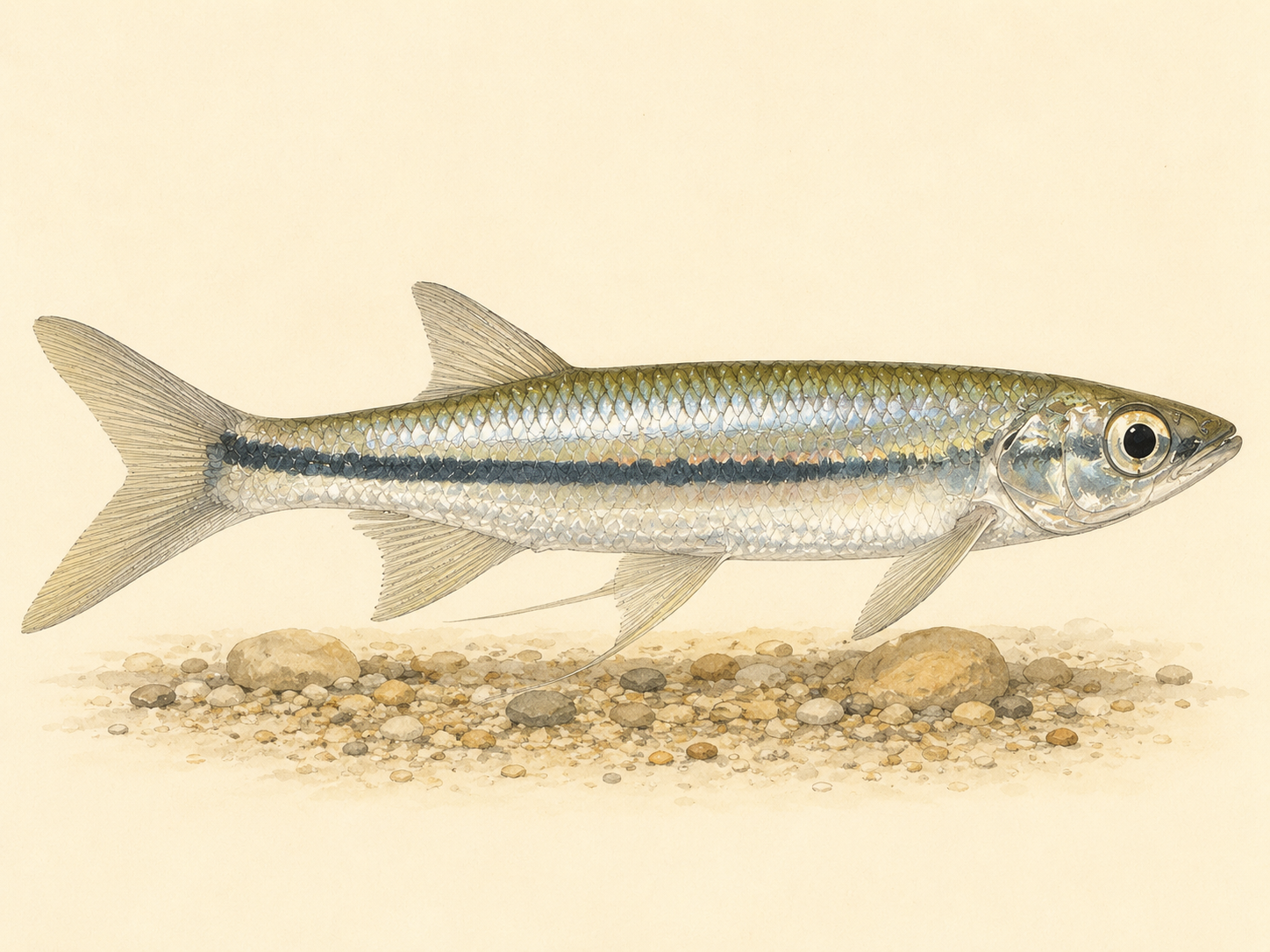
The Apollo Shark has an unmistakable silhouette. Its body is long, slender, and laterally compressed, tapering to a deeply forked caudal fin that speaks to its life as a fast, open-water swimmer. The overall body shape is distinctly torpedo-like, reminiscent of predatory fish such as barracudas or needlefish, though the Apollo Shark’s mouth is far smaller and oriented in a slightly upturned position, reflecting its surface and midwater feeding habits.
The base colouration of Luciosoma setigerum is a bright, reflective silver that covers the flanks and belly. A prominent dark horizontal stripe runs from the tip of the snout through the eye and along the lateral line to the base of the tail. This stripe can vary in intensity from a deep black to a more muted dark grey depending on the fish’s mood, health, and environmental conditions. Above this stripe, the dorsal surface tends to be an olive or greyish-green, which provides a subtle contrast against the gleaming silver of the lower body.
One of the distinguishing features of this species is its elongated pectoral fins, which are held close to the body when the fish is cruising but extend outward during turns and braking manoeuvres. The dorsal fin is set relatively far back on the body, positioned roughly above the anal fin, which is a characteristic shared with other members of the Luciosoma genus. The caudal fin lobes are long and pointed, further enhancing the fish’s hydrodynamic profile.
The eyes of the Apollo Shark are large and prominent, positioned high on the head. This gives the fish excellent forward and upward vision, which is useful for spotting insects and other food items at the water’s surface. The mouth is small and slightly upturned, with thin lips and no barbels. Juveniles tend to look very similar to adults, though their proportions are slightly less elongated, and their colouration may appear somewhat duller until they reach maturity.
In well-maintained aquariums with clean water and good nutrition, Apollo Sharks develop a stunning iridescent sheen that catches the light beautifully. Their scales have a subtle metallic quality that can appear almost pearlescent under certain lighting conditions. Stressed or poorly kept specimens, by contrast, may appear washed out, with a faded lateral stripe and a dull, lacklustre body colour.
Natural Habitat
Luciosoma setigerum is found across a wide range in Southeast Asia, including the Malay Peninsula, the islands of Borneo and Sumatra, and parts of mainland Thailand. Within this range, the species inhabits medium to large rivers and their tributaries, showing a strong preference for areas with moderate to strong water flow. It is a rheophilic species, meaning it actively seeks out moving water rather than still or stagnant environments.
In the wild, Apollo Sharks are typically found in the main channels of rivers where the current is strongest. They inhabit the upper and middle water columns, rarely venturing to the substrate. The riverbed in these habitats is often composed of sand, gravel, and rounded stones, with scattered submerged logs and root tangles along the banks. Overhanging vegetation from the riparian zone provides shade and occasional insect food sources that fall onto the water’s surface.
The water in these habitats tends to be clear to slightly tannin-stained, with a pH that ranges from slightly acidic to neutral. Temperatures remain relatively stable throughout the year due to the tropical climate, generally sitting between 22 and 27 degrees Celsius. Dissolved oxygen levels are high due to the constant water movement, which is a critical factor to replicate in the home aquarium.
Apollo Sharks are schooling fish in nature, often encountered in groups of a dozen or more individuals. They swim in loose shoals in open water, coordinating their movements as they hunt for small insects, insect larvae, and other invertebrates. Their habitat overlaps with a diverse community of other cyprinids, loaches, and various catfish species. Understanding this natural environment is essential for recreating appropriate conditions in captivity.
Tank Size and Setup
A long aquarium is essential for Apollo Sharks. The minimum recommended tank size is 450 litres, but this should be considered an absolute baseline for a small group. A tank measuring at least 180 cm (6 feet) in length is far more important than volume alone, as these fish need substantial horizontal swimming space to behave naturally and remain healthy. Taller or cube-shaped tanks are unsuitable regardless of their total volume. For a group of five or six specimens, a tank of 600 litres or more with a length of 200 cm or greater is ideal.
The aquascape should prioritise open swimming space above all else. Avoid cluttering the middle and upper water column with dense hardscape or tall plant stems. Instead, position any decor along the sides and back of the tank, leaving a clear central corridor for the fish to patrol. Driftwood and large river stones placed along the periphery can provide visual barriers and resting spots without impeding swimming lanes.
A sandy or fine gravel substrate is appropriate and mimics the riverbeds of their natural habitat. Live plants can be included, but choose robust, low-growing species or attach plants to hardscape. Anubias, Java fern, and Bolbitis are good choices as they tolerate strong flow and do not require planting into the substrate. Floating plants can be used sparingly to provide some shaded areas, but avoid covering more than a third of the surface to ensure adequate gas exchange and light penetration.
A tight-fitting lid is absolutely necessary. Apollo Sharks are powerful jumpers, especially when startled, and an uncovered tank will almost certainly result in losses. Even small gaps around filter inlets or cable entry points should be covered. This cannot be overstated – jumping is one of the most common causes of Apollo Shark deaths in captivity.
Strong water movement across the length of the tank is a non-negotiable requirement. This can be achieved through the strategic placement of powerheads, wavemakers, or the use of a high-flow canister filter with a spray bar directed along the tank’s length. The goal is to create a unidirectional current that the fish can swim into, replicating the river conditions they are adapted to.
Water Parameters
Apollo Sharks are reasonably adaptable when it comes to water chemistry, provided the water is clean, well-oxygenated, and stable. They originate from soft to moderately hard, slightly acidic to neutral waters and perform best when these conditions are replicated in the aquarium. Sudden fluctuations in any parameter should be avoided, as these fish can be sensitive to rapid changes even if the absolute values are within an acceptable range.
| Temperature | 22-26 °C |
| pH | 6.0-7.5 |
| General hardness (GH) | 2-12 dGH |
| Carbonate hardness (KH) | 2-8 dKH |
| Ammonia | 0 ppm |
| Nitrite | 0 ppm |
| Nitrate | Below 20 ppm |
Maintaining pristine water quality is particularly important for this species. Apollo Sharks come from well-oxygenated riverine environments and do not tolerate elevated levels of dissolved organic waste. Weekly water changes of 25-30% are recommended, and larger changes may be necessary in heavily stocked tanks. Use a reliable liquid test kit to monitor ammonia, nitrite, and nitrate levels regularly, especially in the first few months after introducing these fish to a new system.
Aeration is another critical factor. In addition to the strong flow provided by filtration, consider supplementing with an air stone or venturi attachment on a powerhead to maximise dissolved oxygen levels. Apollo Sharks will show signs of distress, including gasping at the surface and reduced activity, if oxygen levels drop too low. This is most likely to occur during warm weather when water temperatures rise and dissolved oxygen naturally decreases.
Filtration and Equipment
Filtration for an Apollo Shark tank needs to be robust and capable of handling the bioload of a group of large, active fish while simultaneously providing the strong water movement this species requires. A high-quality canister filter rated for at least 1.5 times the tank volume per hour is a good starting point. Many experienced keepers opt for two canister filters or a canister filter supplemented by one or two powerheads to achieve the desired flow rate and turnover.
A spray bar positioned along the back of the tank at or just below the water surface is an effective way to distribute flow evenly across the length of the aquarium. Alternatively, lily pipe outlets or directional nozzles can be used to create a strong linear current. The aim is to produce a consistent flow pattern that runs the length of the tank, giving the Apollo Sharks a current to swim into without creating dead spots where waste can accumulate.
Biological filtration is the cornerstone of any Apollo Shark setup. Ensure your filter media includes a generous volume of high-quality biological media such as ceramic rings, sintered glass, or bio-balls. Mechanical filtration in the form of filter sponges and floss will help keep the water clear by trapping particulate matter, which should be rinsed or replaced regularly to prevent clogging and reduced flow.
Heating should be provided by a reliable thermostatically controlled heater appropriately sized for the tank volume. In very large tanks, two heaters placed at opposite ends can help maintain a more even temperature distribution. An inline heater connected to the canister filter output is another excellent option, as it keeps the heater out of the display tank and reduces the risk of the fish being burned or damaging the equipment during their rapid swimming.
Lighting is not a critical concern for the fish themselves, but moderate lighting levels are recommended. Apollo Sharks can be somewhat skittish under very bright, unshaded lighting. If your setup includes live plants, choose a lighting system that meets the plants’ needs while providing some shaded areas through floating plants or overhanging hardscape. A timer set to a consistent photoperiod of 8-10 hours helps maintain a stable day-night cycle and reduces stress.
Diet and Feeding
Apollo Sharks are primarily insectivorous in the wild, feeding on small flying insects that land on the water’s surface, aquatic insect larvae, and other small invertebrates. In the aquarium, they readily accept a variety of prepared and live foods, though it may take newly imported specimens a short adjustment period before they begin feeding confidently on dry foods.
A high-quality flake or floating pellet food should form the staple diet. Choose a product with a high protein content and ingredients derived from insect or crustacean sources. Floating foods are preferable to sinking varieties, as Apollo Sharks are naturally inclined to feed at or near the water’s surface and rarely forage along the substrate. Micro pellets and small granules are readily accepted and can be scattered across the surface to encourage natural feeding behaviour.
Supplementing the diet with live and frozen foods is highly recommended. Bloodworms, daphnia, brine shrimp, and mosquito larvae are all eagerly consumed. Live food in particular triggers an impressive feeding response, with the fish darting through the water column to snatch individual prey items. Frozen foods should be thawed before feeding and rinsed to remove any packing liquid. Offering a varied diet helps ensure nutritional completeness and keeps the fish in peak condition.
Feed Apollo Sharks two to three times daily in small portions that can be consumed within a few minutes. These are active, high-metabolism fish that benefit from regular feeding rather than one large meal. Overfeeding should be avoided, as uneaten food will quickly degrade water quality in the strong-flow environment these fish require. Remove any uneaten food promptly.
Behaviour and Temperament
Apollo Sharks are active, fast-swimming schooling fish that spend the vast majority of their time in the upper and middle water columns. They are constantly on the move, patrolling the length of the tank in coordinated groups. Their swimming style is purposeful and directional, quite different from the more meandering movement patterns of many tropical community fish. Watching a group of Apollo Sharks cruising through a strong current is one of the great pleasures of keeping this species.
This species must be kept in groups of at least five, and ideally six or more. Solitary specimens or pairs become extremely stressed, often hiding, refusing food, and developing washed-out colouration. In a properly sized group, Apollo Sharks are far more confident and display a wider repertoire of natural behaviours. Some minor chasing and jostling occurs within the group, particularly during feeding, but this is normal social behaviour and rarely results in injury.
Despite their large size and speed, Apollo Sharks are generally peaceful towards other species. They are not aggressive or territorial and show virtually no interest in fish that are too large to be considered food. However, their constant, rapid movement can be intimidating or stressful to slow-moving or timid species, which should be taken into account when selecting tank mates.
Apollo Sharks are notably skittish, especially when newly introduced to an aquarium. Sudden movements near the tank, loud noises, or changes in lighting can trigger a panicked flight response. This is when jumping is most likely to occur, reinforcing the need for a secure lid. Over time, well-established specimens tend to become calmer and less easily startled, particularly if the tank is positioned in a relatively low-traffic area and a consistent routine is maintained.
They are diurnal fish, most active during daylight hours and resting in the current or in quieter areas of the tank at night. Some keepers report that their Apollo Sharks become particularly active and interactive during feeding times, learning to associate the approach of their owner with food.
Tank Mates
Selecting appropriate tank mates for Apollo Sharks requires consideration of several factors. The ideal companions are similarly sized, active, robust species that can tolerate strong water flow and will not be stressed by the rapid swimming of the Apollo Sharks. Very small fish may be at risk of predation, particularly small tetras or fry, as Apollo Sharks do have a slightly predatory feeding response to tiny, moving prey items. Slow-moving or long-finned species are generally poor choices, as they may struggle in the high-flow environment and could be outcompeted for food.
Good tank mates
- Tinfoil Barb – A similarly sized, robust cyprinid that thrives in strong flow and shares comparable water parameter requirements.
- Denison Barb – An active, rheophilic species that enjoys the same high-flow conditions and occupies a complementary space in the water column.
- Giant Danio – A fast-swimming, schooling fish that is large enough to avoid predation and appreciates strong water movement.
- Clown Loach – A sociable bottom-dweller that is large enough to coexist peacefully and adds activity to the lower water column.
- Bala Shark – Another large, peaceful cyprinid that requires similar tank dimensions and water flow, making it a natural companion.
- Rainbow Shark – A bottom-oriented species that generally stays out of the Apollo Shark’s preferred swimming zone, reducing competition.
- Boesemani Rainbowfish – An active, hardy midwater fish that can handle moderate to strong flow and adds vibrant colour to the display.
- Bristlenose Pleco – A peaceful, substrate-dwelling algae eater that occupies a completely different ecological niche within the aquarium.
Fish to avoid
- Siamese Fighting Fish – Far too slow and delicate for the high-flow environment required by Apollo Sharks, and likely to be severely stressed.
- Neon Tetra – Too small and could be viewed as prey by adult Apollo Sharks, particularly at feeding time.
- Angelfish – Slow-moving with long, flowing fins that would be battered by the strong current, and likely outcompeted for food.
- Discus – Requires calm, warm water with minimal flow, making it fundamentally incompatible with Apollo Shark husbandry requirements.
- Guppy – Far too small and slow to coexist safely with Apollo Sharks, and their delicate finnage would suffer in strong currents.
- Dwarf Gourami – A timid, slow-moving species that would be overwhelmed by the activity level and water flow in an Apollo Shark tank.
- Flowerhorn Cichlid – A highly aggressive, territorial cichlid that would harass and potentially injure the peaceful Apollo Sharks.
- Oscar – A large, predatory cichlid that could view Apollo Sharks as prey and would create territorial conflicts in the aquarium.
Breeding
Breeding Apollo Sharks in the home aquarium is extremely challenging, and verified reports of successful captive breeding are rare. The species is believed to be an egg scatterer in the wild, releasing eggs over gravel or rocky substrates in flowing water. However, replicating the precise environmental triggers for spawning in an aquarium setting has proven to be a significant hurdle for hobbyists and commercial breeders alike.
Sexual dimorphism in Luciosoma setigerum is subtle. Mature females tend to be slightly fuller-bodied than males, particularly when carrying eggs, but there are no reliable external differences in colouration or finnage that allow easy sexing. Obtaining a group of six or more individuals and allowing natural pair formation is the most practical approach for anyone attempting to breed this species.
To encourage spawning, some breeders recommend simulating seasonal changes by gradually lowering the water temperature by two to three degrees Celsius over several weeks, followed by a gradual increase back to normal levels. Simultaneously increasing the frequency and quality of live food offerings may help condition the fish for spawning. Large water changes with slightly cooler, softer water have also been suggested as a potential trigger, mimicking the onset of the rainy season in their native range.
If spawning does occur, the eggs are likely to be small, non-adhesive, and scattered across the substrate or amongst fine-leaved plants. The parents offer no parental care and may consume the eggs if given the opportunity. Separating the adults or providing a spawning grid to protect the eggs is advisable. The fry, once hatched, would be tiny and require infusoria or commercially available liquid fry food as a first food before graduating to newly hatched brine shrimp.
Most Apollo Sharks available in the aquarium trade are wild-caught, reflecting the difficulty of captive propagation. This is worth considering from a conservation and sustainability perspective, though the species is currently assessed as Least Concern by the IUCN.
Common Diseases
Apollo Sharks are generally hardy fish when kept in appropriate conditions, but they are susceptible to the same diseases that affect most freshwater tropical species. Poor water quality, inadequate flow, overcrowding, and stress from inappropriate tank mates are the primary predisposing factors for disease in this species.
White spot disease (Ichthyophthirius multifiliis), commonly known as ich, is one of the most frequently encountered ailments. It presents as small white spots on the body and fins, accompanied by flashing (rubbing against surfaces), lethargy, and loss of appetite. Apollo Sharks are particularly vulnerable to ich during the stress of transport and acclimatisation to a new tank. Treatment involves raising the temperature gradually to 28-30 degrees Celsius and administering a proprietary white spot medication. Note that Apollo Sharks, as scaleless-appearing but actually scaled cyprinids, generally tolerate standard medication dosages, but always read the product instructions carefully.
Bacterial infections can manifest as fin rot, ulcers, or cloudy patches on the body. These are almost always secondary to poor water quality or physical injury. Maintaining pristine water conditions is both the best prevention and a critical component of treatment. Broad-spectrum antibacterial medications may be necessary for advanced cases.
Fungal infections appear as cottony white growths on the body or fins and typically occur on damaged tissue. Antifungal treatments are effective, but addressing the underlying cause of the tissue damage is essential to prevent recurrence.
Internal parasites can be a concern with wild-caught specimens. Signs include weight loss despite a good appetite, stringy or white faeces, and a generally emaciated appearance. A course of anti-parasitic medication designed for internal parasites should be administered if an infestation is suspected. Quarantining new arrivals for two to four weeks before introducing them to an established tank is strongly recommended to identify and treat any latent health issues.
Stress-related issues are perhaps the most significant health concern for Apollo Sharks in captivity. Fish kept alone, in tanks that are too small, or without adequate water flow often develop chronic stress, which suppresses the immune system and makes them vulnerable to opportunistic infections. Providing the correct environment is the single most important factor in keeping Apollo Sharks healthy.
FAQs
How many Apollo Sharks should I keep together?
Apollo Sharks are obligate schooling fish and should be kept in groups of at least five, with six or more being preferable. Solitary specimens or small groups of two or three become chronically stressed, hide constantly, refuse food, and are much more susceptible to disease. A proper shoal displays far more natural and engaging behaviour, with the fish swimming confidently in formation through the water column.
Can Apollo Sharks be kept in a 200-litre tank?
No, a 200-litre tank is far too small for Apollo Sharks. These are large, extremely active fish that require a minimum of 450 litres and, more importantly, a tank length of at least 180 cm. The length of the tank is actually more critical than the raw volume, as Apollo Sharks need long, uninterrupted swimming corridors to maintain their natural behaviour and physical health. Keeping them in cramped conditions leads to stress, stunted growth, and a significantly shortened lifespan.
Do Apollo Sharks eat other fish?
Apollo Sharks are not predatory in the traditional sense, but they are capable of consuming very small fish such as neon tetras, guppy fry, or other species small enough to fit in their mouths. They will not actively hunt or chase down tank mates of a reasonable size. To avoid any issues, simply ensure that all tank mates are large enough that they cannot be swallowed, and avoid keeping Apollo Sharks with tiny or newborn fish.
Why do my Apollo Sharks keep jumping out of the tank?
Jumping is a natural behaviour for Apollo Sharks, particularly when they are startled, stressed, or newly introduced to an aquarium. In the wild, they may leap to escape predators or catch insects above the water’s surface. In captivity, jumping is most often triggered by sudden movements near the tank, loud noises, aggressive tank mates, or poor water quality. A secure, tight-fitting lid is essential. Over time, as the fish settle into their environment and become accustomed to their surroundings, jumping incidents typically decrease.
Are Apollo Sharks suitable for beginners?
Apollo Sharks are generally considered a moderate-difficulty species and are not the best choice for complete beginners. Their requirements for a large, long tank, strong water flow, and excellent water quality place them beyond the scope of a typical starter setup. However, an aquarist with some experience in maintaining larger tropical tanks and a good understanding of water chemistry and filtration should find them manageable. The key is committing to the appropriate equipment and tank size from the outset.
Related Guides
- Bala Shark Care Guide – Another large, peaceful cyprinid with similar tank size and flow requirements, often considered alongside the Apollo Shark for spacious community setups.
- Giant Danio Care Guide – A fast-swimming schooling fish that thrives in high-flow environments and makes an excellent companion species for Apollo Sharks.
- Tinfoil Barb Care Guide – A robust, large-growing cyprinid from Southeast Asia that shares many husbandry requirements with the Apollo Shark.
- Denison Barb Care Guide – A popular rheophilic barb that appreciates similar water movement and tank dimensions, offering useful parallels in care.
- Clown Loach Care Guide – A frequently recommended bottom-dwelling tank mate for Apollo Sharks, with complementary care needs and a peaceful temperament.