
Quick summary
Denison Barbs are a good fit if you have a spacious tank (300 litres or more) with strong flow and cool, pristine water, and can commit to a shoal of six or more, but they’re a poor choice for small setups, warm still-water tanks, or homes with tiny or slow-moving tank mates. Choose captive-bred stock where possible, since wild populations are Endangered.
🐠 Build a tank around this species
In this guide:
- Introduction
- Quick Stats
- Appearance
- Varieties and Morphs
- Natural Habitat
- Tank Size and Setup
- Water Parameters
- Filtration and Equipment
- Diet and Feeding
- Behaviour and Temperament
- Tank Mates
- Breeding
- Common Diseases
- FAQs
Introduction
The Denison Barb is one of the most visually striking freshwater fish available to hobbyists, combining torpedo-shaped elegance with vivid colouration that rivals many marine species. Known by a host of common names, including Roseline Shark, Red-Line Torpedo Barb, and Miss Kerala, this active cyprinid has become enormously popular since it first entered the ornamental fish trade in the mid-1990s. Its bold red and black lateral stripes, shimmering silver body, and lively schooling behaviour make it a centrepiece species in larger community aquariums.
Originally described from the rivers of the Western Ghats in Kerala, India, the Denison Barb was formally classified as Puntius denisonii before being reclassified into the genus Sahyadria in 2013 to reflect its distinct evolutionary lineage. The species shot to international fame after winning the “Best Freshwater Fish” award at Aquarama in 1997, which unfortunately triggered intense wild collection that has since placed considerable pressure on native populations. Today it is listed as Endangered on the IUCN Red List, making responsible sourcing, ideally from captive-bred stock, an important ethical consideration for any prospective keeper.
Despite its exotic appearance, the Denison Barb is not an especially difficult fish to keep, provided its requirements for space, water quality, and social grouping are met. This guide covers everything you need to know to maintain a healthy, thriving shoal, from tank dimensions and water chemistry through to diet, compatible species, and the considerable challenges of captive breeding.
Quick Stats
| Scientific name | Sahyadria denisonii (Day, 1865) |
|---|---|
| Common names | Roseline Shark, Red-Line Torpedo Barb, Miss Kerala, Denison's Barb, Golden Denison Barb |
| Family | Cyprinidae |
| Origin | Western Ghats, Kerala and Karnataka, India |
| Adult size | 13 cm |
| Lifespan | 5–8 years |
| Difficulty | Intermediate |
| Breeding difficulty | Advanced |
| Temperature | 15–25 °C |
| pH | 6.5–7.8 |
| GH | 5–18 dGH |
| KH | 4–10 dKH |
| Minimum tank size | 250 L |
| Conservation status | Endangered (IUCN) |
Appearance
The Denison Barb has a sleek, torpedo-shaped body that immediately communicates speed and agility. The base colour is a bright, reflective silver that catches the light beautifully as the fish moves, and the scales carry a subtle golden-olive wash along the dorsal surface. The most iconic feature is the bold black lateral line that runs from the tip of the snout through the eye and along the flanks to the base of the caudal fin. Sitting directly above this, a vivid red or scarlet stripe extends from the snout, passes through the upper half of the eye, and fades out roughly at the midpoint of the body. The contrast between these two parallel lines is what gives the species its unmistakable appearance and many of its common names.
The dorsal fin features a prominent red-orange leading edge, adding another flash of colour, particularly noticeable when the fish is in motion. The caudal fin displays striking black-and-yellow striping on both the upper and lower lobes, creating a forked tail that almost resembles the markings of a flag. The remaining fins are largely transparent with a faint yellowish or greenish tinge. Juveniles tend to show less intense red colouration, which deepens and becomes more saturated as the fish matures. Males are generally slightly slimmer and may develop a faint greenish iridescence on the head when in breeding condition, though reliable sexing by external appearance alone remains quite difficult outside of spawning periods.
Adult specimens typically reach between 11 and 15 centimetres in total length, with fish in spacious, well-maintained aquariums occasionally reaching the upper end of this range. Their streamlined profile and active swimming style mean they occupy a good deal of visual space even at modest sizes, and a shoal of six or more cutting through a planted aquascape is genuinely one of the finest sights the freshwater hobby can offer.
Varieties and Morphs
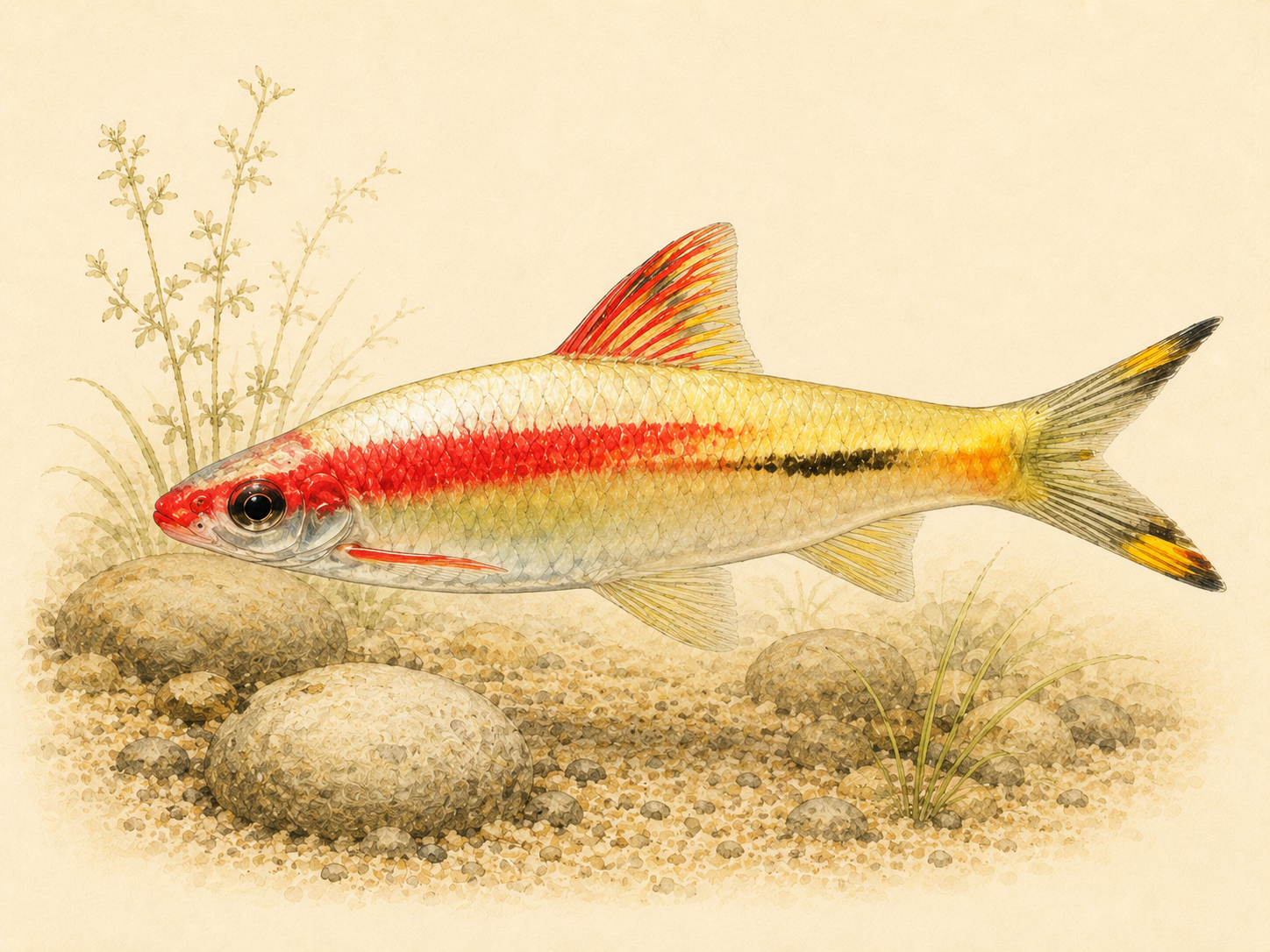
The most widely recognised variant is the Golden Denison Barb, sometimes sold as the Gold Roseline Shark. This captive-bred morph displays a warm golden-yellow body colour in place of the standard silver, while retaining the characteristic red and black lateral stripes, though the black line is often less sharply defined and may appear somewhat muted against the golden background. The dorsal and caudal fin markings remain largely unchanged. The golden morph arose through selective breeding in commercial fish farms, particularly in South-East Asia and parts of India, and it has gained a strong following among aquarists who appreciate its warmer overall tone. It commands a somewhat higher price than the standard form and is generally considered equally hardy, requiring identical care.
Beyond the golden morph, no other stable, widely traded colour variants of Sahyadria denisonii are currently established in the hobby. Occasional listings for “platinum” or “albino” Denison Barbs appear from time to time, but these are exceptionally rare, not consistently reproducible, and often turn out to be mislabelled or naturally pale specimens rather than true genetic morphs. It is also worth noting the closely related species Sahyadria chalakkudiensis, sometimes marketed as the Chalakkudy Denison Barb, which is visually similar but tends to grow slightly smaller, possesses a somewhat shorter red stripe, and typically lacks the yellow-and-black caudal markings of S. denisonii. Although not a morph, this congener is sometimes confused with the true Denison Barb in the trade, so careful identification at the point of purchase is advisable.
Natural Habitat
The Denison Barb is endemic to a handful of fast-flowing hill streams and rivers in the Western Ghats of southern India, primarily within the states of Kerala and Karnataka. Its range is restricted to just a few river systems, including the Achenkovil River, the Chaliyar River, and tributaries of the Valapattanam River. This narrow distribution is one of the key factors behind its Endangered conservation status, as localised threats can have an outsized impact on the total population.
In the wild, these fish inhabit well-oxygenated, moderately fast-flowing stretches of river with rocky or gravelly substrates. The water is typically clear, slightly acidic to neutral, and relatively cool by tropical standards, reflecting the elevated terrain and dense forest canopy of the Western Ghats. Aquatic vegetation is present but not dominant; the banks are often lined with overhanging terrestrial plants, submerged roots, and fallen branches that provide cover and create pockets of calmer water where the fish can rest. Algae and biofilm growing on the surfaces of rocks and wood form an important part of their natural diet.
Seasonal variation in water flow, temperature, and chemistry is thought to play a role in triggering spawning behaviour, with the monsoon season bringing cooler, faster-flowing water conditions. Replicating at least some of this environmental dynamism in captivity can contribute to the long-term health and potential breeding readiness of captive populations.
Tank Size and Setup
The Denison Barb is an active, fast-swimming species that requires considerably more space than its adult size alone might suggest. A minimum aquarium volume of 300 litres is recommended for a group of six, and tanks of 450 litres or more are preferable if you wish to keep a larger shoal or house them alongside other similarly sized community species. Tank length is arguably more important than total volume: aim for an aquarium at least 120 centimetres long to give these powerful swimmers room to build up speed and engage in their characteristic rapid, coordinated shoaling movements.
The aquascape should draw inspiration from the species’ native rocky riverine habitats. A substrate of smooth gravel or a mixture of sand and rounded pebbles works well and allows the fish to forage naturally. Larger cobblestones and pieces of driftwood can be arranged to create flow breaks and shelter without blocking the open swimming lanes these fish need. Hardy live plants such as Anubias, Java Fern, and Vallisneria add visual interest and help with water quality, though they should be secured to hardscape rather than planted in the substrate where the barbs’ active digging might dislodge them. Delicate or slow-growing plants may be nibbled, so robust species are the better choice.
A secure, tightly fitting lid is essential. Denison Barbs are accomplished jumpers, particularly when startled or during periods of high activity. Even seemingly small gaps around filter intakes or cable entry points should be covered, as these fish can and will exploit them. Moderate to strong water movement across the length of the tank replicates the flowing conditions they are accustomed to and encourages natural behaviour.
Water Parameters
Denison Barbs are adaptable within a reasonable range of water chemistry, but they are notably less tolerant of poor water quality than many other barb species. They originate from clean, well-oxygenated hill streams, so pristine water conditions should be the baseline expectation. The species does best in slightly acidic to neutral water, though it will tolerate mildly alkaline conditions provided other parameters remain stable. Temperature-wise, this is a subtropical rather than strictly tropical fish, and it appreciates cooler water than many commonly kept community species. Maintaining temperatures consistently above 26 °C can cause stress and shorten lifespan.
| Temperature | 15–25 °C |
| pH | 6.5–7.8 |
| General hardness (GH) | 5–18 dGH |
| Carbonate hardness (KH) | 4–10 dKH |
| Ammonia | 0 ppm |
| Nitrite | 0 ppm |
| Nitrate | Below 20 ppm |
Consistency matters as much as hitting any specific number. Sudden swings in temperature or pH are poorly tolerated and can trigger stress-related illness. During water changes, which should be generous and regular, it is important to match the temperature and chemistry of the replacement water as closely as possible to the tank water. In warmer climates or during summer months, a chiller or fan-assisted cooling may be needed to keep temperatures within the preferred range, particularly at the lower end of the spectrum.
Filtration and Equipment
Strong, efficient filtration is non-negotiable for Denison Barbs. These fish produce a moderate bioload, consume a varied diet, and inhabit a tank environment that mimics flowing river conditions, all of which demand a filtration system capable of delivering excellent mechanical, biological, and chemical media capacity. A high-quality external canister filter rated for at least 1.5 times the tank’s volume is the standard recommendation. In larger setups, running two canister filters or supplementing a canister with a powerhead offers both redundancy and improved flow distribution.
Water movement should be brisk but not overwhelmingly turbulent. Positioning the filter outlet at one end of the tank and directing it lengthwise creates a directional current that Denison Barbs will actively swim into, replicating their natural habitat behaviour. A spray bar or lily pipe can help distribute flow more evenly and prevent excessively strong currents in any single area, which is especially important if tank mates include species that prefer calmer water.
Oxygenation is a priority. In addition to the surface agitation provided by the filter return, an air stone or supplementary powerhead can help maintain dissolved oxygen levels, particularly during warmer periods when oxygen solubility in water decreases. A reliable heater is still necessary in most temperate homes to prevent dangerous temperature drops during winter, but it should be set conservatively, around 22–24 °C is a sensible target for mixed community tanks. A thermometer placed at the opposite end of the tank from the heater allows you to monitor for temperature gradients. Standard aquarium lighting on a timer providing 8 to 10 hours of light per day suits the species well and supports live plant growth without encouraging excessive algae.
Diet and Feeding
Denison Barbs are true omnivores with a tendency towards opportunistic feeding, and providing a varied diet is the single most effective way to maintain vibrant colouration and robust health. In the wild, their diet consists of algae, biofilm, small invertebrates, insect larvae, plant matter, and detritus gleaned from rocky surfaces and the water column. In captivity, this should be replicated as closely as practical.
A high-quality flake or granule food designed for omnivorous cyprinids makes a suitable staple, supplemented regularly with frozen or live foods such as bloodworm, daphnia, brine shrimp, and tubifex. These protein-rich additions are especially valuable for conditioning fish and enhancing the intensity of the red lateral stripe. Blanched vegetables, spinach, courgette slices, shelled peas, and cucumber, are readily accepted and provide important plant fibre. Spirulina-based foods or algae wafers can also be offered, and the fish will naturally graze on any soft green algae that develops on tank surfaces and hardscape.
Feed two to three times daily in amounts the shoal can consume within two to three minutes. Overfeeding should be avoided, as excess food will degrade water quality rapidly in a high-flow environment where detritus tends to collect in filter media rather than being visibly apparent on the substrate. Occasional fasting days, one per week, can be beneficial for digestive health. Because Denison Barbs are fast, assertive feeders, take care to ensure that slower or shyer tank mates also receive their share when feeding a mixed community.
Behaviour and Temperament
The Denison Barb is a gregarious, highly active species that should always be kept in groups. A minimum of six individuals is essential, and larger groups of eight to twelve produce even more natural and visually impressive schooling behaviour. Solitary or pair-kept specimens become stressed, may hide excessively, and are prone to aggression or fin-nipping, behaviours almost entirely absent in a properly sized shoal.
Within the group, a loose hierarchy will establish itself, with occasional brief chases and displays of dominance, particularly around feeding time. These interactions are entirely normal and rarely result in injury, provided the group is large enough that no single individual is persistently targeted. The fish are predominantly midwater swimmers but will explore all levels of the tank, darting between rockwork, cruising open stretches, and occasionally foraging near the substrate.
Despite their speed and boisterous activity, Denison Barbs are generally peaceful towards other species and make excellent community fish when paired with appropriately chosen tank mates. They are not aggressive predators, though very small fish or fry may occasionally be consumed simply because they fit in the barb’s mouth. They can be skittish, particularly in newly established tanks or when kept in insufficiently sized groups, and sudden movements or loud noises near the tank may trigger rapid, panicked swimming that can lead to collisions with the glass or attempts to jump. A calm environment with adequate cover and a secure lid mitigates these risks.
Tank Mates
Denison Barbs are well suited to community aquariums alongside other robust, active species of a similar size that appreciate good water flow and high oxygen levels. The ideal tank mates are fish that will not be outcompeted for food, are too large to be considered prey, and do not possess long, trailing fins that might invite the occasional nip from an overenthusiastic barb. Peaceful bottom-dwellers, mid-water shoaling species, and calm cichlids all tend to work well. Avoid pairing Denison Barbs with very slow, timid fish or species that require warm, still water, as the environmental preferences are simply too different.
Good tank mates
- Cherry Barb, a peaceful barb that adds colour contrast and thrives in similar water conditions, though it prefers slightly calmer areas of the tank.
- Congo Tetra, Large enough to hold its own alongside Denison Barbs and equally appreciative of clean, well-oxygenated water.
- Bristlenose Pleco, a hardy bottom-dweller that occupies a different zone of the tank and helps manage algae growth.
- Yoyo Loach, an active, sociable loach that enjoys similar flow conditions and provides lively bottom-level activity.
- Boesemani Rainbowfish, a robust, colourful schooling fish that matches the Denison Barb’s energy and water parameter preferences.
- Pearl Gourami, a calm, medium-sized gourami that coexists peacefully provided there are quieter areas in the tank for retreat.
- Corydoras Catfish, Peaceful bottom-feeders that keep to the substrate and pose no competitive or territorial conflict.
- Giant Danio, a fast, active cyprinid that relishes the same strong current and shares a comparable temperament.
Fish to avoid
- Betta, Slow-moving with long fins, bettas would be both stressed by the barbs’ activity and potentially targeted for fin-nipping.
- Discus, Requires warm, soft, still water and a tranquil environment entirely at odds with Denison Barb requirements.
- Guppy, too small and slow to thrive alongside fast, boisterous Denison Barbs, and their flowing tails may attract unwanted attention.
- Neon Tetra, Small enough to be mistaken for food by adult Denison Barbs, especially in dimly lit conditions.
- Oscar, a large, aggressive predatory cichlid that would view Denison Barbs as potential prey items.
- Dwarf Gourami, a timid, slow-moving species that would be outcompeted for food and stressed by the barbs’ energetic behaviour.
- Flowerhorn Cichlid, highly territorial and aggressive; completely incompatible with any peaceful community species.
- Celestial Pearl Danio, far too small and delicate to coexist safely with Denison Barbs in the same tank.
Breeding
Breeding Denison Barbs in captivity is notoriously challenging, and successful home aquarium spawning events remain rare. The species has been bred commercially, primarily in facilities in India and South-East Asia, but these operations typically rely on hormonal induction to trigger spawning, a technique that is not practical or advisable for most hobbyists. Nevertheless, spontaneous spawning in well-maintained home aquariums has been documented on a number of occasions, and understanding the conditions that appear to encourage it is worthwhile for dedicated breeders.
Sexing Denison Barbs outside of breeding condition is difficult. Mature females tend to be slightly fuller-bodied, particularly when gravid, and males may show a subtly more intense red stripe and a faint greenish sheen around the head, but these differences are far from reliable. Maintaining a larger group of eight or more increases the likelihood of having both sexes represented.
Reported successful spawnings in aquariums have typically involved soft, slightly acidic water with temperatures at the lower end of the species’ range, around 18–22 °C, followed by a gradual warming of two to three degrees, mimicking the onset of post-monsoon conditions. Heavy planting, particularly with fine-leaved species such as Java Moss, provides egg-deposition sites. Eggs are small, adhesive, and scattered among vegetation. The parents show no brood care and will readily consume eggs and fry if given the opportunity, so separating adults from the spawning site promptly is essential.
Eggs typically hatch within 24 to 48 hours depending on temperature, and the fry become free-swimming after a further two to three days once the yolk sac is absorbed. Initial food should consist of infusoria or commercially available liquid fry food, graduating to freshly hatched brine shrimp nauplii as the fry grow. Growth is slow compared to many cyprinid species, and maintaining pristine water quality throughout the rearing process is critical. Given the species’ Endangered status, successful captive breeding efforts are highly valuable from a conservation perspective, and any verified spawning events should be shared with the wider fishkeeping community to build the collective knowledge base.
Common Diseases
Denison Barbs are reasonably robust when kept in appropriate conditions, but like all freshwater fish they are susceptible to a range of diseases, particularly when water quality deteriorates or stress levels rise. The most commonly encountered illness is white spot disease, caused by the parasite Ichthyophthirius multifiliis. This presents as small white cysts on the fins and body and is typically triggered by temperature fluctuations or the introduction of new, unquarantined fish. Treatment with a proprietary white spot remedy at the recommended dose, combined with a gradual temperature increase of two to three degrees, is usually effective if caught early.
Bacterial infections, including fin rot and columnaris, can occur in tanks with elevated nitrate levels, poor oxygenation, or overcrowding. Symptoms include frayed or reddened fins, white or grey patches on the body, and lethargy. Prompt water quality improvement is the first line of defence, followed by treatment with appropriate antibacterial medications if symptoms persist. Fungal infections, identifiable by cotton-wool-like growths on the skin or fins, are secondary invaders that often follow physical injuries sustained during aggressive interactions or collisions with hardscape.
Denison Barbs can also be affected by internal parasites, particularly if fed wild-caught live foods without proper precautions. Symptoms of internal parasites include weight loss despite a normal appetite, white or stringy faeces, and a hollow belly. Anti-parasitic foods or bath treatments designed for intestinal worms and flagellates are generally effective. As a preventive measure, always quarantine new arrivals for a minimum of two weeks before introducing them to an established community, and avoid using live foods from unreliable sources. Maintaining a strict water change schedule, avoiding overcrowding, and providing a nutritionally complete diet remain the most effective long-term disease prevention strategies for this species.
FAQs
How many Denison Barbs should I keep together?
A minimum of six is strongly recommended, with groups of eight to twelve being ideal. Denison Barbs are shoaling fish that rely on group dynamics for security and stress reduction. Keeping fewer than six often results in shy, stressed individuals that may become aggressive or develop health problems. Larger groups produce far more natural behaviour and a significantly more impressive visual display.
Are Denison Barbs suitable for a planted aquarium?
Yes, but with some caveats. Denison Barbs will occasionally nibble on soft-leaved or delicate plants, particularly if their diet lacks sufficient vegetable matter. Hardy, robust species such as Anubias, Java Fern, Bolbitis, and Vallisneria tend to be left alone and can tolerate the moderate to strong flow these fish prefer. Securing plants to rocks or driftwood rather than planting them directly in the substrate also helps, as the barbs’ active swimming and occasional substrate foraging can uproot loosely planted specimens.
Can Denison Barbs live in unheated aquariums?
In temperate climates with stable indoor temperatures, Denison Barbs can indeed be kept in unheated tanks, as their natural temperature range extends down to around 15 °C. However, most keepers in the United Kingdom will still benefit from using a heater set to 20–22 °C to prevent dangerous overnight or winter temperature drops. The key consideration is stability, gradual, seasonal temperature variation is tolerated, but rapid fluctuations are harmful.
What is the difference between a Denison Barb and a Golden Denison Barb?
The Golden Denison Barb is a selectively bred colour morph of the same species, Sahyadria denisonii. It differs from the standard form primarily in its golden-yellow base body colour, replacing the typical silver. The red and black lateral stripes and the caudal fin markings are retained, though they may appear slightly less vivid against the warmer background colour. Care requirements for the golden morph are identical to those of the standard variety.
Are Denison Barbs endangered, and should I feel guilty about keeping them?
The wild population is classified as Endangered by the IUCN, primarily due to habitat loss and historical overcollection for the aquarium trade. However, a significant proportion of the Denison Barbs now available in the hobby are captive-bred, particularly those from commercial farms in India, the Czech Republic, and South-East Asia. By purchasing captive-bred specimens from reputable dealers and supporting responsible breeding efforts, hobbyists can enjoy the species without contributing to the decline of wild populations. Always ask your retailer about the origin of their stock.
Related Guides
- Cherry Barb Care Guide, a smaller, peaceful barb species that pairs well with Denison Barbs in spacious community setups.
- Tiger Barb Care Guide, another popular shoaling barb with somewhat different temperament considerations worth comparing before purchase.
- Giant Danio Care Guide, a fast-swimming cyprinid from similar flowing-water habitats that shares many of the same tank requirements.
- Rainbowfish Care Guide, Active, colourful schooling fish that make excellent companions for Denison Barbs in larger aquariums.
- Yoyo Loach Care Guide, a compatible bottom-dwelling species that thrives in the same well-oxygenated, moderate-flow conditions.