Quick summary
The Dumbo Ear Betta is an easy-to-keep, beginner-friendly variant of Betta splendens, distinguished by its oversized pectoral fins, but its delicate finnage means it needs very low water flow, snag-free decor, and careful tank mate selection to avoid fin nipping or damage. If you can provide a calm, well-maintained 20+ litre tank, this is a great choice, though its heavier finnage requires slightly more attentive care than a standard betta.
🐠 Build a tank around this species
In this guide:
- Introduction
- Quick Stats
- Appearance
- Varieties and Morphs
- Natural Habitat
- Tank Size and Setup
- Water Parameters
- Filtration and Equipment
- Diet and Feeding
- Behaviour and Temperament
- Tank Mates
- Breeding
- Common Diseases
Introduction
The Dumbo Ear Betta, also widely sold as the Elephant Ear Betta, is one of the most visually striking and commercially popular variants of Betta splendens. Unlike the majority of domestic betta varieties – which are classified by their tail shape (Halfmoon, Veiltail, Crowntail, and so on) – the Dumbo Ear is defined entirely by a single, distinctive anatomical feature: dramatically enlarged pectoral fins. These oversized pectoral fins fan out from the sides of the body like broad, fluttering ears, giving the fish an unmistakable silhouette that has made it a favourite among hobbyists worldwide.
Because the Dumbo Ear trait is independent of tail type, this variant can appear in virtually any tail configuration. You will find Dumbo Ear Halfmoons, Dumbo Ear Plakats, Dumbo Ear Veiltails, and many other combinations. The enlarged pectorals can also appear alongside any colour or pattern morph. This flexibility means the Dumbo Ear label describes a single genetic trait rather than a complete body plan, and two Dumbo Ear bettas can look wildly different from one another aside from sharing those characteristic oversized pectoral fins.
At its core, the Dumbo Ear Betta is still a domestic Betta splendens, and the vast majority of its care requirements are identical to those of any other domestic betta. If you are new to betta keeping or want a thorough grounding in baseline care fundamentals – covering everything from cycling a tank to understanding the species’ biology – we recommend reading our full Betta Fish Care Guide alongside this page. Throughout this guide, we will focus specifically on how the Dumbo Ear’s enlarged pectoral fins affect its care, housing, feeding, breeding, and compatibility, while still providing a comprehensive standalone reference for keepers of this particular variant.
Quick Stats
| Scientific name | Betta splendens var. Dumbo Ear |
|---|---|
| Common names | Dumbo Ear Betta, Elephant Ear Betta, Big Ear Betta |
| Family | Osphronemidae |
| Origin | Thailand, Cambodia, Laos, Vietnam (domesticated variant) |
| Adult size | 7 cm |
| Difficulty | Easy |
| Breeding difficulty | Moderate |
| Temperature | 24–30 °C |
| pH | 6–8 |
| GH | 1–15 dGH |
| Minimum tank size | 41 L |
| Conservation status | Not evaluated (captive-bred variant; wild Betta splendens is Vulnerable, IUCN 2011) |
Appearance
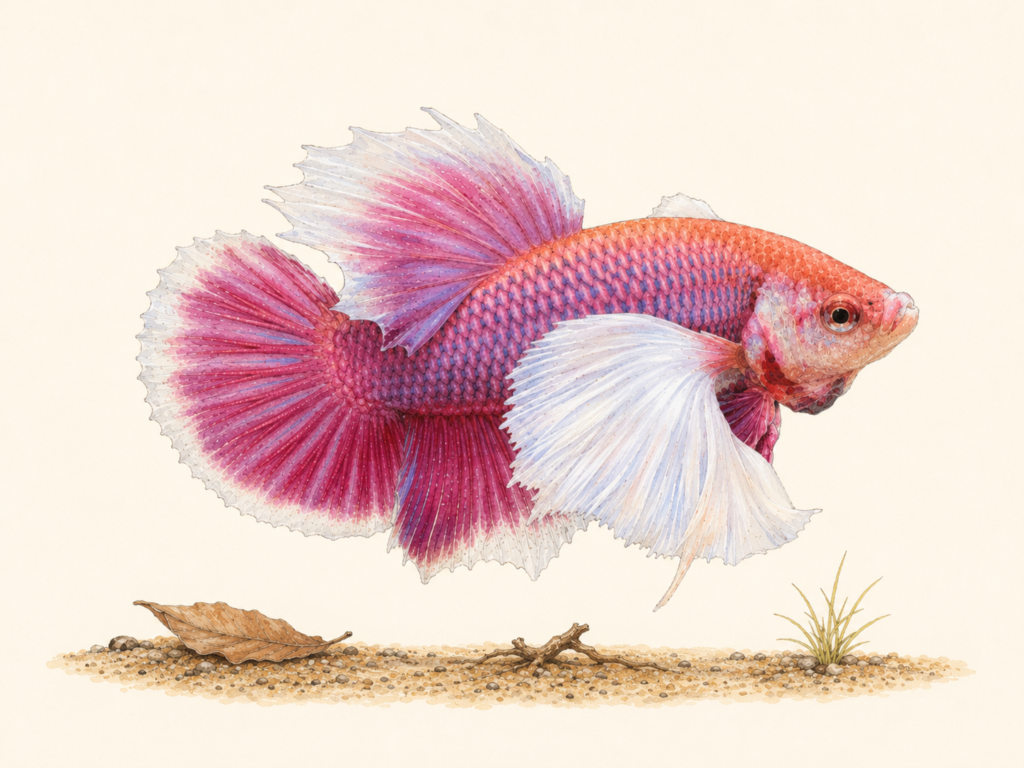
The defining physical trait of the Dumbo Ear Betta is, of course, its pectoral fins. In a standard domestic betta, the pectoral fins are small, translucent, and largely inconspicuous – they sit just behind the gill covers and are used primarily for precise manoeuvring rather than propulsion. In the Dumbo Ear variant, these same fins are selectively bred to be two to three times their normal size, sometimes even larger. They extend outward and downward from the body like broad, rounded paddles or – as the common name suggests – oversized elephant ears.
These enlarged pectorals are typically opaque or semi-opaque and display colour and patterning of their own, which can differ from the body and caudal fin colouration. In many specimens the pectoral fins are bicoloured or feature a contrasting edge, adding an extra layer of visual complexity. The fins flutter and fan continuously as the fish swims, creating a distinctive, almost hovering motion that sets the Dumbo Ear apart from other betta variants even at a distance.
Beyond the pectoral fins, Dumbo Ear Bettas exhibit the same body shape as any other domestic Betta splendens: a laterally compressed, torpedo-shaped body with an upturned mouth, prominent eyes, and a visible labyrinth organ behind the gill plates. Body length typically reaches 6 to 7.5 cm, though total span including the caudal and pectoral fins can be considerably greater. Because the Dumbo Ear trait is independent of tail type, the caudal, anal, and dorsal fins vary enormously depending on what tail morph the individual carries. A Dumbo Ear Halfmoon will have a dramatically different tail profile from a Dumbo Ear Plakat, for example, even though both share the characteristic pectoral fin enlargement.
Colour-wise, Dumbo Ears appear in every hue and pattern found in the broader Betta splendens gene pool: solid reds, blues, blacks, whites, and pastels; marble and koi patterns; metallic and dragon-scale overlays; and multicolour combinations. The pectoral fins may match the body or contrast sharply. White or pastel-bodied Dumbo Ears with richly coloured pectoral fins are particularly sought after in the hobby, as the enlarged ears become the dominant visual feature.
Varieties and Morphs
Because the Dumbo Ear trait is a pectoral fin mutation rather than a tail-type classification, it can be combined with virtually every other recognised betta morph. This creates an unusually broad matrix of possible appearances. The most commonly encountered combinations in the trade include:
Dumbo Ear Halfmoon: Pairs the oversized pectorals with a 180-degree caudal spread, creating an exceptionally heavy-finned fish. This combination is one of the most popular show types but also one of the most demanding in terms of water flow management, as the total fin load is very high.
Dumbo Ear Plakat: Combines the enlarged pectorals with short, traditional-length unpaired fins. This pairing produces a more agile, robust fish that is less prone to fin damage and fatigue. Many experienced keepers consider the Dumbo Ear Plakat the best balance of visual impact and practical ease of care.
Dumbo Ear Veiltail: The veiltail’s long, drooping caudal fin alongside large pectoral fins is perhaps the most commonly available combination in pet shops, as both traits are relatively easy to breed for.
Dumbo Ear Crowntail: The webbing reduction of the crowntail can extend into the pectoral fins themselves in some lines, producing a striking, spiky-eared appearance. This combination is less common but highly prized by collectors.
Dumbo Ear Dragon Scale: Thick, metallic scaling overlays the body while the enlarged pectorals may or may not show the same scaling. Dragon Scale Dumbo Ears are visually arresting but carry an elevated risk of diamond eye (scale growth over the eyes), a concern keepers should be aware of.
In terms of colour morphs, Dumbo Ears are available in koi, marble, galaxy, candy, copper, mustard gas, and essentially every other colour pattern. Marble Dumbo Ears are noteworthy because the marble gene causes ongoing colour changes throughout the fish’s life, meaning the pectoral fins may shift colour independently of the body, producing constantly evolving aesthetics.
When selecting a Dumbo Ear Betta, pay close attention to the symmetry and condition of the pectoral fins specifically. Both pectorals should be roughly equal in size and shape, free of tears, curling, or clamping. Uneven pectoral development can indicate genetic weakness in the trait or past injury, and while minor asymmetry is common, significant disparity may worsen over time.
Natural Habitat
The Dumbo Ear Betta does not exist in the wild. It is an entirely captive-bred variant produced through selective breeding of domestic Betta splendens. The enlarged pectoral fin trait would likely be disadvantageous in a natural setting, as it increases drag and energy expenditure without conferring any survival benefit.
However, understanding the natural habitat of the ancestral wild Betta splendens remains valuable for providing appropriate captive conditions. Wild bettas are native to the shallow, warm, slow-moving or still freshwater habitats of mainland Southeast Asia – particularly Thailand, Cambodia, Laos, and Vietnam. They inhabit rice paddies, roadside ditches, floodplain pools, and the margins of sluggish streams. These environments are characterised by warm temperatures (typically 25 – 30 °C), soft to moderately hard water, slightly acidic to neutral pH, and abundant vegetation or surface cover.
The water in these habitats is often shallow – sometimes just a few centimetres deep – and may be stained with tannins from decaying plant matter. Dissolved oxygen levels are frequently low, which is why Betta splendens evolved its labyrinth organ, allowing it to breathe atmospheric air at the surface. This adaptation is fully retained in the Dumbo Ear variant and is an important consideration when setting up the aquarium (the fish must have unobstructed access to the water surface).
For the Dumbo Ear specifically, the key habitat takeaway is the emphasis on minimal water flow. Wild bettas avoid strong currents, and the Dumbo Ear’s enlarged pectoral fins make it even more susceptible to current stress than a standard domestic betta. Replicating calm, still conditions is not merely a preference for this variant – it is a genuine welfare necessity.
Tank Size and Setup
A minimum tank size of 41 litres is recommended for a single Dumbo Ear Betta. When choosing a tank shape, favour longer, shallower designs over tall, narrow ones. Dumbo Ears are surface breathers and need easy access to the top of the water column; tall tanks force them to expend more energy travelling up and down. This consideration is amplified for Dumbo Ears carrying heavy tail types like Halfmoon, where the combined fin mass of the pectorals plus caudal creates significant drag on vertical movement.
The aquascape should be designed with the Dumbo Ear’s enlarged pectorals firmly in mind. These broad, delicate fins are more vulnerable to snagging and tearing than standard pectoral fins. Avoid sharp-edged decorations, rough stones, jagged driftwood, and plastic plants with stiff, pointed leaves. Smooth river stones, rounded bogwood, and soft live or silk plants are far safer choices. Anubias, Java Fern, and Java Moss are excellent live plant options – they are hardy, low-light tolerant, and their smooth leaf surfaces pose no risk to delicate finnage.
Provide moderate planting density with open swimming lanes through the middle and front of the tank. Dumbo Ears tend to be slightly less agile than short-finned bettas, and cluttered layouts can lead to fin damage as the fish navigates tight spaces. Floating plants such as Salvinia, Amazon Frogbit, or Red Root Floaters are highly recommended. They diffuse overhead light (which bettas generally prefer), provide surface cover that encourages natural behaviour, and help control nitrate levels. Leave a gap in the floating cover so the fish can easily reach the surface to breathe.
A dark substrate – black sand or fine gravel – tends to show off the Dumbo Ear’s colours and pectoral fins best, though this is purely an aesthetic choice. More importantly, ensure the substrate has no sharp edges that could injure fins if the fish rests on the bottom, which bettas frequently do.
A secure lid or cover is essential. Bettas are capable jumpers, and the gap between the water surface and the lid should ideally be 2 to 3 cm to allow the fish to gulp air comfortably without risk of escape. If using an open-top tank, a floating barrier or reduced water level is advisable, though a proper lid is always the safer option.
Water Parameters
| Temperature | 24–30 °C |
| pH | 6.0–8.0 |
| General hardness (GH) | 1–15 dGH |
| Ammonia | 0 ppm |
| Nitrite | 0 ppm |
| Nitrate | Below 20 ppm |
The Dumbo Ear Betta’s water parameter requirements are consistent with those of any domestic Betta splendens. Stability is more important than hitting a precise number within the ranges above. Rapid fluctuations in temperature or pH are far more stressful – and potentially harmful – than a reading that sits slightly outside the ideal band but remains constant.
Temperature is the single most important parameter to maintain accurately. Bettas are tropical fish and require consistently warm water. A reliable, adjustable heater is not optional in most climates. Temperatures below 22 °C will suppress the immune system and slow metabolism, while temperatures consistently above 30 °C accelerate ageing and increase oxygen demand. Aim for a stable 25 – 26 °C as a general sweet spot.
For the Dumbo Ear variant specifically, pristine water quality is arguably even more critical than for short-finned bettas. The enlarged pectoral fins have a greater surface area exposed to the water, and poor water quality – elevated ammonia, nitrite, or nitrate – can trigger fin rot or bacterial infections that attack these large, delicate membranes first. Weekly water changes of 20 to 30 per cent, combined with regular testing using a liquid test kit, will keep conditions within safe limits.
Indian almond leaves (Terminalia catappa) or other tannin-releasing botanicals are a popular addition to Dumbo Ear Betta tanks. The mild tannins lower pH slightly, stain the water a natural amber tone, and are believed to have mild antibacterial and antifungal properties. While scientific evidence for the therapeutic claims is limited, many experienced keepers report improved fin condition and behaviour in betta tanks supplemented with tannins.
Filtration and Equipment
Filtration for a Dumbo Ear Betta must balance effective biological and mechanical filtration against the need for very low water flow. This is the single most important equipment consideration specific to this variant. The enlarged pectoral fins act like sails, catching current and forcing the fish to work harder to maintain position. A Dumbo Ear Betta in a tank with excessive flow will exhibit stress behaviours: clamped fins, hiding, refusal to eat, and eventually physical exhaustion and immune suppression.
Sponge filters are widely regarded as the best filtration option for Dumbo Ear Bettas. They provide excellent biological filtration, produce only a gentle stream of bubbles rather than a directed current, and pose zero risk of fin entrapment. A small, air-driven sponge filter paired with an adjustable air pump is an ideal, low-cost setup. If using a hang-on-back (HOB) filter, choose one with an adjustable flow rate and baffle the outflow with a pre-filter sponge, a piece of filter floss, or a commercially available baffle attachment. Internal power filters can work if set to their lowest flow setting, but always observe the fish carefully after installation – if the Dumbo Ear is being pushed around the tank or struggling to swim against the current, the flow is too strong.
A heater is essential in virtually all keeping scenarios. Choose an adjustable heater rated appropriately for the tank volume – typically 25 to 50 watts for a 20 to 40 litre tank. Place the heater near the filter outflow (if any) to distribute warmth evenly, and use a separate thermometer to verify the temperature independently, as built-in heater thermostats are not always accurate.
Lighting should be moderate. Bettas do not require intense lighting, and the Dumbo Ear’s enlarged pectoral fins are displayed most impressively under soft, diffused light rather than harsh overhead illumination. If growing live plants, a basic LED light on a timer set for 8 to 10 hours per day will support plant growth without stressing the fish. Floating plants will further soften the light reaching the fish.
An air stone is generally unnecessary if a sponge filter is already providing surface agitation, but in unfiltered or lightly filtered setups, a very gentle air stone can help maintain oxygen levels at the surface. Avoid vigorous aeration that creates strong surface turbulence.
Diet and Feeding
The Dumbo Ear Betta’s dietary needs are the same as any domestic Betta splendens: it is a carnivore that requires a protein-rich diet based on insects, larvae, and other small invertebrates. In captivity, this translates to a staple of high-quality betta pellets supplemented with frozen, freeze-dried, or live foods.
Choose pellets specifically formulated for bettas, with whole fish or insect meal listed as the first ingredient. Avoid pellets heavy in fillers like wheat flour or soy. Feed two to three pellets twice daily as a baseline, adjusting up or down based on the individual fish’s body condition. The betta’s stomach is roughly the size of its eye, so overfeeding is a common mistake that leads to bloating, constipation, and water quality problems.
Supplement the pellet staple with frozen or live foods two to three times per week. Bloodworms, daphnia, brine shrimp, and mosquito larvae are all excellent choices. Daphnia is particularly useful as an occasional feeding because its high fibre content can help prevent constipation. Live foods stimulate natural hunting behaviour, and Dumbo Ear Bettas are especially entertaining to watch during live feeding, as their enlarged pectoral fins fan dramatically as they stalk and strike at prey.
One feeding consideration specific to the Dumbo Ear is that fish carrying both the Dumbo Ear trait and a heavy tail type (such as Halfmoon) may be slightly slower to reach food than lighter-finned bettas. In a community setting, ensure that food reaches the Dumbo Ear before faster tank mates consume it. Feeding in the same spot at the same time each day helps the betta learn where to expect food and reduces competition. Sinking pellets can also be useful, as the betta can pick them off the substrate at its own pace.
Fasting the fish for one day per week is a widely recommended practice that allows the digestive system to clear and reduces the risk of bloating. This is especially prudent for heavily finned Dumbo Ears, as bloating can impair an already less-than-nimble fish’s ability to swim and breathe comfortably.
Behaviour and Temperament
The Dumbo Ear Betta retains the full behavioural repertoire of domestic Betta splendens. Males are territorial and will flare aggressively at other males, at their own reflections, and sometimes at anything they perceive as a rival. Females are generally less aggressive but can still display territorial behaviour, particularly in confined spaces.
What distinguishes the Dumbo Ear behaviourally is the effect of its enlarged pectoral fins on locomotion and activity level. The oversized pectorals create additional drag, and Dumbo Ears – particularly those with heavy unpaired fins as well – tend to be somewhat slower and more deliberate swimmers than standard or short-finned bettas. They often favour hovering in place, gently fanning their pectoral fins, rather than actively patrolling the tank. This hovering behaviour is one of the variant’s most appealing visual traits, as the large pectoral fins ripple and flutter constantly, creating an almost hypnotic effect.
Dumbo Ear Bettas are generally curious and interactive fish that quickly learn to recognise their keeper. They will often approach the front glass during feeding time and may follow a finger along the tank wall. They are intelligent enough to learn simple tricks, such as swimming through hoops or jumping for food held above the surface (though jumping exercises should be done carefully with any heavy-finned betta).
Resting behaviour is common and normal. Dumbo Ears will rest on broad plant leaves, on the substrate, or in hammock-style resting spots near the surface. Betta leaf hammocks (commercially available suction-cup mounted fake leaves) are popular accessories and are well-suited to Dumbo Ears, as the fish can rest near the surface without expending energy to stay in the water column.
Flaring is a natural territorial display and is not harmful in brief bursts. Some keepers use a mirror for short (one to two minute) daily flaring sessions to encourage the fish to exercise and fully extend its fins. For Dumbo Ears, this also provides a useful opportunity to visually inspect the pectoral fins for any signs of damage, clamping, or disease. Prolonged mirror exposure (more than a few minutes) causes chronic stress and should be avoided.
Tank Mates
Dumbo Ear Bettas can coexist with certain peaceful tank mates, but the variant’s enlarged pectoral fins introduce an additional compatibility consideration beyond standard betta temperament concerns. First, the Dumbo Ear is a slower swimmer than many other fish, making it more vulnerable to fin-nipping species. Second, the large, colourful pectoral fins can attract the attention of curious or nippy tank mates that might otherwise ignore a standard betta’s fins. Third, tank mates that create excessive activity or compete aggressively for food can stress and exhaust a Dumbo Ear more quickly than a lighter-finned betta. For these reasons, ideal tank mates are calm, small, non-nippy species that occupy different areas of the water column.
Good tank mates
- Pygmy Corydoras – Tiny, peaceful bottom-dwellers that stay out of the betta’s territory and pose no threat to delicate pectoral fins.
- Ember Tetra – Small, calm, and lacking the nippiness associated with larger tetra species, making them a safe mid-water companion.
- Amano Shrimp – Large enough to avoid predation by most bettas and excellent algae cleaners that stay on surfaces and plants.
- Mystery Snail – A hardy, peaceful gastropod that helps with algae and uneaten food; its operculum protects it from occasional betta curiosity.
- Celestial Pearl Danio – A small, shy fish that occupies the lower to mid-water column and is unlikely to interact with a surface-dwelling betta.
- Harlequin Rasbora – A gentle, shoaling species that is too fast to be caught by a Dumbo Ear but too peaceful to harass one.
- Ramshorn Snail – A small, unobtrusive snail that contributes to tank cleanliness without any risk of fin interaction.
- Asian Stone Catfish – A tiny, nocturnal bottom-dweller that remains hidden during the day and is completely non-confrontational.
Fish to avoid
- Tiger Barb – A notorious fin nipper that will relentlessly target the Dumbo Ear’s oversized pectoral fins.
- Chinese Algae Eater – Becomes territorial and aggressive as it matures, and may latch onto the betta’s body or fins.
- Paradise Fish – A fellow labyrinth fish with strong territorial instincts that will clash with a male betta.
- Serpae Tetra – Known for persistent fin nipping, especially targeting slow-moving, heavy-finned fish like Dumbo Ears.
- Convict Cichlid – Far too aggressive and territorial for any betta, and will easily injure or kill a slow Dumbo Ear.
- Red Tail Shark – Highly territorial bottom-dweller that chases and harasses tank mates, particularly in smaller tanks.
- Other Male Bettas – Housing two males together will result in serious aggression, injury, and potentially death.
- Goldfish – Require cooler water, produce excessive waste, and will outgrow any tank suitable for a betta.
Breeding
Breeding Dumbo Ear Bettas follows the same fundamental process as breeding any domestic Betta splendens – bubble-nest construction by the male, a courtship embrace, egg collection, and paternal care of the fry. However, breeding specifically for the Dumbo Ear trait introduces genetic considerations and practical challenges that are worth understanding before attempting a spawn.
The enlarged pectoral fin trait is believed to be controlled by one or more recessive or incompletely dominant genes. Crossing two Dumbo Ear parents produces the highest proportion of Dumbo Ear offspring, but even in such pairings, not all fry will express the trait to the same degree. Some may have moderately enlarged pectorals, some may appear nearly standard, and some will display the full Dumbo Ear phenotype. Selective breeding over multiple generations is necessary to consistently produce high-quality Dumbo Ears with large, symmetrical pectoral fins.
Crossing a Dumbo Ear with a non-Dumbo-Ear betta typically produces fry with slightly enlarged pectorals at best, with the full trait often not appearing until the F2 generation or later. For this reason, breeders working with Dumbo Ears generally maintain dedicated Dumbo Ear breeding lines rather than outcrossing to standard fin types.
The physical mechanics of spawning can be slightly more challenging for heavily finned Dumbo Ears. Males with very large pectoral fins combined with heavy caudal finnage may struggle to wrap the female during the spawning embrace. For this reason, many experienced Dumbo Ear breeders prefer to use Dumbo Ear Plakat males as sires, as their shorter unpaired fins allow for more agile courtship and successful wrapping while still carrying and transmitting the pectoral fin gene.
Condition breeding pairs separately for two to four weeks before introducing them, feeding high-quality live or frozen foods to build energy reserves. Introduce the female in a clear container within the male’s breeding tank so they can see each other without physical contact. Watch for signs of readiness: the male will build a bubble nest, and the female will display vertical breeding bars on her flanks and a visible ovipositor (egg spot). When both are displaying readiness, release the female and supervise closely. Some aggression is normal, but if the male is excessively violent, separate them and try again after a rest period.
After spawning, remove the female and allow the male to tend the nest and fry for approximately 48 to 72 hours until the fry are free-swimming. At that point, remove the male. Free-swimming fry should be fed infusoria or commercially available liquid fry food for the first few days, transitioning to freshly hatched baby brine shrimp as they grow. The enlarged pectoral fin trait does not become clearly visible until the fry are several weeks old, so patience is required when assessing spawning outcomes.
Common Diseases
Dumbo Ear Bettas are susceptible to the same diseases as all domestic Betta splendens, but their enlarged pectoral fins create a specific vulnerability to fin-related conditions. Understanding and watching for these is essential for Dumbo Ear keepers.
Fin rot is the most common and most significant disease concern for Dumbo Ear Bettas. This bacterial (or sometimes fungal) infection attacks the edges of the fins, causing progressive deterioration. The enlarged pectoral fins provide a larger target, and early-stage fin rot on pectoral fins can be easy to miss if the keeper is not specifically looking at them. Check the pectoral fin edges regularly for fraying, discolouration, black or red edges, or uneven recession. Mild fin rot responds well to clean, warm water and may resolve with improved water quality alone. More advanced cases require treatment with antibacterial medication such as kanamycin or a methylene blue bath.
Fin tearing and mechanical damage is not a disease per se, but it is far more common in Dumbo Ears than in standard bettas due to the sheer size of the pectoral fins. Rough decorations, strong filter intakes, or even vigorous flaring can cause tears. Small tears typically heal on their own in clean water, but large tears can become infected if water quality is poor. Prevention through careful aquascaping is the best strategy.
Ich (white spot disease), caused by the parasite Ichthyophthirius multifiliis, presents as small white spots on the body and fins. Treatment involves raising the temperature to 28 – 30 °C gradually and dosing with a suitable ich medication. The enlarged pectoral fins may show spots more visibly, aiding early detection.
Velvet, caused by the parasitic dinoflagellate Piscinoodinium pillulare, produces a fine gold or rust-coloured dust on the skin and fins. It is often harder to spot than ich, especially on metallic or gold-coloured fish. Using a torch at an angle in a darkened room can reveal the characteristic sheen. Treatment involves darkness (the parasite is photosynthetic), raised temperature, and copper-based medication.
Swim bladder disorder affects bettas that are overfed or constipated. The fish may float at the surface, sink to the bottom, or swim at an unnatural angle. Fasting for 24 to 48 hours followed by feeding a small piece of blanched, deshelled pea often resolves mild cases. This condition can be more debilitating for Dumbo Ears, as the fish is already working harder to swim due to its fin load; impaired buoyancy control compounds the problem.
Columnaris, a bacterial infection sometimes mistaken for a fungal infection, produces white or grey patches on the body, fins, and mouth. It can progress rapidly in warm water and requires prompt treatment with antibiotics. The pectoral fins may show early signs before the body is affected.
Preventive care – stable, clean water, appropriate temperature, a varied diet, and an aquascape free of sharp edges – is the most effective approach to disease management in Dumbo Ear Bettas. Quarantine any new tank mates for at least two weeks before introduction to avoid bringing pathogens into an established tank.
FAQs
FAQs
What makes a Dumbo Ear Betta different from a regular betta?
The Dumbo Ear Betta is defined by its dramatically enlarged pectoral fins, which can be two to three times the size of those on a standard domestic betta. These oversized fins fan out from the sides of the body like broad, rounded paddles, giving the fish its distinctive silhouette. Unlike most betta varieties, which are classified by tail shape, the Dumbo Ear trait is purely a pectoral fin mutation and can appear alongside any tail type, colour, or pattern.
What is the minimum tank size for a Dumbo Ear Betta?
A minimum tank size of 41 litres is recommended for a Dumbo Ear Betta. Because the fish’s oversized pectoral fins create extra drag and make swimming more laborious, the tank should also feature very low water flow and snag-free decor to prevent fin damage. A calm, well-maintained environment is essential for this heavier-finned variant.
Can Dumbo Ear Bettas live with other fish?
Dumbo Ear Bettas can live with carefully selected tank mates, but their delicate, oversized finnage makes them especially vulnerable to fin nipping. Any potential companions must be peaceful species that will not target the betta’s large pectoral fins. Careful tank mate selection is critical, and avoiding known fin-nipping species is a must.
What water temperature and pH do Dumbo Ear Bettas need?
Dumbo Ear Bettas thrive in water temperatures of 24 to 30 °C and a pH range of 6.0 to 8.0. General hardness should be kept between 1 and 15 dGH. These parameters are consistent with standard Betta splendens care.
How long do Dumbo Ear Bettas live?
With proper care, Dumbo Ear Bettas typically live between 3 and 5 years. Maintaining stable water parameters, providing a suitable low-flow environment, and feeding a varied diet will all help maximise their lifespan. Their heavier finnage does require slightly more attentive care than a standard betta to keep them in good health.
Related Guides
- Dwarf Pleco – Tank Setup, Feeding and Breeding – A peaceful, small pleco that can make a suitable bottom-dwelling tank mate for a Dumbo Ear Betta in an appropriately sized aquarium.
- Elegant Corydoras – Tank Setup, Feeding and Breeding – A calm, non-aggressive corydoras species that occupies the bottom of the tank and is unlikely to nip a betta’s delicate fins.
- Checkerboard Dwarf Cichlid – Tank Setup, Feeding and Breeding – A small, peaceful dwarf cichlid with similar tropical water parameter requirements to the Dumbo Ear Betta.
- False Bandit Corydoras – Tank Setup, Feeding and Breeding – Another gentle bottom-dweller that shares the betta’s preferred temperature and pH range, making it a potential companion in a community setup.
- Blue-Striped Rivulus – Tank Setup, Feeding and Breeding – A small labyrinth-adjacent killifish that thrives in similar calm, warm water conditions, offering an interesting comparison in care approach.