Quick summary
The Gertrudae Spotted Blue-eye is a peaceful, colourful nano fish best suited to intermediate hobbyists who can maintain warm, soft, slightly acidic water and keep a group of six or more in a well-planted 40 litre or larger tank. It’s not a beginner’s first fish, needs excellent water quality and a varied live/frozen diet to thrive, and naturally lives only one to two years, so it suits keepers interested in an easy breeding project rather than a long-lived pet.
🐠 Build a tank around this species
In this guide:
- Introduction
- Quick Stats
- Appearance
- Varieties and Morphs
- Natural Habitat
- Tank Size and Setup
- Water Parameters
- Filtration and Equipment
- Diet and Feeding
- Behaviour and Temperament
- Tank Mates
- Breeding
- Common Diseases
- FAQs
Introduction
Pseudomugil gertrudae, commonly known as the Gertrudae Spotted Blue-eye or simply the Spotted Blue-eye Rainbowfish, is one of the most enchanting nano fish available in the freshwater aquarium hobby. Despite its common association with rainbowfish, this species belongs to the family Pseudomugilidae rather than the larger Melanotaeniidae family, and its diminutive size, delicate finnage, and captivating courtship displays set it apart from the more robust rainbowfish species most hobbyists are familiar with.
Native to northern Australia and southern New Guinea, this tiny fish rarely exceeds 3.5 centimetres in total length, making it an exceptional candidate for nano aquaria and heavily planted tanks. Males are particularly striking, displaying elongated dorsal and anal fins adorned with intricate spotted patterning, while their eyes shimmer with a vivid blue iridescence that gives the species its common name. In a well-maintained planted aquarium with gentle lighting, a group of Gertrudae Spotted Blue-eyes creates a spectacle that belies their small stature.
Although they are not the most commonly encountered fish in general pet shops, Pseudomugil gertrudae has developed a dedicated following among nano fish enthusiasts and aquascapers. Their peaceful disposition, modest space requirements, and fascinating breeding behaviour make them an outstanding choice for intermediate hobbyists looking to keep something a little different from the usual community fare. This guide covers everything you need to know to keep, breed, and enjoy these remarkable little fish in your home aquarium.
Quick Stats
| Scientific name | Pseudomugil gertrudae |
|---|---|
| Common names | Spotted Blue-eye Rainbowfish, Gertrude's Blue-eye |
| Family | Pseudomugilidae |
| Origin | Northern Australia, southern New Guinea |
| Adult size | 3.5 cm |
| Lifespan | 1–2 years |
| Difficulty | Intermediate |
| Breeding difficulty | Moderate |
| Temperature | 24–30 °C |
| pH | 5–7.5 |
| GH | 2–12 dGH |
| KH | 1–8 dKH |
| Minimum tank size | 40 L |
| Conservation status | Least Concern (IUCN) |
Appearance
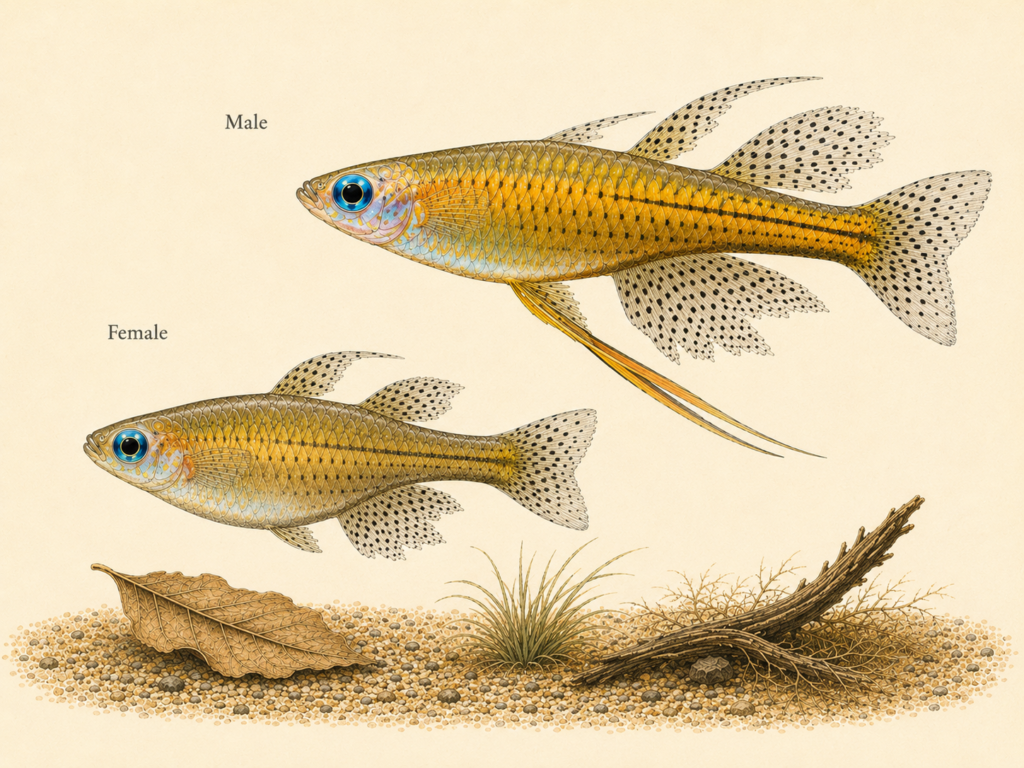
Pseudomugil gertrudae is a slender, laterally compressed fish with an almost translucent body that takes on a pale golden to honey-yellow hue depending on the population and the fish’s condition. The body is subtly marked with fine dark-edged scales that can create a faint reticulated pattern, particularly along the dorsal surface. However, it is the fins and eyes that truly capture the attention of hobbyists and make this species so desirable.
The eyes of both males and females display the characteristic neon-blue iridescence that is the hallmark of the Pseudomugil genus. This brilliant blue ring around the iris is especially vivid under ambient or slightly subdued lighting and provides a striking contrast against the warm body tones. The effect can vary in intensity depending on the angle of light and the fish’s mood, but it is consistently one of the most eye-catching features of the species.
Males are significantly more ornate than females, particularly when in breeding condition. The first and second dorsal fins, the anal fin, and the pelvic fins are elongated and adorned with bold black spots or blotches set against a clear to pale yellow membrane. During courtship displays, males flare these fins to their fullest extent, creating an impressive fan-like presentation that is disproportionately dramatic for such a small fish. The caudal fin is typically rounded to slightly forked and may also carry subtle spotting. The pectoral fins are largely transparent.
Females are more modestly proportioned, with shorter, rounder fins that carry less pronounced spotting. Their body colouration tends to be slightly paler than that of males, and the overall impression is of a simpler, more streamlined fish. Nevertheless, females still possess the characteristic blue-eye ring and are attractive in their own right.
It is worth noting that considerable variation exists between different wild populations of Pseudomugil gertrudae collected from various localities across their range. Some populations display stronger yellows, others more prominent spotting, and still others a more reddish tint to the fins. These locality variants are sometimes available from specialist breeders and can be quite sought after by enthusiasts who appreciate the subtle differences.
Varieties and Morphs
While Pseudomugil gertrudae does not have the extensive catalogue of selectively bred colour morphs seen in species like guppies or bettas, several distinct locality variants are recognised in the aquarium trade, each carrying its own subtle differences in colouration and patterning. These are not artificially created morphs but rather reflect the natural genetic diversity found across the species’ broad geographic range.
The Aru II variant is among the most popular and widely available forms in the hobby. Originating from the Aru Islands of Indonesia (near New Guinea), this population is noted for its particularly vivid yellow to orange body colouration and bold, well-defined black spots on the elongated dorsal and anal fins of males. The contrast between the warm body hue and the dark fin markings is especially pronounced in this form, making it a favourite among aquascapers and nano fish keepers.
Fish from various Australian localities, sometimes traded simply as “Australian Spotted Blue-eye,” tend to display a slightly more subdued overall colouration compared to the Aru form, with a paler golden body and somewhat less dramatic fin extensions. However, the spotting pattern can be equally intricate, and the blue-eye iridescence is typically just as vivid. Within Australia, fish from different river systems and floodplains can show their own minor variations, though these are less commonly differentiated in the retail trade.
Occasionally, breeders offer fish labelled as “Red Spotted Blue-eye” or with other locality-specific designations. These may reflect populations where the fin membranes carry a distinct reddish or orange wash in addition to the characteristic spotting. Hobbyists interested in maintaining the genetic integrity of specific locality variants are encouraged to keep them in separate breeding groups and to document the origin of their stock carefully.
Natural Habitat
Pseudomugil gertrudae is found across a wide geographic range encompassing the tropical lowlands of northern Australia – from the Kimberley region of Western Australia through the Northern Territory and into Queensland – as well as the southern coastal regions of New Guinea and associated island groups. This broad distribution has given rise to the locality variation described above, as isolated populations have adapted to subtly different environmental conditions over time.
In the wild, these fish inhabit shallow, slow-moving or still freshwater environments. They are commonly found in swamps, floodplain lagoons, small creeks, and the margins of rivers where vegetation is dense and water flow is minimal. Paperbark (Melaleuca) swamps are a particularly characteristic habitat, where the water is stained a deep amber or tea colour by tannins leaching from decaying leaves and wood. These blackwater conditions result in soft, acidic water with very low mineral content.
Aquatic and marginal vegetation is typically abundant in their natural habitats. Submerged grasses, floating plants, and overhanging terrestrial vegetation provide cover from predators and create the dappled, low-light conditions that these fish seem to prefer. The substrate is usually composed of fine sand, leaf litter, and organic detritus. Water temperatures in these tropical lowland environments are consistently warm, often ranging from 25 to 30 degrees Celsius, and can fluctuate seasonally with the wet and dry cycles that characterise the Australian and New Guinean tropics.
During the wet season, floodwaters connect previously isolated pools and lagoons, allowing populations to mix and disperse. As the dry season progresses, these water bodies contract, concentrating fish into smaller areas. This seasonal cycle plays a significant role in the species’ breeding ecology and helps explain their relatively short natural lifespan and prolific reproductive output.
Tank Size and Setup
A group of Pseudomugil gertrudae can be comfortably housed in an aquarium of 40 litres or more, making them an excellent choice for nano setups. However, a larger tank of 60 to 80 litres provides more stable water parameters, greater swimming space for courtship displays, and better opportunities for aquascaping. These fish are best kept in groups of at least six to eight individuals, with a ratio of two or three females per male to prevent excessive harassment during courtship.
The ideal aquascape for Gertrudae Spotted Blue-eyes draws inspiration from their natural blackwater habitats. A fine sand or dark-coloured substrate forms the base, complemented by pieces of driftwood and a generous scattering of dried leaf litter such as Indian almond (Terminalia catappa) leaves or oak leaves. The tannins released by these materials will stain the water a gentle amber, replicating the conditions the fish experience in the wild and often bringing out their best colouration. Botanicals such as seed pods and alder cones can further enhance the natural aesthetic and provide additional surfaces for biofilm growth, which serves as a supplementary food source.
Dense planting is highly recommended. Fine-leaved plants such as Java moss, Christmas moss, Riccia fluitans, and Taxiphyllum species provide ideal spawning sites and create the textured, complex environment these fish prefer. Stem plants like Rotala, Ludwigia, and Hygrophila can be used to fill the mid-ground and background, while floating plants such as Salvinia, Frogbit, or Red Root Floaters diffuse overhead lighting and create the shaded conditions that encourage natural behaviour. The fish will spend much of their time in the upper half of the water column, so leaving some open swimming space near the surface is important.
Lighting should be moderate to subdued. Harsh, bright lighting can cause these fish to appear washed out and may make them feel exposed, leading to increased skittishness. If stronger lighting is required for plant growth, floating plants will naturally temper the intensity reaching the lower levels of the tank. A tight-fitting lid or cover is advisable, as Pseudomugil gertrudae are capable of jumping, particularly when startled or during vigorous courtship displays.
Water Parameters
| Temperature | 24 – 30 °C |
| pH | 5.0 – 7.5 |
| General hardness (GH) | 2 – 12 dGH |
| Carbonate hardness (KH) | 1 – 8 dKH |
| Ammonia | 0 ppm |
| Nitrite | 0 ppm |
| Nitrate | Below 20 ppm |
Pseudomugil gertrudae is a tropical species that thrives in warm water, with temperatures between 24 and 30 degrees Celsius being suitable and a range of 26 to 28 degrees Celsius being optimal for most aquarium situations. They are adaptable regarding pH and hardness, tolerating mildly acidic to neutral conditions comfortably. However, they show their finest colours and most natural behaviour in soft, slightly acidic water that mimics the blackwater conditions of their native habitats. A pH of 5.5 to 6.5 with low general hardness is ideal for bringing out the best in these fish.
Water quality must be excellent at all times. As small fish with a relatively high metabolic rate, Pseudomugil gertrudae are sensitive to elevated ammonia and nitrite levels, which must always read zero. Nitrate should be kept as low as possible, ideally below 20 ppm, through regular partial water changes and the presence of live plants that help absorb excess nutrients. Weekly water changes of 15 to 25 per cent are recommended, using water that has been treated to match the temperature and chemistry of the tank.
If you wish to create authentic blackwater conditions, adding Indian almond leaves, driftwood, and peat filtration can naturally lower pH and soften the water. Reverse osmosis water remineralised with a suitable product is an excellent way to achieve consistently soft, clean water for this species. Avoid sudden swings in temperature or chemistry, as these can stress the fish and make them more susceptible to disease.
Filtration and Equipment
Given their small size and preference for calm water, filtration for Pseudomugil gertrudae should prioritise gentle flow above all else. A sponge filter is the ideal choice for most setups, providing excellent biological filtration without creating strong currents that could exhaust these delicate fish. Air-driven sponge filters are particularly well suited to nano tanks and have the added advantage of being safe for fry if breeding occurs in the main display tank.
Small internal filters or hang-on-back filters can also be used, provided the flow rate is reduced or diffused. Positioning the outlet against the glass, using a spray bar, or attaching a pre-filter sponge over the intake will help achieve a gentler current. The intake should always be covered with a fine sponge or mesh to prevent small fish and fry from being drawn in.
A reliable heater is essential, as this tropical species requires consistently warm water. For nano tanks, a small adjustable heater rated appropriately for the tank volume is recommended. Always use a separate thermometer to verify the water temperature, as built-in heater thermostats can sometimes be inaccurate. Placing the heater near the filter outlet helps distribute warmth evenly throughout the tank.
Lighting should support plant growth without being excessively bright. LED fixtures with adjustable intensity or a dimmer function are ideal, allowing you to find a balance that keeps plants healthy while maintaining the subdued ambiance that Pseudomugil gertrudae prefer. A timer set to provide 8 to 10 hours of light per day establishes a consistent photoperiod and helps regulate the fishes’ natural behavioural rhythms.
An air pump connected to a sponge filter typically provides sufficient surface agitation to maintain adequate oxygen levels. In warmer setups approaching 30 degrees Celsius, additional aeration via an airstone may be beneficial, as warmer water holds less dissolved oxygen.
Diet and Feeding
Pseudomugil gertrudae are micro-predators that feed on tiny invertebrates, insect larvae, and zooplankton in the wild. In captivity, they accept a range of foods, but their small mouth size must be taken into account when selecting an appropriate diet. All food items should be finely sized – crushed or powdered if necessary – to ensure the fish can consume them comfortably.
A high-quality micro-pellet or finely crushed flake food can form the staple of their diet. Look for products formulated for small tropical fish or nano species, as these tend to be appropriately sized and nutritionally balanced. However, dry foods alone are unlikely to bring out the best condition and colour in these fish, and a varied diet that includes live and frozen foods is strongly recommended.
Live foods are particularly valuable, both for conditioning breeding adults and for encouraging natural foraging behaviour. Baby brine shrimp (Artemia nauplii) are arguably the single best food for this species and are readily accepted by fish of all ages. Micro-worms, Walter worms, Grindal worms, and vinegar eels are also excellent choices, especially for smaller individuals and newly hatched fry. Daphnia, copepods, and moina provide variety and are enthusiastically consumed.
Frozen foods such as cyclops, baby brine shrimp, and daphnia serve as convenient alternatives when live cultures are unavailable. These should be thawed in a small amount of tank water before being offered, and any uneaten portions should be removed promptly to prevent water quality deterioration.
Feed small amounts two to three times daily rather than one large feeding. These small fish have correspondingly small stomachs and benefit from frequent, modest meals. This approach also reduces the amount of uneaten food that sinks to the substrate and decomposes. Observe your fish during feeding to ensure all individuals are getting their share, as more timid specimens can sometimes be outcompeted at mealtimes.
Behaviour and Temperament
Pseudomugil gertrudae is a peaceful, sociable species that should always be kept in a group. A minimum of six individuals is recommended, though larger groups of ten or more create a more natural dynamic and allow for more impressive displays of courtship behaviour. In smaller groups, subordinate males may be bullied excessively by a dominant individual, whereas in larger groups, aggression is more diffused and all fish tend to be more relaxed.
Males spend a considerable amount of their time displaying to one another and to females. These courtship rituals are one of the great pleasures of keeping this species. A displaying male will raise and flare his elongated dorsal and anal fins, quiver his body, and swim alongside or in front of a female in an attempt to entice her to spawn. Rival males engage in parallel displays, swimming side by side with fins fully extended in a contest of showmanship rather than physical aggression. Actual fin nipping or injury is rare, though persistent chasing of a single female can occur if the sex ratio is skewed too heavily towards males.
These fish are active swimmers that typically occupy the upper and middle portions of the water column. They are most animated during the morning hours, when courtship and spawning activity tends to peak. Throughout the rest of the day, they cruise through the tank in a loose shoal, picking at biofilm on plant surfaces and investigating their environment. They are inquisitive but not bold, and may initially be shy in a newly set-up tank or when first introduced to their environment. Providing ample plant cover and avoiding sudden changes in lighting or disturbance will help them settle in more quickly.
It is important to recognise that Pseudomugil gertrudae are naturally short-lived fish, typically surviving for one to two years even under optimal conditions. This is not a reflection of poor care but rather the species’ natural life history strategy, which favours rapid growth, early reproduction, and a relatively brief adult lifespan. Hobbyists should plan accordingly and consider maintaining a breeding population to ensure continuity.
Tank Mates
Due to their small size and gentle temperament, Pseudomugil gertrudae must be housed with similarly peaceful and appropriately sized companions. They can be overwhelmed or outcompeted for food by larger or more boisterous species, and any fish large enough to view them as prey should be strictly avoided. The ideal tank mates are other small, non-aggressive species that share similar water parameter preferences. In a nano setup, it is often best to keep them in a species-only arrangement to fully appreciate their behaviour and ensure their dietary needs are met without competition.
Good tank mates
- Celestial Pearl Danio – A similarly sized, peaceful nano fish that thrives in planted tanks and shares comparable water parameter requirements.
- Chili Rasbora – This tiny, gentle rasbora occupies similar water conditions and its calm demeanour makes it an excellent companion.
- Ember Tetra – A small, peaceful tetra that adds warm colour contrast without posing any threat to blue-eyes.
- Pygmy Corydoras – These diminutive bottom-dwellers occupy a different zone in the tank and are completely non-aggressive.
- Otocinclus – Peaceful algae grazers that stay small and will not interact negatively with Pseudomugil species.
- Threadfin Rainbowfish – A closely related Pseudomugilidae species with similar care needs and a compatible temperament.
- Endler’s Livebearer – Small, colourful, and peaceful, Endlers make good companions in warmer setups provided the tank is not overstocked.
- Amano Shrimp – Hardy, peaceful invertebrates that help with algae control and coexist safely with small fish.
- Cherry Shrimp – These popular ornamental shrimp are compatible, though adult blue-eyes may occasionally prey on the smallest shrimplets.
- Nerite Snail – Excellent algae-eating snails that are entirely peaceful and will not disturb the fish in any way.
Fish to avoid
- Betta Fish – Male bettas may view the elaborate finnage of male blue-eyes as a threat and respond with aggression.
- Angelfish – Far too large and predatory; angelfish will readily consume fish of this size.
- Tiger Barb – Boisterous and notorious fin nippers that would stress and potentially injure Pseudomugil gertrudae.
- Convict Cichlid – Aggressive and territorial cichlids that are completely incompatible with small, peaceful species.
- Paradise Fish – These robust and often aggressive gouramis would dominate and potentially harm delicate blue-eyes.
- Common Pleco – Grows far too large for the nano environments suited to this species and produces excessive waste.
- Buenos Aires Tetra – A large, active tetra that would outcompete Pseudomugil gertrudae for food and may nip fins.
- Red Tail Shark – Territorial and aggressive, this species would intimidate and chase small blue-eyes relentlessly.
Breeding
Breeding Pseudomugil gertrudae is one of the most rewarding aspects of keeping this species, and it is achievable for hobbyists with moderate experience. These fish are egg scatterers that deposit adhesive eggs among fine-leaved vegetation or artificial spawning mops. In a well-maintained tank with a good ratio of males to females, spawning will often occur spontaneously without any special intervention.
To maximise breeding success, condition the adults with a diet rich in live and frozen foods for one to two weeks prior to attempting to breed them. Baby brine shrimp, daphnia, and micro-worms are particularly effective conditioning foods. Ensure water parameters are within the optimal range, with a temperature of 26 to 28 degrees Celsius and soft, slightly acidic water.
Spawning typically takes place in the early morning hours. Males intensify their courtship displays, and receptive females are led to clumps of fine-leaved vegetation or spawning mops, where they deposit a small number of eggs – often just one to five per spawning event. The eggs are small, spherical, and adhesive, attaching to the plant material or mop fibres by fine threads. Spawning may continue over several days or even weeks, with a few eggs being deposited each day.
Adults will eat their own eggs and fry if given the opportunity. To improve survival rates, regularly inspect spawning mops or plant clumps for eggs and transfer them to a separate rearing container. A small, shallow container with aged water from the parent tank works well. Adding a few drops of methylene blue or Indian almond leaf extract can help prevent fungal infections on the eggs. Maintain gentle aeration and keep the temperature stable.
Eggs typically hatch in 10 to 21 days, depending on temperature, with warmer conditions accelerating development. The fry are extremely tiny and will initially feed on infusoria and other micro-organisms present in a well-established tank or rearing container. After a few days, they can graduate to freshly hatched baby brine shrimp and micro-worms. Growth is steady but not rapid, and fry will begin to show their characteristic colouration and fin development after several weeks. Ensuring a constant supply of appropriately sized food during the first few weeks of life is critical to survival rates.
Given the species’ short natural lifespan, maintaining a rolling breeding programme is advisable for hobbyists who wish to keep Pseudomugil gertrudae long-term. Successive generations can be raised alongside or separately from the parents, ensuring a self-sustaining population.
Common Diseases
Pseudomugil gertrudae is generally a hardy species when maintained in appropriate conditions, but like all aquarium fish, it is susceptible to certain health issues, particularly when stressed by poor water quality, inadequate diet, or incompatible tank mates.
Ich (white spot disease) is one of the most commonly encountered ailments in tropical freshwater fish, and Pseudomugil gertrudae is no exception. It presents as small white cysts on the body and fins and is typically triggered by sudden temperature drops or other stressors. Treatment involves gradually raising the water temperature to 28 to 30 degrees Celsius and, if necessary, using a half-dose of a suitable ich medication, as small fish can be sensitive to full-strength treatments.
Fin rot, characterised by the progressive erosion of the fin edges, can occur in response to poor water quality or bacterial infection. The elaborate fins of male Pseudomugil gertrudae make them particularly susceptible, and early signs include fraying or discolouration at the fin margins. Improving water quality through more frequent water changes is often sufficient to halt and reverse mild cases. In more advanced cases, treatment with an antibacterial medication may be necessary.
Velvet disease (Oodinium) is another parasitic infection that can affect this species. It manifests as a fine golden or rust-coloured dusting on the body and fins, and affected fish may clamp their fins, lose appetite, and become lethargic. Treatment typically involves dimming the lights (as the parasite is partially photosynthetic), raising the temperature, and administering a copper-based medication at a reduced dose appropriate for small fish.
Internal parasites can occasionally be an issue, particularly in wild-caught specimens. Signs include weight loss despite normal feeding, a hollow belly, and pale or stringy faeces. Anti-parasitic foods or medications containing praziquantel or levamisole can be effective treatments.
Prevention is always preferable to treatment with these small, delicate fish. Maintaining pristine water quality, providing a varied and nutritious diet, quarantining new arrivals before adding them to an established tank, and minimising stress through appropriate tank mates and environmental enrichment are the most effective strategies for keeping Pseudomugil gertrudae healthy throughout their lives.
FAQs
How many Pseudomugil gertrudae should I keep together?
A minimum group of six is recommended, though eight to twelve or more is preferable. Larger groups dilute any aggression between males and result in more natural shoaling behaviour and more frequent, more impressive courtship displays. Aim for a ratio of approximately two to three females per male to prevent individual females from being harassed excessively.
Can Gertrudae Spotted Blue-eyes be kept in an unheated tank?
No. Pseudomugil gertrudae is a tropical species that requires consistently warm water between 24 and 30 degrees Celsius. In most climates, a reliable aquarium heater is essential to maintain these temperatures, especially during cooler months. Sustained exposure to temperatures below 22 degrees Celsius can lead to stress, reduced immune function, and ultimately death.
Why are my Pseudomugil gertrudae losing colour?
Colour loss in this species is most commonly a sign of stress. Potential causes include poor water quality, excessively bright lighting without adequate cover, bullying from tank mates, an inadequate or monotonous diet, or simply the stress of acclimation to a new environment. Review your water parameters, ensure plenty of plant cover is available, consider adding tannin sources like Indian almond leaves, and vary the diet with live and frozen foods. Males typically show their brightest colours when in competition with other males and when courtship activity is frequent.
How long do Gertrudae Spotted Blue-eyes live?
Pseudomugil gertrudae has a naturally short lifespan of approximately one to two years, even under ideal aquarium conditions. This is characteristic of many small Pseudomugil species and reflects their wild ecology, where they are adapted for rapid reproduction in ephemeral tropical wetlands. Maintaining a breeding population is the best way to enjoy this species over the long term.
Do Gertrudae Spotted Blue-eyes need live plants?
While not strictly essential for survival, live plants are very strongly recommended for this species. Dense fine-leaved vegetation provides spawning sites, shelter for subdominant individuals and fry, surfaces for biofilm growth that supplements the diet, and a more natural environment that encourages confident behaviour and vivid colouration. Floating plants are particularly beneficial for diffusing light and making the fish feel secure. A well-planted tank will bring out the very best in Pseudomugil gertrudae.
Related Guides
- Threadfin Rainbowfish – A close relative in the family Pseudomugilidae with similar care requirements and equally spectacular male finnage.
- Forktail Blue-eye Rainbowfish – Another popular Pseudomugil species that shares many husbandry needs and makes an excellent companion or alternative choice.
- Celestial Pearl Danio – A fellow nano fish favourite that thrives in similar planted setups and complements Pseudomugil gertrudae beautifully.
- Chili Rasbora – One of the smallest aquarium fish available, ideal for the same nano and planted tank environments suited to blue-eyes.
- Cherry Shrimp – A popular invertebrate often kept alongside nano fish in planted aquaria, with guidance on creating a thriving shrimp and fish community.