Quick summary
The Halfmoon Betta is a stunning but moderately challenging fish, best suited to keepers willing to prioritize gentle water flow, snag-free decor, and vigilant water quality to protect its huge, delicate 180-degree tail from tearing and rot. If you want a low-flow, well-planted 20 to 40 litre tank and don’t mind a slower, more restful fish, it’s a great fit, but breeding one successfully is considered difficult.
🐠 Build a tank around this species
In this guide:
- Introduction
- Quick Stats
- Appearance
- Varieties and Morphs
- Natural Habitat
- Tank Size and Setup
- Water Parameters
- Filtration and Equipment
- Diet and Feeding
- Behaviour and Temperament
- Tank Mates
- Breeding
- Common Diseases
Introduction
The Halfmoon Betta is one of the most visually striking and widely coveted tail-type variants of the domestic Betta splendens. Its defining characteristic is a caudal fin that spreads to a full 180 degrees when flared, forming a near-perfect “D” shape with straight, clean edges. This dramatic finnage has made the Halfmoon a centrepiece of the ornamental fish hobby since its development in the early 1990s, and it remains a benchmark by which many breeders and hobbyists judge betta quality today.
While the Halfmoon shares the same species classification as all domestic bettas – Betta splendens – its exaggerated fin structure introduces genuinely different care considerations compared to shorter-finned forms such as the Plakat or the Crowntail. The sheer weight and surface area of the Halfmoon’s finnage makes it more prone to tearing, fin damage, and swimming fatigue. These are not trivial cosmetic concerns; they directly influence tank setup, water flow choices, decor selection, and even the fish’s long-term health and quality of life. Keepers who underestimate these differences often find themselves managing chronic fin rot, lethargy, or stress in what should be a hardy and resilient species.
This guide focuses specifically on the practical differences involved in keeping Halfmoon Bettas successfully. For comprehensive baseline information on Betta splendens care – including cycling, general biology, and foundational husbandry – please refer to our full Betta Fish Care Guide. The advice below assumes familiarity with those fundamentals and concentrates on what makes the Halfmoon variant unique.
Quick Stats
| Scientific name | Betta splendens var. Halfmoon |
|---|---|
| Common names | HM Betta, Halfmoon Siamese Fighting Fish |
| Family | Osphronemidae |
| Origin | Southeast Asia (Thailand, Cambodia, Laos, Vietnam) |
| Adult size | 7 cm |
| Lifespan | 2–4 years |
| Difficulty | Intermediate |
| Breeding difficulty | Advanced |
| Temperature | 24–30 °C |
| pH | 6–8 |
| GH | 1–15 dGH |
| KH | 2–8 dKH |
| Minimum tank size | 45 L |
| Conservation status | Not evaluated (domestic variant); wild Betta splendens is Vulnerable (IUCN) |
Appearance
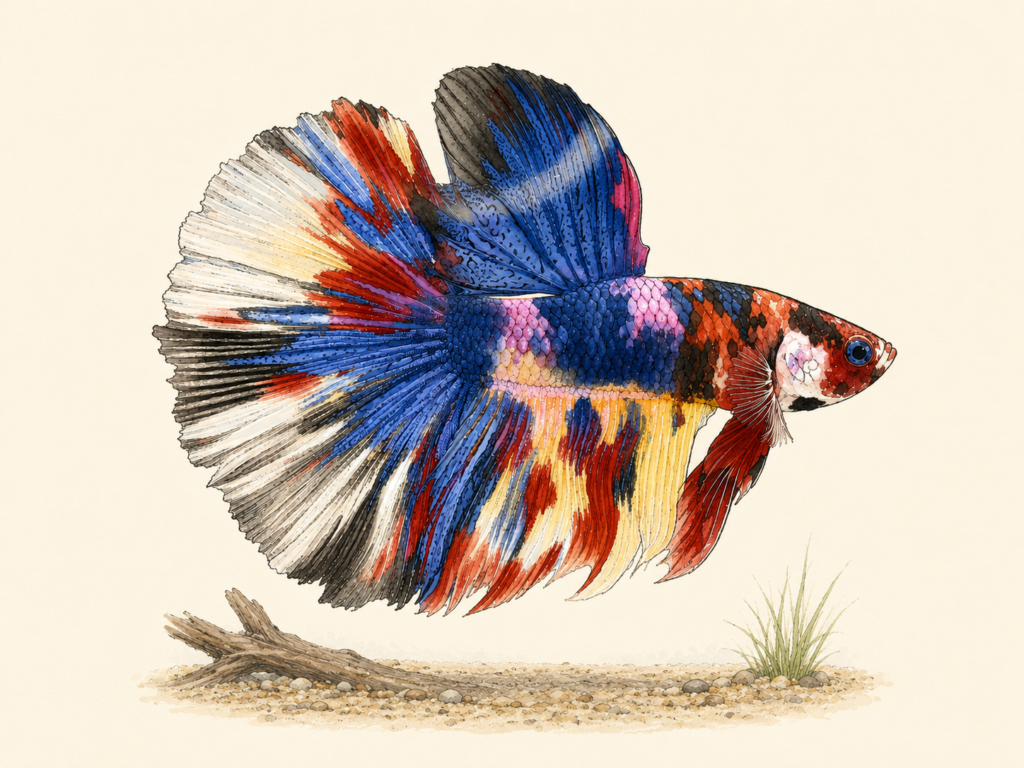
The Halfmoon Betta’s signature feature is its caudal (tail) fin, which fans out to a full 180-degree spread when the fish flares. Viewed from the side, this creates a distinctive “D” or semicircle shape. The trailing edge of the caudal should be straight and crisp rather than curved or wavy – this is the primary quality criterion that distinguishes a true Halfmoon from an “Over-Halfmoon” (which exceeds 180 degrees) or a “Super Delta” (which falls short of the full spread).
Beyond the caudal, the dorsal and anal fins are also significantly enlarged in well-bred Halfmoons. The dorsal fin typically fans out broadly, sometimes matching the width of the caudal, while the anal fin extends in a wide, flowing skirt along the ventral edge of the body. Together, these fins create an almost spherical silhouette when the fish is fully displaying. The pectoral fins may also be elongated, particularly in specimens bred for the “Dumbo” or “Elephant Ear” trait, though this is a separate genetic characteristic layered onto the Halfmoon form.
Body shape in the Halfmoon is typical of domestic Betta splendens – a streamlined, laterally compressed form roughly 6 to 7 centimetres in length, not counting fins. The mouth is upturned, suited to surface feeding and air-breathing via the labyrinth organ. Males display far more exaggerated finnage than females, though female Halfmoons still show noticeably longer fins compared to female Plakats.
Halfmoons are available in virtually every colour and pattern combination found in the betta hobby, from solid reds, blues, and blacks to complex multicolour patterns such as marble, koi, galaxy, and mustard gas. The expansive fin surface area makes colour patterns particularly dramatic in this variant, which is a significant part of its appeal. However, this same surface area also means that any fin damage – tears, holes, curling, or rot – is immediately visible and cosmetically significant, making fin care a genuine priority for Halfmoon keepers.
One subtle but important physical consideration is the weight of all that finnage. A Halfmoon’s fins can represent a substantial proportion of its total body area, and this mass creates real drag. Healthy Halfmoons tend to rest more frequently than short-finned bettas and may appear slower or more deliberate in their movements. This is normal behaviour for the variant and should not automatically be interpreted as illness, though it does mean that distinguishing genuine lethargy from normal resting behaviour requires some experience with the form.
Varieties and Morphs
The Halfmoon is itself a tail-type classification, but within it there are several recognised sub-types and closely related forms that are worth understanding.
The true Halfmoon displays exactly 180 degrees of caudal spread with straight, clean edges. This is the standard by which show-quality fish are judged. Fish that come close but do not quite reach the full 180-degree spread are typically classified as Super Deltas – aesthetically similar but technically distinct in competitive breeding and showing circles.
The Over-Halfmoon (OHM) pushes beyond 180 degrees, with the caudal fin edges curving back towards the fish’s head. While visually impressive, Over-Halfmoons can experience even greater swimming difficulty and fin stress than standard Halfmoons, and some breeders consider the trait excessive. The additional fin weight and drag can genuinely compromise the fish’s quality of life, and responsible breeders tend to avoid pushing spread significantly beyond the 180-degree mark.
The Rosetail is a Halfmoon sub-type where excessive branching of the fin rays causes the fin edges to ruffle and fold, resembling rose petals. While strikingly beautiful, Rosetails are among the most fragile of all betta variants. The extra fin tissue is extremely prone to tearing, collapsing, and developing fin rot. Many experienced keepers consider the Rosetail a cautionary example of selective breeding taken to an extreme that compromises fish welfare.
The Feathertail is an even more extreme version of the Rosetail, with profuse branching and ruffling. The same welfare concerns apply, amplified further.
Halfmoon finnage can be combined with virtually any colour morph available in domestic bettas. Popular combinations include Halfmoon Marble (featuring irregular colour patches that can change over time due to the transposon or “jumping gene” effect), Halfmoon Koi (mimicking the colour patterns of koi carp), Halfmoon Copper (a deep, iridescent metallic sheen), and Halfmoon Butterfly (where each fin displays two or more distinct colour bands radiating outward). The Halfmoon Dumbo or Elephant Ear variant combines the 180-degree caudal spread with enlarged pectoral fins, creating an especially dramatic display fish, though the additional pectoral size adds yet more weight for the fish to manage.
Female Halfmoons exist and are occasionally available in the hobby. Their fins are shorter than males’ but still noticeably longer than female Plakats, and they display the characteristic 180-degree caudal spread, albeit in a less dramatic form. Female Halfmoons can be a good option for keepers who want the Halfmoon aesthetic with reduced fin-care concerns.
Natural Habitat
As a selectively bred domestic variant, the Halfmoon Betta does not occur in the wild. Its ancestors, wild-type Betta splendens, are native to the shallow, slow-moving or stagnant waters of mainland Southeast Asia – particularly Thailand, Cambodia, Laos, and parts of Vietnam. Wild bettas inhabit rice paddies, roadside ditches, floodplain pools, marshes, and the shallow margins of streams and ponds. These environments are typically warm, soft, slightly acidic, and densely vegetated, with minimal water flow.
Understanding this ancestral habitat is especially important for Halfmoon keepers because the low-flow, heavily planted environment that wild bettas evolved in is precisely the type of setup that best accommodates the Halfmoon’s heavy finnage. Wild bettas are adapted to navigate through dense vegetation in shallow water with negligible current – conditions that allow even a heavily finned domestic variant to move and feed without excessive physical strain. Replicating these conditions in the aquarium is not just aesthetically appropriate; for the Halfmoon specifically, it is a genuine welfare consideration.
The water in wild betta habitats is often tinted with tannins from decaying organic matter, resulting in a slightly brown or amber hue. This “blackwater” effect lowers pH, softens the water, and provides mild antibacterial and antifungal properties. Many Halfmoon keepers find that incorporating Indian almond leaves (Terminalia catappa) or similar botanicals into their tanks improves fin condition and overall health, which aligns directly with these natural water chemistry characteristics.
Tank Size and Setup
The minimum recommended tank size for a single Halfmoon Betta is 20 litres, though 30 to 40 litres is strongly preferable. While generic betta care often cites similar minimums, the reasoning is slightly different for Halfmoons. These fish need horizontal swimming space – their heavy fins make sustained vertical movement more taxing – and the additional volume provides greater water chemistry stability, which is important given the Halfmoon’s susceptibility to fin problems in poor water conditions.
Tank shape matters more for Halfmoons than for most other betta variants. Long, shallow tanks are significantly better than tall, narrow ones. A Halfmoon navigating upward through a deep water column to reach the surface for air is working considerably harder than a Plakat doing the same thing. Tanks with a depth of 25 to 30 centimetres are ideal; anything over 35 centimetres can become problematic for heavily finned individuals, particularly older fish or those with Over-Halfmoon or Rosetail traits.
Decor selection is a critical concern specific to the Halfmoon. Every surface in the tank is a potential hazard for those expansive, delicate fins. Avoid any sharp or rough decor – this includes plastic plants with hard edges, rough-textured resin ornaments, and natural rocks with jagged surfaces. Before placing any decor in a Halfmoon tank, run a pair of tights or stockings over it; if the fabric snags, the item will tear fins. Live plants or high-quality silk plants are vastly preferable to plastic alternatives.
Recommended live plants include Anubias species (broad-leafed and smooth), Java Fern (Microsorum pteropus), Java Moss (Taxiphyllum barbieri), floating plants such as Salvinia or Amazon Frogbit (Limnobium laevigatum), and Cryptocoryne species. Floating plants are particularly beneficial as they reduce light intensity (Halfmoons can be light-shy due to their prominent finnage making them feel exposed), provide surface cover that encourages natural behaviour, and offer resting spots near the surface where the fish can breathe air without expending energy swimming upward.
A betta leaf hammock or similar resting platform positioned near the surface is highly recommended for Halfmoons. These fish tire more quickly than short-finned variants and genuinely benefit from having resting spots at multiple levels in the tank, particularly within a few centimetres of the water surface. Broad-leafed plants like Anubias can serve this purpose naturally.
Substrate choice is flexible – fine gravel or sand both work well. Dark substrates tend to bring out brighter colouration in bettas. Avoid very coarse gravel with sharp edges, as a Halfmoon resting on the bottom could damage its ventral fins.
A secure lid is essential, as Halfmoons can and do jump, though their heavy finnage means they tend to be less athletically inclined jumpers than Plakats. Leave a small gap between the water surface and the lid to allow the fish to breathe atmospheric air via its labyrinth organ.
Water Parameters
| Temperature | 24–30 °C |
| pH | 6.0–8.0 |
| General hardness (GH) | 1–15 dGH |
| Carbonate hardness (KH) | 2-8 dKH |
| Ammonia | 0 ppm |
| Nitrite | 0 ppm |
| Nitrate | Below 20 ppm |
While these parameter ranges are broadly the same as for any domestic Betta splendens, the Halfmoon’s extensive finnage makes water quality a more pressing concern than it is for hardier variants. Fin tissue in a Halfmoon is thin, highly vascularised, and constantly exposed to the surrounding water. Even mildly elevated ammonia or nitrite levels that a Plakat might tolerate without visible symptoms can trigger fin erosion, discolouration, or the early stages of fin rot in a Halfmoon within days.
Nitrate levels should ideally be kept below 20 ppm, and below 10 ppm is even better for long-term fin health. Weekly water changes of 20 to 30 per cent are a sensible baseline, with more frequent changes warranted in smaller or more heavily stocked tanks. Use a dechlorinator or water conditioner with every change, and match temperature closely to avoid thermal shock – another factor that can stress the immune system and trigger fin problems.
Temperature stability is particularly important. Halfmoons are somewhat more susceptible to temperature-related stress than short-finned bettas, and fluctuations of more than 1 to 2 degrees Celsius in a single day can suppress immune function. A reliable, adjustable heater with a thermostat is essential, not optional. Position the heater near a gentle flow source to ensure even heat distribution throughout the tank.
Many experienced Halfmoon keepers maintain slightly softer, more acidic water (pH 6.5 to 7.0, GH 4 to 8 dGH) and supplement with Indian almond leaves, alder cones, or other botanicals to release tannins into the water. While the evidence is largely anecdotal, there is a strong consensus in the betta community that tannin-rich water improves fin condition and recovery in heavy-finned variants. The mild antibacterial and antifungal properties of tannins may offer a degree of prophylactic protection to the vulnerable fin tissue.
Filtration and Equipment
Water flow is the single most important equipment consideration specific to the Halfmoon Betta. A filter is absolutely necessary – unfiltered tanks are unsuitable for any betta kept responsibly – but the output must be gentle enough that the fish is not constantly battling the current. A Halfmoon’s 180-degree caudal fin acts like a sail, catching even moderate flow and pushing the fish around the tank. Sustained exposure to excessive current causes stress, exhaustion, and can contribute to fin clamping, a condition where the fish holds its fins tightly closed rather than displaying them.
Sponge filters are the gold standard for Halfmoon tanks. They provide effective biological filtration with minimal water movement, are safe for the fish (no intake slots to trap fins), and can be driven by a small air pump with an adjustable valve to fine-tune flow. A single sponge filter rated for the tank volume is usually sufficient for a solitary Halfmoon setup.
If using a hang-on-back (HOB) filter or small internal filter, reduce the flow rate to the minimum setting and consider adding a baffle – a piece of filter sponge or a plastic bottle cut and placed over the output – to diffuse the current. Some keepers also direct the outflow against the tank wall or into a dense plant mass to break up the flow before it reaches the open water column.
Canister filters are generally unnecessary for the small tank volumes used for Halfmoons and typically produce far too much flow. If one is used in a larger community setup, ensure the output is heavily baffled and the return is positioned to create a gentle flow pattern with obvious still-water zones where the betta can rest.
An adjustable heater is essential, as discussed above. Choose a heater rated appropriately for the tank volume – typically 25 to 50 watts for a 20 to 40 litre tank. Heaters with external temperature controllers or built-in thermostats with reliable calibration are worth the investment. Always use a separate thermometer to verify the heater’s accuracy.
Lighting should be moderate. Halfmoons do not require intense lighting unless the tank is heavily planted with demanding species. Excessively bright light can make the fish feel exposed and stressed, particularly in tanks lacking floating plant cover. A standard LED aquarium light on a timer set for 8 to 10 hours per day is appropriate. Many keepers find that their Halfmoons display more naturally and show better colour under subdued, warm-toned lighting.
Diet and Feeding
The Halfmoon Betta’s dietary requirements are the same as those of any domestic Betta splendens – it is a carnivore that thrives on a protein-rich diet of high-quality pellets, frozen foods, and occasional live foods. However, there are a few feeding considerations that are particularly relevant to the Halfmoon variant.
First, overfeeding is a greater concern for Halfmoons than for more active variants. Because their heavy fins limit their activity levels, Halfmoons burn fewer calories than Plakats or other short-finned bettas. An overfed Halfmoon will gain weight quickly, and excess body weight further compromises its already limited mobility. Feed small portions – typically two to four appropriately sized pellets twice per day, or an equivalent amount of frozen food. The fish’s stomach is roughly the size of its eye, which provides a useful visual reference for portion control.
High-quality betta pellets should form the staple diet. Look for pellets with whole fish or insect meal as the first ingredient and minimal fillers such as wheat or soy. Pellets that soften quickly in water are preferable, as Halfmoons sometimes struggle to chase down food that drifts away in even gentle currents. Floating pellets are generally better than sinking ones, as Halfmoons naturally feed at or near the surface.
Supplement the pellet diet with frozen foods such as bloodworm, daphnia, and brine shrimp two to three times per week. These provide variety and additional nutrition. Daphnia is particularly useful as an occasional treat because of its mild laxative effect, which can help prevent constipation – a common issue in bettas that are overfed or given a monotonous diet. Live foods such as wingless fruit flies, mosquito larvae, or live brine shrimp are excellent enrichment options that stimulate natural hunting behaviour.
A weekly fasting day – one day per week with no food – is widely recommended for bettas and is especially beneficial for Halfmoons to prevent digestive issues and maintain a healthy weight.
Some keepers incorporate foods supplemented with colour-enhancing ingredients such as astaxanthin or spirulina. While these can intensify red, orange, and blue pigmentation, they should be viewed as supplementary rather than essential, and the base nutritional quality of the food should always be the primary selection criterion.
Behaviour and Temperament
Halfmoon Bettas share the same fundamental behavioural profile as all domestic Betta splendens – they are territorial, intelligent, and individually characterful fish. Males are aggressive towards other males and will fight if housed together. However, the Halfmoon’s heavy finnage does introduce some behavioural nuances that are worth understanding.
Halfmoons tend to be less active and less aggressively inclined than short-finned variants such as the Plakat. This is not a temperament difference per se but rather a physical limitation – the energy cost of swimming with a 180-degree caudal fin is significant, and most Halfmoons conserve energy by moving deliberately and resting frequently. Keepers transitioning from a Plakat to a Halfmoon sometimes worry that their new fish is lethargic or unwell when it is simply behaving normally for the variant.
Flaring – the full extension of all fins and gill covers as a territorial or display behaviour – is particularly dramatic in Halfmoons and is the moment when the defining 180-degree caudal spread is most visible. Brief flaring sessions (a few minutes at a time) are healthy exercise and can be stimulated by showing the fish its reflection in a small mirror. However, prolonged or excessive flaring should be avoided with Halfmoons. Extended flaring can overstretch the delicate fin tissue, contribute to fin tearing, and cause stress. Limit mirror exposure to two or three minutes, no more than once or twice per day, and remove the mirror promptly afterwards.
Halfmoons may be somewhat more prone to fin biting – a frustrating behaviour where the fish turns and tears chunks out of its own tail. The causes of fin biting are debated, but stress, boredom, excessively heavy finnage (the fish may find its own fins irritating), and poor water quality are all implicated. Providing a stimulating environment with plants, hiding spots, and varied feeding can help reduce the incidence of fin biting, though some individuals are persistent self-biters regardless of husbandry quality.
Like all bettas, Halfmoons can learn to recognise their keepers, respond to feeding cues, and even perform simple trained behaviours. They are interactive, engaging pets that often develop distinct personalities – some bold and curious, others shy and reserved.
Tank Mates
Choosing tank mates for a Halfmoon Betta requires more caution than for shorter-finned variants. The Halfmoon’s heavy, flowing fins make it a slower swimmer and a more attractive target for fin-nipping species. Additionally, the Halfmoon’s reduced mobility means it cannot easily escape persistent harassment from overly active or boisterous tank mates. Any companion species must be peaceful, non-nippy, and not so energetic that they stress the betta by constantly zipping around the tank. A tank of at least 40 litres is recommended if keeping the Halfmoon with any tank mates, as the additional space helps reduce territorial stress.
Good tank mates
- Ember Tetra – Tiny, peaceful, and slow-moving enough to coexist without provoking the betta or nipping its fins.
- Pygmy Corydoras – Bottom-dwelling and extremely docile, they occupy a different zone of the tank and are too small to be perceived as a threat.
- Kuhli Loach – Nocturnal and reclusive, these slender bottom dwellers rarely interact with the betta and keep to themselves among plants and driftwood.
- Amano Shrimp – Large enough not to be easily eaten by a betta and excellent algae cleaners; their quick reflexes help them avoid confrontation.
- Ramshorn Snail – Completely non-threatening, slow-moving, and useful for consuming leftover food and soft algae.
- Celestial Pearl Danio – Small, relatively calm for a danio, and occupies the middle to lower tank areas away from the betta’s preferred surface zone.
- Malaysian Trumpet Snail – Spends most of its time burrowed in the substrate, posing no interaction risk and helping aerate the substrate.
- Endler’s Livebearer – Female Endlers are subdued in colour and less likely to be mistaken for a rival male betta than brightly coloured male guppies.
Fish to avoid
- Tiger Barb – Notorious fin nippers that will relentlessly target the Halfmoon’s expansive fins, causing severe damage and stress.
- Serpae Tetra – Another well-known fin-nipping species that is incompatible with any long-finned fish.
- Chinese Algae Eater – Becomes aggressive and territorial as it matures, and may attach to the betta’s body or fins.
- Paradise Fish – A fellow labyrinth fish that is highly territorial and aggressive; housing it with a betta will result in conflict.
- Zebra Danio – Extremely active and fast, which stresses the slower Halfmoon, and can nip fins when kept in small groups.
- Dwarf Gourami – Another labyrinth fish that may trigger territorial aggression in the betta; both species can perceive the other as a rival.
- Convict Cichlid – Far too aggressive and territorial for a betta tank; will attack and likely kill a Halfmoon.
- Red Tail Shark – Highly territorial bottom dweller that will harass the betta, especially in smaller tanks.
Breeding
Breeding Halfmoon Bettas is a rewarding but demanding undertaking that requires significantly more skill and preparation than breeding shorter-finned variants. The difficulty lies not in getting the fish to spawn – the breeding mechanics are identical to standard Betta splendens – but in selecting quality breeding stock, managing the heavy-finned adults through the spawning process, and raising fry to achieve the coveted 180-degree spread.
Selecting breeding pairs is the first critical step. Both the male and female should ideally display strong Halfmoon characteristics – the 180-degree caudal spread with clean, straight edges. The female will have shorter fins than the male but should still show a noticeably rounded caudal with good spread when she flares. Avoid pairing two Rosetail or Over-Halfmoon individuals, as this tends to produce offspring with excessively branched rays and compromised fin integrity.
Condition both fish on high-protein foods such as live or frozen bloodworm and brine shrimp for one to two weeks before introducing them. The female should be visibly plump with eggs, displaying vertical breeding bars and a prominent white ovipositor (egg spot) near her ventral fin.
The breeding tank should be shallow – 10 to 15 centimetres of water depth is ideal. This is even more important for Halfmoons than for other variants because the male must repeatedly retrieve sinking eggs from the bottom and carry them to the bubble nest at the surface. A heavily finned Halfmoon male performing this vertical shuttling in deep water will exhaust quickly and may abandon the spawn. Use a gentle sponge filter or no filtration during spawning and the first days of fry development; maintain warmth with a heater set to 26 to 28 degrees Celsius.
Provide floating materials for the male to anchor his bubble nest – a half-cup of polystyrene, a piece of Indian almond leaf, or floating plants work well. Introduce the female in a clear container within the breeding tank so the pair can see each other without physical contact. When the male has built a substantial nest and the female is showing breeding bars and approaching the container wall receptively, release her.
Spawning involves the characteristic betta embrace, where the male wraps around the female and fertilises the eggs as she releases them. This process can take several hours. Once spawning is complete, remove the female promptly to prevent the male from attacking her. The male will tend the nest, retrieving fallen eggs and guarding the developing embryos.
Eggs typically hatch within 24 to 48 hours, and the fry become free-swimming two to three days later. At this point, remove the male. Feed the fry infusoria or liquid fry food for the first few days, transitioning to freshly hatched brine shrimp (Artemia nauplii) once they are large enough. Fry growth rates vary, and developing the full Halfmoon spread can take three to six months, with quality becoming apparent from around eight to twelve weeks of age. Expect large spawns of 50 to 200+ fry; be prepared with grow-out containers and a plan for rehoming juveniles.
A significant challenge in Halfmoon breeding is that not all fry will achieve the full 180-degree spread. Genetics, nutrition, exercise, and water quality all influence fin development. Selective breeding over multiple generations is necessary to consistently produce true Halfmoons, and even experienced breeders typically see a mix of Halfmoon, Super Delta, and occasionally Rosetail offspring in each spawn.
Common Diseases
Halfmoon Bettas are susceptible to the same diseases as all domestic Betta splendens, but their extensive finnage creates a particular vulnerability to fin-related ailments. Understanding these risks and recognising early symptoms is essential for successful Halfmoon keeping.
Fin rot is the most common health issue in Halfmoons. It is caused by bacterial (and sometimes fungal) infection of the fin tissue, typically triggered by poor water quality, stress, or physical damage. Early signs include darkening or discolouration of fin edges, a ragged or eroded appearance, and progressive recession of the fin margin. In mild cases, improving water quality through increased water changes and adding Indian almond leaves may be sufficient. More advanced cases require treatment with antibacterial medications. Fin rot can progress rapidly in Halfmoons due to the large surface area of exposed fin tissue, so early intervention is critical.
Fin tearing is a mechanical injury rather than a disease, but it is far more common in Halfmoons than in short-finned bettas. Causes include sharp decor, rough substrate, excessive water flow, aggressive tank mates, and self-biting. Small tears usually heal on their own in clean water, but larger tears can become entry points for bacterial or fungal infection. Keeping the water pristine during healing is essential – consider slightly increasing water change frequency and adding a tannin source.
Velvet (Oodinium) is a parasitic disease that presents as a fine, gold or rust-coloured dust on the fish’s body and fins. Halfmoons’ broad fin surfaces can make velvet easier to spot than on smaller-finned fish. Treatment involves raising the water temperature slightly, dimming lights (the parasite is partly photosynthetic), and using a copper-based medication.
Ich (white spot
FAQs
What is the minimum tank size for a Halfmoon Betta?
The minimum recommended tank size for a Halfmoon Betta is 20 litres, though a tank in the 20 to 40 litre range is ideal. This gives the fish enough space to move comfortably without excessive open water that forces prolonged swimming, which can fatigue a Halfmoon due to the weight and drag of its large finnage.
Why does my Halfmoon Betta rest so much — is it sick?
Frequent resting is normal behaviour for Halfmoon Bettas. The sheer weight and surface area of their 180-degree caudal fin creates significant drag, so they tend to rest more often and move more deliberately than short-finned variants like Plakats. However, distinguishing normal resting from genuine lethargy takes some experience — if resting is accompanied by loss of appetite, clamped fins, or discolouration, it may indicate illness.
Do Halfmoon Bettas need special water flow compared to other bettas?
Yes. Gentle water flow is essential for Halfmoon Bettas. Their oversized fins act like sails, and strong currents can exhaust the fish and contribute to stress, fin tearing, and long-term health problems. Filtration should be chosen and adjusted to keep flow as low as possible while still maintaining good water quality.
What water parameters do Halfmoon Bettas need?
Halfmoon Bettas thrive at a temperature of 24–28 °C, a pH of 6.0–7.5, general hardness of 3–12 dGH, and carbonate hardness of 2–8 dKH. Vigilant water quality is particularly important for this variant because their large, delicate fins are highly susceptible to fin rot when conditions deteriorate.
Is breeding Halfmoon Bettas difficult?
Yes, breeding Halfmoon Bettas is considered difficult. Achieving the true 180-degree caudal spread with straight, clean edges requires careful selective breeding, and the exaggerated finnage can complicate the spawning process itself. It is rated as a difficult breeding project even for experienced betta keepers.
Related Guides
- Checkerboard Dwarf Cichlid – Another small, peaceful species suited to low-flow planted tanks, making it a useful reference for similar aquarium setups.
- Dwarf Pleco – A compact bottom-dweller that can work in smaller tanks, offering insight into gentle community stocking for betta-sized aquariums.
- Blue-Striped Rivulus – A surface-dwelling labyrinth-adjacent killifish that shares similar low-flow and small-tank requirements with Halfmoon Bettas.
- Elegant Corydoras – A peaceful bottom-dwelling catfish that can be considered as a potential tank mate in appropriately sized betta setups.
- Three-lined Pencilfish – A calm, small-bodied schooling fish suited to planted tanks with gentle filtration, complementing betta-friendly environments.