Quick Summary
The Ornate Bichir is a stunning but demanding predatory fish that requires a very large aquarium (minimum 450 litres for a single adult), a secure weighted lid, and a diet of meaty foods – it is best suited to experienced fishkeepers who can commit to housing a powerful, long-lived bottom-dweller that will eat anything small enough to fit in its mouth.
🐠 Build a tank around this species
Grows large. Read this before buying. The Ornate Bichir is usually sold as a small juvenile and is easy to keep at that size, but a healthy adult reaches around 50 cm. A juvenile will be happy in a standard tank for its first year or so. An adult needs a very large tank, six feet long or more, and the water changes to match. Decide now whether you will build for the adult, or have a realistic rehoming plan, because public aquaria and specialist keepers are often full. It is a superb fish for the keeper who plans for it and a sad one for everyone else.
In this guide:
- Introduction
- Quick Stats
- Appearance
- Natural Habitat
- Tank Size and Setup
- Water Parameters
- Diet and Feeding
- Tank Mates
Introduction
The Ornate Bichir (Polypterus ornatipinnis) is widely regarded as the most visually striking member of the Polypteridae family, a group of ancient freshwater fishes native to Africa. Often described as a “living fossil,” the bichir lineage dates back over 100 million years, and the fish retains a number of primitive anatomical features that set it apart from virtually every other species you will encounter in the aquarium hobby. Chief among these is a modified swim bladder that functions as a rudimentary lung, enabling the Ornate Bichir to gulp atmospheric air at the surface and survive in oxygen-poor water – and even out of water entirely for short periods, provided its skin stays moist.
These prehistoric characteristics make the Ornate Bichir a genuinely fascinating species to keep, but fascination alone is not enough. This is a large, predatory, nocturnal fish with specific requirements that place it firmly in the advanced-keeper category. Adults routinely reach 40-50 cm in captivity, and exceptional specimens may exceed 60 cm. They are powerful, surprisingly agile, and notorious escape artists. If there is any gap in your lid, even one that seems impossibly small, an Ornate Bichir will find it. Keepers regularly share stories of finding their bichir on the floor across the room, sometimes hours later – and thanks to that primitive lung, the fish may still be alive. A weighted, tight-fitting lid is not optional; it is the single most critical piece of equipment for this species.
If you are prepared for the space commitment, the dietary needs, and the security measures, the Ornate Bichir rewards you with decades of companionship. They are surprisingly personable fish that learn to recognise their keepers and will often approach the front glass at feeding time. Their movement – a sinuous, almost serpentine glide along the substrate, punctuated by periodic trips to the surface to breathe – is mesmerising to watch, especially under subdued evening lighting when they become most active.
Quick Stats
| Scientific name | Polypterus ornatipinnis |
|---|---|
| Common names | Ornate Polypterus |
| Family | Polypteridae |
| Origin | Central and East Africa, Congo Basin and Lake Tanganyika |
| Adult size | 50 cm |
| Lifespan | 15–20 years |
| Difficulty | Advanced |
| Breeding difficulty | Advanced |
| Temperature | 25–28 °C |
| pH | 6.5–7.5 |
| GH | 5–20 dGH |
| KH | 5–15 dKH |
| Minimum tank size | 450 L |
| Conservation status | Least Concern (IUCN) |
Appearance
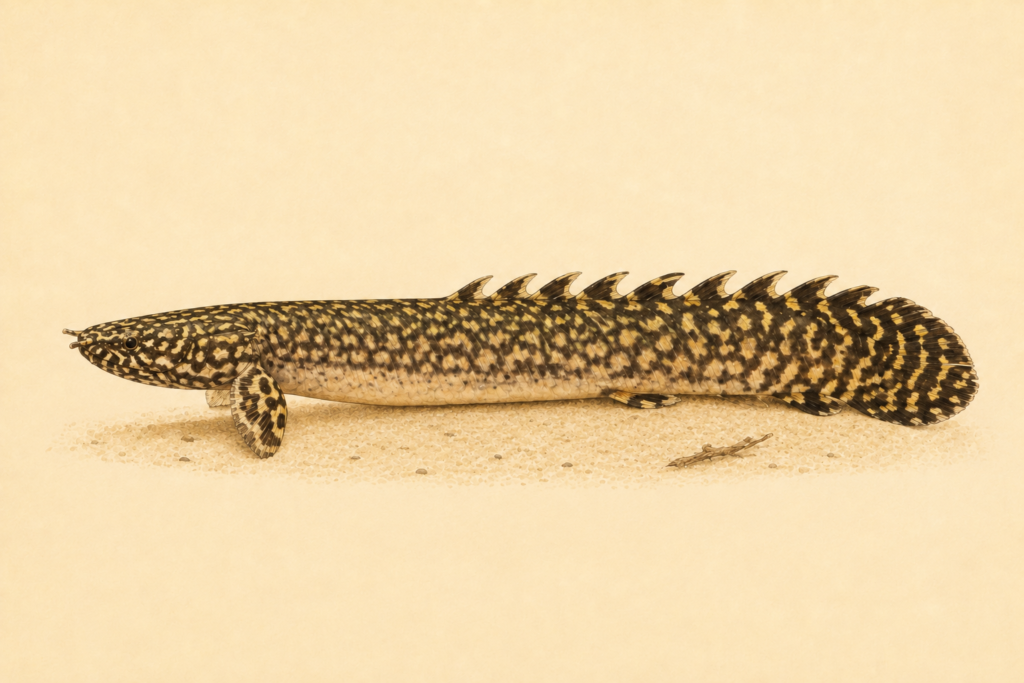
The Ornate Bichir earns its common name through a remarkably elaborate pattern of dark brown to black reticulated markings overlaid on a pale yellowish-tan to golden base colour. This intricate network of lines and spots covers the entire body, including the head and all fins, giving the fish an almost lace-like or mosaic appearance that is unique among bichir species. The patterning is highly variable between individuals, making each Ornate Bichir visually distinct – no two fish are exactly alike.
The body plan is characteristically elongated and cylindrical, reminiscent of a primitive eel or even a small crocodile when viewed from above. The head is broad and somewhat flattened dorsally, with a wide, subterminal mouth equipped with numerous small, conical teeth designed for gripping slippery prey. The eyes are relatively small and set high on the head, reflecting the species’ reliance on other senses – primarily smell and electroreception – when hunting in murky or dark conditions.
One of the most distinctive features of all bichirs is the dorsal fin arrangement. Rather than a single continuous dorsal fin, the Ornate Bichir possesses a series of small, separate finlets (typically 9-11) running along the back, each supported by a single spine with soft rays trailing behind it. These finlets can be raised or lowered independently and give the fish a distinctly prehistoric, almost dragon-like profile. The pectoral fins are fleshy and lobed, mounted on muscular stalks that the fish uses almost like limbs to prop itself up on the substrate or even “walk” along the bottom. This lobed fin structure is one of the features that links bichirs to the ancient lineage of lobe-finned fishes.
The entire body is covered in thick, diamond-shaped ganoid scales – hard, enamel-like plates that provide excellent armour against predators and abrasive substrates. These scales give the fish a slightly rough, almost pebbly texture when handled (which should be avoided unless absolutely necessary). Juvenile Ornate Bichirs display feathery external gills, similar to those seen in larval amphibians, which are reabsorbed as the fish matures.
Males and females can be difficult to distinguish outside of breeding condition. The most reliable indicator is the shape of the anal fin: in mature males, the anal fin is noticeably thicker, wider, and more paddle-shaped, as it is used during spawning to cup and fertilise eggs. Females tend to be slightly heavier-bodied when mature, particularly when gravid.
Natural Habitat
The Ornate Bichir is found across a broad swathe of central and eastern Africa, with its primary range encompassing the Congo River basin and the shores and tributaries of Lake Tanganyika. It has also been recorded in several other river systems including the upper Zambezi. This is a species that inhabits a wide variety of freshwater environments, from slow-moving rivers and floodplain pools to the shallow, vegetated margins of large lakes.
In the wild, the Ornate Bichir favours areas with dense cover – submerged tree roots, fallen timber, rocky crevices, and thick stands of aquatic vegetation. These provide both shelter during the day, when the fish is largely inactive, and ambush points from which to hunt at night. The substrate in these habitats is typically soft mud, fine sand, or a mixture of leaf litter and organic detritus. Water clarity varies enormously across the species’ range, from the relatively clear waters of Lake Tanganyika’s littoral zone to the dark, tannin-stained tributaries of the Congo.
Water parameters in the wild are similarly variable. In Lake Tanganyika, the water is moderately hard and slightly alkaline (pH around 7.5-8.5), whereas Congo basin populations may experience softer, more acidic conditions (pH 6.0-7.0). This broad natural range is reflected in the species’ reasonable tolerance of different water chemistries in captivity, though stability matters far more than hitting a specific number.
Seasonal flooding plays an important role in the ecology of wild Ornate Bichirs. During the wet season, rising waters inundate floodplains and forested areas, creating vast temporary habitats rich in food. Bichirs exploit these flooded zones to feed heavily and, in many cases, to breed. Their ability to breathe atmospheric air is a crucial adaptation for surviving in the warm, oxygen-depleted waters that characterise these seasonal habitats. When pools begin to dry out, bichirs can survive for extended periods in very shallow, stagnant water – and in extreme cases, they have been observed moving short distances overland between pools, using their muscular pectoral fins to drag themselves across damp ground.
Tank Size and Setup
A minimum tank size of 450 litres is required for a single adult Ornate Bichir, and a footprint of at least 150 cm x 60 cm is strongly recommended. This is not a negotiable figure. While juveniles can be started in smaller tanks, they grow steadily throughout their first few years, and planning for adult size from the outset will save you from the stress and expense of multiple upgrades. If you intend to keep a pair or house the bichir with other large species, 600-800 litres or more is a far more appropriate target. The footprint of the tank matters more than the height – bichirs are bottom-dwellers and surface-breathers, so they gain little benefit from tall tanks. A wide, long tank with a depth of 45-60 cm is ideal.
A tight-fitting, weighted lid is absolutely essential. The Ornate Bichir is one of the most determined escape artists in the freshwater hobby. They are surprisingly strong and can push aside lightweight lids, slide through gaps around filter inlets and heater cables, and even force their way through openings that look far too small for their body. Every potential escape route must be sealed. Use foam cut-outs, tape, or custom-cut acrylic panels to block gaps around equipment. Many experienced keepers place weights or clamps on the lid as an additional precaution. If your bichir can find a way out, it eventually will.
Substrate choice should prioritise the fish’s comfort and safety. Fine sand is the best option. The Ornate Bichir spends most of its time resting on or moving across the substrate, and coarse gravel can abrade its ventral surface and barbels over time, potentially leading to infections. Play sand or pool filter sand, thoroughly rinsed, works well and is inexpensive. A thin layer of dried oak or Indian almond leaves scattered over the sand adds a natural look and releases beneficial tannins, though this is optional.
Provide plenty of hiding places. Driftwood, PVC pipes (large diameter – at least 10-15 cm for adults), terracotta pots, rock caves, and dense stands of robust plants all serve as daytime shelters. The more hiding spots you offer, the more confident and visible the fish will become, paradoxically. A bichir that feels secure in its environment will spend more time out in the open than one that feels exposed. When arranging hardscape, ensure that heavy rocks are placed directly on the tank base rather than on the substrate, as bichirs can burrow underneath and dislodge them.
Live plants are possible but will need to be hardy species capable of tolerating the warm temperatures and the physical disruption caused by a large, heavy fish moving through them. Anubias species attached to driftwood, Java Fern, and Bolbitis heudelotii are good choices. Delicate stem plants are likely to be uprooted repeatedly.
Lighting should be subdued. The Ornate Bichir is primarily nocturnal and will be most active and comfortable under dim lighting or during the evening once tank lights are off. Floating plants such as Amazon Frogbit or Water Lettuce can help diffuse overhead light and provide additional cover. A moonlight or blue LED setting on a timer can allow you to observe the fish’s fascinating nighttime behaviour without disturbing it.
Water Parameters
| Temperature | 25-28 C |
| pH | 6.5-7.5 |
| General hardness (GH) | 5-20 dGH |
| Carbonate hardness (KH) | 5-15 dKH |
| Ammonia | 0 ppm |
| Nitrite | 0 ppm |
| Nitrate | Below 40 ppm |
The Ornate Bichir is reasonably adaptable when it comes to water chemistry, reflecting the wide range of conditions it encounters across its natural distribution. However, stability is paramount. Sudden swings in pH or temperature are far more dangerous than a reading that sits slightly outside the ideal range. Aim to keep parameters consistent through regular, partial water changes rather than chasing a “perfect” number with chemical additives.
Temperature is worth paying attention to. The Ornate Bichir originates from tropical Africa and prefers warm water in the 25-28 C range. Temperatures below 24 C can suppress the immune system and reduce appetite, while sustained temperatures above 30 C will stress the fish and reduce dissolved oxygen levels – a concern even for a species that can breathe air. Use a reliable heater rated for the tank volume and check it regularly with a separate thermometer.
Weekly water changes of 25-30% are recommended for most setups. Given the large tank volumes involved and the significant bioload produced by a large predatory fish, a consistent water change schedule is one of the most important aspects of Ornate Bichir husbandry. Use a gravel vacuum to remove uneaten food and waste from the substrate during each change. Dechlorinate replacement water and match the temperature as closely as possible to the tank water before adding it.
Ammonia and nitrite must always read zero. These compounds are acutely toxic to all fish, and while the Ornate Bichir’s ability to breathe air might buy it a little extra time in a crisis, it is by no means immune to the effects of poor water quality. Nitrate should be kept below 40 ppm, and ideally below 20 ppm. High nitrate levels over time can contribute to erosion of the fins and barbels, reduced appetite, and increased susceptibility to disease.
Filtration and Equipment
Robust filtration is non-negotiable for the Ornate Bichir. This is a large, messy carnivore that produces a significant amount of waste, and the filtration system must be capable of handling this bioload effectively. A large external canister filter rated for well above the actual tank volume is the standard approach – aim for a filter turnover of at least four to six times the tank volume per hour. For a 450-litre tank, this means a filter (or combination of filters) capable of processing 1,800-2,700 litres per hour. Many keepers of large predatory fish run two canister filters simultaneously, which also provides a safety net if one filter fails.
Sump filtration is an excellent alternative for very large setups and offers the advantage of increased total water volume, easy maintenance access, and the ability to house heaters and other equipment out of the main display tank. If using a sump, ensure the overflow and return plumbing is bichir-proof – these fish can and will attempt to enter pipes and overflow boxes.
Biological filtration capacity is the priority. Ensure filter media includes ample ceramic rings, sintered glass, or similar high-surface-area media to support the nitrifying bacteria needed to process ammonia and nitrite. Mechanical filtration (foam pads, filter floss) should be cleaned or replaced regularly, as the amount of organic waste produced by a large bichir can clog mechanical media quickly, reducing flow rate and filtration efficiency.
Flow rate within the tank should be moderate. In the wild, the Ornate Bichir inhabits slow-moving or still waters, and it does not appreciate strong currents. Position filter outlets to avoid creating a powerful directional current across the bottom of the tank. A spray bar or lily pipe can help diffuse the outflow.
The heater should be protected with a heater guard. Bichirs are powerful fish with tough scales, and while they are unlikely to burn themselves as easily as softer-skinned species, a broken heater is a serious hazard. Alternatively, use an inline heater connected to the canister filter’s return hose, which keeps the heating element entirely outside the display tank.
An air gap must be maintained between the water surface and the lid. The Ornate Bichir needs regular access to atmospheric air for its primitive lung to function. If the space between the water surface and the lid is too small, or if condensation blocks the air space, the fish may struggle to breathe properly. A gap of at least 5-8 cm is generally sufficient. Ensure this air space is warm and humid rather than cold – a tight-fitting lid naturally achieves this by trapping heat and moisture.
Diet and Feeding
The Ornate Bichir is an obligate carnivore and ambush predator. In the wild, its diet consists primarily of small fish, crustaceans, aquatic insect larvae, and worms. In captivity, it requires a diet centred on high-quality, meaty foods. This species will generally not accept flake or standard pellet foods, particularly as an adult. Some individuals can be trained to take sinking carnivore pellets (such as Hikari Massivore or similar), but this should be considered a bonus rather than an expectation.
The staple diet should include a variety of frozen foods: bloodworm (for juveniles and as an occasional treat for adults), whole prawns and shrimp (shell-on where possible, for roughage and minerals), lancefish, smelt, whitebait, mussel, and squid. Variety is important both nutritionally and to prevent the fish from fixating on a single food item and refusing everything else. Many keepers also offer live earthworms, which are an excellent, nutritious food that virtually no bichir will refuse. Earthworms can be collected from pesticide-free gardens or purchased from fishing bait suppliers.
Live feeder fish are a controversial topic. While the Ornate Bichir is certainly capable of catching and consuming live fish, feeder fish carry a significant risk of introducing parasites and diseases into your tank. If you choose to offer live fish, they should be quarantined and gut-loaded beforehand, and sourced from a reputable supplier. Many experienced bichir keepers avoid live feeders entirely, finding that a varied diet of frozen and prepared foods meets all nutritional needs without the associated risks.
Feed adult Ornate Bichirs two to three times per week. Juveniles under 20 cm should be fed daily or every other day to support growth. Overfeeding is a common mistake – bichirs are opportunistic and will eat as much as offered, but excessive feeding leads to obesity, fatty liver disease, and poor water quality. A good rule of thumb is to offer an amount roughly equivalent to the size of the fish’s head per feeding session. Remove any uneaten food promptly to prevent it from fouling the water.
Feeding is best done in the evening or after lights-out, when the bichir is naturally most active. Many keepers use feeding tongs or tweezers to offer food directly, which helps ensure the bichir gets its share (important in a community setting) and reduces waste. Over time, most Ornate Bichirs learn to associate the tongs with food and will readily approach at feeding time, displaying a surprising degree of learned behaviour for a fish often perceived as “primitive.”
Behaviour and Temperament
The Ornate Bichir is a largely nocturnal, slow-moving predator that spends the majority of the day resting in or near its chosen hiding spot. Activity levels increase dramatically after the lights go out, and it is during the evening and night that the fish will patrol the tank, hunt for food, and explore its environment. This behaviour pattern can be frustrating for keepers who want to see their fish during the day, but patience and a well-designed tank with ample cover will gradually encourage the bichir to venture out during daylight hours, particularly around feeding time.
Despite its predatory nature, the Ornate Bichir is not an aggressive fish in the conventional sense. It does not chase, harass, or attack tank mates out of territorial aggression. Its “aggression” is purely predatory – if a fish is small enough to fit in the bichir’s mouth, it will eventually be eaten. This distinction is important when selecting tank mates. The Ornate Bichir is generally tolerant of other large fish that it cannot swallow, and it can be kept with conspecifics or other bichir species, provided the tank is large enough and all individuals are of a similar size.
Bichirs rely heavily on their sense of smell to navigate and locate food. Their eyesight is relatively poor, and they often “bump” into objects and tank mates while exploring. This is normal behaviour and not a sign of illness. The prominent nasal tubes on the snout are highly sensitive chemoreceptors that allow the fish to detect food from a considerable distance in dark or murky conditions.
One of the most endearing behaviours of the Ornate Bichir is its periodic trips to the surface to gulp air. The fish rises from the bottom, breaks the surface with a quick inhalation, and then sinks back down. This behaviour is entirely normal and should not cause alarm – it is how the fish ventilates its primitive lung. You may notice increased air-gulping in warmer water or after feeding, when oxygen demand is higher.
Ornate Bichirs can become remarkably tame over time. Many keepers report that their bichirs learn to recognise them, approach the glass when they enter the room, and even accept food from their hands. This level of interaction is one of the great rewards of keeping this species, but it takes time and patience to develop.
Tank Mates
Choosing tank mates for the Ornate Bichir requires careful consideration of one overriding principle: any fish small enough to fit in the bichir’s mouth will eventually be eaten. This means that once the bichir reaches adult size, any tank mate under roughly 12-15 cm is at risk. Beyond this, the Ornate Bichir is a relatively peaceful community fish that coexists well with other large, robust species that occupy different niches in the tank. Avoid highly aggressive or territorial species that might harass the bichir, as well as fast-moving fin-nippers that could damage its delicate dorsal finlets.
Good tank mates
- Saddled Bichir – Another large Polypterus species that coexists peacefully with the Ornate Bichir when kept in a suitably spacious tank.
- Senegal Bichir – A smaller bichir species that can work alongside Ornate Bichirs, provided it is not small enough to be swallowed and the tank offers ample hiding spots for both.
- Oscar – A robust, similarly sized cichlid that is generally too large and active to be considered prey, though monitor interactions as Oscars can be boisterous.
- Silver Dollar – A deep-bodied, peaceful schooling fish that grows large enough to avoid predation and occupies the mid-water column away from the bichir.
- Featherfin Synodontis – A hardy African catfish that shares similar water parameter preferences and is generally ignored by bichirs once it reaches a safe size.
- Bristlenose Pleco – Often too large and armoured to be eaten, though very small specimens should not be housed with adult bichirs.
- African Butterfly Fish – Occupies the surface layer and is generally too wide-bodied and spiny to be swallowed, creating a natural biotope pairing, though ensure both are well fed.
- Blood Parrot Cichlid – A peaceful, deep-bodied cichlid that is too large to be considered prey and unlikely to harass the bichir.
Fish to avoid
- Neon Tetra – Far too small; will be eaten immediately as a snack.
- Guppy – Tiny, slow-moving livebearers that are easy prey for any bichir.
- Tiger Barb – Persistent fin-nippers that will target the bichir’s dorsal finlets and are also small enough to be eaten.
- Flowerhorn – Highly aggressive and territorial cichlid that is likely to attack and injure the bichir.
- Red Tail Catfish – Grows far too large for all but the most enormous setups and will eventually outgrow and potentially eat the bichir.
- Dwarf Gourami – Too small to survive alongside an adult bichir and will be consumed.
- Cherry Shrimp – Invertebrates of this size are a natural food item and will not last a single night.
Breeding
Breeding the Ornate Bichir in captivity is achievable but difficult, and it remains relatively uncommon in the home aquarium. Most captive breeding successes have occurred in very large tanks or dedicated breeding setups where conditions can be carefully controlled. The species is an egg-scatterer with a distinctive courtship ritual that involves the male using his enlarged, paddle-shaped anal fin to cup and fertilise the eggs as the female releases them.
Sexing adult Ornate Bichirs requires careful observation. The most reliable method is to examine the anal fin: in mature males, this fin is noticeably wider, thicker, and more muscular than in females. Females may appear slightly deeper-bodied, particularly when carrying eggs. These differences can be subtle in younger fish and are most apparent in individuals over 30 cm in length.
To trigger breeding behaviour, many keepers simulate a “rainy season” by performing larger-than-usual water changes (40-50%) with slightly cooler water (2-3 C below the normal tank temperature) over a period of several weeks. Increasing the frequency of feeding with high-quality live and frozen foods during this conditioning period helps bring both sexes into breeding condition. Some breeders also report success with gradually lowering the water level over several weeks and then raising it again to simulate flooding.
During courtship, the male will pursue the female around the tank, often nudging her flanks and swimming alongside her in a parallel position. When the female is ready, the pair will adopt a characteristic side-by-side posture, and the male will cup his anal fin beneath the female’s vent to receive the eggs as they are released. The eggs are adhesive and will scatter among fine-leaved plants, spawning mops, or other surfaces. Dense clumps of Java Moss or synthetic spawning mops provide ideal egg-catching surfaces.
After spawning, the adults should be removed or the eggs carefully transferred to a separate rearing tank, as the parents will readily eat the eggs and fry. The eggs are small (approximately 2-3 mm) and hatch in three to four days at 26-27 C. The newly hatched fry are tiny and possess the characteristic larval external gills that are a hallmark of the Polypteridae. They will absorb their yolk sac over the first few days and then require very small live foods such as newly hatched brine shrimp (Artemia nauplii) and microworms. Growth is slow initially but accelerates once the fry reach about 3-4 cm, at which point they can be transitioned to chopped bloodworm and small pieces of frozen food.
Fry should be sorted by size as they grow, as larger siblings will readily cannibalise smaller ones. Provide plenty of cover in the rearing tank – small sections of PVC pipe and dense plant material work well – and maintain excellent water quality with frequent small water changes.
Common Diseases
The Ornate Bichir is a hardy species that is resistant to many of the common diseases that plague tropical freshwater fish, thanks in part to its thick ganoid scales and robust immune system. However, it is not invulnerable, and certain conditions are worth being aware of.
Polypterus species are susceptible to a number of external parasites, most notably the macrogyrodactylid monogenean parasites (commonly known as “bichir flukes”) that are specific to the Polypteridae family. These parasites attach to the skin and fins and can cause irritation, excessive mucus production, flashing (rubbing against objects), and in severe infestations, secondary bacterial infections. Newly acquired bichirs should always be quarantined and treated prophylactically with praziquantel, which is effective against these parasites. A dose of 2-5 mg per litre, repeated after two weeks, is the standard protocol.
Bacterial infections, including fin rot and skin ulcers, can occur when water quality is poor or when the fish has suffered physical injury – for example, from a failed escape attempt or abrasive substrate. Maintaining clean water and providing a smooth, sandy substrate are the best preventative measures. If infection does occur, broad-spectrum antibacterial treatments can be effective, though treatment in a quarantine tank is preferable to dosing the main display.
Ichthyophthirius multifiliis (white spot disease or “ich”) can affect bichirs, though their thick scales may make the characteristic white spots less visible than on thinner-scaled species. Treatment with elevated temperature (gradually raising to 30 C) combined with a half-dose of a proprietary white spot remedy is generally effective. Note that some white spot treatments contain ingredients that are poorly tolerated by scaleless or primitive-scaled fish, so always check the label and err on the side of caution with dosing.
Obesity and fatty liver disease are common in overfed captive bichirs. These are entirely preventable through disciplined feeding. An adult Ornate Bichir does not need to eat every day, and many experienced keepers feed just two to three times per week with great success.
Internal parasites, including intestinal worms, can be introduced through live feeder fish. This is one of the strongest arguments against routine use of feeder fish. If internal parasites are suspected (symptoms include weight loss despite a good appetite, white stringy faeces, and bloating), treatment with levamisole or flubendazole can be effective.
FAQs
Can the Ornate Bichir really survive out of water?
Yes, but only for limited periods and under specific conditions. The Ornate Bichir possesses a modified swim bladder that functions as a primitive lung, allowing it to extract oxygen from atmospheric air. If its skin remains moist, it can survive out of water for several hours – and there are anecdotal reports of much longer survival times
Related Guides
- False Tiger Knifefish – Tank Setup, Feeding and Breeding – Another large, predatory, nocturnal fish with similar tank size requirements and care challenges suited to experienced keepers.
- Demon Eartheater – Tank Setup, Feeding and Breeding – A sizeable South American cichlid that can work as a tank mate for large predatory species and shares comparable water parameter needs.
- Altum Angelfish – Tank Setup, Feeding and Breeding – An advanced-level species requiring spacious, well-maintained aquaria, offering insight into keeping demanding large-bodied fish.
- Bucktooth Tetra – Tank Setup, Feeding and Breeding – A predatory characin with aggressive feeding behaviour, useful reading for keepers interested in housing carnivorous freshwater species.
- L168 Butterfly Pleco – Tank Setup, Feeding and Breeding – A bottom-dwelling species that thrives in similar warm, dimly lit setups and is sometimes kept alongside bichirs in large tanks.