Quick summary
The Chinese Algae Eater is a hardy fish that grazes algae only while young, but adults can reach up to 28 cm, turn territorial and aggressive, and may harass slow or flat-bodied tank mates like discus and angelfish, so it needs a large 200+ litre tank and careful tank mate selection. It’s best suited to keepers who can accommodate its full adult size and temperament rather than beginners seeking a simple algae control solution.
🐠 Build a tank around this fish
In this guide:
- Introduction
- Quick Stats
- Appearance
- Varieties and Morphs
- Natural Habitat
- Tank Size and Setup
- Water Parameters
- Filtration and Equipment
- Diet and Feeding
- Behaviour and Temperament
- Tank Mates
- Breeding
- Common Diseases
- FAQs
Introduction
The Chinese Algae Eater (Gyrinocheilus aymonieri) is one of the most widely sold freshwater fish in the aquarium trade, often marketed as an industrious algae-removal solution for community tanks. While juveniles do live up to their name by enthusiastically grazing biofilm and green algae from hard surfaces, this species undergoes a significant behavioural transformation as it matures. Adults frequently become territorial, aggressive, and far less interested in algae, preferring meatier fare and occasionally harassing slow-moving or flat-bodied tank mates by latching onto their flanks with their specialised sucker mouths.
Despite belonging to its own family, Gyrinocheilidae, the Chinese Algae Eater is often loosely referred to as a “loach relative,” though it is more accurately described as a distant cousin of the cyprinid and loach lineages. Its unique oral disc, adapted for both feeding and respiration in fast-flowing water, sets it apart from true suckermouth catfishes such as plecos. Native to large river systems across mainland Southeast Asia, not, as its common name implies, exclusively to China, this fish can reach an impressive 25–28 cm in captivity and requires substantially more space than many new fishkeepers anticipate.
This guide provides a thorough overview of Chinese Algae Eater care, covering tank requirements, feeding, behaviour, breeding, and compatible tank mates. Understanding the full adult potential of this species is essential before purchase, as many specimens end up rehomed once their territorial nature emerges. With the right setup and realistic expectations, however, the Chinese Algae Eater can be a hardy and long-lived addition to a suitably sized aquarium.
Quick Stats
| Scientific name | Gyrinocheilus aymonieri |
|---|---|
| Common names | CAE, Indian Algae Eater, Sucking Loach, Golden Algae Eater, Honey Sucker |
| Family | Gyrinocheilidae |
| Origin | Mekong, Chao Phraya, and Mae Klong river basins, Southeast Asia |
| Adult size | 27 cm |
| Lifespan | 10–15 years |
| Difficulty | Intermediate |
| Breeding difficulty | Advanced |
| Temperature | 24–28 °C |
| pH | 6–8 |
| GH | 5–19 dGH |
| KH | 3–12 dKH |
| Minimum tank size | 200 L |
| Conservation status | Least Concern (IUCN) |
Appearance
The Chinese Algae Eater has an elongated, torpedo-shaped body that is laterally compressed with a slightly flattened underside. Its most distinctive anatomical feature is its ventral sucker mouth, an oral disc lined with rough, keratinised tissue that allows the fish to cling to rocks, glass, and driftwood in strong currents. Unlike plecos, the Chinese Algae Eater possesses a separate set of gill openings (opercular slits) on the upper sides of its head, which allow it to breathe while its mouth is attached to a surface. This adaptation is vital in its natural fast-flowing habitat.
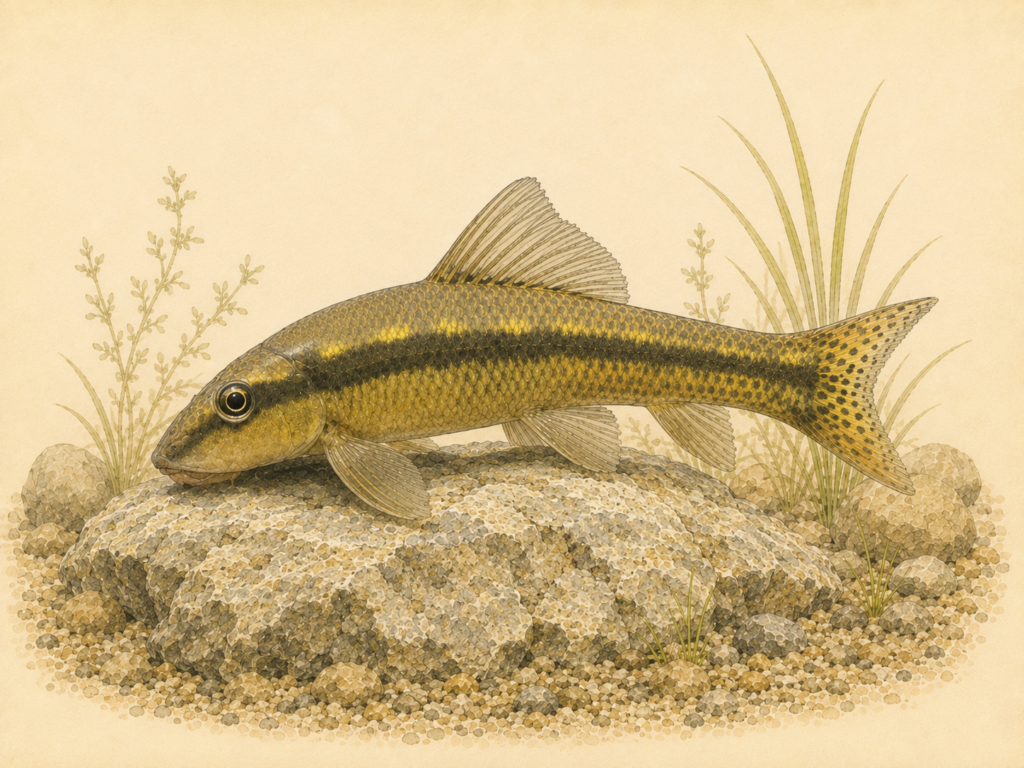
The wild-type colouration consists of a pale olive-green to yellowish-brown base overlaid with a dark lateral stripe running from the snout through the eye to the caudal peduncle. This stripe can appear solid or fragmented into a series of blotches depending on the individual’s mood and stress level. The dorsal surface is darker, often with a greenish sheen, while the belly is pale cream or white. The fins are largely translucent with a slight yellowish or greyish tint.
Juveniles tend to be more attractively marked, with clearer patterning and a more vivid contrast between the lateral stripe and the lighter body. As the fish matures, colouration often dulls, and the body becomes bulkier, particularly around the head and abdomen. Males and females are difficult to distinguish visually outside of breeding condition; gravid females may appear slightly rounder when viewed from above, and males in spawning readiness can develop small tubercles around the snout, though this is rarely observed in aquarium settings.
Varieties and Morphs


The Golden Chinese Algae Eater is by far the most popular captive-bred colour morph and is arguably more frequently sold than the wild-type form. This variant lacks the dark lateral stripe and most of the darker pigmentation of the standard form, instead displaying a uniform golden to pale honey-yellow body colouration. The eyes are typically dark, distinguishing it from true albino specimens. The golden morph retains the same body shape, sucker mouth, and adult size as the wild type, and its care requirements are identical. It is sometimes sold simply as the “Golden Algae Eater” or “Golden Sucker.” Aquarists should be aware that, despite its more appealing juvenile appearance, the golden form undergoes the same behavioural shift towards aggression and reduced algae consumption as it ages.
The Black and Yellow Chinese Algae Eater is a less commonly encountered variant that features a more pronounced contrast between a dark brownish-black dorsal region and bright yellow or golden flanks and ventral surface. The lateral stripe is often prominent and nearly black, creating a striking banded effect against the lighter body. Some specimens labelled with this trade name may simply represent particularly well-marked wild-type individuals, while others appear to have been selectively bred for enhanced contrast. Regardless of origin, this morph reaches the same adult size and exhibits the same temperamental changes as other forms. It can be an attractive fish in a suitably spacious setup, but prospective keepers should apply the same caution regarding long-term aggression and tank mate compatibility.
Natural Habitat
Despite its common name, the Chinese Algae Eater is primarily found in the river systems of mainland Southeast Asia rather than China, although its range does extend into the Yunnan province of southern China. Its core distribution spans the Mekong, Chao Phraya, and Mae Klong river basins across Thailand, Laos, Cambodia, and Vietnam. It inhabits a variety of freshwater environments, from large, fast-flowing rivers with rocky or gravelly substrates to flooded forests and seasonal wetlands during the monsoon period.
In its native rivers, this species favours stretches with moderate to strong current, where it uses its sucker mouth to cling to submerged rocks and boulders while grazing on periphyton, the complex community of algae, bacteria, diatoms, and detritus that coats hard surfaces. The water in these habitats is typically well-oxygenated, warm, and ranges from slightly acidic to mildly alkaline depending on the specific locality and season. Substrates are predominantly composed of smooth stones, gravel, and sand, with scattered driftwood and submerged vegetation along the margins.
Juvenile Chinese Algae Eaters tend to occupy shallower, slower-moving tributary streams and marginal zones, while larger adults are found in deeper, faster-flowing main channels. This ecological shift mirrors the behavioural change seen in captivity, where young fish are gregarious algae grazers and older individuals become more solitary and territorial. Seasonal flooding plays a significant role in the species’ life cycle, with migrations into inundated floodplains for feeding and potentially for spawning.
Tank Size and Setup
A single Chinese Algae Eater requires a minimum tank volume of 200 litres, though 250 litres or more is preferable once the fish reaches adult size. These are active, fast-growing fish that can exceed 20 cm within a couple of years under good conditions, and cramped quarters will exacerbate their territorial tendencies. If keeping more than one specimen, which is generally discouraged unless the aquarium is very large, aim for 400 litres or above, with multiple distinct territories separated by visual barriers.
The ideal aquascape for a Chinese Algae Eater mimics a rocky riverbed. Use a substrate of smooth gravel or sand, and provide an abundance of large, rounded stones, cobbles, and pieces of driftwood to create caves, crevices, and hiding places. These structures serve as territorial boundaries and retreat areas, which help to diffuse aggression. Ensure that rockwork is securely positioned, as a large Chinese Algae Eater can dislodge poorly balanced décor.
Live plants can be included, though robust species such as Java fern, Anubias, and Vallisneria are the best choices, as delicate or slow-growing plants may be uprooted or damaged by the fish’s activity. Floating plants can be used to diffuse lighting and provide a sense of overhead cover, which many specimens appreciate. Standard aquarium lighting is fine; the species has no special requirements in this regard.
A tight-fitting lid or cover glass is advisable. While Chinese Algae Eaters are not habitual jumpers, they can and do leap from open-topped tanks, particularly when startled or during disputes with tank mates. Good water circulation is important to replicate the well-oxygenated conditions of their natural environment, more on this in the filtration section below.
Water Parameters
| Temperature | 24–28 °C |
| pH | 6.0–8.0 |
| General hardness (GH) | 5–19 dGH |
| Carbonate hardness (KH) | 3–12 dKH |
| Ammonia | 0 ppm |
| Nitrite | 0 ppm |
| Nitrate | Below 40 ppm |
The Chinese Algae Eater is a notably adaptable species when it comes to water chemistry, tolerating a wide range of pH and hardness values. This tolerance is one of the reasons it has become so popular in the trade. That said, stable conditions are always preferable to fluctuating ones, and the fish tends to show its best colouration and behaviour in moderately warm, slightly acidic to neutral water with good oxygenation.
Perform weekly water changes of 25–30% to maintain low nitrate levels and replenish essential minerals. While the species can tolerate nitrate concentrations somewhat higher than more sensitive fish, chronic exposure to elevated nitrates contributes to stress, reduced immune function, and a shortened lifespan. Use a reliable liquid test kit to monitor ammonia, nitrite, nitrate, and pH on a regular basis, especially during the initial months after introducing the fish or whenever stocking levels change.
Filtration and Equipment
Strong, efficient filtration is essential for Chinese Algae Eater care. In nature, this species inhabits well-oxygenated, current-rich waterways, and replicating that environment in the aquarium promotes health and natural behaviour. An external canister filter rated for the aquarium’s volume, or ideally slightly over-rated, is the best choice, as it provides excellent mechanical, biological, and chemical filtration in a single unit while allowing the aquarist to direct the outflow to create moderate current.
Supplementary powerheads or wavemakers can be used to increase flow in larger tanks, particularly if the fish seems lethargic or is not using its sucker mouth as actively as expected. Ensure that intake strainers are protected with pre-filter sponges to prevent juvenile specimens from being drawn against the intake, although adults are too large and strong for this to be a concern.
An air pump and airstone, while not strictly necessary if surface agitation from the filter is adequate, can provide additional oxygenation and visual interest. A heater with an integrated thermostat, correctly sized for the tank volume, should maintain a stable temperature within the recommended 24–28 °C range. Place heater guards or position the heater behind décor where the fish is less likely to rest against it, as Chinese Algae Eaters sometimes latch onto flat surfaces including equipment.
Standard aquarium lighting, LED or fluorescent tubes providing a day/night cycle of roughly 8–10 hours, is suitable. Brighter lighting may encourage some algae growth on hard surfaces, which juvenile specimens will graze enthusiastically. Avoid leaving lights on for excessively long periods, however, as this can promote problematic algae species rather than the benign biofilm the fish prefers.
Diet and Feeding
The dietary requirements of the Chinese Algae Eater shift considerably as the fish matures, and understanding this transition is crucial for long-term care. Juveniles are primarily herbivorous and will actively graze green algae, diatoms, and biofilm from glass, rocks, and driftwood. This is the life stage at which the species earns its common name, and a young Chinese Algae Eater in a well-lit tank with plenty of hard surfaces can be a genuinely effective contributor to algae management.
As the fish grows, however, its dietary preference shifts progressively towards omnivory, with a growing appetite for protein-rich foods. Adults may show little interest in algae altogether, and keepers who purchased the fish solely for algae control are often disappointed. To maintain good health in adults, offer a varied diet that includes high-quality sinking algae wafers, spirulina-based pellets, blanched vegetables (courgette, cucumber, peas, and spinach), and regular portions of frozen or live foods such as bloodworm, brine shrimp, daphnia, and tubifex.
Feed once or twice daily, providing only as much food as the fish can consume within a few minutes. Sinking foods are preferred, as the Chinese Algae Eater is a bottom-dwelling feeder. If kept in a community tank, ensure that food reaches the lower levels of the aquarium before being intercepted by mid-water or surface-feeding species. Offering food after lights-out can help if the fish is shy or competing poorly for food during the day, although most specimens are bold feeders.
Supplementing the diet with fresh or dried plant matter is beneficial regardless of the fish’s age. Driftwood in the tank also provides a surface for biofilm growth, which even older specimens will occasionally rasp. Avoid over-reliance on a single food type, dietary variety is the cornerstone of good nutrition for this species.
Behaviour and Temperament
The behavioural profile of the Chinese Algae Eater is perhaps the single most important factor prospective keepers need to understand. Juveniles are generally peaceful and industrious, but adults frequently become territorial, aggressive, and problematic in community settings. This transformation is not universal, some individuals remain relatively docile, but it is common enough that the species has earned a reputation as one of the most frequently rehomed aquarium fish.
Young Chinese Algae Eaters spend the majority of their time attached to hard surfaces, methodically grazing algae and biofilm. They are typically indifferent to other species and show little intraspecific aggression when small. As they approach 10–15 cm, however, many individuals begin to claim a section of the tank as their own territory, chasing away any fish that encroaches. This behaviour escalates with size and age.
One particularly troublesome behaviour is the tendency of mature Chinese Algae Eaters to latch onto the sides of slow-moving or flat-bodied tank mates, particularly discus, angelfish, and large, sedentary goldfish, to feed on their slime coat. This can cause significant stress and physical damage to the victim, leading to secondary infections and, in severe cases, death. The behaviour appears to be linked to the fish’s increasing preference for protein as it matures, combined with an opportunistic feeding strategy.
Keeping multiple Chinese Algae Eaters together is generally inadvisable unless the tank is very large with abundant territory and visual barriers. Two males in a standard-sized aquarium will almost certainly fight, and even mixed-sex pairs can be antagonistic outside of a brief breeding window. Solitary specimens in spacious, well-decorated tanks tend to fare best in terms of both their own welfare and that of their tank mates.
The species is predominantly crepuscular, showing peak activity during dawn and dusk periods, though aquarium specimens adapt readily to daytime feeding schedules. They are surprisingly fast swimmers when motivated, capable of rapid dashes across the tank during disputes or when startled.
Tank Mates
Selecting appropriate tank mates for a Chinese Algae Eater requires careful consideration of the species’ adult temperament. The best companions are robust, fast-moving fish that are large enough not to be bullied but not so slow or flat-bodied that they become targets for slime-coat feeding. Avoid housing Chinese Algae Eaters with very small fish that could be stressed by their territorial displays, and steer well clear of species with broad, flat bodies or slow swimming habits. Mid-water and surface-dwelling species that largely ignore the bottom of the tank tend to coexist most successfully.
Good tank mates
- Tiger Barb, a fast-moving, robust species that occupies the mid-water column and is generally too quick to be targeted by a Chinese Algae Eater.
- Giant Danio, Active, large enough to hold its own, and prefers the upper water levels, minimising territorial overlap.
- Rainbow Shark, a similarly assertive bottom-dweller that can stand its ground, though a large tank with separate territories is essential.
- Clown Loach, a gregarious, sizeable species that is too fast and socially robust to be easily intimidated, provided the tank is suitably spacious.
- Denison Barb, an active, streamlined schooling fish that thrives in the same high-flow conditions and is unlikely to provoke or be victimised by a Chinese Algae Eater.
- Blue Gourami, a sturdy, medium-large gourami that generally inhabits the upper reaches of the tank and is resilient enough for this pairing.
- Silver Dollar, a deep-bodied but fast-moving schooling fish that occupies mid-water and is typically ignored by bottom-dwelling aggressors.
- Bristlenose Pleco, a well-armoured catfish that can usually coexist peacefully, though monitoring for territorial disputes over hiding spots is advisable.
Fish to avoid
- Discus, their slow movement, flat body shape, and heavy slime coat make them a prime target for slime-coat feeding by mature Chinese Algae Eaters.
- Angelfish, Similar concerns to discus; their laterally compressed bodies and relatively sedate nature invite unwanted attention from this species.
- Goldfish, Slow, large-bodied, and coldwater-preferring, goldfish are frequent victims of Chinese Algae Eater aggression and slime-coat damage.
- Betta, far too small, slow, and fragile to coexist with a territorial Chinese Algae Eater, and the temperature overlap does not justify the risk.
- Guppy, Tiny and slow enough to be perpetually harassed, with long fins that may attract unwanted attention.
- Flowerhorn Cichlid, while large enough to defend itself, the extreme aggression of a flowerhorn combined with a territorial Chinese Algae Eater creates a highly volatile and stressful environment for both fish.
- Chinese Algae Eater, Conspecifics are among the worst tank mates; two adults in the same tank will frequently engage in prolonged, damaging territorial battles.
- Corydoras Catfish, Peaceful, small bottom-dwellers that will be relentlessly chased and stressed by a territorial Chinese Algae Eater occupying the same zone.
Breeding
Breeding the Chinese Algae Eater in the home aquarium is exceptionally rare and has only been achieved reliably through the use of hormonal induction in commercial fish farms, primarily in Southeast Asia and the Far East. Hobbyist breeding reports are sparse and often unverified, making this an expert-level endeavour with a very low probability of success under typical aquarium conditions.
In the wild, spawning is believed to occur during the monsoon season, triggered by environmental cues such as rising water levels, changes in water chemistry, increased flow, and an abundance of food. These conditions are extremely difficult to replicate convincingly in a home aquarium. The species is thought to be an egg scatterer, releasing adhesive eggs over rocky or gravelly substrates in flowing water, with no parental care provided after spawning.
Sexing the Chinese Algae Eater is challenging. Males may develop small breeding tubercles on the snout during spawning condition, and females may appear fuller-bodied when carrying eggs, but these differences are subtle and unreliable outside of active breeding attempts. There is no consistent external dimorphism in finnage or colouration between the sexes.
For those determined to attempt breeding, a very large, dedicated breeding tank with strong current, slightly cooler water temperatures gradually raised to simulate seasonal warming, and soft, slightly acidic water may provide the best approximation of natural spawning triggers. A group of at least six or more individuals would be needed to improve the chances of having both sexes represented and to distribute aggression. However, maintaining a group of adult Chinese Algae Eaters peacefully requires an exceptionally spacious setup, likely 500 litres or more, with abundant hiding places and visual barriers.
If spawning were to occur, the eggs would need to be protected from the adults, which will readily consume them. Hatching typically takes 24–48 hours at tropical temperatures, and the resulting fry are very small, requiring infusoria or similarly fine first foods before graduating to newly hatched brine shrimp. Realistically, almost all Chinese Algae Eaters in the hobby are commercially bred using hormonal stimulation, and the species is not considered a viable candidate for home breeding programmes.
Common Diseases
The Chinese Algae Eater is a hardy species with no specific diseases unique to it, but it remains susceptible to the common freshwater ailments that affect most aquarium fish. Its robust constitution means that, provided water quality is maintained and the fish is not chronically stressed, disease outbreaks are relatively infrequent.
White spot disease (Ichthyophthirius multifiliis), commonly known as ich, is the most frequently encountered illness. It presents as small white cysts on the body, fins, and gills, often triggered by temperature drops, stress from aggression, or introduction of new, unquarantined fish. Treatment involves raising the water temperature gradually to 28–30 °C and administering a proprietary white spot remedy. Note that Chinese Algae Eaters, like many scaleless or small-scaled fish, can be sensitive to certain medications, particularly those containing copper or malachite green. Always use half-doses initially and monitor the fish’s response carefully.
Bacterial infections, including fin rot and body sores, can occur in fish subjected to ongoing stress or physical damage from territorial encounters. Maintaining pristine water quality is the best preventative measure, and mild cases often resolve with improved conditions alone. More severe infections may require treatment with antibacterial medications.
Fungal infections appear as white, cotton-like growths on the body or fins, typically developing on wounds or areas of damaged tissue. These are secondary infections and should prompt an investigation into the root cause, often aggression from tank mates or poor water quality. Anti-fungal treatments are effective when combined with addressing the underlying issue.
Internal parasites can occasionally affect Chinese Algae Eaters, particularly wild-caught or poorly conditioned specimens. Symptoms include weight loss despite normal feeding, pale or stringy faeces, and lethargy. Proprietary internal parasite treatments are available and generally well-tolerated by this species.
Quarantining all new fish for a minimum of two to four weeks before introducing them to an established tank remains the single most effective strategy for disease prevention. Combined with regular water changes, a varied diet, and appropriate stocking levels, this approach will keep disease risk to a minimum.
FAQs
Do Chinese Algae Eaters actually eat algae?
Juvenile Chinese Algae Eaters are genuinely effective algae grazers and will consume green algae, diatoms, and biofilm from glass, rocks, and driftwood. However, as the fish matures, its dietary preference shifts towards protein-rich and omnivorous foods, and most adults show minimal interest in algae. If your primary goal is long-term algae control, species such as Siamese Algae Eaters, Otocinclus catfish, or Nerite snails are more reliable choices.
How big do Chinese Algae Eaters get?
Chinese Algae Eaters commonly reach 20–25 cm in aquarium conditions, with some specimens approaching 28 cm. They are frequently sold as small juveniles of 3–5 cm, which can create a misleading impression of their eventual size. A tank of at least 200 litres is necessary to house a single adult comfortably, and larger tanks are preferable.
Can I keep a Chinese Algae Eater with discus or angelfish?
This combination is strongly discouraged. Mature Chinese Algae Eaters are known to latch onto the flanks of slow-moving, flat-bodied fish such as discus and angelfish to feed on their slime coat. This behaviour causes considerable stress and physical damage to the victim, often leading to secondary infections. Choose tank mates that are fast-moving and do not present a flat body profile.
Why has my Chinese Algae Eater become aggressive?
Increasing aggression is a natural developmental change in this species and is not necessarily a sign of illness or poor care. As Chinese Algae Eaters grow, they become territorial and may chase or attack other bottom-dwelling fish, or even mid-water species that venture too close to their claimed area. Providing a larger tank, more hiding places, and breaking up lines of sight with décor can help manage aggression, but in some cases rehoming the fish or its tank mates may be the only viable solution.
Is the Golden Chinese Algae Eater a different species?
No, the Golden Chinese Algae Eater is a captive-bred colour morph of the same species, Gyrinocheilus aymonieri. It displays a uniform golden-yellow colouration instead of the wild-type olive-brown with a dark lateral stripe. Its care requirements, adult size, lifespan, and behavioural tendencies are identical to those of the standard form. Keepers should not assume that the golden morph will be any more docile or smaller than the wild type.
Related Guides
- Siamese Algae Eater, often confused with the Chinese Algae Eater, this species is a more reliably peaceful and effective algae consumer for community tanks.
- Bristlenose Pleco, a popular algae-eating catfish that remains smaller and more docile than the Chinese Algae Eater, making it a better choice for many setups.
- Otocinclus Catfish, a tiny, peaceful, and dedicated algae grazer ideal for smaller community tanks where a Chinese Algae Eater would be unsuitable.
- Rainbow Shark, another semi-aggressive bottom-dweller with similar territorial behaviour, useful for comparison when planning a setup around assertive species.
- Clown Loach, a large, sociable bottom-dweller that can coexist with Chinese Algae Eaters in spacious tanks, with overlapping care requirements.