Quick summary
The Polka Dot Catfish is a striking but demanding choice, growing up to 25 cm and needing at least 300 litres, so it suits experienced keepers with large, well-decorated tanks rather than beginners. It’s hardy and can live 15-25 years once settled, but its territorial nature, nocturnal habits, and near-impossible breeding make it a long-term commitment best suited to those ready to plan tank mates and space carefully.
🐠 Build a tank around this fish
In this guide:
- Introduction
- Quick Stats
- Appearance
- Natural Habitat
- Tank Size and Setup
- Water Parameters
- Filtration and Equipment
- Diet and Feeding
- Behaviour and Temperament
- Tank Mates
- Breeding
- Common Diseases
- FAQs
Introduction
The Polka Dot Catfish, known scientifically as Synodontis angelicus, is one of the most visually striking freshwater catfish available to aquarists. Adorned with a constellation of bright white or yellowish spots set against a deep purple-black body, this species has captivated fishkeepers since it first appeared in the hobby during the mid-twentieth century. Native to the river systems of Central Africa, it carries a certain prestige among catfish enthusiasts, partly due to its beauty and partly because it remains relatively uncommon in the trade compared to other Synodontis species.
Despite its undeniable appeal, the Polka Dot Catfish is not a species to acquire on impulse. It can reach a respectable size, displays territorial behaviour, particularly towards conspecifics, and requires thoughtful tank design to thrive. That said, keepers who provide the right environment will be rewarded with a hardy, long-lived fish whose personality and appearance make it a genuine centrepiece in any suitable community aquarium. This guide covers everything you need to know to keep Synodontis angelicus successfully, from water chemistry and diet to tank mates and breeding considerations.
Quick Stats
| Scientific name | Synodontis angelicus |
|---|---|
| Common names | Polka Dot Synodontis, Angel Catfish, Angelicus Catfish, Angel Squeaker |
| Family | Mochokidae |
| Origin | Congo River basin, Central Africa |
| Adult size | 23 cm |
| Lifespan | 15–25 years |
| Difficulty | Intermediate |
| Breeding difficulty | Advanced |
| Temperature | 23–28 °C |
| pH | 6–7.5 |
| GH | 4–15 dGH |
| KH | 4–12 dKH |
| Minimum tank size | 300 L |
| Conservation status | Least Concern (IUCN) |
Appearance
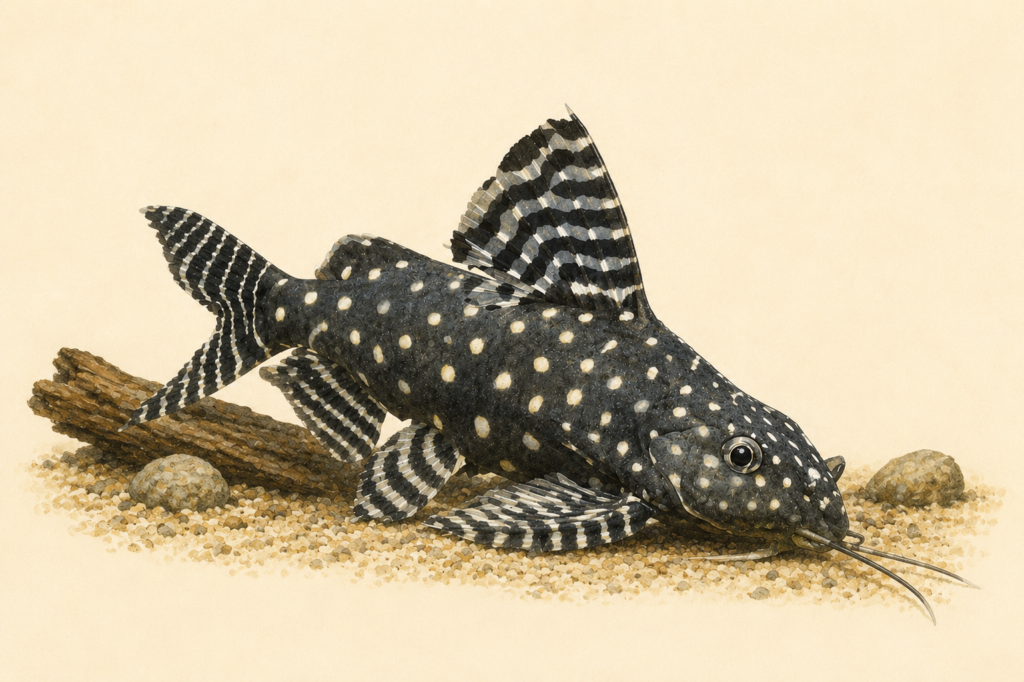
Synodontis angelicus is, without exaggeration, one of the most handsome catfish in the freshwater hobby. The base body colour is a rich, dark purple-brown to jet black, overlaid with a pattern of bold, roughly circular spots that range from pure white to pale yellow. The spots extend across the head, body, and fins, creating an effect reminiscent of a starry night sky, an image that has earned the species its angelic common name. In juveniles, the spots tend to be smaller and more numerous, occasionally merging into short bars or vermiculations. As the fish matures, the spots generally become larger and more widely spaced, and the contrast between the dark base and the pale markings can intensify, making older specimens particularly impressive.
The body shape is typical of the Synodontis genus: laterally compressed with a broad, somewhat flattened head and a large, downward-facing mouth flanked by three pairs of barbels. The maxillary barbels are the longest and often feature fine branching, a characteristic shared with several other Synodontis species. The dorsal fin is tall with a strong, serrated leading spine, and the adipose fin is well developed. The caudal fin is forked, and the pectoral fins also bear robust, locking spines that can cause injury during netting, so care must be taken when handling or transporting this fish. Sexing adults is notoriously difficult; females may appear slightly rounder in the belly when gravid, but there are no reliable external sexual dimorphisms.
There is considerable natural variation in spot density and colouration among wild-caught specimens, which likely reflects geographic origin within the broad Congo basin range. Some individuals display a distinctly warmer, brownish-black base colour with golden-yellow spots, while others are cooler-toned with stark white markings. This variation is part of the species’ charm and means that no two fish look quite alike.
Natural Habitat
Synodontis angelicus is found across a wide area of the Congo River basin in Central Africa, including tributaries in the Democratic Republic of the Congo, the Republic of the Congo, and parts of Cameroon. It inhabits a range of habitats within these river systems, from the main channels of large, slow-moving rivers to smaller tributaries with moderate current. The species tends to favour areas with abundant rocky cover, submerged wood, and overhanging vegetation, where it can shelter during the day and emerge to forage at dusk and during the night.
The waters of the Congo basin are generally soft to moderately hard and slightly acidic to neutral, though conditions vary considerably depending on the specific location and season. During the wet season, river levels rise dramatically, flooding surrounding forest and creating temporary habitats rich in food resources. The substrate in typical Synodontis angelicus habitat is often a mixture of sand, gravel, and scattered rocks, with a layer of leaf litter and decomposing organic matter providing both cover and a source of invertebrate prey. Understanding this natural environment is key to replicating suitable conditions in the aquarium.
The Congo River system is one of the most biodiverse freshwater ecosystems on earth, and Synodontis angelicus shares its habitat with a tremendous variety of cichlids, characins, other catfish species, and numerous invertebrates. This rich community context is worth bearing in mind when planning tank mates, as the species has evolved alongside robust, medium-to-large fish rather than delicate nano species.
Tank Size and Setup
Given that Synodontis angelicus regularly reaches 20–25 cm in captivity and is an active swimmer once settled, a minimum tank volume of 300 litres is recommended for a single specimen. If you intend to keep more than one, which is possible but comes with caveats discussed in the behaviour section, you should plan for at least 450–500 litres to provide enough territory and hiding spots to diffuse aggression. Larger tanks are always preferable and make territorial disputes far less likely.
The aquascape should prioritise shelter and visual barriers. Provide a generous selection of caves, whether formed from stacked rocks, purpose-built ceramic caves, or sections of large-diameter PVC pipe. Bogwood and driftwood are excellent additions, offering hiding spots as well as contributing tannins that slightly soften and acidify the water, an effect that mirrors natural conditions. It is important to have more hiding places than fish so that each individual can claim a preferred retreat without having to contest for space.
The substrate should be smooth sand or fine rounded gravel. Synodontis angelicus regularly sifts through substrate with its barbels while foraging, and sharp or coarse substrates can damage these delicate sensory organs over time. A sandy base also allows the fish to exhibit more natural feeding behaviour, which is enriching and reduces stress.
Live plants can be included, but bear in mind that this is a sizeable, somewhat boisterous fish that may uproot delicate plantings. Hardy, well-anchored species such as Anubias, Java Fern, and Bolbitis are good choices, as they can be attached to wood or rock rather than planted in the substrate. Floating plants are also beneficial, as they dim the light and create the low-light conditions that encourage the fish to be more active and visible during the day.
Lighting should be subdued. Synodontis angelicus is primarily nocturnal or crepuscular, and under bright lighting it will typically remain hidden for the majority of the photoperiod. Dimmer lighting, the use of floating plants, or a moonlight LED setting during the evening can significantly increase the time you spend observing this fish outside of feeding sessions.
Water Parameters
Synodontis angelicus is reasonably adaptable when it comes to water chemistry, provided extremes are avoided and conditions remain stable. The species comes from soft to moderately hard, slightly acidic to neutral waters, and it does best when these conditions are approximated in the aquarium. Consistency is more important than hitting an exact number, so focus on maintaining steady parameters rather than chasing a perfect reading.
| Temperature | 23–28 °C |
| pH | 6.0–7.5 |
| General hardness (GH) | 4–15 dGH |
| Carbonate hardness (KH) | 4–12 dKH |
| Ammonia | 0 ppm |
| Nitrite | 0 ppm |
| Nitrate | Below 30 ppm |
A temperature of around 25–26 °C is a good target for most community setups. As with all catfish, ammonia and nitrite must be maintained at zero, Synodontis species lack scales in the traditional sense and can be particularly sensitive to dissolved nitrogenous wastes. Regular water changes of 25–30% per week are recommended to keep nitrate levels in check, especially in well-stocked tanks. If your tap water is particularly hard or alkaline, blending it with reverse osmosis water is a practical way to bring parameters into the preferred range.
Filtration and Equipment
Effective filtration is essential for any tank housing Synodontis angelicus. The species is a messy eater and produces a fair amount of waste relative to its size, so the filtration system should be rated for well above the actual tank volume. An external canister filter is the most practical choice for tanks of 300 litres and above, ideally turning over the tank volume at least four to five times per hour. For larger setups, running two filters or supplementing a canister with an internal powerhead provides redundancy and improved water circulation.
Moderate water flow is appreciated and mirrors the riverine conditions the species encounters in the wild. Positioning the filter outlet to create a gentle current across the length of the tank encourages natural behaviour without creating overly turbulent conditions. Avoid directing strong flow directly into cave openings, as the fish may avoid shelters that feel exposed to current.
A reliable heater with an accurate thermostat is necessary to maintain the tropical temperatures this species requires. In tanks of 300 litres or more, using two heaters, each rated at roughly half the required wattage, provides a safety net against heater failure and ensures more even heat distribution. An air pump is not strictly necessary if surface agitation from the filter outlet is sufficient, but supplementary aeration can be beneficial in warmer conditions when dissolved oxygen levels naturally decrease.
A tight-fitting lid or cover glass is recommended. While Synodontis angelicus is not a habitual jumper, sudden frights or territorial chases can lead to unexpected leaps, particularly in tanks that are not filled to the very top. The locking pectoral and dorsal spines of this species also make retrieving a stranded fish from the floor a painful experience for keeper and fish alike.
Diet and Feeding
Synodontis angelicus is an omnivore with a strong inclination towards meaty foods, though it will readily consume vegetable matter and algae as part of a balanced diet. In the wild, it feeds on aquatic invertebrates, insect larvae, small crustaceans, plant material, and organic detritus, often foraging along the substrate during the hours around dusk and dawn.
In captivity, a high-quality sinking pellet or wafer should form the staple of the diet. Choose a formula designed for medium-to-large catfish, as these typically have the right balance of protein, fat, and fibre. Supplement this regularly with frozen or live foods such as bloodworm, brine shrimp, daphnia, and chopped earthworms. Occasional treats of blanched courgette, cucumber, or shelled peas provide valuable fibre and help ensure a well-rounded nutritional intake. Spirulina-based wafers or flakes can also be offered a couple of times per week to cover the herbivorous component of the diet.
Feeding should ideally take place in the evening or just after lights-out, when the fish is most likely to emerge from its daytime hiding spot. This timing aligns with the natural crepuscular activity pattern and often results in the fish feeding more enthusiastically. If you keep Synodontis angelicus in a community with diurnal species, you may find that the catfish misses out on food offered during the day, so a dedicated evening feed ensures it receives its share. Avoid overfeeding, uneaten food will degrade water quality rapidly, and Synodontis species are prone to becoming obese in captivity if fed excessively.
Behaviour and Temperament
Synodontis angelicus has a reputation as one of the more territorial members of its genus, and this assessment is broadly fair. While it is not aggressive in the predatory sense, it will vigorously defend its chosen cave or shelter against other bottom-dwelling fish, and this territorial behaviour is most pronounced towards conspecifics and other Synodontis species. In tanks that are too small or that lack sufficient hiding places, this can escalate to persistent chasing and physical confrontation, with the powerful pectoral spines occasionally causing injuries.
When kept singly, Synodontis angelicus tends to be a peaceful, if somewhat reclusive, community member. It will largely ignore mid-water and surface-dwelling fish and confine its territorial instincts to the immediate vicinity of its preferred shelter. The species can be kept in groups, but success depends heavily on the size of the tank and the availability of separate territories. A group of three or more in a spacious, well-decorated tank often works better than a pair, as aggression is diffused rather than concentrated on a single target.
Like other members of the Mochokidae family, Synodontis angelicus is capable of producing audible sounds by locking and grinding its pectoral spines, a behaviour that gives the family its common name of “squeaker catfish.” This is most commonly heard during handling or when the fish is startled, but it can occasionally be detected during territorial disputes. The species is primarily nocturnal, spending much of the day wedged into a cave or tucked beneath a piece of driftwood, often adopting the characteristic upside-down resting position that is common among Synodontis species. Activity increases markedly after lights-out, and the fish can often be observed cruising the tank, sifting through substrate, and investigating every corner of the aquarium during the night.
Tank Mates
Selecting tank mates for Synodontis angelicus requires consideration of both its size and its territorial nature. The ideal companions are robust, medium-to-large fish that occupy the mid-water or upper water column and are unlikely to compete for the same bottom-dwelling hiding spots. Avoid very small fish that might be swallowed, while Synodontis angelicus is not a dedicated piscivore, it has a large mouth and will opportunistically consume fish small enough to fit inside it, particularly at night when the catfish is most active and smaller fish are sleeping. Similarly, delicate or slow-moving species with long, trailing fins may be harassed or have their fins nipped.
Good tank mates
- Congo Tetra, a natural companion from the same geographic region, large enough to avoid predation and active in the mid-water zone.
- African Butterfly Cichlid (Anomalochromis thomasi), a peaceful, moderately sized cichlid that generally stays out of the catfish’s territory.
- Boesemani Rainbowfish, Active, colourful, and robust mid-water swimmers that complement Synodontis angelicus well in a large tank.
- Severum, a generally placid cichlid of appropriate size that occupies different areas of the tank.
- Blood Parrot Cichlid, Peaceful enough to coexist, with a body size that prevents it from being bothered by the catfish.
- African Red-Eye Tetra (Arnoldichthys spilopterus), another Congo basin native and an excellent mid-water schooling companion.
- Geophagus, Eartheater cichlids are generally peaceful bottom-feeders large enough to hold their own alongside Synodontis.
- Clown Loach, Sociable and active bottom-dwellers that are large enough to coexist, though ample space and hiding spots are needed for both species.
Fish to avoid
- Neon Tetra, far too small and will almost certainly be eaten during the night.
- Cherry Shrimp, Treated as a food item rather than a tank mate by any Synodontis of this size.
- Freshwater Angelfish, their slow movement and trailing fins make them vulnerable to harassment, and they may also be outcompeted for food.
- Flowerhorn Cichlid, highly aggressive and territorial; likely to injure or kill the catfish, especially in confined quarters.
- Common Plecostomus, Competition for the same bottom-dwelling caves and hiding spots frequently leads to persistent territorial conflict.
- Betta, too small, too slow, and too delicate in every respect for cohabitation with this species.
- Guppy, Bite-sized prey for a fully grown Synodontis angelicus, especially vulnerable at night.
- African Dwarf Frog, Slow-moving and small enough to be consumed or injured by the catfish.
Breeding
Breeding Synodontis angelicus in captivity is exceptionally difficult and has rarely been achieved outside of commercial operations that use hormonal induction. The species has not been reliably bred using natural methods in the home aquarium, and the vast majority of specimens available in the trade are wild-caught. This contributes to the species’ relatively high price and intermittent availability.
Part of the challenge lies in the near-impossibility of sexing adults visually. Females may be slightly plumper than males when carrying eggs, but this is not a dependable indicator, and attempting to sex the fish by examining the genital papilla requires experience and is stressful for the fish. In the wild, spawning is thought to be triggered by the onset of the rainy season, with rising water levels, increased flow, a drop in water temperature, and changes in water chemistry all playing a role. Replicating these cues in captivity is difficult, though large water changes with slightly cooler, softer water have been used in attempts to simulate seasonal flooding.
In commercial breeding facilities, spawning is typically induced with hormone injections, after which eggs are collected and hatched artificially. The eggs are adhesive and relatively small. Fry are tiny at hatching and require infusoria or liquid fry food initially, graduating to newly hatched brine shrimp as they grow. Growth is slow compared to many other catfish species. For the home aquarist, breeding Synodontis angelicus should be regarded as an aspirational rather than a practical goal. Focusing on providing excellent long-term care is a far more realistic and rewarding objective.
Common Diseases
Synodontis angelicus is a generally hardy species when kept in appropriate conditions, but it is susceptible to the same diseases that affect most tropical freshwater fish. Ich (white spot disease) is perhaps the most commonly encountered ailment and typically arises following a stressful event such as a move to a new tank, a sudden temperature drop, or poor water quality. Because Synodontis species lack traditional scales, they can be more sensitive to certain medications, particularly those containing copper or malachite green. When treating ich, it is advisable to use a half-strength dose of medication and to raise the water temperature gradually to 28–30 °C to accelerate the parasite’s life cycle, always monitoring the fish closely for signs of distress.
Bacterial infections, often presenting as fin rot, body sores, or reddened patches on the skin, are usually secondary to an underlying water quality issue. Maintaining pristine water conditions through regular water changes and effective filtration is the best preventative measure. If a bacterial infection does develop, broad-spectrum antibacterial treatments formulated for scaleless fish should be used, again with care regarding dosage.
Fungal infections can occasionally affect the barbels or body, particularly if the fish has sustained a wound from a territorial dispute or rough handling. Ensuring the substrate is smooth and that there are no sharp edges on décor reduces the risk of such injuries. Parasitic infections, including gill flukes and internal worms, can occur in wild-caught specimens and may warrant a precautionary quarantine and treatment period before the fish is introduced to an established community tank. A quarantine period of two to four weeks in a separate tank is strongly recommended for any newly acquired Synodontis angelicus.
Obesity is an underappreciated health concern for this species in captivity. Because Synodontis angelicus is an enthusiastic and somewhat indiscriminate feeder, it is easy to overfeed, particularly with rich, meaty foods. Excess weight places strain on the internal organs and can shorten the fish’s lifespan. Feeding a varied diet in moderate quantities and incorporating fasting days once or twice per week helps maintain a healthy body condition over the long term.
FAQs
How big does a Polka Dot Catfish get?
In captivity, Synodontis angelicus typically reaches 20–25 cm (approximately 8–10 inches) in total length, though exceptional specimens may grow slightly larger in very spacious tanks. Growth is relatively slow, and it may take several years for the fish to reach its full adult size. This eventual size should be planned for from the outset, as the species requires a tank of at least 300 litres to thrive as an adult.
Can you keep Polka Dot Catfish together?
It is possible to keep multiple Synodontis angelicus together, but it requires a large, well-decorated tank with plenty of separate hiding spots and visual barriers. Territorial aggression towards conspecifics is common, particularly in smaller tanks, and keeping a group of three or more tends to work better than keeping a pair, as aggression is spread more evenly. A tank of 450–500 litres or larger is recommended for a small group.
Is Synodontis angelicus nocturnal?
Yes, this species is primarily nocturnal or crepuscular, meaning it is most active during the evening, night, and early morning hours. During the day, it typically hides in caves or beneath wood. Subdued lighting, floating plants, and feeding after lights-out can encourage the fish to be more visible during the hours when you are most likely to be observing the tank. Over time, well-settled specimens often become bolder and may emerge during daylight, especially in anticipation of food.
What do Polka Dot Catfish eat?
Synodontis angelicus is an omnivore that accepts a wide range of foods. A high-quality sinking pellet or catfish wafer should form the dietary staple, supplemented with frozen or live foods such as bloodworm, brine shrimp, and daphnia. Blanched vegetables like courgette and cucumber provide useful fibre. Feed primarily in the evening to align with the fish’s natural activity period, and avoid overfeeding to prevent obesity.
How long does a Polka Dot Catfish live?
With proper care, Synodontis angelicus is a remarkably long-lived species. Lifespans of 15–20 years are common in well-maintained aquaria, and some specimens have been reported to exceed 25 years. This longevity makes the species a serious long-term commitment, and prospective keepers should be prepared for decades of care when acquiring one of these fish.
Related Guides
- Featherfin Synodontis (Synodontis eupterus), a closely related and more commonly available Synodontis species that makes an excellent alternative for those seeking a similarly sized squeaker catfish.
- Cuckoo Catfish (Synodontis multipunctatus), another spotted Synodontis with fascinating brood-parasitic breeding behaviour, suited to African cichlid community tanks.
- Congo Tetra, an ideal mid-water companion for Synodontis angelicus, sharing the same geographic origin and water parameter preferences.
- Upside-Down Catfish (Synodontis nigriventris), a smaller member of the same family, useful for comparison when deciding which Synodontis species best fits your setup.
- African Cichlid Tank Setup Guide, Helpful guidance on creating a robust African biotope that could house Synodontis angelicus alongside compatible cichlids.