Three-striped Dwarf Cichlid Care Guide — Tank Setup, Feeding and Breeding
Quick summary
The Three-striped Dwarf Cichlid is a stunning but moderately challenging fish best suited to hobbyists with some prior experience, since it needs soft, acidic water and a carefully planted 60+ litre tank to truly thrive. If you can maintain stable water chemistry, it rewards you with brilliant colours and fascinating breeding behaviour.
🐠 Build a tank around this fish
In this guide:
- Introduction
- Quick Stats
- Appearance
- Varieties and Morphs
- Natural Habitat
- Tank Size and Setup
- Water Parameters
- Filtration and Equipment
- Diet and Feeding
- Behaviour and Temperament
- Tank Mates
- Breeding
- Common Diseases
- FAQs
Introduction
The Three-striped Dwarf Cichlid, known scientifically as Apistogramma trifasciata, is one of the most visually striking and rewarding members of the Apistogramma genus. Native to the slow-moving waterways of South America, this small but charismatic cichlid has earned a devoted following among aquarists who appreciate its vivid colouration, fascinating breeding behaviour, and relatively manageable care requirements. Males, in particular, display a dazzling combination of iridescent blues, yellows, and reds that can rival fish many times their size in sheer visual impact.
First described by Kullander and Staeck in 1991, Apistogramma trifasciata takes its name from the three dark lateral stripes that run along its body, a distinguishing feature that separates it from many of its close relatives. While it is not the most commonly available Apistogramma in the trade, it appears with enough regularity that dedicated hobbyists can source healthy specimens from specialist breeders and importers. This species is well suited to planted community aquariums and biotope setups, provided that the keeper pays careful attention to water chemistry and tank design. For those with some experience in keeping dwarf cichlids, A. trifasciata offers an excellent blend of beauty, behaviour, and breeding potential.
Quick Stats
| Scientific name | Apistogramma trifasciata |
| Common names | Three-striped Dwarf Cichlid, Three-stripe Apisto, Blue Apistogramma |
| Family | Cichlidae |
| Origin | South America, Paraguay, Brazil (Mato Grosso do Sul), Argentina, Bolivia |
| Adult size | Males 5–6 cm; Females 3.5–4.5 cm |
| Lifespan | 3–5 years |
| Difficulty | Moderate |
| Breeding difficulty | Moderate |
| Temperature | 22–28 °C |
| pH range | 5.0–7.0 |
| General hardness (GH) | 1–10 dGH |
| Carbonate hardness (KH) | 1–5 dKH |
| Minimum tank size | 60 litres |
| Conservation status | Not Evaluated |
Appearance
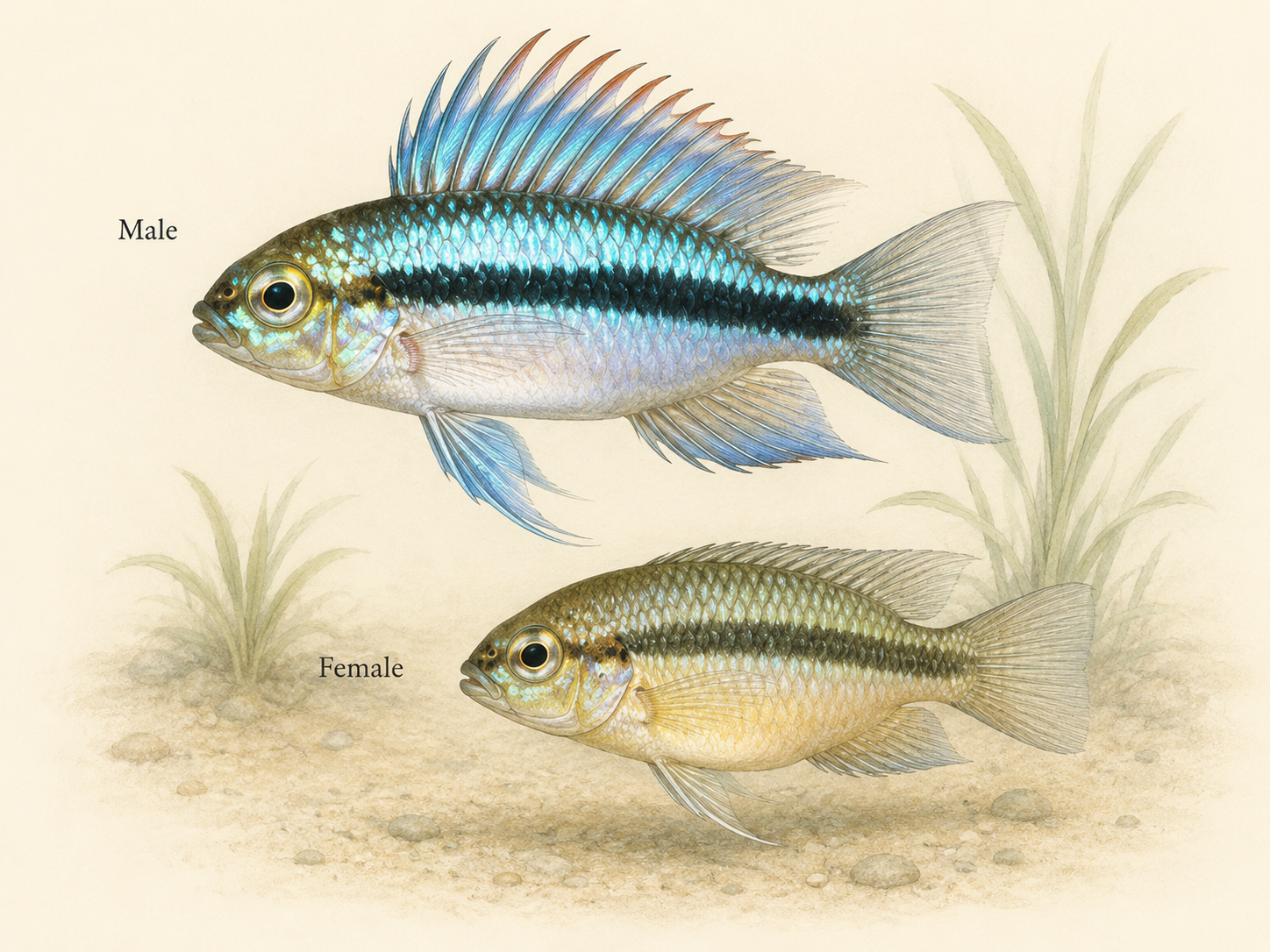
Apistogramma trifasciata is a genuinely handsome fish, and sexually mature males are among the most colourful of all dwarf cichlids. The body shape is typical of the genus, laterally compressed with a moderately elongated profile and a pointed snout. The defining feature that gives the species its common name is the series of three dark horizontal stripes running along the flanks. The uppermost stripe follows the dorsal ridge, the middle stripe extends from the snout through the eye and along the lateral line to the caudal peduncle, and the lowest stripe traces the ventral region. These stripes are most prominent in females and subdominant males, while dominant males often display such intense body colouration that the stripes become partially obscured.
Males in breeding condition are truly spectacular. The body takes on a luminous blue-violet sheen overlaid with flashes of metallic turquoise, and the flanks may show golden-yellow or orange highlights, particularly around the ventral area and lower cheeks. The dorsal fin is tall and sail-like, often edged in red or orange with electric blue spangling across the membrane. The caudal fin is rounded to slightly lyrate, typically adorned with red, orange, and blue patterning. The anal fin mirrors the dorsal in its vivid colouration, while the elongated ventral fins often show bright blue or white leading edges.
Females are considerably smaller and more subdued in their base colouration, displaying an olive-grey to yellowish-brown body with the three lateral stripes rendered in sharper contrast. When guarding eggs or fry, females undergo a dramatic colour change, turning a vivid lemon-yellow with intensified dark markings, a transformation that serves both as a warning to potential threats and as a visual signal to her brood. This brood-care colouration is one of the most distinctive and endearing aspects of keeping this species.
Varieties and Morphs
Apistogramma trifasciata exhibits notable geographical variation across its wide natural range, and several location-specific forms are recognised in the hobby. While these are not captive-bred colour morphs in the strictest sense, they are traded under distinct names and display appreciable differences in colouration and patterning. Aquarists seeking this species should be aware of these variants, as they may differ in their precise care requirements and should not be crossbred.
The most commonly encountered form is the standard type, sometimes sold simply as Apistogramma trifasciata, which typically originates from Paraguayan or southern Brazilian populations and displays the classic blue and red colouration described above. The “Guaporé” form, collected from the Rio Guaporé drainage on the Brazil-Bolivia border, tends to show more intense blue body colouration with vivid red markings in the fins. The “Maciliensis” variant, sometimes treated as a separate subspecies (A. trifasciata maciliensis), exhibits a somewhat different colour pattern with stronger yellow tones. A form sold as “Haraldschultzi” features particularly vibrant red fins and is highly sought after by collectors. Additional location variants from various tributaries in the Paraguay basin occasionally appear in specialist imports, each showing subtle but discernible differences in stripe intensity, fin shape, and colour distribution. Keepers who acquire wild-caught or F1 specimens should make every effort to maintain the provenance of their fish and avoid mixing populations.
Natural Habitat
Apistogramma trifasciata is found across a broad swathe of the Paraguay River basin and its tributaries, spanning portions of southern Brazil (particularly Mato Grosso do Sul), Paraguay, northern Argentina, and eastern Bolivia. This is a relatively wide distribution for an Apistogramma species, which partly accounts for the geographical variation observed in the hobby.
In the wild, this species inhabits shallow, slow-moving or still waters including small streams, flooded forest margins, marshes, and backwater pools. The substrate in these habitats is typically composed of sand and fine sediment, overlaid with a deep layer of fallen leaves, seed pods, and woody debris. The water is often stained a rich amber or tea colour by the tannins released from decomposing organic matter, resulting in low pH values and negligible mineral hardness. Dense marginal vegetation and submerged root tangles provide an abundance of cover, and the interplay of light and shadow created by overhanging riparian plants defines the visual character of these environments.
Water temperatures in the natural range can fluctuate seasonally. The southern portions of its distribution experience cooler winters compared to many other Apistogramma habitats, meaning A. trifasciata is somewhat more tolerant of lower temperatures than some of its tropical congeners. This adaptability is a useful trait in the aquarium, offering the keeper a broader temperature range to work with. The diet in the wild consists primarily of small invertebrates, insect larvae, micro-crustaceans, and other tiny organisms found within the leaf litter and detritus.
Tank Size and Setup
A single pair of Apistogramma trifasciata can be comfortably housed in a tank of 60 litres or more, though a larger aquarium of 80 to 120 litres is preferable if you intend to keep a small group or add tank mates. For a harem setup with one male and two to three females, a minimum of 80 litres is advisable, with each female requiring her own defined territory. Tanks with a longer footprint are always preferable to tall, narrow designs, as these cichlids spend most of their time in the lower third of the water column and benefit from a generous floor area.
The substrate should consist of fine sand, ideally in a natural tan or pale colour that allows the fish to display their best colouration. Avoid sharp or coarse gravels that could injure the delicate barbels and mouths of these bottom-dwelling fish as they sift through the substrate in search of food. A generous covering of dried leaf litter, Indian almond leaves, oak leaves, or beech leaves, is highly recommended, as it provides naturalistic cover, promotes the growth of beneficial microorganisms, and releases tannins that help soften and acidify the water.
Hardscape should include driftwood, bogwood roots, or coconut shells arranged to create caves, overhangs, and visual barriers. Each female in a harem will need at least one cave or sheltered crevice that she can claim as a spawning site, so provide more potential territories than there are females to reduce conflict. Small terracotta pots, ceramic caves, or inverted coconut shell halves with a small entrance hole all work well as spawning sites. Planting the tank with species that thrive in soft, acidic water, such as Java fern, Anubias, Cryptocoryne species, and floating plants like Amazon frogbit, adds further cover and helps subdue the lighting, which this species appreciates. Dense planting along the sides and back of the tank creates a sense of security and allows subordinate fish to retreat from view when necessary.
Water Parameters
Maintaining appropriate water chemistry is one of the most important aspects of keeping Apistogramma trifasciata successfully. This species originates from soft, acidic waters and performs best when these conditions are replicated in the aquarium. While captive-bred specimens may tolerate a slightly wider range of parameters than wild-caught fish, straying too far from the ideal will compromise the health, colouration, and breeding potential of the fish.
| Temperature | 22–28 °C |
| pH | 5.0–7.0 |
| General hardness (GH) | 1–10 dGH |
| Carbonate hardness (KH) | 1–5 dKH |
| Ammonia | 0 ppm |
| Nitrite | 0 ppm |
| Nitrate | Below 20 ppm |
For general maintenance, a temperature of around 24–26 °C and a pH between 5.5 and 6.5 represents the sweet spot. The use of reverse osmosis (RO) water remineralised with an appropriate product, or naturally soft tap water, is often necessary to achieve the low hardness values this species prefers. Peat filtration or the addition of botanical extracts can help maintain a stable acidic pH. Consistency is key, sudden fluctuations in pH or hardness are far more damaging than a reading that sits slightly outside the ideal range. Regular water changes of 15–25% per week, using temperature-matched and appropriately treated water, will help maintain excellent water quality without causing parameter swings.
Filtration and Equipment
Apistogramma trifasciata does not require powerful filtration, and indeed an overly strong current can cause stress in this species, which naturally inhabits still or gently moving water. A quality sponge filter is an excellent choice, particularly in breeding tanks, as it provides effective biological filtration without creating excessive flow and poses no risk of trapping fry. For community setups or larger tanks, a small internal filter or a hang-on-back filter with an adjustable flow rate works well. If using a canister filter, consider fitting a spray bar to diffuse the outflow, and position it so that calm areas exist within the tank where the fish can rest undisturbed.
Lighting should be subdued to moderate. Intense illumination tends to wash out the colours of these fish and can cause them to become timid and reclusive. Floating plants are an excellent way to reduce light intensity naturally while also providing cover. If using LED lighting, a unit with adjustable brightness or a dimming period allows you to tailor the light level to the fish’s preferences.
A reliable heater with an accurate thermostat is essential to maintain stable temperatures. Given that A. trifasciata tolerates cooler conditions than many tropical species, you may find that in heated homes during summer, additional cooling measures are unnecessary. However, during winter months or in cooler climates, a heater set to around 24–26 °C ensures stability. A thermometer placed at the opposite end of the tank from the heater helps you verify that the temperature is consistent throughout the aquarium.
Diet and Feeding
In the wild, Apistogramma trifasciata is a micro-predator that feeds on tiny invertebrates, insect larvae, and other small organisms found within the leaf litter. In captivity, a varied diet that mirrors this natural feeding behaviour will produce the best health, colouration, and breeding condition. While most specimens will accept high-quality dry foods, a diet based solely on flakes or pellets is insufficient for long-term wellbeing.
The foundation of the diet should consist of small, protein-rich frozen or live foods. Frozen bloodworm, brine shrimp, daphnia, cyclops, and mosquito larvae are all eagerly accepted and should be offered regularly, ideally forming the majority of the diet. Live foods, when available, are even more enthusiastically consumed and are particularly valuable for conditioning breeding pairs. Newly hatched brine shrimp (Artemia nauplii) are invaluable for feeding fry but are also relished by adults. Micro-worms and grindal worms make excellent supplementary live foods.
High-quality micro-pellets or granules designed for small cichlids can be offered as a convenient daily staple, and most captive-bred fish will accept them readily. Choose products with a high proportion of whole fish or invertebrate ingredients and avoid those heavy in fillers and cereal meals. Feeding should be done in small portions once or twice daily, offering only as much as the fish can consume within a few minutes. Overfeeding in a soft-water aquarium is particularly problematic, as uneaten food decomposes rapidly and can lead to dangerous spikes in ammonia and nitrite.
Behaviour and Temperament
Apistogramma trifasciata is a relatively peaceful dwarf cichlid by the standards of the genus, though it is by no means devoid of character or territorial instinct. Males establish and defend territories centred around prominent features in the aquarium, a favoured piece of driftwood, a cave, or a cluster of plants, and will display vigorously to rivals using flared fins, intensified colouration, and lateral body postures. In a well-structured tank with adequate space and visual barriers, these displays rarely escalate to physical aggression, and the interplay between territorial males is one of the great pleasures of keeping this species.
The harem social structure is the most natural and successful arrangement in captivity. A single male presides over a territory that encompasses the smaller sub-territories of two or three females. Each female defends her own cave or shelter and the immediate surrounding area, particularly during breeding. Interactions between females can sometimes be more heated than those involving the male, especially when territories overlap, so providing sufficient space and multiple potential spawning sites is essential to prevent bullying.
Outside of breeding periods, A. trifasciata is generally tolerant of other peaceful fish species, particularly those that occupy different areas of the water column. The fish spends much of its time patrolling the lower reaches of the tank, investigating the substrate, and exploring caves and crevices. It is not a particularly shy species once settled, and in a well-planted tank with appropriate water conditions, individuals will often display openly in the front of the aquarium. However, during the first few days or weeks after introduction, some timidity is normal, and patience is required as the fish acclimatise to their new surroundings.
Tank Mates
Selecting appropriate companions for Apistogramma trifasciata requires consideration of the species’ preference for soft, acidic water, its relatively peaceful but territorial nature, and its small size. Ideal tank mates are peaceful, occupy the middle to upper water column, and thrive in similar water chemistry. Avoid large, boisterous, or aggressive species that could outcompete the Apistos for food or intimidate them into hiding.
Good tank mates
- Cardinal Tetra, a classic soft-water companion that occupies the mid-water column and shares the same preference for warm, acidic conditions.
- Rummy-nose Tetra, a peaceful schooling fish that thrives in soft, warm water and adds attractive movement to the upper levels of the tank.
- Ember Tetra, a tiny, gentle tetra whose warm orange colouration complements the blues of A. trifasciata beautifully without competing for territory.
- Pygmy Corydoras, a diminutive bottom-dweller that is too small and inoffensive to provoke aggression from the cichlids, though care should be taken during breeding.
- Otocinclus, a peaceful algae-eating catfish that keeps to itself and poses no threat to eggs or fry, making it an ideal functional tank mate.
- Harlequin Rasbora, a hardy, attractive schooling fish that prefers similar soft, slightly acidic water conditions.
- Beckford’s Pencilfish, a slender, surface-dwelling species that stays well out of the cichlids’ territory and tolerates soft water extremely well.
- Chocolate Gourami, a fellow soft-water specialist that occupies the upper water levels and has a calm, retiring disposition.
Fish to avoid
- Oscar, a large, predatory cichlid that would view A. trifasciata as prey and requires vastly different tank conditions.
- Convict Cichlid, a highly aggressive Central American cichlid that would dominate and likely injure or kill dwarf cichlids.
- Tiger Barb, a notorious fin-nipper whose boisterous behaviour would stress and damage the elongated fins of male Apistos.
- Malawi Cichlids, require hard, alkaline water that is fundamentally incompatible with the soft, acidic conditions A. trifasciata needs.
- Chinese Algae Eater, becomes increasingly aggressive with age and is known to harass and attach itself to slow-moving fish.
- Common Pleco, grows far too large for the tanks typically used for dwarf cichlids and produces excessive waste that degrades water quality.
- Angelfish, though they share a preference for soft water, their size and predatory nature make them a significant threat to small Apistos and their fry.
- Jack Dempsey, a large, territorial, and aggressive cichlid that is wholly incompatible with any dwarf cichlid species.
Breeding
Breeding Apistogramma trifasciata is a thoroughly rewarding experience and is well within the reach of hobbyists with some prior fishkeeping knowledge. This species is a cave spawner, with the female selecting and preparing a sheltered site, typically a small cave, overturned pot, or crevice within driftwood, in which she deposits her eggs. Successful breeding hinges on providing appropriate water conditions, a well-structured environment, and a balanced diet rich in live and frozen foods.
To condition a breeding pair or harem, gradually lower the pH to around 5.5–6.0 and ensure the general hardness is below 5 dGH. Increase the proportion of live foods in the diet over a period of two to three weeks. A slight rise in temperature to around 26–27 °C can also help trigger spawning behaviour. The male will begin to display intensely, flaring his fins and presenting his vivid colours to attract the attention of receptive females. A willing female responds by adopting her bright yellow brood-care colouration and leading the male towards her chosen spawning cave.
The female deposits between 40 and 80 small, adhesive eggs on the ceiling or walls of the cave. After fertilisation by the male, she assumes sole responsibility for guarding and tending the clutch, fanning the eggs with her pectoral fins to ensure adequate water circulation and removing any that become fungused. During this period, the female becomes fiercely territorial and will chase away any fish that ventures too close, including the male. It is often wise to provide the male with his own retreat well away from the spawning site to avoid injury.
The eggs typically hatch within 48 to 72 hours at 26 °C, and the larvae remain attached to the substrate by their yolk sacs for a further three to five days before becoming free-swimming. At this point, the female will shepherd her tiny fry around the tank, leading them to food sources and aggressively defending them against perceived threats. First foods for the fry should be infusoria, paramecium cultures, or commercially available liquid fry food, transitioning to freshly hatched brine shrimp nauplii and micro-worms after the first week. The fry grow relatively slowly and will require several months of attentive feeding and excellent water quality to reach a size where they can be safely moved or rehomed.
Water chemistry during the egg and fry stages is critical. Excessively hard or alkaline water can cause egg fungus, poor hatch rates, and developmental problems in the fry. Maintaining pristine water quality through gentle, frequent water changes with parameter-matched water is essential throughout the rearing period.
Common Diseases
Apistogramma trifasciata is not unusually prone to disease, but like all dwarf cichlids, it can be susceptible to certain conditions if water quality deteriorates or if the fish are subjected to stress. The most important preventive measure is maintaining stable, clean water with appropriate chemistry. Most health problems in this species can be traced back to poor water conditions, an inadequate diet, or the introduction of pathogens from improperly quarantined new additions.
White spot disease, caused by the protozoan parasite Ichthyophthirius multifiliis, is one of the most commonly encountered ailments and presents as small white cysts on the fins and body. It is highly treatable if caught early, and raising the temperature to 28–30 °C alongside the use of a suitable ich medication will typically resolve the infection. However, care must be taken when medicating, as dwarf cichlids can be sensitive to certain chemicals, particularly copper-based treatments and formalin at high doses. Always use medications at half the recommended dose initially and observe the fish closely for adverse reactions.
Bacterial infections, including fin rot and body ulcers, can occur in tanks with elevated nitrate levels or where physical injuries have provided an entry point for pathogens. Maintaining nitrate below 20 ppm and providing a well-structured environment that minimises aggressive encounters will reduce the risk of these conditions. Hole-in-the-head disease (HITH), sometimes associated with the flagellate parasite Hexamita, can affect cichlids kept in suboptimal conditions and is characterised by pitting and erosion of the head and lateral line areas. Improving diet quality, reducing stress, and ensuring excellent water conditions are the primary treatments.
Internal parasites can be a concern with wild-caught specimens. Quarantining new fish for a minimum of two to four weeks in a separate tank before introducing them to an established setup is strongly recommended. During quarantine, observe the fish carefully for signs of illness such as loss of appetite, abnormal faeces, lethargy, or clamped fins, and treat prophylactically with an appropriate anti-parasitic medication if warranted.
FAQs
Can I keep Apistogramma trifasciata in hard, alkaline tap water?
While captive-bred specimens may survive in moderately hard water for a time, they will not thrive, display their best colours, or breed successfully under such conditions. This species genuinely requires soft, acidic water for long-term health. If your tap water is hard, investing in a reverse osmosis unit and remineralising the output to the desired parameters is the most reliable approach. Alternatively, mixing tap water with RO water can bring hardness and pH into an acceptable range.
How many Apistogramma trifasciata can I keep together?
The ideal arrangement is a harem of one male with two or three females in a tank of 80 litres or more. Keeping two males together is generally inadvisable unless the tank is very large (150 litres or more) and densely structured with visual barriers to allow each male to establish a separate territory. In smaller tanks, a single pair can work well, though the female may bear the brunt of the male’s attention without other females to diffuse it.
What is the best temperature for breeding Apistogramma trifasciata?
A temperature of 26–27 °C is generally optimal for triggering spawning behaviour and ensuring healthy egg development. Some breeders report that a slight temperature drop of one or two degrees, followed by a gradual rise back to 27 °C, can simulate the onset of the rainy season and encourage reluctant pairs to spawn. It is worth noting that water temperature during egg incubation may influence the sex ratio of the fry, with higher temperatures tending to produce a greater proportion of males, though this effect is not as well documented in A. trifasciata as in some other Apistogramma species.
Do Apistogramma trifasciata eat plants?
No, this species is not herbivorous and will not damage aquarium plants. In fact, a well-planted tank is highly beneficial, as the vegetation provides cover, helps maintain water quality, and creates the kind of complex environment in which these fish feel most secure. Hardy, low-light species such as Java fern, Anubias, and various Cryptocoryne species are particularly well suited to the soft, acidic water conditions this cichlid requires.
How can I tell males from females?
Sexual dimorphism in Apistogramma trifasciata is pronounced in mature specimens. Males are noticeably larger, reaching 5–6 cm, and display far more vivid colouration, including intense blues, reds, and iridescent highlights across the body and fins. Their dorsal and caudal fins are more elongated and elaborately patterned. Females are smaller at 3.5–4.5 cm, have a rounder body shape, and exhibit a more subdued olive-grey or brownish base colour with clearer dark lateral stripes. When in breeding condition, females turn a striking bright yellow, making identification unmistakable.
Related Guides
- Apistogramma cacatuoides, a closely related and popular dwarf cichlid that shares many care requirements and makes an excellent alternative for beginners to the genus.
- Apistogramma borellii, another southern Apistogramma species with overlapping range and similar tolerance for cooler temperatures, offering useful comparisons in care.
- Apistogramma agassizii, a widely kept congener with comparable water requirements and breeding behaviour, ideal for aquarists looking to expand their Apistogramma collection.
- Cardinal Tetra, one of the best companion species for soft-water biotope tanks and a natural co-inhabitant of South American blackwater habitats.
- Setting Up a Blackwater Aquarium, a comprehensive guide to creating the soft, tannin-stained conditions that Apistogramma trifasciata and similar species thrive in.
- Breeding Dwarf Cichlids, a general guide covering the principles of conditioning, spawning, and fry rearing applicable to Apistogramma and related genera.