Veiltail Betta Care Guide – Tank Setup, Feeding and Breeding
Quick summary
The Veiltail Betta is a hardy, affordable, beginner-friendly fish, easy to keep and easy to breed, though its long trailing fins need gentle water flow, snag-free decor, and pristine water quality to avoid fin rot. It suits anyone wanting a striking, low-maintenance solo fish in at least a 20 litre tank, kept alone or with carefully chosen peaceful tank mates.
🐠 Build a tank around this fish
In this guide:
- Introduction
- Quick Stats
- Appearance
- Varieties and Morphs
- Natural Habitat
- Tank Size and Setup
- Water Parameters
- Filtration and Equipment
- Diet and Feeding
- Behaviour and Temperament
- Tank Mates
- Breeding
- Common Diseases
- FAQs
Introduction
The Veiltail Betta is, for many fishkeepers, the betta – the long-finned, richly coloured fish that has graced pet shop shelves for decades and serves as most people’s introduction to the world of tropical fishkeeping. A tail-type variant of Betta splendens, the Veiltail is characterised by its long, flowing, asymmetrical caudal fin that drapes gracefully downward like a hanging veil, rather than spreading into the fan-like displays seen in Halfmoon or Delta tail types. It is the most widely available and affordable form of domestic betta, and its ubiquity sometimes leads experienced hobbyists to overlook it in favour of rarer tail varieties. That is a shame, because the Veiltail remains one of the hardiest and most beginner-friendly long-finned bettas available, and a well-kept specimen in peak condition is a genuinely striking fish.
If you are looking for comprehensive baseline care information covering all domestic Betta splendens varieties – including water chemistry fundamentals, the labyrinth organ, general health, and core husbandry – please see our full Betta Fish Care Guide. This guide focuses specifically on the Veiltail form: what makes it distinct in terms of appearance, finnage, swimming behaviour, and the practical care considerations that arise from its particular tail morphology. Whether you are a first-time fishkeeper who has just brought home a Veiltail from a local shop or a seasoned hobbyist looking to give this classic variety the attention it deserves, this guide covers everything you need to know.
Quick Stats
| Scientific name | Betta splendens var. Veiltail |
| Common names | Veiltail Betta, VT Betta, Standard Betta, Long-tail Betta |
| Family | Osphronemidae |
| Origin | Domesticated variant; wild ancestor native to Thailand, Cambodia, Laos, and Vietnam |
| Adult size | 6-7.5 cm (body length, excluding finnage) |
| Lifespan | 3-5 years |
| Difficulty | Easy |
| Breeding difficulty | Easy |
| Temperature | 24-28 °C |
| pH range | 6.0-7.5 |
| General hardness (GH) | 3-12 dGH |
| Carbonate hardness (KH) | 2-8 dKH |
| Minimum tank size | 20 litres |
| Conservation status | Vulnerable (IUCN, wild Betta splendens); domestic variant Not Evaluated |
Appearance
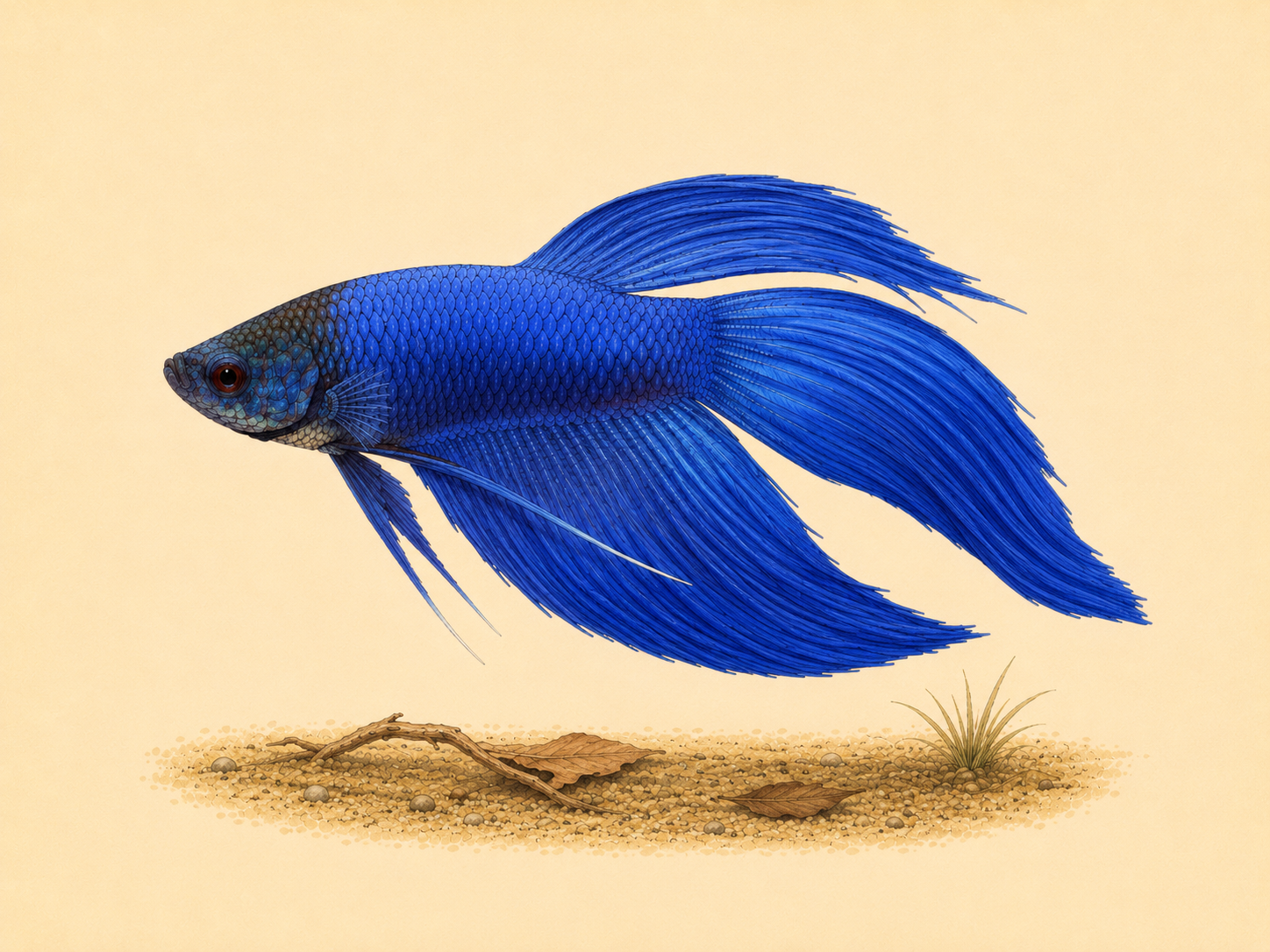
The defining feature of the Veiltail Betta is its caudal fin, which extends in a single, elongated lobe that tapers to a point and hangs downward when the fish is at rest. Unlike the symmetrical, semicircular spread of a Halfmoon or the triangular shape of a Delta, the Veiltail’s caudal is distinctly asymmetrical – the upper rays are shorter than the lower rays, creating that characteristic drooping, veil-like profile. When the fish swims, the tail trails behind in a flowing, undulating motion rather than fanning outward. This gives the Veiltail a languid, elegant appearance that is quite different from the strutting display posture of show-bred tail types.
The anal fin is also notably long in Veiltail males, often extending almost as far back as the caudal fin and contributing to the overall impression of trailing drapery. The dorsal fin is typically modest compared to varieties like the Rosetail or Feathertail, though it may still be reasonably elongated. Female Veiltails have shorter fins than males but still tend to show slightly longer finnage than females of some other tail types, making sex identification relatively straightforward even in juvenile fish.
Body shape in the Veiltail is the standard Betta splendens form – torpedo-shaped, laterally compressed, with an upturned mouth designed for surface feeding. Adult males typically reach 6 to 7.5 cm in body length, though the total length including finnage can push well past 10 cm in well-developed specimens. Veiltails are available in virtually every colour and pattern found in domestic bettas, including solid reds, blues, blacks, whites, and multicoloured patterns such as marble, butterfly, and koi.
One practical note on appearance: because the Veiltail’s caudal fin hangs rather than spreads, any fin damage, splitting, or curling is often more visually apparent than it might be on a short-finned Plakat. Conversely, a healthy Veiltail with pristine, undamaged finnage and vibrant colour is a genuinely beautiful fish that holds its own against any show variety.
Varieties and Morphs
While “Veiltail” refers specifically to the tail type, this form is combined with an enormous range of colour morphs and patterns. Because the Veiltail is the most commonly bred domestic betta, virtually every colour variant that exists in the hobby has been produced in Veiltail form at some point. The most frequently encountered include:
Solid colours: Red, royal blue, steel blue, turquoise, black (in several sub-types including Melano and Black Lace), white (Opaque), yellow, orange, and green. Solid red and blue Veiltails are the most common specimens found in general pet shops.
Bi-colour and multicolour: Butterfly patterns (where the body and fin bases are one colour and the fin edges another), Cambodian (pale body with coloured fins), Chocolate (dark body with yellow or orange fins), and various bi-colour combinations.
Marble: Veiltails carrying the marble gene display irregular, blotchy patterns that may shift and change throughout the fish’s life. This can be surprising for new keepers who notice their betta’s colour changing over weeks or months – this is normal marble gene expression, not a sign of illness.
Koi: A subset of the marble pattern producing red, white, and sometimes black patches reminiscent of koi carp. Koi-patterned Veiltails are increasingly popular.
Metallic and Dragon Scale: Veiltails with thick, iridescent metallic scaling. Dragon Scale Veiltails are visually impressive but warrant extra attention, as heavy scaling around the gill plates and eyes can occasionally cause issues – see the Common Diseases section for more detail.
It is worth noting that in competitive betta showing, the Veiltail is generally not entered in International Betta Congress (IBC) or similar competitions, as judging standards favour symmetrical fin types. This means there is less selective breeding pressure on Veiltail fin form compared to Halfmoons or Crowntails, and fin quality can be quite variable between individual fish. However, this same lack of extreme selective pressure is arguably why the Veiltail remains one of the most genetically robust and healthy long-finned forms.
When purchasing a Veiltail, look for a fish with clean, unbroken fin edges, no visible lumps or patches of discolouration that might indicate disease, and an alert, responsive demeanour. A healthy Veiltail should flare when presented with a mirror or another betta, spreading its gill covers and erecting its fins even if the caudal does not fan symmetrically.
Natural Habitat
The Veiltail is entirely a product of selective breeding and does not exist in the wild. Its ancestor, Betta splendens, is native to the lowland river basins and floodplains of mainland Southeast Asia, particularly Thailand (formerly Siam, from which the common name “Siamese Fighting Fish” derives), Cambodia, Laos, and Vietnam. Wild Betta splendens are short-finned, relatively drab fish compared to their domestic descendants – typically brown, green, or dull red, with short fins that allow agile swimming in dense vegetation.
Understanding the wild habitat is still relevant for Veiltail care because the fundamental biological needs have not changed through domestication. Wild bettas inhabit shallow, warm, slow-moving or still waters: rice paddies, roadside ditches, swamp margins, and heavily vegetated ponds. These environments are characterised by warm temperatures (typically 25-30 °C), soft to moderately hard water, a slightly acidic to neutral pH, abundant plant cover, and low current. The water is often stained with tannins from decaying plant matter, resulting in dim, tea-coloured conditions.
For the Veiltail specifically, the wild habitat context is important for one additional reason: current strength. The drooping, trailing fins of the Veiltail create considerably more drag than the short fins of a wild betta, meaning that even moderate water flow can exhaust a Veiltail far more quickly. The still or near-still conditions of the ancestral habitat should be replicated even more carefully for Veiltails than for short-finned domestic forms like Plakats.
Wild Betta splendens are classified as Vulnerable by the IUCN, primarily due to habitat loss from agricultural expansion and urban development. The domestic Veiltail, however, is bred in vast numbers commercially and faces no conservation concern. Virtually all Veiltails in the aquarium trade are captive-bred, primarily in Thailand, Indonesia, and increasingly in domestic breeding operations worldwide.
Tank Size and Setup
A minimum of 20 litres is recommended for a single Veiltail Betta. While this minimum is the same as for other betta varieties, the Veiltail’s trailing fins make certain aspects of tank setup more consequential. A longer, shallower tank is preferable to a tall, narrow one – Veiltails need to reach the surface to breathe atmospheric air via their labyrinth organ, and a tall water column means more effort expended swimming upward with those heavy fins. A tank with a footprint of at least 40 x 20 cm at the minimum size is a good baseline.
Aquascaping for a Veiltail requires particular attention to snag hazards. The long, delicate fins are prone to tearing on sharp edges, rough surfaces, and pointed decorations. Avoid plastic plants with hard, sharp leaf edges, rough-textured resin ornaments, and any decoration with small holes or crevices where fins could become caught. Live plants are the ideal choice – they provide cover, improve water quality, and have soft, fin-safe surfaces. Suitable live plants include Anubias species (which tolerate low light and attach to hardscape), Java Fern, Java Moss, Cryptocoryne species, and floating plants such as Salvinia or Amazon Frogbit. Floating plants are especially beneficial as they dim the lighting, provide surface cover, and encourage the betta to use the upper water column where it naturally prefers to spend time.
If you prefer artificial plants, choose silk rather than plastic varieties. Smooth river stones, driftwood with no sharp protrusions, and ceramic hides with wide, smooth openings are all safe hardscape options. Always run a finger or a piece of tights fabric over any decoration before placing it in the tank – if the material snags, it will snag a Veiltail’s fins.
Substrate choice is largely a matter of preference. Fine gravel or sand both work well. Dark-coloured substrates tend to make betta colours appear more vivid, and many keepers prefer sand for planted setups. Ensure the substrate is thoroughly rinsed before adding it to the tank.
A lid or cover is essential. Bettas are capable jumpers, and Veiltails, despite their heavy finnage, can and do leap from open tanks. A small gap for air exchange is fine, but the tank should not be left fully uncovered. Ensure the air above the water surface does not become significantly cooler than the water itself, as bettas breathing cold air can be stressed – this is especially relevant in unheated rooms during winter.
Water Parameters
| Temperature | 24-28 °C |
| pH | 6.0-7.5 |
| General hardness (GH) | 3-12 dGH |
| Carbonate hardness (KH) | 2-8 dKH |
| Ammonia | 0 ppm |
| Nitrite | 0 ppm |
| Nitrate | Below 20 ppm |
The Veiltail’s water parameter requirements are essentially the same as for any domestic Betta splendens, and you can find a fuller discussion in our main Betta Fish Care Guide. However, there is one Veiltail-specific consideration worth emphasising: water quality has a direct and visible impact on fin condition. Because the Veiltail’s long, trailing fins present a large surface area to the water, poor water quality – even levels of ammonia, nitrite, or nitrate that a short-finned fish might tolerate without obvious distress – can manifest quickly as fin erosion, discolouration, or the onset of fin rot. Keeping ammonia and nitrite at a consistent 0 ppm and nitrate below 20 ppm is not merely a guideline for Veiltails; it is the single most important factor in maintaining those long, flowing fins in pristine condition.
Temperature stability is also important. Veiltails are tropical fish and must be kept at a consistent temperature within the 24-28 °C range. Fluctuations of more than 2 °C within a 24-hour period can stress the fish and suppress immune function, increasing susceptibility to fin rot and other infections. A reliable, adjustable aquarium heater is essential in all but the warmest climates.
Weekly water changes of 20-30% are recommended for most setups. In smaller tanks at the minimum size, more frequent changes (twice weekly) may be necessary to keep nitrate levels in check. Always treat replacement water with a quality dechlorinator and match the temperature to the tank water before adding it.
Indian almond leaves (Catappa leaves) or other tannin sources are a popular addition to betta tanks. They release tannins that gently lower pH, tint the water a natural amber colour, and have mild antibacterial and antifungal properties. Many keepers find that Veiltails kept in tannin-stained water maintain better fin condition, though this is anecdotal rather than rigorously proven.
Filtration and Equipment
Filtration is where Veiltail-specific considerations become most critical. The trailing, heavy caudal fin creates substantial drag, and Veiltails are poor swimmers in any appreciable current. A gentle, low-flow filter is essential. Sponge filters are widely regarded as the best option for Veiltail bettas – they provide excellent biological filtration, produce minimal current, and pose no risk of fin entrapment in intake tubes. An air-pump-driven sponge filter sized appropriately for the tank volume is the simplest and most effective choice.
If you prefer a hang-on-back (HOB) filter, choose a model with an adjustable flow rate and set it to its lowest setting. You can further reduce current by fitting a pre-filter sponge over the intake (which also prevents fin entrapment) and baffling the outflow with a piece of filter sponge, a plastic bottle baffle, or by directing the flow against the tank wall. Internal power filters can work if they have adjustable flow, but many models produce too much current even at their lowest settings for a Veiltail to be comfortable.
Signs that the current is too strong include the betta being visibly pushed around, spending most of its time hiding behind decorations on the sheltered side of the tank, or clamping its fins tightly against its body rather than allowing them to flow. If you observe any of these behaviours, reduce the flow further.
An adjustable heater rated for the tank size is necessary unless you live in a consistently warm climate where room temperature never drops below 24 °C. For tanks of 20-40 litres, a 25-50 watt heater is usually sufficient. Place the heater near the filter outflow (however gentle) to help distribute heat evenly. A separate thermometer – either a digital probe or a simple glass stick-on type – allows you to verify the heater is maintaining the correct temperature.
Lighting should be moderate. Veiltails do not require intense lighting, and overly bright conditions can stress them. If you are growing live plants, a basic LED light on a timer providing 8-10 hours of light per day is ideal. Floating plants help diffuse light and create the shaded conditions bettas prefer.
Diet and Feeding
The Veiltail’s dietary needs are identical to those of other domestic Betta splendens – they are primarily carnivorous, requiring a protein-rich diet based on insects and insect larvae in the wild. In captivity, a high-quality betta-specific pellet should form the staple diet. Look for pellets with whole fish or insect meal as the first ingredient, and avoid products heavy in fillers like wheat or soy.
One Veiltail-specific feeding consideration relates to the fish’s swimming ability. Because the heavy fins make the Veiltail a less agile swimmer than short-finned varieties, food that sinks quickly to the substrate may be difficult for the fish to retrieve efficiently. Floating pellets are therefore preferable to sinking types. Feed small pellets – two to four per feeding, twice daily – to avoid overfeeding. A Veiltail’s stomach is roughly the size of its eye, so portions should be small.
Supplement the pellet diet with frozen or live foods two to three times per week. Excellent options include bloodworms (as an occasional treat rather than a staple, as they are relatively fatty), daphnia, brine shrimp, and mosquito larvae. Daphnia are particularly valuable as they act as a mild laxative and can help prevent the bloating and constipation that bettas are prone to. Live foods also encourage natural hunting behaviour, which provides enrichment.
Freeze-dried foods are acceptable as an occasional alternative to frozen, but soak them in a small amount of tank water for a few minutes before feeding. Dry freeze-dried foods can expand in the fish’s stomach and contribute to bloating.
Fasting one day per week is a common and recommended practice. This gives the digestive system a rest and helps prevent constipation. If you notice your Veiltail appearing bloated or lethargic after feeding, reduce portion sizes and increase the frequency of fasting days until the issue resolves.
Behaviour and Temperament
The Veiltail shares the territorial, solitary temperament of all domestic Betta splendens males, but its heavy finnage does influence behaviour in observable ways. Compared to lighter-finned varieties like Plakats or even Crowntails, Veiltails tend to be somewhat less active and aggressive. This is not because they are inherently more placid – it is largely because the weight and drag of the trailing fins make sustained flaring and chasing more physically demanding. A Veiltail will still flare aggressively at perceived rivals and should never be housed with another male betta, but it is less likely to sustain aggressive displays for extended periods compared to a short-finned male.
This reduced mobility has implications for enrichment. Veiltails benefit from a well-structured tank with multiple resting spots at different heights. Broad-leafed plants like Anubias, or purpose-made betta hammocks (suction-cup mounted leaves near the surface), give the fish comfortable perches where it can rest its heavy fins while staying close to the surface for breathing. Without these resting spots, a Veiltail in a sparsely decorated tank may become lethargic and spend excessive time lying on the substrate, which can be mistaken for illness.
Veiltails are generally curious and interactive fish. Many learn to recognise their keeper and will approach the front glass during feeding time. They can be trained to follow a finger along the glass or even to jump for food (though encouraging jumping is not recommended in tanks without secure lids). Providing gentle environmental enrichment – rearranging decorations occasionally, offering live food to chase, or placing a mirror outside the tank for brief periods (no more than a few minutes at a time) to encourage flaring – helps keep the fish mentally stimulated.
Female Veiltails are generally less aggressive than males but can still be territorial. They are occasionally kept in sorority setups (groups of five or more females in a sufficiently large, heavily planted tank), though sororities are not recommended for beginners and require careful monitoring. Female Veiltails, with their shorter fins, are more agile than males and may be more assertive in mixed-species community settings.
Tank Mates
The Veiltail’s long, trailing fins make tank mate selection a particularly important consideration. Its slow swimming speed and conspicuous finnage make it vulnerable to fin-nipping species, and its territorial nature means it may itself harass fish that it perceives as rivals – particularly any species with long, colourful fins. The ideal tank mate for a Veiltail is a peaceful, non-nippy species that occupies a different area of the water column, is not brightly coloured enough to trigger aggression, and is too fast or well-armoured for the betta to bully. Tank size also matters – in the minimum 20-litre setup, a Veiltail is best kept alone or with a small invertebrate companion only. A 40-litre or larger tank opens up more options for compatible tank mates.
Good tank mates
- Pygmy Corydoras – Tiny, peaceful bottom-dwellers that stay well out of the betta’s preferred upper water column and are too quick to be easily harassed.
- Ember Tetra – Small, calm schooling fish with subdued orange colouration unlikely to trigger aggression, and they are not fin nippers.
- Kuhli Loach – Nocturnal, eel-shaped bottom-dwellers that are largely invisible to the betta during the day and occupy completely different tank space.
- Amano Shrimp – Large enough to avoid being eaten by most bettas, excellent algae cleaners, and generally ignored by Veiltails.
- Mystery Snail – Hardy, colourful snails with an operculum to protect against curious bettas, and they help keep the tank clean.
- Celestial Pearl Danio – Tiny, peaceful microfish that tend to stay in the mid to lower water column among plants, reducing territorial conflict.
- Ramshorn Snail – Small, unobtrusive snails that help with algae and detritus and are generally ignored by bettas.
- Harlequin Rasbora – A classic betta companion; peaceful, appropriately sized, and native to similar soft-water habitats in Southeast Asia.
Fish to avoid
- Tiger Barb – Notorious fin nippers that will relentlessly shred a Veiltail’s long, trailing fins, causing severe stress and injury.
- Serpae Tetra – Aggressive nippy tetras that target slow-moving, long-finned fish and will damage the Veiltail’s caudal fin.
- Male Guppy – Their flowing, colourful tails can be mistaken for a rival male betta, triggering persistent aggression from the Veiltail.
- Paradise Fish – A fellow labyrinth fish that is highly territorial and will fight with a betta, often with lethal results for the slower Veiltail.
- Chinese Algae Eater – Becomes aggressive and territorial as it matures, and may latch onto the betta’s body or fins to feed on its slime coat.
- Convict Cichlid – Far too aggressive and territorial for any betta; will harass, injure, and likely kill a Veiltail.
- Red Tail Shark – Highly territorial bottom-to-mid dweller that will chase and stress a slow-moving Veiltail relentlessly.
- Angelfish – Territorial cichlids that may nip at trailing fins and will compete aggressively for space, especially as they mature.
Breeding
The Veiltail is one of the easiest betta varieties to breed, and it is often recommended as the ideal starting point for anyone new to betta breeding. The Veiltail tail type is genetically dominant over most other tail types, meaning that crossing a Veiltail with almost any other variety will typically produce predominantly Veiltail offspring. This genetic dominance is, in fact, a significant reason why the Veiltail is so common in the hobby and why experienced breeders working with other tail types actively avoid introducing Veiltail genetics into their lines.
Breeding follows the standard Betta splendens bubblenest method. The male constructs a nest of bubbles at the water surface, typically among floating plants or under a floating object. When ready, the pair engage in an elaborate courtship display, culminating in the spawning embrace where the male wraps his body around the female, who releases eggs that are fertilised and then collected by both fish and placed into the bubblenest.
To breed Veiltails, set up a separate breeding tank of at least 20 litres with a gentle sponge filter, a heater set to 26-27 °C, and shallow water of around 12-15 cm depth. Include floating plants or a small piece of polystyrene foam as a bubblenest anchor. Condition both the male and female with high-protein live or frozen foods for one to two weeks before introduction. Introduce the female in a clear container (such as a hurricane glass or plastic divider) within the breeding tank so the pair can see each other without physical contact. Watch for signs of readiness: the male will build a bubblenest and display intensely, and the female will develop vertical breeding bars on her body and appear receptive rather than fearful.
Release the female when both fish appear ready. Monitor the spawning closely – some aggression from the male is normal, but if the female is being seriously injured (torn fins, scales missing, prolonged chasing without any spawning embrace), separate them and try again after a few days. After spawning, remove the female, as the male will guard the nest and may attack her.
The male tends the eggs and fry, retrieving any that fall from the nest and blowing them back into the bubbles. Eggs hatch in 24-48 hours, and fry become free-swimming approximately three days after hatching. At this point, remove the male. Feed fry with infusoria or commercially available liquid fry food for the first few days, transitioning to baby brine shrimp (Artemia nauplii) once they are large enough. A typical spawn can produce 50 to 300 fry, so be prepared with grow-out space and a plan for rehoming the juveniles.
As males mature and begin showing aggression toward each other (usually at 8-12 weeks), they must be separated into individual containers. This is the most labour-intensive aspect of betta breeding and should be planned for before you begin.
Common Diseases
Veiltails are susceptible to the same diseases as all domestic Betta splendens, but their long finnage makes certain conditions more likely and more visible. The most Veiltail-relevant health issues are:
Fin rot: This is the single most common health problem in Veiltail bettas. The long, trailing fins are highly susceptible to bacterial and fungal infection, particularly in tanks with suboptimal water quality. Fin rot presents as fraying, discolouration (often darkening or whitening of the fin edges), and progressive erosion of the fin tissue. Mild cases often resolve with pristine water quality alone – perform daily partial water changes of 25% and ensure ammonia and nitrite are at 0 ppm. More advanced cases may require treatment with a broad-spectrum antibacterial medication. Prevention is straightforward: maintain excellent water quality, avoid sharp decorations, and minimise stress.
Fin biting: Some Veiltails develop the habit of biting their own tail fins. This is believed to be related to stress, boredom, or the sheer weight and drag of the fins causing discomfort. The resulting damage looks similar to fin rot but tends to appear suddenly as large, clean-edged chunks rather than the gradual fraying of bacterial fin rot. Addressing fin biting involves reducing stress (stable water parameters, adequate hiding spots, appropriate lighting), providing enrichment, and ensuring the current is not causing the fish to struggle. Some individuals are persistent fin biters regardless of conditions, and unfortunately, there is no guaranteed cure for the behaviour.
Swim bladder disorder: Bettas are prone to swim bladder issues, often related to overfeeding, constipation, or swallowing air while eating floating foods. Symptoms include difficulty swimming, floating at odd angles, or sinking to the bottom. Fasting the fish for 24-48 hours and then offering a small amount of daphnia (which acts as a laxative) often resolves the issue. If the problem is chronic, it may indicate a more serious underlying condition.
Ich (white spot disease): This common parasitic infection presents as small white spots on the body and fins. It is typically triggered by temperature fluctuations or stress. Treatment involves gradually raising the water temperature to 28-30 °C and adding aquarium salt or a dedicated ich medication. The Veiltail’s large fin surface area means spots may be more numerous and visible than on shorter-finned fish.
Velvet (Oodinium): A parasitic infection that gives the fish a fine, gold or rust-coloured dusting, most visible under a torch beam. It is more dangerous than ich and requires prompt treatment with a copper-based medication and darkening of the tank (the parasite is partly photosynthetic).
Dragon Scale eye issues: Specifically relevant to Dragon Scale Veiltails – the thick metallic scaling can grow over the eyes, gradually reducing or eliminating vision. This is a genetic condition with no cure. If you keep a Dragon Scale Veiltail, monitor for scaling over the eyes and be prepared to adjust feeding methods (using feeding tongs or consistently placing food in the same spot) if the fish’s vision becomes impaired.
Regular observation is your best diagnostic tool. Spend a few minutes each day watching your Veiltail. Changes in colour, appetite, activity level, or fin condition are usually the earliest signs of a problem, and early intervention almost always produces better outcomes.
FAQs
Is the Veiltail the best betta for beginners?