Neon Tetra Care Guide — Tank Setup, Feeding and Breeding
Introduction
If there is one freshwater fish that has earned the right to be called iconic, it is the Neon Tetra. Since its discovery in the Amazonian waterways of South America in the 1930s, Paracheirodon innesi has become the single most popular tropical aquarium fish in the world, and for good reason. That electric blue stripe running the length of its body, paired with a vivid red splash across the tail half, creates a visual effect that looks almost too perfect to be real. When a school of twenty or more drifts through a planted tank, the effect is genuinely mesmerising, and it never really gets old, even for experienced fishkeepers who have seen it a thousand times.
Beyond their beauty, Neon Tetras have earned their popularity through sheer practicality. They are small, peaceful, hardy once established, and relatively undemanding when it comes to food and care. They thrive in community tanks, rarely bother other fish, and their modest adult size means you can keep a proper school even in a modestly sized aquarium. For many of us, a group of Neons was the first fish we ever owned, and the memory of watching them settle into a newly cycled tank stays with you. They are the fish that hooks people on the hobby.
Neon Tetras are an excellent choice for beginners, but they are equally at home in the carefully aquascaped tanks of seasoned hobbyists. They are not quite as bulletproof as some guides suggest, they do need a cycled tank with stable water parameters and can be sensitive to sudden changes, but any keeper willing to do the basics right will find them a joy to keep. Whether you are setting up your first community tank or looking for the perfect schooling fish to bring a planted layout to life, the Neon Tetra is a thoroughly rewarding choice.
Quick stats
| Scientific name | Paracheirodon innesi |
| Family | Characidae |
| Origin | Western Brazil, southeastern Colombia, eastern Peru (Amazon basin) |
| Adult size | 3 – 4 cm (1.2 – 1.5 inches) |
| Lifespan | 5 – 8 years with good care |
| Difficulty | Beginner |
| Breeding difficulty | Challenging |
| Temperature | 20 – 26 °C |
| pH range | 5.0 – 7.5 |
| Minimum tank size | 60 litres |
Appearance
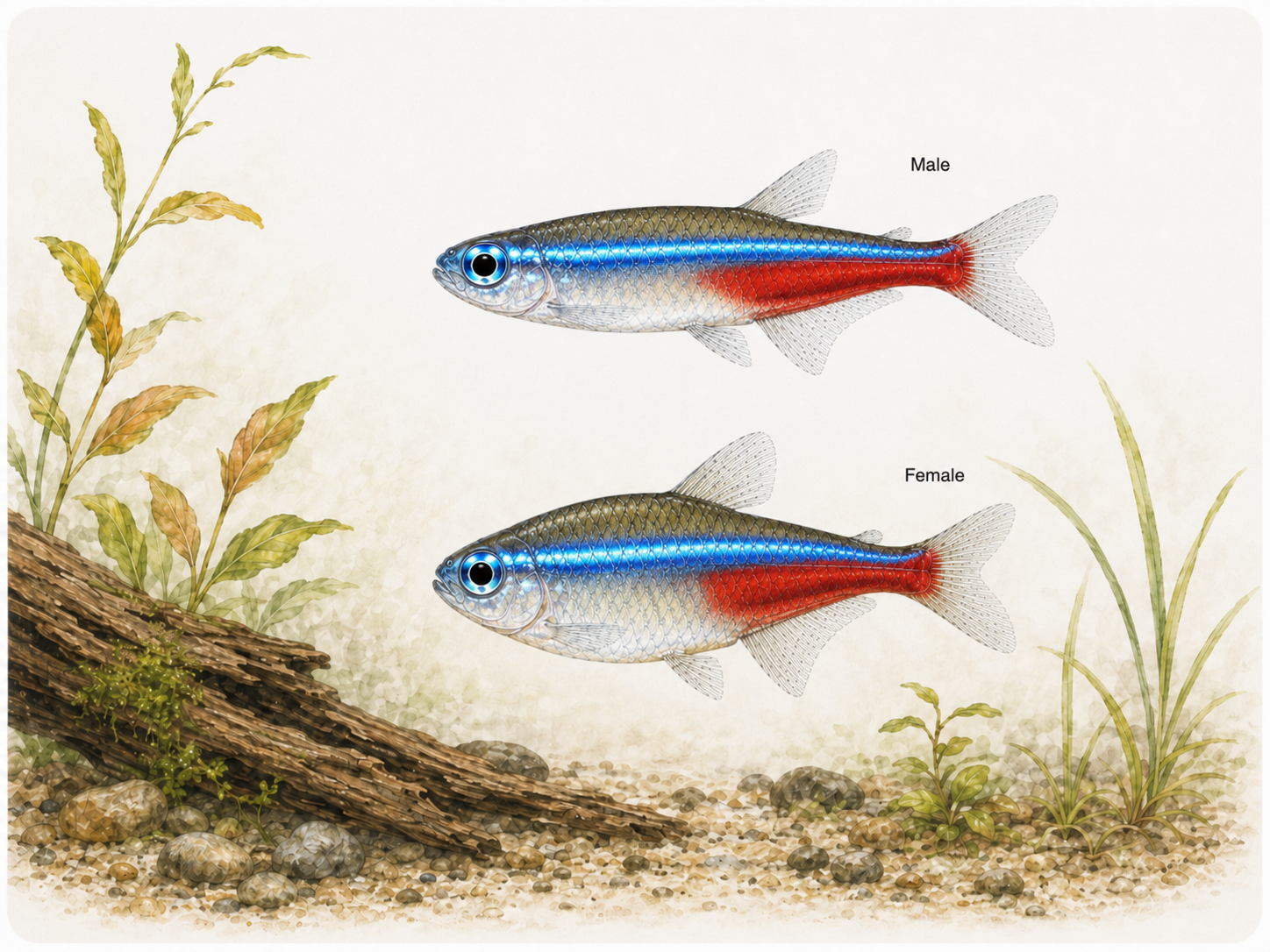
The Neon Tetra is a small, slender-bodied fish with a distinctive torpedo shape common to many characins. Its most famous feature is the iridescent blue-green stripe that runs horizontally from the tip of the nose, over the eye, and along the upper flank to roughly the adipose fin. Below this, the lower half of the body from the mid-section to the base of the tail is a rich, vivid red. The belly is silvery-white, and the fins are largely transparent with a slight milky hue. Under different lighting conditions the blue stripe can appear to shift between turquoise and deep blue, which is part of what makes them so captivating in a well-lit aquarium. Commercially bred variants include the long-fin Neon Tetra, which sports extended finnage, and the diamond or albino Neon Tetra, though the classic wild-type colouration remains by far the most popular.
Telling males from females is subtle but possible once the fish are mature. Females tend to be slightly larger and rounder in the belly, especially when carrying eggs. This fuller body shape can cause the blue stripe to appear slightly curved rather than perfectly straight. Males are typically a touch slimmer and more streamlined. The colour differences between the sexes are negligible, both display the same vivid blue and red. In a mixed school, you will usually notice the size and body-shape differences most easily when the fish are viewed from above or when females are well-conditioned with food.
Natural habitat
Neon Tetras originate from the blackwater and clearwater streams of the western Amazon basin, spanning parts of Brazil, Colombia, and Peru. These are typically slow-moving tributaries and forest streams shaded by dense tropical canopy. The water in these habitats is often stained dark brown by tannins leaching from decomposing leaves and wood, giving it that characteristic tea-coloured appearance. The substrate is usually a mix of fine sand, leaf litter, and fallen branches, and aquatic plants can be sparse since the canopy above blocks much of the sunlight. The water is extremely soft, often with a total hardness close to zero, and quite acidic, with pH values regularly dipping below 5.0 in some locations.
Understanding this natural environment matters because it informs how you should set up your tank. While captive-bred Neon Tetras are far more adaptable than their wild-caught ancestors and can thrive in moderately hard, neutral water, they still do best when you provide subdued lighting, plenty of cover, and a dark substrate that mimics the shaded forest floor. You do not need to replicate blackwater conditions exactly, but adding Indian almond leaves or driftwood to gently tint the water and lower the pH slightly will bring out stronger colours and more natural behaviour. A tank that feels open and exposed under bright light is not where a Neon Tetra feels at home.
Tank size and setup
A group of ten to twelve Neon Tetras can live comfortably in a 60-litre aquarium, though 80 litres or more gives them significantly more swimming room and makes it easier to maintain stable water quality. If you plan to keep a larger school of twenty or more, or mix them with other community species, aim for at least 100 to 120 litres. Neons are active mid-water swimmers, so a tank with some horizontal length is preferable to a tall, narrow design.
For substrate, a dark fine-grain sand such as ADA La Plata Sand or CaribSea Super Naturals Torpedo Beach works beautifully. Dark substrates make the Neon’s colours pop noticeably compared to pale gravel, and sand is a better match for the kind of planted setup these fish appreciate. Plant the tank generously along the sides and back, leaving open swimming space in the centre and foreground. Good plant choices include Cryptocoryne wendtii, Vallisneria nana, Java Fern (Microsorum pteropus), Java Moss (Taxiphyllum barbieri), and Anubias barteri var. nana. Floating plants like Amazon Frogbit (Limnobium laevigatum) or Red Root Floaters (Phyllanthus fluitans) are particularly valuable because they diffuse overhead light and create the dappled shade Neons prefer.
Add a few pieces of driftwood, Malaysian driftwood or spider wood are both good options, and consider scattering some dried Indian almond leaves on the substrate. These release tannins that gently stain the water and provide a natural look. Lighting should be moderate; if your light is on the bright side, floating plants will help tone it down. Water flow should be gentle. Neon Tetras come from slow-moving waters and will stress if the current is too strong. If your filter output pushes them around, use a spray bar or baffle to diffuse the flow.
Water parameters
| Temperature | 20 – 26 °C (ideally 23 – 25 °C) |
| pH | 5.0 – 7.5 (ideally 6.0 – 7.0) |
| Hardness (GH) | 2 – 10 dGH |
| Ammonia | 0 ppm |
| Nitrite | 0 ppm |
| Nitrate | Below 20 ppm |
The single most important thing to understand about Neon Tetra water requirements is that stability matters more than hitting a perfect number. A tank that sits steadily at pH 7.2 is far better for your fish than one you are constantly tinkering with to push down to 6.5. That said, very hard, alkaline water above pH 8.0 is not suitable, and most tap water in soft to moderately hard regions will be just fine. Always dechlorinate tap water before adding it to the tank, and keep up with regular weekly water changes of around 20 to 25 percent to keep nitrates in check. Neon Tetras are sensitive to ammonia and nitrite, so never add them to an uncycled aquarium. A fully cycled tank with zero ammonia and nitrite is non-negotiable.
Filtration and equipment
For a Neon Tetra tank in the 60 to 120 litre range, a quality hang-on-back filter or a small canister filter will do the job well. Sponge filters are also an excellent choice, especially if you plan to breed, they provide gentle flow and pose no risk to fry. Good options include the Aquael Versamax Mini or the Fluval C2 for hang-on-back setups, or the Oase Filtosmart 100 if you prefer a compact canister. The key is gentle, consistent filtration without excessive current.
A reliable heater is essential unless you live in a consistently warm climate. An adjustable heater rated for your tank size, such as the Eheim Jäger or the Fluval M series, will let you dial in the temperature to around 24 °C. Pair it with a separate digital thermometer to verify the reading, built-in heater thermostats are not always perfectly accurate. For water testing, the API Freshwater Master Test Kit is the gold standard for home use. It covers ammonia, nitrite, nitrate, and pH with liquid reagent tests that are far more reliable than paper strips. Test weekly during normal maintenance and daily when the tank is new or after any changes.
Diet and feeding
In the wild, Neon Tetras are omnivorous micro-predators, feeding on tiny invertebrates, insect larvae, algae, and organic detritus drifting through the water column. In captivity, they are wonderfully easy to feed and will accept just about anything small enough to fit in their mouths. A high-quality micro-pellet or small-flake food should form the staple of their diet. Hikari Micro Pellets, Fluval Bug Bites for small fish, and Northfin Community Formula are all excellent choices that provide balanced nutrition.
Supplement the staple food two to three times a week with frozen or freeze-dried foods like baby brine shrimp, daphnia, cyclops, or bloodworms (chopped small). These protein-rich foods help bring out the best colour and are especially important if you are conditioning fish for breeding. Feed small amounts once or twice a day, only as much as the fish can consume in about two minutes. Neon Tetras have tiny stomachs, and overfeeding is a common mistake that leads to poor water quality and health problems. If there is uneaten food settling on the substrate after feeding, you are giving too much.
Behaviour and temperament
Neon Tetras are peaceful, sociable schooling fish that spend the majority of their time swimming together in loose groups through the middle water column. In a well-planted tank with appropriate numbers, you will see them drifting in coordinated formation, occasionally breaking apart to explore individually before regrouping. They are most active and confident when kept in groups of at least ten, smaller groups of three or four tend to result in shy, stressed fish that hide more and colour up less. The difference in behaviour between a group of six and a group of twenty is dramatic, so keep as many as your tank allows.
They are not aggressive in any meaningful sense. Mild chasing can occur between males, especially at feeding time, but it is harmless and brief. Neons are timid by nature and can be intimidated by larger or boisterous tank mates, so their companions should be chosen with care. One charming quirk is how their colours fade noticeably when the lights are off or when they are sleeping, the blue stripe dims and the red fades to a muted pink. This is completely normal and nothing to worry about. Within minutes of the lights coming back on, the colour returns to full intensity.
Tank mates
Good tank mates
- Cardinal Tetra (Paracheirodon axelrodi), very similar needs and temperament, schools beautifully alongside Neons
- Harlequin Rasbora (Trigonostigma heteromorpha), peaceful, similarly sized, and enjoys the same water conditions
- Corydoras catfish (Corydoras species), gentle bottom-dwellers that occupy a different zone of the tank, such as Corydoras pygmaeus or Corydoras panda
- Otocinclus catfish (Otocinclus vittatus), small, peaceful algae grazers that make excellent companions
- Ember Tetra (Hyphessobrycon amandae), tiny, calm, and adds a complementary warm colour to the tank
- Honey Gourami (Trichogaster chuna), a gentle, slow-moving surface dweller that coexists peacefully
- Cherry Shrimp (Neocaridina davidi), safe with adult Neons, though very small shrimplets may occasionally be eaten
- Kuhli Loach (Pangio kuhlii), shy, nocturnal bottom-dwellers that stay out of the Neons’ way entirely
Fish to avoid
- Angelfish (Pterophyllum scalare), adult angels will readily eat Neon Tetras; they are a natural prey item in the wild
- Oscars (Astronotus ocellatus), far too large and predatory; Neons would be a snack
- Betta fish (Betta splendens), sometimes works, but many bettas will harass or nip at small tetras, and the risk is not worth it
- Tiger Barbs (Puntigrus tetrazona), notorious fin nippers and too boisterous for the timid Neon Tetra
- African cichlids, far too aggressive, territorial, and require completely different water chemistry
- Red-Tail Catfish (Phractocephalus hemioliopterus), a massive predator that will eat anything it can swallow
Breeding
Breeding Neon Tetras is one of the more challenging projects in the freshwater hobby, not because the fish are reluctant to spawn, but because the eggs and fry are extremely sensitive to light and water conditions. Success requires a dedicated breeding setup and some patience.
Start by identifying a healthy, well-conditioned pair. Females will appear rounder in the belly, while males are slimmer. Condition both sexes for one to two weeks with frequent feedings of high-protein live or frozen foods like baby brine shrimp and daphnia. Set up a separate breeding tank of around 20 to 30 litres with very soft, acidic water, aim for a pH of 5.0 to 6.0 and a hardness below 4 dGH. Use reverse osmosis water if your tap water is too hard. Keep the tank dimly lit or cover it with dark paper, as Neon Tetra eggs are highly sensitive to light and can be destroyed by it. Add a spawning mop or a clump of fine-leaved Java Moss on the bottom for the eggs to fall into.
Introduce the pair in the evening. Spawning typically occurs in the early morning hours. The female will scatter up to 130 small, transparent eggs among the plants or spawning mop, and the male will fertilise them as they fall. Remove both parents immediately after spawning, as they will eat the eggs without hesitation. Keep the breeding tank dark or very dimly lit. The eggs hatch in roughly 24 hours, and the fry will survive on their yolk sacs for the first two to three days. Once free-swimming, feed them infusoria or commercially available liquid fry food such as Hikari First Bites, graduating to freshly hatched baby brine shrimp after a week or so. Fry growth is slow, and it will take several weeks before they begin to show their characteristic blue and red colouring.
Common diseases and health
Neon Tetra Disease (NTD)
This is the most well-known and feared illness affecting this species, caused by the microsporidian parasite Pleistophora hyphessobryconis. Symptoms include loss of colour starting with fading of the blue stripe, restlessness, difficulty swimming, a lumpy or irregular body shape, and the fish separating itself from the school. Unfortunately, there is no reliable cure. Affected fish should be removed and humanely euthanised to prevent the disease spreading, as other fish can become infected by consuming the tissue of a dead or dying carrier. Prevention through quarantining new fish and sourcing stock from reputable suppliers is the best defence.
Ich (White Spot Disease)
Caused by the protozoan Ichthyophthirius multifiliis, ich presents as small white spots resembling grains of salt scattered across the body and fins. Affected fish may flash against objects, clamp their fins, and become lethargic. Treatment involves gradually raising the temperature to around 28 °C over 24 hours and dosing with a proprietary ich medication such as Waterlife Protozin or eSHa EXIT. Neon Tetras can be sensitive to some medications at full dose, so start at half strength and monitor closely.
Fin rot
Fin rot typically appears as ragged, disintegrating fin edges, sometimes with a white or reddish margin. It is usually caused by bacterial infection brought on by poor water quality or stress. The first step in treatment is always improving water conditions through water changes and checking your parameters. Mild cases often resolve on their own once conditions improve. More advanced cases may need treatment with an antibacterial product like Seachem Kanaplex or API Fin and Body Cure.
A strong general note on disease prevention: always quarantine new fish for at least two to three weeks in a separate tank before adding them to your main aquarium. This simple step catches the vast majority of diseases before they have a chance to spread. It is one of the most important habits you can develop as a fishkeeper, yet it is routinely skipped by beginners and experienced hobbyists alike.
Frequently asked questions
How many Neon Tetras should I keep together?
Keep a minimum of six, but ten or more is strongly recommended. Neon Tetras are true schooling fish and feel safer, display better colour, and behave more naturally in larger groups. A school of fifteen to twenty in a well-planted tank is where you really start to see their best behaviour and that stunning coordinated swimming.
Can Neon Tetras live in an unheated tank?
It depends on your room temperature. Neon Tetras need water between 20 and 26 °C, so if your home stays consistently within that range year-round, a heater may not be strictly necessary. However, in most climates, room temperatures fluctuate enough, especially overnight and in winter, that a heater is a wise investment to prevent stress from temperature swings.
Why are my Neon Tetras losing their colour?
Temporary colour loss is normal at night or when the lights first come on. If the colour loss persists during the day, it can indicate stress from poor water quality, illness such as Neon Tetra Disease, bullying from tank mates, or a recent environmental change. Test your water parameters, check for signs of disease, and review your tank mate choices. Strong, consistent colour is generally a sign of a healthy, unstressed fish.
Are Neon Tetras and Cardinal Tetras the same fish?
No, they are separate species, though they are closely related and look quite similar. The easiest way to tell them apart is by the red stripe. On a Neon Tetra, the red colouring extends from roughly the middle of the body to the tail. On a Cardinal Tetra (Paracheirodon axelrodi), the red runs the entire length of the lower body from head to tail. Cardinals also tend to be slightly larger and prefer warmer water.
Can I keep Neon Tetras with a Betta?
This is one of the most commonly asked questions in the hobby, and the honest answer is that it sometimes works and sometimes does not. It depends entirely on the temperament of the individual Betta. Some Bettas ignore Neon Tetras completely, while others will chase and nip at them relentlessly. If you want to try it, have a backup plan in place in case the Betta turns aggressive, and make sure the tank is at least 60 litres with plenty of plants and sight breaks.