Cardinal Tetra Care Guide — Tank Setup, Feeding and Breeding
Introduction
The Cardinal Tetra is one of the most celebrated freshwater fish in the aquarium hobby, and for good reason. Its breathtaking neon-blue stripe and vivid red belly make it one of the most visually striking small fish available, and when kept in a proper shoal, the effect is nothing short of mesmerising. Often confused with its close relative the Neon Tetra, the Cardinal Tetra is distinguished by its more extensive red colouration, which runs the full length of the body rather than just the posterior half.
First described by Schultz in 1956 and named in honour of the ichthyologist Herbert R. Axelrod, Paracheirodon axelrodi hails from the blackwater tributaries of the upper Orinoco and Negro river basins in South America. Despite its enduring popularity, the Cardinal Tetra remains a species that rewards keepers who take the time to understand its needs. While it is not a difficult fish to maintain, it does have preferences for soft, acidic water and a well-planted environment that, when met, bring out the very best in its colouration and behaviour.
The vast majority of Cardinal Tetras in the trade are still wild-caught, primarily from Brazil and Colombia. This fishery is considered one of the most sustainable ornamental fish harvests in the world, providing vital income to local communities along the Rio Negro. Captive-bred specimens are increasingly available, and these tend to be somewhat hardier and more tolerant of a broader range of water parameters. Whether you are setting up your first community tank or designing an elaborate biotope aquarium, the Cardinal Tetra is a superb choice that will reward you with years of colour and graceful behaviour.
Quick Stats
| Scientific name | Paracheirodon axelrodi |
| Common names | Cardinal Tetra, Red Neon Tetra, Large Neon Tetra |
| Family | Characidae |
| Origin | Upper Orinoco and Rio Negro basins, Brazil, Colombia, and Venezuela |
| Adult size | 3–5 cm (1.2–2 inches) |
| Lifespan | 4–5 years (up to 8 years in optimal conditions) |
| Difficulty | Moderate |
| Breeding difficulty | Difficult |
| Temperature | 24–28 °C |
| pH range | 4.5–7.0 |
| General hardness (GH) | 1–8 dGH |
| Carbonate hardness (KH) | 1–4 dKH |
| Minimum tank size | 60 litres |
| Conservation status | Not Evaluated |
Appearance
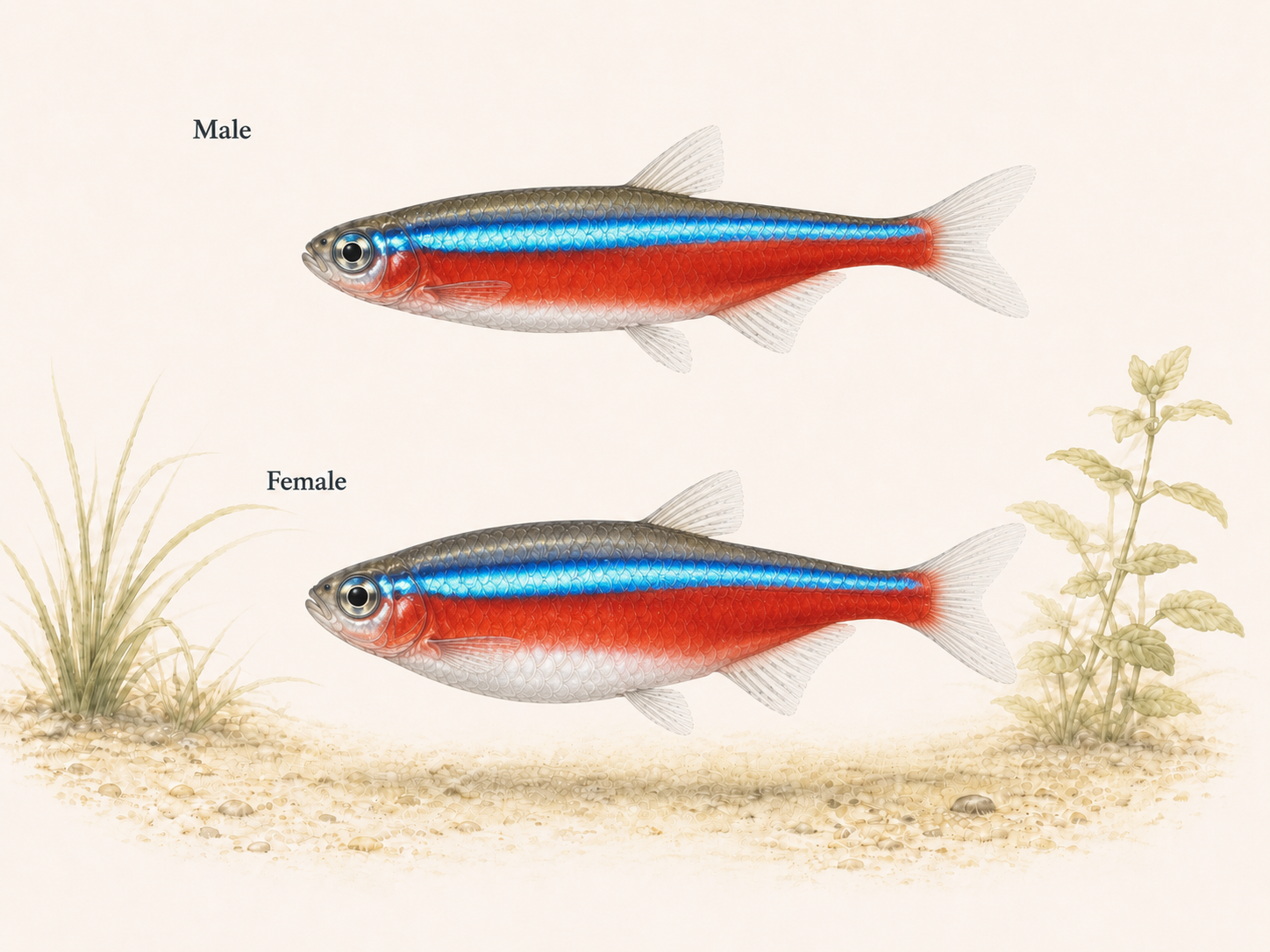
The Cardinal Tetra is a small, slender-bodied characin that rarely exceeds 5 cm in total length. Its body is laterally compressed and torpedo-shaped, giving it a streamlined profile perfectly suited to life in flowing water. The most immediately striking feature is the brilliant iridescent blue-green stripe that runs horizontally from the tip of the snout, through the eye, and along the upper flank to the base of the adipose fin. This stripe is not produced by pigment but by light-refracting guanine crystals within specialised cells called iridophores, which is why its intensity can appear to shift depending on the angle of the light and the viewing position.
Beneath this luminous blue band lies the feature that sets the Cardinal Tetra apart from the Neon Tetra: a deep, rich red that extends from beneath the eye all the way to the caudal peduncle, covering the entire lower half of the body. In the Neon Tetra, this red colouration is confined to the rear portion of the fish only. The belly is typically a lighter silvery-white, and the fins are largely transparent with a very faint hint of colour. The dorsal and anal fins may show a subtle whitish edging. The adipose fin, characteristic of the characin family, is small and translucent.
Sexual dimorphism is subtle and can be difficult to detect outside of breeding condition. Females tend to be slightly rounder and deeper-bodied when viewed from above, particularly when gravid with eggs. Males are generally a touch slimmer and may appear marginally more intensely coloured, though this is not a reliable means of sexing. When kept in optimal water conditions with subdued lighting and a dark substrate, the colours of the Cardinal Tetra become exceptionally vivid, producing one of the most spectacular displays available from any freshwater fish.
Natural Habitat
Cardinal Tetras are found in the wild across a broad range within the upper reaches of the Orinoco River basin in Venezuela and Colombia, and throughout the Rio Negro system in Brazil. These regions are characterised by their distinctive blackwater environments, where the water is stained a deep tea-brown colour by the decomposition of vast quantities of leaf litter and other organic matter. The tannins and humic acids released by this process create water that is extremely soft, highly acidic, and remarkably low in dissolved minerals. pH values in the wild frequently fall between 3.5 and 5.5, with general hardness often registering as essentially zero.
The habitats where Cardinal Tetras are typically collected include slow-moving forest streams, flooded igapó forests, and the margins of larger rivers where the current is gentle. The substrate in these environments is usually composed of fine white sand overlaid with a thick carpet of fallen leaves, seed pods, and submerged branches. Aquatic plants may be present but are often sparse, as the dark tannin-stained water limits light penetration. Instead, the fish find shelter among root tangles, submerged wood, and the leaf litter itself.
Water temperatures in these habitats are consistently warm, typically ranging from 24 to 30 °C depending on the season and exact locality. The near-absence of dissolved minerals means the water has very little buffering capacity, and pH can fluctuate with rainfall and seasonal flooding. Cardinal Tetras are found in large aggregations in the wild, often numbering in the hundreds or thousands, and they tend to occupy the mid-water column where they feed on tiny invertebrates, zooplankton, and organic detritus.
Understanding this natural environment is immensely helpful when setting up a Cardinal Tetra aquarium. While captive-bred specimens can tolerate a wider range of conditions than their wild-caught counterparts, all Cardinal Tetras will display their best colours and most natural behaviour in water that at least approximates the soft, acidic conditions of their native blackwater streams.
Tank Size and Setup
A minimum tank size of 60 litres is recommended for a small group of Cardinal Tetras, though a larger aquarium of 80 to 120 litres or more is preferable and will allow you to keep a more impressive shoal. Cardinal Tetras are active swimmers and naturally form large groups, so they benefit considerably from the additional swimming space that a longer tank provides. A tank measuring at least 60 cm in length should be considered the starting point, with longer dimensions being preferable to taller ones.
The ideal setup for Cardinal Tetras aims to replicate, at least in spirit, the blackwater environments they inhabit in the wild. A dark, fine-grained substrate such as dark sand or specialised aquarium soil is an excellent foundation, as it not only looks natural but also helps to intensify the fish’s colours through contrast. Driftwood and bogwood should feature prominently in the aquascape, providing both visual structure and a source of tannins that will naturally soften the water and tint it a gentle amber hue. Indian almond leaves, oak leaves, or alder cones can be added to further condition the water and create a more authentic environment.
Live plants are warmly recommended and will be appreciated by the fish, though the choice of species should reflect the relatively low light conditions that suit Cardinal Tetras best. Hardy, low-light tolerant plants such as Java Fern, Anubias, Cryptocoryne species, and various mosses work beautifully. Floating plants are particularly valuable, as they diffuse overhead light and create the dappled, shaded conditions under which Cardinal Tetras feel most secure and display their most vivid colouration. Avoid excessively bright lighting, which can cause the fish to appear washed out and may make them feel exposed and stressed.
Open swimming space in the middle of the tank is essential, as the fish spend much of their time cruising together in the mid-water column. Arrange hardscape and planting around the sides and rear of the tank to create a natural corridor for the shoal to move through. A well-fitting lid or cover glass is advisable, as Cardinal Tetras can occasionally jump, particularly if startled.
Water Parameters
Cardinal Tetras are somewhat more demanding in their water chemistry requirements than many commonly kept community fish. While captive-bred specimens have become more adaptable over the years, maintaining appropriate water conditions remains one of the most important factors in keeping these fish healthy and colourful. The key priorities are soft, acidic water with minimal dissolved pollutants and stable conditions.
| Temperature | 24–28 °C |
| pH | 4.5–7.0 |
| General hardness (GH) | 1–8 dGH |
| Carbonate hardness (KH) | 1–4 dKH |
| Ammonia | 0 ppm |
| Nitrite | 0 ppm |
| Nitrate | Below 20 ppm |
For general community keeping, a temperature of around 26 °C and a pH between 5.5 and 6.5 represent the sweet spot where Cardinal Tetras truly thrive. They can tolerate neutral water of pH 7.0 reasonably well, especially captive-bred fish, but their colours and long-term health are demonstrably better in slightly acidic conditions. Hard, alkaline water should be avoided, as it can lead to chronic stress and increased susceptibility to disease.
If your tap water is moderately hard or alkaline, you may wish to consider using a reverse osmosis (RO) unit to produce purified water, which can then be remineralised to the desired parameters using a GH remineraliser. Alternatively, mixing RO water with tap water in appropriate proportions can achieve suitable softness. The addition of tannin-releasing materials such as driftwood, Indian almond leaves, and peat filtration media will also help to naturally lower pH and add beneficial humic substances to the water.
Consistency is arguably more important than achieving any single target number. Cardinal Tetras are sensitive to sudden fluctuations in temperature, pH, or hardness, so any water changes should be performed with pre-conditioned water that closely matches the tank conditions. Regular partial water changes of 20 to 25 per cent on a weekly basis are recommended to maintain water quality without causing undue parameter swings.
Filtration and Equipment
Cardinal Tetras do not require powerful filtration, and in fact an excessively strong current can be detrimental, as these are fish adapted to gentle or near-still water in the wild. A quality sponge filter is an excellent choice for a dedicated Cardinal Tetra tank, providing reliable biological filtration with minimal water disturbance. For larger or more densely stocked aquariums, a small hang-on-back filter or canister filter with an adjustable flow rate works well. If using a more powerful filter, positioning the outlet to baffle the flow against the glass or using a spray bar will help to reduce the current to a comfortable level.
A reliable heater is essential, as Cardinal Tetras require consistently warm water. Choose a heater with a thermostat rated for your tank volume and position it near a gentle area of water circulation to ensure even heat distribution. A separate thermometer — digital or glass — is a worthwhile investment for monitoring accuracy independently of the heater’s built-in thermostat.
Lighting should be subdued to moderate. Cardinal Tetras originate from dimly lit blackwater environments, and their iridescent colours are actually most striking under low to moderate lighting conditions rather than intense illumination. If you are growing live plants, select a light that meets the needs of your plant species but consider using floating plants to create areas of shade. A timer set for 8 to 10 hours of light per day will provide a natural photoperiod and help to control algae growth.
An air pump is not strictly necessary if your filter provides adequate surface agitation for gas exchange, but it can be useful for powering sponge filters or providing supplemental aeration in warmer conditions when dissolved oxygen levels may drop. Peat granules or specialised blackwater extract added to the filter can be beneficial for conditioning the water to more closely match the fish’s natural environment.
Diet and Feeding
Cardinal Tetras are omnivores with a diet that in the wild consists primarily of tiny invertebrates, insect larvae, zooplankton, and small quantities of organic detritus and algae. In the aquarium they are not fussy eaters and will accept a wide range of commercially prepared and live foods, making them straightforward to feed once settled into their environment.
A high-quality micro-granule or small flake food designed for tropical fish should form the staple of the diet. Look for products with a high proportion of whole fish or invertebrate ingredients and avoid those padded out with excessive fillers. The food particles should be small enough for the Cardinal Tetra’s diminutive mouth; crushing larger flakes between the fingers before adding them to the tank is a simple way to ensure appropriate sizing.
To bring out the best colour and promote overall vitality, supplement the staple diet with regular offerings of frozen or live foods. Frozen bloodworm, daphnia, brine shrimp, cyclops, and mosquito larvae are all eagerly accepted and provide valuable nutritional variety. Live foods, when available from a trusted source, are particularly stimulating and can encourage more natural foraging behaviour. Newly hatched brine shrimp (Artemia nauplii) are an outstanding treat and are small enough to be consumed with ease.
Feed small amounts two to three times per day rather than one large feeding. Cardinal Tetras have small stomachs and process food quickly, so frequent small meals more closely mirror their natural grazing behaviour and reduce the risk of uneaten food fouling the water. Each feeding session should provide only as much food as the fish can consume within two to three minutes. Overfeeding is a common cause of water quality deterioration in small aquariums and should be carefully avoided.
Behaviour and Temperament
Cardinal Tetras are peaceful, social fish that should always be kept in groups. A minimum shoal of eight is recommended, but larger groups of fifteen, twenty, or more are far preferable and will result in more confident, naturally behaving fish that spend more time in the open. In very small groups, Cardinal Tetras can become timid and may spend extended periods hiding among the décor, which defeats the purpose of keeping such a visually stunning species.
When kept in appropriate numbers, Cardinal Tetras form a loose, flowing shoal that moves gracefully through the mid-water column. They tighten their formation when they feel threatened and spread out to explore and feed when relaxed. Watching a large group of Cardinals drift through a well-planted aquarium is one of the genuinely captivating sights in the fishkeeping hobby. There is very little aggression within the group, though occasional minor chasing or jockeying for position within the shoal is normal and harmless.
Cardinal Tetras are primarily diurnal, being most active during daylight hours and retreating to quieter areas of the tank as the lights dim. They tend to be somewhat shy when first introduced to a new aquarium, often hiding and displaying muted colours for the first few days. This is entirely normal behaviour and should not cause alarm. As the fish acclimatise and establish their routine, they will gradually venture out more and their colour will intensify. The presence of floating plants and areas of dim lighting within the tank greatly accelerates this settling-in process, as the fish feel more secure when they are not exposed to bright overhead light.
One important behavioural consideration is that Cardinal Tetras can be sensitive to sudden changes in their environment. Loud noises, vibrations, abrupt lighting changes, or the introduction of boisterous tank mates can all cause stress. A calm, stable environment is the key to seeing Cardinal Tetras at their best.
Tank Mates
The Cardinal Tetra’s peaceful nature makes it compatible with a wide range of similarly gentle community fish. The ideal tank mates are species that share a preference for soft, acidic water, are not aggressive or overly boisterous, and are too small to view the Cardinal Tetra as a potential meal. Avoid housing them with any fish large enough to fit a Cardinal Tetra in its mouth, as even otherwise peaceful species may opportunistically prey on these small tetras.
Good tank mates
- Neon Tetra — A close relative with identical water requirements, creating a beautiful mixed tetra display when kept alongside Cardinals.
- Rummy-nose Tetra — Another tight-shoaling tetra that thrives in soft, acidic water and adds complementary colour and movement to the aquarium.
- Ember Tetra — A tiny, peaceful species whose warm orange tones contrast beautifully with the Cardinal Tetra’s blue and red.
- Corydoras sterbai — A warm-water-tolerant bottom dweller that peacefully occupies a different zone of the tank and helps to clean up uneaten food.
- Otocinclus — A gentle, small algae-eating catfish that shares the Cardinal’s preference for soft, clean water and poses no threat whatsoever.
- Harlequin Rasbora — A peaceful, similarly sized shoaling fish that enjoys comparable water conditions and adds a warm coppery presence to the tank.
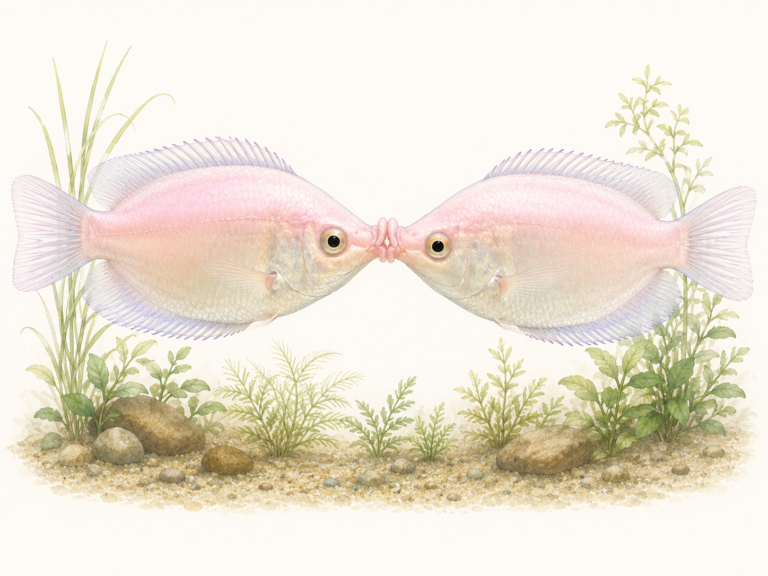
- Honey Gourami — A calm, small gourami that makes an excellent centrepiece fish in a Cardinal Tetra community without causing any aggression.
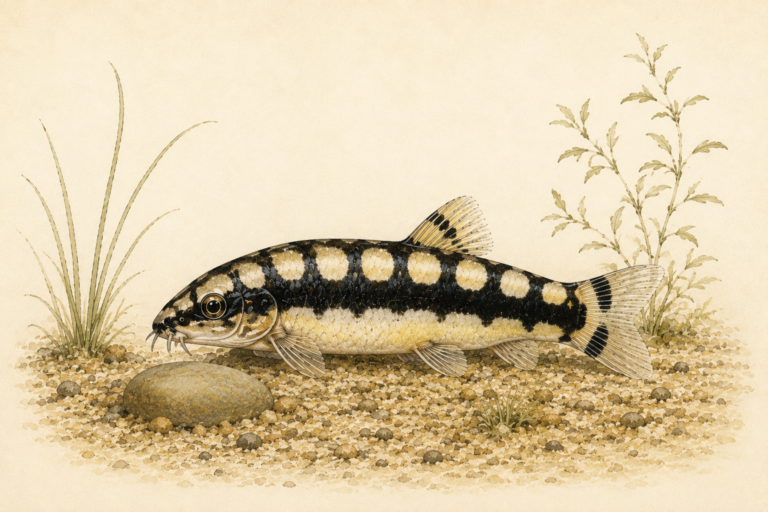
- Kuhli Loach — A peaceful, nocturnal bottom dweller that stays out of the Cardinals’ way and adds interest to the lower levels of the aquarium.
- Amano Shrimp — A useful algae-eating invertebrate that is too large to be eaten by Cardinals and coexists peacefully.
- Pygmy Corydoras — A diminutive, sociable catfish that often hovers in mid-water alongside tetras, making it an endearing companion species.
Fish to avoid
- Oscar — A large, predatory cichlid that will readily consume Cardinal Tetras and requires entirely different water conditions.
- Angelfish — Although sometimes suggested as tank mates, adult Angelfish are large enough to eat Cardinal Tetras, especially at night when the tetras are resting.
- Tiger Barb — A boisterous, nippy species that can harass and stress small, peaceful tetras like Cardinals.
- Convict Cichlid — An aggressive, territorial cichlid that is wholly unsuitable for a peaceful community with small tetras.
- African Cichlids — Most Rift Lake cichlids require hard, alkaline water that is the polar opposite of what Cardinal Tetras need and are typically too aggressive.
- Red-tailed Black Shark — A territorial and sometimes aggressive fish that can intimidate and chase small, timid species like Cardinal Tetras.
- Green Terror — A large, predatory cichlid that is completely incompatible with any small community fish.
- Bucktooth Tetra — Despite being a fellow tetra, this species is a notorious scale-eater and predator of smaller fish.
Breeding
Breeding Cardinal Tetras in captivity is a genuinely challenging endeavour that places this species firmly in the advanced category for aquarium propagation. While it is certainly achievable with dedication and careful preparation, it is significantly more difficult than breeding the closely related Neon Tetra. The primary obstacles are the extremely specific water conditions required for egg viability and the pronounced sensitivity of the eggs and fry to light and water quality.
To attempt breeding, a separate spawning tank should be set up. A small aquarium of 15 to 20 litres is adequate. The water must be extremely soft, with a general hardness of 1 to 2 dGH or lower, and very acidic, with a pH between 5.0 and 6.0. A temperature of 26 to 27 °C is appropriate. RO water remineralised to the barest minimum is typically necessary to achieve these conditions. The tank should be very dimly lit or completely darkened, as Cardinal Tetra eggs are highly photosensitive and will be destroyed by exposure to light. A clump of fine-leaved plants such as Java Moss, or a purpose-made spawning mop, should be provided as an egg-laying substrate. A thin layer of mesh above the tank floor can help to protect fallen eggs from being eaten by the parents.
Condition a pair or small group of proven adults with generous feedings of live and frozen foods for one to two weeks before transferring them to the spawning tank. Spawning typically occurs in the evening or during the night and involves the pair swimming side by side, with the female releasing small batches of eggs that are fertilised by the male as they scatter among the plants or fall to the substrate. A single spawning event may produce between 100 and 500 eggs.
The adults should be removed immediately after spawning, as they will readily consume their own eggs. The eggs are tiny, translucent, and adhesive. They typically hatch within 24 to 36 hours at the recommended temperature. The fry are minute and will survive on their yolk sac for a further three to four days before becoming free-swimming and requiring their first external food. Infusoria, paramecium cultures, or commercially available liquid fry food are essential first foods, as the fry are too small to accept even newly hatched brine shrimp initially. After approximately one to two weeks, they can be transitioned to freshly hatched Artemia nauplii and microworms.
Throughout the rearing process, maintaining impeccable water quality is paramount. The fry are extremely delicate, and even minor spikes in ammonia or sudden shifts in pH can cause heavy losses. Gentle sponge filtration is recommended to avoid drawing in the tiny fry. The tank should be kept dark or very dimly lit for the first week or two, with light levels gradually increased as the fry grow. Growth is relatively slow, and it may take three to four months before the juvenile Cardinal Tetras begin to develop their characteristic adult colouration.
Common Diseases
Cardinal Tetras are generally robust fish when maintained in appropriate water conditions, but they are susceptible to a number of diseases, some of which are particularly associated with this species. Prevention through good water quality, a balanced diet, and careful quarantine of new additions is always the best strategy.
Neon Tetra Disease (NTD) is perhaps the most feared ailment among keepers of small characins. Despite its name, it affects Cardinal Tetras and several other species equally. Caused by the microsporidian parasite Pleistophora hyphessobryconis, it manifests as progressive loss of colour, often appearing as pale or whitish patches beneath the skin, accompanied by a loss of shoaling behaviour, erratic swimming, and eventual emaciation. There is no reliable cure for NTD, and affected fish should be humanely euthanised and removed promptly to prevent transmission to other individuals. Purchasing fish from reputable sources and quarantining all new arrivals for at least two to four weeks is the most effective preventative measure.
It is worth noting that a bacterial condition sometimes called False Neon Tetra Disease can present with very similar symptoms. This is caused by bacterial infection rather than the Pleistophora parasite and may respond to antibiotic treatment if caught early. Distinguishing between the two conditions can be difficult without laboratory analysis, but if the disease progresses slowly and affects multiple fish simultaneously, a bacterial cause may be more likely.
Ich, or white spot disease, caused by the protozoan Ichthyophthirius multifiliis, is another common ailment. It presents as small white cysts on the fins and body and is usually triggered by stress, temperature fluctuations, or the introduction of infected fish. Treatment involves gradually raising the water temperature to 28–30 °C and adding an appropriate ich medication at half the recommended dose, as tetras can be sensitive to certain treatments. Cardinal Tetras are also susceptible to velvet disease (Piscinoodinium), fin rot, and various fungal infections, all of which are best prevented through diligent water maintenance and avoided by never introducing sick fish to an established tank.
Stress is the underlying factor in the vast majority of disease outbreaks. Keeping Cardinal Tetras in appropriate water conditions, in sufficiently large groups, with compatible tank mates, and in a well-maintained aquarium will go a very long way towards preventing illness.
FAQs
What is the difference between a Cardinal Tetra and a Neon Tetra?
The most reliable way to distinguish the two species is by looking at the extent of the red colouration on the lower body. In the Cardinal Tetra, the red band runs the entire length of the body from the head to the base of the tail. In the Neon Tetra, the red is restricted to the posterior half of the body only, with the front half being silvery-white below the blue stripe. Cardinal Tetras also tend to grow slightly larger and are generally a touch more demanding in their water chemistry requirements, preferring softer and more acidic conditions than Neon Tetras.
How many Cardinal Tetras should I keep together?
A minimum group of eight is recommended, but Cardinal Tetras are far happier and more impressive in larger groups. If your tank volume allows, keeping fifteen, twenty, or more will produce a much more natural-looking shoal and result in bolder, less skittish fish. In very small groups, Cardinal Tetras tend to hide and may display stressed, washed-out colouration. The visual impact of a large shoal moving together through a planted aquarium is one of the great pleasures of keeping this species.
Are Cardinal Tetras suitable for beginners?
Cardinal Tetras can be kept by relatively new fishkeepers, provided the tank is fully cycled before the fish are introduced and the keeper is willing to maintain stable, appropriate water conditions. They are not the most forgiving species if water quality is neglected or parameters swing dramatically. For absolute beginners, starting with the slightly hardier Neon Tetra may be a more sensible introduction to the hobby, with a transition to Cardinals once experience and confidence have been gained.
Why do my Cardinal Tetras look pale?
Pale or faded colouration in Cardinal Tetras is almost always a sign of stress or suboptimal conditions. Common causes include excessively bright lighting, water that is too hard or alkaline, poor water quality with elevated nitrate levels, an insufficiently sized group, aggressive or boisterous tank mates, and recent transport or acclimatisation stress. Ensuring soft, slightly acidic water, subdued lighting, a dark substrate, and a peaceful environment with plenty of companions will typically restore full colour within a few days to a couple of weeks.
Can Cardinal Tetras live with shrimp?
Cardinal Tetras are generally compatible with larger ornamental shrimp species such as Amano Shrimp and adult Cherry Shrimp. However, they may prey upon very small shrimp and will almost certainly eat newborn shrimplets if given the opportunity. If you are attempting to breed dwarf shrimp in the same tank as Cardinal Tetras, providing dense plant cover, particularly mosses, will give the shrimplets hiding places that improve their survival rate, though some predation is inevitable.
Related Guides
- Neon Tetra Care Guide — The Cardinal Tetra’s most famous relative, with similar care requirements and an excellent species for comparison.
- Green Neon Tetra Care Guide — The third member of the Paracheirodon genus, a smaller species ideal for nano blackwater setups.
- Rummy-nose Tetra Care Guide — Another outstanding soft-water shoaling tetra that pairs beautifully with Cardinal Tetras in community tanks.
- Blackwater Aquarium Setup Guide — A comprehensive guide to creating the tannin-stained, soft-water environments that Cardinal Tetras naturally inhabit.
- Corydoras sterbai Care Guide — One of the best bottom-dwelling companions for Cardinal Tetras, tolerant of the warmer temperatures they prefer.
- How to Cycle an Aquarium — Essential reading before introducing any fish, particularly sensitive species like the Cardinal Tetra.