Guppy Care Guide — Tank Setup, Feeding and Breeding
Introduction
If there is a single fish that has introduced more people to the hobby of fishkeeping than any other, it is almost certainly the guppy. Poecilia reticulata has been a staple of the aquarium world for well over a century, and its popularity shows no signs of fading. Small, colourful, hardy, and endlessly variable, the guppy manages to be both the perfect beginner fish and a lifelong obsession for selective breeders who dedicate entire fish rooms to perfecting a single tail shape or colour strain. It is a fish that genuinely has something to offer everyone.
People love guppies for a long list of reasons. Males are spectacularly colourful, displaying an almost absurd range of patterns and fin shapes that rival fish costing ten times as much. They are active, always visible, and interact with their environment in a way that makes a tank feel alive. They breed readily, which means many keepers get their first experience raising fry without needing any specialised equipment. And they are peaceful community fish that coexist happily with a wide range of tank mates, making them a natural fit for nearly any tropical setup.
Guppies are ideal for beginners, but calling them a “beginner fish” sells them short. Experienced aquarists keep them too, whether for breeding projects, nano tank communities, or simply because a well-planted tank full of healthy guppies is a genuinely beautiful thing to look at. If you are setting up your first aquarium or your fifteenth, the guppy deserves serious consideration. This guide covers everything you need to keep them thriving.
Quick stats
| Scientific name | Poecilia reticulata |
| Family | Poeciliidae |
| Origin | Northeast South America and the Caribbean (Venezuela, Trinidad, Barbados, Guyana) |
| Adult size | Males 3–4 cm; Females 4–6 cm |
| Lifespan | 2–3 years |
| Difficulty | Beginner |
| Breeding difficulty | Easy |
| Temperature | 22–28 °C |
| pH range | 6.8–8.0 |
| Minimum tank size | 40 litres |
Appearance
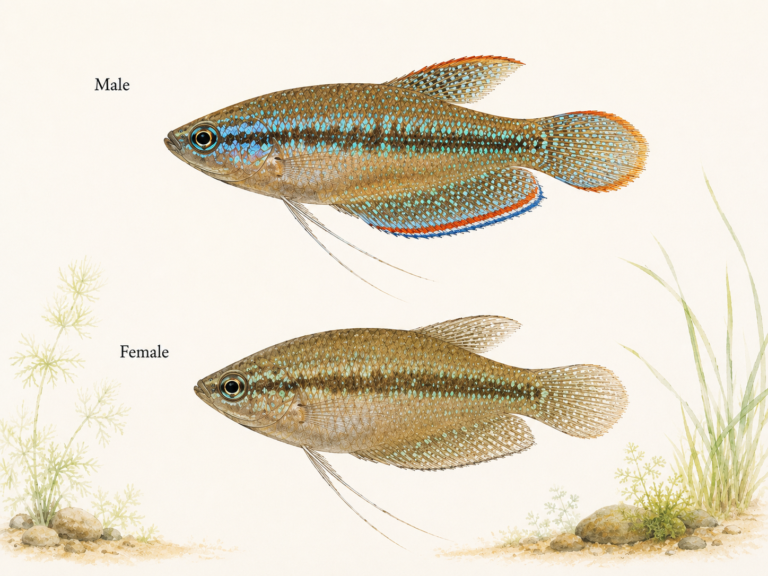
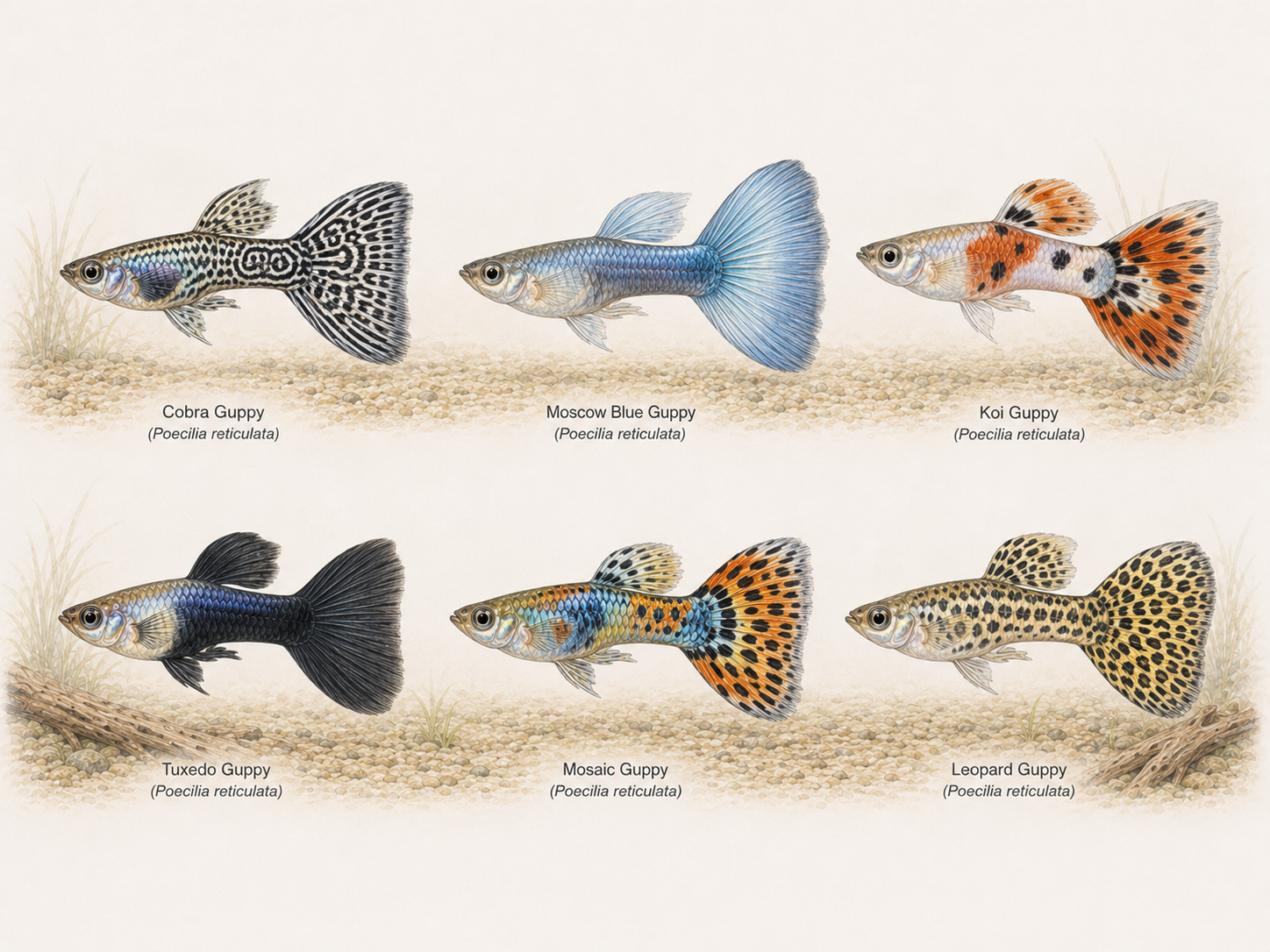
Male guppies are where all the visual drama lives. They are smaller than females, typically reaching 3 to 4 centimetres in body length, but their caudal fins can add considerably to their overall size. Depending on the strain, tails can be round, fan-shaped, lyre-shaped, swordtail, pin-tail, or the extravagant delta and half-moon forms favoured by show breeders. Colours span effectively the entire spectrum: solid reds, blues, greens, yellows, blacks, purples, and whites, plus metallic sheens, leopard spots, snakeskin patterns, tuxedo markings, and mosaic designs. No two males from a mixed gene pool will look exactly alike, which is part of their charm.
Females are larger, reaching 4 to 6 centimetres, and considerably plainer. They tend to be a soft grey or olive with perhaps a slight colour wash on the tail, though selectively bred females from high-quality strains can show more colour than wild-type fish. Females have a rounder, deeper body profile than males, and their anal fin is fan-shaped rather than modified into a gonopodium, which is the narrow, pointed fin males use for reproduction. Telling the sexes apart is straightforward even for a complete beginner, as the differences in size, colour, and fin shape are obvious from a young age.
Natural habitat
Wild guppies originate from freshwater and slightly brackish habitats in northeastern South America and the southern Caribbean islands, particularly Venezuela, Trinidad and Tobago, Barbados, and parts of Guyana and Brazil. They inhabit a wide range of water types, from warm, slow-moving lowland streams and drainage ditches to slightly cooler, faster-flowing mountain creeks. This natural adaptability is a large part of why they are so robust in captivity. Guppies have also been introduced to tropical and subtropical regions across the globe as a mosquito control measure, and feral populations now exist on every continent except Antarctica.
Their native waters tend to be warm, slightly hard, and neutral to mildly alkaline. Vegetation is often abundant, with floating plants, marginal grasses, and submerged plant matter providing cover from predators. The substrate varies from sandy to silty, and the water can range from clear to tannin-stained depending on the specific location. For aquarium purposes, the key takeaway is that guppies appreciate some plant cover, moderate water flow, and stable water chemistry. They are not fussy about exact parameters, but they do best in water that is not too soft or acidic, which distinguishes them from many other popular tropical species.
Tank size and setup
A group of guppies can be kept in a tank as small as 40 litres, which is suitable for a trio of one male and two females or a small group of males. If you plan to keep a larger community or allow breeding, 60 to 80 litres gives you far more flexibility and stability. Bigger tanks are always easier to maintain, and guppies are active swimmers that appreciate the extra space. For a mixed community tank with other species, 80 litres and above is a sensible starting point.
Substrate choice is largely down to personal preference. Fine gravel or sand both work well. Pool filter sand is a cheap and effective option, while something like Seachem Flourite or CaribSea Eco-Complete suits planted setups where you want to encourage root growth. Guppies look particularly striking against a dark substrate, which brings out the intensity of their colours.
Live plants are highly recommended. Guppies feel more secure with vegetation to retreat into, and plants help stabilise water quality. Good choices include Java fern (Microsorum pteropus), Anubias barteri, Amazon sword (Echinodorus bleheri), Vallisneria spiralis, and Hornwort (Ceratophyllum demersum). Floating plants such as Amazon frogbit (Limnobium laevigatum) or Salvinia are excellent for diffusing overhead light and providing cover, which is especially important if you want fry to survive in the main tank. A few pieces of driftwood or smooth rock give the tank a natural feel without restricting swimming space.
Lighting should be moderate. Standard LED aquarium lights are fine. Guppies are not sensitive to light levels, but heavily planted tanks benefit from a decent light with a timer set to around 8 to 10 hours per day. Water flow should be gentle to moderate. Guppies, particularly the long-finned fancy strains, are not strong swimmers and will struggle in a strong current. If your filter output is too powerful, baffle it with a sponge or adjust the flow rate.
Water parameters
| Temperature | 22–28 °C (ideal range 24–26 °C) |
| pH | 6.8–8.0 |
| Hardness (GH) | 8–12 dGH |
| Ammonia | 0 ppm |
| Nitrite | 0 ppm |
| Nitrate | Below 20 ppm (below 40 ppm tolerated) |
Guppies are tolerant fish, but they genuinely thrive in moderately hard, slightly alkaline water. Many tap water supplies in the UK, Europe, and much of the United States are a natural fit. Very soft, acidic water is not ideal and can lead to health problems over time. If your water is particularly soft, adding a small amount of crushed coral to the filter or substrate can help raise hardness and buffer the pH. As with all fish, ammonia and nitrite must always be at zero in an established tank. Regular partial water changes of 20 to 30 percent weekly will keep nitrates in check and maintain overall water quality.
Filtration and equipment
Guppies do not need powerful filtration, but they do need reliable filtration. A sponge filter is an excellent choice for guppy tanks, especially breeding setups, because it provides gentle flow and will not suck up fry. The Hikari Bacto-Surge or an equivalent air-driven sponge filter works well for tanks up to about 60 litres. For larger tanks or community setups, a hang-on-back filter like the Fluval AquaClear 30 or a small internal filter is perfectly adequate. Just ensure the intake is covered with a pre-filter sponge if there is any chance of fry in the tank.
A heater is necessary unless you keep your home consistently above 22 °C year-round. An adjustable heater rated for your tank size is the way to go. The Eheim Jäger and Fluval M series are well-regarded and reliable. Set it to around 24 to 26 °C for general keeping. A thermometer, either a digital probe or a simple glass stick-on, lets you confirm the heater is doing its job.
A liquid water testing kit is essential, particularly during the cycling phase and the first few months of a new tank. The API Freshwater Master Test Kit is the standard recommendation for good reason: it is accurate, affordable, and tests for ammonia, nitrite, nitrate, and pH. Avoid test strips where possible, as they are less reliable and more expensive per test in the long run.
Diet and feeding
In the wild, guppies are omnivores with a diet that leans toward the micro end of the food chain. They eat algae, biofilm, tiny aquatic invertebrates, insect larvae, and organic detritus. They are not picky, and this carries over into captivity where they will eat practically anything offered.
A high-quality flake or micro-pellet should form the staple of their diet. Fluval Bug Bites for small tropical fish, Hikari Micro Pellets, and Omega One Color Mini Pellets are all excellent choices. Supplement this with frozen or live foods a few times a week: baby brine shrimp, daphnia, cyclops, and bloodworms are all readily accepted and encourage good colour development. Blanched vegetables like zucchini medallions or shelled peas offer variety, though guppies will naturally graze on algae and biofilm in a planted tank, which is beneficial.
Feed small amounts once or twice a day, giving only what the fish can consume in about two minutes. Guppies are enthusiastic eaters and will happily overeat if given the chance, so portion control matters. Overfeeding is the fastest route to poor water quality in a small tank, and poor water quality is the fastest route to sick guppies. If you are raising fry, increase feeding to three or four small meals a day using crushed flake, powdered fry food, or freshly hatched baby brine shrimp.
Behaviour and temperament
Guppies are peaceful, social, and active. They spend most of their time in the middle and upper levels of the tank, swimming in loose groups and exploring their environment. Males are constantly on display, flaring their fins and performing courtship dances for any female in the vicinity. This behaviour is entertaining to watch, but it does mean females can get harassed if the male-to-female ratio is off. A ratio of one male to two or three females spreads the attention and reduces stress on individual females.
Male-only tanks are also a perfectly valid approach and eliminate the constant stream of fry that comes with mixed groups. Males may occasionally posture at each other, but actual aggression is rare and almost never results in injury. Guppies are curious fish that will investigate anything new in the tank, from a recently added plant to the siphon during a water change. They quickly learn to associate the sight of their keeper with food and will come to the front of the glass at feeding time. There is a reason people get attached to these little fish: they have genuine personality.
Tank mates
Good tank mates
- Corydoras catfish, Peaceful bottom dwellers that occupy a different zone and never bother guppies.
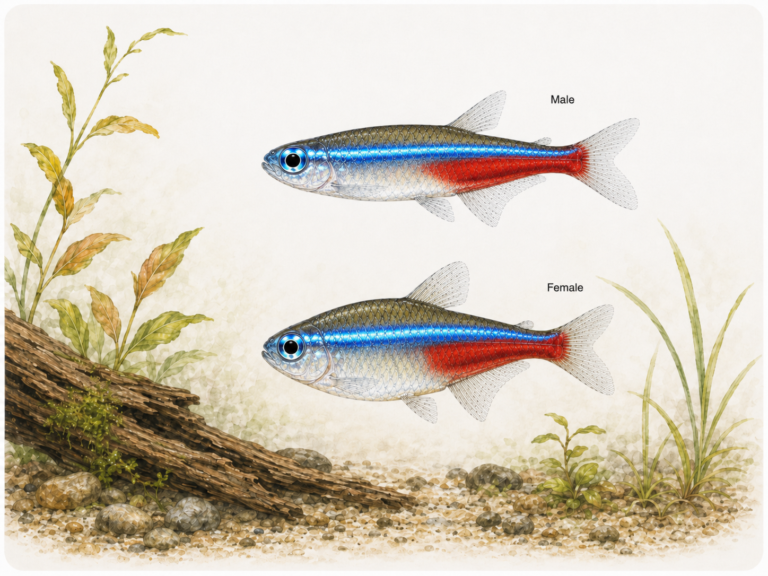
- Neon tetras, Small, calm schooling fish that coexist beautifully in a community tank.
- Harlequin rasboras, Gentle, similarly sized, and add a lovely splash of colour at the mid-level.
- Cherry shrimp, Great cleanup crew and safe with adult guppies, though tiny shrimplets may be eaten.
- Otocinclus catfish, Small algae eaters that are completely peaceful and stay out of the way.
- Platies, Fellow livebearers with a similar temperament and water parameter requirements.
- Bristlenose pleco, A useful algae eater that ignores guppies entirely, though requires a slightly larger tank.
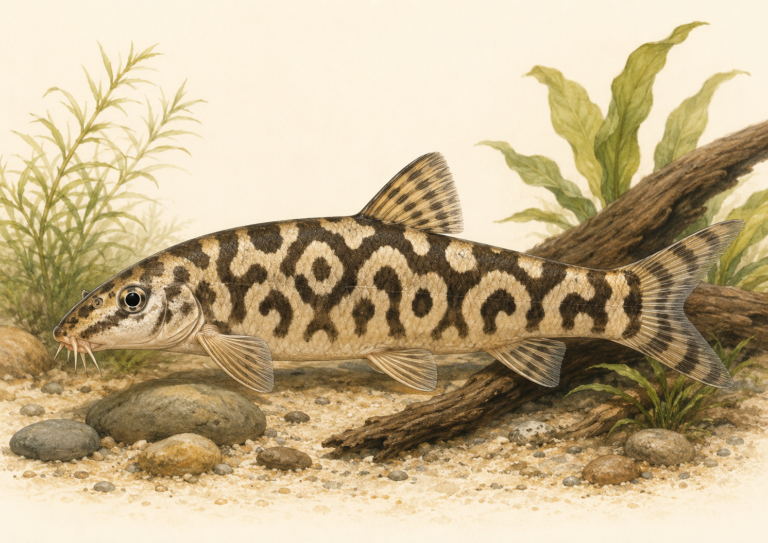
- Kuhli loaches, Peaceful nocturnal bottom dwellers that are fun to keep alongside guppies.
- Nerite snails, Excellent algae grazers and completely harmless to fish.
Fish to avoid
- Angelfish, Large enough to eat adult guppies and will almost certainly snack on fry.
- Betta fish, Male bettas often mistake male guppies for rival bettas due to the flowing tails and bright colours, leading to aggression.
- Tiger barbs, Notorious fin nippers that will shred guppy tails in short order.
- Oscars, Far too large and predatory; guppies would simply be food.
- Chinese algae eaters, Become aggressive and territorial as they mature and may latch onto guppies.
- Red tail sharks, Territorial bottom dwellers that can bully smaller fish relentlessly.
- African cichlids, Too aggressive and require different water chemistry for most species commonly kept.
Breeding
Guppies are livebearers, meaning females give birth to free-swimming fry rather than laying eggs. Breeding them is famously easy, in fact, the bigger challenge is usually preventing them from breeding. If you have males and females together in a healthy tank with decent water quality, you will have fry. It is practically inevitable.
Sexing guppies is straightforward. Males are smaller, far more colourful, and have a gonopodium, a narrow, pointed modification of the anal fin used to deliver sperm. Females are larger, rounder, and have a standard fan-shaped anal fin. You can reliably sex most guppies by the time they are four to six weeks old.
No special conditioning is required. A well-fed female in good water conditions will become pregnant after a single brief encounter with a male, and females can store sperm for several months, producing multiple batches of fry from a single mating. The gestation period is typically 21 to 30 days. As a female approaches delivery, you will notice her belly becoming visibly distended and a dark area near the base of the anal fin called the gravid spot becoming more prominent.
Females typically give birth to between 10 and 50 fry per brood, though experienced, well-fed females can produce more. The fry are tiny but fully formed and capable of swimming and feeding immediately. Adult guppies, including the mother, will eat fry if given the opportunity, so dense plant cover is essential if you want any to survive in the main tank. Floating plants like Java moss (Taxiphyllum barbieri) and Guppy grass (Najas guadalupensis) are particularly effective at providing hiding spots. Alternatively, move the pregnant female to a separate breeding tank and return her to the main tank after she gives birth.
Fry can be fed powdered fry food, crushed flake, or freshly hatched baby brine shrimp from day one. Feed small amounts three to four times daily. Growth is rapid with good feeding and clean water, and fry will begin showing colour within a few weeks. You can expect them to reach a sellable or tradeable size within two to three months.
Common diseases and health
Ich (white spot disease)
Ich is one of the most common diseases in freshwater aquariums and guppies are no exception. It presents as small white spots resembling grains of salt on the body and fins, often accompanied by flashing (rubbing against surfaces) and clamped fins. Raise the temperature gradually to 28 °C and treat with a white spot remedy such as eSHa Exit or API Super Ick Cure. Maintain treatment for the full recommended course, even after spots disappear, to catch the parasite at all stages of its life cycle.
Fin rot
Fin rot is usually a bacterial infection triggered by poor water quality or physical damage. The edges of the fins become ragged, discoloured, or appear to be dissolving. The first step is always to check and correct water parameters. Perform extra water changes and, if the condition does not improve, treat with an antibacterial medication such as eSHa 2000 or API Melafix. Severe cases may require a stronger antibiotic treatment. Catching it early makes all the difference.
Guppy disease (Protozoan infection, Tetrahymena)
Sometimes called guppy disease or guppy killer, this protozoan infection causes lethargy, loss of colour, skin lesions, and a wasting appearance. It can spread quickly through a tank and is often fatal if not caught early. Quarantine affected fish immediately. Treatment options include salt baths and anti-parasitic medications. Maintaining excellent water quality and avoiding overcrowding are the best preventative measures.
A general note on quarantining: always quarantine new fish for at least two weeks before adding them to your main tank. This simple step prevents the vast majority of disease outbreaks. A basic quarantine setup can be as simple as a 20-litre tank with a sponge filter, a heater, and a hiding spot. It is well worth the small investment.
Frequently asked questions
How many guppies can I keep in a 40-litre tank?
A 40-litre tank comfortably houses a group of around five to six guppies. If you are keeping a mixed-sex group, aim for one male to every two or three females to prevent the females from being overly harassed. Keep in mind that if you have both sexes, fry will arrive quickly and can overstock a small tank in a matter of months.
Can I keep male guppies together without females?
Yes, and many keepers prefer this approach. An all-male tank gives you all the colour and activity without the constant reproduction. Males may occasionally display at each other, but genuine aggression is uncommon. A group of six or more males in a well-planted tank makes for an excellent display.
Why are my guppies dying shortly after I buy them?
This is unfortunately common with mass-bred guppies from large-scale farms. These fish are often raised in medicated water and can struggle to adapt to new conditions. Poor water quality in the home tank is another frequent cause. Make sure your tank is fully cycled before adding fish, acclimate them slowly, and consider sourcing guppies from a reputable local breeder rather than a chain pet store.
Do guppies need a heater?
In most home environments, yes. Guppies are tropical fish and need a stable temperature between 22 and 28 °C. Unless your room never drops below 22 °C, a heater is necessary to prevent temperature swings, which stress fish and weaken their immune systems. An adjustable heater set to 24–26 °C is the standard recommendation.
How long are guppies pregnant for?
The gestation period for guppies is typically 21 to 30 days, though it can vary depending on temperature, the individual fish, and environmental conditions. Warmer water tends to shorten gestation slightly. A female’s gravid spot will darken and her belly will become noticeably swollen as she approaches delivery.