Rainbow Snakehead Gudgeon Care Guide — Tank Setup, Feeding and Breeding
Quick summary
The Rainbow Snakehead Gudgeon suits experienced keepers with a large tank of 300 litres or more, since this hardy predator will eat any fish or invertebrate small enough to fit in its mouth. It’s not a fit for typical community setups, but makes a rewarding centrepiece if paired only with similarly large, robust tank mates.
🐠 Build a tank around this fish
In this guide:
- Introduction
- Quick Stats
- Appearance
- Natural Habitat
- Tank Size and Setup
- Water Parameters
- Filtration and Equipment
- Diet and Feeding
- Behaviour and Temperament
- Tank Mates
- Breeding
- Common Diseases
- FAQs
Introduction
The Rainbow Snakehead Gudgeon, known scientifically as Giuris margaritaceus, is a striking and robust sleeper goby that has slowly garnered attention among dedicated freshwater aquarists seeking something genuinely unusual for their tanks. Despite its common name referencing snakeheads, this species is not a true snakehead at all but rather a member of the family Eleotridae, the sleeper gobies. The misleading name likely derives from its elongated body shape, broad head, and predatory disposition, all of which give it a superficial resemblance to members of the Channidae family.
Native to a vast range spanning the Indo-Pacific region, from eastern Africa through South and Southeast Asia to the islands of Oceania, Giuris margaritaceus inhabits freshwater and slightly brackish environments, often in lowland rivers and streams with access to the sea. It is an amphidromous species, meaning its larvae drift downstream to estuarine or coastal waters before migrating back into freshwater as juveniles. This fascinating life history makes it an ecologically important species across its range, though it remains relatively uncommon in the aquarium trade.
For aquarists willing to accommodate its size and temperament, the Rainbow Snakehead Gudgeon offers a rewarding keeping experience. It is a hardy, characterful fish that readily adapts to captive conditions once properly settled. Its iridescent colouration, which intensifies with maturity and good husbandry, makes it a genuinely eye-catching centrepiece species. This guide covers everything you need to know to keep Giuris margaritaceus successfully in the home aquarium.
Quick Stats
| Scientific name | Giuris margaritaceus |
| Common names | Rainbow Snakehead Gudgeon, Snakehead Gudgeon, Marbled Sleeper Goby, Tarpon Gudgeon |
| Family | Eleotridae |
| Origin | Widespread across the Indo-Pacific: eastern Africa, Madagascar, India, Sri Lanka, Southeast Asia, Indonesia, Philippines, Papua New Guinea, northern Australia, and various Pacific islands |
| Adult size | 20–30 cm (typically around 25 cm in aquaria) |
| Lifespan | 8–12 years |
| Difficulty | Moderate |
| Breeding difficulty | Difficult |
| Temperature | 22–28 °C |
| pH range | 6.5–8.0 |
| General hardness (GH) | 5–20 dGH |
| Carbonate hardness (KH) | 3–15 dKH |
| Minimum tank size | 300 litres |
| Conservation status | Least Concern (IUCN) |
Appearance
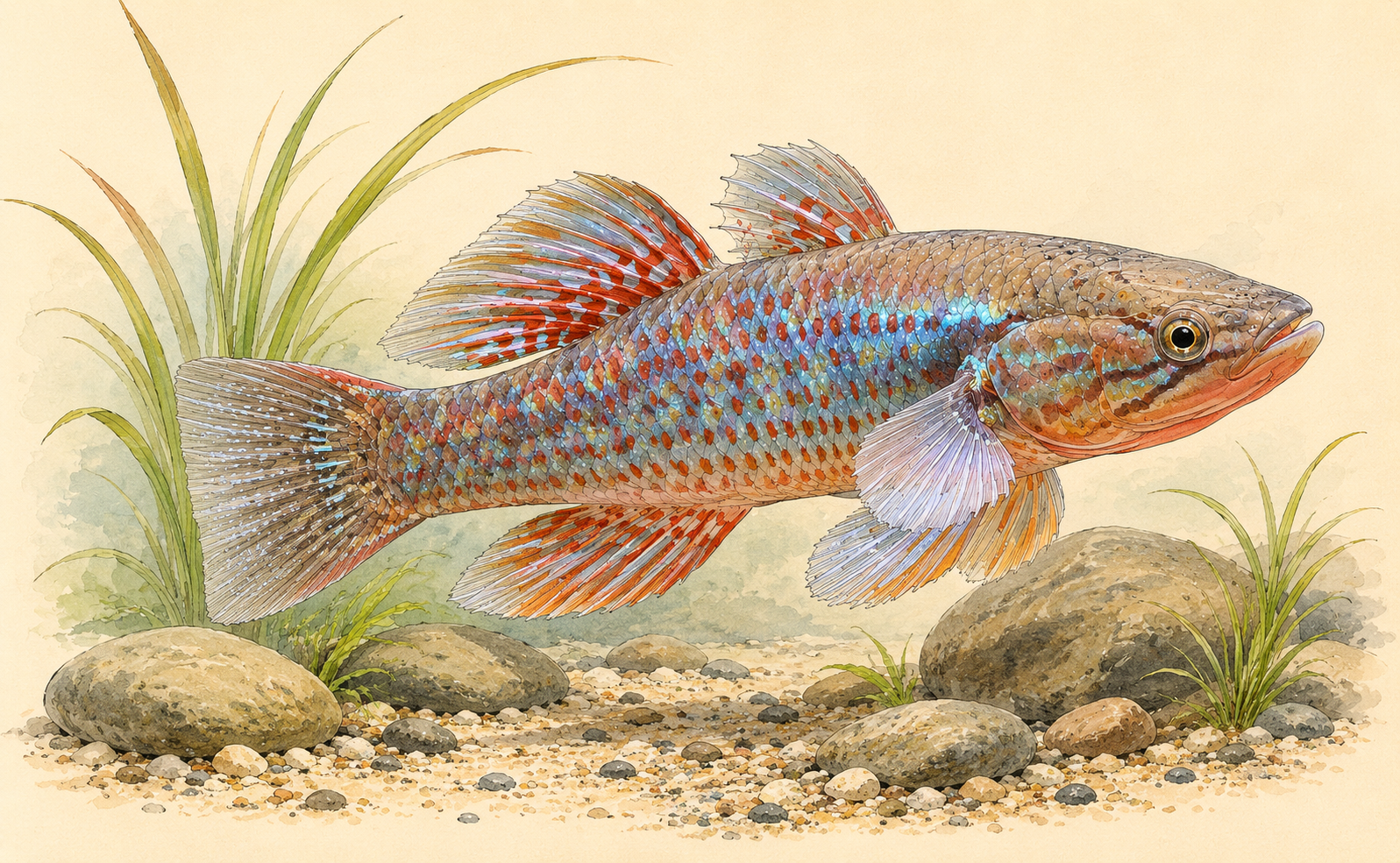
Giuris margaritaceus is a solidly built, elongated fish with a broad, flattened head and a wide terminal mouth that immediately betrays its predatory nature. The body is cylindrical in cross-section, tapering gently towards the caudal peduncle. Like all sleeper gobies, it possesses two separate dorsal fins rather than one continuous fin, which is a useful distinguishing feature from true gobies. The pelvic fins are notably separate rather than fused into a suction disc, another hallmark of the Eleotridae.
The base colouration is typically olive-brown to dark grey, overlaid with a scattering of pearlescent spots and markings that give the species both its scientific epithet (margaritaceus, meaning “pearly”) and its common name. Under good conditions and appropriate lighting, these spots shimmer with iridescent blues, greens, and golds, creating a genuinely rainbow-like effect that is most pronounced in mature males. The fins often display similar iridescence, with the dorsal and caudal fins frequently edged or spotted with blue-green highlights.
Juveniles are somewhat plainer, often displaying a series of dark lateral blotches or bars along the flanks that may fade or become less distinct as the fish matures. A dark stripe running from the snout through the eye to the operculum is usually visible at all ages. Sexual dimorphism is present but subtle outside of breeding condition. Males tend to grow slightly larger, develop a more robust head profile, and display more intense colouration, particularly along the fins. Females are generally a little more slender and may appear paler, though both sexes can be attractive when kept in optimal conditions.
The overall impression is of a powerful, alert predator with an understated elegance. While it may not have the immediate visual impact of brightly coloured cichlids or killifish, the pearlescent sheen and confident bearing of a well-kept Rainbow Snakehead Gudgeon make it a compelling addition to an appropriately sized aquarium.
Natural Habitat
Giuris margaritaceus has one of the broadest natural distributions of any eleotrid species, found across a sweeping arc from the rivers of eastern Africa and Madagascar, through the Indian subcontinent and Sri Lanka, across Southeast Asia, into the Indonesian archipelago, the Philippines, Papua New Guinea, northern Australia, and numerous Pacific island groups. This extraordinary range is facilitated by its amphidromous life history: larvae are swept downstream into brackish or marine environments, where they develop before migrating back upstream into freshwater habitats as juveniles.
In its adult freshwater phase, this species is most commonly encountered in lowland rivers, streams, and associated floodplain habitats at relatively low elevations, typically below 200 metres above sea level and often much closer to the coast. It favours areas with moderate to slow current, frequently found amongst submerged rocks, fallen timber, root tangles, and overhanging vegetation that provide both hunting cover and shelter. Substrates in its native waters range from sand and gravel to mud, and the species shows no strong preference, being highly adaptable in this regard.
Water conditions across its range are variable, reflecting its impressive physiological tolerance. It is found in soft, slightly acidic waters in some river systems and in harder, more alkaline conditions in others. Some populations inhabit waters with mild salinity, particularly in coastal streams and estuarine reaches, which speaks to the species’ euryhaline capabilities. Water temperatures in its native range typically fall between 22 °C and 30 °C, with seasonal fluctuations common in many habitats.
The Rainbow Snakehead Gudgeon is a benthic ambush predator in the wild, spending much of its time resting motionless on or near the substrate before lunging at passing prey. Its diet in nature consists primarily of smaller fish, aquatic insects, crustaceans, and other invertebrates. Understanding this sit-and-wait predatory strategy is key to replicating appropriate conditions in captivity and selecting suitable tank mates.
Tank Size and Setup
Given that Giuris margaritaceus can reach 25 to 30 cm in length and is a territorial, predatory species, a minimum tank volume of 300 litres is recommended for a single adult specimen. For a pair or a small group, a tank of 450 to 600 litres or more is advisable to allow sufficient space for each individual to establish its own territory and reduce the likelihood of aggression. A tank with a generous footprint is more important than height, as this is primarily a bottom-dwelling species that uses horizontal space rather than vertical.
The aquascape should be designed to provide ample cover and visual barriers. Large pieces of driftwood, smooth rocks, and sections of PVC pipe or ceramic caves all make excellent shelter options. Arranging hardscape to create distinct territories separated by line-of-sight breaks is particularly important if keeping more than one individual. Dense planting can be incorporated, though robust species such as Anubias, Java Fern, and Bolbitis are preferable, as delicate plants may be uprooted or damaged by the movement of these large, active fish. Floating plants can also be beneficial, as they diffuse overhead lighting and help the fish feel more secure.
The substrate should be fine to medium-grained sand or smooth gravel. Avoid sharp or coarse substrates that could abrade the fish’s ventral surface, as sleeper gobies spend a great deal of time resting directly on the bottom. A sandy substrate also allows for more natural behaviour, as the fish may occasionally rearrange small amounts of substrate around its preferred resting spots.
A secure, well-fitting lid is essential. While not renowned as leapers in the way that some snakeheads and killifish are, Giuris margaritaceus is perfectly capable of jumping, particularly when startled, newly introduced, or stressed. Ensure there are no gaps around filter intakes, heater cables, or other equipment through which the fish could escape. Lighting should be moderate rather than intense, reflecting the shaded habitats this species typically occupies in the wild.
Water Parameters
Giuris margaritaceus is a tolerant species when it comes to water chemistry, which is unsurprising given its vast natural range and amphidromous habits. Nevertheless, maintaining stable conditions within the recommended ranges is always preferable to relying on the fish’s hardiness. The following parameters represent the ideal target range for long-term captive maintenance.
| Temperature | 22–28 °C |
| pH | 6.5–8.0 |
| General hardness (GH) | 5–20 dGH |
| Carbonate hardness (KH) | 3–15 dKH |
| Ammonia | 0 ppm |
| Nitrite | 0 ppm |
| Nitrate | Below 30 ppm |
While the species can tolerate a broad range of hardness and pH values, a neutral to slightly alkaline pH around 7.0 to 7.5 with moderate hardness tends to suit most captive specimens well. Some keepers choose to add a small amount of marine salt to the aquarium (around 1–3 grams per litre) to mimic the mildly brackish conditions found in some of the species’ native habitats. This is not strictly necessary for long-term health but may benefit fish that appear stressed or that were recently imported from brackish-water collection sites.
Consistency is more important than hitting a precise number. Avoid sudden swings in temperature or chemistry, and carry out regular partial water changes of 20 to 30 per cent weekly to maintain excellent water quality. As a large, protein-heavy feeder, this species produces a significant bioload, making diligent maintenance an absolute requirement.
Filtration and Equipment
Robust filtration is non-negotiable for a species of this size and feeding habits. A high-quality external canister filter rated for at least 1.5 times the tank volume is the preferred choice, and running two filters in tandem provides both redundancy and additional biological filtration capacity. The filter should turn over the tank volume at least four to six times per hour to ensure adequate mechanical and biological processing of waste.
While Giuris margaritaceus does not require strong current and is naturally found in moderate to slow-flowing water, it does appreciate well-oxygenated conditions. An additional air pump and airstone, or a spray bar positioned at the surface, can help maintain dissolved oxygen levels, particularly in warmer conditions when oxygen solubility decreases. Positioning the filter outlet to create a gentle, directional flow across the tank mimics natural stream conditions without creating excessive turbulence that might stress a bottom-dwelling ambush predator.
A reliable, thermostatically controlled heater appropriate for the tank volume is essential. Given the size of aquarium required, two smaller heaters are often preferable to a single large unit, as they provide more even heat distribution and a safety net in case one fails. The heater should ideally be protected with a guard to prevent the fish from resting against it and sustaining burns, a genuine risk with large benthic species.
Standard aquarium lighting is perfectly adequate. The species does not have any specialised lighting requirements, and moderately dim conditions are generally preferred. If live plants are part of the setup, choose lighting that meets the plants’ needs while providing shaded retreats via floating vegetation or overhanging hardscape. A timer set for a photoperiod of eight to ten hours daily provides a consistent and appropriate light cycle.
Diet and Feeding
Giuris margaritaceus is an obligate carnivore and a voracious predator. In the wild, its diet consists of small fish, crustaceans, aquatic insect larvae, and other invertebrates. In captivity, replicating this protein-rich diet is essential for maintaining good health, colouration, and vigour.
Newly imported specimens may initially accept only live foods, and offering live river shrimp, earthworms, small fish, and aquatic insects can be an effective way to encourage feeding during the settling-in period. However, most individuals can be weaned onto dead or prepared foods with patience. High-quality sinking carnivore pellets, frozen prawns, mussel, whitebait, bloodworm, and lance fish all make excellent staple foods. Variety is important, so aim to rotate between several food types throughout the week to ensure a balanced nutritional intake.
Feed adult specimens once daily or every other day, offering an amount they can consume within a few minutes. Overfeeding is a common pitfall with large predatory species and leads rapidly to water quality problems. Juveniles and sub-adults should be fed daily to support growth, with portion sizes adjusted as the fish matures. Avoid feeding mammalian meat or poultry, as the lipid profiles of these foods are unsuitable for fish and can cause fatty deposits and organ damage over time.
It is worth noting that this species will readily consume any tank mate small enough to fit in its capacious mouth. This is not aggression in the traditional sense but simply the natural predatory behaviour of an opportunistic ambush feeder. Diet planning and tank mate selection must account for this reality.
Behaviour and Temperament
The Rainbow Snakehead Gudgeon is a sedentary, sit-and-wait predator by nature. It spends much of its time resting motionless on the substrate, on flat rocks, or wedged into crevices and caves, waiting for prey to stray within striking distance. This behaviour can give the impression that the fish is inactive or lethargic, but it is simply operating according to its evolved hunting strategy. When prey or food is detected, the fish launches itself forward with surprising speed and precision.
Territorial behaviour is a significant consideration, particularly when keeping multiple individuals. Males in particular can be aggressive towards conspecifics, and even mixed-sex pairs may squabble if the tank lacks sufficient space and visual barriers. In a large, well-structured aquarium with plenty of hiding spots and separated territories, it is possible to keep a small group, but the aquarist must be prepared to separate individuals if aggression becomes problematic. Introducing all fish simultaneously can help reduce territorial disputes compared to adding new individuals to an established territory.
Towards other species, Giuris margaritaceus is generally indifferent provided they are too large to be considered food. It is not an actively aggressive fish in the manner of many cichlids; it will not chase, harass, or fin-nip tank mates. However, any fish or invertebrate small enough to be swallowed will eventually be eaten, often under cover of darkness when the gudgeon becomes more active. This pragmatic predatory nature must be the primary consideration when selecting companions.
The species is predominantly crepuscular and nocturnal, showing increased activity during dawn, dusk, and nighttime hours. Keepers who observe their tanks in the evening or with dim blue lighting will often see a very different, more active fish than the apparently dormant creature visible during the day. Over time, captive specimens often become bolder and more active during daylight hours as they associate the keeper’s presence with food.
Tank Mates
Choosing appropriate tank mates for Giuris margaritaceus requires careful thought. The overriding principle is simple: if a fish can fit in the gudgeon’s mouth, it will eventually end up there. Tank mates should therefore be of similar size or large enough to be completely off the menu. Additionally, overly aggressive or territorial species that might bully the gudgeon during its inactive daytime periods should be avoided.
Good tank mates
- Silver Dollar (Metynnis hypsauchen), a peaceful, deep-bodied schooling fish that is far too large and tall to be swallowed and occupies the mid-water column away from the gudgeon’s territory.
- Tinfoil Barb (Barbonymus schwananfeldii), a robust, active schooling fish that grows large enough to be safe and adds movement to the upper and middle tank levels.
- Giant Gourami (Osphronemus goramy), a large, generally placid species that coexists well with bottom-dwelling predators in suitably sized aquaria.
- Sailfin Pleco (Pterygoplichthys gibbiceps), a large, armoured catfish that is too big and well-protected to be at risk and helps manage algae growth.
- Bala Shark (Balantiocheilos melanopterus), a fast, active mid-water swimmer that grows large enough to be safe and is generally peaceful towards bottom-dwellers.
- Boesemani Rainbowfish (Melanotaenia boesemani), a colourful, moderately sized schooling fish that occupies the upper water column and, when kept in a group of adults, is generally too large for the gudgeon to consume.
- Clown Loach (Chromobotia macracanthus), a sociable, growing-large loach that adds activity at the bottom level and is typically too sizeable and spiny to be eaten.
- Blue Acara (Andinoacara pulcher), a moderately sized, generally peaceful cichlid that can hold its own without being overly aggressive towards the gudgeon.
Fish to avoid
- Neon Tetra (Paracheirodon innesi), far too small and will be quickly consumed as live food.
- Guppy (Poecilia reticulata), tiny and slow enough to be easy prey for any ambush predator of this size.
- Cherry Shrimp (Neocaridina davidi), ornamental shrimp of any kind represent a natural food item and will not survive alongside this species.
- Flowerhorn Cichlid, an extremely aggressive and territorial cichlid that is likely to attack and injure the more sedentary gudgeon.
- Red Devil Cichlid (Amphilophus labiatus), a highly aggressive, territorial species that poses a serious risk of injury to the gudgeon.
- Celestial Pearl Danio (Danio margaritatus), a tiny nano species that would be consumed almost immediately.
- Corydoras Catfish, too small to coexist safely, and their benthic habits place them directly in the gudgeon’s predatory zone.
- African Dwarf Frog (Hymenochirus boettgeri), small, slow, and soft-bodied, making them an easy and appealing target for any large predator.
Breeding
Breeding Giuris margaritaceus in captivity is a challenging undertaking and has been accomplished only rarely in home aquaria. The primary difficulty lies in the species’ amphidromous reproductive strategy: in the wild, newly hatched larvae are carried downstream into brackish or marine waters, where they undergo a planktonic larval phase before migrating back into freshwater as juveniles. Replicating this complex life cycle in captivity requires considerable expertise and specialised facilities.
In breeding condition, males typically intensify in colouration, with the pearlescent spots becoming more vivid and the overall body colour darkening. Males may also develop a slight nuchal hump and become more territorial, defending a chosen spawning site, usually a flat rock, a cave ceiling, or the underside of a piece of driftwood. Courtship involves the male displaying to the female with flared fins and quivering body movements, attempting to lure her into his chosen territory.
Spawning itself is a relatively standard substrate-spawning affair for an eleotrid. The female deposits adhesive eggs on the prepared surface, and the male fertilises them externally. The male typically guards the eggs, fanning them to ensure oxygenation and removing any that become fungused. Egg counts can number in the thousands, and the eggs are very small, consistent with the planktonic larval strategy.
The larvae hatch after approximately 24 to 48 hours, depending on temperature, and are extremely tiny and undeveloped. In the wild, they would be swept into estuarine waters where they feed on marine plankton. In captivity, successfully rearing the larvae requires transferring them to brackish or marine water and providing an appropriate diet of infusoria, rotifers, and subsequently newly hatched brine shrimp nauplii. The larval phase can last several weeks, during which mortality rates are typically very high. Gradually reducing salinity as the juveniles grow mimics the natural upstream migration and is an essential step in the rearing process.
Given these challenges, most aquarists content themselves with keeping this species for its ornamental value and fascinating behaviour rather than attempting to breed it. Those interested in captive propagation should seek out published accounts of amphidromous goby breeding for guidance and be prepared for a significant investment of time, equipment, and effort.
Common Diseases
Giuris margaritaceus is a generally hardy species that is not especially susceptible to any particular disease beyond those that affect freshwater fish in general. However, as with all aquarium species, poor water quality, stress, and inadequate nutrition can predispose individuals to illness.
Ichthyophthirius multifiliis, commonly known as white spot or ich, is perhaps the most frequently encountered ailment. It presents as small white cysts on the skin, fins, and gills and is typically triggered by temperature fluctuations or the introduction of new, unquarantined fish. Treatment with elevated temperature (to around 30 °C) combined with a suitable ich medication is usually effective, though the species’ tolerance of salt means that a mild salt treatment (2–3 grams per litre) can also be employed as a complementary measure.
Bacterial infections, including fin rot and ulcerative conditions, may occur in fish kept in suboptimal water conditions or those that have sustained injuries through territorial disputes or rough handling. Maintaining excellent water quality through regular water changes and robust filtration is the best preventative measure. Should bacterial infections arise, broad-spectrum antibacterial treatments designed for tropical fish are generally appropriate.
Internal parasites can be a concern, particularly in wild-caught specimens. Newly acquired fish should be quarantined for a minimum of two to four weeks and observed for signs of weight loss, abnormal faeces, or lethargy that might indicate parasitic infection. Prophylactic treatment with a suitable anti-parasitic medication during quarantine is a prudent step for any wild-caught predatory fish, given their diet of live prey in the wild.
Fungal infections, typically appearing as white cottony growths on the skin or fins, are usually secondary to existing wounds or poor water quality. Addressing the underlying cause and treating with an appropriate antifungal medication will resolve most cases. Ensuring that the tank environment is free of sharp edges and that territorial aggression is managed helps prevent the wounds that can serve as entry points for fungal pathogens.
FAQs
Is the Rainbow Snakehead Gudgeon actually a snakehead?
No, it is not. Despite its common name, Giuris margaritaceus belongs to the family Eleotridae (sleeper gobies), not Channidae (snakeheads). The name likely arises from its superficial resemblance to snakeheads in terms of head shape and body plan. It lacks the accessory breathing organ found in true snakeheads and differs from them in numerous anatomical and behavioural respects.
Can the Rainbow Snakehead Gudgeon be kept in brackish water?
Yes, this species tolerates mild brackish conditions very well, which is unsurprising given its amphidromous life history. A low-level addition of marine salt (around 1–5 grams per litre) is well tolerated and may even benefit some individuals, particularly those recently imported from coastal or estuarine habitats. However, it thrives perfectly well in pure freshwater, and salt is not a requirement for long-term health.
How large does this species grow in captivity?
In a well-maintained aquarium with appropriate feeding, Giuris margaritaceus typically reaches 20 to 25 cm in total length, with occasional individuals exceeding this to approach 30 cm. Growth rate is moderate, and it may take two to three years for the fish to reach its full adult size. Tank size and diet quality both influence ultimate size.
Will the Rainbow Snakehead Gudgeon eat my other fish?
It will eat any fish or invertebrate small enough to fit in its mouth, which is surprisingly large relative to its body size. This is natural predatory behaviour rather than aggression, and it cannot be trained out of the fish. All tank mates should be carefully chosen to be too large to be considered prey, and new additions should always be assessed for size compatibility.
Is this species suitable for a community aquarium?
It can be kept in a community setting, but only with appropriately sized, robust tank mates in a sufficiently large aquarium. It is not suitable for a general community tank containing small tetras, livebearers, or ornamental shrimp. Think of it as a centrepiece species for a large tank housing other medium to large fish that occupy different niches within the water column.
Related Guides
- Peacock Gudgeon (Tateurndina ocellicauda), another member of the Eleotridae family, offering a comparison in care requirements and behaviour for those interested in sleeper gobies at a smaller scale.
- Empire Gudgeon (Hypseleotris compressa), a smaller, colourful Australian eleotrid that shares similar habitat preferences and provides an alternative for aquarists with limited tank space.
- Channa Snakehead Care Guide, useful for understanding the true snakeheads to which this species is often erroneously compared, highlighting key differences in biology and husbandry.
- Sailfin Pleco (Pterygoplichthys gibbiceps), a popular large tank mate option for predatory species, with compatible water and space requirements.
- Setting Up a Large Freshwater Tank, essential reading for anyone planning the 300-litre-plus aquarium that this species demands.