Macmaster’s Dwarf Cichlid Care Guide — Tank Setup, Feeding and Breeding
Quick summary
Macmaster’s Dwarf Cichlid is a stunning but moderately challenging fish best suited to keepers who can provide soft, acidic water and a well-decorated tank of at least 75 litres with plenty of caves and cover. It’s a great choice if you’re ready to fine-tune water chemistry and enjoy fascinating breeding behaviour, but less ideal for beginners still mastering basic water parameter control.
🐠 Build a tank around this fish
In this guide:
- Introduction
- Quick Stats
- Appearance
- Varieties and Morphs
- Natural Habitat
- Tank Size and Setup
- Water Parameters
- Filtration and Equipment
- Diet and Feeding
- Behaviour and Temperament
- Tank Mates
- Breeding
- Common Diseases
- FAQs
Introduction
The Macmaster’s Dwarf Cichlid, known scientifically as Apistogramma macmasteri, is one of the most visually striking members of the Apistogramma genus and a firm favourite among dwarf cichlid enthusiasts. Named after Mark McMaster, who collected the first specimens, this small but charismatic fish hails from the river systems of Colombia and offers a captivating blend of vivid colouration, fascinating behaviour, and manageable size that makes it well suited to planted community aquaria.
While Apistogramma macmasteri is not quite as commonly available as some of its relatives such as Apistogramma cacatuoides or Apistogramma borellii, it has developed a dedicated following in the hobby. Males in particular display an impressive palette of colours ranging from fiery reds and oranges on their tails and fins to iridescent blues and golds across the flanks. Their behaviour during courtship and breeding is endlessly entertaining, and they exhibit a level of personality that belies their diminutive stature.
This care guide covers everything you need to know to keep and breed Apistogramma macmasteri successfully, from water chemistry and tank setup through to diet, breeding strategies, and compatible tank mates. Whether you are an experienced cichlid keeper looking to add another species to your collection or a relative newcomer drawn in by their spectacular appearance, this guide will help you provide the best possible environment for these wonderful fish.
Quick Stats
| Scientific name | Apistogramma macmasteri |
| Common names | Macmaster’s Dwarf Cichlid, McMaster’s Apistogramma, Red-Tailed Dwarf Cichlid, Villavicencio Dwarf Cichlid |
| Family | Cichlidae |
| Origin | Colombia, Río Meta and Río Guaviare basins, Orinoco drainage |
| Adult size | Males 7–8 cm; Females 5–6 cm |
| Lifespan | 3–5 years |
| Difficulty | Moderate |
| Breeding difficulty | Moderate |
| Temperature | 24–28 °C |
| pH range | 5.0–7.0 |
| General hardness (GH) | 1–10 dGH |
| Carbonate hardness (KH) | 1–5 dKH |
| Minimum tank size | 75 litres |
| Conservation status | Not Evaluated |
Appearance
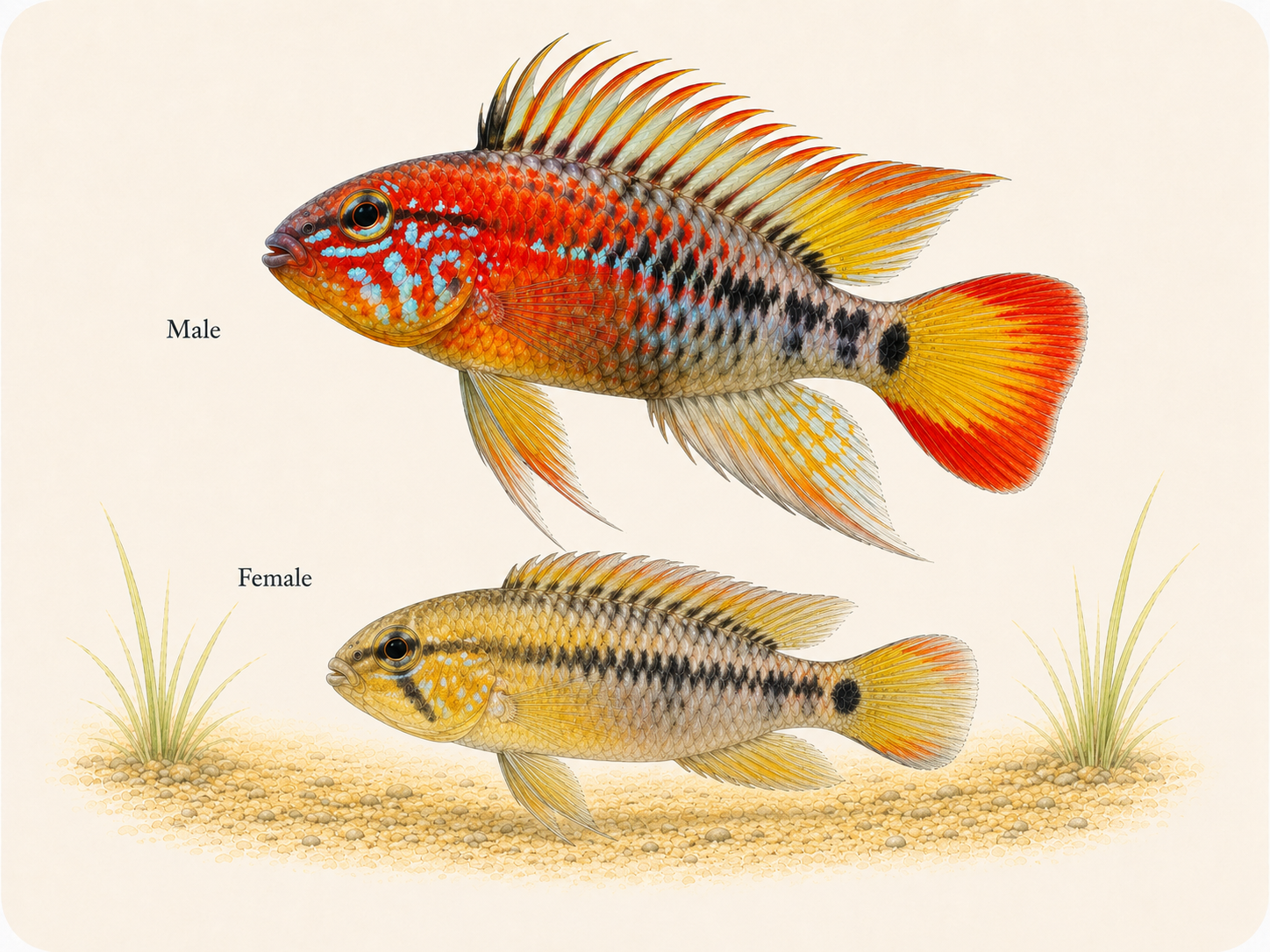
Apistogramma macmasteri is widely regarded as one of the most colourful species in the genus, and for good reason. Males are the showier sex, displaying a base body colour that ranges from golden-yellow to a warm olive-brown, overlaid with iridescent scales that shimmer blue, green, or turquoise under aquarium lighting. A thick, dark lateral band runs from the snout through the eye and along the flanks, though its intensity can vary depending on the fish’s mood, health, and the particular population from which it originates.
The dorsal fin in males is tall and elongated, often featuring extended ray tips that give it a spiky, ornamental profile. It is typically edged with red or orange and may show blue iridescence at the base. The caudal fin is one of the species’ most distinguishing features, usually displaying vivid red or deep orange colouration with a lyretail or rounded shape depending on the variant. The anal and ventral fins are also brightly coloured, often tipped with extensions in mature specimens.
Females are considerably smaller and less flamboyant, adopting a more subdued yellowish or greyish coloration for much of the time. However, when in breeding condition, females undergo a remarkable transformation, turning a bright, buttery yellow with intensified dark markings on the face and body. This yellow breeding dress serves as a signal of readiness to spawn and is also used in brood care, warning other fish away from the fry.
Both sexes have a relatively deep, laterally compressed body typical of Apistogramma species. The head is proportionately large with an intelligent, slightly upturned eye, and the mouth is small but well adapted for picking invertebrates from the substrate. Overall, this is a species where the visual appeal only grows as the fish mature and settle into well-maintained aquaria.
Varieties and Morphs
Apistogramma macmasteri exhibits notable geographical variation across its native range, and selective breeding has further refined some of these forms in the hobby. It is worth noting that taxonomic confusion has historically surrounded this species, with Apistogramma viejita sometimes being sold under the macmasteri name and vice versa. Careful sourcing from reputable breeders or importers is important if you are seeking a specific form.
The “Red Neck” or “Rotruecken” variant is one of the most popular, distinguished by an intense red-orange wash across the nape and gill covers of the male that bleeds into the dorsal fin. This form is exceptionally colourful and is widely available from European breeders. The “Super Red” morph takes this further, with males displaying deep crimson tones across much of the body and fins, making it one of the most intensely red Apistogramma forms available in the trade.
The “Gold” or “Yellow” form features a warmer golden base colouration with less red emphasis, giving the fish a sunlit, amber appearance. The “Blue” variant, sometimes labelled as “Steel Blue,” showcases more pronounced metallic blue-green iridescence on the flanks and fins, with the red being more restricted to the caudal fin. Wild-type specimens from different collection localities in the Meta drainage may show subtle but meaningful differences in fin shape, colour intensity, and patterning, and these locality forms are prized by specialist keepers.
The “Villavicencio” form refers to fish from the area around the Colombian city of Villavicencio and tends to be one of the more commonly imported wild forms. Some hobbyists also encounter fish sold as Apistogramma macmasteri “Orange,” which feature warm tangerine tones across the body and finnage. Regardless of the variant, all forms share the same care requirements and behavioural traits outlined in this guide.
Natural Habitat
Apistogramma macmasteri is found in the llanos region of Colombia, primarily within the Río Meta and Río Guaviare basins, both of which form part of the larger Orinoco river drainage. This region is characterised by vast tropical grasslands interspersed with gallery forests, and the streams and tributaries where this species is found tend to be slow-moving, shallow, and heavily shaded by overhanging vegetation.
The water in these habitats is typically soft and acidic, often stained a tea-brown colour by tannins leaching from decomposing leaves, wood, and other organic matter. The substrate is usually composed of fine sand or mud, carpeted with a thick layer of fallen leaves that provides both food sources in the form of micro-organisms and shelter from predators. Submerged roots, branches, and aquatic plants create a complex, three-dimensional environment full of hiding places and territorial boundaries.
Water temperatures in these habitats generally remain warm and stable throughout the year, typically between 24 and 28 °C, with pH values often falling between 5.0 and 6.5. Dissolved mineral content is very low, with general hardness frequently below 5 dGH. These conditions should be kept in mind when setting up a captive environment, as recreating the soft, acidic, tannin-rich water of their homeland will bring out the best colour, behaviour, and breeding potential in this species.
In the wild, Apistogramma macmasteri lives alongside a diverse community of small characins, other dwarf cichlids, catfish, and various invertebrates. Males establish small territories centred on a cave or sheltered spot, while females roam within overlapping ranges. Understanding this social structure is key to replicating successful conditions in the aquarium.
Tank Size and Setup
A single pair of Apistogramma macmasteri can be housed in a tank of at least 75 litres, though a larger aquarium of 100 litres or more is preferable if you wish to keep a small group or a male with multiple females, which is the more natural social configuration. For a community setup incorporating other species, 120 litres or above will provide the space needed to reduce territorial aggression and allow all inhabitants to establish their own areas.
The substrate should be fine sand, ideally in a natural tan or brown shade. Apistogramma macmasteri spends a significant amount of time foraging along the bottom, sifting mouthfuls of substrate in search of food, and a fine, smooth sand allows this behaviour without risking damage to the gills or mouth. Coarse gravel should be avoided as it inhibits this natural behaviour and can harbour waste in the gaps between stones.
Décor should prioritise the creation of caves, sheltered areas, and broken lines of sight. Coconut shells with entrance holes cut into them, small ceramic caves, overturned terracotta pots, and pieces of driftwood arranged to form archways and overhangs all make excellent territory markers and potential spawning sites. Each female in the tank should have access to at least one or two cave options, as they will select and defend their preferred site when ready to breed.
Live plants are highly beneficial and help to replicate the natural environment. Species such as Java fern, Anubias, Cryptocoryne, and various mosses thrive in the same water conditions favoured by Apistogramma macmasteri and provide additional cover and biological filtration. Floating plants like Amazon frogbit or Salvinia are particularly useful for diffusing overhead light and creating the dappled, subdued illumination that these fish prefer. Bright, open tanks with harsh lighting will cause them to appear washed out and stressed.
A layer of dried Indian almond leaves (Terminalia catappa) or oak leaves scattered across the substrate is an excellent addition. These leaves release tannins that acidify and soften the water, provide a substrate for biofilm and infusoria that fry can feed on, and visually replicate the leaf litter found in the species’ natural habitat. Replace the leaves as they decompose, typically every few weeks.
Water Parameters
Maintaining appropriate water chemistry is one of the most important aspects of Apistogramma macmasteri care. This species originates from soft, acidic waters and will show its best colours, strongest immune response, and most reliable breeding behaviour when kept in conditions that reflect this. While captive-bred specimens may tolerate a slightly broader range than wild-caught fish, consistently clean, soft, and mildly acidic water should be the goal.
| Temperature | 24–28 °C |
| pH | 5.0–7.0 |
| General hardness (GH) | 1–10 dGH |
| Carbonate hardness (KH) | 1–5 dKH |
| Ammonia | 0 ppm |
| Nitrite | 0 ppm |
| Nitrate | Below 20 ppm |
For general keeping, a pH between 6.0 and 6.8 and a GH of 3–8 dGH will suit most captive-bred specimens well. For breeding, dropping the pH to 5.5–6.0 and reducing hardness further can improve fertility and hatch rates. If your tap water is hard and alkaline, a reverse osmosis unit is the most reliable way to achieve the desired parameters, with minerals added back using a remineralising product to reach the target GH.
Temperature stability is important. Sudden fluctuations can stress the fish and leave them susceptible to disease. A reliable heater paired with a thermometer placed at the opposite end of the tank will help you monitor and maintain a consistent temperature. Weekly water changes of 20–30% using temperature-matched, dechlorinated water of the correct hardness and pH are essential for keeping nitrate levels low and water quality high.
Filtration and Equipment
Apistogramma macmasteri does not require powerful filtration and in fact prefers gentle water movement. In their natural habitat, they inhabit slow-moving or near-still waters, and a strong current will cause stress and may exhaust the fish over time. A sponge filter is an excellent choice for a dedicated breeding tank, as it provides effective biological filtration without generating excessive flow and poses no risk to fry. For community setups, a small hang-on-back filter or a canister filter with the output diffused or directed against the glass will work well.
If using a canister or power filter, ensure that the intake is covered with a sponge pre-filter to prevent fry from being drawn in. Flow rate can be further reduced by fitting a spray bar or lily pipe to spread the output across a wider area. The goal is clean, well-oxygenated water with minimal surface agitation.
Lighting should be moderate to subdued. These fish come from heavily shaded environments and will feel far more comfortable under low to medium light levels. If you are growing plants that require brighter light, floating plants can be used to create shaded zones beneath. LED fixtures with adjustable intensity and a warm colour temperature of around 6,500K work well and can enhance the natural colours of the fish.
A reliable, adjustable heater rated appropriately for the tank volume is essential. For tanks up to 100 litres, a 50–100 watt heater is typically sufficient, though this depends on the ambient room temperature. A digital thermometer provides more accurate readings than stick-on strip thermometers and should be checked regularly.
Diet and Feeding
Apistogramma macmasteri is an omnivore with a strong preference for small, protein-rich live and frozen foods. In the wild, the species feeds primarily on insect larvae, micro-crustaceans, worms, and other tiny invertebrates found within the leaf litter and substrate. Replicating this diet in captivity will promote optimal health, vibrant colouration, and successful breeding.
Live foods such as baby brine shrimp (Artemia nauplii), daphnia, grindal worms, micro-worms, and mosquito larvae are all eagerly accepted and should form a significant portion of the diet when available. Frozen alternatives including bloodworm, brine shrimp, cyclops, and daphnia are also excellent and can serve as staple foods when live options are not at hand. These should be thawed in a small amount of tank water before feeding to avoid introducing excessively cold food into the aquarium.
High-quality micro-pellets and flake foods formulated for small cichlids or tropical fish can be offered as a supplement, and most captive-bred specimens will accept them readily. However, dry foods alone are unlikely to sustain the best condition and should not be relied upon as the sole diet. Look for products with high protein content and minimal fillers.
Feed small amounts two to three times daily rather than one large feeding. Apistogramma macmasteri has a small stomach, and overfeeding can lead to bloating, poor water quality, and associated health problems. Any uneaten food should be removed promptly. When conditioning fish for breeding, increase the proportion of live foods in the diet for two to three weeks beforehand, as this mimics the natural abundance of food that triggers spawning in the wild.
Behaviour and Temperament
Apistogramma macmasteri is a generally peaceful species, but like all Apistogramma, it is a cichlid with a well-developed sense of territory and social hierarchy. Males can be assertive, particularly towards other males of the same species, and will establish a territory centred on a group of caves or sheltered areas. Within this territory, the male will court one or more females, displaying his fins, intensifying his colours, and performing a characteristic shimmying dance.
Outside of breeding, aggression is typically limited to brief displays and chasing rather than genuine physical confrontation, provided the tank offers sufficient space and visual barriers. Problems are most likely to arise in tanks that are too small, too sparsely decorated, or that contain more than one male without adequate room for separate territories. In a well-planned aquarium, a single male can coexist peacefully with two or three females, each of which will claim her own cave and surrounding area.
Females become notably more aggressive when guarding eggs or fry. A brooding female will vigorously defend her cave and the surrounding zone against any fish that ventures too close, including the male. This is normal and healthy behaviour, and in most cases the male will simply retreat to a safe distance. However, in very small tanks, the female’s aggression can become problematic, so providing ample cover for the male to escape to is important.
These fish are intelligent, curious, and highly aware of their surroundings. They will quickly learn to recognise their keeper and will often approach the front glass at feeding time. Their behaviour is endlessly watchable, from the male’s courtship displays to the female’s meticulous brood care, making them one of the most rewarding species to observe in the home aquarium.
Tank Mates
Apistogramma macmasteri can be kept successfully in a community aquarium, but tank mate selection requires some thought. The ideal companions are small, peaceful species that occupy different areas of the water column and will not compete for territory on the bottom. Avoid large, boisterous, or aggressive species that could intimidate or outcompete these relatively small cichlids, and steer clear of other bottom-dwelling cichlids that might clash over territory.
Good tank mates
- Cardinal Tetra, a classic companion that thrives in the same soft, acidic water and occupies the mid-water zone, posing no territorial conflict.
- Rummy-Nose Tetra, a peaceful shoaling species that prefers similar warm, soft water conditions and adds movement to the upper levels of the tank.
- Ember Tetra, Tiny and unobtrusive, these warm-toned tetras complement the colours of Apistogramma macmasteri without competing for space or food.
- Harlequin Rasbora, a gentle shoaling fish that stays in the mid-water column and tolerates the soft, slightly acidic conditions preferred by macmasteri.
- Otocinclus, Peaceful algae-eating catfish that remain small and rarely interact with dwarf cichlids, making them excellent functional tank mates.
- Pygmy Corydoras, Small enough to avoid triggering territorial aggression, these tiny catfish shoal in the lower and mid-water layers.
- Beckford’s Pencilfish, a calm, surface-dwelling species that stays out of the cichlids’ territory and does well in soft, warm water.
- Chocolate Gourami, a fellow soft-water specialist that occupies the upper half of the tank, though only suitable for experienced keepers due to its own sensitivity.
Fish to avoid
- Oscar, far too large and predatory; an Oscar would view Apistogramma macmasteri as food rather than a tank mate.
- Convict Cichlid, highly aggressive and territorial, this Central American cichlid would dominate and harass the far smaller Apistogramma.
- Tiger Barb, a notorious fin nipper that would target the elaborate finnage of male Apistogramma macmasteri.
- African Rift Lake Cichlids, Require hard, alkaline water completely incompatible with the soft, acidic conditions needed by macmasteri.
- Common Pleco, Grows far too large for the tanks suited to dwarf cichlids and produces excessive waste that compromises water quality.
- Chinese Algae Eater, Becomes aggressive and territorial with age and may harass or attach to the bodies of slower-moving fish.
- Apistogramma cacatuoides, another Apistogramma species that will compete directly for caves and territory, often leading to persistent conflict.
- Jack Dempsey, a large, aggressive New World cichlid that would easily bully or kill a dwarf cichlid of this size.
Breeding
Breeding Apistogramma macmasteri is one of the most rewarding aspects of keeping this species and is achievable for hobbyists with moderate experience. This is a cave-spawning species, meaning the female deposits her eggs on the ceiling or walls of a small cave, which she then guards fiercely while the male patrols the wider territory.
To encourage breeding, start by conditioning the pair or group with a varied diet rich in live and frozen foods for two to three weeks. Water parameters should be optimised for breeding, with the temperature raised slightly to around 26–28 °C, the pH lowered to 5.5–6.5, and hardness kept as low as practically achievable, ideally below 5 dGH. Clean, stable water with low nitrate levels is essential, and a partial water change with slightly cooler, softer water can sometimes trigger spawning behaviour.
The ideal breeding setup includes multiple small caves scattered around the tank. The female will inspect and eventually select her preferred site, cleaning the interior surfaces in preparation for egg-laying. Courtship involves the male displaying his extended fins and intensified colours, performing lateral displays, and shimmying his body in front of the female. When the female is receptive, she will adopt her vivid yellow breeding dress and lead the male towards the chosen cave.
The female typically lays between 40 and 100 small, reddish eggs on the cave ceiling. After fertilisation, the male’s role largely ends, and the female takes over sole guardianship of the clutch. She fans the eggs constantly with her pectoral fins to ensure water circulation and removes any unfertilised or fungused eggs. During this period, she will aggressively chase away any fish that approaches, including the male. It is wise to ensure the male has sufficient hiding spots to retreat to, or in smaller tanks, it may be necessary to remove him.
The eggs hatch after approximately three to four days at 26 °C, and the wrigglers remain attached to the cave surfaces for a further three to five days as they absorb their yolk sacs. Once free-swimming, the fry emerge from the cave under the watchful eye of the mother, who shepherds them around the tank in a tight group. First foods should consist of infusoria, paramecium, or commercially available liquid fry food, transitioning to freshly hatched baby brine shrimp and micro-worms within the first week. The leaf litter mentioned in the setup section is particularly valuable at this stage, as it supports populations of micro-organisms that the fry can graze on.
The female will continue to guard the fry for several weeks, gradually becoming less protective as the young grow. In a well-established tank with plenty of cover, a surprising number of fry can survive even in a community setting, though dedicated breeding tanks will always yield higher survival rates.
Common Diseases
Apistogramma macmasteri is not especially prone to disease when kept in clean, appropriate water conditions, but like all freshwater fish, it can fall victim to a range of illnesses if stressed or maintained in suboptimal environments. Prevention through good husbandry is always preferable to treatment.
Ich, or white spot disease, caused by the parasite Ichthyophthirius multifiliis, is one of the most common ailments encountered. It presents as small white cysts on the fins and body and is usually triggered by temperature fluctuations or the introduction of infected fish. Treatment involves raising the temperature to 30 °C gradually over 24 hours and adding aquarium salt at a low dose, or using a proprietary ich medication. Note that Apistogramma can be sensitive to some medications, particularly those containing copper, so always use treatments at half dose initially and monitor the fish closely.
Bacterial infections, including fin rot and body ulcers, can occur when water quality deteriorates or the fish sustains an injury. Maintaining pristine water conditions and removing aggressive tank mates are the best preventative measures. Mild cases may resolve with improved water quality alone, while more advanced infections may require treatment with an antibacterial medication.
Internal parasites can be introduced via live foods or wild-caught specimens. Symptoms include weight loss despite a healthy appetite, white or stringy faeces, and lethargy. Anti-parasitic medications containing praziquantel or levamisole are effective treatments. Quarantining new fish for a minimum of two to four weeks before adding them to an established tank is one of the best ways to prevent the introduction of parasites and other pathogens.
Hole-in-the-head disease, caused by the flagellate parasite Hexamita, can occasionally affect dwarf cichlids kept in poor conditions. It manifests as small pits or lesions on the head and lateral line. Improving water quality, reducing nitrate levels, and treating with metronidazole are the standard approaches. This condition is almost always associated with chronic stress, poor diet, or deteriorating water quality.
Fungal infections are most commonly seen on eggs during breeding or on fish with compromised immune systems. Methylene blue can be used as a prophylactic treatment in breeding tanks to reduce fungal growth on eggs. For infections on adult fish, proprietary antifungal treatments are available and generally well tolerated.
FAQs
Can I keep Apistogramma macmasteri in a pair, or do they need a group?
A single pair can be kept successfully in a suitably sized and well-decorated tank of at least 75 litres. However, the more natural social structure involves one male with two or three females, which distributes the male’s attention and reduces pressure on any single female. This arrangement requires a larger tank of around 100–120 litres with multiple cave sites so each female can establish her own territory. Keeping two males together is only advisable in spacious tanks of 150 litres or more with extensive visual barriers.
What is the difference between Apistogramma macmasteri and Apistogramma viejita?
These two species are very closely related and have been the subject of considerable taxonomic confusion over the years. Apistogramma viejita was historically considered a colour variant of macmasteri by some authorities but is now generally accepted as a separate species. The most reliable differences lie in subtle features of fin shape, the pattern of markings on the head and cheeks, and the geographic origin of the specimens. In practice, many fish sold under one name in the hobby may actually be the other, and hybridisation in captive breeding has further muddied the waters. Purchasing from specialist breeders who maintain accurate lineage records is the best way to obtain correctly identified stock.
Do I need soft water to keep Apistogramma macmasteri?
Soft, slightly acidic water will always produce the best results in terms of colour, health, and breeding success. Captive-bred specimens are generally more tolerant of moderate hardness than wild-caught fish and can often be maintained at a GH of up to 10 dGH and a pH of up to 7.0 without obvious ill effects. However, breeding success is significantly improved in softer, more acidic water, and long-term health and lifespan are likely to be better when the fish are kept closer to their natural parameters. If your tap water is very hard, a reverse osmosis unit is a worthwhile investment.
How can I tell males from females?
Males are larger, more colourful, and have more elongated and elaborate finnage, particularly the dorsal and caudal fins. Females are smaller, more compact, and generally duller in colour, though they develop a striking yellow breeding dress when ready to spawn. In juvenile fish, sexing can be more difficult, but as the fish mature beyond about four months of age, the differences in size, colour, and fin development become increasingly apparent. Males also tend to have more pointed dorsal fin tips and a more robust body profile.
Will Apistogramma macmasteri eat their fry?
Females are typically excellent mothers and will guard and shepherd their fry for several weeks after they become free-swimming. The male generally does not participate in direct brood care and may be chased away by the female, but he rarely targets the fry deliberately. Other tank mates, however, will readily eat fry if given the opportunity. For maximum survival rates, breeding in a dedicated species tank or removing other fish after spawning occurs is recommended. In a well-planted community tank with plenty of cover, some fry may survive, but losses will be higher.
Related Guides
- Apistogramma cacatuoides Care Guide, another popular and colourful Apistogramma species with similar care requirements, ideal for comparison if choosing between dwarf cichlid species.
- Apistogramma borellii Care Guide, a slightly hardier Apistogramma that tolerates cooler temperatures, offering an alternative for those new to the genus.
- German Blue Ram Care Guide, a fellow South American dwarf cichlid with overlapping water parameter requirements and a similar niche in community aquaria.
- Cardinal Tetra Care Guide, one of the best companion species for Apistogramma macmasteri, sharing a preference for soft, acidic water.
- Reverse Osmosis for Aquariums Guide, Essential reading for keepers who need to soften their water to meet the requirements of soft-water species like Apistogramma macmasteri.