Quick Summary
The Amazon Leaffish is a fascinating but demanding ambush predator that requires live food, dim lighting, and specialist knowledge – it is not suitable for beginners or standard community aquariums and should only be kept by experienced aquarists who can maintain a reliable supply of live prey.
🐠 Build a tank around this species
In this guide:
- Introduction
- Quick Stats
- Appearance
- Natural Habitat
- Tank Size and Setup
- Water Parameters
- Diet and Feeding
- Behaviour and Temperament
Introduction
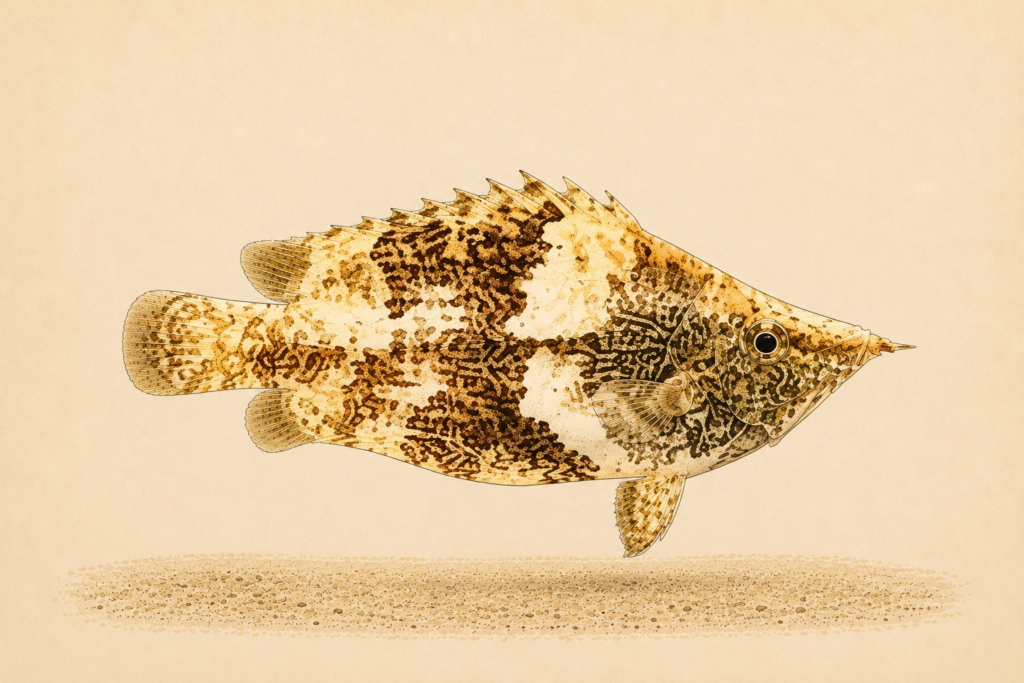
Few freshwater fish can claim to be as masterfully camouflaged as the Amazon Leaffish (Monocirrhus polyacanthus). This remarkable predator has evolved to look, drift, and even behave exactly like a dead leaf floating through the dark, tannin-stained waters of the Amazon basin. Everything about its anatomy serves this deception: its laterally compressed, leaf-shaped body; its mottled brown, tan, and ochre colouration; the irregular outline of its fins; and – most strikingly – a small fleshy barbel (or chin appendage) on its lower jaw that perfectly mimics a leaf stem. When the fish hangs motionless in the water column, head angled slightly downward, the illusion is so convincing that prey items swim within striking range without any alarm.
While the Amazon Leaffish is undeniably one of the most intriguing species available in the aquarium trade, it is equally one of the most challenging to keep successfully. It is a near-obligate live-food feeder. The overwhelming majority of specimens will refuse dead, frozen, or dried foods entirely, meaning that the keeper must be able to provide a steady, sustainable supply of appropriately sized live prey throughout the fish’s life. This single requirement alone places the species firmly in the realm of advanced and specialist fishkeeping. Add to this its need for very specific water chemistry, dim lighting, minimal water flow, and careful tank mate selection (or, more accurately, the near-total absence of tank mates), and it becomes clear that the Amazon Leaffish is a commitment that demands genuine dedication.
For those willing and able to meet its needs, however, the Amazon Leaffish rewards with behaviour that is endlessly fascinating to observe. Watching it stalk prey with imperceptible, fin-powered movements before engulfing a fish in a sudden protrusible-jaw strike is a genuinely thrilling experience. This guide covers everything you need to know to provide proper care for this extraordinary species.
Quick Stats
| Scientific name | Monocirrhus polyacanthus |
|---|---|
| Common names | South American Leaffish, Leaf Fish, Barbeled Leaffish |
| Family | Polycentridae |
| Origin | Amazon basin (Brazil, Peru, Colombia, Bolivia, Venezuela, Guyana) |
| Adult size | 8 cm |
| Lifespan | 5–8 years |
| Difficulty | Advanced |
| Breeding difficulty | Advanced |
| Temperature | 24–28 °C |
| pH | 4.5–6.5 |
| GH | 1–5 dGH |
| KH | 0–3 dKH |
| Minimum tank size | 75 L |
| Conservation status | Least Concern (IUCN, assessed 2020) |
Appearance
The entire body of Monocirrhus polyacanthus has been shaped by evolution to serve one purpose: to look exactly like a dead leaf. The body is laterally compressed and roughly ovate, tapering to a slightly pointed snout that contributes to the leaf shape. The dorsal, anal, and caudal fins blend seamlessly into the body outline, with the caudal fin forming the narrow “stem” end of the leaf. The dorsal and anal fins bear numerous spiny rays that create an irregular, slightly ragged edge – perfectly replicating the appearance of a decaying leaf margin.
The most distinctive anatomical feature is the small, fleshy barbel that protrudes from the tip of the lower jaw. This appendage resembles a leaf petiole (stem) and completes the dead-leaf disguise when the fish hangs head-down in the water. The mouth itself is highly protrusible, capable of rapidly extending forward to engulf prey in a fraction of a second. When fully extended, the gape is surprisingly large relative to the fish’s body size, allowing it to consume prey items up to roughly half its own length.
Colouration is variable and can change somewhat depending on the fish’s mood, health, and surroundings. The base colour typically ranges from pale yellowish-brown to dark chocolate brown, often with mottled patches of tan, olive, or near-black. Many specimens display a lateral line marking that resembles the midrib of a leaf, with fainter diagonal lines branching off it that mimic leaf veins. Some individuals show darker blotches or a more uniform colouration. The eyes are often obscured by a dark stripe or patch that runs through them, breaking up the outline and further enhancing the camouflage. When settled and healthy, the fish’s colour tends to darken, and the leaf-vein patterning becomes more pronounced.
There is minimal sexual dimorphism, making it difficult to distinguish males from females outside of breeding condition. Males may develop a slightly fuller body shape when mature, and during spawning the female’s belly becomes noticeably rounded with eggs. Some experienced keepers report that males tend to have a slightly more angular head profile, but this is unreliable as a sole sexing method.
Natural Habitat
The Amazon Leaffish is found across a broad swathe of the Amazon basin, including tributaries and floodplain systems in Brazil, Peru, Colombia, Bolivia, Venezuela, and Guyana. Its preferred habitats are slow-moving or virtually still blackwater streams, flooded forest floors, oxbow lakes, and sheltered backwaters where leaf litter accumulates in thick layers. These environments are characterised by extremely soft, highly acidic water that is heavily stained with tannins released by decomposing vegetation.
Light levels in these habitats are typically very low. The forest canopy overhead filters much of the sunlight, and the dark, tea-coloured water further reduces light penetration. The substrate is composed primarily of fallen leaves, decomposing plant matter, and fine organic sediment. Submerged roots, fallen branches, and driftwood provide additional structure. Aquatic plants are often sparse or absent in the deepest blackwater areas, though in some marginal habitats the fish may be found near floating vegetation or among the roots of emergent plants.
Water flow in these habitats is negligible. The Amazon Leaffish is a poor swimmer by design – its entire hunting strategy relies on drifting passively, and any significant current would undermine this behaviour and stress the fish. Water temperatures typically range from 24 to 28 degrees Celsius, with pH values often falling between 4.0 and 6.0. General hardness is extremely low, frequently below 1 dGH. These are among the most extreme soft, acidic conditions found in any freshwater fish habitat, and replicating them as closely as possible is essential to the long-term health of captive specimens.
In the wild, the Amazon Leaffish feeds on small fish, aquatic invertebrates, and insect larvae. It typically occupies the mid-water to lower water column, drifting among submerged leaves and debris where it is virtually invisible to both prey and potential predators. It is largely solitary outside of breeding, though small, loose aggregations may occur where food is plentiful.
Tank Size and Setup
A single Amazon Leaffish can be housed in a tank of 75 litres or more, though a pair or small group of three to four individuals would benefit from a tank of at least 120 to 150 litres. This is not a species that needs vast swimming space – it is sedentary by nature and spends most of its time hovering or drifting. However, adequate volume is important for maintaining stable water quality, particularly given the soft, acidic conditions required and the heavy bioload associated with a live-food diet.
The tank setup should aim to replicate the fish’s natural blackwater environment as closely as possible. Dim lighting is essential. Bright aquarium lights will stress the fish, suppress its natural behaviour, and may contribute to disease. Use low-intensity lighting, or better yet, provide heavy shading with floating plants such as Amazon frogbit, water lettuce, or salvinia. Indian almond leaves (Terminalia catappa), oak leaves, or other dried botanicals should be scattered generously across the bottom of the tank. These serve multiple purposes: they release tannins that darken and acidify the water, they provide visual cover, and they create the leaf-littered environment in which the fish feels most secure and hunts most effectively.
Driftwood is another critical component of the setup. Pieces of Malaysian driftwood, mopani wood, or spider wood should be arranged to create shaded areas, overhangs, and visual barriers. Avoid sharp-edged decorations or rough rocks that could injure the fish’s delicate fins. Live plants are not strictly necessary and can be difficult to maintain under the low light and acidic conditions preferred by this species, but hardy, low-light species such as Java fern (Microsorum pteropus), Java moss (Taxiphyllum barbieri), or Anubias species attached to driftwood can work well and add to the natural aesthetic.
The substrate should be fine sand or a thin layer of organic material. A deep, coarse gravel substrate is unnecessary and may trap uneaten food or deceased feeder organisms, leading to water quality problems. Many specialist keepers opt for a bare bottom with a deep layer of dried leaves, which simplifies maintenance and creates the most naturalistic appearance.
Water flow must be kept to an absolute minimum. The Amazon Leaffish cannot cope with significant current. If using a hang-on-back or canister filter, baffle the outflow using a spray bar angled at the glass, a piece of sponge, or a lily pipe designed to diffuse flow. Sponge filters or air-driven corner filters are ideal for this species, as they provide gentle biological filtration without creating problematic water movement.
Water Parameters
Getting the water chemistry right is one of the most critical aspects of Amazon Leaffish care, and it is also one of the most challenging for many aquarists. This species comes from some of the softest, most acidic freshwater habitats on earth, and while captive-bred specimens (which are uncommon) may tolerate slightly broader parameters, wild-caught fish – which represent the majority of those available in the trade – will often struggle or fail in hard, alkaline water.
| Temperature | 24-28 C |
| pH | 4.5-6.5 |
| General hardness (GH) | 1-5 dGH |
| Carbonate hardness (KH) | 0-3 dKH |
| Ammonia | 0 ppm |
| Nitrite | 0 ppm |
| Nitrate | Below 20 ppm |
Most keepers in areas with hard tap water will need to use reverse osmosis (RO) water, remineralised very lightly to achieve the desired softness. Some aquarists use pure RO water with tannin-releasing botanicals as the sole source of trace minerals. Peat filtration can also be employed to lower pH and soften the water naturally. Whichever method is used, consistency is paramount – sudden swings in pH or hardness are far more dangerous to this species than a reading that is slightly outside the ideal range.
Ammonia and nitrite must always be at zero. The Amazon Leaffish is sensitive to dissolved nitrogenous waste, and even low levels of ammonia or nitrite can cause rapid health deterioration. Nitrate should be kept below 20 ppm, and ideally below 10 ppm. Regular water changes of 15 to 25 per cent weekly, using pre-conditioned water matched to the tank’s temperature and chemistry, are strongly recommended. When performing water changes in very soft, acidic water, be cautious about changing too much at once, as this can cause dangerous pH swings in poorly buffered systems.
Filtration and Equipment
Filtration for an Amazon Leaffish tank must balance two competing demands: effective biological processing of waste (especially important given the protein-rich, live-food diet) and minimal water flow. Sponge filters are the most commonly recommended option for this species. A mature, well-colonised sponge filter driven by a gentle air pump provides excellent biological filtration without creating any significant current. For larger tanks housing a group of leaffish, a pair of sponge filters positioned at opposite ends of the aquarium can provide adequate filtration capacity.
If you prefer a canister filter or hang-on-back filter for their superior mechanical filtration (useful for capturing uneaten food particles), you must take steps to reduce the outflow velocity. A spray bar positioned along the back glass and angled upward or against the wall will dissipate the flow effectively. Alternatively, the outflow can be directed into a baffle made from filter sponge or a perforated plastic container. The goal is to ensure that there is no perceptible current in the main body of the tank where the fish lives and hunts.
A heater is necessary to maintain stable tropical temperatures. Use a reliable, thermostatically controlled heater rated for the tank’s volume. In very soft, acidic water, some cheaper heater brands may corrode more quickly, so invest in a quality unit with a robust glass or titanium element. Position the heater near the filter outflow (if using a powered filter) to ensure even heat distribution, or use two smaller heaters for redundancy in larger setups.
Lighting should be subdued. Standard aquarium LED units can be used at low intensity settings, or with extensive floating plant cover to shade the water below. Some keepers use no dedicated aquarium light at all, relying solely on ambient room lighting filtered through the tannin-stained water. If you wish to observe the fish more easily, a very low-wattage light on a timer set for no more than eight hours per day is a reasonable compromise. Avoid sudden changes from darkness to bright light, as this can startle the fish.
An air pump connected to the sponge filter or a simple airstone provides gentle surface agitation for gas exchange without creating excessive water movement. In blackwater setups with heavy leaf litter, a small amount of surface movement helps prevent the formation of a bacterial biofilm on the water’s surface.
Diet and Feeding
This is the single most important consideration before acquiring an Amazon Leaffish, and the area where most failures in captive care occur. Monocirrhus polyacanthus is a near-obligate live-food predator. The vast majority of specimens – particularly wild-caught individuals – will categorically refuse dead, frozen, or dried foods. Some long-term captive fish and rare captive-bred individuals may learn to accept frozen foods such as bloodworm or brine shrimp with patient training, but this should never be assumed or relied upon when deciding whether to keep this species.
Before purchasing an Amazon Leaffish, you must have a reliable, sustainable source of live food. The primary diet in captivity typically consists of small live fish – often livebearers such as guppies or endlers bred specifically as feeders. The leaffish can consume prey of surprising size relative to its own body; fish up to roughly half the leaffish’s body length can be engulfed thanks to its highly protrusible jaws. However, offering a variety of prey sizes is advisable, with most feeder fish being approximately one-third of the leaffish’s length.
Live river shrimp, glass shrimp, and cherry shrimp are also eagerly taken and provide excellent nutritional variety. Live earthworms (chopped to appropriate size), blackworms, and large daphnia can supplement the diet. Some keepers have success with live insect larvae such as mosquito larvae during warmer months.
A few important points regarding feeder fish: never use feeder fish from unknown or unreliable sources, as these can introduce parasites and diseases into the tank. The safest approach is to breed your own feeder guppies or endlers in a separate tank, gut-loading them with high-quality flake food and spirulina before offering them to the leaffish. This practice ensures both food safety and optimal nutrition.
Feeding frequency varies with the size of prey items. A general guideline is to offer two to four small feeder fish every two to three days for an adult leaffish. The fish’s belly should appear gently rounded after feeding but never distended. Overfeeding is a risk with live food, as the leaffish will often continue to hunt and consume prey opportunistically. Monitor the fish’s body condition and adjust feeding accordingly. Uneaten feeder fish left in the tank for extended periods contribute to the bioload and may nibble at the leaffish’s fins, so remove any that are not consumed within a day or so.
Attempts to wean an Amazon Leaffish onto dead or frozen foods can be made using a technique called “target feeding,” in which frozen bloodworm or shrimp pieces are presented on a long pair of tweezers, moved gently in the water to simulate live movement. Success rates are low, but some patient keepers have achieved partial acceptance of frozen foods over a period of weeks or months. Even in these cases, live food should remain the staple of the diet.
Behaviour and Temperament
The Amazon Leaffish is one of the most behaviourally fascinating freshwater fish available to aquarists, but its lifestyle is the antithesis of what many hobbyists expect from their fish. It is sedentary, cryptic, and largely motionless for extended periods. It does not swim in the conventional sense. Instead, it drifts through the water column using nearly invisible movements of its transparent pectoral fins, orienting itself head-down at a slight angle to complete its dead-leaf impression. It may remain in a single position for minutes or even hours at a time, swaying gently as if caught in a faint current.
When prey comes within range – typically a body length or less – the leaffish strikes with astonishing speed. The protrusible mouth shoots forward, creating a vacuum that sucks the prey item into the gape. The entire strike takes a fraction of a second and is often over before the observer fully registers what has happened. Watching this behaviour in person is one of the great rewards of keeping this species.
The Amazon Leaffish is not aggressive in the conventional sense – it does not chase, harass, or territorially defend space against other fish in the way that cichlids or bettas might. However, it is an indiscriminate predator that will attempt to eat any fish small enough to fit in its mouth. This is not aggression; it is simply the fish’s fundamental feeding behaviour. It does not distinguish between feeder fish and expensive tank mates. Any fish roughly half the leaffish’s length or smaller is at serious risk of being consumed.
With conspecifics (other leaffish), Monocirrhus polyacanthus is generally tolerant provided there is adequate space and visual cover. Small groups of three to five individuals can coexist in a suitably sized and decorated tank. Minor squabbles or displays of dominance may occur, particularly at feeding time, but serious aggression between leaffish is uncommon. Keeping a group can result in more natural behaviour, as the fish seem to feel more secure when others of their kind are present.
The fish is primarily crepuscular to nocturnal in its activity patterns, being most active during dawn, dusk, and nighttime hours. During the brightest part of the day, it tends to find a shaded spot among leaves or under driftwood and remain motionless. Keepers who maintain very dim lighting throughout the day often observe more consistent activity and hunting behaviour.
Tank Mates
The Amazon Leaffish is best kept in a species-only setup or with very carefully chosen companions. Its predatory nature means that any fish small enough to be swallowed will eventually be eaten – this includes most tetras, rasboras, small barbs, dwarf corydoras, and shrimp. Conversely, the leaffish is a slow, delicate fish that can be stressed, outcompeted for food, or physically harmed by boisterous, aggressive, or fast-moving species. The ideal tank mates, if any are desired, are calm, peaceful species that are too large to be eaten and that thrive in the same soft, acidic blackwater conditions.
Good tank mates
- Angelfish (Pterophyllum scalare) – Peaceful cichlids that share the same Amazonian blackwater preferences and are too large to be consumed by adult leaffish.
- Discus (Symphysodon spp.) – Another soft-water Amazonian species with calm temperament, though their demanding care adds complexity to an already advanced setup.
- Marbled Hatchetfish (Carnegiella strigata) – Surface-dwelling fish that occupy a different zone in the tank and are generally too deep-bodied to be swallowed, though very small individuals may still be at risk.
- Chocolate Gourami (Sphaerichthys osphromenoides) – A fellow soft-water specialist with a peaceful demeanour, though ensure individuals are large enough not to be eaten.
- Bristlenose Pleco (Ancistrus sp.) – A bottom-dwelling algae eater that is too armoured and too large to be predated upon, and tolerates soft, acidic water well.
- Corydoras sterbai – A warm-water Corydoras species that thrives in soft, acidic conditions and is generally too large and spiny for the leaffish to consume.
- Apistogramma cacatuoides – A dwarf cichlid suited to blackwater conditions; adults are typically large enough to coexist, but monitor carefully.
Fish to avoid
- Neon Tetra (Paracheirodon innesi) – Far too small; these will be quickly consumed as prey.
- Cardinal Tetra (Paracheirodon axelrodii) – Despite sharing the same natural habitat, their small size makes them ideal prey items for the leaffish.
- Cherry Shrimp (Neocaridina davidi) – Shrimp of any small species will be eaten without hesitation.
- Tiger Barb (Puntigrus tetrazona) – Active, nippy fish that will stress the leaffish and may damage its fins; they also prefer harder, more alkaline water.
- Oscar (Astronotus ocellatus) – Far too large, aggressive, and boisterous; would likely injure or kill the leaffish.
- African Cichlids – Require hard, alkaline water that is fundamentally incompatible with the leaffish’s needs, and most species are far too aggressive.
- Betta (Betta splendens) – The long fins of a betta may be nipped, and the betta itself may harass the leaffish; water parameter preferences also differ significantly.
- Guppy (Poecilia reticulata) – Too small and will be treated as food; guppies also prefer harder, more alkaline water.
Breeding
Breeding the Amazon Leaffish in captivity is achievable but challenging. It requires a well-conditioned pair, pristine water quality, and an appropriate environment. Successful spawning in home aquariums has been documented, though it remains relatively uncommon compared to more mainstream species.
Sexing is difficult outside of breeding condition. The most reliable method is to observe a group of leaffish over time and watch for natural pair formation. When ready to spawn, the female becomes noticeably rounder as she fills with eggs. The male may display slightly more intense colouration and become more active in patrolling a chosen spawning site.
Spawning typically occurs on a flat surface – the underside of a broad leaf (such as an Anubias or Amazon sword leaf), a piece of driftwood, or even the aquarium glass. The pair cleans the chosen site together before the female deposits a clutch of eggs, usually numbering between 200 and 400. The eggs are small, adhesive, and often somewhat transparent. The male fertilises them and subsequently takes on the primary role of guarding and fanning the clutch. He will defend the eggs vigorously, even against the female, who should be removed or separated if possible to reduce stress on both fish.
The eggs typically hatch within three to four days at temperatures around 26 to 28 degrees Celsius. The fry are tiny and initially feed on their yolk sacs. Once free-swimming, they require extremely small live foods – infusoria, vinegar eels, or freshly hatched brine shrimp nauplii. This stage is one of the most challenging aspects of breeding, as the fry are delicate and require excellent water quality and consistent food availability. Frequent, very small water changes using aged, temperature-matched water are essential during fry rearing.
As the fry grow, they can be gradually transitioned to larger live foods such as microworms, grindal worms, and eventually small daphnia and mosquito larvae. Growth rate is moderate, and the young fish begin to display the characteristic leaf-mimicking shape and behaviour within a few weeks of becoming free-swimming. Raising fry to a size where they can accept small feeder fish typically takes several months of diligent care.
Common Diseases
The Amazon Leaffish is not especially prone to any species-specific diseases, but its requirement for very soft, acidic water and a live-food diet means that certain health issues are more commonly encountered than with hardier species.
Internal parasites are one of the most significant risks, particularly for wild-caught specimens. Fish collected from the wild frequently harbour intestinal parasites that may not cause obvious symptoms initially but can lead to wasting, loss of appetite, and eventual death if left untreated. Many experienced keepers recommend a prophylactic anti-parasitic treatment (such as praziquantel or levamisole) during the quarantine period for all newly acquired wild-caught leaffish. A quarantine period of at least four to six weeks in a separate tank is strongly advised before introducing any new specimen to an established setup.
Diseases introduced by feeder fish are another major concern. Feeder fish from pet shops or fish farms can carry a range of bacterial, viral, and parasitic infections. This is why breeding your own feeder fish in a controlled environment is so strongly recommended. If you must purchase feeder fish, quarantine them separately for at least two weeks before offering them to the leaffish.
Ich (white spot disease, caused by Ichthyophthirius multifiliis) can affect the Amazon Leaffish, particularly if the fish is stressed by poor water quality, inappropriate water chemistry, or sudden temperature changes. Treatment with heat (raising the temperature to 30 degrees Celsius gradually over 24 to 48 hours) combined with aquarium salt at a low concentration is often preferred over chemical treatments for this sensitive species, though note that very soft, acidic water may make salt dissolution less predictable. Some keepers prefer formalin-based or malachite green treatments at half the standard dose, but always exercise caution with medications in very soft water, as the reduced buffering capacity can amplify their effects.
Bacterial infections, including fin rot and body sores, can occur when water quality deteriorates. These are almost always secondary to environmental stress and are best prevented through diligent tank maintenance. If treatment is necessary, broad-spectrum antibacterial medications can be used, but again, dose conservatively and monitor the fish closely.
Fungal infections may occasionally appear on wounds or stressed tissue. These are typically treated with antifungal medications or salt baths. Ensuring that the tank contains adequate tannins from leaf litter and driftwood provides a mild natural antifungal effect, as the humic acids and tannins in blackwater environments have some antimicrobial properties.
FAQs
Can I feed my Amazon Leaffish frozen or dried food?
In the vast majority of cases, no. Most Amazon Leaffish will refuse anything that is not alive and moving. While a very small number of long-term captive or captive-bred individuals have been trained to accept frozen bloodworm or similar foods presented with tweezers, this is the exception rather than the rule. You should only acquire this species if you are confident in your ability to provide live food – primarily small feeder fish and live shrimp – for the duration of the fish’s life.
How many Amazon Leaffish can I keep together?
Amazon Leaffish are generally tolerant of conspecifics and can be kept in small groups of three to five individuals in a tank of 120 litres or more, provided there is adequate visual cover in the form of driftwood, plants, and leaf litter. Keeping a group often results in more natural and relaxed behaviour. Ensure that all individuals in the group are of similar size to prevent the largest from viewing the smallest as potential prey.
Will the Amazon Leaffish eat my other fish?
Yes, if the other fish are small enough to fit in its mouth. The Amazon Leaffish does not distinguish between feeder fish and ornamental tank mates. Any fish roughly half the leaffish’s body length or smaller is at serious risk of being consumed. This includes most popular community fish such as tetras, rasboras, and small livebearers. Only keep the leaffish with species that are clearly too large to be swallowed.
Do I need to use RO water?
If your tap water is moderately hard or alkaline (GH above 6 dGH or pH above 7.0), then yes, you will almost certainly need to use reverse osmosis water to achieve the very soft, acidic conditions this species requires. In areas with naturally soft, acidic tap water, it may be possible to use dechlorinated tap water directly, but always test your parameters carefully. Adding Indian almond leaves, alder cones, and peat to the filter will help lower pH and soften the water further.
Is the Amazon Leaffish suitable for beginners?
No. The Amazon Leaffish is firmly an advanced or specialist species. Its requirement for live food, very specific water chemistry, dim lighting, and minimal water flow places it well beyond the scope of beginner fishkeeping. Even experienced aquarists who have not previously kept predatory
Related Guides
- Bucktooth Tetra – Another predatory Amazonian species with specialist feeding requirements, making it a useful comparison for keepers interested in aggressive fish.
- Checkerboard Dwarf Cichlid – A small, soft-water Amazonian cichlid that thrives in the same acidic blackwater conditions favoured by the Amazon Leaffish.
- Demon Eartheater – A South American cichlid from similar soft, acidic habitats that benefits from comparable water chemistry and tannin-stained setups.
- Dwarf Pleco – A small, peaceful Amazonian catfish well suited to the dim, low-flow blackwater environments that the Amazon Leaffish requires.
- Altum Angelfish – An advanced-level Amazonian species that demands very soft, acidic water and careful husbandry, appealing to the same experienced keepers drawn to the Leaffish.