Red-tailed Black Shark Care Guide — Tank Setup, Feeding and Breeding
Introduction
The Red-tailed Black Shark is one of the most visually striking freshwater fish available in the aquarium hobby. With its velvety jet-black body and vivid crimson caudal fin, it has captured the attention of fishkeepers around the world since it was first exported from Thailand in the 1960s. Despite its common name, this species is not a shark at all but rather a member of the carp family, Cyprinidae. Its sleek, torpedo-shaped body and confident, patrolling behaviour lend it a commanding presence in any community aquarium.
While its beauty is undeniable, the Red-tailed Black Shark comes with a reputation for territorial aggression that demands thoughtful planning. This is not a fish that can simply be dropped into any community setup. It requires adequate space, well-designed décor that breaks sight lines, and carefully chosen tank mates that can hold their own without provoking conflict. When these needs are met, however, Epalzeorhynchos bicolor proves itself to be a hardy, long-lived, and endlessly fascinating aquarium resident.
It is worth noting that this species is considered critically endangered in the wild, with populations in its native Thai waterways having declined drastically due to habitat destruction and damming. Virtually all specimens available in the aquarium trade today are commercially bred, primarily in farms across Southeast Asia. Keeping this fish responsibly in the home aquarium is therefore not a conservation concern, but understanding its origins and natural behaviour remains essential for providing proper care.
Quick Stats
| Scientific name | Epalzeorhynchos bicolor |
| Common names | Red-tailed Black Shark, Red-tail Shark, Redtail Sharkminnow, RTBS |
| Family | Cyprinidae |
| Origin | Chao Phraya basin, central Thailand |
| Adult size | 12–15 cm (5–6 inches) |
| Lifespan | 5–8 years |
| Difficulty | Moderate |
| Breeding difficulty | Expert |
| Temperature | 22–26 °C |
| pH range | 6.5–7.5 |
| General hardness (GH) | 5–15 dGH |
| Carbonate hardness (KH) | 3–10 dKH |
| Minimum tank size | 200 litres |
| Conservation status | Critically Endangered (IUCN) |
Appearance
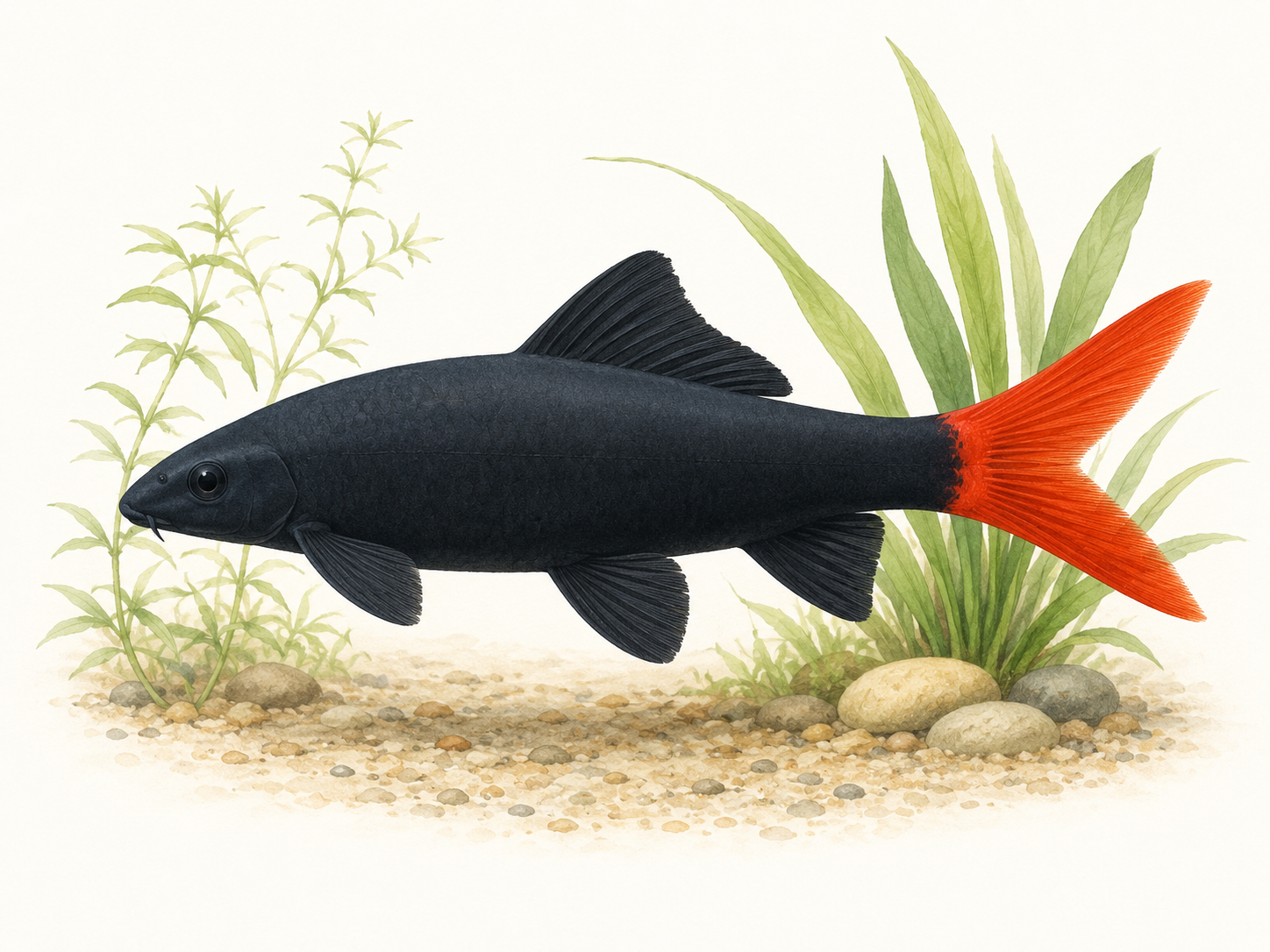
The defining feature of Epalzeorhynchos bicolor is the stark contrast between its deep black body and its bright red or orange-red caudal fin. In healthy, well-kept specimens, the black colouration is rich and velvety, covering the entire body, head, and all fins except the tail. The caudal fin ranges from a deep scarlet to a vibrant orange-red, depending on the individual’s genetics, diet, and overall condition. When a Red-tailed Black Shark is stressed, unwell, or kept in poor conditions, the black may fade to a washed-out grey, and the tail can lose its intensity—colour quality is therefore an excellent barometer of the fish’s wellbeing.
The body shape is elongated and somewhat laterally compressed, with a slightly arched dorsal profile that contributes to its shark-like silhouette. The dorsal fin is large and triangular, held erect as the fish patrols its territory, further enhancing the impression of a miniature shark. The mouth is subterminal and equipped with fleshy, downward-facing lips suited to grazing algae and biofilm from hard surfaces. Two pairs of short barbels are present near the mouth, which the fish uses to detect food particles on the substrate.
Adults typically reach 12 to 15 centimetres in total length, with females tending to be slightly heavier-bodied than males, particularly when carrying eggs. Males are generally more slender and may develop marginally more intense colouration, though sexing is notoriously difficult outside of breeding condition. Juvenile specimens sold in shops are usually around 3 to 5 centimetres and can appear somewhat drab compared to fully grown adults, but their colour intensifies considerably as they mature.
Varieties and Morphs
The aquarium trade has produced a small number of captive-bred morphs of the Red-tailed Black Shark, though the wild-type form remains by far the most popular and widely available. The most commonly encountered variant is the albino Red-tailed Black Shark, which replaces the black body colouration with a pale pinkish-white or creamy body while retaining the red caudal fin. This morph has pinkish-red eyes and generally displays the same behavioural tendencies as the standard form, though some keepers report that albino individuals can be slightly less robust in the early stages of life.
Occasionally, specimens marketed as “high-fin” or “long-fin” Red-tailed Black Sharks appear in specialist shops. These fish possess extended finnage, particularly in the dorsal and caudal fins, giving them a more flowing, dramatic appearance. The long-fin trait is the result of selective breeding and does not occur in wild populations. While visually appealing, the extended fins can make these fish marginally slower swimmers, which is worth considering when planning tank mates.
Beyond these two main variants, no other widely recognised morphs are currently established in the trade. Any further colour variations—such as unusually pale or blotchy specimens—are more likely indicative of stress, poor genetics, or dye-injection practices, the latter of which should always be avoided by responsible fishkeepers.
Natural Habitat
Epalzeorhynchos bicolor was originally described from the Mae Klong and Chao Phraya river basins in central Thailand. These lowland river systems pass through a variety of habitats, from clear, fast-flowing streams with rocky substrates to slower, murkier stretches with silty bottoms and submerged vegetation. The Red-tailed Black Shark historically inhabited streams and smaller tributaries with moderate flow, where it was found near rocky outcrops, fallen logs, and areas of dense riparian vegetation that provided shade and shelter.
The species was once reported in relatively large numbers, but extensive dam construction, agricultural runoff, and general habitat degradation led to a severe decline in wild populations during the latter half of the twentieth century. By the 1990s, it was feared extinct in the wild, though a small population was subsequently rediscovered. The IUCN currently lists it as Critically Endangered, and wild collection for the aquarium trade is prohibited. All commercially available specimens originate from large-scale breeding operations in Thailand, Indonesia, and other parts of Southeast Asia, where hormone-induced spawning is the standard method of production.
Understanding its natural habitat helps inform proper aquarium care. The species is accustomed to well-oxygenated water with moderate current, a substrate of sand, gravel, and smooth rocks, and abundant hiding spots created by wood and stone. Replicating these conditions in captivity helps reduce stress and encourages natural behaviour, including territorial establishment and algae grazing.
Tank Size and Setup
The minimum recommended tank size for a single Red-tailed Black Shark is 200 litres, with a length of at least 120 centimetres. This species is an active swimmer and an assertive territory holder, so floor space matters more than height. A longer aquarium provides the room necessary for the shark to establish its domain while leaving enough open water for tank mates to move freely and avoid confrontation. In smaller tanks, aggression tends to escalate dramatically because subordinate fish have nowhere to retreat.
The aquascape should be designed with territoriality in mind. Use a combination of driftwood, rocks, and dense plantings to create multiple visual barriers and distinct zones within the aquarium. Caves, overhangs, and hollowed-out wood pieces are particularly valued as hiding spots, and providing several of these throughout the tank helps prevent the shark from claiming the entire space as its own. If the décor is too sparse or too open, the Red-tailed Black Shark will patrol relentlessly and harass anything that enters its line of sight.
A sandy or fine gravel substrate is ideal and reflects the species’ natural environment. Coarse, sharp substrates should be avoided as the fish spends considerable time foraging along the bottom and its fleshy lips and barbels can be damaged by rough materials. Hardy, well-rooted plants such as Anubias, Java Fern, and Vallisneria work well in a Red-tailed Black Shark setup, as do floating plants that diffuse overhead lighting and provide a sense of security. The species does not typically damage live plants, though it may graze algae from their leaves.
A secure, tight-fitting lid is advisable. While not a habitual jumper, the Red-tailed Black Shark can leap when startled or during disputes, and a gap in the cover is an invitation for disaster.
Water Parameters
Epalzeorhynchos bicolor is a reasonably adaptable species that tolerates a range of water chemistry, provided conditions remain stable. Consistency is far more important than hitting an exact number, and sudden fluctuations in temperature, pH, or hardness can trigger stress and disease. The ideal parameters for this species are as follows.
| Temperature | 22–26 °C |
| pH | 6.5–7.5 |
| General hardness (GH) | 5–15 dGH |
| Carbonate hardness (KH) | 3–10 dKH |
| Ammonia | 0 ppm |
| Nitrite | 0 ppm |
| Nitrate | Below 20 ppm |
Regular water changes of 20 to 30 per cent weekly are the simplest way to maintain these parameters and keep nitrate levels in check. The Red-tailed Black Shark is sensitive to deteriorating water quality, and elevated nitrate or dissolved organic waste can lead to faded colouration and increased susceptibility to infection. Always treat replacement water with a dechlorinator and match it as closely as possible to the tank’s existing temperature before adding it.
Filtration and Equipment
A robust filtration system is essential for keeping Epalzeorhynchos bicolor in good health. An external canister filter rated for the full volume of the tank—or ideally slightly above—is the best choice, as it provides excellent mechanical, biological, and chemical filtration while allowing flexible positioning of inlet and outlet pipes. The Red-tailed Black Shark appreciates moderate water movement, so directing the filter outlet along the length of the tank to create a gentle current mimics its natural riverine habitat and promotes oxygenation.
Supplementary aeration via an air stone or a spray bar is beneficial but not strictly necessary if the filter already produces adequate surface agitation. Good oxygen levels are important for this species, particularly at higher temperatures where dissolved oxygen naturally decreases. If the tank is densely planted, ensure that gas exchange at the surface is not impeded by excessive floating plant cover.
A reliable, adjustable heater is needed to maintain the preferred temperature range of 22 to 26 °C. In larger tanks, two smaller heaters positioned at opposite ends provide more even heat distribution than a single unit. A digital thermometer placed where it is easily visible allows for quick daily checks.
Standard aquarium lighting is perfectly suitable. The Red-tailed Black Shark has no special lighting requirements, but it does prefer subdued to moderate illumination. If the tank features open areas without shade, consider incorporating floating plants or dimmer settings during peak activity hours to reduce stress and encourage more confident, natural behaviour.
Diet and Feeding
The Red-tailed Black Shark is an omnivore with a strong inclination towards algae and plant-based foods, though it readily accepts a broad range of offerings in captivity. In the wild, its diet consists primarily of algae, biofilm, small invertebrates, plant matter, and detritus scraped from rocks and submerged wood. In the aquarium, this translates to an easy-to-manage feeding regime based on high-quality prepared foods supplemented with fresh and frozen options.
A good-quality sinking pellet or wafer designed for bottom-dwelling omnivores should form the foundation of the diet. Spirulina-based wafers and algae discs are particularly well received and help maintain the deep, velvety black body colour for which the species is prized. These can be complemented with blanched vegetables such as courgette, cucumber, spinach, and peas, which should be weighted down to prevent them floating out of reach. The fish will also eagerly consume standard tropical flake food that sinks to the lower levels of the tank.
Protein-rich foods should be offered two to three times per week to round out the diet. Bloodworm, brine shrimp, daphnia, and tubifex—whether frozen or freeze-dried—are all suitable options. Live foods, when available, provide enrichment and stimulate natural foraging behaviour. Avoid overfeeding, as the Red-tailed Black Shark has a hearty appetite and will gorge itself given the opportunity, which can lead to digestive issues and water quality problems. Feed small amounts once or twice daily, offering only what the fish can consume within a few minutes.
Behaviour and Temperament
The Red-tailed Black Shark’s temperament is the single most important consideration for any prospective keeper. This species is strongly territorial, particularly towards conspecifics and fish of a similar body shape, size, or colouration. In the wild, individuals maintain and defend feeding territories along the riverbed, and this instinct persists fully in captivity. A well-established Red-tailed Black Shark will select a favourite cave, rock formation, or section of the tank and patrol it vigorously, chasing away any fish it perceives as a threat or competitor.
Aggression is not constant or indiscriminate, however, and it is important to understand the nuances of this fish’s behaviour. The Red-tailed Black Shark is typically most aggressive towards its own kind, other Epalzeorhynchos species, and bottom-dwelling fish that encroach upon its territory. It is far less interested in mid-water and upper-level swimmers that stay out of its domain. In a well-designed tank with plenty of visual barriers and sufficient space, aggression can be managed to a level that is compatible with a thriving community.
Keeping two Red-tailed Black Sharks together is strongly discouraged unless the tank is exceptionally large—in the range of 500 litres or more—with extensive hardscape to break sight lines. In smaller tanks, the dominant individual will relentlessly bully the subordinate, potentially to the point of death. If keeping multiple specimens is desired, a group of five or more in a very large aquarium can sometimes diffuse aggression, though this is an advanced undertaking and not recommended for most hobbyists.
Juveniles are often relatively peaceful, which can give new keepers a false sense of security. Territorial behaviour intensifies significantly as the fish matures, typically becoming most pronounced once it reaches around 8 centimetres in length. Planning for the adult temperament from the outset is essential to avoid problems later.
Despite its assertive nature, the Red-tailed Black Shark is also a curious and active fish that can become surprisingly bold once settled into its environment. It will patrol its territory with purpose, investigate new additions to the tank, and develop recognisable routines. Many keepers find that their Red-tailed Black Shark becomes the centrepiece personality of the aquarium, and its confident, watchful presence is a significant part of its appeal.
Tank Mates
Selecting appropriate tank mates for the Red-tailed Black Shark requires careful thought. The ideal companions are robust, moderately active species that primarily occupy the mid-water and upper levels of the aquarium, giving the shark the bottom territory it craves without triggering confrontation. Avoid species that are overly timid, very slow-moving, or similar in appearance to the Red-tailed Black Shark, as these are most likely to be targeted.
Good tank mates
- Tiger Barb — A fast-moving, boisterous shoaling fish that occupies the mid-water column and is robust enough to hold its own against occasional chasing.
- Congo Tetra — A larger, active tetra that stays in mid-water and is too quick and confident to be easily bullied.
- Pearl Gourami — A peaceful but sizeable gourami that generally occupies the upper half of the tank and is not easily intimidated.
- Giant Danio — An energetic, fast-swimming schooling fish that naturally inhabits the upper water column and is rarely bothered by bottom-dwelling species.
- Boesemani Rainbowfish — A colourful, active mid-water swimmer that is large and fast enough to coexist comfortably with a territorial bottom-dweller.
- Clown Loach — A sociable bottom-dweller that, when kept in groups, is assertive enough to share the lower levels without being dominated, though a large tank is essential.
- Swordtail — A hardy, active livebearer that tends to stay in mid-water and is generally ignored by the Red-tailed Black Shark.
- Angelfish — A taller-bodied cichlid that occupies the middle and upper levels and is typically left alone provided the tank is spacious.
Fish to avoid
- Rainbow Shark — A closely related species with a very similar body shape and territorial nature, virtually guaranteeing persistent, intense aggression.
- Siamese Algae Eater — Its elongated body shape and bottom-dwelling habits make it a frequent target for harassment.
- Common Pleco — While large enough to avoid serious harm, this bottom-dweller competes directly for territory and hiding spots, leading to frequent conflict in all but the largest tanks.
- Betta — A slow-moving, long-finned fish that is too passive to escape persistent chasing and is likely to suffer severe stress or fin damage.
- Guppy — A small, slow-swimming livebearer that is easily overwhelmed and outcompeted by an assertive Red-tailed Black Shark.
- Corydoras Catfish — These gentle bottom-dwellers directly overlap with the shark’s preferred territory and are too docile to cope with its aggression.
- Bristlenose Pleco — Although small and generally peaceful, it occupies the same benthic niche and is frequently chased and stressed.
- Red-tailed Black Shark (conspecifics) — Keeping two together in a standard-sized aquarium almost invariably results in severe bullying or death of the subordinate fish.
Breeding
Breeding the Red-tailed Black Shark in the home aquarium is extraordinarily difficult and is not something most hobbyists will achieve. The overwhelming majority of specimens in the trade are produced in commercial breeding facilities using hormonal injection techniques to induce spawning, a process that is impractical for home setups. Natural spawning in captivity is exceptionally rare, and there are very few verified accounts of it occurring without hormonal intervention.
Part of the difficulty lies in the species’ intense intraspecific aggression. Maintaining a compatible pair requires a very large tank with extensive territory divisions, and even then, the male may attack the female aggressively outside of a very brief spawning window. Sexing is also challenging, as differences between males and females are subtle. Females tend to be slightly larger and more rounded in the abdomen when gravid, while males may show marginally more intense colouration and a slimmer profile, but these distinctions are unreliable outside of breeding condition.
In commercial operations, broodstock are conditioned with high-protein diets, and spawning is induced via injections of hormones such as human chorionic gonadotropin. The fish spawn in large, shallow tanks or ponds, and the eggs are collected and hatched artificially. The eggs are small, non-adhesive, and typically hatch within 30 to 60 hours at 26 °C. Fry are tiny and require infusoria or commercially available liquid fry food for the first few days before being transitioned to freshly hatched brine shrimp nauplii.
For the dedicated aquarist interested in attempting to breed this species, conditioning a group of individuals in a very large, densely decorated tank with pristine water quality, gradually lowering pH to around 6.5, and increasing protein-rich foods may help simulate spawning conditions. However, success without hormonal intervention remains highly unlikely, and the keeper should be prepared for the possibility that breeding will not occur regardless of effort.
Common Diseases
The Red-tailed Black Shark is a generally hardy species that, under proper conditions, is not particularly prone to disease. However, like all aquarium fish, it can fall victim to common freshwater ailments, especially when stressed by poor water quality, inappropriate tank mates, or inadequate nutrition.
White spot disease, also known as ich, caused by the parasite Ichthyophthirius multifiliis, is one of the most frequently encountered problems. It presents as small white spots on the body and fins, accompanied by flashing against hard surfaces and general lethargy. Treatment involves raising the water temperature to 28–30 °C over 24 hours to accelerate the parasite’s life cycle, combined with the addition of a proprietary white spot remedy or a half-dose of malachite green and formalin. The Red-tailed Black Shark’s scaleless head and barbels can make it sensitive to certain medications, so always use treatments at the lower recommended dose and monitor the fish closely.
Fungal infections, appearing as cottony white growths on the body or fins, can occur following physical injury or in tanks with chronically poor water quality. These are best treated with antifungal medications such as those containing methylene blue or phenoxyethanol, alongside immediate attention to the underlying water quality issues.
Fin rot, caused by opportunistic bacterial infections, may develop when the fish is kept in dirty or overcrowded conditions. Early-stage fin rot can often be resolved simply by improving water quality through more frequent water changes and ensuring the filter is functioning correctly. More advanced cases may require treatment with a broad-spectrum antibacterial medication.
Faded or patchy colouration, while not a disease per se, is a common indicator of chronic stress in this species. If a Red-tailed Black Shark’s normally jet-black body appears grey or washed out, the keeper should investigate potential stressors including bullying by tank mates, insufficient hiding places, poor diet, or suboptimal water parameters. Addressing the root cause typically results in a return to full colour within days to weeks.
FAQs
Can I keep two Red-tailed Black Sharks together?
In most home aquaria, keeping two Red-tailed Black Sharks together is a recipe for disaster. The dominant individual will relentlessly chase and bully the subordinate, often resulting in severe stress, injury, or death. This behaviour is driven by strong territorial instincts and does not diminish over time. Only in exceptionally large setups of 500 litres or more, with extensive rockwork and hardscape to break sight lines, might a group of five or more individuals be maintained—though this is an advanced strategy that still carries significant risk. For the vast majority of keepers, a single specimen is the safest and most humane approach.
Why has my Red-tailed Black Shark turned grey?
A loss of colour, where the normally deep black body fades to grey or develops pale patches, is almost always a sign of stress. Common causes include poor water quality, bullying from tank mates, insufficient hiding places, an overly bright or exposed tank, or a nutritionally deficient diet. Begin by testing your water parameters and performing a water change, then assess whether the tank provides enough cover and whether any other fish are harassing the shark. In most cases, once the stressor is identified and corrected, colour returns to normal within a few days to a couple of weeks.
Is the Red-tailed Black Shark a good algae eater?
While the Red-tailed Black Shark does graze on algae and biofilm, it should not be considered a primary algae control solution. Its contribution to algae removal is modest compared to dedicated algae eaters like certain plecos or Amano shrimp, and it is kept primarily for its striking appearance and engaging personality rather than as a utility fish. Supplementing its diet with algae wafers and spirulina-based foods will satisfy its natural preference for plant matter without relying on tank algae as a food source.
How big does a Red-tailed Black Shark get?
Adult Red-tailed Black Sharks typically reach 12 to 15 centimetres in total length, with most individuals settling around the 12 to 13 centimetre mark in home aquaria. They grow relatively quickly during their first year and reach full size within roughly two years. It is important to plan for their adult size from the outset, as juvenile specimens sold in shops at 3 to 5 centimetres can give the misleading impression that they will remain small.
Can Red-tailed Black Sharks be kept with shrimp?
Small ornamental shrimp such as Cherry Shrimp or Amano Shrimp are generally not safe companions for a Red-tailed Black Shark. The shark will actively hunt and consume smaller shrimp, and even larger species like Amano Shrimp may be harassed or eaten, particularly in tanks without extensive dense planting. If you wish to keep shrimp alongside this species, the aquarium must be very heavily planted with mosses and dense vegetation that provides ample hiding opportunities, and even then, some losses should be expected.
Related Guides
- Rainbow Shark Care Guide — A closely related species with similar care requirements and territorial behaviour, useful for comparison when deciding between the two.
- Tiger Barb Care Guide — One of the most popular and compatible tank mates for the Red-tailed Black Shark, making this guide a natural companion read.
- Clown Loach Care Guide — Another bold bottom-dweller that can coexist with the Red-tailed Black Shark in suitably large aquaria.
- Siamese Algae Eater Care Guide — Often confused with or considered alongside the Red-tailed Black Shark, this guide helps clarify the differences and compatibility issues.
- Community Tank Setup Guide — Essential reading for anyone planning a mixed-species aquarium that includes a territorial species like the Red-tailed Black Shark.