Skunk Corydoras Care Guide — Tank Setup, Feeding and Breeding
Introduction
The Skunk Corydoras, now formally classified as Hoplisoma granti but long known under its previous name Corydoras arcuatus, is one of the most visually distinctive members of the Corydoradinae subfamily. Named for the bold dark stripe that arcs along the dorsal ridge of its body — reminiscent of a skunk’s marking — this peaceful bottom-dweller has been a favourite among community aquarium enthusiasts for decades. It combines the endearing, bustling personality common to all corydoras with a particularly elegant appearance that sets it apart from its more plainly coloured relatives.
Native to the upper Amazon basin in South America, the Skunk Corydoras thrives in soft, slightly acidic water and appreciates a well-planted tank with a sandy substrate. It is a highly social species that should always be kept in groups, where its natural shoaling behaviour can be observed in full. Whether you are new to fishkeeping or an experienced aquarist looking to add a charming and low-maintenance species to a community setup, the Skunk Corydoras is an excellent choice. This guide covers everything you need to know about its care, from tank setup and water parameters to diet, breeding, and disease prevention.
Quick Stats
| Scientific name | Hoplisoma granti (previously Corydoras arcuatus) |
| Common names | Skunk Corydoras, Skunk Cory, Arched Corydoras |
| Family | Callichthyidae |
| Origin | Upper Amazon basin — Peru, Brazil, Ecuador, Colombia |
| Adult size | 5–6 cm |
| Lifespan | 5–8 years |
| Difficulty | Easy |
| Breeding difficulty | Moderate |
| Temperature | 22–26 °C |
| pH range | 6.0–7.5 |
| General hardness (GH) | 2–12 dGH |
| Carbonate hardness (KH) | 1–8 dKH |
| Minimum tank size | 75 litres |
| Conservation status | Not Evaluated |
Appearance
The Skunk Corydoras is a compact, attractively marked catfish that typically reaches between five and six centimetres in total length. Its body shape follows the classic corydoras template: a rounded, slightly compressed form with an arched back, a flat ventral surface suited to bottom-dwelling, and a blunt, downturned snout equipped with two pairs of sensitive barbels used for foraging.
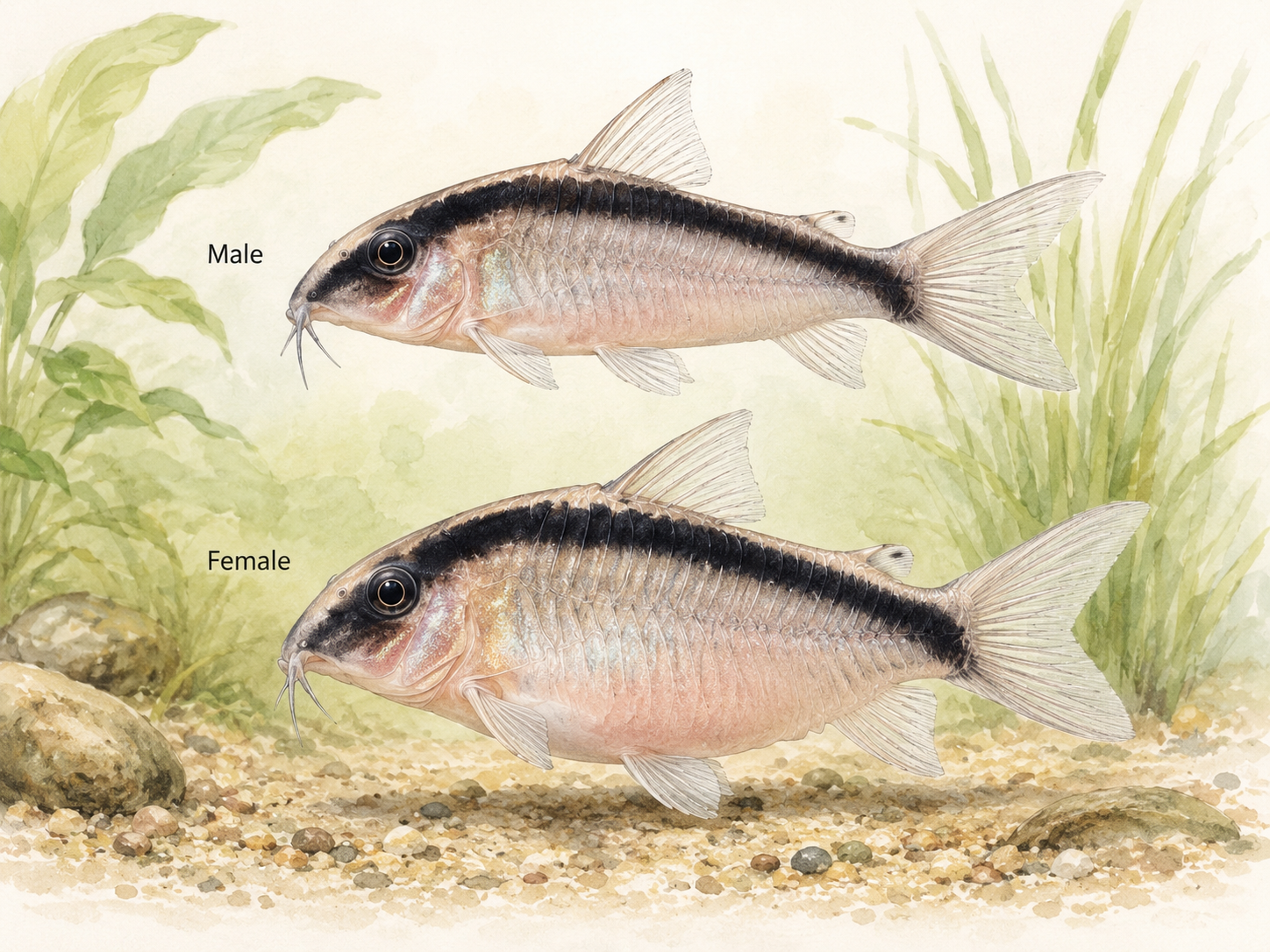
The base colouration of the body is a warm, pale beige to silvery-cream, often with a subtle golden or pinkish sheen that becomes more apparent under good lighting. The defining feature of the species is a broad, dark stripe that begins at the tip of the snout, runs upward through the eye, and then arcs along the dorsal ridge of the body before curving down into the lower lobe of the caudal fin. This distinctive arched marking is the source of both its common name, Skunk Corydoras, and its former specific epithet, arcuatus. The stripe can vary in intensity from a deep chocolate brown to near-black, and it contrasts sharply against the lighter body colour.
The fins are largely transparent to pale yellow, and the dorsal fin may show a faint dark blotch near its leading edge. The eyes are relatively large and dark, giving the fish an alert, inquisitive expression. Like all members of the family, the Skunk Corydoras possesses two rows of overlapping bony scutes rather than true scales, providing a degree of armoured protection. Sexual dimorphism is subtle; females tend to be slightly larger and broader when viewed from above, particularly when carrying eggs, while males are somewhat more slender and streamlined.
Natural Habitat
The Skunk Corydoras originates from the upper Amazon basin, with populations recorded in Peru, western Brazil, Ecuador, and Colombia. It inhabits slow-moving tributaries, small streams, and flooded forest areas where the water is typically soft, slightly acidic, and stained a tea colour by tannins leaching from decomposing leaf litter and fallen wood. These environments are characterised by dim lighting filtered through dense canopy cover, sandy or fine-gravel substrates, and an abundance of submerged roots, branches, and leaf debris.
In the wild, Skunk Corydoras are found in large groups, often numbering in the dozens or even hundreds. They spend their time foraging across the substrate, sifting through sand and detritus in search of insect larvae, small crustaceans, worms, and organic matter. The water in their native habitats is generally warm, ranging from roughly 22 to 26 °C, with a pH that typically falls between 6.0 and 7.0 and very low mineral content. Replicating these conditions as closely as possible in the home aquarium will help the fish display its best colouration and most natural behaviour.
Seasonal flooding plays an important role in the ecology of these fish. During the wet season, rising water levels expand the available habitat enormously, and corydoras move into flooded forest margins to feed on the rich bounty of invertebrates that proliferate in these temporary environments. The onset of the dry season, with its associated drop in water temperature and change in water chemistry, is thought to be a key spawning trigger for many Amazonian corydoras species, including Hoplisoma granti.
Tank Size and Setup
A minimum tank size of 75 litres is recommended for a small group of Skunk Corydoras. Because this species is highly social and must be kept in groups of at least six individuals, a larger aquarium of 100 litres or more is preferable, particularly if you intend to house them alongside other community fish. A tank with a generous footprint is more important than height, as corydoras spend the vast majority of their time on or near the bottom.
The single most important element of the substrate is that it must be soft and smooth. Fine sand is the ideal choice, as it allows the fish to engage in their natural foraging behaviour, sifting mouthfuls of substrate through their gills to extract food particles. Coarse or sharp gravel should be avoided entirely, as it can damage the delicate barbels over time, leading to erosion, infection, and difficulty feeding. Play sand, pool filter sand, or commercially available aquarium sand in a natural colour all work well.
Décor should aim to replicate the shaded, structurally complex habitats the Skunk Corydoras occupies in the wild. Driftwood, bogwood, and smooth stones provide welcome hiding spots and help the fish feel secure. Adding dried Indian almond leaves or other botanical leaf litter to the tank serves a dual purpose: the leaves release beneficial tannins that slightly lower pH and provide antifungal properties, and they create a naturalistic carpet across the substrate that the corydoras will actively forage through. Live plants are not essential but are appreciated, with species such as Java Fern, Anubias, and Cryptocoryne being excellent choices because they tolerate the lower light levels that suit this species.
Lighting should be moderate to subdued. The Skunk Corydoras is noticeably more active and confident under dimmer conditions, and floating plants such as Amazon Frogbit or Water Lettuce can be used to diffuse overhead light. Ensure there are open areas of sand for the group to forage across, as well as shaded retreats where they can rest during less active periods.
Water Parameters
Maintaining stable, clean water is fundamental to keeping Skunk Corydoras healthy. While they are reasonably adaptable, they are sensitive to poor water quality, particularly elevated nitrate levels and fluctuating parameters. The following ranges represent the ideal conditions for long-term care.
| Temperature | 22–26 °C |
| pH | 6.0–7.5 |
| General hardness (GH) | 2–12 dGH |
| Carbonate hardness (KH) | 1–8 dKH |
| Ammonia | 0 ppm |
| Nitrite | 0 ppm |
| Nitrate | Below 20 ppm |
Ammonia and nitrite must always read zero in a properly cycled aquarium. Nitrate should be kept as low as possible, ideally below 20 ppm, through regular water changes. A weekly water change of 25–30% is a good baseline, though tanks with heavier stocking may require more frequent maintenance. When performing water changes, ensure that the replacement water is dechlorinated and closely matched in temperature to avoid shocking the fish. Sudden drops in temperature, while sometimes used as a deliberate breeding trigger, can stress the fish if they occur unintentionally.
If your tap water is particularly hard or alkaline, using a blend of reverse osmosis water and tap water can help achieve the softer, slightly acidic conditions that this species prefers. The addition of tannin-releasing botanicals such as Indian almond leaves, alder cones, or driftwood will also contribute to a more suitable and stable water chemistry.
Filtration and Equipment
The Skunk Corydoras does not require particularly powerful filtration, but it does demand consistently clean water. A hang-on-back filter or a small canister filter rated for the tank’s volume will provide adequate mechanical and biological filtration for most setups. Sponge filters are another excellent option, particularly in breeding tanks, as they provide gentle water movement and biological filtration without posing a risk to eggs or fry being sucked into the intake.
Water flow should be gentle to moderate. In the wild, these fish inhabit calm backwaters and slow-moving streams, and they will be visibly uncomfortable in strong currents. If your filter produces a powerful output, consider using a spray bar or directing the flow against the glass to disperse it. Good oxygenation is important, and a gentle air stone can supplement gas exchange, especially in warmer weather when dissolved oxygen levels naturally decrease.
A reliable heater with an accurate thermostat is essential to maintain a stable temperature within the recommended 22–26 °C range. Ideally, use a heater with a built-in thermometer or pair it with an external digital thermometer for accurate monitoring. A tight-fitting lid or cover glass is also advisable. Although corydoras are not known jumpers under normal circumstances, they occasionally dart to the surface to gulp atmospheric air — a perfectly natural behaviour related to their ability to breathe intestinally — and a startled fish may occasionally breach the surface.
Diet and Feeding
Skunk Corydoras are omnivorous and unfussy feeders, accepting a wide variety of foods with enthusiasm. In the wild, their diet consists primarily of small invertebrates, insect larvae, worms, and organic detritus gleaned from the substrate. In captivity, a varied diet that includes both prepared and live or frozen foods will keep them in the best possible condition.
High-quality sinking pellets or wafers designed for bottom-dwelling catfish should form the dietary staple. These ensure the food reaches the substrate where the corydoras feed, rather than being intercepted by mid-water tankmates. Supplement this base diet regularly with frozen or live foods such as bloodworm, daphnia, brine shrimp, tubifex, and white worms. These protein-rich foods are not only excellent for general health but are particularly beneficial for conditioning adults prior to breeding. Blanched vegetables such as courgette, cucumber, or spinach can be offered occasionally for additional variety and fibre.
Feed once or twice daily, offering only as much food as the group can consume within a few minutes. It is important not to overfeed, as uneaten food will decompose on the substrate and degrade water quality. Because corydoras are somewhat crepuscular in their feeding habits, an evening feed shortly before lights-out can be particularly effective, as the fish tend to become more active as lighting dims. Observe the barbels of your fish regularly; healthy barbels that are long and intact are a reliable indicator that both the diet and substrate conditions are appropriate.
Behaviour and Temperament
The Skunk Corydoras is a quintessentially peaceful and sociable species. It is entirely non-aggressive and poses no threat to any tankmate, regardless of size. Its primary activity consists of methodically working across the substrate in search of food, using its sensitive barbels to probe sand and detritus. This foraging behaviour is endlessly entertaining to watch and serves a useful function in the aquarium by helping to turn over the substrate and prevent the formation of anaerobic pockets.
This species is a dedicated shoaling fish and must be kept in groups of six or more. When kept in insufficient numbers, Skunk Corydoras become visibly stressed, often hiding for extended periods and displaying faded colouration. In a properly sized group, they are confident, active, and will spend much of the day moving together across the tank floor. They frequently rest together in tight clusters, often stacking on top of one another in a behaviour that, while comical, reflects their strong social bonds.
Like all members of the family, the Skunk Corydoras is capable of intestinal breathing. You will regularly observe individuals darting to the surface to gulp a mouthful of air before returning to the bottom. This is entirely normal and not a sign of oxygen deprivation, though a marked increase in the frequency of this behaviour can indicate poor water quality or insufficient dissolved oxygen. They are also known to “wink” their eyes — a characteristic corydoras behaviour made possible by the rotation of the eye within the socket — which gives them an unusually expressive quality among fish.
Activity levels tend to peak during dawn and dusk, consistent with their crepuscular nature. Under subdued lighting, or in tanks with plenty of cover and a dark substrate, they will be noticeably bolder and more active throughout the day.
Tank Mates
The Skunk Corydoras is an ideal community fish, compatible with a wide range of small, peaceful species. When selecting tankmates, prioritise fish that share a preference for soft to moderately hard water and temperatures in the low to mid twenties. Avoid any species large enough to view the corydoras as prey or aggressive enough to harass them.
Good tank mates
- Cardinal Tetra — A classic Amazonian companion that shares the same water chemistry preferences and occupies the mid-water column, leaving the bottom free for the corydoras.
- Rummy-Nose Tetra — A peaceful, tightly shoaling tetra that thrives in the soft, warm water conditions ideal for Skunk Corydoras.
- Ember Tetra — A tiny, gentle species that adds a splash of colour to the upper water levels without any risk of conflict.
- Harlequin Rasbora — A hardy, undemanding rasbora that coexists peacefully and tolerates the same temperature and pH range.
- Otocinclus — A small, algae-eating catfish that shares the same preference for calm water and sandy substrates, and will not compete for food.
- Kuhli Loach — A peaceful bottom-dweller that, while occupying a similar niche, rarely competes directly and coexists harmoniously in well-structured tanks.
- Honey Gourami — A calm, slow-moving surface dweller that makes an excellent centrepiece fish without causing stress to bottom-dwelling species.
- Cherry Barb — A mild-mannered barb that is too small and gentle to pose any problem to corydoras and adds activity to the middle of the tank.
- Bristlenose Pleco — A peaceful algae eater that cohabits well with corydoras provided the tank is large enough to accommodate both species comfortably.
- Amano Shrimp — Excellent clean-up crew members that are far too large for the corydoras to bother and contribute to overall tank hygiene.
Fish to avoid
- Oscar — A large, predatory cichlid that will readily consume any fish small enough to fit in its mouth, including adult corydoras.
- Red-Tail Catfish — An enormous predatory catfish entirely unsuitable for community tanks and capable of eating tankmates many times the size of a corydoras.
- Tiger Barb — A known fin-nipper that can persistently harass slower-moving bottom dwellers, causing chronic stress.
- Convict Cichlid — An aggressive, territorial cichlid that becomes especially hostile during breeding and will attack bottom-dwelling fish in its territory.
- Jack Dempsey — A large, aggressive Central American cichlid that is far too boisterous and predatory for a corydoras community.
- African Rift Lake Cichlids — These species require hard, alkaline water that is fundamentally incompatible with the soft, acidic conditions preferred by Skunk Corydoras.
- Green Terror — A highly territorial cichlid that will dominate the lower levels of the tank and readily attack smaller fish.
- Common Pleco — While not aggressive, this species grows far too large for most community tanks and can produce enormous amounts of waste, degrading water quality for sensitive species.
Breeding
Breeding the Skunk Corydoras in captivity is achievable and follows the general pattern observed across many corydoras species, though it is considered moderately challenging compared to the more prolific species such as the Bronze or Peppered Corydoras. Success typically requires deliberate conditioning, specific environmental triggers, and careful management of eggs and fry.
Begin by conditioning a group of adults — ideally with a ratio of two males to each female — with generous quantities of high-quality live and frozen foods over a period of two to four weeks. Bloodworm, white worms, daphnia, and brine shrimp are all excellent conditioning foods. Well-conditioned females will appear noticeably rounder when viewed from above.
The most reliable spawning trigger is a large, cool water change that simulates the onset of the rainy season. Replace 50–70% of the tank water with dechlorinated water that is several degrees cooler than the current tank temperature. A drop of 3–5 °C, combined with increased oxygenation from an air stone, often induces spawning within 24 to 48 hours. Some breeders also report success by performing repeated large water changes over consecutive days and lowering atmospheric pressure, which can coincide with natural weather changes.
Spawning follows the characteristic T-position observed in most corydoras species. The female cups her ventral fins to form a pouch in which she catches a small number of eggs — typically two to four at a time — which the male then fertilises. She then swims to a chosen surface, usually the aquarium glass, a broad leaf, or a piece of décor, and carefully affixes the adhesive eggs. This process is repeated many times over several hours, with a typical clutch consisting of 30 to 80 eggs.
The eggs are at significant risk of fungal infection, particularly in warmer water. Many breeders remove the eggs to a separate, well-aerated hatching container with clean water at the same parameters as the spawning tank. Adding a few drops of methylene blue or placing an Indian almond leaf in the hatching container can help suppress fungal growth. Infertile eggs will turn opaque white within 24 hours and should be removed promptly to prevent fungus spreading to viable eggs.
At temperatures around 24 °C, the eggs typically hatch within three to five days. The newly hatched fry are tiny and will initially absorb their yolk sacs over the first day or two. Once free-swimming, they can be fed infusoria, commercially available liquid fry food, or freshly hatched baby brine shrimp. As they grow, transition them onto microworms and finely crushed flake or pellet food. Maintaining impeccable water quality in the rearing tank is critical, as fry are exceptionally sensitive to ammonia and nitrite. Small, frequent water changes performed with care will support healthy development.
Common Diseases
The Skunk Corydoras is generally a hardy species when kept in appropriate conditions, but like all fish, it is susceptible to a number of common ailments, particularly when water quality deteriorates or the fish is subjected to chronic stress.
White spot disease, or ich, caused by the parasite Ichthyophthirius multifiliis, is one of the most frequently encountered illnesses. It presents as small white spots resembling grains of salt across the body and fins. Treatment involves raising the temperature gradually to 28–30 °C (if the fish can tolerate it) and using a half-dose of a proprietary ich medication, as corydoras, being scaleless fish with bony scutes, are more sensitive to many chemical treatments than scaled species. Always read medication labels carefully and reduce dosages as recommended for scaleless fish.
Barbel erosion is a condition particularly relevant to corydoras and is almost always attributable to poor substrate choices or degraded water quality. When kept on sharp or coarse gravel, the barbels gradually wear down and can become infected. Similarly, high nitrate levels or a dirty substrate can contribute to bacterial infections of the barbels and ventral surface. Prevention is straightforward: use fine, smooth sand and maintain excellent water quality through regular maintenance.
Bacterial infections can manifest in various ways, including redness or inflammation on the body, fin rot, or lethargy. These are typically secondary to underlying issues such as poor water conditions, injuries, or stress. Improving water quality is always the first step in treatment, and in more serious cases, a broad-spectrum antibacterial medication may be required.
Corydoras are also susceptible to internal parasites, particularly in wild-caught specimens. Symptoms may include weight loss despite a good appetite, white or stringy faeces, and general listlessness. Treatments containing praziquantel or levamisole are commonly used to address internal parasites. Quarantining new arrivals for two to four weeks before introducing them to an established tank is strongly recommended to prevent the introduction of pathogens.
It is worth noting that corydoras possess venomous spines in their dorsal and pectoral fins. While not dangerous to humans beyond a painful sting, this defence mechanism means that care should be taken when handling the fish during tank maintenance or transfers. Use a container rather than a net when moving them, as their spines can become entangled in mesh and cause injury to the fish.
FAQs
How many Skunk Corydoras should I keep together?
A minimum group of six is essential, but more is always better. In groups of fewer than six, Skunk Corydoras tend to be reclusive, stressed, and display washed-out colouration. In larger groups of eight to twelve or more, they become noticeably more confident, active, and socially engaged, spending much of the day foraging together across the substrate in a manner that closely mirrors their wild behaviour.
Can Skunk Corydoras be kept on gravel?
While they can survive on smooth, fine gravel, sand is strongly preferred and should be considered the default substrate for any corydoras species. Sand allows them to perform their natural sifting behaviour, where they take mouthfuls of substrate and filter it through their gills to extract food. Coarse or sharp-edged gravel will gradually damage their sensitive barbels, leading to erosion and potential secondary infections that compromise the fish’s ability to feed.
Why do my Skunk Corydoras keep swimming to the surface?
Occasional trips to the surface to gulp air are completely normal. Corydoras possess a modified intestine that allows them to extract oxygen directly from swallowed air, supplementing their gill respiration. This is an adaptation to their natural habitat, where dissolved oxygen levels can sometimes be low. However, if you notice your fish making very frequent trips to the surface, it may indicate that dissolved oxygen levels in the tank are too low, or that water quality has deteriorated. Check your water parameters and ensure adequate aeration.
Is the Skunk Corydoras the same as the Corydoras arcuatus?
Yes. The fish historically and widely known as Corydoras arcuatus has been reclassified into the genus Hoplisoma following a major taxonomic revision of the Corydoradinae subfamily. Its current accepted scientific name is Hoplisoma granti. You will still encounter it listed under its former name in many aquarium shops, books, and online resources, but both names refer to the same species. The common names Skunk Corydoras and Arched Corydoras remain unchanged.
Are Skunk Corydoras sensitive to medication?
Yes, like all corydoras and other scaleless or armoured catfish, they are more sensitive to certain medications — particularly those containing copper or formalin — than typical scaled fish. When treating a tank containing Skunk Corydoras, always use medications at a reduced dose, typically half the standard concentration, unless the product specifically states it is safe for scaleless fish at full strength. Salt treatments should also be used with caution, as corydoras have a lower tolerance for elevated salinity than many other freshwater species.
Related Guides
- Bronze Corydoras Care Guide — A closely related and widely available corydoras species that shares similar care requirements and makes an excellent companion in community setups.
- Panda Corydoras Care Guide — Another popular small corydoras species that thrives in similar soft-water conditions and benefits from the same tank setup principles.
- Pygmy Corydoras Care Guide — A miniature corydoras species ideal for smaller tanks, with care requirements that overlap significantly with those of the Skunk Corydoras.
- Sterba’s Corydoras Care Guide — A beautifully patterned Amazonian corydoras with comparable water parameter preferences and social behaviour.
- How to Set Up a South American Biotope Aquarium — A comprehensive guide to creating an authentic Amazonian habitat that perfectly suits the Skunk Corydoras and its natural tankmates.
- How to Breed Corydoras — A detailed guide covering spawning triggers, egg care, and fry rearing techniques applicable to Hoplisoma granti and other corydoras species.