Quick summary
The Flowerhorn Cichlid is a large, strikingly colourful hybrid best suited to committed keepers who can provide a spacious tank (280 litres minimum), heavy filtration, and a species-only setup due to its intense aggression. If you want an interactive fish that recognises its owner and don’t mind the significant space, maintenance, and tank mate limitations, it can be a rewarding choice.
🐠 Build a tank around this species
In this guide:
- Introduction
- Quick Stats
- Appearance
- Varieties and Morphs
- Natural Habitat
- Tank Size and Setup
- Water Parameters
- Filtration and Equipment
- Diet and Feeding
- Behaviour and Temperament
- Tank Mates
- Breeding
- Common Diseases
- FAQs
Introduction
The Flowerhorn Cichlid is one of the most recognisable and polarising fish in the freshwater aquarium hobby. A man-made hybrid with no direct wild counterpart, the Flowerhorn was first developed in Malaysia during the late 1990s through selective crossbreeding of Central and South American cichlid species, most notably blood parrot cichlids and trimac cichlids (Amphilophus trimaculatus), along with contributions from species such as Amphilophus citrinellus (Midas cichlid) and Vieja synspila. The precise genetic lineage remains somewhat debated and varies between strains, but the result is unmistakable: a large, robust, brilliantly coloured cichlid with a pronounced nuchal hump, known as a kok, that has captivated hobbyists across South-East Asia and, increasingly, throughout the rest of the world.
Culturally, the Flowerhorn holds special significance in parts of Asia, where its vivid colours and prominent head growth are considered symbols of prosperity and good fortune. Some specimens displaying markings that resemble Chinese characters or auspicious symbols have famously commanded extraordinary prices. Beyond the cultural mystique, however, the Flowerhorn is simply a compelling aquarium fish: interactive, boldly patterned, and possessed of a personality that few other species can match. These fish recognise their owners, respond to visual cues, and will often follow a keeper’s movements from across the room.
Keeping a Flowerhorn is not without its challenges. They grow large, produce a considerable amount of waste, and are notoriously aggressive, often requiring a species-only setup. Prospective owners should be prepared for a significant commitment in terms of tank space, filtration, and ongoing maintenance. This guide covers everything you need to know to keep a Flowerhorn Cichlid healthy, vibrant, and thriving for years to come.
Quick Stats
| Scientific name | Cichlasomatinae hybrid (no formal binomial name) |
|---|---|
| Common names | Flowerhorn, Hua Luo Han, Luo Han |
| Family | Cichlidae |
| Origin | Captive-bred hybrid, parent species from Central and South America |
| Adult size | 30 cm |
| Difficulty | Intermediate |
| Breeding difficulty | Moderate |
| Temperature | 26–30 °C |
| pH | 6.5–8 |
| GH | 6–20 dGH |
| Minimum tank size | 280 L |
| Conservation status | Not Evaluated (captive-bred hybrid) |
Appearance
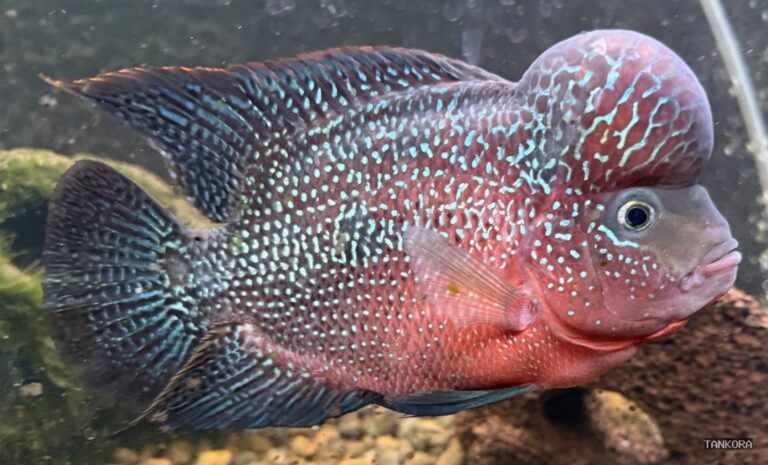
The Flowerhorn Cichlid is an undeniably striking fish. Its most famous feature is the nuchal hump, or kok, a large fatty and cartilaginous protuberance that develops on the forehead, particularly prominent in males. The size and shape of the kok vary considerably between individuals and strains, influenced by genetics, diet, and water quality. In prized specimens, this hump can grow to dramatic proportions, giving the fish an almost comically oversized head profile.
The body is deep, laterally compressed, and powerfully built, reflecting the fish’s cichlid heritage. Adult Flowerhorns typically reach between 25 and 35 cm in length, with some exceptional individuals surpassing this range. The base colouration ranges from vivid crimson and orange to deep pink, often overlaid with iridescent blue, green, or black markings. Many strains exhibit a row of dark blotches or a broken lateral stripe along the flanks, and the most sought-after specimens display intricate pearl or flower-like patterns across the body, a trait known as “pearling” or “floral” marking, from which the common name partly derives.
The fins are large and well-developed. The dorsal and anal fins often extend into long, trailing filaments, particularly in males, and may display bold red, blue, or white edging. The caudal fin is typically rounded or slightly fan-shaped and can be vividly coloured. The eyes are large and expressive, often with a reddish iris. Sexual dimorphism is noticeable: males are generally larger, develop a more prominent kok, and display more intense colouration, whilst females tend to be smaller, less vividly coloured, and usually retain a smaller or absent nuchal hump. Females also typically show a dark spot on the dorsal fin and may display an orange belly during breeding condition.


Varieties and Morphs
The Flowerhorn Cichlid has been subject to decades of intensive selective breeding, resulting in a wide array of named varieties that differ in body shape, colour intensity, pearl patterning, and head growth. The classification of Flowerhorn strains is not standardised in a scientific sense but rather follows trade and hobbyist conventions that have solidified over time. Below are the most widely recognised varieties.
The Zhen Zhu (Pearl) Flowerhorn is one of the most popular strains, prized for its extensive pearl-like iridescent scales that cover the body and sometimes extend onto the face. These fish typically display a prominent kok and a vivid red or yellow base colour with pronounced blue or white pearling. The Golden Monkey (Good Fortune) strain, sometimes called Malau or Golden Base, is considered one of the original and most prestigious lines. These fish exhibit a deep golden or reddish base with a large, well-formed kok, and command particularly high prices in Asian markets.
The Kamfa strain is recognised by its squared body profile, sunken or protruding eyes, prominent head growth, and typically more subdued background colouration offset by intense pearling and striking fin extensions. Kamfa Flowerhorns often have a distinctive fan tail rather than the trailing caudal filaments seen in other lines. The Red Dragon (Super Red Dragon) is a dramatic variety featuring an intense crimson to blood-red body with a clean, relatively unmarked appearance and a large rounded kok. These are among the most visually arresting Flowerhorns available.
The Thai Silk, also called Titanium Flowerhorn, is a newer variety noted for its metallic silver, blue, or white body colouration, which can appear almost artificial in its intensity. These fish may display less pearling but compensate with their extraordinary sheen. The King Kong Parrot Flowerhorn is a stockier, rounder variety more closely related to blood parrot cichlid genetics, displaying a deep red colouration and a more compressed body shape. The Tan King variety is a Zhen Zhu derivative with a strongly pronounced floral pattern, whilst the IndoMalau is a strain originating from Indonesian breeding programmes that emphasises large kok development and vivid red colouration. The Super Red Texas Flowerhorn is a cross involving Texas cichlids (Herichthys cyanoguttatus) that produces stunning blue-spangled patterns over a red base. Finally, the Fader variety is a unique line whose juveniles begin with a dark or dull colouration that gradually “fades” to reveal brilliant red, yellow, or golden hues as the fish matures, a transformation that can take several months and adds a compelling element of anticipation for the keeper.
Natural Habitat
The Flowerhorn Cichlid does not occur naturally in the wild, as it is an entirely man-made hybrid. Its parent species, however, originate from freshwater environments across Central and South America. The Midas cichlid (Amphilophus citrinellus) and trimac cichlid (Amphilophus trimaculatus) inhabit warm, slow-moving rivers, lakes, and volcanic crater lakes in countries such as Nicaragua, Honduras, Guatemala, and Mexico. The Vieja synspila is native to rivers and lagoons in southern Mexico, Belize, and Guatemala. These environments are typically warm, with moderate to hard water and rocky or sandy substrates interspersed with submerged wood and vegetation.
Understanding these ancestral habitats helps inform the ideal captive conditions for Flowerhorns. Warm temperatures, slightly alkaline to neutral water, and a moderately hard mineral profile closely mirror the conditions experienced by the parent species. It is worth noting that feral populations of Flowerhorn Cichlids have established themselves in waterways in several countries, including Singapore, Malaysia, Australia, and parts of the United States, where released or escaped specimens have become invasive. This is a serious ecological concern, and responsible fishkeeping means never releasing any Flowerhorn into natural waterways under any circumstances.
Tank Size and Setup
A single adult Flowerhorn requires a minimum tank size of 280 litres (approximately 75 US gallons), though larger is always better. A 350 to 450 litre tank is a more comfortable long-term home and provides the space needed for the fish to turn, swim, and display naturally without feeling cramped. If you intend to keep a pair or attempt housing a Flowerhorn with other large cichlids, a tank of 550 litres or more is strongly recommended, along with robust dividers or sight-line breaks.
The tank dimensions are as important as the total volume. Flowerhorns are broad-bodied, active swimmers, so prioritise floor space over height. A tank measuring at least 150 cm in length and 50 cm in depth (front to back) provides a good footprint for a single specimen. Standard aquarium dimensions of 180 × 60 × 60 cm are ideal for larger setups.
When it comes to décor, simplicity is key. Flowerhorns are notorious redecorators, they will uproot plants, shift gravel, and move lightweight ornaments with remarkable determination. A bare-bottom setup or a tank with a thin layer of smooth, rounded gravel or sand is the most practical approach. Live plants are generally not viable unless they are extremely robust species attached to heavy stones or driftwood, and even then survival is not guaranteed. Many keepers opt for a minimalist aesthetic with a few large rocks or pieces of driftwood that are too heavy for the fish to displace. Ensure that any rocks are stable and cannot topple, as a determined Flowerhorn can shift surprisingly heavy objects.
A secure, tight-fitting lid is essential. Although Flowerhorns are not habitual jumpers, they can launch themselves out of the water during feeding frenzies or when startled. Adequate lighting is important for displaying the fish’s colours but need not be specialised, a standard LED fixture on a timer providing 8 to 10 hours of light per day is perfectly sufficient.
Water Parameters
Flowerhorn Cichlids are reasonably adaptable when it comes to water chemistry, reflecting the varied conditions tolerated by their parent species. However, they do best within a fairly specific range, and maintaining stable parameters is more important than hitting any single target value. Sudden fluctuations in temperature, pH, or hardness can stress the fish and trigger health problems.
| Temperature | 26–30 °C |
| pH | 6.5–8.0 |
| General hardness (GH) | 6–20 dGH |
| Ammonia | 0 ppm |
| Nitrite | 0 ppm |
| Nitrate | Below 30 ppm |
A temperature of 28 °C is often considered the sweet spot for most Flowerhorn strains, promoting good metabolism, colour development, and overall vitality. Water that is slightly alkaline, around pH 7.0 to 7.8, tends to produce the best results. Moderately hard water is preferred, and many keepers find that their local tap water, once dechlorinated, is perfectly suitable without significant modification. Regular testing with a reliable liquid test kit is strongly advised, particularly during the first few months of setting up a new tank.
Filtration and Equipment
Flowerhorns are messy eaters and prolific waste producers, so robust filtration is non-negotiable. An external canister filter rated for at least 1.5 to 2 times the tank’s volume is the minimum standard. Many experienced keepers run two canister filters simultaneously or supplement a canister with a large sponge filter or hang-on-back unit to ensure redundancy and maximum biological filtration capacity. Sump-based filtration is another excellent option for larger setups, providing ample space for mechanical, biological, and chemical media whilst keeping equipment out of the display tank.
Water movement should be moderate. Flowerhorns do not naturally inhabit fast-flowing environments, and excessive current can cause stress. Position filter outlets to create gentle circulation throughout the tank without producing a strong directional flow. An air stone or secondary source of surface agitation can help maintain dissolved oxygen levels, particularly in warmer water where oxygen solubility decreases.
A reliable heater is essential. Choose a unit rated appropriately for the tank volume, or better still, use two slightly undersized heaters placed at opposite ends of the tank. This provides a safety net: if one heater fails, the other prevents a catastrophic temperature drop, and if one malfunctions and sticks in the on position, a single undersized unit is less likely to overheat the water before the issue is noticed. A digital thermometer placed away from the heater provides an accurate, independent temperature reading.
Weekly water changes of 25 to 40 per cent are strongly recommended. Large, regular water changes are one of the single most important factors in keeping a Flowerhorn healthy, promoting good colour, robust head growth, and resistance to disease. Use a dechlorinator or water conditioner with every change, and try to match the temperature of the replacement water to the tank to avoid thermal shock.
Diet and Feeding
Flowerhorn Cichlids are omnivorous with a strong carnivorous leaning. In captivity, a high-quality cichlid pellet should form the staple of their diet. Several commercial brands produce pellets specifically formulated for Flowerhorns and large cichlids, designed to promote colour enhancement, growth, and kok development. Choose a pellet with a protein content of around 40 to 50 per cent and look for ingredients such as whole fish meal, krill, and spirulina near the top of the list. Avoid products that rely heavily on fillers like wheat or soy.
Supplement the staple pellets with regular offerings of frozen or fresh foods. Bloodworms, brine shrimp, krill, mysis shrimp, and chopped prawns are all excellent choices. Earthworms and mealworms can be offered occasionally as treats and are particularly relished. Some keepers feed small amounts of blanched peas or spinach to provide fibre and support digestive health. Live feeder fish are best avoided, as they carry a significant risk of introducing parasites and diseases into the tank, and their nutritional value does not justify the hazard.
Feed juveniles two to three times daily in small portions to support their rapid growth. As the fish matures, reduce feeding to once or twice daily, offering only as much food as the Flowerhorn can consume within two to three minutes. Overfeeding is a common mistake and leads to poor water quality, obesity, and digestive issues. One fasting day per week can be beneficial for adult fish, allowing the digestive system to rest.
There is considerable debate in the hobby about the role of diet in kok development. Whilst genetics are the primary determinant of head growth, a nutritious, varied diet and excellent water quality are believed to support the fullest expression of an individual’s genetic potential. Some keepers supplement with products containing astaxanthin or other carotenoids to enhance red and orange colouration, which can be effective when used judiciously.
Behaviour and Temperament
The Flowerhorn Cichlid is one of the most interactive and personality-driven fish available to the freshwater hobbyist. These fish readily learn to recognise their owner and will often approach the front glass in anticipation of food, follow hand movements, and even allow themselves to be touched or hand-fed, a level of engagement that is rare in aquarium fish and is a major part of their appeal.
However, the other side of this strong personality is pronounced aggression. Flowerhorns are highly territorial and dominant fish that will attack and potentially kill tank mates, particularly in confined spaces. This aggression is not limited to other fish; Flowerhorns have been known to attack thermometers, heaters, filter intakes, and even the hands of their keepers during tank maintenance. Aggression levels vary between individuals, but as a general rule, Flowerhorns should be considered species-only fish unless the keeper has significant experience with large, aggressive cichlids and a very large tank.
Males are typically more aggressive than females, and aggression tends to intensify during breeding condition. Even bonded breeding pairs can turn on each other with little warning, making it essential to have a divider or contingency plan in place when keeping more than one Flowerhorn. Solitary keeping is the safest and most commonly recommended approach for the average hobbyist.
Flowerhorns are also avid diggers and rearrangers. Expect the substrate to be moved, gravel piled against the glass, and any unsecured items displaced. This behaviour is entirely normal and is part of the fish’s natural repertoire inherited from its cichlid ancestors. Rather than fighting this tendency, it is best to design the tank layout with the fish’s habits in mind.
Tank Mates
Selecting tank mates for a Flowerhorn is one of the most challenging aspects of keeping this fish, and many experienced keepers ultimately conclude that a species-only setup is the wisest approach. That said, with a sufficiently large tank, typically 550 litres or more, and careful management, some robust species can coexist with a Flowerhorn, provided there are adequate sight-line breaks and hiding spots. Success depends heavily on the individual temperament of the Flowerhorn, and there is always a degree of risk involved.
Good tank mates
- Oscar Cichlid (Astronotus ocellatus), a large, robust cichlid that can hold its own against moderate Flowerhorn aggression in a spacious tank.
- Jaguar Cichlid (Parachromis managuensis), a powerful, similarly-sized cichlid that is unlikely to be easily bullied, though careful monitoring is essential.
- Common Pleco (Hypostomus plecostomus), its heavily armoured body and nocturnal habits help it avoid conflict, and it can tolerate similar water conditions.
- Sailfin Pleco (Pterygoplichthys gibbiceps), another large, armoured catfish that is generally ignored by Flowerhorns and assists with algae management.
- Giant Gourami (Osphronemus goramy), its large adult size and relatively calm but resilient demeanour can make it a viable companion in very large systems.
- Texas Cichlid (Herichthys cyanoguttatus), a tough, similarly-sized cichlid from a related lineage that can sometimes coexist in very spacious setups.
- Silver Arowana (Osteoglossum bicirrhosum), Occupies the upper water column and is large enough to avoid predation, though only suitable for very large tanks.
- Bichir (Polypterus spp.), Bottom-dwelling and armoured, bichirs generally stay out of the Flowerhorn’s way and are tough enough to withstand occasional aggression.
Fish to avoid
- Neon Tetra (Paracheirodon innesi), far too small and will be instantly consumed or killed by a Flowerhorn.
- Angelfish (Pterophyllum scalare), their slow movement, laterally compressed body, and peaceful nature make them easy targets for Flowerhorn aggression.
- Discus (Symphysodon spp.), highly sensitive, peaceful fish that would be severely stressed and likely injured or killed.
- Guppy (Poecilia reticulata), far too small and defenceless to survive alongside any large cichlid.
- Corydoras Catfish (Corydoras spp.), Small, peaceful bottom-dwellers that would be harassed or eaten by a Flowerhorn.
- Dwarf Gourami (Trichogaster lalius), Much too small and timid to coexist with a large, aggressive cichlid.
- German Blue Ram (Mikrogeophagus ramirezi), a small, delicate cichlid that would not survive the aggression of a Flowerhorn.
- Goldfish (Carassius auratus), Requires cooler water temperatures and is too slow-moving and vulnerable to coexist with a Flowerhorn.
Breeding
Breeding Flowerhorn Cichlids is achievable for dedicated hobbyists, though it requires careful planning and close monitoring. Because Flowerhorns are hybrids, the offspring may show considerable variation in appearance, and not all pairings will produce fertile eggs. Males of certain strains, particularly those with a high degree of hybrid vigour, may be infertile, which is one of the recognised consequences of extensive cross-breeding.
To attempt breeding, you will need a confirmed male and female pair. Sexing Flowerhorns can be done with reasonable accuracy once the fish reach approximately 10 to 12 cm. Males develop a more pronounced kok, grow larger, and generally display more intense colouration. Females often show a black spot on the dorsal fin and may have a more rounded belly. Venting, examining the genital papilla, is the most reliable method, with females displaying a broader, more rounded papilla compared to the male’s more pointed one.
Introduce the pair with a clear tank divider between them. This allows the fish to see and assess each other without the risk of one killing the other, a very real danger with Flowerhorns. Watch for signs of mutual interest: both fish may display heightened colour, flare their fins, and position themselves close to the divider. If the female displays a swollen, orange-tinged belly and appears receptive, the divider can be removed, but only under close supervision. Many breeders keep the divider in place permanently, using a small gap or mesh panel that allows eggs and sperm to pass through but prevents physical contact.
The female will lay eggs on a cleaned flat surface, a smooth rock, a ceramic plate, or even the bare tank bottom. A single clutch can contain anywhere from 500 to over 2,000 eggs. Both parents may exhibit guarding behaviour, fanning the eggs and removing any that turn white (indicating they are unfertilised). The eggs typically hatch within 48 to 72 hours at 28 °C, and the fry become free-swimming approximately three to four days after hatching.
Once free-swimming, the fry can be fed newly hatched brine shrimp (Artemia nauplii), microworms, or finely crushed high-quality fry food. Growth can be rapid with frequent feeding and excellent water quality. It is generally advisable to remove the fry to a separate rearing tank to prevent predation and to manage water quality more effectively during this critical growth phase. As the juveniles grow, sort them by size to prevent the larger, more aggressive individuals from dominating food resources and bullying their smaller siblings.
Common Diseases
Flowerhorn Cichlids are generally hardy fish, but they are susceptible to a number of common freshwater ailments, particularly when water quality is allowed to deteriorate or the fish is subjected to chronic stress.
Hole-in-the-head disease, also known as head and lateral line erosion (HLLE), is one of the most frequently encountered conditions in Flowerhorns. It manifests as small pits or erosions on the head and along the lateral line, which can deepen and enlarge if left untreated. The condition is associated with poor water quality, nutritional deficiencies (particularly a lack of vitamins C and D), and the flagellate parasite Hexamita. Treatment involves improving water quality through more frequent water changes, enriching the diet with vitamin-supplemented foods, and, in cases where Hexamita is suspected, treating with metronidazole under veterinary guidance.
White spot disease, or ich (Ichthyophthirius multifiliis), presents as small white cysts resembling grains of salt on the body and fins. It is highly contagious and often triggered by sudden temperature drops or the introduction of infected fish or equipment. Treatment involves gradually raising the water temperature to 30–32 °C and administering a proprietary ich medication according to the manufacturer’s instructions.
Bacterial infections can manifest in various ways, including fin rot, ulcers, and cloudy eyes. These are almost always secondary to poor water quality or physical injury. Maintaining pristine water conditions is both the best prevention and the first line of treatment. Severe cases may require treatment with antibacterial medications. Fungal infections, recognisable by white, cotton-like growths on the body or fins, are similarly linked to poor conditions or open wounds and can be treated with antifungal preparations.
Internal parasites can occasionally affect Flowerhorns, particularly those fed live foods. Symptoms include weight loss despite a good appetite, white stringy faeces, and lethargy. Anti-parasitic treatments containing praziquantel or levamisole are typically effective. Bloat, characterised by a visibly swollen abdomen, can result from overfeeding, constipation, or internal infection and should be addressed promptly by fasting the fish for several days and, if the condition persists, consulting an aquatic veterinarian.
As with most aquarium fish, prevention is far more effective than cure. Consistent water changes, a varied and nutritious diet, appropriate stocking levels, and quarantining any new additions to the aquarium will go a long way towards keeping your Flowerhorn in excellent health throughout its long lifespan.
FAQs
Can a Flowerhorn be kept in a community tank?
In the vast majority of cases, a Flowerhorn is best kept alone. Their aggression is usually too intense and unpredictable for a standard community setup. While some keepers have success housing Flowerhorns with other large, robust species in very spacious tanks of 550 litres or more, this requires experience, careful observation, and contingency plans should aggression escalate. For most hobbyists, a species-only tank is the safest and most practical choice.
How do I encourage my Flowerhorn’s kok to grow larger?
The size and shape of the nuchal hump are primarily determined by genetics, no amount of dietary supplementation or water parameter manipulation will produce a large kok on a fish that is not genetically predisposed to develop one. However, you can support the fullest expression of your fish’s genetic potential by maintaining excellent water quality with regular large water changes, feeding a high-quality, varied diet rich in protein, and minimising stress. Some keepers believe that keeping the fish in a slightly warmer range (around 29–30 °C) and providing visual stimulation, such as a mirror for short periods, can encourage head growth, though the evidence for these practices is largely anecdotal.
Are Flowerhorn Cichlids legal to keep everywhere?
Flowerhorn Cichlids are legal to keep in most countries, but some regions have restrictions or outright bans due to the ecological damage caused by released specimens becoming invasive. Australia, for example, has strict regulations regarding Flowerhorn importation and ownership. Always check your local and national regulations before acquiring a Flowerhorn, and under no circumstances should these fish ever be released into natural waterways.
Why has my Flowerhorn’s colour faded?
Colour fading can result from a number of factors. Poor water quality is the most common cause, so begin by testing your parameters and performing a large water change. Stress from aggressive tank mates, an undersized tank, or a recent move can also cause temporary colour loss. Nutritional deficiencies, particularly a diet lacking in carotenoid-rich foods, can dull colouration over time. Some Flowerhorns also undergo natural colour changes as they mature, and certain strains, notably Fader types, will lose and regain colour as part of their normal development. If colour fading is accompanied by other symptoms such as lethargy, clamped fins, or loss of appetite, investigate potential health issues.
How can I tell if my Flowerhorn is male or female?
Males are generally larger, develop a more prominent nuchal hump, and display bolder colouration. Females tend to be smaller, often show a dark spot on the dorsal fin, and may develop an orange or pinkish tinge to the belly when in breeding condition. The most reliable method of sexing is venting: gently examining the genital area reveals a smaller, more pointed papilla in males and a broader, rounder papilla in females. This technique is most accurate in fish that are at least 10 to 12 cm in length and is best performed by someone with experience to avoid stressing the fish unnecessarily.
Related Guides
- Oscar Cichlid Care Guide, another large, personality-driven New World cichlid with similar care requirements and temperament considerations.
- Blood Parrot Cichlid Care Guide, one of the Flowerhorn’s parent hybrids, sharing many husbandry requirements and behavioural traits.
- Jaguar Cichlid Care Guide, a large, aggressive Central American cichlid often discussed alongside Flowerhorns as a potential tank mate.
- Texas Cichlid Care Guide, a robust cichlid species involved in some Flowerhorn breeding lines, with overlapping care needs.
- Midas Cichlid Care Guide, a key ancestor species of the Flowerhorn, offering insight into the genetic origins of the hybrid.