Bluefin Notho Care Guide — Tank Setup, Feeding and Breeding
Quick summary
The Bluefin Notho is a stunningly colourful but short-lived killifish, best suited to hobbyists who understand basic water chemistry and are prepared for its unusual annual life cycle, including its 9-18 month lifespan and peat-based egg incubation for breeding. It’s manageable in a small 40 litre tank and doesn’t require advanced skills, but it’s not a typical low-maintenance beginner fish.
🐠 Build a tank around this fish
In this guide:
- Introduction
- Quick Stats
- Appearance
- Varieties and Morphs
- Natural Habitat
- Tank Size and Setup
- Water Parameters
- Filtration and Equipment
- Diet and Feeding
- Behaviour and Temperament
- Tank Mates
- Breeding
- Common Diseases
- FAQs
Introduction
The Bluefin Notho, known scientifically as Nothobranchius rachovii, is widely regarded as one of the most stunningly colourful freshwater fish in the world. This small killifish hails from the seasonal floodplains of south-eastern Africa, where it has evolved a remarkable life strategy to cope with its ephemeral habitat. As an annual killifish, it completes its entire life cycle, from hatching to reproduction, within the brief window of a single rainy season, depositing drought-resistant eggs in the substrate before the pools dry out entirely.
First described by the ichthyologist Max Ahl in 1926 and named in honour of the aquarist Arthur Rachow, this species has captivated fishkeepers for nearly a century. Its breathtaking combination of fiery oranges, electric blues, and intricate patterning makes it a living jewel, and many hobbyists consider it the most beautiful of all killifish. Despite its relatively short lifespan, the Bluefin Notho offers a deeply rewarding keeping and breeding experience that sets it apart from more conventional aquarium species.
While not a beginner’s fish in the strictest sense, the Bluefin Notho is perfectly manageable for anyone with a basic understanding of water chemistry and a willingness to meet its specific needs. Its modest space requirements, fascinating behaviour, and spectacular appearance make it an outstanding choice for the dedicated aquarist looking for something truly special. This guide covers everything you need to know to keep, feed, breed, and enjoy Nothobranchius rachovii in the home aquarium.
Quick Stats
| Scientific name | Nothobranchius rachovii |
| Common names | Bluefin Notho, Rachow’s Notho, Rachow’s Killifish |
| Family | Nothobranchiidae |
| Origin | Mozambique and South Africa (coastal lowlands between the Limpopo and Zambezi river systems) |
| Adult size | 5–6 cm |
| Lifespan | 9–18 months |
| Difficulty | Moderate |
| Breeding difficulty | Moderate |
| Temperature | 20–24 °C |
| pH range | 6.0–7.5 |
| General hardness (GH) | 2–12 dGH |
| Carbonate hardness (KH) | 2–8 dKH |
| Minimum tank size | 40 litres |
| Conservation status | Least Concern (IUCN) |
Appearance
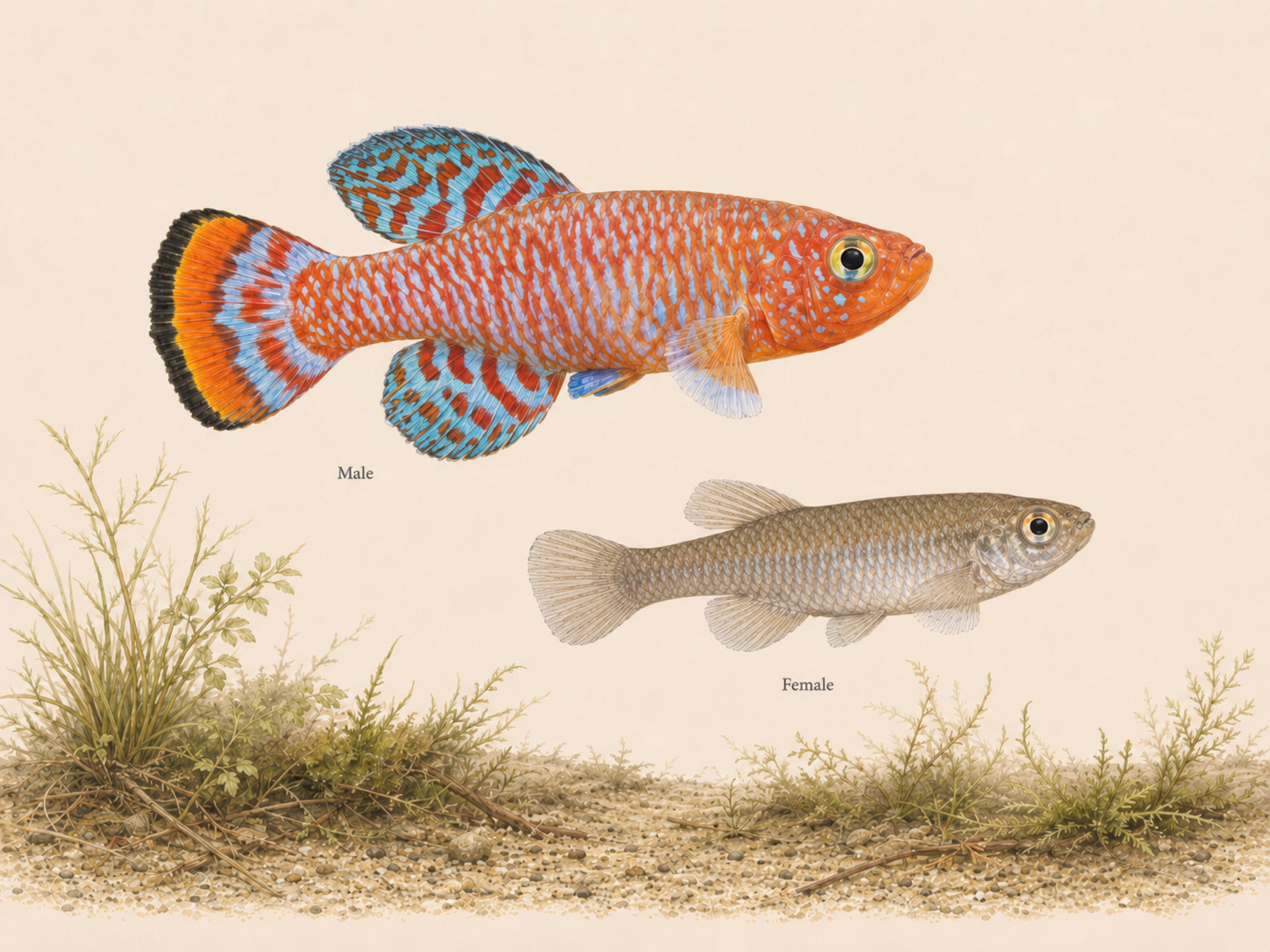
There are few freshwater fish that can rival the male Bluefin Notho for sheer visual impact. The body of the male is a deep, saturated orange-red, overlaid with an intricate network of iridescent blue-green scales that create a mosaic-like pattern across the flanks. This combination of warm and cool tones is remarkably vivid and appears almost luminous under good aquarium lighting. The dorsal and anal fins are large and rounded, edged with a striking band of bright blue followed by a thin margin of black, white, or red depending on the population. The caudal fin continues the blue-and-red theme, often displaying bold concentric bands of colour that give it a fan-like elegance.
Females, by contrast, are considerably more subdued in appearance. They are a uniform greyish-brown or olive colour, sometimes with faint spotting on the flanks. This cryptic colouration serves them well in the wild, offering camouflage among the leaf litter and murky waters of their natural pools. Females are also slightly smaller and more slender than males, typically reaching around 4 cm in length compared to the male’s 5–6 cm.
The body shape of Nothobranchius rachovii is robust and somewhat deep-bodied for a killifish, with a slightly upturned mouth adapted for surface and mid-water feeding. The eyes are large and expressive, and the gill covers often display a metallic blue-green sheen. Juveniles of both sexes are initially drab, but males begin to develop their colour surprisingly quickly, often showing recognisable patterning within just a few weeks of hatching.
Varieties and Morphs
Because Nothobranchius rachovii has been collected from numerous locations across its range in Mozambique and South Africa, several distinct locality variants circulate within the hobby. These populations differ in the intensity, distribution, and exact hue of their colouration, and killifish enthusiasts take great care to keep them separate to preserve genetic integrity. The following are the most commonly encountered variants and morphs in the aquarium trade.
The Beira 98 population is one of the most widely kept and is considered by many to be the quintessential form, with vivid orange-red bodies and strongly contrasting turquoise-blue scale markings. It has been maintained in captivity for decades and remains a benchmark for the species. The LM (Lourenço Marques, now Maputo) variant is another classic strain, displaying a slightly deeper red base colour and somewhat broader blue patterning on the body.
The Quelimane population tends to show more pronounced blue coverage on the body, sometimes appearing almost predominantly blue with red visible mainly around the belly and throat. In contrast, the Inhambane variant features a warmer, more orange-toned base with finer blue reticulation. The Save River population is notable for its particularly bright caudal fin markings, with bold alternating bands of red and blue that are especially eye-catching.
Beyond natural locality variants, selective breeding has produced a few recognised aquarium strains. The “Super Red” or “Red” morph has been line-bred to emphasise the red-orange base colour while reducing the blue overlay, resulting in a fish that appears almost entirely flame-red. Conversely, a “Blue” or “High Blue” strain exists in which breeders have selected for maximum blue coverage. There is also an albino form that occasionally appears, lacking the typical dark pigments and displaying a pale pinkish body with translucent fins, though this is uncommon. Killifish societies and specialist breeders typically label their fish with the collection locality code, and responsible hobbyists should always maintain and label populations separately to prevent hybridisation.
Natural Habitat
Nothobranchius rachovii is found in the coastal lowlands of Mozambique and the far north-eastern corner of South Africa, in the region between the Limpopo and Zambezi river systems. Its habitat consists of temporary, seasonal pools, marshes, and floodplains that fill with water during the annual rainy season, typically from October to March in the Southern Hemisphere. These pools are often shallow, rarely exceeding 30–40 cm in depth, and are heavily shaded by surrounding vegetation or scattered with aquatic grasses and emergent plants.
The water in these ephemeral pools is typically soft to moderately hard, with a slightly acidic to neutral pH. It is often stained a light amber or brown colour by decaying organic matter such as fallen leaves, grass, and other plant debris. The substrate is generally composed of soft mud or peat-like material, into which the fish deposit their eggs. Temperatures can fluctuate considerably, from relatively cool nights to warm afternoons, though they tend to remain within the range of 20–26 °C for most of the season.
As the dry season advances, these pools gradually shrink and eventually disappear entirely. The adult fish perish as the water evaporates, but their eggs survive buried in the damp substrate, entering a state of suspended development known as diapause. The eggs can remain viable for months, waiting for the return of the rains to trigger hatching. This extraordinary adaptation means that an entire generation of Bluefin Nothos exists only during the wet months, and the species’ survival depends entirely on the resilience of its eggs through the drought. Understanding this natural cycle is key to appreciating the fish’s behaviour, short lifespan, and breeding requirements in captivity.
Tank Size and Setup
The Bluefin Notho’s modest adult size and relatively sedentary habits mean that it does not require a large aquarium. A tank of 40 litres is sufficient for a trio, one male and two females, which is the most commonly recommended grouping. For a small colony of one male with three or four females, or for two males with a larger group of females, a tank of 60–80 litres provides more comfortable space and allows for the establishment of loose territories.
The substrate is an important consideration, particularly if you intend to breed the fish. A layer of coco peat, fine peat moss, or a dedicated spawning substrate placed in a shallow container on the tank floor mimics the soft, organic-rich mud of their natural habitat and serves as a spawning medium. Alternatively, a thin layer of fine dark sand can be used as the main substrate for aesthetic purposes, with a separate spawning container filled with peat placed in the tank. Dark substrates and backgrounds are highly recommended, as they bring out the full intensity of the male’s colours.
Planting the tank is beneficial both for water quality and for providing cover. Floating plants such as Amazon frogbit, salvinia, or duckweed help to diffuse light and create the slightly dim conditions that Nothobranchius species prefer. Rooted plants such as Java fern, Anubias, and Cryptocoryne species are all suitable and add structure to the aquarium. Dense plantings also offer retreating spots for females, which is important given the male’s persistent courtship behaviour. Driftwood, dried leaf litter (such as Indian almond leaves), and bogwood all contribute to creating a naturalistic environment and help to gently lower the pH through the release of tannins.
A tight-fitting lid is essential. Killifish are accomplished jumpers, and the Bluefin Notho is no exception. Even a small gap in the aquarium cover can result in the loss of fish, so ensure that all openings around filter inlets, heater cables, and airline tubing are securely covered.
Water Parameters
Maintaining stable and appropriate water conditions is crucial for the health and longevity of Nothobranchius rachovii. While the species is reasonably adaptable, it thrives best in soft to moderately hard water with a slightly acidic to neutral pH. Temperatures should be kept on the cooler side of the tropical range, as higher temperatures tend to accelerate the fish’s metabolism and shorten its already brief lifespan. Keeping the aquarium at around 22 °C strikes a good balance between activity, colour development, and longevity.
| Temperature | 20–24 °C |
| pH | 6.0–7.5 |
| General hardness (GH) | 2–12 dGH |
| Carbonate hardness (KH) | 2–8 dKH |
| Ammonia | 0 ppm |
| Nitrite | 0 ppm |
| Nitrate | Below 20 ppm |
Regular water changes are important and should be carried out weekly, replacing approximately 20–30% of the tank volume with dechlorinated water matched to the tank’s temperature. The addition of Indian almond leaves or alder cones can help to maintain a slightly acidic pH and introduce beneficial tannins into the water, replicating the blackwater conditions of many natural Nothobranchius habitats. Avoid sudden swings in temperature or chemistry, as these can cause stress and increase susceptibility to disease. Consistent, stable conditions are far more important than hitting an exact number on any single parameter.
Filtration and Equipment
Given that Nothobranchius rachovii inhabits still or very slow-moving waters in the wild, strong filtration and high flow rates are not appropriate. A gentle sponge filter driven by an air pump is the ideal choice for a Bluefin Notho aquarium. Sponge filters provide excellent biological filtration without creating excessive water movement, and they pose no risk of trapping small fry should breeding occur in the main tank. An air-driven sponge filter also contributes to gentle surface agitation, which aids gas exchange without disturbing the fish.
If you prefer to use a small internal or hang-on-back filter, ensure that the flow rate can be reduced or baffled to create minimal current. Adjustable-flow filters are useful in this regard, and positioning the outflow against the glass or using a pre-filter sponge over the intake can further reduce water movement.
A reliable heater is recommended to maintain a consistent temperature, particularly in cooler climates or during winter months. A submersible heater with a built-in thermostat rated for the size of your tank will suffice. Set it to the lower end of the acceptable range, around 21–22 °C, to promote a longer lifespan. A thermometer should be used to verify the actual water temperature, as built-in heater thermostats can sometimes be inaccurate.
Lighting should be moderate to subdued. The Bluefin Notho’s colours actually appear more vibrant under softer lighting, and the fish will behave more naturally and confidently when not subjected to harsh illumination. Floating plants can be used to diffuse overhead lighting effectively. A standard LED aquarium light set on a timer for 8–10 hours per day is perfectly adequate.
Diet and Feeding
Nothobranchius rachovii is a carnivore in the wild, feeding on small invertebrates, insect larvae, crustaceans, and zooplankton found in its temporary pools. In the aquarium, it strongly prefers live and frozen foods over dried alternatives, and a diet centred on these items will result in the best colour, health, and breeding condition.
Live foods are the gold standard for Bluefin Nothos. Artemia nauplii (newly hatched brine shrimp) are eagerly accepted and are an excellent staple, particularly for younger fish. Daphnia, grindal worms, white worms, and micro worms are all superb live food options that can be easily cultured at home. Bloodworm and mosquito larvae are also relished and provide excellent nutrition, though bloodworm should be offered in moderation as a rich treat rather than a daily staple.
Frozen foods serve as a convenient and nutritious alternative when live cultures are unavailable. Frozen bloodworm, frozen brine shrimp, frozen daphnia, and frozen cyclops are all readily accepted. Thaw frozen foods in a small amount of tank water before offering them to prevent temperature shock to the fish’s digestive system.
High-quality dry foods such as micro pellets or crushed flakes formulated for small carnivorous fish can sometimes be accepted, but many Nothobranchius specimens are reluctant to take dried food, especially wild-caught or first-generation captive-bred individuals. If you wish to wean your fish onto dry food, introduce it gradually alongside live or frozen items. However, for optimal health and colour, the bulk of the diet should consist of live or frozen invertebrate foods.
Feed small amounts two to three times daily rather than a single large meal. Bluefin Nothos have high metabolisms and benefit from frequent feeding, but take care not to overfeed, as uneaten food will quickly foul the water in a small tank. Remove any uneaten food promptly after each feeding session.
Behaviour and Temperament
The Bluefin Notho is an active and engaging fish with a personality that belies its small size. Males are bold and confident, spending much of their time displaying to females, patrolling their territory, and showing off their magnificent fins. Their courtship displays are among the most captivating behaviours you will observe in a freshwater aquarium, the male will position himself alongside a female, spreading his fins to their full extent and vibrating his body in a shimmer of colour as he attempts to lead her to the spawning substrate.
Males can be competitive with one another, and while aggression is rarely severe enough to cause physical harm, dominant males will chase and display at subordinate rivals. In a small tank, it is generally best to keep only one male unless the aquarium is large enough to support multiple territories with adequate visual barriers. A ratio of one male to two or three females helps to distribute the male’s amorous attention and prevents any single female from being harassed excessively.
Females are more reserved and spend much of their time foraging and resting among plants and cover. They are generally peaceful towards one another and towards other species. Both sexes are mid-water to bottom-dwelling fish, occasionally rising to the surface to feed but typically occupying the lower half of the water column.
It is worth noting that the Bluefin Notho’s behaviour is influenced by its compressed lifespan. These fish mature rapidly, often reaching sexual maturity within six to eight weeks of hatching, and they tend to live life at a faster pace than longer-lived species. They eat enthusiastically, breed prolifically, and can show signs of ageing, such as reduced colour, slowed activity, and slightly curved spines, within nine to twelve months. This is entirely normal for an annual species and should not be interpreted as a sign of poor husbandry.
Tank Mates
Choosing tank mates for the Bluefin Notho requires some thought. As a small, relatively peaceful species from calm, shallow waters, it does best with similarly sized, non-aggressive companions that will not outcompete it for food or cause undue stress. Many killifish enthusiasts prefer to keep Nothobranchius rachovii in a species-only setup, which allows the keeper to fully appreciate the fish’s natural behaviour and simplifies breeding efforts. However, carefully chosen community companions can work well in a suitably sized aquarium.
Good tank mates
- Celestial Pearl Danio, a small, peaceful species that occupies similar water conditions and will not compete aggressively for food.
- Ember Tetra, its tiny size, gentle temperament, and preference for soft, acidic water make it an excellent companion.
- Pygmy Corydoras, a peaceful bottom-dweller that stays small and helps to keep the substrate tidy without disturbing spawning sites.
- Endler’s Livebearer, Hardy, small, and peaceful, Endler’s occupy the upper water column and rarely interact with Nothobranchius.
- Amano Shrimp, Large enough to avoid predation, these shrimp are useful algae grazers and coexist peacefully with small killifish.
- African Dwarf Frog, a calm, bottom-dwelling amphibian that shares similar water parameter preferences and poses no threat.
- Cherry Shrimp, Adults can coexist with Bluefin Nothos, though shrimplets may occasionally be eaten, making this pairing better suited to heavily planted tanks.
- Sparkling Gourami, another small, quiet species that appreciates calm water and subdued lighting, making it a natural fit.
Fish to avoid
- Betta Fish, Males may perceive the colourful Nothobranchius as a rival, leading to aggression in confined spaces.
- Tiger Barb, a notorious fin nipper that would relentlessly harass the slow-moving, large-finned Bluefin Notho.
- Convict Cichlid, far too aggressive and territorial for any small killifish, posing a serious risk of injury or death.
- Angelfish, Large enough to view Bluefin Nothos as prey and requires a much bigger tank with different conditions.
- Chinese Algae Eater, Becomes increasingly aggressive with age and may attach to the flanks of slow-moving fish.
- Rainbow Shark, highly territorial at the bottom of the tank, where Nothobranchius spend much of their time feeding and spawning.
- Buenos Aires Tetra, a large, boisterous tetra that can be nippy and will outcompete the Bluefin Notho for food.
- Green Terror, a large, predatory cichlid that is entirely incompatible with any small, peaceful species.
Breeding
Breeding Nothobranchius rachovii is one of the most rewarding aspects of keeping this species, and it is well within the reach of any dedicated hobbyist. As an annual killifish, the Bluefin Notho is driven to reproduce prolifically, and a healthy pair or group will spawn readily given the right conditions. The breeding process involves egg deposition in a soft substrate, a period of dry incubation outside the aquarium, and controlled hatching, a process unique to annual killifish and deeply fascinating to observe.
To set up for breeding, place a shallow container, such as a small plastic tub or margarine pot, filled with moistened coco peat or fine peat moss on the floor of the aquarium. The container should be around 3–5 cm deep, and the peat should be thoroughly rinsed and waterlogged before use to remove any floating particles. The male will actively court females, leading them to the spawning container with dramatic fin displays and body shimmering. When the female is receptive, both fish will dive into the peat side by side and deposit eggs just below the surface. This behaviour is repeated many times throughout the day, and a productive pair can lay several eggs daily.
After one to two weeks of spawning activity, remove the peat container from the tank and gently squeeze out most of the excess water. The peat should be damp but not dripping, roughly the consistency of wrung-out tobacco. Place the peat and eggs into a sealed plastic bag or airtight container, label it with the species name, variant, and date, and store it in a dark location at room temperature, ideally around 20–22 °C. This simulates the dry season, during which the eggs undergo diapause.
The incubation period is variable and depends on temperature and the specific developmental stage of the eggs, but typically ranges from 8 to 16 weeks. Periodically, every two to three weeks, open the bag and inspect the eggs using a hand lens or magnifying glass. Healthy developing eggs will appear amber or golden and you may eventually see the dark eye spots of the developing embryos through the transparent chorion. Eggs that turn white or fuzzy should be removed as they are infertile or have succumbed to fungus.
When the eggs show fully developed embryos with clearly visible eyes, they are ready to hatch. Place the peat into a shallow container and add cool, soft water, around 18–20 °C, to a depth of approximately 2–3 cm. The sudden immersion in water simulates the return of the rains and triggers hatching, which often occurs within minutes to a few hours. The fry are tiny but immediately free-swimming and capable of feeding. Offer them infusoria, vinegar eels, or freshly hatched artemia nauplii as first foods. Growth is rapid, and the young fish can reach sexual maturity in as little as six to eight weeks under good conditions.
It is wise to stagger your egg collections and hatching attempts, as not all eggs develop at the same rate and some batches may require an additional rest period before they are ready. This approach ensures a continuous supply of young fish to maintain your colony over time.
Common Diseases
Nothobranchius rachovii is generally a hardy species when kept in clean, stable conditions, but its short lifespan and the challenges of keeping a tropical fish in a relatively small body of water mean that certain health issues can arise. Prevention through good husbandry is always preferable to treatment, and maintaining excellent water quality is the single most important factor in disease prevention.
Velvet disease, caused by the parasitic dinoflagellate Piscinoodinium, is one of the more common ailments seen in killifish. It manifests as a fine, gold or rust-coloured dusting on the skin, clamped fins, and lethargy. It can spread rapidly in a small tank and is best treated with copper-based medications or proprietary velvet treatments combined with raising the temperature slightly and dimming the lights. Early detection is critical, as advanced cases are difficult to treat.
White spot disease (ich), caused by Ichthyophthirius multifiliis, presents as small white cysts on the body and fins. It is often triggered by temperature fluctuations or the introduction of new fish without proper quarantine. Treatment involves raising the water temperature gradually to around 26 °C (noting that this is above the species’ ideal range and should only be maintained temporarily) and dosing with a suitable white spot remedy.
Bacterial infections, including fin rot and body ulcers, can occur in response to poor water quality, physical injury, or stress. Symptoms include frayed or eroding fins, reddened areas on the body, and loss of appetite. Improving water quality through increased water changes is often sufficient to resolve mild cases, while more severe infections may require treatment with antibacterial medications.
Fungal infections typically appear as white, cotton-like growths on the body, fins, or mouth. They often develop secondary to an existing wound or in immunocompromised fish. Antifungal treatments available from aquarium retailers are generally effective. Internal parasites can occasionally affect Nothobranchius, particularly in wild-caught or recently imported specimens, and may present as weight loss despite a healthy appetite. Antiparasitic foods or medications can be used if internal parasites are suspected.
As Bluefin Nothos age, they may naturally develop a slightly curved spine, reduced colouration, and decreased activity. These are signs of senescence rather than disease and are a normal part of the annual killifish life cycle. Providing optimal care can extend their lifespan somewhat, but it is important to set realistic expectations and understand that even the healthiest specimens will rarely exceed 18 months of age.
FAQs
How long do Bluefin Nothos live?
In the wild, Nothobranchius rachovii typically lives for only a single rainy season, which may last just a few months. In captivity, with stable conditions and good nutrition, they generally live between 9 and 18 months. Keeping them at the cooler end of their temperature range, around 20–22 °C, can help to slow their metabolism slightly and extend their lifespan, but they remain fundamentally short-lived fish. This is an inherent characteristic of annual killifish rather than a reflection of care quality.
Can I keep Bluefin Nothos in a community tank?
Yes, provided the tank mates are carefully chosen. Small, peaceful species that share a preference for calm water and similar temperature and pH ranges are the best companions. Avoid any fish that are large enough to view the Nothobranchius as food, any species known for fin nipping, and any highly active or aggressive fish that would cause stress. A species-only tank is often the simplest and most rewarding approach, particularly if breeding is a goal.
Do I need to buy eggs or live fish?
Both options are available. Many killifish enthusiasts and specialist breeders sell Nothobranchius rachovii eggs by post, which is a safe and economical way to obtain the species. Eggs are shipped in damp peat and can survive transit remarkably well. You simply add water when the eggs are ready to hatch. Live fish are also available from specialist dealers, aquarium shops, and killifish society auctions, though they may be harder to find than eggs due to the species’ niche status in the wider hobby.
Is a heater necessary for Bluefin Nothos?
In most homes, a heater is advisable to maintain a stable temperature, particularly during winter months or in rooms where the ambient temperature drops below 20 °C. While the species can tolerate brief dips to around 18 °C, prolonged exposure to low temperatures can suppress the immune system and reduce activity. A heater set to 21–22 °C provides a safe, consistent environment. In consistently warm climates, an unheated tank may suffice, but a thermometer should always be used to monitor conditions.
Why are my Bluefin Notho eggs not hatching?
There are several possible reasons. The most common is that the eggs have not completed their diapause and are not yet fully developed. Inspect the eggs with a magnifying glass, if you cannot see clear eye spots and a fully formed embryo, the eggs need more incubation time. Seal them back up and check again in two to three weeks. Other factors include the peat being too dry during storage, which can desiccate the eggs, or the peat being too wet, which can cause premature development or fungal growth. When you attempt to hatch, ensure the water is cool and soft, as warm or hard water can sometimes inhibit hatching. If eggs appear clear or white, they may be infertile or have died during incubation.
Related Guides
- Killifish Care Guide, a comprehensive overview of killifish keeping that covers the diverse families and general husbandry principles relevant to Nothobranchius species.
- Nothobranchius guentheri Care Guide, a closely related annual killifish species with similar care requirements, offering an excellent companion species for the Nothobranchius enthusiast.
- Fundulopanchax gardneri Care Guide, a popular semi-annual killifish that provides a good introduction to killifish keeping for those not yet ready for annual species.
- Breeding Killifish Guide, an in-depth guide to breeding both annual and non-annual killifish, covering egg collection, incubation, hatching techniques, and fry rearing.
- Indian Almond Leaves in the Aquarium, Explains the benefits of botanical additions for creating blackwater conditions favoured by many killifish and other soft-water species.


