Quick summary
Rosy Loaches are small, colourful cool-water fish best suited to keepers who can provide a mature, well-planted tank, a group of six or more, and stable temperatures between 18-24°C rather than a standard tropical setup. They’re moderately challenging to keep and breed, so they suit hobbyists with some prior experience rather than complete beginners.
🐠 Build a tank around this species
In this guide:
- Introduction
- Quick Stats
- Appearance
- Natural Habitat
- Tank Size and Setup
- Water Parameters
- Filtration and Equipment
- Diet and Feeding
- Behaviour and Temperament
- Tank Mates
- Breeding
- Common Diseases
- FAQs
Introduction
The Rosy Loach is one of the most endearing and underappreciated nano fish available in the freshwater hobby. Formally described as Petruichthys sp. ‘rosy’ for many years before receiving the scientific name Physoschistura mango, this diminutive loach hails from the hill streams of Myanmar and has steadily gained a devoted following among aquarists who appreciate small, active, and beautifully coloured fish. Despite the common name suggesting it belongs alongside the more familiar loach families, it is actually a member of the Nemacheilidae, the stone loaches, and its care requirements reflect this ancestry.
What makes the Rosy Loach so appealing is the combination of its petite adult size, its warm pinkish-orange coloration, and its remarkably social and active behaviour. Unlike many loach species that spend most of their time hidden beneath rocks or driftwood, Rosy Loaches are bold mid-water swimmers that shoal together in a constantly shifting, playful group. Males, in particular, develop striking rosy-pink hues that intensify when they are in breeding condition or engaged in social displays with one another. This species is an excellent choice for planted nano aquariums and community tanks housing other small, peaceful species.
Despite their small size and relatively recent appearance in the trade, Rosy Loaches are reasonably hardy once settled into a mature aquarium. They do have some specific requirements regarding water flow, oxygenation, and group size that keepers should understand before purchasing. This guide covers everything you need to know to keep and potentially breed this charming little loach successfully.
Quick Stats
| Scientific name | Physoschistura mango (formerly Petruichthys sp. ‘rosy’) |
|---|---|
| Common names | Mini Rosy Loach, Petruichthys Rosy Loach, Petruichthys sp. rosy |
| Family | Nemacheilidae |
| Origin | Myanmar, Shan State, Lake Inle drainage |
| Adult size | 2.5 cm |
| Lifespan | 3–5 years |
| Difficulty | Intermediate |
| Breeding difficulty | Moderate |
| Temperature | 18–24 °C |
| pH | 6.5–7.5 |
| GH | 2–10 dGH |
| KH | 2–8 dKH |
| Minimum tank size | 40 L |
| Conservation status | Not Evaluated |
Appearance
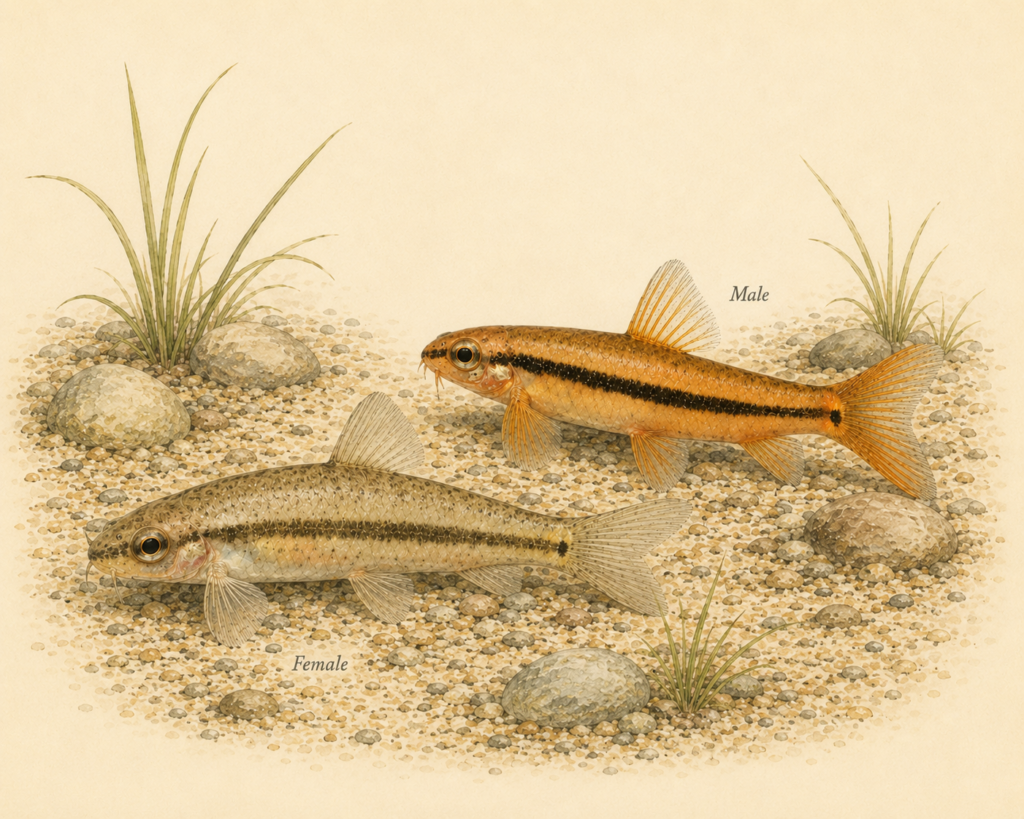
The Rosy Loach is a tiny, elongated fish with a streamlined, slightly laterally compressed body that distinguishes it from the more cylindrical shape typical of many nemacheilid loaches. Adults rarely exceed 3 cm in total length, with most specimens in aquaria settling around 2 to 2.5 cm. The overall body shape is torpedo-like, tapering gently towards a small, rounded caudal fin. The mouth is subterminal with a small set of barbels, though these are far less prominent than those seen on larger loach species.
The species exhibits notable sexual dimorphism, making it relatively straightforward to distinguish males from females once they have matured. Males develop a warm, rosy-pink to orange-red base colour across the body, which is most intense along the flanks and towards the belly. This coloration deepens considerably when males are in good condition, well-fed, and socially stimulated by the presence of other males. A dark lateral stripe runs from the snout through the eye and along the midline of the body to the base of the tail, and this is often bordered by a finer, lighter stripe above it. The fins of males are generally more colourful, sometimes showing a subtle reddish or orange wash, particularly in the caudal and dorsal fins.
Females are noticeably less colourful, presenting a more subdued sandy or yellowish-brown body colour with the same lateral stripe pattern but less contrast. They tend to be slightly plumper in build, especially when carrying eggs. Both sexes display a series of faint vertical bars or blotches along the flanks, though these markings vary in intensity between individuals and can appear or fade depending on mood, stress level, and social context. The eyes are relatively large for the body size, giving the fish an alert, inquisitive expression that adds to its charm.
Juvenile Rosy Loaches are paler and less distinctly marked, with both sexes appearing similar until they reach a size of roughly 1.5 cm, at which point males begin to develop their characteristic pink flush. It is worth noting that stressed or recently imported specimens may appear washed out and unremarkable, so it is important not to judge the species by individuals that have just arrived in a shop. Once settled into a well-maintained aquarium with appropriate companions, their true colours emerge over the course of several weeks.
Natural Habitat
The Rosy Loach originates from the Shan Plateau in eastern Myanmar, specifically from tributaries and streams within the broader Lake Inle drainage basin. This region is characterised by elevated terrain, and the waters these fish inhabit are typically clear, relatively cool, and well-oxygenated hill streams. These streams flow over substrates of gravel, pebbles, and sand, interspersed with water-worn rocks and patches of aquatic vegetation. The surrounding landscape includes areas of both open grassland and light forest, and the streams tend to be shallow with moderate to gentle flow.
Water conditions in their natural range are typically soft to moderately hard, with a near-neutral pH. Temperatures in these hill streams are significantly cooler than the tropical lowlands, often sitting between 18 and 24 °C depending on season and altitude. This is an important consideration for aquarium keeping, as the Rosy Loach does not thrive in the warm conditions preferred by many tropical community fish. Prolonged exposure to temperatures above 26 °C can lead to stress, reduced lifespan, and increased susceptibility to disease.
In the wild, Rosy Loaches are found in groups, often in areas where the current is moderate and there is a mix of open substrate and cover provided by rocks, plant growth, and submerged debris. They occupy both the bottom and mid-water zones, foraging on biofilm, tiny invertebrates, and organic detritus. Their natural habitat is shared with a number of other small cyprinids and loaches endemic to the Inle region, many of which have become popular aquarium species in their own right. The broader Inle ecosystem faces considerable conservation pressure from agriculture, sedimentation, and overharvesting of natural resources, which underscores the importance of responsible captive husbandry and, where possible, captive breeding of species from this region.
Tank Size and Setup
A minimum aquarium volume of 40 litres is recommended for a small group of Rosy Loaches, though a tank of 60 litres or larger will provide a more stable environment and allow for a more natural group size. Because these fish are active swimmers that make extensive use of the water column, rather than simply hugging the substrate as many loaches do, the footprint of the tank matters more than height. A tank with dimensions of at least 60 cm in length is ideal, as it gives the group room to shoal, display, and explore without feeling cramped.
The substrate should consist of fine gravel or smooth sand, or a mixture of both. Sharp or rough substrates should be avoided, as the fish do spend time resting on and foraging along the bottom, and coarse materials can damage their delicate barbels. A layer of smooth river pebbles and rounded stones scattered across the substrate creates a naturalistic look and provides both visual barriers and resting spots. Driftwood pieces and small root tangles add further complexity to the aquascape and offer shelter without overly darkening the water if pre-soaked.
Live plants are highly recommended and serve multiple purposes in a Rosy Loach aquarium. They help maintain water quality by absorbing nitrates, they provide cover and security, and they support the growth of biofilm and microfauna upon which the loaches graze. Hardy species such as Anubias, Java fern, various mosses, and Vallisneria work well. Stem plants can be used to create denser planted areas towards the rear and sides of the tank, leaving open swimming space in the centre and foreground. Floating plants can also be used to diffuse overhead lighting, which the fish seem to appreciate, though total coverage should be avoided so that adequate light reaches submerged plants.
These loaches are accomplished jumpers when startled, so a well-fitting lid or cover is essential. Even small gaps around filter inlets and heater cables should be blocked or minimised. Lighting should be moderate; overly bright conditions can make the fish skittish, while very dim lighting may reduce plant growth and biofilm production. A standard LED fixture suited to a planted aquarium is usually appropriate.
Water Parameters
| Temperature | 18–24 °C |
| pH | 6.5–7.5 |
| General hardness (GH) | 2–10 dGH |
| Carbonate hardness (KH) | 2–8 dKH |
| Ammonia | 0 ppm |
| Nitrite | 0 ppm |
| Nitrate | Below 20 ppm |
Maintaining stable water parameters is more important for Rosy Loaches than hitting a precise number within their tolerated ranges. They are sensitive to sudden shifts in temperature, pH, and hardness, particularly during water changes. It is good practice to match replacement water closely to the tank water in temperature and chemistry. Weekly water changes of 20–30 per cent are generally sufficient to keep nitrate levels low and maintain overall water quality.
One of the most common mistakes made with this species is keeping them too warm. Because they originate from cooler hill streams, temperatures above 25 °C should be avoided for extended periods. In many households, particularly in temperate climates, a heater may only be necessary during winter months to prevent temperatures from dropping below 18 °C. During warmer seasons, a room-temperature tank often sits comfortably within their preferred range. If a heater is used, it should be set to the lower end of the range, around 20–22 °C, rather than the higher tropical temperatures common in many community tanks.
Filtration and Equipment
Good water movement and oxygenation are important for replicating the stream-like conditions that Rosy Loaches prefer. A hang-on-back filter or a small internal power filter can work well for smaller tanks, while a compact external canister filter is an excellent option for setups of 60 litres and above. The filter should generate a gentle to moderate current across the length of the tank, ideally creating a visible flow without producing violent turbulence that would exhaust these tiny fish. An air stone or sponge filter running alongside the main filter can further boost dissolved oxygen levels, which is particularly beneficial during warmer months when oxygen solubility decreases.
Sponge filters deserve special mention as they are exceptionally well-suited to Rosy Loach tanks, especially breeding setups. They provide biological filtration without any risk of trapping or injuring small fish or fry, and their surfaces become colonised by the biofilm and microfauna that these loaches naturally graze upon. A dual-sponge filter rated for the tank volume, driven by a modest air pump, makes an ideal primary or supplementary filtration choice.
As noted above, a heater may or may not be required depending on ambient room temperature. If one is used, a reliable model with an accurate thermostat is important, as these fish have a relatively narrow temperature tolerance compared to many tropical species. A thermometer, preferably a digital one, should be used to monitor temperature consistently. Avoid placing the tank in direct sunlight or near radiators, as this can cause temperature fluctuations that stress the fish.
Lighting should support plant growth if live plants are used but need not be excessively powerful. A timer set to provide 8–10 hours of light per day helps establish a consistent photoperiod, which benefits both the fish and the plants. Rosy Loaches are most active and display their best colour under moderate, slightly subdued lighting conditions.
Diet and Feeding
Rosy Loaches are omnivores with a diet that leans towards small invertebrates and biofilm in the wild. In captivity, they accept a wide range of foods, but their small mouths mean that all offerings must be appropriately sized. High-quality micro-pellets and crushed flake foods form a suitable staple diet, though these should be supplemented regularly with live or frozen foods to promote optimal health, coloration, and breeding condition.
Excellent supplementary foods include baby brine shrimp (both live and frozen), micro worms, grindal worms, daphnia, cyclops, and finely chopped frozen bloodworm. Live foods in particular elicit a strong feeding response and encourage the fish to forage naturally. It is genuinely a delight to watch a group of Rosy Loaches hunting tiny live prey, darting through the water with surprising agility and precision for such small fish.
Feeding should be done in small amounts once or twice daily. These are tiny fish with correspondingly small stomachs, and overfeeding can quickly lead to water quality issues in a small tank. Any uneaten food should be removed promptly. In a well-established planted tank with good biofilm growth, the loaches will supplement their diet by grazing surfaces throughout the day, which helps keep them well-nourished between scheduled feedings.
Vegetable matter is not a major component of their diet, but they will nibble on blanched courgette, spinach, or algae wafers if offered. These should be considered occasional treats rather than dietary staples. The focus should remain on protein-rich micro foods and a good-quality micro pellet or granule as the core diet.
Behaviour and Temperament
The Rosy Loach is a gregarious, social species that must be kept in groups. A minimum group of six is essential, but eight to twelve or more is strongly recommended. In larger groups, these fish display a far wider repertoire of natural behaviours, including shoaling, chasing, sparring, and courtship displays. Solitary individuals or pairs become reclusive, stressed, and pale, and often fail to thrive.
Within the group, males engage in frequent but harmless sparring bouts. These displays involve two males positioning themselves side by side, flaring their fins, and intensifying their colour before one backs down. No physical damage results from these interactions, and they are in fact a sign that the fish are comfortable and well-settled. Males may also pursue females, and the overall social dynamic of a healthy group is one of constant, low-level activity that makes the tank endlessly watchable.
Unlike many loach species that are primarily nocturnal or crepuscular, Rosy Loaches are active throughout the day. They spend much of their time in the lower half of the water column and along the substrate, but they regularly move into mid-water, particularly during feeding and social interactions. They are not aggressive towards other species and are generally indifferent to fish that do not closely resemble them or compete for the same microhabitats.
One notable aspect of their behaviour is their sensitivity to their environment. In a sparsely decorated tank with few hiding spots, they tend to be nervous and spend much of their time hidden. Conversely, in a well-planted, thoughtfully aquascaped tank with plenty of visual complexity, they become bold and spend most of their time in the open. This is a common pattern among small, prey-sized fish: the more secure they feel, the more visible they become. Providing adequate cover paradoxically results in fish that are more, not less, visible to the keeper.
Tank Mates
The Rosy Loach’s small size, peaceful temperament, and preference for cooler water narrow the list of ideal companions somewhat, but there are still many excellent choices. The key criteria for compatibility are similar temperature requirements, a peaceful disposition, and a size that does not allow predation on these tiny loaches. Fast-moving, boisterous, or significantly larger fish should be avoided, as they can outcompete Rosy Loaches for food and cause chronic stress.
Good tank mates
- Celestial Pearl Danio (Danio margaritatus), shares a similar geographical origin and temperature preference, and both species are peaceful and similarly sized.
- Emerald Dwarf Rasbora (Microdevario kubotai), a gentle, tiny cyprinid that occupies the mid-water column without competing directly for bottom space.
- White Cloud Mountain Minnow (Tanichthys albonubes), an excellent cool-water companion that is hardy, peaceful, and active without being aggressive.
- Pygmy Corydoras (Corydoras pygmaeus), a diminutive, peaceful bottom dweller that thrives in similar water conditions and adds activity to the lower levels of the tank.
- Ember Tetra (Hyphessobrycon amandae), a calm, small tetra that tolerates the lower end of tropical temperatures and coexists peacefully with small loaches.
- Chili Rasbora (Boraras brigittae), a tiny, non-competitive rasbora that occupies the upper and mid-water zones, leaving the lower areas for the loaches.
- Otocinclus (Otocinclus vittatus), a peaceful algae-eating catfish that ignores other small species and helps keep surfaces clean.
- Amano Shrimp (Caridina multidentata), too large to be eaten by Rosy Loaches and an excellent clean-up crew member in planted tanks.
- Nerite Snail (Neritina sp.), a harmless algae grazer that adds interest and utility without any risk of negative interactions.
Fish to avoid
- Angelfish (Pterophyllum scalare), far too large and predatory towards tiny fish; will readily eat Rosy Loaches.
- Betta (Betta splendens), males can be aggressive, and bettas prefer warmer, still water that is unsuitable for Rosy Loaches.
- Tiger Barb (Puntigrus tetrazona), boisterous and nippy, capable of bullying and outcompeting tiny loaches for food.
- Convict Cichlid (Amatitlania nigrofasciata), highly territorial and aggressive, completely incompatible with any nano species.
- Oscar (Astronotus ocellatus), an enormous predatory cichlid that would view Rosy Loaches as food.
- Chinese Algae Eater (Gyrinocheilus aymonieri), becomes aggressive and territorial as it matures and can harass small tank mates relentlessly.
- Common Pleco (Pterygoplichthys pardalis), grows far too large for the tanks suited to Rosy Loaches and produces excessive waste.
- Red-Tail Shark (Epalzeorhynchos bicolor), highly territorial and aggressive towards bottom-dwelling species, which would include Rosy Loaches.
Breeding
Breeding Rosy Loaches in captivity is achievable and has been accomplished by a number of hobbyists, though it is not as straightforward as breeding some other nano species. The first requirement is a healthy, well-conditioned group with a good ratio of males to females. A ratio of roughly two females to every male helps distribute male attention and reduces any single female from being harassed excessively. Identifying the sexes is not difficult once the fish are mature, as males are distinctly more colourful with their characteristic rosy hue, while females are plumper and paler.
Conditioning the group for breeding involves providing a varied, protein-rich diet heavy on live and frozen foods such as baby brine shrimp, micro worms, and daphnia. Over the course of two to three weeks of generous feeding, females will visibly plump up with eggs. Spawning tends to occur in the early morning hours and is often triggered by a partial water change with slightly cooler water, mimicking the effect of rainfall in their natural habitat.
The spawning act itself involves a male pursuing and positioning himself alongside a receptive female, after which eggs are scattered among fine-leaved plants, moss, or across the substrate. The eggs are small, non-adhesive or weakly adhesive, and the parents show no interest in guarding them. In a community or group setting, both the adults and any tank mates will readily consume the eggs and fry if given the opportunity, so a separate breeding tank or the use of spawning mops and egg traps is advisable if the goal is to raise a significant number of fry.
A dedicated breeding setup might consist of a small tank of 20–30 litres with a thin layer of fine substrate, clumps of Java moss or spawning mops, and a gentle sponge filter. After spawning has been observed, the adults can be removed and the eggs left to develop. At temperatures around 22 °C, eggs typically hatch within three to four days, and the fry become free-swimming a day or two thereafter. The fry are extremely tiny and initially require infusoria or commercially available liquid fry food as a first food. After a week or two, they can graduate to freshly hatched baby brine shrimp and micro worms. Growth is slow but steady, and young fish begin to show colour differentiation between the sexes at roughly six to eight weeks of age.
Water quality must be maintained fastidiously in a fry tank, with small, frequent water changes using matched water. Even minor spikes in ammonia or nitrite can prove fatal to the delicate young fish. Patience is essential, as Rosy Loach fry are slow growers and it may take several months before they reach a size suitable for introduction to the main display tank.
Common Diseases
Rosy Loaches are reasonably robust fish when kept in appropriate conditions, but like all aquarium species, they can fall victim to a range of common diseases, particularly when stressed by poor water quality, incorrect temperature, or inadequate group size.
Ich (white spot disease) is perhaps the most frequently encountered ailment and presents as small, white, grain-like spots across the body and fins. It is typically triggered by temperature fluctuations or the introduction of infected fish. Treatment involves gradually raising the temperature to the upper end of the species’ tolerable range, around 24–25 °C, combined with the use of a proprietary ich medication. It is important to note that loaches, including Rosy Loaches, can be sensitive to certain medications, particularly those containing copper or malachite green at full strength. Half-dosing is often recommended, and keepers should always read product labels carefully and monitor the fish closely during treatment.
Bacterial infections can occur secondary to physical injury or chronic stress. Symptoms include reddened areas on the body, frayed fins, lethargy, and loss of appetite. Maintaining pristine water quality is both the best prevention and the first line of treatment. In more serious cases, a broad-spectrum antibacterial treatment formulated for use with sensitive species may be necessary.
Fungal infections, recognisable by cotton-like white growths on the body or fins, can develop on fish with compromised immune systems or open wounds. These are usually treated with antifungal medications, again at reduced dosages for loaches. Internal parasites can also affect wild-caught specimens, manifesting as weight loss despite a good appetite, white or stringy faeces, and a gradual decline in condition. Anti-parasitic foods or medications may be required in such cases.
Preventative care is always preferable to reactive treatment. Quarantining new fish for two to three weeks before introducing them to the main tank, maintaining stable water parameters, feeding a varied and nutritious diet, and keeping the fish in a sufficiently large group all contribute to a strong immune system and a long, healthy life.
FAQs
How many Rosy Loaches should I keep together?
A minimum group of six is necessary, but a group of eight to twelve or more is strongly recommended. Rosy Loaches are highly social fish that rely on the presence of conspecifics for security and behavioural enrichment. In larger groups, they display a far more varied and interesting range of behaviours, including sparring, shoaling, and courtship, and their colours are noticeably more vibrant. Keeping them in insufficient numbers leads to stress, shyness, and washed-out coloration.
Can Rosy Loaches be kept in a tropical community tank?
They can be kept with other peaceful, small species, but the typical tropical community tank temperature of 25–27 °C is too warm for them on a long-term basis. Rosy Loaches prefer cooler conditions of 18–24 °C, so they are best paired with other species that share this preference, such as White Cloud Mountain Minnows, Celestial Pearl Danios, or Pygmy Corydoras. Keeping them at elevated temperatures will shorten their lifespan and make them more susceptible to disease.
Are Rosy Loaches safe with shrimp?
Adult Rosy Loaches are generally safe with adult shrimp such as Amano Shrimp, Cherry Shrimp, and similar species. However, they may prey upon very small newborn shrimplets, so if you are maintaining a breeding colony of dwarf shrimp, be aware that some predation on the smallest offspring is likely. Providing dense plant cover, particularly mosses, gives shrimplets a much better chance of survival in a shared tank.
Do Rosy Loaches need a heater?
This depends entirely on the ambient temperature of the room where the aquarium is kept. In many UK homes, room temperature sits comfortably within the Rosy Loach’s preferred range of 18–24 °C for much of the year. During colder winter months, a heater set to around 18–20 °C may be needed to prevent the tank temperature from dropping too low, particularly in unheated rooms. In warmer weather, no heater is required, and in fact, steps should be taken to ensure the tank does not overheat above 25 °C.
Why are my Rosy Loaches hiding all the time?
Persistent hiding is usually a sign of stress, which can stem from several causes. The most common are an insufficiently large group, a lack of cover and planting in the aquarium, overly bright lighting, or the presence of boisterous or intimidating tank mates. Addressing these factors typically resolves the issue. Adding more individuals to the group, increasing plant cover and hardscape, and dimming or diffusing the lighting will usually encourage the fish to come out into the open within a week or two. Paradoxically, the more hiding spots you provide, the more confident and visible these fish become.
Related Guides
- Celestial Pearl Danio Care Guide, another popular nano species from Myanmar with similar water parameter requirements, making it an ideal companion for the Rosy Loach.
- White Cloud Mountain Minnow Care Guide, a classic cool-water nano fish that shares the Rosy Loach’s preference for lower temperatures and peaceful community setups.
- Pygmy Corydoras Care Guide, a tiny, sociable bottom dweller that complements Rosy Loaches beautifully in a planted nano aquarium.
- Nano Aquarium Setup Guide, comprehensive guidance on establishing and maintaining small planted tanks, which are the ideal home for Rosy Loaches.
- Hillstream Loach Care Guide, useful background on keeping loach species adapted to flowing, well-oxygenated water, with many principles applicable to Rosy Loach care.