Hairy Puffer Care Guide — Tank Setup, Feeding and Breeding
Introduction
The Hairy Puffer, scientifically known as Pao baileyi, is one of the most visually striking and behaviourally fascinating freshwater pufferfish available in the aquarium hobby. Named for the distinctive fleshy projections — or cirri — that adorn its body, this species resembles a small, living piece of moss-covered rock, an adaptation that serves it well as an ambush predator in its native fast-flowing rivers. While it may not be the most beginner-friendly pufferfish, its unique appearance and engaging personality have earned it a devoted following among experienced fishkeepers.
Originally described from specimens collected in the Mekong River basin, Pao baileyi was for many years placed in the genus Tetraodon before taxonomic revisions moved several Southeast Asian pufferfish into the genus Pao. In the aquarium trade, it is sometimes sold under older names or labelled simply as the “Hairy Puffer” or “Baileyi Puffer.” Regardless of the name on the shop label, this is a fish that demands respect, careful planning, and a dedicated aquarium. It rewards the committed keeper with a level of interactivity and character rarely seen in freshwater species.
This care guide covers everything you need to know about successfully keeping Pao baileyi in captivity, from tank dimensions and water chemistry to diet, temperament, and the particular challenges of maintaining this remarkable predator.
Quick Stats
| Scientific name | Pao baileyi |
| Common names | Hairy Puffer, Baileyi Puffer, Hairy Freshwater Puffer |
| Family | Tetraodontidae |
| Origin | Mekong River basin — Thailand, Laos, Cambodia |
| Adult size | 12–13 cm (approximately 5 inches) |
| Lifespan | 8–12 years |
| Difficulty | Advanced |
| Breeding difficulty | Expert |
| Temperature | 22–28 °C |
| pH range | 6.5–7.5 |
| General hardness (GH) | 5–15 dGH |
| Carbonate hardness (KH) | 3–10 dKH |
| Minimum tank size | 150 litres |
| Conservation status | Least Concern (IUCN) |
Appearance
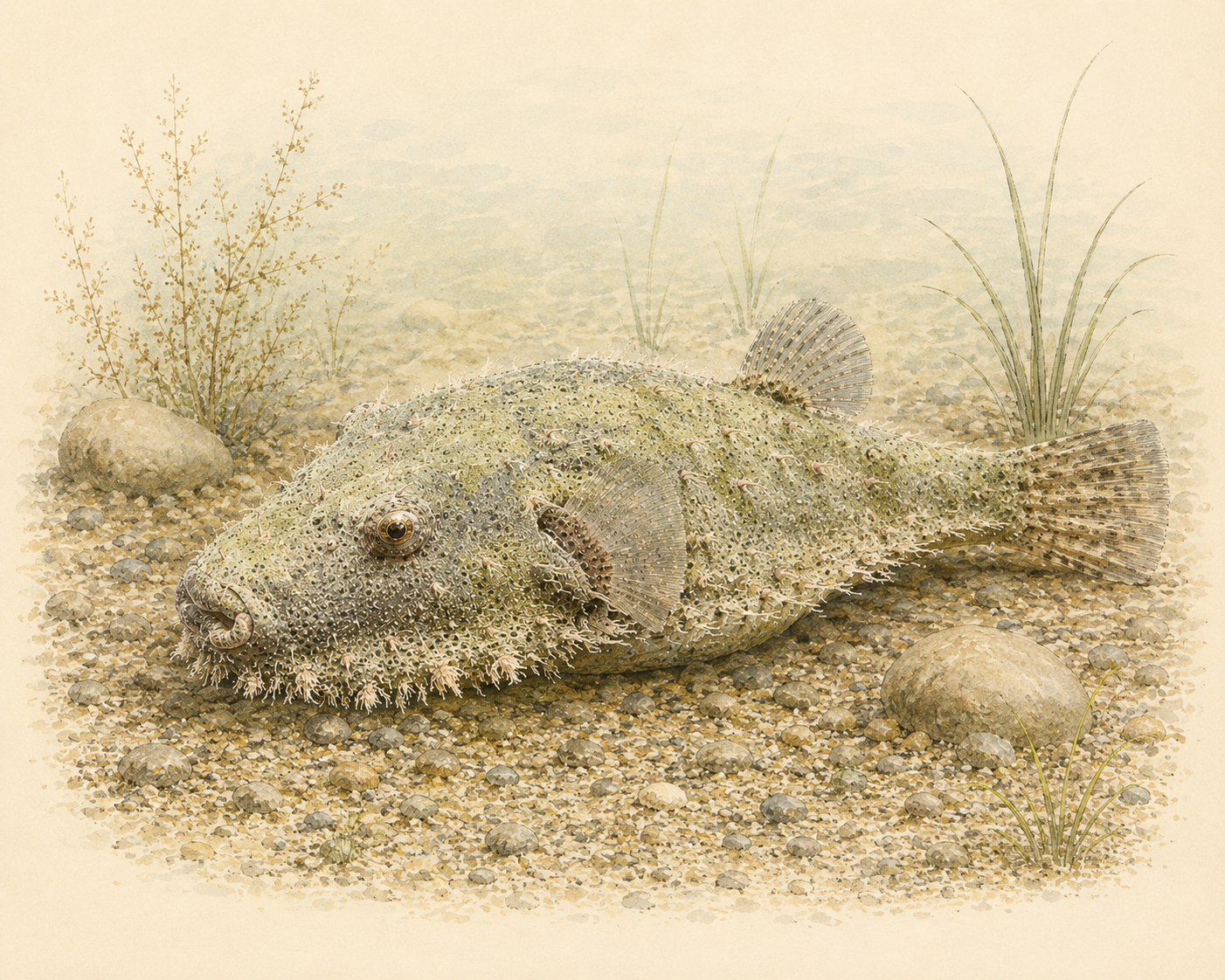
The Hairy Puffer’s most defining characteristic is its namesake “hair” — fleshy dermal cirri that sprout across much of its body, most densely along the dorsal surface and flanks. These soft, elongated projections are not true hair, of course, but rather epidermal outgrowths that help break up the fish’s outline and aid in camouflage among rocky substrates and debris. The degree to which these cirri develop can vary between individuals, and stressed or newly imported specimens may display them less prominently. In a well-established, healthy individual, the cirri can be remarkably lush, giving the fish the appearance of a moss-encrusted stone.
The base body colour is typically a mottled combination of dark brown, olive green, and tan, with irregular darker patches and lighter blotches that further enhance the camouflage effect. The belly is usually lighter, often cream or pale yellow. The eyes are large, highly mobile, and capable of independent movement — a trait common to pufferfish — and they are often a striking golden or coppery colour. This independent eye movement gives the fish a remarkably intelligent and expressive appearance, and many keepers report that their Hairy Puffer appears to watch them with genuine curiosity.
Like all members of the Tetraodontidae, Pao baileyi possesses a fused beak-like dental structure composed of four plates — two upper and two lower — which grows continuously throughout the fish’s life and is used to crush hard-shelled prey. The body is robust, somewhat compressed laterally compared to rounder puffer species, and lacks the pelvic fins found in most other fish families. When threatened or stressed, Hairy Puffers can inflate their bodies by swallowing water, though this defence mechanism should never be deliberately provoked by keepers, as it causes significant stress. Adult specimens typically reach 12 to 13 centimetres in length, with some individuals growing slightly larger under optimal conditions.
Natural Habitat
Pao baileyi inhabits the main channel and major tributaries of the Mekong River system, with populations documented in Thailand, Laos, and Cambodia. Its preferred environment consists of fast-flowing stretches of river with rocky substrates, where the fish can wedge itself into crevices and gaps between boulders, lying in ambush for passing invertebrates and small fish. The water in these habitats is typically well-oxygenated due to the current, moderately hard, and maintains a near-neutral to slightly acidic pH.
The riverbed in these areas is characterised by large rocks, cobbles, and gravel, with relatively sparse vegetation due to the strong current. Seasonal variations in the Mekong can alter water levels, flow rates, and turbidity significantly, which suggests that the species possesses a reasonable degree of adaptability to changing conditions. However, the consistent factor across its range is the presence of strong flow and ample rocky structure. This is an important consideration for aquarium design, as attempting to keep this species in still or slow-moving water goes against its biological needs and can lead to stress and health problems.
The Hairy Puffer’s remarkable camouflage is a direct adaptation to this rocky environment. By resembling a small, moss-covered stone, it can remain virtually invisible to both predators and prey, striking with impressive speed when a suitable food item drifts within range. Understanding this sit-and-wait predatory strategy is essential for replicating appropriate feeding conditions in captivity.
Tank Size and Setup
A single Hairy Puffer requires a minimum tank volume of 150 litres, though a larger aquarium of 200 litres or more is preferable, particularly if you wish to provide the strong water flow this species appreciates. The tank’s footprint matters more than its height; a longer, wider aquarium offers more usable territory and better opportunities to create current patterns. A standard 120 × 40 cm footprint works well as a starting point.
The aquascape should be designed to replicate the rocky riverbed habitats where this species is found in nature. Use a substrate of smooth river gravel or sand, and build up substantial rockwork to create caves, overhangs, ledges, and crevices. Pao baileyi spends much of its time perched on or wedged between rocks, and it will quickly adopt a favoured resting spot from which it surveys its surroundings. Ensure that all rocks are stable and cannot shift or collapse, as puffers will squeeze into surprisingly tight spaces. Smooth, rounded stones are preferable to sharp-edged rocks to avoid injury.
Driftwood can be included as supplementary décor and helps to acidify the water slightly if desired, though it is not as essential as the rockwork. Live plants are not a strong feature of the Hairy Puffer’s natural environment, but hardy species attached to rocks or wood — such as Anubias, Java Fern, and Bucephalandra — can be used to enhance the aquascape without being uprooted. Rooted plants in the substrate are less practical, as pufferfish may disturb them. Floating plants can also be useful for diffusing overhead light, which the Hairy Puffer tends to prefer; it is not a species that enjoys brightly lit, open environments.
A secure, tight-fitting lid is essential. While Hairy Puffers are not notorious jumpers compared to some fish, pufferfish in general can and do launch themselves out of water when startled, and any gaps in the tank cover represent a risk. Additionally, the strong filtration and water movement recommended for this species may occasionally create surface turbulence that could facilitate accidental escapes.
Water Parameters
| Temperature | 22–28 °C |
| pH | 6.5–7.5 |
| General hardness (GH) | 5–15 dGH |
| Carbonate hardness (KH) | 3–10 dKH |
| Ammonia | 0 ppm |
| Nitrite | 0 ppm |
| Nitrate | Below 20 ppm |
Pao baileyi is a riverine species accustomed to clean, well-oxygenated water with moderate flow. It is less tolerant of poor water quality than many commonly kept tropical fish, and elevated levels of ammonia, nitrite, or nitrate can quickly cause health problems. Weekly water changes of 25 to 30 per cent are recommended as a baseline, though the exact schedule should be guided by your testing results. Consistency is key; sudden swings in temperature, pH, or hardness are more dangerous than values that sit slightly outside the ideal range but remain stable.
The temperature range of 22 to 28 °C gives considerable flexibility, but aiming for the middle of this range — around 24 to 26 °C — works well for most aquarium setups. At the lower end of the range, metabolism slows and the fish may become less active, while sustained temperatures at the upper end will increase metabolic demand and oxygen consumption, necessitating even more vigorous aeration and filtration.
Filtration and Equipment
Robust filtration is non-negotiable for the Hairy Puffer. As a messy, protein-heavy feeder, Pao baileyi produces a considerable bioload relative to its size. A canister filter rated for at least 1.5 to 2 times the tank’s volume is a sensible starting point. Many experienced keepers opt for an oversized canister combined with a supplementary powerhead or wavemaker to replicate the strong current that this species encounters in the wild. Positioning the filter outlet and any additional flow devices to create directional current through the rockwork will encourage natural behaviour and help maintain dissolved oxygen levels.
Biological filtration should be prioritised, with ample ceramic media, sintered glass, or similar high-surface-area biomedia in the canister. Mechanical filtration in the form of sponges and filter floss will help manage the particulate waste generated by a diet of shelled foods, and these mechanical stages should be rinsed regularly in old tank water to prevent clogging. Chemical filtration using activated carbon can be useful for maintaining water clarity and removing dissolved organics, though it is not strictly necessary in a well-maintained system.
An air pump with an airstone or sponge filter can provide valuable supplementary oxygenation, particularly during warmer months or in smaller tanks where oxygen depletion is a greater risk. A reliable heater with a thermostat, appropriately sized for the tank volume, is essential to maintain stable temperatures. Use a heater guard to prevent the puffer from resting against the heating element and suffering burns — puffers are curious animals and will investigate every object in their tank.
Lighting does not need to be intense; moderate to subdued lighting suits the Hairy Puffer’s preference for shaded environments and helps reduce stress. If you are growing live plants, a standard planted-tank LED fixture on a timer providing 8 to 10 hours of light per day will suffice, with the floating plants or overhanging rockwork providing shaded retreats.
Diet and Feeding
Feeding is one of the most critical — and most engaging — aspects of Hairy Puffer care. Pao baileyi is an obligate carnivore and, in the wild, feeds primarily on snails, crustaceans, insect larvae, and small fish. In captivity, a varied diet of hard-shelled and meaty foods is essential both for nutrition and for dental maintenance. The continuously growing beak must be worn down through regular consumption of hard items; if the beak overgrows, the fish may struggle to eat and veterinary intervention may be required to trim it.
Snails are the cornerstone of the Hairy Puffer’s diet and should be offered several times per week. Malaysian trumpet snails, pond snails, and ramshorn snails are all excellent choices and can be cultured at home in a separate container with minimal effort. Offer snails of an appropriate size — the puffer should be able to crush them relatively easily, but they should still provide meaningful resistance to keep the beak trimmed. Over time, you will learn your individual fish’s preferences and crushing ability.
Beyond snails, the diet should include a rotation of other foods such as frozen or live bloodworm, mussels (chopped to size), cockle, prawns with the shell on (for smaller specimens, chopped prawns), crab legs, and crayfish. Earthworms are also readily accepted and are highly nutritious. Live river shrimp and small crayfish provide enrichment as well as nutrition, triggering the puffer’s natural hunting instincts. Avoid dried or processed foods such as flakes and pellets, as Hairy Puffers will almost universally refuse them and they do not contribute to beak wear.
Feed your Hairy Puffer once daily or every other day, offering only as much as the fish will consume in a few minutes. Overfeeding is a common mistake, particularly because pufferfish are highly effective at begging for food and many keepers find it difficult to resist their expressive faces. Uneaten food should be removed promptly to prevent water quality deterioration. A fasting day once per week is beneficial, particularly for adult specimens, as it helps prevent obesity — a genuine concern with pufferfish that have enthusiastic appetites and relatively sedentary lifestyles.
Behaviour and Temperament
The Hairy Puffer is a classic ambush predator: patient, watchful, and capable of sudden, explosive strikes when prey comes within range. In the aquarium, it spends much of its time perched on a favourite rock or wedged into a crevice, surveying its surroundings with independently moving eyes. This behaviour can initially lead new keepers to worry that the fish is inactive or unwell, but it is entirely normal for the species. When food is introduced or something catches its attention, the puffer will become immediately alert and surprisingly agile.
Pao baileyi is generally considered a solitary species, and most experienced keepers recommend housing it alone or in very carefully managed groups. Conspecific aggression can be severe, particularly in smaller tanks where territorial boundaries cannot be adequately established. In larger aquaria of 400 litres or more with abundant visual barriers and rockwork, some keepers have maintained small groups, but this is not without risk and should only be attempted by those prepared to separate individuals at short notice.
Towards other fish species, the Hairy Puffer is opportunistically predatory and will readily consume anything it can fit into its mouth. It can also be a fin nipper, targeting slow-moving or long-finned species. However, it is not ceaselessly aggressive in the manner of some cichlids; it tends to ignore fish that are too large to eat and too fast to catch, provided they do not invade its personal space. That said, the risk to tank mates is always present, and any community setup involving this species should be approached with caution and realistic expectations.
One of the most endearing traits of the Hairy Puffer — and pufferfish in general — is its apparent recognition of its keeper. Many owners report that their Pao baileyi learns to associate their presence with food and will swim to the front of the tank, track their movements, and even “beg” by swimming actively at the glass. This interactive quality is a significant part of the species’ appeal and contributes to its reputation as one of the more personable freshwater fish available.
Tank Mates
Housing Pao baileyi with other fish is inherently risky, and many experienced keepers advocate for a species-only setup as the safest and simplest approach. However, cohabitation is possible under certain conditions, provided that tank mates are chosen with care. Ideal companions are robust, fast-moving species that occupy different areas of the water column, are too large to be eaten, and are not aggressive enough to harass the puffer. Long-finned, slow-moving, or very small species should be avoided entirely.
Good tank mates
- Giant Danio — fast-swimming and too large to be easily predated, these active schooling fish tend to stay in the upper water column away from the puffer’s territory.
- Buenos Aires Tetra — a hardy, robust tetra large enough to avoid predation and active enough to keep out of trouble.
- Clown Loach — a tough, sizeable bottom-dweller that can hold its own and appreciates similar water flow conditions, though a very large tank is needed for both species.
- Bristlenose Pleco — an armoured catfish that generally stays out of the puffer’s way and is well-protected by its bony plates.
- Rainbowfish — fast, colourful mid-water swimmers that are typically too quick and too large for the puffer to target.
- Swordtail — reasonably sized and active livebearers that tend to occupy the mid to upper regions of the tank.
- Hillstream Loach — shares the preference for fast-flowing, well-oxygenated water and is generally ignored due to its low-profile, substrate-hugging habits.
- Siamese Algae Eater — a fast, hardy species that provides useful algae control and is typically nimble enough to avoid the puffer.
Fish to avoid
- Neon Tetra — far too small and will be seen as food rather than a tank mate.
- Betta — slow-moving and long-finned, making it an irresistible target for fin nipping or outright predation.
- Guppy — small size and flowing finnage make guppies a near-certain casualty in a puffer tank.
- Cherry Shrimp — invertebrates of any kind are natural prey items for Pao baileyi and will be hunted relentlessly.
- Apple Snail — while large, snails are a primary food source for this puffer and will be consumed.
- Angelfish — their slow, graceful movement and trailing fins make them highly vulnerable to nipping and harassment.
- Corydoras Catfish — too small and slow-moving for safety; their spines may also pose a choking hazard if the puffer attempts to eat them.
- Goldfish — incompatible temperature requirements and their slow nature makes them easy targets in a puffer’s territory.
Breeding
Breeding Pao baileyi in captivity is exceptionally rare and remains poorly documented. The species is not commercially bred for the aquarium trade, and virtually all specimens available for purchase are wild-caught. The handful of reported breeding attempts that have achieved any success suggest that replicating the species’ natural breeding triggers — which likely involve seasonal changes in water level, temperature, and flow rate associated with the Mekong’s monsoon cycle — is extremely challenging in a home aquarium.
Sexing Hairy Puffers externally is difficult and unreliable. Males may be slightly slimmer and display more prominent cirri than females, and gravid females may appear noticeably rounder when carrying eggs, but these distinctions are subtle and not consistent enough to serve as definitive identification. Some keepers have noted behavioural differences, with males tending to be more territorial, though this too is anecdotal.
In the few instances where spawning behaviour has been observed, it appears that the male courts the female by displaying near a chosen spawning site — typically a flat rock surface or a sheltered crevice. Eggs are deposited on or near this substrate, and the male may guard them. Incubation and fry-rearing details are scant; if fry were to hatch, they would almost certainly require very small live foods such as infusoria initially, graduating to brine shrimp nauplii as they grow. Given the near-total absence of reliable captive breeding data, anyone interested in attempting to breed this species should approach it as a long-term research project rather than an expected outcome.
Common Diseases
Hairy Puffers are scaleless fish, which makes them more susceptible to certain parasitic infections and more sensitive to medications containing copper or formalin. This is an important consideration when treating any illness, as standard dosing recommendations for scaled fish may be too aggressive for a pufferfish. Always use medications at reduced concentrations — typically half the standard dose — and monitor the fish closely during treatment.
Ich (white spot disease), caused by the parasite Ichthyophthirius multifiliis, can affect Hairy Puffers, particularly newly imported specimens that are stressed from transit. Raising the water temperature gradually to 30 °C over several days, combined with increased aeration, is often the safest first-line treatment. If medication is necessary, heat-and-salt methods (using pure, additive-free aquarium salt at approximately 2 grams per litre) are generally safer for scaleless fish than chemical ich treatments.
Internal parasites are another concern, especially with wild-caught specimens. Signs of internal parasites include weight loss despite a healthy appetite, stringy white faeces, and general lethargy. A course of treatment with praziquantel-based medication is usually effective and is reasonably well-tolerated by pufferfish. It is good practice to prophylactically treat newly acquired wild-caught puffers for internal parasites during the quarantine period.
Beak overgrowth is a husbandry-related issue rather than a disease, but it is one of the most common health problems seen in captive pufferfish. If the beak grows beyond the point where the fish can effectively feed, manual trimming under sedation by an experienced aquatic veterinarian may be necessary. Prevention through regular feeding of hard-shelled snails and crustaceans is far preferable to intervention.
Skin lesions, bacterial infections, and fungal outbreaks can occur if water quality is allowed to deteriorate or if the fish sustains injuries from sharp décor or aggressive tank mates. Maintaining pristine water conditions and providing smooth, safe tank furnishings are the best preventive measures. If bacterial infections do develop, broad-spectrum antibiotic treatments such as those containing kanamycin or nitrofurazone can be effective, but again, use them cautiously and at reduced doses for scaleless species.
FAQs
Do Hairy Puffers really need snails in their diet?
Yes, snails are considered essential for Hairy Puffers. Their continuously growing beak requires regular wear from crushing hard-shelled prey. Without snails or similarly hard foods such as shell-on prawns and crab legs offered frequently, the beak can overgrow and prevent the fish from eating properly. Culturing your own snails in a separate container is the most cost-effective and reliable way to ensure a steady supply.
Can I keep more than one Hairy Puffer in the same tank?
It is possible but risky. Pao baileyi is a territorial and generally solitary species, and conspecific aggression can result in serious injury. If you wish to attempt keeping more than one, you will need a very large tank — 400 litres or more — with extensive rockwork creating numerous visual barriers and separate territories. Even then, close monitoring is required, and you should have a contingency plan to separate individuals if aggression becomes problematic.
Why does my Hairy Puffer sit in one spot all day?
This is entirely normal behaviour for the species. Pao baileyi is an ambush predator that naturally spends long periods motionless on rocks or in crevices, waiting for prey to come within striking distance. As long as the fish is eating well, its colouration is healthy, and it responds alertly to stimuli such as feeding time, there is no cause for concern. Activity levels tend to increase around feeding and during periods of dim lighting.
Are Hairy Puffers safe with live plants?
Generally, yes. Pao baileyi is a carnivore and shows little interest in eating or deliberately destroying live plants. However, the species may inadvertently uproot substrate-planted vegetation through its movements. Hardy epiphytes attached to rocks and driftwood, such as Anubias, Java Fern, and Bucephalandra, are the safest choices as they cannot be dislodged from the substrate.
How do I trim an overgrown puffer beak?
Beak trimming is a delicate procedure that ideally should be performed by an aquatic veterinarian experienced with pufferfish. The fish is typically sedated using clove oil dissolved in tank water, and the overgrown portions of the beak are carefully trimmed with cuticle clippers or similar fine tools. Attempting this without experience risks injuring the fish. The best approach is prevention through a diet rich in hard-shelled snails and crustaceans, which naturally wear the beak down.
Related Guides
- Congo Puffer (Tetraodon miurus) — another ambush-predator pufferfish with similar care requirements and an equally striking appearance.
- Fahaka Puffer (Tetraodon lineatus) — a larger freshwater puffer species that shares many dietary and husbandry needs with Pao baileyi.
- Figure Eight Puffer (Dichotomyctere ocellatus) — a smaller, more commonly kept pufferfish offering an alternative for those interested in the puffer family.
- Pea Puffer (Carinotetraodon travancoricus) — the smallest commonly kept freshwater puffer, useful for comparison of pufferfish care across different size classes.
- Breeding Snails as Feeder Animals — a practical guide to culturing the snails essential for maintaining healthy puffer dentition.