Quick summary
Delta and Super Delta Bettas are easy-to-keep, active swimmers whose moderately spread tails make them more manageable and less prone to fin damage than extreme-finned types like Halfmoons, making them a good fit for beginners who want dramatic finnage without the extra fuss. Just be prepared to keep them alone or with carefully chosen calm tank mates in a heated, gently filtered tank of at least 20 litres, with breeding rated as moderately difficult if you plan to go beyond basic care.
🐠 Build a tank around this species
In this guide:
- Introduction
- Quick Stats
- Appearance
- Varieties and Morphs
- Natural Habitat
- Tank Size and Setup
- Water Parameters
- Filtration and Equipment
- Diet and Feeding
- Behaviour and Temperament
- Tank Mates
- Breeding
- Common Diseases
Introduction
The Delta Betta and Super Delta Betta are tail-type variants of the domestic Betta splendens, selectively bred for a distinctive triangular caudal fin that fans outward from the caudal peduncle in a clean, crisp wedge shape. Rather than being two truly separate categories, the Delta and Super Delta labels describe a continuous spectrum of caudal fin spread. A standard Delta typically displays a spread of roughly 90 to 120 degrees, while a Super Delta pushes that spread further – approximately 120 to 160 degrees – approaching but never quite reaching the full 180-degree splay that defines a true Halfmoon. Because the distinction between the two is simply a matter of degree rather than any fundamental difference in genetics, care, or morphology, this guide covers both under a single entry.
As a variant of Betta splendens, the Delta and Super Delta share the same core biology, water requirements, and behavioural traits as any other domestic betta. If you are new to betta keeping or want a thorough grounding in baseline care fundamentals – covering everything from cycling a tank to understanding the species’ labyrinth organ – we recommend reading our comprehensive Betta Fish Care Guide alongside this page. The present guide focuses specifically on what makes the Delta and Super Delta tail types distinctive: their fin structure, the implications of that finnage for tank setup and flow management, their position within the broader betta classification system, and the particular considerations that arise when keeping and breeding fish selected for this tail shape.
Delta and Super Delta bettas occupy an interesting middle ground in the hobby. They offer the visual drama of an expansive, flowing caudal fin without the extreme finnage of a Halfmoon or Over-Halfmoon, which can make them somewhat easier to keep healthy and active. Their fins are less prone to the severe tearing, biting, and fatigue issues that plague the most extreme tail types, yet they still present a striking display when flared. This balance of beauty and practicality has made them enduringly popular among both newcomers and experienced betta enthusiasts.
Quick Stats
| Scientific name | Betta splendens var. Delta / Super Delta |
|---|---|
| Common names | Delta Betta, Super Delta Betta, Delta Tail Betta, SD Betta |
| Family | Osphronemidae |
| Origin | Thailand, Cambodia, Laos, Vietnam |
| Adult size | 7 cm |
| Lifespan | 3–5 years |
| Difficulty | Easy |
| Breeding difficulty | Moderate |
| Temperature | 24–30 °C |
| pH | 6–8 |
| GH | 1–15 dGH |
| KH | 2–8 dKH |
| Minimum tank size | 45 L |
| Conservation status | Vulnerable (IUCN, wild Betta splendens) |
Appearance
The defining feature of the Delta and Super Delta is the caudal (tail) fin. When viewed from behind or the side while the fish is flaring or swimming actively, the caudal fin forms a triangular or wedge-shaped spread originating from a single point at the caudal peduncle and fanning outward toward the trailing edge. The edges of this triangle should ideally be straight and crisp rather than curved or ruffled – a key distinction from other tail types such as the Rosetail or Feathertail, which feature excessive branching and frilling along the fin edges.
In a standard Delta, the angle between the upper and lower edges of the spread caudal fin measures roughly 90 to 120 degrees when fully flared. A Super Delta extends this spread to approximately 120 to 160 degrees. It is worth emphasising that these numbers are guidelines rather than hard boundaries. A fish measured at exactly 120 degrees might reasonably be called either a good Delta or a modest Super Delta, depending on the context and the observer. The spectrum is continuous, and classification at the boundaries is inherently subjective. What separates a Super Delta from a true Halfmoon is the final gap: a Halfmoon achieves a full 180-degree spread (or more, in the case of Over-Halfmoons), while even the best Super Deltas fall short of that benchmark.
Beyond the caudal fin, Delta and Super Delta bettas typically display proportionally generous anal and dorsal fins as well, though these are not the primary focus of the classification. The dorsal fin is usually upright and moderately broad, while the anal fin sweeps back along the ventral profile. The pectoral fins may be elongated in some lines, though this varies. Body shape follows the standard domestic betta splendens form – a laterally compressed, torpedo-shaped body with an upturned mouth adapted for surface feeding and air-breathing.
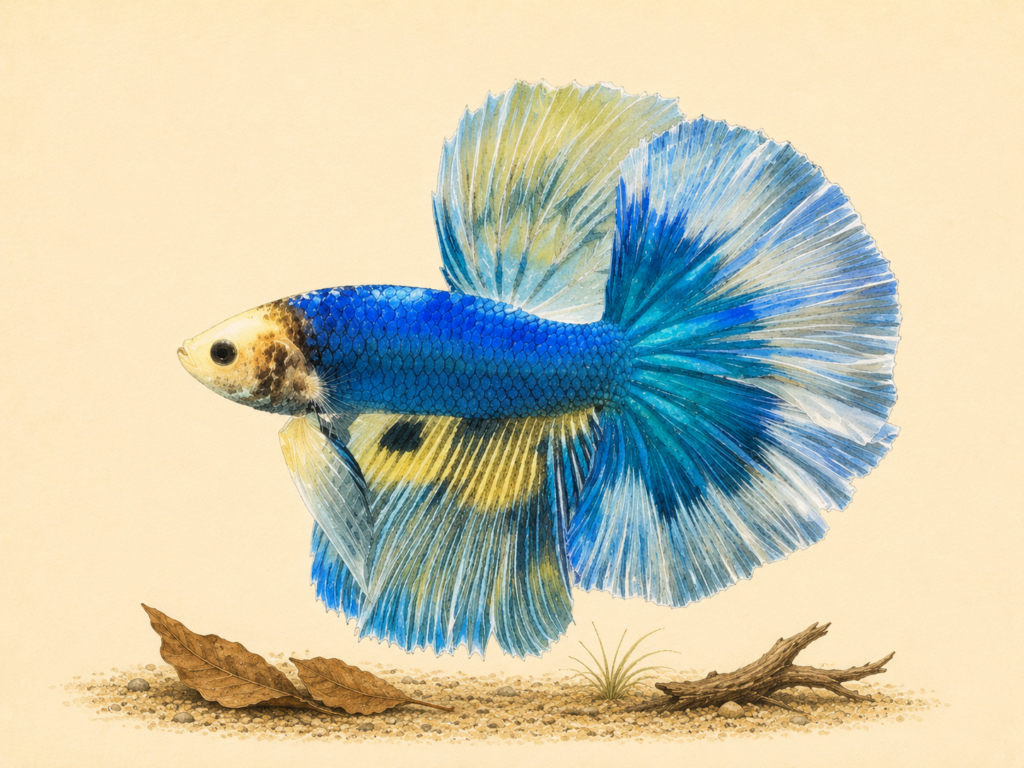
Delta and Super Delta bettas come in virtually every colour and pattern available in the broader Betta splendens gene pool. The featured photograph for this page shows a fish combining a wide Delta-range tail spread with a Butterfly colour pattern. The Butterfly pattern is a separate classification system from tail type – it refers to a distinct colour arrangement in which the fins display a solid base colour closest to the body, followed by a sharply demarcated band of contrasting colour (often white, cellophane, or a paler shade) along the outer margins of the fins. This particular fish illustrates beautifully how the two classification systems – tail type and colour pattern – operate independently and can combine on a single individual. A Delta can be solid, bicolour, marble, koi, dragon scale, Butterfly, or any other recognised colour pattern. The tail-type label describes only the shape and spread of the finnage, not its colouration.
Compared to Halfmoon bettas, Delta and Super Delta fins carry slightly less total membrane area, which has practical consequences. Less fin area means less weight to carry through the water, less surface area vulnerable to tearing, and generally better swimming ability. Many keepers find that Delta and Super Delta bettas are noticeably more active and agile swimmers than their Halfmoon counterparts, which can become lethargic or struggle to navigate current in the aquarium.
Varieties and Morphs
Because Delta and Super Delta are purely tail-type classifications, they intersect freely with all colour varieties, scale types, and additional fin modifications found in domestic Betta splendens. Understanding these overlapping classification systems helps avoid confusion when shopping for or describing these fish.
Within the Delta/Super Delta tail-type category, the primary variation is simply the degree of caudal spread. Fish at the lower end (around 90 degrees) are sometimes informally called “narrow Delta” or simply standard Delta, while those pushing close to 160 degrees are firmly Super Delta territory. Breeders aiming for Halfmoon lines often produce Super Deltas as by-products – fish that are genetically close to the Halfmoon standard but do not quite achieve the full 180-degree spread. These Super Deltas from Halfmoon breeding programmes are often exceptionally well-formed fish with excellent symmetry and fin ray structure.
Colour varieties commonly seen in Delta and Super Delta form include solid colours (red, blue, royal blue, steel blue, turquoise, black, white, yellow, orange, green, copper), bicolour combinations, cambodian (pale body with coloured fins), chocolate (brown body with yellow or gold fins), marble (irregular blotched patterning that may shift over time), koi (marble-type patterning resembling koi carp), dragon scale (thick, opaque, metallic-looking scales over the body), mustard gas (typically a dark body with yellow or gold fins), and the Butterfly pattern described above. Metallic and iridescent layers can overlay many of these base colours.
It is also possible to find Delta and Super Delta bettas with additional fin modifications such as combtail (slight extension of the fin rays beyond the membrane, creating a serrated edge) or double-tail genetics expressed partially. However, these combinations are less common and begin to blur the classification boundaries. A Delta with heavily extended and branching fin rays, for instance, may start to resemble a Rosetail and would likely be classified differently by show judges.
Female Delta and Super Delta bettas exist but are far less dramatic in appearance. Females generally have shorter finnage overall, and the tail spread differences that define the Delta type are much subtler in females. Most commercially available Delta and Super Delta bettas are males, and the tail-type classification is primarily applied to male fish in both the hobby and competitive showing contexts.
Natural Habitat
As a domesticated variant, the Delta and Super Delta Betta does not exist in the wild. However, its ancestor, wild Betta splendens, is native to the shallow freshwater habitats of mainland Southeast Asia, particularly Thailand (where it is the national aquatic animal), Cambodia, Laos, and Vietnam. Wild bettas inhabit rice paddies, roadside ditches, floodplain pools, slow-moving streams, and stagnant or near-stagnant bodies of water. These environments are characterised by warm temperatures, soft to moderately hard water, low flow, abundant vegetation, and often relatively shallow depth.
The development of the labyrinth organ – an accessory breathing structure that allows bettas to gulp atmospheric air – is an adaptation to these oxygen-poor habitats. During the dry season, wild bettas may find themselves in very small, isolated pools with minimal dissolved oxygen, and the labyrinth organ provides a crucial survival advantage under these conditions.
Understanding this wild heritage is important for Delta and Super Delta keepers because it informs appropriate tank conditions. While domestic bettas are far removed from their wild ancestors in terms of appearance, their physiological needs remain broadly similar: warm, calm, slightly acidic to neutral water with access to the surface for air-breathing. The extended finnage of Delta and Super Delta bettas makes the low-flow requirement even more critical than it would be for a short-finned plakat-type betta, as the larger fins create significantly more drag and make swimming against current more taxing.
Wild Betta splendens is currently classified as Vulnerable on the IUCN Red List, primarily due to habitat loss, pollution, and hybridisation with released domestic stock. The domestic Delta and Super Delta variants, being products of selective breeding, are not separately assessed for conservation purposes.
Tank Size and Setup
A minimum tank volume of 20 litres is recommended for a single Delta or Super Delta Betta, though 30 to 40 litres or more is preferable and provides a more stable environment with greater scope for aquascaping. The tank shape matters as much as volume for these fish. A long, shallow tank is generally better than a tall, narrow one, as bettas are surface-oriented fish that need easy access to the air-water interface to use their labyrinth organ. Tanks taller than about 30 cm can pose problems for heavily finned bettas, which may struggle to reach the surface comfortably.
The single most important setup consideration specific to Delta and Super Delta bettas – and to long-finned bettas generally – is avoiding sharp or abrasive decor. The broad, thin membranes of the caudal, anal, and dorsal fins are extremely delicate and can tear on rough surfaces, jagged plastic plants, unfinished ceramic ornaments, or even sharp gravel. Use smooth river stones, rounded driftwood (check for splinters), and live or high-quality silk plants. If in doubt, run a pair of tights or stockings over a decoration: if the fabric snags, the surface is too rough for a long-finned betta.
Live plants are strongly recommended. They provide cover, reduce stress, help absorb nitrogenous waste, and soften water flow. Good choices include Java Fern (Microsorum pteropus), Anubias species, Java Moss (Taxiphyllum barbieri), Amazon Sword (Echinodorus species), and floating plants such as Salvinia, Amazon Frogbit (Limnobium laevigatum), or Red Root Floater (Phyllanthus fluitans). Floating plants are particularly beneficial as they provide shade, reduce surface agitation, and offer resting spots near the surface where bettas like to lounge.
A lid or cover is essential. Bettas are accomplished jumpers, and an uncovered tank invites disaster. The lid should still allow some air exchange, and ideally the air layer between the water surface and the lid should be warm and humid, as bettas breathing cold, dry air can suffer respiratory stress. A tight-fitting lid over a heated tank generally achieves this naturally.
Substrate choice is flexible. Fine gravel, smooth sand, or specialised plant substrates all work well. Dark substrates tend to show off betta colours more effectively and may reduce stress compared to pale or reflective substrates. Some keepers opt for bare-bottom tanks for ease of cleaning, though this is less aesthetically pleasing and provides no rooting medium for plants.
Provide hiding spots and visual barriers. Even a single betta benefits from having places to retreat and explore. Driftwood, coconut shells (with sanded edges), ceramic caves (smooth-glazed), and dense plant growth all serve this purpose. If you plan to house tank mates with your betta, visual barriers become even more important for reducing stress and territorial aggression.
Water Parameters
| Temperature | 24–30 °C |
| pH | 6.0–8.0 |
| General hardness (GH) | 1–15 dGH |
| Carbonate hardness (KH) | 2 – 8 dKH |
| Ammonia | 0 ppm |
| Nitrite | 0 ppm |
| Nitrate | Below 20 ppm |
The water parameter requirements for Delta and Super Delta bettas are identical to those of other domestic Betta splendens variants. Temperature stability is arguably the most critical factor. Bettas are tropical fish and require consistently warm water; temperatures below 22 degrees Celsius will suppress immune function, reduce appetite, and lead to lethargy. A reliable, adjustable heater is essential in most climates, even during summer months, as overnight temperature drops can stress the fish.
One consideration somewhat more relevant to Delta and Super Delta bettas than to short-finned varieties is the relationship between water quality and fin health. Long fins provide a large surface area that is in constant contact with the water column. Poor water quality – elevated ammonia, nitrite, or high nitrate levels – will manifest as fin deterioration (fin rot, fin melt, or pinhole damage) more quickly and more visibly on a Delta or Super Delta than on a plakat. For this reason, maintaining pristine water quality is not merely advisable but essential for keeping these fish in good condition. Weekly water changes of 20 to 30 per cent are a minimum; in smaller tanks, more frequent changes may be necessary.
Indian almond leaves (Terminalia catappa), also known as catappa leaves, are a popular addition to betta tanks. They release tannins that gently lower pH, tint the water a light amber, and are believed to have mild antibacterial and antifungal properties. While not strictly necessary, many experienced betta keepers find that tannin-rich water promotes better fin condition and overall health, which is particularly beneficial for long-finned varieties.
Filtration and Equipment
Filtration for a Delta or Super Delta betta tank must balance effective biological and mechanical filtration with minimal water flow. This is the single most important equipment consideration specific to these tail types. The broad, membranous caudal fin of a Delta or Super Delta acts like a sail, catching current and forcing the fish to expend energy fighting the flow. Excessive current leads to stress, exhaustion, and can contribute to fin damage and tail biting.
Sponge filters are the gold standard for betta tanks. They provide excellent biological filtration, create only gentle water movement, pose no risk of fin entrapment, and are inexpensive. An air-driven sponge filter paired with a small, adjustable air pump is an ideal setup. If using a hang-on-back (HOB) filter or small internal filter, choose a model with an adjustable flow rate and turn it down to its lowest setting. You can further baffle the output by attaching a pre-filter sponge, directing the flow against the tank wall, or using a piece of filter foam secured over the outlet to diffuse the current. Some keepers use a plastic bottle baffle – a clean, cut section of a plastic bottle placed over the filter outlet to redirect and spread the flow.
An adjustable heater rated for the tank volume is essential. For tanks of 20 to 40 litres, a 25 to 50 watt heater is usually sufficient. Place the heater near the filter outlet (if using a powered filter) to help distribute heat evenly. A separate thermometer – digital or glass – is recommended to verify the heater is maintaining the correct temperature, as built-in heater thermostats can be inaccurate.
Lighting should be moderate. Bettas do not have specific lighting requirements, but a regular light cycle of approximately 8 to 10 hours per day supports live plant growth and establishes a healthy circadian rhythm. Avoid leaving lights on 24 hours a day, as bettas need a period of darkness for rest. LED lights designed for planted tanks work well and typically do not generate significant heat.
An aquarium lid, as mentioned previously, is non-negotiable. If your filter or heater requires cable access, choose a lid with cutouts or use a mesh or perspex cover that can be fitted around equipment.
Diet and Feeding
Delta and Super Delta bettas have the same dietary requirements as all domestic Betta splendens. They are primarily carnivorous (more accurately, insectivorous) and require a protein-rich diet. A high-quality betta-specific pellet should form the staple of their diet. Look for pellets where whole fish, fish meal, or insect-based ingredients (such as black soldier fly larvae meal) are listed as the first ingredients, and avoid products where wheat flour or other fillers dominate the ingredient list.
Supplement pellets with a rotation of frozen or live foods. Bloodworm, daphnia, brine shrimp, mosquito larvae, and tubifex worms are all excellent choices. Live foods are particularly stimulating and encourage natural hunting behaviours, while frozen foods are more convenient and carry a lower risk of introducing parasites. Freeze-dried foods can be used occasionally but should be pre-soaked in tank water before feeding, as they can expand in the fish’s stomach and cause bloating if fed dry.
Feed small amounts once or twice daily – only as much as the fish can consume in two to three minutes. Overfeeding is one of the most common mistakes in betta keeping and can lead to bloating, constipation, obesity, and deteriorating water quality. A weekly fast day (no food for 24 hours) can help promote digestive health, particularly for bettas prone to bloating.
One feeding consideration that is somewhat more relevant to Delta and Super Delta bettas than to short-finned varieties relates to the physical effort of feeding. Fish with very heavy finnage may be slightly slower to reach food and may struggle to chase sinking pellets through the water column. Floating pellets or slow-sinking micro-pellets are generally preferable, and feeding at the surface where the betta naturally orients is easiest for them. If housing a Delta or Super Delta with bottom-dwelling tank mates, ensure that food reaches the bottom dwellers without forcing the betta to compete at depth.
Behaviour and Temperament
Delta and Super Delta bettas display the characteristic Betta splendens temperament: curious, interactive, and territorial. Males are aggressive toward other male bettas and will fight if housed together – this is non-negotiable and applies regardless of tail type. They may also show aggression toward fish with similar body shapes, bright colours, or flowing fins that could be mistaken for a rival male betta.
Compared to the most extreme long-finned varieties (Halfmoon, Over-Halfmoon, Rosetail), Delta and Super Delta bettas tend to be somewhat more active and mobile swimmers. Their fins, while generous, carry less total weight and drag, allowing these fish to navigate their environment with greater ease. This can make them more engaging to watch, as they patrol their territory, investigate new objects, and interact with their keeper more readily than a heavily finned Halfmoon that spends much of its time resting.
Flaring – the dramatic display in which a betta spreads its gill covers (opercula) and extends all fins to maximum span – is a natural territorial and communicative behaviour. It is during flaring that the Delta or Super Delta tail spread is most fully appreciated. Brief flaring sessions (a minute or two) are healthy exercise that strengthens fin muscles and prevents fin atrophy. You can encourage flaring by briefly showing the betta a mirror or placing a picture of another betta near the tank. However, prolonged or constant flaring is stressful and should be avoided. Remove the stimulus after a short period.
Tail biting – a frustrating behaviour in which the betta turns and bites chunks from its own caudal fin – can occur in any long-finned betta, including Delta and Super Delta types. The causes are debated but may include stress, boredom, excessively heavy or long fins, poor water quality, or strong current. While Delta and Super Delta bettas are less prone to tail biting than the most extreme tail types (their fins are lighter and less cumbersome), it can still occur. Environmental enrichment – live plants, rearranging decor periodically, floating objects, and varied feeding – can help prevent boredom-related tail biting. Ensuring low flow and excellent water quality addresses the other common triggers.
Delta and Super Delta bettas are generally compatible with peaceful tank mates, though individual temperament varies considerably. Some individuals are remarkably tolerant, while others will harass anything that enters their perceived territory. Observe your specific fish carefully when introducing tank mates.
Tank Mates
Choosing tank mates for a Delta or Super Delta Betta requires the same general caution as for any Betta splendens. The betta must be the only male betta in the tank, and tank mates should be peaceful species that will not nip the betta’s fins or outcompete it for food. The somewhat lighter finnage of a Delta or Super Delta compared to a Halfmoon gives these fish a slight advantage in mixed-species setups, as they can manoeuvre and escape more effectively. Nonetheless, only add tank mates if the tank is large enough to provide adequate space and hiding spots – a minimum of 40 litres is advisable for a community setup, with larger tanks being preferable.
Good tank mates
- Ember Tetra – Tiny, peaceful, and subdued in colour, Ember Tetras occupy mid-water levels and are unlikely to provoke or be targeted by a Delta Betta.
- Pygmy Corydoras – These diminutive bottom dwellers are gentle and unobtrusive, staying well out of a betta’s typical patrol zone near the surface.
- Amano Shrimp – Large enough to avoid being eaten by most bettas, Amano Shrimp are excellent algae cleaners and generally ignored by bettas.
- Ramshorn Snail – Hardy and useful algae grazers, Ramshorn Snails are too well-armoured and slow-moving to trigger a betta’s predatory or territorial instincts.
- Celestial Pearl Danio – These small, beautifully patterned fish are peaceful and prefer densely planted environments, making them a good match for a betta tank with ample vegetation.
- Kuhli Loach – Nocturnal and reclusive, Kuhli Loaches spend most of their time hiding among decor or burrowing in substrate, largely avoiding interaction with the betta.
- Malaysian Trumpet Snail – These burrowing snails help aerate the substrate and consume detritus, operating mostly out of sight and posing no threat to a betta.
- Chili Rasbora – One of the smallest freshwater fish available, Chili Rasboras are timid and stick together in a shoal, rarely drawing a betta’s attention.
Fish to avoid
- Tiger Barb – Notorious fin nippers that will relentlessly target the flowing fins of a Delta or Super Delta, causing severe damage and stress.
- Male Guppy – Their bright colours and flowing tails closely resemble a rival male betta to many bettas, frequently provoking aggression.
- Chinese Algae Eater – Becomes territorial and aggressive as it matures, and may latch onto a slow-moving betta’s body to feed on its slime coat.
- Paradise Fish – A fellow labyrinth fish with strong territorial instincts, Paradise Fish will compete for surface space and are likely to fight with a betta.
- Convict Cichlid – Aggressive and territorial, Convict Cichlids will bully and likely injure a betta, especially in confined spaces.
- Serpae Tetra – Known fin nippers, Serpae Tetras are drawn to flowing fins and will harass a Delta or Super Delta relentlessly.
- Dwarf Gourami – Another labyrinth fish that occupies the same niche, Dwarf Gouramis and bettas frequently clash over territory and surface access.
- Red Tail Shark – Highly territorial bottom dwellers that become increasingly aggressive as they mature, posing a serious threat in most community setups.
Breeding
Breeding Delta and Super Delta bettas follows the same general process as breeding any domestic Betta splendens – the male builds a bubble nest at the water surface, the pair engage in a spawning embrace beneath the nest, and the male collects and tends the fertilised eggs in the nest until they hatch. However, breeding specifically for the Delta or Super Delta tail type introduces additional considerations around line selection, genetics, and fry evaluation.
To begin, you need a healthy, mature pair. Males are typically ready to breed at 4 to 6 months of age, though waiting until 6 to 8 months ensures better size and fin development. Females should be plump and showing vertical breeding bars (pale vertical stripes on the body) and a visible ovipositor (a small white spot near the ventral fins) to indicate readiness. Condition both fish with high-protein foods – live or frozen bloodworm, brine shrimp, and daphnia – for one to two weeks before attempting to spawn.
Set up a separate breeding tank of approximately 20 to 40 litres with a heater set to 26 to 28 degrees Celsius, very gentle or no filtration (a mature sponge filter on its lowest setting is safest), a tight-fitting lid, and floating plants or a small piece of bubble wrap or a styrofoam cup half (cut lengthways and floated on the surface) to provide an anchor point for the bubble nest. Water depth should be relatively shallow – approximately 12 to 15 cm – to make it easier for the male to collect falling eggs and for fry to reach the surface after hatching.
Introduce the female in a clear container (a plastic cup, breeder box, or hurricane glass) within the breeding tank so the pair can see each other but not make physical contact. This allows the male to begin building a bubble nest in response to the female’s presence and allows you to gauge the pair’s readiness. If the male builds an enthusiastic nest and the female displays breeding bars and approaches the container showing interest rather than fear, you can release her into the tank. Observe carefully. Some chasing and minor nipping is normal courtship behaviour, but if the male is excessively aggressive or the female is clearly distressed and unable to escape, separate them and try again later or with a different pair.
Spawning involves the male wrapping his body around the female in a series of embraces beneath the bubble nest. During each embrace, eggs are released and fertilised, and the male (and sometimes the female) collects the sinking eggs and places them in the nest. The entire process can take several hours and may involve dozens of embraces. After spawning is complete, remove the female promptly, as the male will become aggressively protective of the nest and may injure her.
The male tends the nest, retrieving any fallen eggs and adding bubbles, for approximately 24 to 48 hours until the eggs hatch. Fry initially hang from the nest with their yolk sacs attached. After a further 24 to 48 hours, they become free-swimming and begin to need food. Remove the male at this point, as he may begin to eat the fry once they disperse.
Free-swimming fry are tiny and require infusoria or commercially available liquid fry food for the first few days, transitioning to freshly hatched baby brine shrimp (Artemia nauplii) and microworms as they grow. Frequent, small water changes with carefully matched water parameters are crucial during the fry-rearing stage.
From a genetics standpoint, breeding Delta to Delta typically produces predominantly Delta and Super Delta offspring, with some variation toward wider or narrower spreads. Crossing a Super Delta with a Halfmoon may produce a mix of Super Deltas and Halfmoons. Selecting breeding pairs with the best tail symmetry, clean straight edges, and the desired degree of spread will gradually refine the line over successive generations. Be aware that a single spawn can produce 50 to 300+ fry, and responsible breeders must have a plan for housing and rehoming the offspring, particularly the males, which must eventually be separated into individual containers.
Common Diseases
Delta and Super Delta bettas are susceptible to the same diseases as all domestic Betta splendens. However, their finnage makes certain conditions more visible, more common, or more impactful than they might be in short-finned varieties.
Fin rot is the most significant concern for any long-finned betta. This bacterial (and sometimes fungal) infection causes progressive deterioration of the fin tissue, beginning at the edges and working inward. Early signs include darkening, fraying, or receding fin edges, sometimes with a white or reddish margin. In mild cases, improving water quality through frequent water changes and maintaining optimal temperature is often sufficient to halt and reverse the damage. More advanced cases may require treatment with antibacterial medications such as those containing erythromycin or kanamycin, or antifungal treatments if a fungal component is present. Prevention is paramount: maintain excellent water quality, avoid sharp decor, and minimise stress.
Ich (white spot disease), caused by the protozoan parasite Ichthyophthirius multifiliis, presents as small white spots resembling grains of salt on the body and fins. Treatment involves raising the temperature gradually to 28 to 30 degrees Celsius (which speeds up the parasite’s life cycle, making it vulnerable to treatment) combined with aquarium salt or commercial ich medication. The large fin surface area of a Delta or
FAQs
What is the difference between a Delta and a Super Delta Betta?
The distinction is simply a matter of caudal fin spread. A standard Delta typically displays a spread of roughly 90 to 120 degrees, while a Super Delta pushes that spread to approximately 120 to 160 degrees. They share the same genetics, care requirements, and morphology — the labels describe a continuous spectrum rather than two fundamentally separate categories.
What size tank does a Delta or Super Delta Betta need?
A minimum tank size of 20 litres is recommended. The tank should be heated and gently filtered to maintain stable water conditions without creating strong currents that could stress or damage the fish’s moderately spread finnage.
Are Delta and Super Delta Bettas easier to keep than Halfmoons?
Yes, they generally are. Because their caudal fins don’t reach the extreme 180-degree spread of a Halfmoon or Over-Halfmoon, Delta and Super Delta Bettas are less prone to severe fin tearing, fin biting, and swimming fatigue. This balance of visual drama and practicality makes them a good fit for beginners who want impressive finnage without the extra fuss.
Can Delta Bettas be kept with other fish?
They can, but only with carefully chosen calm tank mates. Delta and Super Delta Bettas should be kept alone or with peaceful, non-nippy species that won’t target their flowing fins. Avoid housing them with other bettas or aggressive fish.
How hard is it to breed Delta or Super Delta Bettas?
Breeding is rated as moderately difficult. While the core process follows the standard Betta splendens bubble-nest breeding method, selectively producing offspring with the desired triangular caudal fin spread and crisp, straight fin edges adds an extra layer of challenge beyond basic care.
Related Guides
- Checkerboard Dwarf Cichlid – Tank Setup, Feeding and Breeding – A peaceful dwarf cichlid that can make a compatible tank mate choice for community setups with similarly calm, small species.
- Elegant Corydoras – Tank Setup, Feeding and Breeding – A gentle bottom-dwelling catfish whose peaceful temperament and small size make it a potential companion in a betta community tank.
- Dwarf Pleco – Tank Setup, Feeding and Breeding – A small, non-aggressive pleco species worth considering as a bottom-dwelling tank mate for bettas in appropriately sized setups.
- Exclamation Mark Tetra – Tank Setup, Feeding and Breeding – A small, calm schooling tetra that could suit a peaceful betta community tank, provided space and water parameters align.
- L168 Butterfly Pleco – Tank Setup, Feeding and Breeding – Shares a warm-water preference and peaceful disposition, making it a relevant read for keepers exploring compatible bottom-dwellers for betta tanks.