Samurai Betta Care Guide – Tank Setup, Feeding and Breeding
Quick summary
The Samurai Betta suits keepers who already have solid basic betta experience, since its striking black-and-white contrast pattern demands consistently excellent water quality and stable conditions to stay vibrant, and any fading signals a problem. It needs at least a 20 litre planted tank and is best for a single fish rather than a busy community, so it is a good fit for hobbyists who enjoy close observation and meticulous maintenance rather than absolute beginners.
🐠 Build a tank around this fish
In this guide:
- Introduction
- Quick Stats
- Appearance
- Varieties and Morphs
- Natural Habitat
- Tank Size and Setup
- Water Parameters
- Filtration and Equipment
- Diet and Feeding
- Behaviour and Temperament
- Tank Mates
- Breeding
- Common Diseases
Introduction
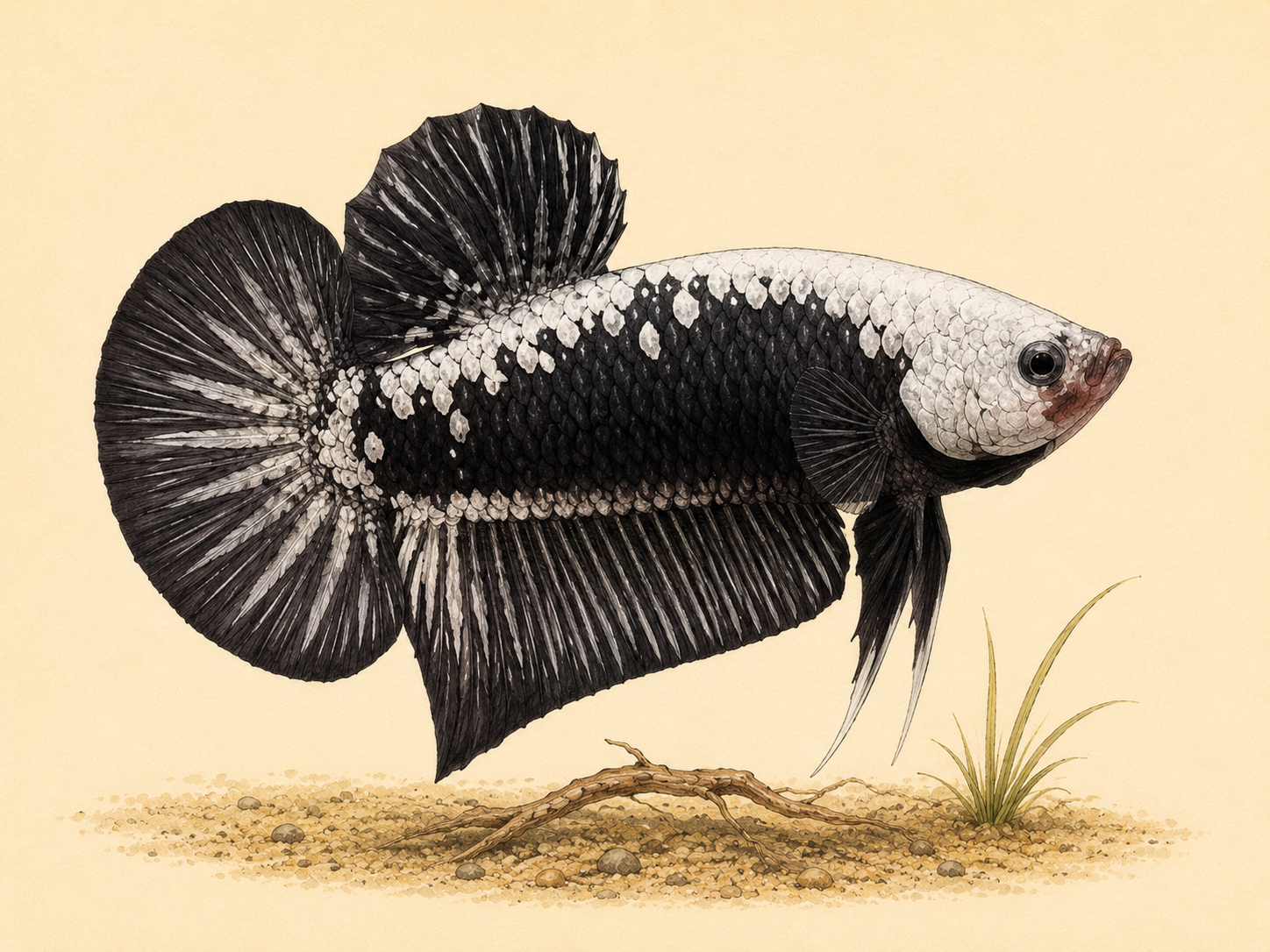
The Samurai Betta is one of the most visually dramatic colour pattern variants of the domestic Betta splendens, prized for its bold, high-contrast appearance that evokes the striking aesthetics of traditional Japanese samurai armour. Characterised by a dark – often black or deep metallic – body paired with strongly contrasting white or pale fins, and sometimes featuring dark banding across the fin rays, the Samurai Betta commands attention in any aquarium. This is purely a colour and pattern classification, entirely separate from tail-shape categories such as halfmoon, plakat, or crowntail, meaning Samurai patterning can appear across a range of fin types.
As a variant of Betta splendens, the Samurai Betta shares the same fundamental care requirements as any domestic betta. For a thorough grounding in baseline betta husbandry – including cycling, general temperament, and core water chemistry – please refer to our comprehensive Betta Fish Care Guide. This guide focuses specifically on what sets the Samurai Betta apart: the genetics and maintenance of its distinctive colouration, the particular challenges of preserving high-contrast patterning, selection considerations when purchasing, and breeding strategies aimed at producing quality Samurai offspring.
The Samurai Betta has risen in popularity among betta enthusiasts and collectors who value bold pattern definition over iridescence or pastel tones. Because the pattern relies on a precise interplay of dark pigmentation and pale, near-white fin tissue, maintaining the clarity and vibrancy of this contrast requires some additional attention to water quality, diet, and stress management that goes beyond standard betta keeping. This guide will walk you through every aspect of Samurai Betta care with that specific focus in mind.
Quick Stats
| Scientific name | Betta splendens var. Samurai |
| Common names | Samurai Betta, Samurai Fighter, Black Samurai Betta, Dragon Samurai Betta |
| Family | Osphronemidae |
| Origin | Selectively bred variant; ancestral range Southeast Asia (Thailand, Cambodia, Laos, Vietnam) |
| Adult size | 6 – 7.5 cm |
| Lifespan | 2 – 4 years |
| Difficulty | Moderate |
| Breeding difficulty | Difficult |
| Temperature | 24 – 28 °C |
| pH range | 6.0 – 7.5 |
| General hardness (GH) | 3 – 12 dGH |
| Carbonate hardness (KH) | 2 – 8 dKH |
| Minimum tank size | 20 litres |
| Conservation status | Not Evaluated (captive-bred variant; wild Betta splendens is Vulnerable per IUCN) |
Appearance
The defining hallmark of the Samurai Betta is its dramatic two-tone contrast between body and fins. The body is typically a deep, saturated black or near-black shade, sometimes carrying a dark metallic sheen that can appear gunmetal, deep blue-black, or even dark bronze depending on the specific lineage. This dark body pigmentation is dense and opaque, covering the scales uniformly and extending across the head, gill plates, and often the pectoral fins.
The fins present a stark contrast, displaying white, cream, or very pale silvery colouration. In high-quality specimens, the transition from dark body to pale fins is sharp and well-defined, with minimal bleed or muddying at the boundary. Many Samurai Bettas also exhibit dark banding or striping across the fin rays, where the dark body pigment extends outward along the ray structures while the membrane between rays remains pale. This banding effect is a key distinguishing feature and strongly contributes to the “armoured” look that gives the variant its name.
The overall impression is of a fish wearing dark plate armour with contrasting pale fabric or silk visible between the plates – a visual metaphor that has made this variant extremely popular among collectors who appreciate clean, geometric patterning. The intensity of the contrast can vary considerably between individuals. Show-quality Samurai Bettas will have near-black bodies with crisp white fins and clearly defined banding, while lower-grade specimens may show greyish bodies, yellowish fin tinting, or poorly defined pattern boundaries.
Samurai patterning exists independently of tail type, so you may encounter Samurai Halfmoons, Samurai Plakats, Samurai Crowntails, and other combinations. The plakat (short-finned) form is particularly popular in the Samurai pattern, as the shorter fins tend to display the banding pattern more crisply, and the compact, muscular body shape reinforces the martial aesthetic. Long-finned variants can be equally striking but may show slightly softer pattern definition due to the greater expanse of fin membrane.
It is worth noting that the Samurai pattern can sometimes be confused with or overlap with Dragon scaling, where thick, opaque white or metallic scales cover the body. In true Samurai Bettas, the contrast runs in the opposite direction – the body is dark and the fins are pale – whereas Dragon Bettas typically have pale or metallic scaling on the body with coloured fins. Some breeders have crossed these lines to produce “Dragon Samurai” fish, which combine elements of both patterns, though purists tend to keep the classifications separate.
One important consideration specific to the Samurai Betta’s appearance is colour stability. The dark body pigmentation can fade or shift if the fish is stressed, unwell, or kept in suboptimal water conditions. Pale, washed-out body colour in a Samurai Betta is almost always a sign that something in the fish’s environment or health needs attention. Conversely, the pale fins can develop yellowish discolouration or dark smudging if water quality deteriorates, particularly if ammonia or nitrite levels creep above zero. Maintaining the crisp, high-contrast look that defines this variant therefore demands consistently excellent husbandry.
Varieties and Morphs
Because the Samurai designation refers specifically to a colour and pattern trait rather than a fin shape, it can be combined with virtually any tail type to create distinct sub-varieties. The most commonly encountered combinations include:
Samurai Plakat (HMPK Samurai): This is arguably the most iconic form of the Samurai Betta. The short, robust finnage of the plakat tail type displays the dark banding across the fin rays with exceptional clarity, and the compact body shape lends the fish an athletic, powerful appearance that complements the samurai theme perfectly. Halfmoon plakat (HMPK) Samurais, with their 180-degree tail spread and short fins, are particularly sought after in competitions and among collectors.
Samurai Halfmoon: The long, flowing fins of the halfmoon tail create a more dramatic canvas for the pale fin colouration and dark banding. While the extended fin membrane can sometimes soften the crispness of the banding pattern, high-quality Samurai Halfmoons are breathtaking fish. The greater fin area also means these fish are more susceptible to fin damage, which is particularly noticeable against the pale fin background.
Samurai Crowntail: The reduced webbing between fin rays in crowntail bettas creates a unique interaction with the Samurai pattern, as the dark ray extensions become more prominent against the reduced pale membrane. This produces a spiky, aggressive-looking fish that is quite distinct from other Samurai tail types.
Dragon Samurai: A crossover variant that combines the thick, opaque scaling associated with the Dragon gene with the dark body and pale fin contrast of the Samurai pattern. These fish often display a complex layered appearance, with metallic or white Dragon scaling visible on parts of the body alongside the deep black Samurai base. Dragon Samurai Bettas can be visually stunning but are associated with a higher risk of diamond eye – a condition where the opaque scaling grows over the eyes, impairing vision – due to the Dragon gene’s influence.
Blue Samurai / Steel Samurai: Variants where the dark body pigment carries a noticeable blue or steel-blue metallic sheen rather than pure black. These are sometimes considered a separate sub-class by breeders, as the blue iridescence adds another dimension to the fish’s appearance while retaining the core Samurai contrast pattern.
Copper Samurai: A less common variant where the dark body has a coppery or warm metallic undertone. These fish can be particularly striking under certain lighting conditions, though achieving a clean contrast with the pale fins is more challenging when the body carries warm tones.
When selecting a Samurai Betta, look for sharp, well-defined contrast between the dark body and pale fins, consistent body pigmentation without patchy areas, clean white or near-white fins free of yellowish tinting, and clearly visible banding across the fin rays. The overall symmetry and density of the pattern are typically the most important quality indicators for this variant.
Natural Habitat
As a selectively bred colour variant, the Samurai Betta does not exist in the wild. Its ancestor, Betta splendens, is native to the shallow, slow-moving waters of Southeast Asia, particularly Thailand, Cambodia, Laos, and Vietnam. Wild bettas inhabit rice paddies, shallow ponds, drainage ditches, floodplain margins, and slow streams, often in waters with dense vegetation, leaf litter, and relatively low dissolved oxygen levels. This is the ecological context in which the betta’s labyrinth organ evolved, allowing the fish to breathe atmospheric air at the surface.
Wild Betta splendens bears little visual resemblance to the Samurai Betta. Wild fish are typically short-finned with muted green, brown, and red colouration that provides camouflage among vegetation and tannin-stained water. The dramatic black-and-white contrast of the Samurai pattern is entirely a product of selective breeding, developed by breeders primarily in Thailand and other Southeast Asian countries who have spent decades refining melanistic body colouration alongside leucistic or near-white fin traits.
Understanding the wild habitat remains relevant to Samurai Betta care because the fish retains all of the physiological and behavioural adaptations of its wild ancestors. The preference for warm, slightly acidic to neutral water, the need for surface access for labyrinth breathing, the territorial aggression of males, and the preference for densely planted environments with plenty of cover all stem directly from the species’ natural ecology. Replicating elements of this habitat – particularly the inclusion of live plants, subdued lighting, and gentle water flow – benefits the Samurai Betta just as it does any other Betta splendens variant.
One habitat consideration that is especially pertinent to the Samurai Betta is the role of tannins in the water. Wild betta habitats are often rich in tannins released from decaying leaves and wood, which give the water a characteristic amber tint and mildly lower pH. While tannins are generally beneficial for betta health due to their mild antifungal and antibacterial properties, heavily tannin-stained water can alter the visual appearance of the Samurai Betta’s pale fins, making them appear yellowish or amber-tinted rather than the clean white that defines the pattern. Keepers who prioritise the crisp visual contrast of the Samurai pattern may therefore choose to use tannin sources sparingly or filter through activated carbon to maintain water clarity, balancing aesthetic preferences with the health benefits of a botanically enriched environment.
Tank Size and Setup
The minimum recommended tank size for a single Samurai Betta is 20 litres, though a tank of 30 to 40 litres or larger will provide a noticeably better environment and make it easier to maintain the stable water conditions that this variant’s colouration demands. Larger volumes offer greater stability in temperature and water chemistry, which directly supports the vibrancy and contrast of the Samurai pattern.
When setting up a tank for a Samurai Betta, substrate choice deserves particular consideration. A dark substrate – such as black sand or dark gravel – will complement and enhance the fish’s appearance by providing a backdrop that makes both the dark body and pale fins stand out. Pale or brightly coloured substrates can wash out the visual impact of the fish and may also reflect light upward in a way that can stress the fish, as bettas generally prefer subdued lighting conditions reminiscent of their heavily vegetated wild habitats.
Live plants are highly recommended and serve multiple functions in a Samurai Betta tank. They provide visual barriers and resting spots, help maintain water quality by absorbing nitrates, and create the naturalistic environment that bettas find most comfortable. Broad-leaved plants such as Anubias species are particularly beneficial, as bettas frequently rest on or near broad leaves close to the water surface. Java fern, cryptocorynes, and floating plants like Salvinia or Amazon frogbit are all excellent choices. Floating plants are especially valuable as they diffuse overhead light, which reduces stress and can help the dark body pigmentation of a Samurai Betta appear richer and more saturated.
Hardscape elements such as driftwood and smooth stones can be used to create caves and sheltered areas. Avoid sharp or rough decorations that could tear the betta’s fins, as damage to the pale fins of a Samurai Betta is particularly conspicuous and can take weeks to heal. If using driftwood, be aware that it will release tannins into the water, which may tint the pale fins over time. This is not harmful but may reduce the visual crispness of the Samurai contrast pattern.
A secure lid is essential, as bettas are capable jumpers. Ensure there is a small gap between the water surface and the lid to allow the fish to access atmospheric air through its labyrinth organ. The water level should be kept a few centimetres below the rim to provide this access while preventing escapes.
Lighting should be moderate. Intense lighting can cause the fish to appear washed out and may encourage excessive algae growth, which can coat surfaces and degrade the overall tank aesthetic. A planted tank light on a timer set for 8 to 10 hours daily will typically support plant growth without overstressing the fish. Some keepers of Samurai Bettas find that slightly cooler-toned (6500K) lighting best showcases the contrast between the black body and white fins, while warmer lighting can make the pale fins appear more cream or ivory.
Water Parameters
| Temperature | 24 – 28 °C |
| pH | 6.0 – 7.5 |
| General hardness (GH) | 3 – 12 dGH |
| Carbonate hardness (KH) | 2 – 8 dKH |
| Ammonia | 0 ppm |
| Nitrite | 0 ppm |
| Nitrate | Below 20 ppm |
While the acceptable parameter ranges for a Samurai Betta are identical to those of any Betta splendens, the visual nature of this variant means that suboptimal water quality manifests more obviously. The dark body pigmentation of a Samurai Betta is one of the first things to suffer when conditions deteriorate – the fish will appear grey, faded, or patchy rather than the deep, saturated black that characterises a healthy specimen. Similarly, the pale fins can develop a yellowish or brownish tinge when exposed to elevated nitrate levels or poor water quality over time.
Maintaining ammonia and nitrite at absolute zero is non-negotiable, as with all bettas, but keepers of Samurai Bettas have an additional visual incentive to keep nitrates as low as possible. Weekly water changes of 20 to 30 per cent are the standard recommendation, but in smaller tanks or those without live plants to absorb nitrates, more frequent changes may be necessary to keep nitrates comfortably below 20 ppm.
Temperature stability is particularly important. Fluctuations of more than 2 degrees Celsius within a 24-hour period can trigger stress responses that dull the fish’s colouration. A reliable, adjustable heater rated for the tank volume is essential, and a separate thermometer should be used to verify the heater’s accuracy. The ideal range of 25 to 27 degrees Celsius will keep the fish’s metabolism, immune system, and colour expression at their best.
Water chemistry within the slightly acidic to neutral range (pH 6.5 to 7.0) tends to produce the most vibrant colouration in Samurai Bettas, though they will tolerate the full range listed above without issue. Avoid sudden pH shifts, which can stress the fish and compromise its immune system. If your tap water has a high or fluctuating pH, consider using a remineralised reverse osmosis water mix for water changes to provide a stable, consistent environment.
Filtration and Equipment
Filtration for a Samurai Betta should prioritise gentle flow and excellent biological filtration capacity. Sponge filters are the most popular choice for betta tanks, providing effective biological and mechanical filtration without creating the strong currents that can stress bettas and damage their fins. For Samurai Bettas with longer finnage (halfmoon, rosetail), a sponge filter is almost always the best option. For short-finned Samurai Plakats, a small hang-on-back filter with an adjustable flow rate or a baffled output can also work well.
One filtration consideration specific to the Samurai Betta’s aesthetics is the use of activated carbon or chemical filtration media. If you wish to maintain the cleanest possible pale fin appearance, running activated carbon in your filter will help remove dissolved organic compounds and tannins that could otherwise tint the fins. However, carbon also removes beneficial tannins and some medications, so its use should be balanced against other husbandry goals. Many keepers run carbon for a few days after water changes or driftwood additions, then remove it during normal operation.
A heater is essential unless you live in a tropical climate where ambient room temperature consistently stays within the 24 to 28 degree Celsius range. Adjustable heaters are preferable to preset models, as they allow fine-tuning to the optimal temperature for colour expression. For tanks of 20 to 40 litres, a 25 to 50 watt heater is typically sufficient. Always use a heater guard if the betta is likely to rest against it, as contact burns can cause unsightly damage to the dark body scales.
An LED light suitable for planted tanks is recommended. As noted in the tank setup section, the colour temperature of the light can influence the perceived appearance of the Samurai pattern, so experimenting with different settings (if your light allows it) can help you find the most flattering illumination for your particular fish.
An air pump is not strictly necessary if using a sponge filter (which is typically air-driven) or if the tank has adequate surface agitation from the filter output. However, in warm weather when water temperatures may rise and dissolved oxygen decreases, supplemental aeration can be beneficial. The betta’s labyrinth organ provides a safety net for low-oxygen conditions, but well-oxygenated water supports overall health and colour vibrancy.
Diet and Feeding
The Samurai Betta’s diet follows the same carnivorous principles as all Betta splendens, but the specific nutritional requirements for maintaining intense dark pigmentation and clean white fin colouration are worth understanding in detail.
A high-quality betta pellet should form the staple diet. Look for pellets where whole fish, fish meal, or insect meal is the first ingredient, and that contain a crude protein content of at least 40 per cent. Feed two to four appropriately sized pellets twice daily – a betta’s stomach is roughly the size of its eye, so portion control is critical. Overfeeding leads to obesity, bloating, and excess waste that degrades water quality, all of which will dull the Samurai Betta’s appearance.
To support the rich melanin-based pigmentation of the Samurai Betta’s body, ensure the diet includes natural colour-enhancing ingredients. Foods containing astaxanthin, spirulina, and carotenoids can support overall pigment intensity. While these compounds are most commonly associated with enhancing red and orange colouration, they contribute to general skin and scale health, which in turn supports the density and saturation of dark pigmentation. Some breeders of dark-bodied bettas report that diets rich in varied protein sources produce better colour depth than single-source diets.
Supplementary live or frozen foods are highly beneficial and should be offered two to three times per week. Bloodworms, daphnia, brine shrimp, and mosquito larvae are all excellent choices. These foods provide nutritional variety, stimulate natural hunting behaviour, and are generally associated with better overall health and colour compared to pellet-only diets. Frozen foods are a convenient and safe alternative to live foods, which can occasionally introduce parasites if sourced from unreliable suppliers.
A weekly fasting day is recommended to support digestive health and reduce the risk of bloating and constipation. Samurai Bettas, like all bettas, have short digestive tracts that benefit from periodic rest. If the fish shows signs of bloating, withholding food for 24 to 48 hours and then offering a small amount of daphnia (which has a mild laxative effect) is a standard remedy.
Avoid freeze-dried foods as a primary diet component, as they can cause digestive issues if not pre-soaked. If using freeze-dried bloodworms or brine shrimp as occasional treats, soak them in a small amount of tank water for five to ten minutes before feeding to allow them to rehydrate and reduce the risk of internal expansion.
Behaviour and Temperament
The Samurai Betta’s behaviour is consistent with standard Betta splendens temperament, though some keepers and breeders note subtle behavioural tendencies in plakat-type Samurai Bettas that may relate to their closer genetic proximity to fighting lines. Plakat Samurais, in particular, can be notably more active, assertive, and aggressive than their long-finned counterparts, which is worth bearing in mind when considering tank mates.
Males are territorial and will aggressively defend their chosen area against other male bettas and any fish they perceive as a rival. This aggression is triggered by bright colours and flowing fins in conspecifics, and the Samurai Betta’s high-contrast appearance can occasionally elicit aggressive responses from other species that might otherwise ignore a more subtly coloured fish. Conversely, the Samurai Betta itself may flare more readily at its own reflection or at brightly coloured tank mates due to the heightened visual contrast in its environment.
Flaring behaviour – where the betta extends its gill covers and spreads its fins to appear larger – is a normal part of betta behaviour and can actually be beneficial in small doses, as it provides exercise and allows the keeper to inspect the fish’s fins and body for damage or disease. In Samurai Bettas, flaring is particularly dramatic due to the stark contrast between the dark body and pale fins that become visible when fully extended. Brief flaring sessions using a mirror (limited to one to two minutes, no more than once or twice a week) can be used to encourage exercise and display behaviour without causing chronic stress.
Samurai Bettas are generally curious and interactive fish that will learn to recognise their keeper and respond to feeding routines. They often develop preferences for particular resting spots – typically near the water surface on plant leaves or inside sheltered areas – and may patrol their territory methodically throughout the day. Activity levels tend to be highest during the first hour after the lights come on and in the period before feeding times.
Stress responses in Samurai Bettas are visually obvious. A stressed fish will display faded body colour (shifting from deep black to grey), clamped fins, reduced activity, and loss of appetite. Because the colour change is so dramatic in this variant, it serves as an excellent early warning system for environmental problems. If your Samurai Betta suddenly appears grey or washed-out, investigate water parameters, temperature, and potential stressors immediately.
Tank Mates
While Samurai Bettas can be kept in community settings, their bold appearance and assertive temperament require careful consideration when selecting companions. The high-contrast colouration of a Samurai Betta may attract more attention from fin-nipping species than a more subtly coloured betta would, and the conspicuous pale fins are particularly vulnerable to nipping damage that would be both harmful and aesthetically devastating. Tank mates should be peaceful, non-fin-nipping, and not so colourful or large-finned that they trigger territorial aggression from the betta.
Good tank mates
- Ember Tetra – A tiny, peaceful schooling fish whose small size and warm orange colouration pose no threat and are unlikely to trigger betta aggression.
- Pygmy Corydoras – Bottom-dwelling and unobtrusive, these diminutive catfish occupy a completely different zone and are too small to be perceived as rivals.
- Amano Shrimp – Hardy enough to coexist with most bettas and too large to be easily eaten, they also serve as effective algae cleaners.
- Chili Rasbora – Extremely small and peaceful, these tiny rasboras are fast enough to avoid an inquisitive betta and add gentle movement to the mid-water column.
- Malaysian Trumpet Snail – A burrowing snail that helps aerate the substrate and is largely ignored by bettas due to its small size and nocturnal habits.
- Kuhli Loach – A peaceful, nocturnal bottom-dweller that stays hidden during the day and occupies a completely separate niche from the betta.
- Ramshorn Snail – A hardy snail species that contributes to algae control and is generally tolerated by bettas without issues.
- Celestial Pearl Danio – A small, beautifully patterned fish that is peaceful enough to coexist with bettas in a well-planted tank with sufficient hiding spots.
Fish to avoid
- Tiger Barb – A notorious fin-nipper that will relentlessly target the Samurai Betta’s flowing pale fins, causing severe damage and stress.
- Male Guppy – The flowing, brightly coloured tails of male guppies are frequently mistaken for rival male bettas, triggering persistent aggression.
- Paradise Fish – A fellow labyrinth fish with strong territorial instincts that will inevitably clash with a betta in confined quarters.
- Chinese Algae Eater – Becomes aggressive and territorial with age and has a tendency to latch onto the sides of slow-moving fish, damaging scales and slime coat.
- Convict Cichlid – Far too aggressive and territorial for a betta tank, and will easily outcompete and injure a Samurai Betta.
- Red Tail Shark – Highly territorial and aggressive towards fish that enter its space, posing a constant threat to a slow-moving betta.
- Serpae Tetra – Known for persistent fin-nipping behaviour, especially towards long-finned or slow-moving species, making them a poor choice.
- Dwarf Gourami – Another labyrinth fish that occupies the same water column niche and can lead to territorial disputes and stress for both species.
Breeding
Breeding Samurai Bettas is rated as difficult, not because the mechanics of betta breeding differ from standard Betta splendens, but because consistently producing offspring with the desired high-contrast Samurai pattern is a significant genetic challenge. The Samurai pattern involves multiple genetic factors controlling melanin distribution, leucistic fin colouration, and the distinctive banding across fin rays, and these traits do not always combine predictably in offspring.
Selecting breeding pairs is the most critical step. Both the male and female should display strong Samurai characteristics – dense, uniform dark body colouration and clean, well-contrasted pale fins. Females of the Samurai pattern exist but are typically less dramatic in appearance than males, with shorter fins and sometimes less defined pattern boundaries. Look for females with deep black body colour and pale fin edges, as these traits suggest strong Samurai genetics even if the full pattern expression is subdued.
The breeding process follows the standard betta bubble nest method. Condition both fish with high-quality live and frozen foods for two to three weeks before introduction. Set up a dedicated breeding tank of at least 20 litres with a heater set to 27 degrees Celsius, very gentle or no filtration, and floating plants or a foam cup cut in half to encourage bubble nest construction. The water level should be lowered to approximately 12 to 15 centimetres to reduce the distance fry must travel to reach the surface for air.
Introduce the female in a clear container within the breeding tank to allow the pair to see each other without physical contact. The male should begin building a bubble nest within 24 to 48 hours if he is receptive. When the female displays vertical breeding bars on her body and appears receptive (approaching the male’s side of the container rather than retreating), release her into the tank. Monitor the pair closely during spawning, as the male’s embrace can be rough. Remove the female immediately after spawning is complete, as the male will guard the nest aggressively and may injure her.
The male will tend the eggs and developing fry for approximately 48 to 72 hours until they become free-swimming. At this point, remove the male to prevent him from eating the fry. Initial feeding should consist of infusoria or commercially available liquid fry food for the first few days, transitioning to freshly hatched baby brine shrimp once the fry are large enough to consume them.
The genetic outcome of Samurai pairings is variable. A well-matched Samurai-to-Samurai cross may produce a proportion of offspring with the desired pattern, but many fry will show intermediate or non-Samurai colouration. Selective culling (rehoming fish that do not display the target pattern) is a normal part of the process for breeders working to refine the Samurai line. Multiple generations of selective breeding are typically required to achieve consistent, high-quality Samurai patterning in a majority of offspring.
A particular challenge in Samurai breeding is the potential for the Dragon gene to infiltrate the line, especially in Dragon Samurai crosses. While this can produce visually impressive fish, the Dragon gene carries the risk of diamond eye (where opaque scaling grows over the cornea, impairing or eliminating vision). Breeders should be aware of this risk and avoid pairing two heavy-Dragon individuals if they wish to minimise the incidence of diamond eye in their fry.
Common Diseases
Samurai Bettas are susceptible to the same diseases as all Betta splendens, but their distinctive colouration provides some unique diagnostic advantages and challenges. The high-contrast pattern makes certain conditions more visible at an early stage, while others may be masked