Quick summary
The Spadetail Betta is an easy-to-keep, hardy variant suited to beginners, needing just a 20 litre (ideally 30+) heated, filtered tank and standard betta care. Its streamlined, less voluminous tail makes it a stronger swimmer and somewhat less prone to fin rot than Halfmoons or Veiltails, though males must always be housed alone and it can be harder to find than more common betta varieties.
🐠 Build a tank around this species
In this guide:
- Introduction
- Quick Stats
- Appearance
- Varieties and Morphs
- Natural Habitat
- Tank Size and Setup
- Water Parameters
- Filtration and Equipment
- Diet and Feeding
- Behaviour and Temperament
- Tank Mates
- Breeding
- Common Diseases
Introduction
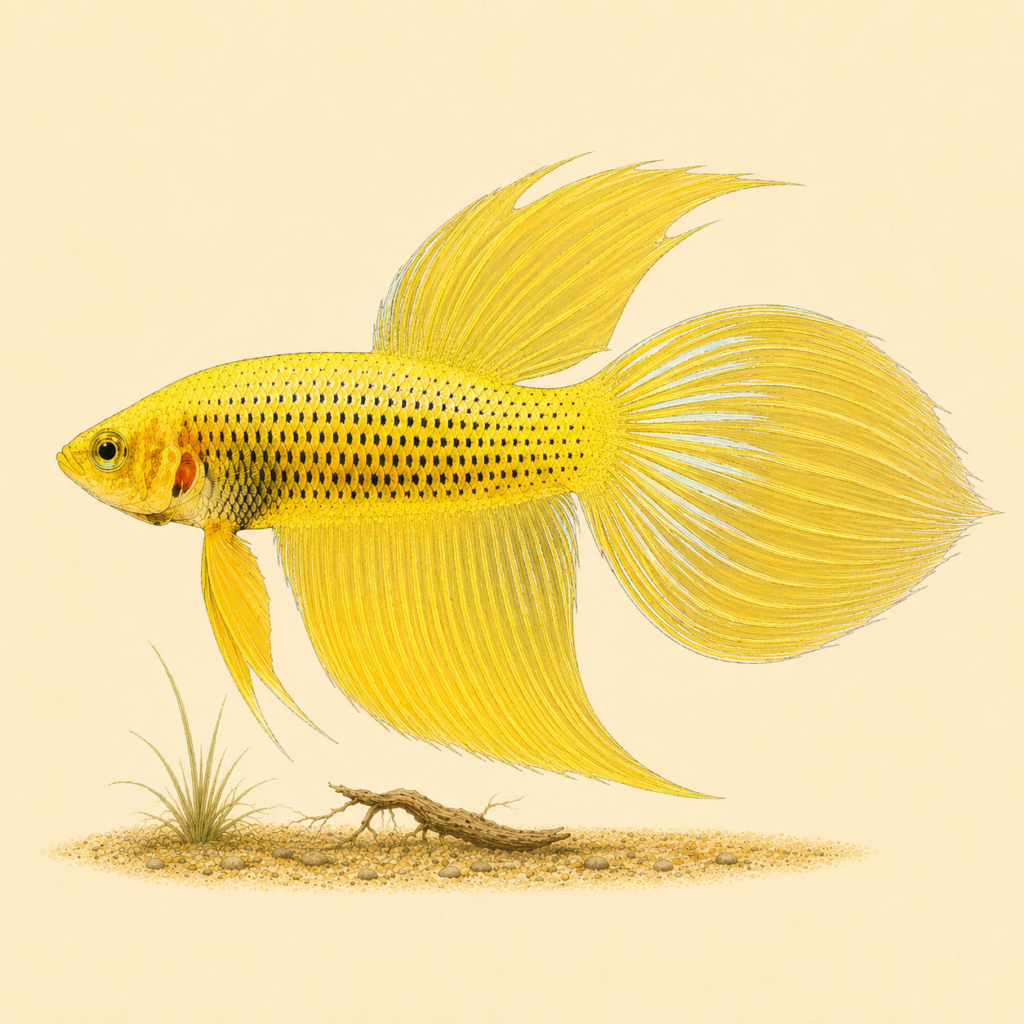
The Spadetail Betta is a distinctive tail-type variant of Betta splendens, the domesticated Siamese fighting fish that has captivated aquarists for well over a century. Among the many tail forms selectively bred from the species – including the flamboyant Halfmoon, the theatrical Crowntail, and the flowing Veiltail – the Spadetail occupies a quieter, more understated position. Its defining characteristic is a caudal fin with a broad base that tapers symmetrically to a single, clean point, producing a silhouette reminiscent of a garden spade or the suit of spades on a playing card. This elegant, geometric shape sets it apart from most other betta varieties, which tend to prioritise fullness, spread, or dramatic ray extensions.
Because the Spadetail is a colour and finnage variant rather than a separate species, its fundamental care requirements – water chemistry, diet, housing philosophy, and general health management – are shared with all domestic Betta splendens. For a thorough grounding in baseline betta husbandry, readers are encouraged to consult the main Betta Fish Care Guide. This guide will cover all the same sections in full but will place its emphasis squarely on what makes the Spadetail distinctive: its fin morphology, the practical implications of that fin shape for swimming ability, disease susceptibility, tank design, and breeding, as well as its relative rarity in the hobby and the specific considerations that come with keeping a less common variant.
The Spadetail is not as widely available as Halfmoons, Crowntails, or Veiltails, and this scarcity is part of its appeal for enthusiasts who appreciate a more refined, less ostentatious aesthetic. Its pointed tail gives it a somewhat wild, torpedo-like profile that recalls the body plan of wild-type Betta splendens more closely than the exaggerated finnage of many modern show bettas. This also means the Spadetail tends to be a stronger, more agile swimmer than its heavily finned counterparts – a practical advantage that influences tank setup, tank mate selection, and overall quality of life.
Quick Stats
| Scientific name | Betta splendens var. Spadetail |
|---|---|
| Common names | Spadetail Betta, Spade Tail Betta, Pointed Tail Betta |
| Family | Osphronemidae |
| Origin | Thailand, Laos, Cambodia, Vietnam, Myanmar |
| Adult size | 7 cm |
| Lifespan | 3–5 years |
| Difficulty | Easy |
| Breeding difficulty | Moderate |
| Temperature | 24–30 °C |
| pH | 6–8 |
| GH | 1–15 dGH |
| KH | 2–8 dKH |
| Minimum tank size | 45 L |
| Conservation status | Vulnerable (IUCN, wild Betta splendens) |
Appearance
The Spadetail Betta’s most immediately recognisable feature is, of course, its caudal fin. Unlike the round, 180-degree spread of a Halfmoon or the ragged, spiked extensions of a Crowntail, the Spadetail’s caudal fin fans out from a wide base and then converges smoothly to a single distinct point. When the fish is at rest or swimming calmly, the tail may appear roughly diamond-shaped or leaf-like; when flared, the broad base becomes more apparent, but the defining point at the tip remains. The symmetry of this taper is a key quality marker – a well-bred Spadetail will have even, balanced edges leading to a clean central point rather than a ragged or off-centre tip.
The overall body shape of the Spadetail is consistent with other domestic Betta splendens: a laterally compressed, elongated body with an upturned mouth adapted for surface feeding and labyrinth breathing. The dorsal and anal fins in Spadetails tend to be proportionate and moderate in length, complementing the pointed tail rather than overwhelming it. In some specimens, the anal fin may also show a slight taper, echoing the spade motif, though this is not a defining breed standard and varies between individuals.
Because the Spadetail’s finnage is less voluminous than that of Halfmoons, Rosetails, or even standard Veiltails, the fish tends to look more streamlined and athletic. The reduced fin mass means the body proportions are more visible, and a healthy Spadetail should display a smooth, muscular profile without visible pinching behind the head or a distended belly. The overall impression is one of understated elegance rather than dramatic spectacle.
Spadetails are available in the full spectrum of Betta splendens colour genetics. Solid colours – royal blue, turquoise, red, black, white (opaque), yellow, and orange – are all encountered, as are bi-colour and multi-colour patterns. Marble patterning, butterfly patterns (where the body and fin base are one colour and the fin edges another), and metallic or dragon-scale overlays can all appear in Spadetail lines. However, because the Spadetail is a less commercially prominent variety, the range of colours readily available at any given time tends to be narrower than for Halfmoons or Plakats. Breeders who specialise in Spadetails often focus on clean, solid colours or classic bi-colours that complement the geometric fin shape.
Sexual dimorphism follows the standard betta pattern. Males are larger, more vividly coloured, and have longer, more developed finnage. Females have shorter fins – including the caudal – and while the spade shape may still be discernible, it is typically less pronounced. Females also tend to show a visible ovipositor (egg spot) near the ventral fins and have a slightly rounder body profile.
Varieties and Morphs
The Spadetail is itself a finnage morph of Betta splendens, and within this tail type, variation comes primarily from colour genetics and scale type rather than further fin subdivisions. That said, there are a few distinctions worth noting for hobbyists interested in this variant.
The most important visual variable is the sharpness and symmetry of the spade point. Show-quality Spadetails have a crisply defined, centrally located point with smoothly tapering edges and no splits, tears, or asymmetrical notching. Pet-quality Spadetails may have a softer or slightly rounded point, or edges that are mildly uneven. Some fish sold as Spadetails may in fact be “round tails with a point” – fish whose caudal fin is predominantly circular but has a slight extension at the centre. Purists distinguish between a true Spadetail (where the taper is a defining structural feature of the fin) and a Round Tail that merely happens to have a pointed tip.
Colour morphs within the Spadetail type mirror the broader betta colour palette. Metallic and dragon-scale Spadetails, where thick, iridescent scales overlay the body and sometimes extend onto the fin rays, create a striking combination with the geometric tail shape. Koi-patterned and marble Spadetails are occasionally produced but are less predictable in breeding programmes due to the transposon (jumping gene) nature of the marble gene, which causes colour patterns to shift over the fish’s lifetime.
Crosses between Spadetails and other tail types can produce intermediate forms. A Spadetail bred with a Halfmoon may yield offspring with a rounded tail that has a mild central point, or fish with a broader spread than a typical Spadetail but without the full 180-degree Halfmoon fan. These intermediates are generally not considered desirable by Spadetail breeders, who aim to preserve and refine the clean spade geometry, but they can appear in mixed breeding programmes or in fish sold without strict lineage records.
Plakat (short-finned) Spadetails do exist, though they are rare. In these fish, the caudal fin is short but still displays the characteristic taper to a point. The visual effect is quite different from a long-finned Spadetail – more compact and aggressive-looking – and these fish tend to be exceptionally strong swimmers.
Natural Habitat
As a selectively bred domestic variant, the Spadetail Betta does not occur in the wild. Its ancestor, wild-type Betta splendens, is native to the shallow, slow-moving, and often stagnant freshwater habitats of mainland Southeast Asia, particularly Thailand (where the species has deep cultural significance), Laos, Cambodia, Vietnam, and parts of Myanmar and Malaysia. Wild bettas inhabit rice paddies, roadside ditches, floodplain pools, marshes, and the margins of slow streams – environments characterised by warm temperatures, soft to moderately hard water, abundant vegetation, and often low dissolved oxygen levels.
Understanding this ancestral habitat is relevant to Spadetail care because the variant’s fin shape is, in some respects, closer to the wild-type caudal profile than many other domestic forms. Wild Betta splendens have relatively short, rounded to slightly pointed tails that allow efficient movement through dense vegetation and shallow water. The Spadetail’s tapered fin, while longer and more exaggerated than a wild betta’s, retains more of this functional hydrodynamic shape than the broad, heavy fins of Halfmoons or the trailing curtains of Veiltails. This connection to the wild form gives the Spadetail a slight practical edge in navigating planted aquariums and coping with mild currents.
The wild habitats of Betta splendens are typically acidic to neutral (pH 5.0 – 7.0), warm (25 – 30 °C), and soft. The water is often tannin-stained from decomposing leaf litter, giving it a tea-brown colour. Dense marginal vegetation, floating plants, and submerged roots provide cover and territorial boundaries. These conditions can be replicated in the aquarium using Indian almond leaves, driftwood, and dense planting – an approach that suits the Spadetail well and can enhance the fish’s colour and behaviour.
Tank Size and Setup
The minimum recommended tank size for a single Spadetail Betta is 20 litres, though 30 litres or more is preferable and provides a noticeably better quality of life. The Spadetail’s relatively streamlined fin shape means it is a more active and capable swimmer than heavily finned varieties, and it will make good use of additional horizontal swimming space. A 40- to 60-litre tank allows for a more interesting aquascape and a small community of compatible invertebrates or peaceful nano fish, which can make for a far more engaging display.
Tank shape matters. Long, shallow tanks are preferable to tall, narrow ones because bettas are labyrinth breathers that must periodically visit the surface to gulp air. A tank that is excessively deep forces the fish to expend more energy travelling to and from the surface. For a Spadetail, a water depth of 20 to 30 cm is comfortable.
Aquascaping for a Spadetail should prioritise cover, visual barriers, and resting spots. Live plants are ideal: species such as Anubias, Java fern (Microsorum pteropus), Cryptocoryne species, and floating plants like Amazon frogbit (Limnobium laevigatum) or red root floaters (Phyllanthus fluitans) all work well. Floating plants are particularly beneficial as they diffuse overhead light (which bettas can find stressful in bare tanks), provide a surface for bubble nests, and create a sense of security. Driftwood, smooth stones, and ceramic caves or coconut shell hides offer additional shelter.
One advantage of the Spadetail’s fin type is that its pointed, less voluminous tail is less prone to snagging on rough decor than the flowing fins of Halfmoons or Veiltails. However, sharp edges, rough resin ornaments, and plastic plants with hard edges should still be avoided. If in doubt, run a pair of tights over any decor item – if the fabric catches or tears, the decoration could damage a betta’s fins.
A tight-fitting lid or cover glass is essential. Bettas are capable jumpers, and the Spadetail’s stronger swimming ability can make it more likely to clear the water surface than a heavily finned betta that is weighed down by its fins. A small gap should be left between the water surface and the lid to allow access to atmospheric air.
Substrate choice is flexible. Fine gravel or sand both work well. Dark substrates tend to bring out richer colours in bettas and create a more natural-looking environment. Bare-bottom tanks are functional for breeding and hospital setups but are less aesthetically pleasing and can make the fish feel exposed.
Water Parameters
| Temperature | 24–30 °C |
| pH | 6.0–8.0 |
| General hardness (GH) | 1–15 dGH |
| Carbonate hardness (KH) | 2 – 8 dKH |
| Ammonia | 0 ppm |
| Nitrite | 0 ppm |
| Nitrate | Below 20 ppm |
The Spadetail Betta’s water parameter requirements are identical to those of other domestic Betta splendens variants. Temperature stability is critical – bettas are tropical fish and suffer significant stress, immune suppression, and lethargy when kept below 22 °C. A reliable, adjustable heater is not optional in most climates. The ideal temperature range sits between 24 and 28 °C, with 26 °C being a comfortable middle ground for most setups.
Soft to moderately hard, slightly acidic to neutral water suits the Spadetail best. Many municipal water supplies in the UK fall within an acceptable range, though very hard water areas may benefit from blending tap water with RO (reverse osmosis) water to bring hardness down. The addition of Indian almond leaves, alder cones, or other botanical materials can gently acidify the water and release tannins that have mild antibacterial and antifungal properties – a practice that many betta keepers find beneficial and that mimics the species’ natural blackwater habitats.
Consistency matters more than hitting a precise number. Sudden swings in pH or temperature are far more harmful than being slightly outside the “ideal” range. When performing water changes, new water should be temperature-matched and treated with a dechlorinator. Weekly water changes of 20 – 30% are a good baseline for most setups, adjusted according to tank size, stocking density, and filtration capacity.
One parameter-related consideration specific to the Spadetail – and other less heavily finned bettas – is that these fish can tolerate slightly more water movement than their long-finned counterparts without becoming exhausted. This is not an invitation to create strong currents, but it does mean that filter output does not need to be as aggressively baffled as it might for a Halfmoon or Rosetail. A gentle flow that the Spadetail can comfortably swim against is acceptable and can even provide beneficial exercise.
Filtration and Equipment
Every Spadetail Betta tank requires filtration. The labyrinth organ allows bettas to survive in poorly oxygenated water, but this does not mean they thrive without biological and mechanical filtration to process ammonia and nitrite. A gentle sponge filter powered by an air pump is the classic betta filtration solution – it provides excellent biological filtration, creates minimal current, and is inexpensive to run and maintain. For the Spadetail specifically, the slightly stronger swimming ability means that a small hang-on-back (HOB) filter or internal filter can also be used successfully, provided the outflow is baffled or directed to avoid creating a strong jet. A pre-filter sponge on any intake is advisable to prevent fin damage.
A thermostatically controlled heater is essential in all but the warmest climates. For tanks of 20 – 40 litres, a 25 – 50 watt adjustable heater is usually sufficient. Position the heater near the filter outflow to help distribute warmth evenly, and use a separate thermometer (digital probe or glass alcohol thermometer) to verify the temperature independently of the heater’s built-in thermostat, which can drift over time.
Lighting should be moderate. Bettas do not require intense lighting, and excessively bright overhead light can cause stress, especially in tanks without floating plant cover. A standard LED aquarium light on a timer providing 8 – 10 hours of light per day is appropriate. If live plants are kept, choose a light with a spectrum suitable for plant growth (6500K is a common benchmark), but ensure there are shaded areas in the tank where the fish can retreat.
An air pump is beneficial if using a sponge filter but is not strictly necessary for oxygenation, given the betta’s labyrinth breathing. If an air stone or bubble wall is used for aesthetic reasons, keep the flow gentle – a fine mist of small bubbles is preferable to a violent torrent.
Test kits for ammonia, nitrite, nitrate, and pH are essential equipment for any aquarium. Liquid test kits (such as the API Master Test Kit) are more accurate and cost-effective in the long run than test strips. Regular testing – weekly during stable periods, daily during cycling or after any changes – is the foundation of proactive fishkeeping.
Diet and Feeding
The Spadetail Betta is a carnivore, as are all Betta splendens variants. In the wild, the species feeds on insect larvae, small crustaceans, zooplankton, and terrestrial insects that fall onto the water surface. The domestic Spadetail should be offered a varied, protein-rich diet that reflects these natural preferences.
A high-quality betta-specific pellet should form the staple of the diet. Look for pellets where whole fish, insect meal, or shrimp meal is listed as the first ingredient, and avoid products that lead with fillers such as wheat flour or soy. Pellets designed for bettas are typically small enough for the fish’s upturned mouth and float or sink slowly, suiting surface and mid-water feeding behaviour. Feed two to four pellets per meal, twice daily, adjusting the quantity so that all food is consumed within two minutes.
Variety is important for nutrition and enrichment. Supplement the pellet staple with live, frozen, or freeze-dried foods two to three times per week. Bloodworms (Chironomus larvae), daphnia, brine shrimp (Artemia), mosquito larvae, and tubifex worms are all excellent choices. Live and frozen foods are nutritionally superior to freeze-dried options, which can cause bloating if not pre-soaked. Daphnia is particularly valuable as it contains natural fibre that aids digestion and can help prevent constipation, a common issue in bettas fed exclusively on dry food.
The Spadetail’s more active swimming style compared to heavily finned bettas means it may have a slightly higher metabolic rate and caloric need. Observe the fish’s body condition – a healthy Spadetail should have a smoothly rounded belly without visible pinching or distension. Overfeeding is a more common problem than underfeeding in betta keeping; obesity contributes to fatty liver disease and shortens lifespan. One fasting day per week – where no food is offered – can help prevent digestive issues and is a widely recommended practice.
Avoid feeding bettas tropical flake food designed for community fish. These products are typically too high in plant-based fillers and too low in animal protein to meet a betta’s nutritional requirements. Similarly, do not rely solely on freeze-dried bloodworms as a staple – while bettas find them irresistible, they are nutritionally incomplete and can cause constipation if fed in excess.
Behaviour and Temperament
The Spadetail Betta shares the core behavioural traits of all domestic Betta splendens: male-to-male aggression, territoriality, and a complex repertoire of display behaviours including gill flaring, fin spreading, and body curving. Males should never be housed together in the same tank unless the tank is very large and heavily divided with visual barriers – and even then, the risk of aggression remains high. This is not a species that can be kept in male groups under any normal aquarium conditions.
Where the Spadetail’s behaviour diverges from more heavily finned varieties is in its activity level and swimming confidence. The lighter, more hydrodynamic fin structure means the Spadetail is typically a more energetic, exploratory fish. It is more likely to patrol the full extent of its territory, investigate new objects or tank mates, and respond quickly to external stimuli such as feeding time or the approach of the keeper. Heavily finned bettas – Halfmoons and Rosetails in particular – often spend significant time resting because the sheer weight of their fins is physically exhausting. The Spadetail is less burdened and, as a result, often displays a more engaging, natural range of behaviours.
Flaring – the dramatic display in which a betta extends its gill covers and spreads all fins to maximum extent – is a territorial behaviour used to intimidate rivals. In the Spadetail, the flare display is visually distinct from other tail types. The pointed caudal fin creates a sleek, arrow-like silhouette rather than the broad fan of a Halfmoon flare. Some keepers find this less visually impressive, while others appreciate the sharp, purposeful aesthetic. Brief, occasional flaring (for example, in response to a mirror shown for a minute or two) is normal and can be a form of exercise, but prolonged or constant flaring indicates chronic stress and should be addressed by identifying and removing the trigger.
Spadetails are generally curious and can develop a recognisable relationship with their keeper. Many bettas learn to associate the approach of a person with feeding and will swim to the front of the tank in anticipation. Enrichment – rearranging decor occasionally, offering live food that requires hunting, or providing floating objects to investigate – helps keep the fish mentally stimulated and reduces the risk of lethargy or glass surfing (repetitive swimming along the tank walls, often a sign of boredom or stress).
Females are generally less aggressive than males but are not entirely peaceful. Female bettas can be kept in “sorority” groups under certain conditions, but this is a contentious practice with significant risks and is not recommended for beginners. Spadetail females, being more active swimmers, may be slightly more assertive in establishing pecking orders within a sorority than slower, heavily finned females.
Tank Mates
The Spadetail Betta can be kept as a solitary fish – and many thrive in this setup – but its more active temperament and stronger swimming ability also make it a reasonable candidate for a carefully chosen community. The key principles for selecting tank mates are the same as for any betta: avoid fin nippers, avoid other brightly coloured or long-finned species that might trigger aggression, avoid anything large enough to bully the betta, and ensure the tank is large enough (at least 40 litres for a community) to provide adequate space and visual barriers. The Spadetail’s more streamlined fins make it somewhat less vulnerable to persistent fin nippers than a Halfmoon, but no betta should be exposed to habitual fin-nipping species.
Good tank mates
- Ember Tetra – Tiny, peaceful, and occupies the mid-water column, posing no threat and rarely triggering betta aggression.
- Pygmy Corydoras – A diminutive, bottom-dwelling shoaler that stays out of the betta’s preferred territory near the surface.
- Amano Shrimp – Large enough to avoid predation by most bettas, and an excellent algae-eating addition to planted tanks.
- Ramshorn Snail – A hardy, unobtrusive snail that helps with algae and detritus; too slow and armoured to provoke betta interest.
- Chili Rasbora – A tiny, peaceful nano fish that adds subtle colour without competing visually with the betta.
- Kuhli Loach – A nocturnal, bottom-dwelling species that rarely interacts with surface-oriented bettas and adds interest to the lower tank levels.
- Malaysian Trumpet Snail – A burrowing snail that aerates substrate, controls uneaten food, and is largely ignored by bettas.
- Celestial Pearl Danio – A small, shy species that thrives in planted tanks and tends to keep to itself, minimising conflict.
Fish to avoid
- Tiger Barb – A notorious fin nipper that will relentlessly target a betta’s fins, causing stress and injury.
- Male Guppy – Bright colouration and flowing fins can be mistaken for a rival male betta, provoking sustained aggression.
- Paradise Fish – Another territorial labyrinth fish that will compete aggressively for the same space and resources.
- Chinese Algae Eater – Becomes aggressive and territorial with age and may latch onto the betta’s body to feed on its slime coat.
- Convict Cichlid – Far too aggressive and territorial; will bully and likely injure a betta.
- Red Tail Shark – Highly territorial bottom dweller that can harass and chase tank mates relentlessly in smaller tanks.
- Serpae Tetra – Known for persistent nipping behaviour, especially towards slow or long-finned species.
- Dwarf Gourami – A closely related labyrinth fish that occupies the same niche, leading to territorial disputes and stress.
Breeding
Breeding the Spadetail Betta follows the same bubble nest methodology as all domestic Betta splendens, but there are some variant-specific considerations related to genetics, fry quality, and maintaining the characteristic tail shape across generations.
To begin, a healthy, mature male (at least four months old, ideally six to twelve months) and a receptive female should be selected. Both fish should be in excellent health, well-conditioned on a protein-rich diet for two to three weeks prior to breeding, and free of any signs of disease. When selecting breeding stock specifically to produce Spadetail offspring, both parents should ideally display the Spadetail phenotype. Crossing a Spadetail with another tail type – such as a Halfmoon or Veiltail – will typically produce offspring with intermediate or mixed fin shapes, and the clean spade point may be lost or diluted in the first generation. Breeding Spadetail to Spadetail gives the best chance of consistent offspring.
The breeding tank should be 15 to 30 litres, bare-bottomed or with a very thin layer of substrate, filled to a depth of around 12 to 15 cm, and heated to 26 – 28 °C. Provide floating plants or a small piece of bubble wrap or polystyrene on the surface to give the male an anchor point for his bubble nest. Gentle filtration via a small sponge filter (set to very low flow) is recommended but not always used during the spawning period itself. A lid is essential to maintain a warm, humid air layer above the water surface, which is critical for the development of the fry’s labyrinth organs.
Introduce the female in a clear container (a glass jar or plastic breeding box) within the breeding tank so the pair can see each other without the male being able to attack. The male will typically begin building a bubble nest within hours of seeing the female. When the nest is well-formed and the female shows vertical breeding bars (dark vertical stripes on her body) and a prominent, white ovipositor, she can be released. Spawning involves the male wrapping around the female in a characteristic embrace beneath the nest, during which eggs are released and fertilised. The male collects the eggs in his mouth and places them in the bubble nest.
Remove the female immediately after spawning is complete, as the male will become aggressive towards her in his role as nest guardian. The male tends the nest alone, retrieving any fallen eggs and repairing bubbles. Eggs typically hatch within 24 to 48 hours, and the fry become free-swimming two to three days later. The male should be removed once the fry are free-swimming, as he may begin to eat them at this stage.
Fry are extremely small and require infusoria or liquid fry food for the first few days, transitioning to freshly hatched brine shrimp (Artemia nauplii) and then micro worms as they grow. The Spadetail’s defining fin shape will not be clearly visible in young fry; it typically becomes apparent as the caudal fin develops over several weeks. Culling or separating fish with non-Spadetail fin shapes is part of a selective breeding programme if the goal is to maintain the line. As males mature and begin showing aggression (usually around eight to twelve weeks), they must be separated into individual containers to prevent fighting and fin damage.
The Spadetail trait can be genetically complex. Because it is a less intensively bred variety than Halfmoons or Plakats, lineage records and genetic information are often less well-documented. Breeders working with Spadetails should expect some variability in offspring and be prepared for patient, multi-generational selection to refine the tail shape.
Common Diseases
The Spadetail Betta is susceptible to the same diseases as all domestic Betta splendens, but its fin morphology offers a subtle advantage in one key area: fin rot. Because the Spadetail’s caudal fin is less voluminous and has less surface area than that of Halfmoons, Rosetails, or Veiltails, there is less tissue available for bacterial or fungal colonisation, and the fin edges experience less mechanical stress from drag and snagging. This does not make the Spadetail immune to fin rot – poor water quality will cause problems regardless of fin type – but the incidence may be somewhat lower compared to heavily finned varieties kept in similar conditions.
Fin rot remains one of the most common
FAQs
What is the minimum tank size for a Spadetail Betta?
The minimum tank size for a Spadetail Betta is 20 litres, though 30 litres or more is ideal. A larger tank provides more stable water parameters and gives this active, streamlined swimmer more room to move comfortably.
Is the Spadetail Betta a good choice for beginners?
Yes. The Spadetail Betta is rated as easy to keep and is considered a hardy variant well suited to beginners. It simply needs a heated, filtered tank and standard betta care. Its less voluminous tail also makes it a stronger swimmer and somewhat less prone to fin rot than heavily finned varieties like Halfmoons or Veiltails.
Can male Spadetail Bettas be kept together?
No. As with all domestic Betta splendens, male Spadetail Bettas must always be housed alone. They are territorial and will fight if kept with other males.
How long do Spadetail Bettas live?
Spadetail Bettas have a typical lifespan of 3 to 5 years when kept in appropriate conditions, including a heated tank maintained at 24–28 °C, a pH of 6.0–7.5, and a proper diet.
Are Spadetail Bettas hard to find?
Spadetail Bettas are less widely available than more common varieties such as Halfmoons, Crowntails, or Veiltails. This relative scarcity is part of their appeal for hobbyists who appreciate a more refined, understated aesthetic. You may need to seek out specialist breeders rather than relying on general pet shops.
Related Guides
- Checkerboard Dwarf Cichlid – Tank Setup, Feeding and Breeding – A peaceful dwarf cichlid that thrives in similar warm, soft-water conditions, making it a potential tank mate consideration for community setups.
- Elegant Corydoras – Tank Setup, Feeding and Breeding – A calm bottom-dweller that can work alongside bettas in appropriately sized tanks, occupying a different water column level.
- Dwarf Pleco – Tank Setup, Feeding and Breeding – A small, unobtrusive algae eater whose peaceful temperament and compact size make it worth researching as a companion species for betta tanks.
- Exclamation Mark Tetra – Tank Setup, Feeding and Breeding – A tiny, peaceful schooling tetra that prefers warm, soft water, relevant for keepers exploring small community setups with their Spadetail Betta.
- Blue-Striped Rivulus – Tank Setup, Feeding and Breeding – A surface-dwelling killifish with labyrinth-like hardiness that offers an interesting comparison in care requirements and breeding behaviour.